Chapter 7
Weighing anchor at Buenos Aires—An outburst of emotion at the mouth of the Plate—Submerged by a great wave—A stormy entrance to the strait—Captain Samblich's happy gift of a bag of carpet-tacks—Off Cape Froward—Chased by Indians from Fortescue Bay—A miss-shot for "Black Pedro"—Taking in supplies of wood and water at Three Island Cove—Animal life.
Leaving Buenos Aires. An outburst of emotion at the mouth of the Plate. Submerged by a huge wave. A stormy entrance to the strait. Captain Samblich's welcome gift of a bag of carpet tacks. Off Cape Froward. Chased by Indians from Fortescue Bay. A missed shot at "Black Pedro". Taking on supplies of wood and water at Three Island Cove. Animal life.
On January 26, 1896, the Spray, being refitted and well provisioned in every way, sailed from Buenos Aires. There was little wind at the start; the surface of the great river was like a silver disk, and I was glad of a tow from a harbor tug to clear the port entrance. But a gale came up soon after, and caused an ugly sea, and instead of being all silver, as before, the river was now all mud. The Plate is a treacherous place for storms. One sailing there should always be on the alert for squalls. I cast anchor before dark in the best lee I could find near the land, but was tossed miserably all night, heartsore of choppy seas. On the following morning I got the sloop under way, and with reefed sails worked her down the river against a head wind. Standing in that night to the place where pilot Howard joined me for the up-river sail, I took a departure, shaping my course to clear Point Indio on the one hand, and the English Bank on the other.
On January 26, 1896, the Spray sailed from Buenos Aires, refitted and fully provisioned in every way. There was little wind at first. The surface of the great river looked like a silver disk. I was glad when a harbor tug towed me clear of the port entrance. But a gale soon arose, stirring up a rough sea. Instead of being all silver, as before, the river was now all mud. The Plate is a treacherous place for storms. Anyone sailing there should always be alert for squalls. Before dark, I anchored near land in the best shelter I could find. But I was tossed about miserably all night, sick at heart from the choppy seas. The following morning, I got the sloop under way. With her sails reefed, I worked her down the river against a headwind. That night, I sailed in to the place where pilot Howard had joined me for the trip upriver. From there, I set a course to clear Point Indio on one side and the English Bank on the other.
I had not for many years been south of these regions. I will not say that I expected all fine sailing on the course for Cape Horn direct, but while I worked at the sails and rigging I thought only of onward and forward. It was when I anchored in the lonely places that a feeling of awe crept over me. At the last anchorage on the monotonous and muddy river, weak as it may seem, I gave way to my feelings. I resolved then that I would anchor no more north of the Strait of Magellan.
I had not been south of these regions for many years. I would not say I expected smooth sailing all the way on a direct course to Cape Horn. But while I worked on the sails and rigging, I thought only of pressing forward. When I anchored in lonely places, a feeling of awe crept over me. At my last anchorage on the monotonous, muddy river, I gave in to my feelings, weak as that may seem. I resolved then that I would not anchor again north of the Strait of Magellan.
On the 28th of January the Spray was clear of Point Indio, English Bank, and all the other dangers of the River Plate. With a fair wind she then bore away for the Strait of Magellan, under all sail, pressing farther and farther toward the wonderland of the South, till I forgot the blessings of our milder North.
On January 28, the Spray was clear of Point Indio, English Bank, and all the other dangers of the River Plate. With a favorable wind and all sails set, she headed for the Strait of Magellan. She sailed farther and farther toward the wonderland of the South, until I forgot the blessings of our milder North.
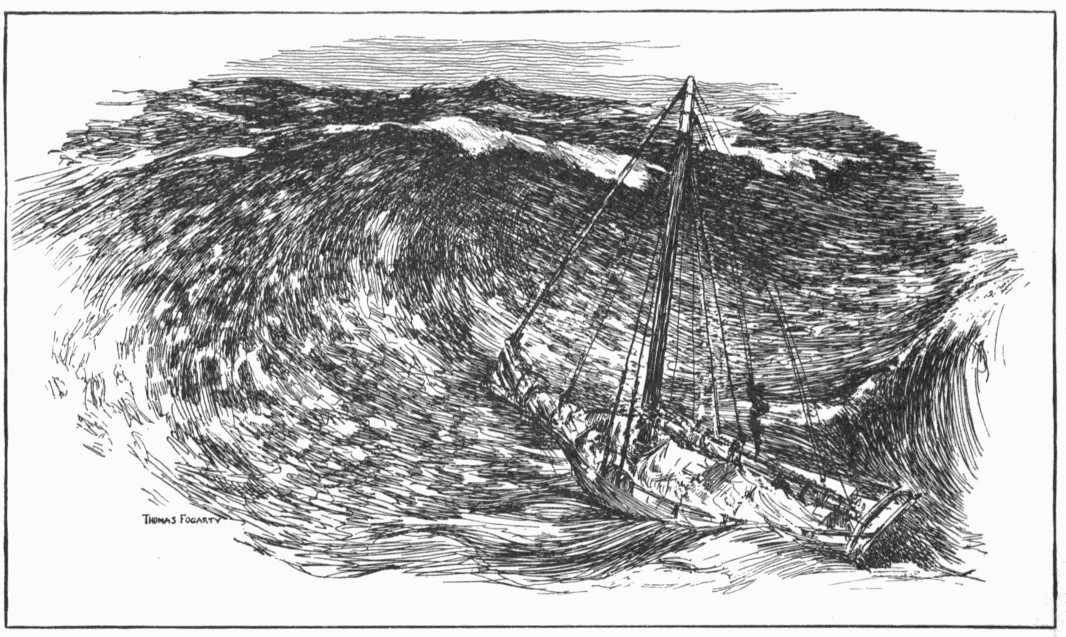
My ship passed in safety Bahia Blanca, also the Gulf of St. Matias and the mighty Gulf of St. George. Hoping that she might go clear of the destructive tide-races, the dread of big craft or little along this coast, I gave all the capes a berth of about fifty miles, for these dangers extend many miles from the land. But where the sloop avoided one danger she encountered another. For, one day, well off the Patagonian coast, while the sloop was reaching under short sail, a tremendous wave, the culmination, it seemed, of many waves, rolled down upon her in a storm, roaring as it came. I had only a moment to get all sail down and myself up on the peak halliards, out of danger, when I saw the mighty crest towering masthead-high above me. The mountain of water submerged my vessel. She shook in every timber and reeled under the weight of the sea, but rose quickly out of it, and rode grandly over the rollers that followed. It may have been a minute that from my hold in the rigging I could see no part of the Spray's hull. Perhaps it was even less time than that, but it seemed a long while, for under great excitement one lives fast, and in a few seconds one may think a great deal of one's past life. Not only did the past, with electric speed, flash before me, but I had time while in my hazardous position for resolutions for the future that would take a long time to fulfil. The first one was, I remember, that if the Spray came through this danger I would dedicate my best energies to building a larger ship on her lines, which I hope yet to do. Other promises, less easily kept, I should have made under protest. However, the incident, which filled me with fear, was only one more test of the Spray's seaworthiness. It reassured me against rude Cape Horn.
My ship passed safely by Bahia Blanca, the Gulf of St. Matias, and the mighty Gulf of St. George. I hoped she would avoid the destructive tide-races, which were feared by ships of all sizes along this coast. So I kept about fifty miles away from all the capes, because the danger extended many miles from land. But in avoiding one danger, the sloop encountered another. One day, well off the Patagonian coast, the sloop was sailing with reduced sail in a storm. A tremendous wave rolled down on her, roaring as it came. It seemed to be the culmination of many waves. I had only a moment to lower all sail and climb the peak halyards, out of danger. Then I saw the mighty crest towering above me, as high as the masthead. The mountain of water submerged my vessel. Every timber shook, and she reeled under the weight of the sea. But she rose quickly and rode grandly over the rollers that followed. From my hold in the rigging, I may have been unable to see any part of the Spray's hull for a minute. Perhaps it was even less, but it seemed a long time. In moments of great excitement, one lives fast. In a few seconds, one may think a great deal about one's past life. Not only did the past flash before me at lightning speed, but I also had time to make resolutions for the future. They would take a long time to fulfill. The first, I remember, was that if the Spray survived, I would devote my best efforts to building a larger ship on her lines. I still hope to do that. I would have made other, less easily kept promises only under protest. However, the incident, frightening as it was, was only one more test of the Spray's seaworthiness. It reassured me about facing rough Cape Horn.
From the time the great wave swept over the Spray until she reached Cape Virgins nothing occurred to move a pulse and set blood in motion. On the contrary, the weather became fine and the sea smooth and life tranquil. The phenomenon of mirage frequently occurred. An albatross sitting on the water one day loomed up like a large ship; two fur-seals asleep on the surface of the sea appeared like great whales, and a bank of haze I could have sworn was high land. The kaleidescope then changed, and on the following day I sailed in a world peopled by dwarfs.
From the time the great wave swept over the Spray until she reached Cape Virgins, nothing happened to quicken my pulse. Instead, the weather turned fine, the sea grew smooth, and life became peaceful. Mirages appeared often. One day, an albatross sitting on the water looked as large as a ship. Two fur seals asleep on the surface looked like great whales, and I could have sworn a bank of haze was high land. Then the kaleidoscope changed, and the next day I sailed in a world populated by dwarfs.
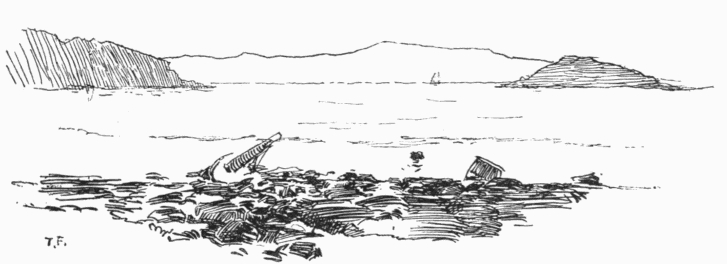
On February 11 the Spray rounded Cape Virgins and entered the Strait of Magellan. The scene was again real and gloomy; the wind, northeast, and blowing a gale, sent feather-white spume along the coast; such a sea ran as would swamp an ill-appointed ship. As the sloop neared the entrance to the strait I observed that two great tide-races made ahead, one very close to the point of the land and one farther offshore. Between the two, in a sort of channel, through combers, went the Spray with close-reefed sails. But a rolling sea followed her a long way in, and a fierce current swept around the cape against her; but this she stemmed, and was soon chirruping under the lee of Cape Virgins and running every minute into smoother water. However, long trailing kelp from sunken rocks waved forebodingly under her keel, and the wreck of a great steamship smashed on the beach abreast gave a gloomy aspect to the scene.
On February 11, the Spray rounded Cape Virgins and entered the Strait of Magellan. The scene was once again real and gloomy. A gale blew from the northeast, sending feather-white spray along the coast. The sea was rough enough to swamp a poorly equipped ship. As the sloop neared the entrance to the strait, I saw two powerful tidal currents ahead. One ran very close to the point of land, and the other farther offshore. Between them was a sort of channel. The Spray sailed through it and the breaking waves with her sails tightly reefed. But a rolling sea followed her far into the strait, and a fierce current swept against her around the cape. She pushed through the current and was soon chirruping in the shelter of Cape Virgins. With every minute, she sailed into smoother water. However, long strands of kelp from submerged rocks waved ominously beneath her keel. The wreck of a great steamship, smashed on the beach alongside, added to the gloom.
I was not to be let off easy. The Virgins would collect tribute even from the Spray passing their promontory. Fitful rain-squalls from the northwest followed the northeast gale. I reefed the sloop's sails, and sitting in the cabin to rest my eyes, I was so strongly impressed with what in all nature I might expect that as I dozed the very air I breathed seemed to warn me of danger. My senses heard "Spray ahoy!" shouted in warning. I sprang to the deck, wondering who could be there that knew the Spray so well as to call out her name passing in the dark; for it was now the blackest of nights all around, except away in the southwest, where the old familiar white arch, the terror of Cape Horn, rapidly pushed up by a southwest gale. I had only a moment to douse sail and lash all solid when it struck like a shot from a cannon, and for the first half-hour it was something to be remembered by way of a gale. For thirty hours it kept on blowing hard. The sloop could carry no more than a three-reefed mainsail and forestaysail; with these she held on stoutly and was not blown out of the strait. In the height of the squalls in this gale she doused all sail, and this occurred often enough.
I was not going to get off easy. The Virgins would collect tribute even from the Spray as she passed their promontory. Fitful rain squalls from the northwest followed the northeast gale. I reefed the sloop's sails and sat in the cabin to rest my eyes. I had such a strong sense of what nature might have in store that, as I dozed, even the air I breathed seemed to warn me of danger. I heard "Spray ahoy!" shouted as a warning. I sprang to the deck, wondering who could be there and know the Spray well enough to call her name in the dark. For the night was now pitch-black all around, except far to the southwest. There, the old familiar white arch, the terror of Cape Horn, was rising rapidly, pushed up by a southwest gale. I had only a moment to lower the sails and secure everything before the gale struck like a cannon shot. For the first half-hour, the gale was one to remember. It continued to blow hard for thirty hours. The sloop could carry no more than a mainsail with three reefs and a forestaysail. With these, she held on stoutly and was not blown out of the strait. At the height of the squalls during this gale, she lowered all sail. This happened often enough.
After this gale followed only a smart breeze, and the Spray, passing through the narrows without mishap, cast anchor at Sandy Point on February 14, 1896.
After the gale, there was only a brisk breeze. The Spray passed safely through the narrows and anchored at Sandy Point on February 14, 1896.
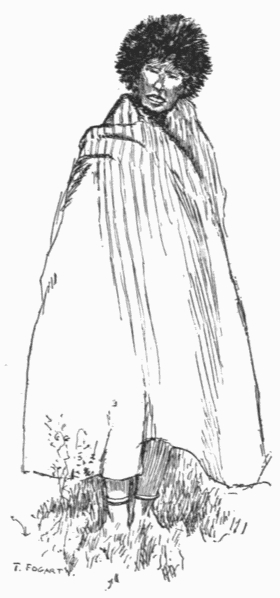
Sandy Point (Punta Arenas) is a Chilean coaling-station, and boasts about two thousand inhabitants, of mixed nationality, but mostly Chileans. What with sheep-farming, gold-mining, and hunting, the settlers in this dreary land seemed not the worst off in the world. But the natives, Patagonian and Fuegian, on the other hand, were as squalid as contact with unscrupulous traders could make them. A large percentage of the business there was traffic in "fire-water." If there was a law against selling the poisonous stuff to the natives, it was not enforced. Fine specimens of the Patagonian race, looking smart in the morning when they came into town, had repented before night of ever having seen a white man, so beastly drunk were they, to say nothing about the peltry of which they had been robbed.
Sandy Point (Punta Arenas) is a Chilean coaling station with about two thousand residents. They come from various countries, but most are Chilean. With sheep farming, gold mining, and hunting, the settlers in this dreary land seemed not to be the worst off in the world. The native Patagonians and Fuegians, on the other hand, lived in the squalor brought on by contact with unscrupulous traders. A large part of the business there was the sale of "fire-water." If there was a law against selling the poisonous stuff to the natives, it was not enforced. Fine specimens of the Patagonian people came into town looking smart in the morning. By night, they were so terribly drunk that they had repented of ever seeing a white man. That is to say nothing of the animal skins they had been robbed of.
The port at that time was free, but a customhouse was in course of construction, and when it is finished, port and tariff dues are to be collected. A soldier police guarded the place, and a sort of vigilante force besides took down its guns now and then; but as a general thing, to my mind, whenever an execution was made they killed the wrong man. Just previous to my arrival the governor, himself of a jovial turn of mind, had sent a party of young bloods to foray a Fuegian settlement and wipe out what they could of it on account of the recent massacre of a schooner's crew somewhere else. Altogether the place was quite newsy and supported two papers—dailies, I think. The port captain, a Chilean naval officer, advised me to ship hands to fight Indians in the strait farther west, and spoke of my stopping until a gunboat should be going through, which would give me a tow. After canvassing the place, however, I found only one man willing to embark, and he on condition that I should ship another "mon and a doog." But as no one else was willing to come along, and as I drew the line at dogs, I said no more about the matter, but simply loaded my guns. At this point in my dilemma Captain Pedro Samblich, a good Austrian of large experience, coming along, gave me a bag of carpet-tacks, worth more than all the fighting men and dogs of Tierra del Fuego. I protested that I had no use for carpet-tacks on board. Samblich smiled at my want of experience, and maintained stoutly that I would have use for them. "You must use them with discretion," he said; "that is to say, don't step on them yourself." With this remote hint about the use of the tacks I got on all right, and saw the way to maintain clear decks at night without the care of watching.
The port was free at the time, but a customhouse was being built. Once it was finished, port fees and tariffs would be collected. Soldiers policed the place, and a sort of vigilante force also took up its guns now and then. But in my opinion, whenever they carried out an execution, they generally killed the wrong man. Just before I arrived, the governor, a jolly man himself, had sent a party of young men to raid a Fuegian settlement. They were to wipe out as much of it as they could. This was in response to the recent massacre of a schooner’s crew somewhere else. All in all, there was plenty of news in the place, enough to support two papers, daily papers, I think. The port captain, a Chilean naval officer, advised me to hire crewmen to fight Indians farther west in the strait. He also suggested I stay until a gunboat was going through, which could give me a tow. After looking around the place, however, I found only one man willing to sail with me. Even he would come only if I took another “mon and a doog.” But no one else was willing to come, and I drew the line at dogs. So I said no more about it and simply loaded my guns. At this point in my dilemma, Captain Pedro Samblich came along. He was a good Austrian with a great deal of experience. He gave me a bag of carpet tacks, worth more than all the fighting men and dogs of Tierra del Fuego. I protested that I had no use for carpet tacks on board. Samblich smiled at my lack of experience and insisted that I would have use for them. “You must use them with discretion,” he said. “That is to say, don’t step on them yourself.” With this indirect hint about using the tacks, I got on all right. I saw how to keep the decks clear at night without having to keep watch.
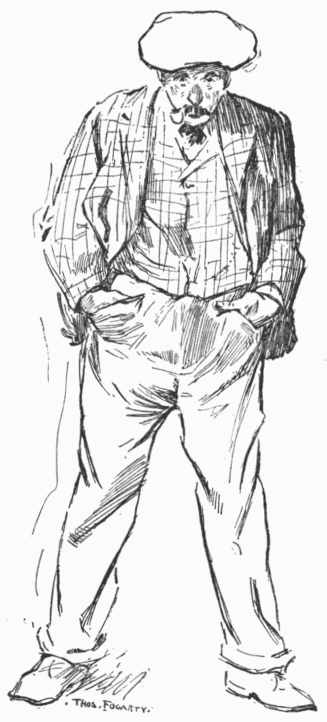
Samblich was greatly interested in my voyage, and after giving me the tacks he put on board bags of biscuits and a large quantity of smoked venison. He declared that my bread, which was ordinary sea-biscuits and easily broken, was not nutritious as his, which was so hard that I could break it only with a stout blow from a maul. Then he gave me, from his own sloop, a compass which was certainly better than mine, and offered to unbend her mainsail for me if I would accept it. Last of all, this large-hearted man brought out a bottle of Fuegian gold-dust from a place where it had been cached and begged me to help myself from it, for use farther along on the voyage. But I felt sure of success without this draft on a friend, and I was right. Samblich's tacks, as it turned out, were of more value than gold.
Samblich was very interested in my voyage. After giving me the tacks, he put bags of biscuits and plenty of smoked venison on board. He said my bread, ordinary sea biscuits that broke easily, was less nutritious than his. His biscuits were so hard that I could break them only with a heavy blow from a mallet. Then he gave me a compass from his own sloop. It was certainly better than mine. He also offered to take down the sloop’s mainsail for me, if I would accept it. Finally, this generous man brought out a bottle of Fuegian gold dust from a place where it had been hidden. He begged me to take some for use later in the voyage. But I felt sure I could succeed without drawing on a friend’s supply, and I was right. As it turned out, Samblich’s tacks were worth more than gold.
The port captain finding that I was resolved to go, even alone, since there was no help for it, set up no further objections, but advised me, in case the savages tried to surround me with their canoes, to shoot straight, and begin to do it in time, but to avoid killing them if possible, which I heartily agreed to do. With these simple injunctions the officer gave me my port clearance free of charge, and I sailed on the same day, February 19, 1896. It was not without thoughts of strange and stirring adventure beyond all I had yet encountered that I now sailed into the country and very core of the savage Fuegians.
The port captain saw that I was determined to go, even alone, since there was no alternative. He raised no further objections. But he advised me to shoot straight if the savages tried to surround me in their canoes. He also told me to start shooting in time, but to avoid killing them if possible. I wholeheartedly agreed. After giving me these simple instructions, the officer issued my port clearance free of charge. I sailed that same day, February 19, 1896. As I sailed into the very heart of the savage Fuegians’ country, I could not help thinking of the strange and exciting adventures ahead, beyond all I had yet encountered.
A fair wind from Sandy Point brought me on the first day to St. Nicholas Bay, where, so I was told, I might expect to meet savages; but seeing no signs of life, I came to anchor in eight fathoms of water, where I lay all night under a high mountain. Here I had my first experience with the terrific squalls, called williwaws, which extended from this point on through the strait to the Pacific. They were compressed gales of wind that Boreas handed down over the hills in chunks. A full-blown williwaw will throw a ship, even without sail on, over on her beam ends; but, like other gales, they cease now and then, if only for a short time.
A favorable wind carried me from Sandy Point to St. Nicholas Bay on the first day. I had been told I might meet savages there, but I saw no signs of life. I anchored in eight fathoms of water and spent the night beneath a high mountain. There I first experienced the terrific squalls called williwaws. They occurred from that point through the strait to the Pacific. They were compressed gales that Boreas sent down over the hills in chunks. A full-blown williwaw can throw a ship onto its side, even with no sails up. But like other gales, williwaws stop now and then, even if only for a short time.
February 20 was my birthday, and I found myself alone, with hardly so much as a bird in sight, off Cape Froward, the southernmost point of the continent of America. By daylight in the morning I was getting my ship under way for the bout ahead.
February 20 was my birthday, and I was alone, with hardly a bird in sight. I was off Cape Froward, the southernmost point of the American continent. At daybreak, I began getting my ship underway for the struggle ahead.
The sloop held the wind fair while she ran thirty miles farther on her course, which brought her to Fortescue Bay, and at once among the natives' signal-fires, which blazed up now on all sides. Clouds flew over the mountain from the west all day; at night my good east wind failed, and in its stead a gale from the west soon came on. I gained anchorage at twelve o'clock that night, under the lee of a little island, and then prepared myself a cup of coffee, of which I was sorely in need; for, to tell the truth, hard beating in the heavy squalls and against the current had told on my strength. Finding that the anchor held, I drank my beverage, and named the place Coffee Island. It lies to the south of Charles Island, with only a narrow channel between.
The sloop kept a favorable wind as she sailed another thirty miles along her course. This brought her to Fortescue Bay, where the natives’ signal fires immediately blazed up on all sides. Clouds swept over the mountain from the west all day. At night, my good east wind died, and a gale from the west soon took its place. At midnight, I anchored in the shelter of a small island and made myself a much-needed cup of coffee. To tell the truth, beating hard through heavy squalls and against the current had drained my strength. Once I saw that the anchor was holding, I drank my coffee and named the place Coffee Island. It lies south of Charles Island, with only a narrow channel between them.
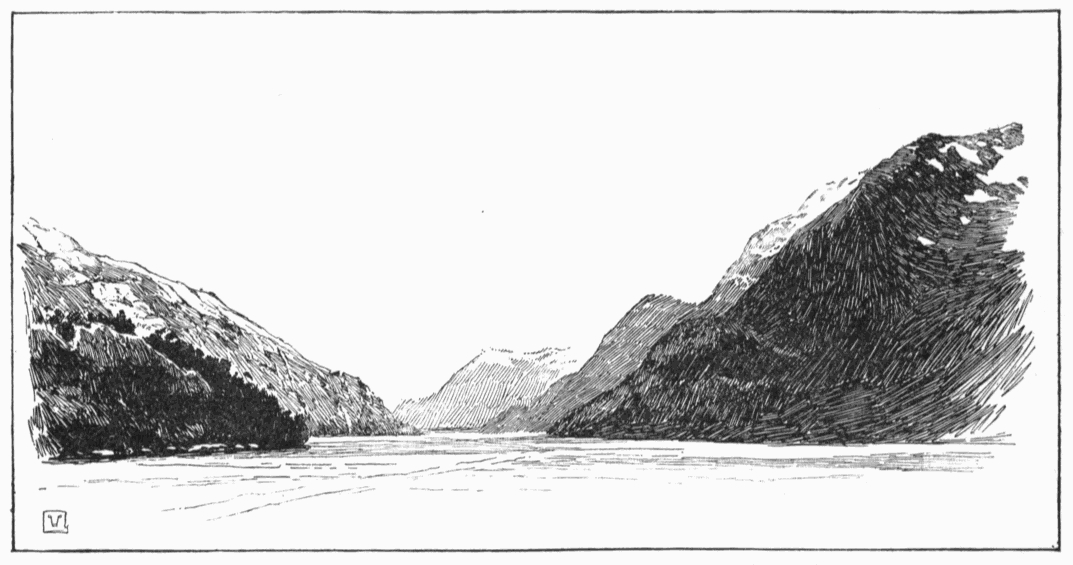
By daylight the next morning the Spray was again under way, beating hard; but she came to in a cove in Charles Island, two and a half miles along on her course. Here she remained undisturbed two days, with both anchors down in a bed of kelp. Indeed, she might have remained undisturbed indefinitely had not the wind moderated; for during these two days it blew so hard that no boat could venture out on the strait, and the natives being away to other hunting-grounds, the island anchorage was safe. But at the end of the fierce wind-storm fair weather came; then I got my anchors, and again sailed out upon the strait.
By daylight the next morning, the Spray was sailing again, beating hard against the wind. But she anchored in a cove on Charles Island, two and a half miles along her course. She stayed there undisturbed for two days, with both anchors down in a bed of kelp. Indeed, she might have stayed undisturbed indefinitely if the wind had not eased. For those two days, the wind blew so hard that no boat could venture onto the strait. And because the natives were away at other hunting grounds, the island anchorage was safe. But fair weather came after the fierce windstorm. Then I hauled up my anchors and sailed out onto the strait again.
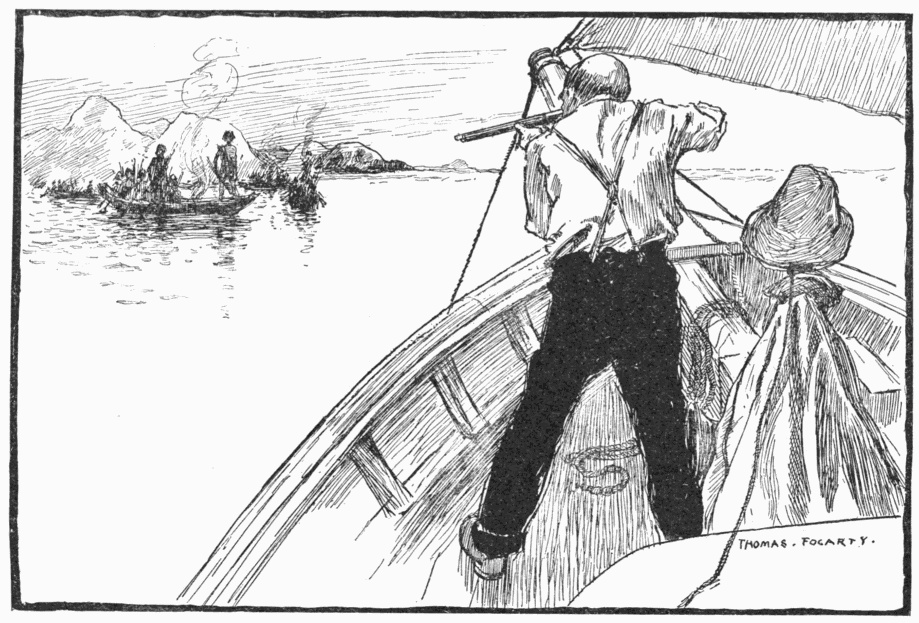
Canoes manned by savages from Fortescue now came in pursuit. The wind falling light, they gained on me rapidly till coming within hail, when they ceased paddling, and a bow-legged savage stood up and called to me, "Yammerschooner! yammerschooner!" which is their begging term. I said, "No!" Now, I was not for letting on that I was alone, and so I stepped into the cabin, and, passing through the hold, came out at the fore-scuttle, changing my clothes as I went along. That made two men. Then the piece of bowsprit which I had sawed off at Buenos Aires, and which I had still on board, I arranged forward on the lookout, dressed as a seaman, attaching a line by which I could pull it into motion. That made three of us, and we didn't want to "yammerschooner"; but for all that the savages came on faster than before. I saw that besides four at the paddles in the canoe nearest to me, there were others in the bottom, and that they were shifting hands often. At eighty yards I fired a shot across the bows of the nearest canoe, at which they all stopped, but only for a moment. Seeing that they persisted in coming nearer, I fired the second shot so close to the chap who wanted to "yammerschooner" that he changed his mind quickly enough and bellowed with fear, "Bueno jo via Isla," and sitting down in his canoe, he rubbed his starboard cat-head for some time. I was thinking of the good port captain's advice when I pulled the trigger, and must have aimed pretty straight; however, a miss was as good as a mile for Mr. "Black Pedro," as he it was, and no other, a leader in several bloody massacres. He made for the island now, and the others followed him. I knew by his Spanish lingo and by his full beard that he was the villain I have named, a renegade mongrel, and the worst murderer in Tierra del Fuego. The authorities had been in search of him for two years. The Fuegians are not bearded.
Canoes manned by savages from Fortescue now came after me. The wind grew light, and the canoes rapidly gained on me. When they came close enough to call out, the men stopped paddling. A bow-legged savage stood up and called to me, "Yammerschooner! yammerschooner!" That was their term for begging. I said, "No!" I did not want to let them know I was alone. So I stepped into the cabin, passed through the hold, and came out through the forward hatch, changing clothes along the way. That made two men. I still had aboard the piece of bowsprit I had sawed off at Buenos Aires. I dressed it as a sailor and set it up forward as a lookout. I attached a line so I could make it move. That made three of us, and we did not want to "yammerschooner". But the savages came on faster than before. In the nearest canoe, I could see four men paddling and others lying in the bottom. They were often changing places at the paddles. When the nearest canoe was eighty yards away, I fired a shot across its bow. All the canoes stopped, but only for a moment. They kept coming closer, so I fired a second shot very close to the fellow who wanted to "yammerschooner". He changed his mind quickly enough and bellowed with fear, "Bueno jo via Isla". He sat down in his canoe and rubbed his starboard cat-head for some time. I was thinking of the good port captain's advice when I pulled the trigger, and I must have aimed pretty straight. However, a miss was as good as a mile for Mr. "Black Pedro". For it was he, and no one else, a leader in several bloody massacres. He now headed for the island, and the others followed him. His Spanish speech and full beard told me he was the villain I have named, a renegade mongrel and the worst murderer in Tierra del Fuego. The authorities had been searching for him for two years. The Fuegians do not have beards.
So much for the first day among the savages. I came to anchor at midnight in Three Island Cove, about twenty miles along from Fortescue Bay. I saw on the opposite side of the strait signal-fires, and heard the barking of dogs, but where I lay it was quite deserted by natives. I have always taken it as a sign that where I found birds sitting about, or seals on the rocks, I should not find savage Indians. Seals are never plentiful in these waters, but in Three Island Cove I saw one on the rocks, and other signs of the absence of savage men.
So much for my first day among the savages. At midnight, I anchored in Three Island Cove, about twenty miles beyond Fortescue Bay. I saw signal fires on the opposite side of the strait and heard dogs barking. But there were no natives where I anchored. I have always taken birds sitting around or seals on the rocks as a sign that I would not find savage Indians nearby. Seals are never plentiful in these waters, but I saw one on the rocks in Three Island Cove. I also saw other signs that no savage men were there.
On the next day the wind was again blowing a gale, and although she was in the lee of the land, the sloop dragged her anchors, so that I had to get her under way and beat farther into the cove, where I came to in a landlocked pool. At another time or place this would have been a rash thing to do, and it was safe now only from the fact that the gale which drove me to shelter would keep the Indians from crossing the strait. Seeing this was the case, I went ashore with gun and ax on an island, where I could not in any event be surprised, and there felled trees and split about a cord of fire-wood, which loaded my small boat several times.
The next day, the wind was blowing a gale again. Although the sloop was sheltered by the land, she dragged her anchors. So I had to get her moving and sail against the wind farther into the cove. There I anchored in a pool surrounded by land. At another time or place, this would have been rash. It was safe now only because the gale that drove me to shelter would keep the Indians from crossing the strait. Seeing this, I went ashore with a gun and an ax on an island where I could not be surprised. There I cut down trees and split about a cord of firewood, enough to load my small boat several times.
While I carried the wood, though I was morally sure there were no savages near, I never once went to or from the skiff without my gun. While I had that and a clear field of over eighty yards about me I felt safe.
While I carried the wood, I was almost certain no savages were nearby. Even so, I never went to or from the skiff without my gun. As long as I had my gun and a clear field of over eighty yards around me, I felt safe.
The trees on the island, very scattering, were a sort of beech and a stunted cedar, both of which made good fuel. Even the green limbs of the beech, which seemed to possess a resinous quality, burned readily in my great drum-stove. I have described my method of wooding up in detail, that the reader who has kindly borne with me so far may see that in this, as in all other particulars of my voyage, I took great care against all kinds of surprises, whether by animals or by the elements. In the Strait of Magellan the greatest vigilance was necessary. In this instance I reasoned that I had all about me the greatest danger of the whole voyage—the treachery of cunning savages, for which I must be particularly on the alert.
The island’s few scattered trees were a kind of beech and a stunted cedar. Both made good fuel. Even the green beech branches burned readily in my large drum stove. They seemed to contain resin. I have described how I gathered wood in detail for the reader who has kindly stayed with me this far. I wanted to show that I took great care to guard against all kinds of surprises, whether from animals or the elements. I took the same care in every other part of my voyage. In the Strait of Magellan, I had to be extremely watchful. Here, I believed I was surrounded by the greatest danger of the whole voyage: the treachery of cunning savages. I had to be especially alert to that danger.
The Spray sailed from Three Island Cove in the morning after the gale went down, but was glad to return for shelter from another sudden gale. Sailing again on the following day, she fetched Borgia Bay, a few miles on her course, where vessels had anchored from time to time and had nailed boards on the trees ashore with name and date of harboring carved or painted. Nothing else could I see to indicate that civilized man had ever been there. I had taken a survey of the gloomy place with my spy-glass, and was getting my boat out to land and take notes, when the Chilean gunboat Huemel came in, and officers, coming on board, advised me to leave the place at once, a thing that required little eloquence to persuade me to do. I accepted the captain's kind offer of a tow to the next anchorage, at the place called Notch Cove, eight miles farther along, where I should be clear of the worst of the Fuegians.
The Spray sailed from Three Island Cove in the morning after the gale died down. But another sudden gale came up, and I was glad to return to shelter. We sailed again the next day and reached Borgia Bay, a few miles farther along our course. Ships had anchored there from time to time. Their crews had nailed boards to the trees ashore, with their names and the dates of their stays carved or painted on them. I could see no other sign that civilized man had ever been there. I had surveyed the gloomy place through my spyglass and was getting my boat out to go ashore and take notes. Then the Chilean gunboat Huemel came in. Its officers came aboard and advised me to leave at once. It took little persuasion to convince me. I accepted the captain's kind offer of a tow to the next anchorage, at Notch Cove, eight miles farther along. There I would be clear of the worst of the Fuegians.
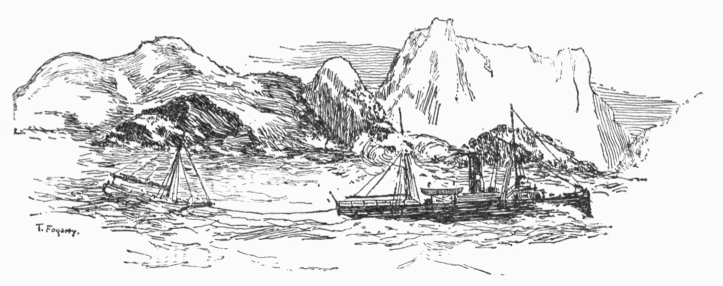
We made anchorage at the cove about dark that night, while the wind came down in fierce williwaws from the mountains. An instance of Magellan weather was afforded when the Huemel, a well-appointed gunboat of great power, after attempting on the following day to proceed on her voyage, was obliged by sheer force of the wind to return and take up anchorage again and remain till the gale abated; and lucky she was to get back!
We anchored in the cove around dark that night, as fierce williwaws blew down from the mountains. The next day brought an example of Magellan weather. The Huemel, a powerful, well-equipped gunboat, tried to continue her voyage. But the wind was so strong that she had to return and anchor again until the gale died down. She was lucky to get back!
Meeting this vessel was a little godsend. She was commanded and officered by high-class sailors and educated gentlemen. An entertainment that was gotten up on her, impromptu, at the Notch would be hard to beat anywhere. One of her midshipmen sang popular songs in French, German, and Spanish, and one (so he said) in Russian. If the audience did not know the lingo of one song from another, it was no drawback to the merriment.
Meeting this ship was a little godsend. Her captain and officers were first-rate sailors and educated gentlemen. They put on an impromptu show aboard her at the Notch that would be hard to beat anywhere. One of her midshipmen sang popular songs in French, German, and Spanish, and one in Russian, or so he said. If the audience couldn’t tell one language from another, it didn’t spoil the fun.
I was left alone the next day, for then the Huemel put out on her voyage the gale having abated. I spent a day taking in wood and water; by the end of that time the weather was fine. Then I sailed from the desolate place.
I was left alone the next day because the Huemel set sail after the gale had eased. I spent a day taking on wood and water. By the end of the day, the weather was fine. Then I sailed away from the desolate place.
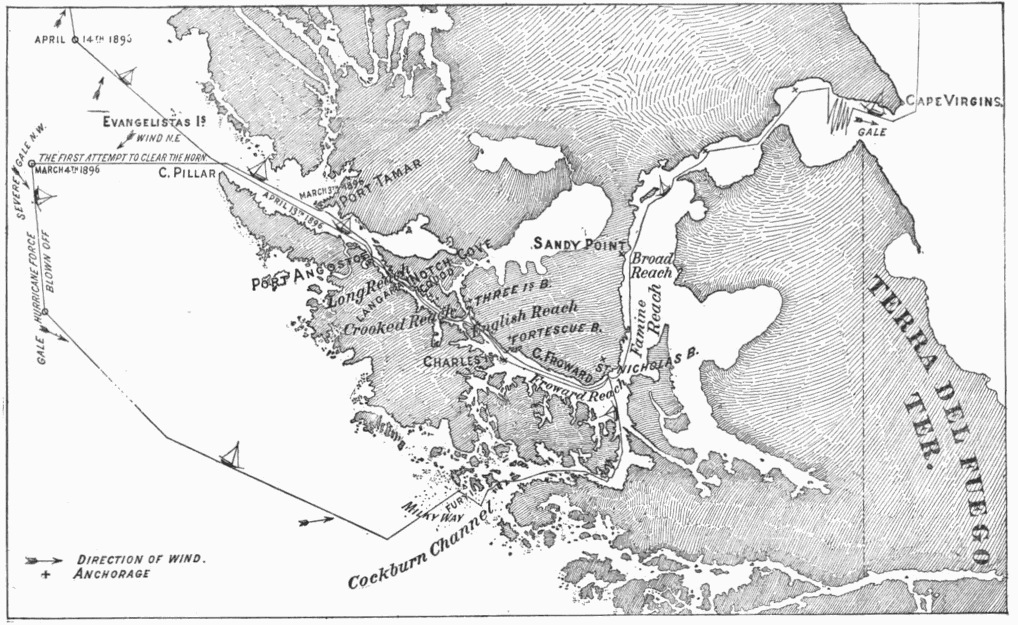
There is little more to be said concerning the Spray's first passage through the strait that would differ from what I have already recorded. She anchored and weighed many times, and beat many days against the current, with now and then a "slant" for a few miles, till finally she gained anchorage and shelter for the night at Port Tamar, with Cape Pillar in sight to the west. Here I felt the throb of the great ocean that lay before me. I knew now that I had put a world behind me, and that I was opening out another world ahead. I had passed the haunts of savages. Great piles of granite mountains of bleak and lifeless aspect were now astern; on some of them not even a speck of moss had ever grown. There was an unfinished newness all about the land. On the hill back of Port Tamar a small beacon had been thrown up, showing that some man had been there. But how could one tell but that he had died of loneliness and grief? In a bleak land is not the place to enjoy solitude.
There is little more to say about the Spray's first passage through the strait that I have not already recorded. She anchored and set sail again many times. For many days she sailed against the wind and current, occasionally catching a favorable "slant" for a few miles. At last she reached Port Tamar, where she anchored for the night in shelter, with Cape Pillar in sight to the west. There I felt the pulse of the great ocean ahead. I knew now that I had left one world behind and was entering another. I had passed the places where savages lived. Great masses of granite mountains lay behind me, bleak and lifeless. On some of them, not even a speck of moss had ever grown. The whole landscape had an unfinished newness about it. A small beacon had been built on the hill behind Port Tamar, showing that someone had been there. But how could I know whether the man had died of loneliness and grief? A bleak land is no place to enjoy solitude.
Throughout the whole of the strait west of Cape Froward I saw no animals except dogs owned by savages. These I saw often enough, and heard them yelping night and day. Birds were not plentiful. The scream of a wild fowl, which I took for a loon, sometimes startled me with its piercing cry. The steamboat duck, so called because it propels itself over the sea with its wings, and resembles a miniature side-wheel steamer in its motion, was sometimes seen scurrying on out of danger. It never flies, but, hitting the water instead of the air with its wings, it moves faster than a rowboat or a canoe. The few fur-seals I saw were very shy; and of fishes I saw next to none at all. I did not catch one; indeed, I seldom or never put a hook over during the whole voyage. Here in the strait I found great abundance of mussels of an excellent quality. I fared sumptuously on them. There was a sort of swan, smaller than a Muscovy duck, which might have been brought down with the gun, but in the loneliness of life about the dreary country I found myself in no mood to make one life less, except in self-defense.
Throughout the strait west of Cape Froward, I saw no animals except dogs owned by the local people. I saw these dogs often enough and heard them yelping night and day. Birds were not plentiful. The piercing cry of a wild bird, which I took for a loon, sometimes startled me. I sometimes saw the steamboat duck scurrying away from danger. It gets its name from the way it uses its wings to propel itself over the sea, like a miniature side-wheel steamer. It never flies. Instead, it beats its wings against the water and moves faster than a rowboat or a canoe. The few fur seals I saw were very shy, and I saw hardly any fish. I did not catch one. In fact, I rarely, if ever, put a hook in the water during the whole voyage. Here in the strait, I found an abundance of excellent mussels. I feasted on them. There was a kind of swan, smaller than a Muscovy duck, that I could have shot. But amid the loneliness of life in that dreary country, I was in no mood to take a life, except in self-defense.