Chapter 1
A blue-nose ancestry with Yankee proclivities—Youthful fondness for the sea—Master of the ship Northern Light—Loss of the Aquidneck—Return home from Brazil in the canoe Liberdade—The gift of a "ship"—The rebuilding of the Spray-Conundrums in regard to finance and calking—The launching of the Spray.
Blue-nose ancestry with Yankee tendencies. A youthful love of the sea. Captain of the ship Northern Light. Loss of the Aquidneck. Return home from Brazil in the canoe Liberdade. The gift of a "ship". Rebuilding the Spray. Puzzles about money and caulking. The launch of the Spray.
In the fair land of Nova Scotia, a maritime province, there is a ridge called North Mountain, overlooking the Bay of Fundy on one side and the fertile Annapolis valley on the other. On the northern slope of the range grows the hardy spruce-tree, well adapted for ship-timbers, of which many vessels of all classes have been built. The people of this coast, hardy, robust, and strong, are disposed to compete in the world's commerce, and it is nothing against the master mariner if the birthplace mentioned on his certificate be Nova Scotia. I was born in a cold spot, on coldest North Mountain, on a cold February 20, though I am a citizen of the United States—a naturalized Yankee, if it may be said that Nova Scotians are not Yankees in the truest sense of the word. On both sides my family were sailors; and if any Slocum should be found not seafaring, he will show at least an inclination to whittle models of boats and contemplate voyages. My father was the sort of man who, if wrecked on a desolate island, would find his way home, if he had a jack-knife and could find a tree. He was a good judge of a boat, but the old clay farm which some calamity made his was an anchor to him. He was not afraid of a capful of wind, and he never took a back seat at a camp-meeting or a good, old-fashioned revival.
In the beautiful maritime province of Nova Scotia, a ridge called North Mountain overlooks the Bay of Fundy on one side. On the other side lies the fertile Annapolis valley. Hardy spruce trees grow on the northern slope. Their wood is well suited to shipbuilding, and many vessels of all kinds have been built from it. The people of this coast are hardy, robust, and strong, and eager to compete in world commerce. A master mariner is no worse off if his certificate lists Nova Scotia as his birthplace. I was born in a cold spot on the coldest part of North Mountain, on a cold February 20. Though I am now a United States citizen, a naturalized Yankee, one might say Nova Scotians are Yankees in the truest sense. On both sides, my family were sailors. If a Slocum is not a sailor, he will at least have a taste for carving model boats and imagining voyages. My father was the kind of man who could find his way home after being shipwrecked on a deserted island, if he had a pocketknife and could find a tree. He was a good judge of a boat, but the old clay farm that some misfortune had made his kept him anchored. He was not afraid of a bit of wind, and he never took a back seat at a camp meeting or a good, old-fashioned revival.
As for myself, the wonderful sea charmed me from the first. At the age of eight I had already been afloat along with other boys on the bay, with chances greatly in favor of being drowned. When a lad I filled the important post of cook on a fishing-schooner; but I was not long in the galley, for the crew mutinied at the appearance of my first duff, and "chucked me out" before I had a chance to shine as a culinary artist. The next step toward the goal of happiness found me before the mast in a full-rigged ship bound on a foreign voyage. Thus I came "over the bows," and not in through the cabin windows, to the command of a ship.
As for me, the wonderful sea charmed me from the start. By age eight, I was already out on the bay with other boys, with a good chance of drowning. As a boy, I held the important position of cook on a fishing schooner. But I did not stay in the galley long. The crew mutinied when they saw my first duff, a boiled pudding, and "chucked me out" before I could shine as a culinary artist. My next step toward happiness took me aboard a full-rigged ship bound for a foreign port, where I served as an ordinary sailor. So I came to command a ship "over the bows," not through the cabin windows.
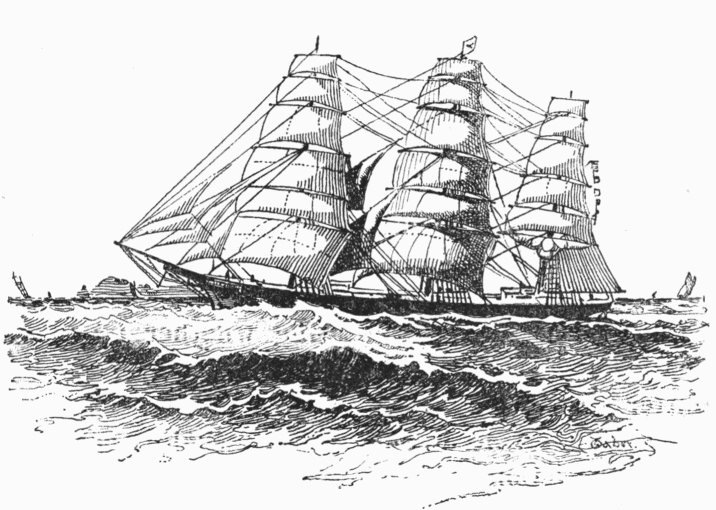
My best command was that of the magnificent ship Northern Light, of which I was part-owner. I had a right to be proud of her, for at that time—in the eighties—she was the finest American sailing-vessel afloat. Afterward I owned and sailed the Aquidneck, a little bark which of all man's handiwork seemed to me the nearest to perfection of beauty, and which in speed, when the wind blew, asked no favors of steamers, I had been nearly twenty years a shipmaster when I quit her deck on the coast of Brazil, where she was wrecked. My home voyage to New York with my family was made in the canoe Liberdade, without accident.
The finest ship I commanded was the magnificent Northern Light, which I partly owned. I had every right to be proud of her. In the 1880s, she was the finest American sailing vessel afloat. Later, I owned and sailed the Aquidneck, a small bark. Of all things made by human hands, she seemed to me the closest to perfect beauty. And when the wind blew, she could match steamers for speed. I had been a shipmaster for nearly twenty years when I left her deck on the coast of Brazil, where she was wrecked. My family and I sailed home to New York in the canoe Liberdade, without accident.
My voyages were all foreign. I sailed as freighter and trader principally to China, Australia, and Japan, and among the Spice Islands. Mine was not the sort of life to make one long to coil up one's ropes on land, the customs and ways of which I had finally almost forgotten. And so when times for freighters got bad, as at last they did, and I tried to quit the sea, what was there for an old sailor to do? I was born in the breezes, and I had studied the sea as perhaps few men have studied it, neglecting all else. Next in attractiveness, after seafaring, came ship-building. I longed to be master in both professions, and in a small way, in time, I accomplished my desire. From the decks of stout ships in the worst gales I had made calculations as to the size and sort of ship safest for all weather and all seas. Thus the voyage which I am now to narrate was a natural outcome not only of my love of adventure, but of my lifelong experience.
All my voyages were abroad. I carried freight and traded mainly in China, Australia, Japan, and the Spice Islands. My life at sea did not make me long to settle on land. By then, I had almost forgotten the customs and ways of life ashore. Eventually, business grew poor for freighters, and I tried to leave the sea. But what was an old sailor to do? I was born in the breezes, and I had studied the sea as perhaps few men have, neglecting everything else. After seafaring, shipbuilding appealed to me most. I longed to master both professions, and in time I achieved my wish on a small scale. From the decks of sturdy ships in the worst gales, I had calculated what size and kind of ship would be safest in all weather and on all seas. So the voyage I am about to describe grew naturally from my love of adventure and my lifelong experience.
One midwinter day of 1892, in Boston, where I had been cast up from old ocean, so to speak, a year or two before, I was cogitating whether I should apply for a command, and again eat my bread and butter on the sea, or go to work at the shipyard, when I met an old acquaintance, a whaling-captain, who said: "Come to Fairhaven and I'll give you a ship. But," he added, "she wants some repairs." The captain's terms, when fully explained, were more than satisfactory to me. They included all the assistance I would require to fit the craft for sea. I was only too glad to accept, for I had already found that I could not obtain work in the shipyard without first paying fifty dollars to a society, and as for a ship to command—there were not enough ships to go round. Nearly all our tall vessels had been cut down for coal-barges, and were being ignominiously towed by the nose from port to port, while many worthy captains addressed themselves to Sailors' Snug Harbor.
One winter day in 1892, I was in Boston, where the old ocean had washed me ashore, so to speak, a year or two earlier. I was wondering whether to seek command of a ship and earn my living at sea again, or work at the shipyard. Then I met an old acquaintance, a whaling captain, who said: "Come to Fairhaven and I'll give you a ship. But," he added, "she needs some repairs." When the captain fully explained his terms, I was more than satisfied. They included all the help I would need to prepare the craft for sea. I was only too glad to accept. I had already found that I could not get work at the shipyard without first paying fifty dollars to a society. And as for a ship to command, there were not enough ships to go around. Nearly all our tall ships had been cut down into coal barges. They were being shamefully towed by the nose from port to port, while many worthy captains turned to Sailors' Snug Harbor.
The next day I landed at Fairhaven, opposite New Bedford, and found that my friend had something of a joke on me. For seven years the joke had been on him. The "ship" proved to be a very antiquated sloop called the Spray, which the neighbors declared had been built in the year 1. She was affectionately propped up in a field, some distance from salt water, and was covered with canvas. The people of Fairhaven, I hardly need say, are thrifty and observant. For seven years they had asked, "I wonder what Captain Eben Pierce is going to do with the old Spray?" The day I appeared there was a buzz at the gossip exchange: at last some one had come and was actually at work on the old Spray. "Breaking her up, I s'pose?" "No; going to rebuild her." Great was the amazement. "Will it pay?" was the question which for a year or more I answered by declaring that I would make it pay.
The next day I landed at Fairhaven, across from New Bedford, and discovered that my friend had played a bit of a joke on me. For seven years, the joke had been on him. The "ship" turned out to be a very old sloop called the Spray, which the neighbors said had been built in the year 1. She was lovingly propped up in a field, some distance from salt water, and covered with canvas. The people of Fairhaven, I hardly need say, are thrifty and observant. For seven years they had asked, "I wonder what Captain Eben Pierce is going to do with the old Spray?" The day I arrived, the local gossip was buzzing. At last someone had come and was actually working on the old Spray. "Breaking her up, I suppose?" "No, going to rebuild her." Everyone was amazed. "Will it pay?" For a year or more, I answered that question by declaring that I would make it pay.
My ax felled a stout oak-tree near by for a keel, and Farmer Howard, for a small sum of money, hauled in this and enough timbers for the frame of the new vessel. I rigged a steam-box and a pot for a boiler. The timbers for ribs, being straight saplings, were dressed and steamed till supple, and then bent over a log, where they were secured till set. Something tangible appeared every day to show for my labor, and the neighbors made the work sociable. It was a great day in the Spray shipyard when her new stem was set up and fastened to the new keel. Whaling-captains came from far to survey it. With one voice they pronounced it "A 1," and in their opinion "fit to smash ice." The oldest captain shook my hand warmly when the breast-hooks were put in, declaring that he could see no reason why the Spray should not "cut in bow-head" yet off the coast of Greenland. The much-esteemed stem-piece was from the butt of the smartest kind of a pasture oak. It afterward split a coral patch in two at the Keeling Islands, and did not receive a blemish. Better timber for a ship than pasture white oak never grew. The breast-hooks, as well as all the ribs, were of this wood, and were steamed and bent into shape as required. It was hard upon March when I began work in earnest; the weather was cold; still, there were plenty of inspectors to back me with advice. When a whaling-captain hove in sight I just rested on my adz awhile and "gammed" with him.
I cut down a sturdy oak nearby for a keel. For a small sum, Farmer Howard hauled it in, along with enough timber for the new vessel’s frame. I rigged a steam box and used a pot as a boiler. The timbers for the ribs were straight saplings. I trimmed and steamed them until they were flexible, then bent them over a log. I fastened them there until they held their shape. Every day, I had something tangible to show for my work, and the neighbors made it sociable. It was a great day in the Spray shipyard when her new stem was raised and fastened to the new keel. Whaling captains came from far away to inspect it. They all declared it "A 1" and, in their opinion, "fit to smash ice." When the breast-hooks were put in, the oldest captain shook my hand warmly. He said he could see no reason why the Spray should not yet "cut in bow-head" off Greenland’s coast. The much-admired stem-piece came from the base of a fine pasture oak. Later, it split a coral patch in two at the Keeling Islands without a blemish. Better timber for a ship than pasture white oak never grew. The breast-hooks and all the ribs were made from it, steamed and bent into shape as needed. It was nearly March when I began work in earnest. The weather was cold, but there were still plenty of inspectors to support me with advice. Whenever a whaling captain appeared, I rested on my adz for a while and "gammed" with him.
New Bedford, the home of whaling-captains, is connected with Fairhaven by a bridge, and the walking is good. They never "worked along up" to the shipyard too often for me. It was the charming tales about arctic whaling that inspired me to put a double set of breast-hooks in the Spray, that she might shunt ice.
New Bedford, home to whaling captains, is connected to Fairhaven by a bridge, and it is an easy walk. They could never "work their way up" to the shipyard too often for me. Their charming tales of Arctic whaling inspired me to put a double set of breast-hooks in the Spray. I wanted her to be able to push ice aside.
The seasons came quickly while I worked. Hardly were the ribs of the sloop up before apple-trees were in bloom. Then the daisies and the cherries came soon after. Close by the place where the old Spray had now dissolved rested the ashes of John Cook, a revered Pilgrim father. So the new Spray rose from hallowed ground. From the deck of the new craft I could put out my hand and pick cherries that grew over the little grave. The planks for the new vessel, which I soon came to put on, were of Georgia pine an inch and a half thick. The operation of putting them on was tedious, but, when on, the calking was easy. The outward edges stood slightly open to receive the calking, but the inner edges were so close that I could not see daylight between them. All the butts were fastened by through bolts, with screw-nuts tightening them to the timbers, so that there would be no complaint from them. Many bolts with screw-nuts were used in other parts of the construction, in all about a thousand. It was my purpose to make my vessel stout and strong.
The seasons passed quickly while I worked. The sloop’s ribs were hardly in place before the apple trees were in bloom. Daisies and cherries soon followed. Near the place where the old Spray had now fallen apart lay the ashes of John Cook, a revered Pilgrim father. So the new Spray rose from hallowed ground. From the deck of the new craft, I could reach out and pick cherries growing over the little grave. I soon began putting planks on the new vessel. They were made of Georgia pine, an inch and a half thick. Putting them on was tedious, but caulking them was easy once they were in place. The outer edges stood slightly open to receive the caulking. But the inner edges were so close that I could not see daylight between them. All the plank ends were fastened with bolts that passed through them, with nuts tightening them to the timbers. That way, there would be no complaints from them. Many bolts and nuts were also used in other parts of the construction, about a thousand in all. I meant to make my vessel stout and strong.
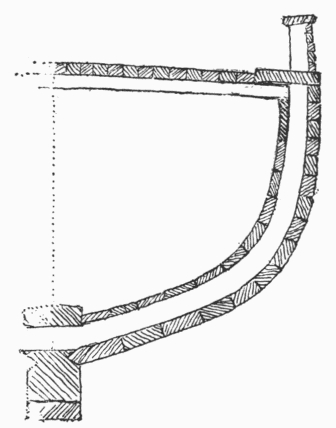
Now, it is a law in Lloyd's that the Jane repaired all out of the old until she is entirely new is still the Jane. The Spray changed her being so gradually that it was hard to say at what point the old died or the new took birth, and it was no matter. The bulwarks I built up of white-oak stanchions fourteen inches high, and covered with seven-eighth-inch white pine. These stanchions, mortised through a two-inch covering-board, I calked with thin cedar wedges. They have remained perfectly tight ever since. The deck I made of one-and-a-half-inch by three-inch white pine spiked to beams, six by six inches, of yellow or Georgia pine, placed three feet apart. The deck-inclosures were one over the aperture of the main hatch, six feet by six, for a cooking-galley, and a trunk farther aft, about ten feet by twelve, for a cabin. Both of these rose about three feet above the deck, and were sunk sufficiently into the hold to afford head-room. In the spaces along the sides of the cabin, under the deck, I arranged a berth to sleep in, and shelves for small storage, not forgetting a place for the medicine-chest. In the midship hold, that is, the space between cabin and galley, under the deck, was room for provision of water, salt beef, etc., ample for many months.
Now, Lloyd's has a rule: if the Jane is repaired bit by bit until she is entirely new, she is still the Jane. The Spray changed so gradually that it was hard to say when the old boat died or the new one was born. And it did not matter. I built the bulwarks with white oak stanchions fourteen inches high, covered with seven-eighth-inch white pine. The stanchions were set through mortises in a two-inch covering board. I caulked them with thin cedar wedges, and they have remained perfectly tight ever since. I made the deck of white pine planks, one and a half inches by three inches, spiked to beams. The beams were six inches by six inches, made of yellow or Georgia pine, and placed three feet apart. There were two enclosures on the deck. One was over the six-foot-by-six-foot main hatch, for a cooking galley. Farther aft was a trunk, about ten feet by twelve, for a cabin. Both rose about three feet above the deck and extended far enough into the hold to provide headroom. Along the sides of the cabin, under the deck, I fitted a berth for sleeping and shelves for small storage. I did not forget a place for the medicine chest. The midship hold was the space under the deck between the cabin and the galley. It had ample room for many months' supply of water, salt beef, and other provisions.
The hull of my vessel being now put together as strongly as wood and iron could make her, and the various rooms partitioned off, I set about "calking ship." Grave fears were entertained by some that at this point I should fail. I myself gave some thought to the advisability of a "professional calker." The very first blow I struck on the cotton with the calking-iron, which I thought was right, many others thought wrong. "It'll crawl!" cried a man from Marion, passing with a basket of clams on his back. "It'll crawl!" cried another from West Island, when he saw me driving cotton into the seams. Bruno simply wagged his tail. Even Mr. Ben J——, a noted authority on whaling-ships, whose mind, however, was said to totter, asked rather confidently if I did not think "it would crawl." "How fast will it crawl?" cried my old captain friend, who had been towed by many a lively sperm-whale. "Tell us how fast," cried he, "that we may get into port in time."
The hull of my vessel was now as strong as wood and iron could make it, and the rooms were partitioned off. I set about “caulking the ship.” Some people had serious doubts that I could do it. I even considered hiring a “professional caulker.” Many people thought my very first blow on the cotton with the caulking iron was wrong, though I thought it was right. “It’ll crawl!” cried a man from Marion, passing by with a basket of clams on his back. “It’ll crawl!” cried another from West Island when he saw me driving cotton into the seams. Bruno simply wagged his tail. Even Mr. Ben J..., a noted authority on whaling ships, asked rather confidently if I did not think “it would crawl.” People said, however, that his mind was failing. “How fast will it crawl?” cried my old captain friend, who had been towed by many a lively sperm whale. “Tell us how fast,” he cried, “so we can get into port in time.”
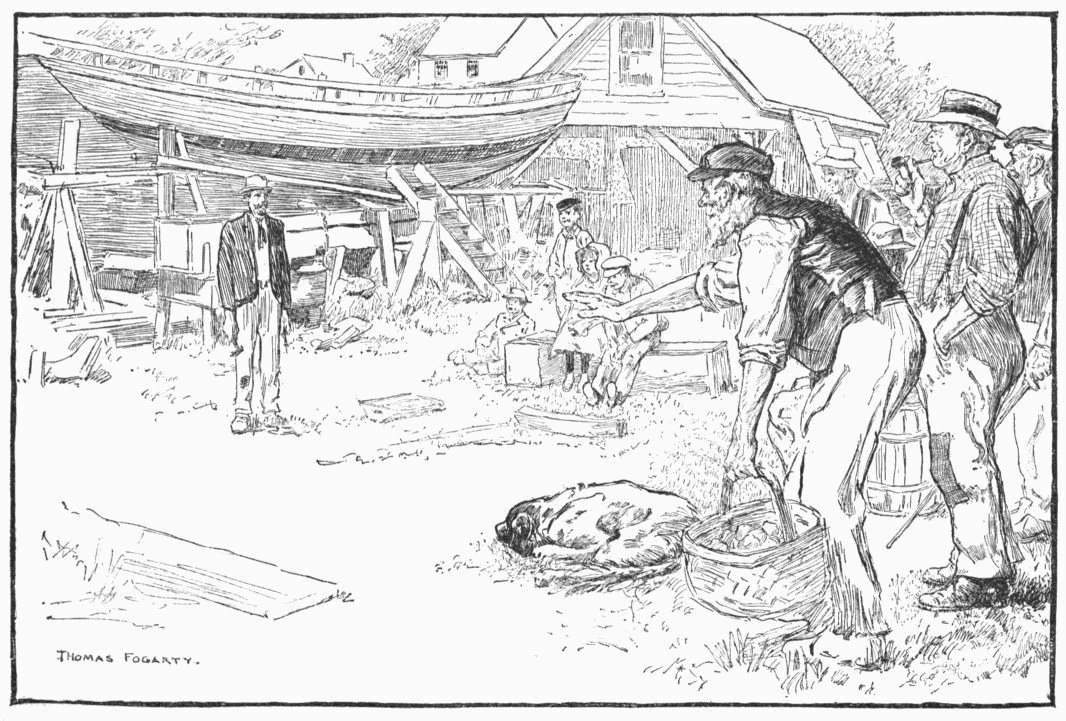
However, I drove a thread of oakum on top of the cotton, as from the first I had intended to do. And Bruno again wagged his tail. The cotton never "crawled." When the calking was finished, two coats of copper paint were slapped on the bottom, two of white lead on the topsides and bulwarks. The rudder was then shipped and painted, and on the following day the Spray was launched. As she rode at her ancient, rust-eaten anchor, she sat on the water like a swan.
However, I packed a strand of oakum over the cotton, as I had intended from the start. Bruno wagged his tail again. The cotton never "crawled." When the caulking was finished, two coats of copper paint were slapped on the bottom, and two coats of white lead paint on the sides above the waterline and the bulwarks. The rudder was then fitted and painted. The next day, the Spray was launched. As she rode at her old, rust-eaten anchor, she sat on the water like a swan.
The Spray's dimensions were, when finished, thirty-six feet nine inches long, over all, fourteen feet two inches wide, and four feet two inches deep in the hold, her tonnage being nine tons net and twelve and seventy-one hundredths tons gross.
When finished, the Spray was thirty-six feet nine inches long overall and fourteen feet two inches wide. Her hold was four feet two inches deep. Her tonnage was nine tons net and 12.71 tons gross.
Then the mast, a smart New Hampshire spruce, was fitted, and likewise all the small appurtenances necessary for a short cruise. Sails were bent, and away she flew with my friend Captain Pierce and me, across Buzzard's Bay on a trial-trip—all right. The only thing that now worried my friends along the beach was, "Will she pay?" The cost of my new vessel was $553.62 for materials, and thirteen months of my own labor. I was several months more than that at Fairhaven, for I got work now and then on an occasional whale-ship fitting farther down the harbor, and that kept me the overtime.
Then the mast, a fine New Hampshire spruce, was fitted, along with all the small fittings needed for a short cruise. The sails were attached, and she flew across Buzzard's Bay on a trial trip with my friend Captain Pierce and me aboard. All went well. The only thing that now worried my friends along the shore was, "Will she pay?" My new vessel cost $553.62 for materials and thirteen months of my own labor. I spent several more months than that at Fairhaven. Now and then I found work on a whale-ship being fitted out farther down the harbor, and that kept me there longer.