Chapter 8
AT five o’clock the two ladies retired to dress, and at half-past six Elizabeth was summoned to dinner. To the civil inquiries which then poured in, and amongst which she had the pleasure of distinguishing the much superior solicitude of Mr. Bingley, she could not make a very favourable answer. Jane was by no means better. The sisters, on hearing this, repeated three or four times how much they were grieved, how shocking it was to have a bad cold, and how excessively they disliked being ill themselves; and then thought no more of the matter: and their indifference towards Jane, when not immediately before them, restored Elizabeth to the enjoyment of all her original dislike.
At five o’clock the two ladies went to dress, and at half past six Elizabeth was called to dinner. Everyone politely asked about Jane, and Elizabeth was pleased to notice that Mr. Bingley’s concern far exceeded anyone else’s. But she could not give a very encouraging answer. Jane was no better at all. On hearing this, the sisters repeated three or four times how sorry they were. They said how dreadful it was to have a bad cold, and how much they hated being ill themselves. Then they gave the matter no further thought. Their indifference to Jane whenever she was out of sight allowed Elizabeth to enjoy disliking them as much as ever.
Their brother, indeed, was the only one of the party whom she could regard with any complacency. His anxiety for Jane was evident, and his attentions to herself most pleasing; and they prevented her feeling herself so much an intruder as she believed she was considered by the others. She had very little notice from any but him. Miss Bingley was engrossed by Mr. Darcy, her sister scarcely less so; and as for Mr. Hurst, by whom Elizabeth sat, he was an indolent man, who lived only to eat, drink, and play at cards, who, when he found her prefer a plain dish to a ragout, had nothing to say to her.
Their brother, in fact, was the only person in the group she could view with any pleasure. His worry about Jane was obvious, and his attention to Elizabeth was very pleasing. His kindness made her feel less like an intruder, though she believed the others saw her as one. Almost no one but him paid her any attention. Miss Bingley was absorbed in Mr. Darcy, and her sister was almost equally absorbed in him. As for Mr. Hurst, whom Elizabeth sat beside, he was a lazy man. He lived only to eat, drink, and play cards. When he discovered she preferred a plain dish to a rich stew, he had nothing to say to her.
When dinner was over, she returned directly to Jane, and Miss Bingley began abusing her as soon as she was out of the room. Her manners were pronounced to be very bad indeed,—a mixture of pride and impertinence: she had no conversation, no style, no taste, no beauty. Mrs. Hurst thought the same, and added,—
After dinner, she went straight back to Jane. As soon as she left the room, Miss Bingley began criticizing her harshly. Her manners were declared very bad indeed, a mixture of pride and rudeness. She had no conversation skills, no style, no taste, and no beauty. Mrs. Hurst agreed and added:
“She has nothing, in short, to recommend her, but being an excellent walker. I shall never forget her appearance this morning. She really looked almost wild.”
“In short, she has nothing going for her except that she’s an excellent walker. I’ll never forget how she looked this morning. She really looked almost wild.”
“She did indeed, Louisa. I could hardly keep my countenance. Very nonsensical to come at all! Why must she be scampering about the country, because her sister had a cold? Her hair so untidy, so blowzy!”
“She certainly did, Louisa. I could hardly keep a straight face. So ridiculous to come at all! Why must she go running around the countryside because her sister had a cold? Her hair was so messy, so windswept!”
“Yes, and her petticoat; I hope you saw her petticoat, six inches deep in mud, I am absolutely certain, and the gown which had been let down to hide it not doing its office.”
“Yes, and her petticoat. I hope you saw her petticoat, covered in mud six inches up from the hem. I’m absolutely certain of it. And her dress, which had been lengthened to hide the petticoat, wasn’t doing its job.”
“Your picture may be very exact, Louisa,” said Bingley; “but this was all lost upon me. I thought Miss Elizabeth Bennet looked remarkably well when she came into the room this morning. Her dirty petticoat quite escaped my notice.”
“Your description may be very accurate, Louisa,” said Bingley. “But I noticed none of those things. I thought Miss Elizabeth Bennet looked remarkably good when she came into the room this morning. I didn’t notice her dirty petticoat at all.”
“You observed it, Mr. Darcy, I am sure,” said Miss Bingley; “and I am inclined to think that you would not wish to see your sister make such an exhibition.”
“You noticed it, Mr. Darcy, I’m sure,” said Miss Bingley. “And I tend to think you wouldn’t want to see your sister make such a spectacle of herself.”
“Certainly not.”
“Certainly not.”
“To walk three miles, or four miles, or five miles, or whatever it is, above her ancles in dirt, and alone, quite alone! what could she mean by it? It seems to me to show an abominable sort of conceited independence, a most country-town indifference to decorum.”
“To walk three miles, or four miles, or five miles, or whatever the distance is! With mud above her ankles, and alone, completely alone! What could she have been thinking? To me, her behavior shows a dreadful sort of arrogant independence. It shows a very small-town disregard for proper behavior.”
“It shows an affection for her sister that is very pleasing,” said Bingley.
“It shows a love for her sister that is very nice to see,” said Bingley.
“I am afraid, Mr. Darcy,” observed Miss Bingley, in a half whisper, “that this adventure has rather affected your admiration of her fine eyes.”
“I’m afraid, Mr. Darcy,” Miss Bingley said in a near whisper, “this adventure has somewhat changed your admiration for her beautiful eyes.”
“Not at all,” he replied: “they were brightened by the exercise.” A short pause followed this speech, and Mrs. Hurst began again,—
“Not at all,” he replied. “The exercise made them brighter.” After a brief pause, Mrs. Hurst spoke again:
“I have an excessive regard for Jane Bennet,—she is really a very sweet girl,—and I wish with all my heart she were well settled. But with such a father and mother, and such low connections, I am afraid there is no chance of it.”
“I am extremely fond of Jane Bennet. She really is a very sweet girl. And I wish with all my heart that she could make a good marriage. But with parents like hers and such low-status relatives, I’m afraid she has no chance of marrying well.”
“I think I have heard you say that their uncle is an attorney in Meryton?”
“I think I heard you say their uncle is a lawyer in Meryton?”
“Yes; and they have another, who lives somewhere near Cheapside.”
“Yes, and they have another who lives somewhere near Cheapside.”
“That is capital,” added her sister; and they both laughed heartily.
“That’s excellent,” her sister added, and they both laughed heartily.
“If they had uncles enough to fill all Cheapside,” cried Bingley, “it would not make them one jot less agreeable.”
“If they had enough uncles to fill all Cheapside,” Bingley exclaimed, “they wouldn’t be any less pleasant.”
“But it must very materially lessen their chance of marrying men of any consideration in the world,” replied Darcy.
“But it must greatly reduce their chances of marrying men of any social standing,” Darcy replied.
To this speech Bingley made no answer; but his sisters gave it their hearty assent, and indulged their mirth for some time at the expense of their dear friend’s vulgar relations.
Bingley said nothing in reply, but his sisters enthusiastically agreed. They spent some time laughing at their dear friend’s vulgar relatives.
With a renewal of tenderness, however, they repaired to her room on leaving the dining-parlour, and sat with her till summoned to coffee. She was still very poorly, and Elizabeth would not quit her at all, till late in the evening, when she had the comfort of seeing her asleep, and when it appeared to her rather right than pleasant that she should go down stairs herself. On entering the drawing-room, she found the whole party at loo, and was immediately invited to join them; but suspecting them to be playing high, she declined it, and making her sister the excuse, said she would amuse herself, for the short time she could stay below, with a book. Mr. Hurst looked at her with astonishment.
With renewed tenderness, however, they left the dining room and went to her room. They sat with her until they were called for coffee. She was still very unwell, and Elizabeth would not leave her until late that evening. Only then did Elizabeth have the comfort of seeing her asleep. Going downstairs herself seemed more a duty than a pleasure. When Elizabeth entered the drawing room, she found everyone playing loo and was immediately invited to join them. But she suspected they were playing for high stakes, so she declined. Using her sister as an excuse, she said she would entertain herself with a book during her short stay downstairs. Mr. Hurst looked at her in astonishment.
“Do you prefer reading to cards?” said he; “that is rather singular.”
“Do you prefer reading to playing cards?” he asked. “That’s rather unusual.”
“Miss Eliza Bennet,” said Miss Bingley, “despises cards. She is a great reader, and has no pleasure in anything else.”
“Miss Eliza Bennet,” said Miss Bingley, “hates playing cards. She reads a great deal and enjoys nothing else.”
“I deserve neither such praise nor such censure,” cried Elizabeth; “I am not a great reader, and I have pleasure in many things.”
“I don’t deserve that much praise or criticism,” Elizabeth exclaimed. “I am not a big reader, and I enjoy many things.”
“In nursing your sister I am sure you have pleasure,” said Bingley; “and I hope it will soon be increased by seeing her quite well.”
“I’m sure you find pleasure in caring for your sister,” said Bingley. “And I hope seeing her fully recovered will soon give you even more pleasure.”
Elizabeth thanked him from her heart, and then walked towards a table where a few books were lying. He immediately offered to fetch her others; all that his library afforded.
Elizabeth thanked him with all her heart, then walked toward a table with a few books on it. He immediately offered to bring her other books, all that his library had to offer.
“And I wish my collection were larger for your benefit and my own credit; but I am an idle fellow; and though I have not many, I have more than I ever looked into.”
“And I wish my collection were larger, for your benefit and to make me look better. But I’m lazy. And though I don’t have many books, I have more than I’ve ever opened.”
Elizabeth assured him that she could suit herself perfectly with those in the room.
Elizabeth assured him she could find exactly what she wanted among those in the room.
“I am astonished,” said Miss Bingley, “that my father should have left so small a collection of books. What a delightful library you have at Pemberley, Mr. Darcy!”
“I’m amazed,” said Miss Bingley, “that my father left such a small collection of books. What a wonderful library you have at Pemberley, Mr. Darcy!”
“It ought to be good,” he replied: “it has been the work of many generations.”
“It should be good,” he replied. “Many generations have worked on it.”
“And then you have added so much to it yourself—you are always buying books.”
“And you’ve added so much to it yourself. You’re always buying books.”
“I cannot comprehend the neglect of a family library in such days as these.”
“I can’t understand how anyone could neglect a family library in times like these.”
“Neglect! I am sure you neglect nothing that can add to the beauties of that noble place. Charles, when you build your house, I wish it may be half as delightful as Pemberley.”
“Neglect! I’m sure you overlook nothing that could make that grand place more beautiful. Charles, when you build your house, I hope it will be half as delightful as Pemberley.”
“I wish it may.”
“I hope so.”
“But I would really advise you to make your purchase in that neighbourhood, and take Pemberley for a kind of model. There is not a finer county in England than Derbyshire.”
“But I would really advise you to buy a property in that area and use Pemberley as a model. There is no finer county in England than Derbyshire.”
“With all my heart: I will buy Pemberley itself, if Darcy will sell it.”
“Gladly! I’ll buy Pemberley itself, if Darcy will sell it.”
“I am talking of possibilities, Charles.”
“I’m talking about possibilities, Charles.”
“Upon my word, Caroline, I should think it more possible to get Pemberley by purchase than by imitation.”
“Honestly, Caroline, I’d think you’d have a better chance of getting Pemberley by buying it than by imitation.”
Elizabeth was so much caught by what passed, as to leave her very little attention for her book; and, soon laying it wholly aside, she drew near the card-table, and stationed herself between Mr. Bingley and his eldest sister, to observe the game.
Elizabeth was so absorbed in what was happening that she could barely focus on her book. Soon she put the book aside and moved closer to the card table. She stood between Mr. Bingley and his eldest sister to watch the game.
“Is Miss Darcy much grown since the spring?” said Miss Bingley: “will she be as tall as I am?”
“Has Miss Darcy grown much since the spring?” asked Miss Bingley. “Will she be as tall as I am?”
“I think she will. She is now about Miss Elizabeth Bennet’s height, or rather taller.”
“I think she will. She is now about as tall as Miss Elizabeth Bennet, or rather, a little taller.”
“How I long to see her again! I never met with anybody who delighted me so much. Such a countenance, such manners, and so extremely accomplished for her age! Her performance on the pianoforte is exquisite.”
“How I long to see her again! I’ve never met anyone who delighted me so much. Such a lovely face, such lovely manners, and so extremely accomplished for her age! She plays the piano beautifully.”
“It is amazing to me,” said Bingley, “how young ladies can have patience to be so very accomplished as they all are.”
“It amazes me,” said Bingley, “that young women have the patience to become as highly skilled as they all are.”
“All young ladies accomplished! My dear Charles, what do you mean?”
“All young women are talented! My dear Charles, what do you mean?”
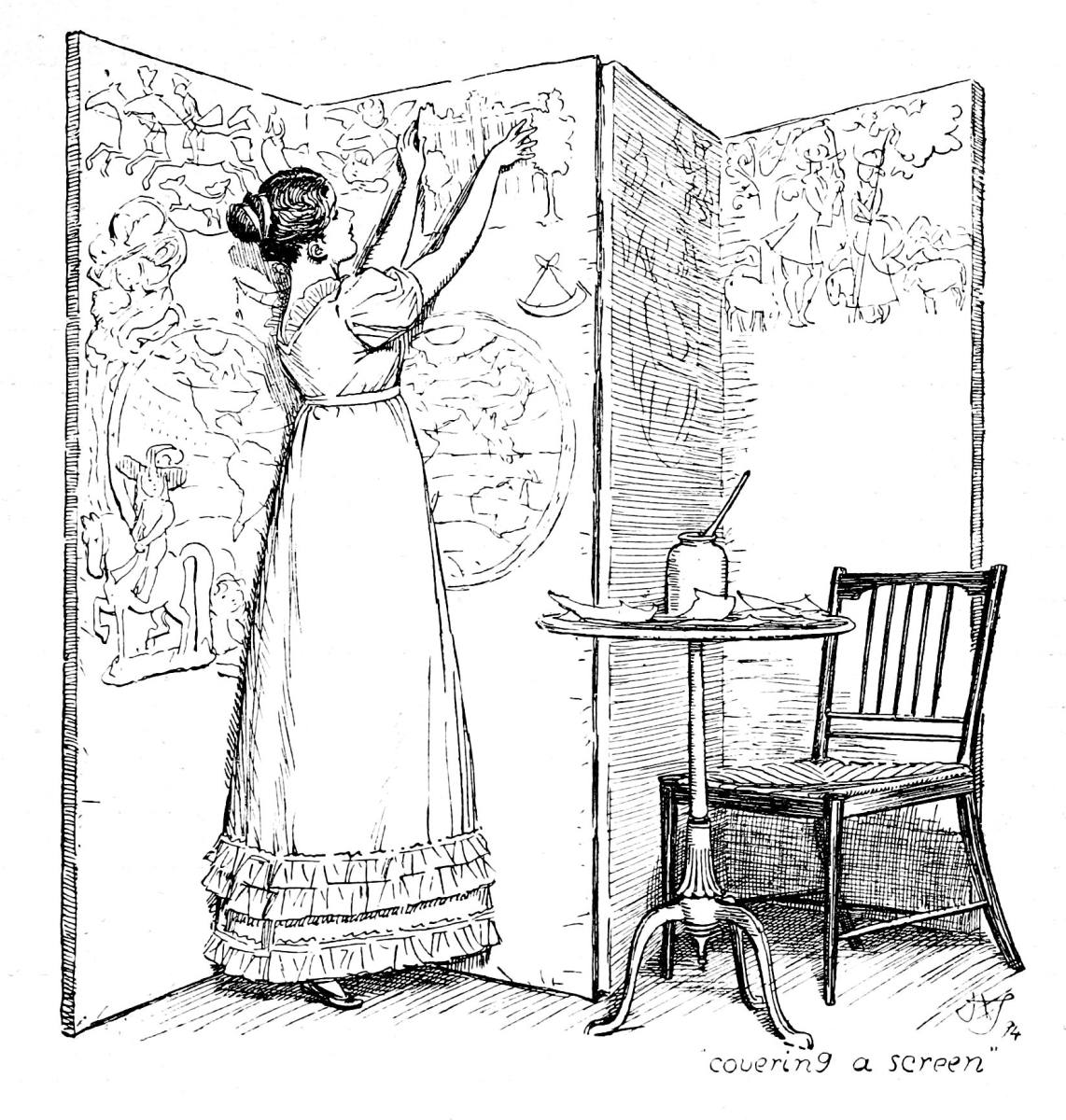
“Yes, all of them, I think. They all paint tables, cover screens, and net purses. I scarcely know any one who cannot do all this; and I am sure I never heard a young lady spoken of for the first time, without being informed that she was very accomplished.”
“Yes, all of them, I think. They all paint tables, decorate screens, and make netted purses. I hardly know anyone who can't do all these things. And I'm sure I've never heard a young woman mentioned for the first time without being told she was very accomplished.”
“Your list of the common extent of accomplishments,” said Darcy, “has too much truth. The word is applied to many a woman who deserves it no otherwise than by netting a purse or covering a screen; but I am very far from agreeing with you in your estimation of ladies in general. I cannot boast of knowing more than half-a-dozen in the whole range of my acquaintance that are really accomplished.”
“Your list of what usually counts as accomplishments,” said Darcy, “is all too accurate. Many women are called accomplished simply because they can make a netted purse or cover a decorative screen. But I strongly disagree with your opinion of women in general. Among all the women I know, I cannot claim that more than half a dozen are truly accomplished.”
“Nor I, I am sure,” said Miss Bingley.
“Me neither, I’m sure,” said Miss Bingley.
“Then,” observed Elizabeth, “you must comprehend a great deal in your idea of an accomplished woman.”
“Then,” Elizabeth said, “you must include a great deal in your idea of an accomplished woman.”
“Yes; I do comprehend a great deal in it.”
“Yes, I do include a lot in it.”
“Oh, certainly,” cried his faithful assistant, “no one can be really esteemed accomplished who does not greatly surpass what is usually met with. A woman must have a thorough knowledge of music, singing, drawing, dancing, and the modern languages, to deserve the word; and, besides all this, she must possess a certain something in her air and manner of walking, the tone of her voice, her address and expressions, or the word will be but half deserved.”
“Oh, certainly,” exclaimed his faithful assistant. “No one can truly be called accomplished without being far above average. A woman must thoroughly know music, singing, drawing, dancing, and modern languages to deserve the word. Besides all these skills, she must have a certain something in her bearing and the way she walks. The same goes for her tone of voice, how she speaks to people, and how she expresses herself. Otherwise, she will only half deserve the word.”
“All this she must possess,” added Darcy; “and to all she must yet add something more substantial in the improvement of her mind by extensive reading.”
“She must have all these qualities,” Darcy added. “And she must add something more substantial by developing her mind through extensive reading.”
“I am no longer surprised at your knowing only six accomplished women. I rather wonder now at your knowing any.”
“I’m no longer surprised that you know only six accomplished women. Now I’m surprised you know any.”
“Are you so severe upon your own sex as to doubt the possibility of all this?”
“Are you so hard on your own sex that you doubt all this is possible?”
“I never saw such a woman. I never saw such capacity, and taste, and application, and elegance, as you describe, united.”
“I have never seen such a woman. I have never seen such ability, taste, dedication, and elegance combined in one person as you describe.”
Mrs. Hurst and Miss Bingley both cried out against the injustice of her implied doubt, and were both protesting that they knew many women who answered this description, when Mr. Hurst called them to order, with bitter complaints of their inattention to what was going forward. As all conversation was thereby at an end, Elizabeth soon afterwards left the room.
Mrs. Hurst and Miss Bingley both protested loudly that her implied doubt was unfair. Both insisted they knew many women who fit this description, but Mr. Hurst called them to order. He complained bitterly that they were not paying attention to what was happening. This put an end to all conversation, so Elizabeth left the room soon afterward.
“Eliza Bennet,” said Miss Bingley, when the door was closed on her, “is one of those young ladies who seek to recommend themselves to the other sex by undervaluing their own; and with many men, I daresay, it succeeds; but, in my opinion, it is a paltry device, a very mean art.”
“Eliza Bennet,” said Miss Bingley after the door had closed behind Eliza, “is one of those young women who try to impress men by putting down other women. I dare say that approach works with many men. But in my opinion, it’s a cheap trick, a very petty tactic.”
“Undoubtedly,” replied Darcy, to whom this remark was chiefly addressed, “there is meanness in all the arts which ladies sometimes condescend to employ for captivation. Whatever bears affinity to cunning is despicable.”
“Certainly,” Darcy replied. The remark had been directed mainly at him. “There is something shameful in all the tricks ladies sometimes stoop to using to charm others. Anything resembling deceit is despicable.”
Miss Bingley was not so entirely satisfied with this reply as to continue the subject.
Miss Bingley was not satisfied enough with this reply to continue the conversation on that subject.
Elizabeth joined them again only to say that her sister was worse, and that she could not leave her. Bingley urged Mr. Jones’s being sent for immediately; while his sisters, convinced that no country advice could be of any service, recommended an express to town for one of the most eminent physicians. This she would not hear of; but she was not so unwilling to comply with their brother’s proposal; and it was settled that Mr. Jones should be sent for early in the morning, if Miss Bennet were not decidedly better. Bingley was quite uncomfortable; his sisters declared that they were miserable. They solaced their wretchedness, however, by duets after supper; while he could find no better relief to his feelings than by giving his housekeeper directions that every possible attention might be paid to the sick lady and her sister.
Elizabeth rejoined them only to say that her sister was worse and that she could not leave her. Bingley urged them to send for Mr. Jones immediately. His sisters, however, were convinced that no local doctor could help. They recommended sending an urgent message to London for one of the most distinguished doctors. Elizabeth would not hear of that, but she was more willing to agree to Bingley’s suggestion. They agreed to send for Mr. Jones early the next morning if Miss Bennet was not clearly better. Bingley was deeply uneasy. His sisters declared that they were miserable. They comforted themselves in their misery, however, by singing duets after supper. Meanwhile, Bingley could find no better way to ease his feelings than to give his housekeeper instructions. He told her to make sure the sick lady and her sister received every possible attention.