Chapter 9
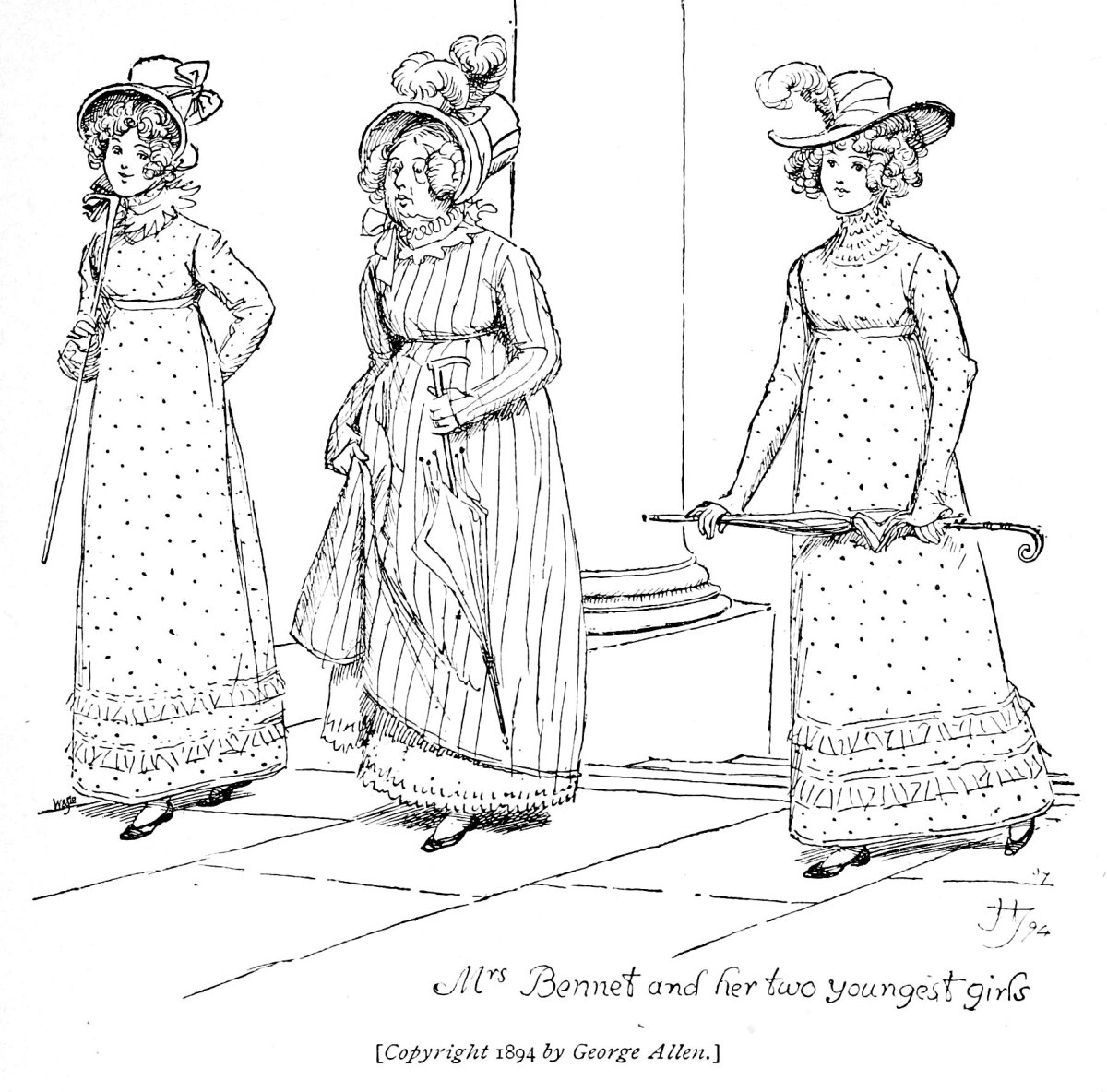
ELIZABETH passed the chief of the night in her sister’s room, and in the morning had the pleasure of being able to send a tolerable answer to the inquiries which she very early received from Mr. Bingley by a housemaid, and some time afterwards from the two elegant ladies who waited on his sisters. In spite of this amendment, however, she requested to have a note sent to Longbourn, desiring her mother to visit Jane, and form her own judgment of her situation. The note was immediately despatched, and its contents as quickly complied with. Mrs. Bennet, accompanied by her two youngest girls, reached Netherfield soon after the family breakfast.
Elizabeth spent most of the night in her sister’s room. In the morning, she was pleased to give a fairly reassuring report on Jane’s condition. Mr. Bingley had sent a housemaid very early to ask how Jane was. Some time later, the two elegant ladies who served his sisters came to ask as well. Despite Jane’s improvement, Elizabeth asked for a note to be sent to Longbourn, asking her mother to visit Jane. She wanted her mother to judge Jane’s condition for herself. The note was sent immediately, and Mrs. Bennet acted on it just as quickly. Accompanied by her two youngest daughters, Mrs. Bennet reached Netherfield soon after the family had finished breakfast.
Had she found Jane in any apparent danger, Mrs. Bennet would have been very miserable; but being satisfied on seeing her that her illness was not alarming, she had no wish of her recovering immediately, as her restoration to health would probably remove her from Netherfield. She would not listen, therefore, to her daughter’s proposal of being carried home; neither did the apothecary, who arrived about the same time, think it at all advisable. After sitting a little while with Jane, on Miss Bingley’s appearance and invitation, the mother and three daughters all attended her into the breakfast parlour. Bingley met them with hopes that Mrs. Bennet had not found Miss Bennet worse than she expected.
If Jane had seemed to be in any danger, Mrs. Bennet would have been very distressed. But seeing Jane reassured her that the illness was not serious, so she had no wish for an immediate recovery. After all, getting well would probably mean Jane would leave Netherfield. Mrs. Bennet therefore refused to consider her daughter’s suggestion that she be carried home. The apothecary, who arrived at about the same time, also thought taking Jane home would be quite unwise. The mother and three daughters sat with Jane for a little while. Then Miss Bingley appeared and invited them into the breakfast room, and all four followed her there. Bingley met them, expressing his hope that Mrs. Bennet had not found Miss Bennet worse than she had expected.
“Indeed I have, sir,” was her answer. “She is a great deal too ill to be moved. Mr. Jones says we must not think of moving her. We must trespass a little longer on your kindness.”
“Yes, I have, sir,” she answered. “She is far too ill to be moved. Mr. Jones says we must not even consider moving her. We must rely on your kindness a little longer.”
“Removed!” cried Bingley. “It must not be thought of. My sister, I am sure, will not hear of her removal.”
“Moved!” cried Bingley. “We must not even consider moving her. I’m sure my sister won’t allow her to be moved.”
“You may depend upon it, madam,” said Miss Bingley, with cold civility, “that Miss Bennet shall receive every possible attention while she remains with us.”
“You can be sure, madam,” said Miss Bingley with cold politeness. “Miss Bennet will receive every possible attention while she stays with us.”
Mrs. Bennet was profuse in her acknowledgments.
Mrs. Bennet thanked them generously.
“I am sure,” she added, “if it was not for such good friends, I do not know what would become of her, for she is very ill indeed, and suffers a vast deal, though with the greatest patience in the world, which is always the way with her, for she has, without exception, the sweetest temper I ever met with. I often tell my other girls they are nothing to her. You have a sweet room here, Mr. Bingley, and a charming prospect over that gravel walk. I do not know a place in the country that is equal to Netherfield. You will not think of quitting it in a hurry, I hope, though you have but a short lease.”
“I’m sure,” she added, “if she didn’t have such good friends, I don’t know what would become of her. She really is very ill and suffers a great deal, though she bears it with the greatest patience imaginable. She is always like that, because she has, without exception, the sweetest temper I have ever known. I often tell my other girls they are nothing compared to her. You have a lovely room here, Mr. Bingley, and a charming view over that gravel path. I don’t know any place in the country equal to Netherfield. I hope you won’t think of leaving anytime soon, though you only have a short lease.”
“Whatever I do is done in a hurry,” replied he; “and therefore if I should resolve to quit Netherfield, I should probably be off in five minutes. At present, however, I consider myself as quite fixed here.”
“Whatever I do, I do in a hurry,” he replied. “So if I decided to leave Netherfield, I would probably be gone in five minutes. For now, though, I consider myself quite settled here.”
“That is exactly what I should have supposed of you,” said Elizabeth.
“That’s exactly what I would have expected of you,” said Elizabeth.
“You begin to comprehend me, do you?” cried he, turning towards her.
“You’re starting to understand me, are you?” he exclaimed, turning toward her.
“Oh yes—I understand you perfectly.”
“Oh yes, I understand you perfectly.”
“I wish I might take this for a compliment; but to be so easily seen through, I am afraid, is pitiful.”
“I wish I could take that as a compliment. But I’m afraid it’s pathetic to be so easy to see through.”
“That is as it happens. It does not necessarily follow that a deep, intricate character is more or less estimable than such a one as yours.”
“That depends. A deep, complex character is not necessarily more or less worthy of respect than one like yours.”
“Lizzy,” cried her mother, “remember where you are, and do not run on in the wild manner that you are suffered to do at home.”
“Lizzy,” her mother cried, “remember where you are. And don't go on talking so wildly, as you're allowed to do at home.”
“I did not know before,” continued Bingley, immediately, “that you were a studier of character. It must be an amusing study.”
“I didn’t know before,” Bingley continued at once, “that you study people’s personalities. That must be an entertaining study.”
“Yes; but intricate characters are the most amusing. They have at least that advantage.”
“Yes, but complicated personalities are the most entertaining. At least they have that advantage.”
“The country,” said Darcy, “can in general supply but few subjects for such a study. In a country neighbourhood you move in a very confined and unvarying society.”
“The countryside,” said Darcy, “generally offers few people for such a study. In a rural neighbourhood, you mix with a very small social circle that rarely changes.”
“But people themselves alter so much, that there is something new to be observed in them for ever.”
“But people change so much that there is always something new to notice about them.”
“Yes, indeed,” cried Mrs. Bennet, offended by his manner of mentioning a country neighbourhood. “I assure you there is quite as much of that going on in the country as in town.”
“Yes, indeed,” Mrs. Bennet exclaimed, offended by the way he spoke about country communities. “I assure you, just as much of that goes on in the country as in town.”
Everybody was surprised; and Darcy, after looking at her for a moment, turned silently away. Mrs. Bennet, who fancied she had gained a complete victory over him, continued her triumph,—
Everyone was surprised. Darcy looked at her for a moment, then silently turned away. Mrs. Bennet thought she had won a complete victory over him and continued to gloat:
“I cannot see that London has any great advantage over the country, for my part, except the shops and public places. The country is a vast deal pleasanter, is not it, Mr. Bingley?”
“For my part, I don’t see any great advantage London has over the country, except its shops and public places. The country is much more pleasant, isn’t it, Mr. Bingley?”
“When I am in the country,” he replied, “I never wish to leave it; and when I am in town, it is pretty much the same. They have each their advantages, and I can be equally happy in either.”
“When I’m in the country,” he replied, “I never want to leave. And when I’m in town, I feel much the same. Both have their advantages, and I can be equally happy in either.”
“Ay, that is because you have the right disposition. But that gentleman,” looking at Darcy, “seemed to think the country was nothing at all.”
“Yes, that's because you have the right temperament.” The speaker looked at Darcy. “But that gentleman seemed to think the countryside had nothing at all to offer.”
“Indeed, mamma, you are mistaken,” said Elizabeth, blushing for her mother. “You quite mistook Mr. Darcy. He only meant that there was not such a variety of people to be met with in the country as in town, which you must acknowledge to be true.”
“Really, Mama, you’re mistaken,” said Elizabeth, blushing with embarrassment for her mother. “You completely misunderstood Mr. Darcy. He only meant you don’t meet as wide a variety of people in the country as in town. You must admit that’s true.”
“Certainly, my dear, nobody said there were; but as to not meeting with many people in this neighbourhood, I believe there are few neighbourhoods larger. I know we dine with four-and-twenty families.”
“Of course, my dear, nobody said there were. But as for not meeting many people around here, I believe few neighborhoods are larger than ours. I know we dine with twenty-four families.”
Nothing but concern for Elizabeth could enable Bingley to keep his countenance. His sister was less delicate, and directed her eye towards Mr. Darcy with a very expressive smile. Elizabeth, for the sake of saying something that might turn her mother’s thoughts, now asked her if Charlotte Lucas had been at Longbourn since her coming away.
Only concern for Elizabeth kept Bingley from laughing. His sister was less tactful and looked at Mr. Darcy with a very knowing smile. Elizabeth now asked her mother a question to distract her. Had Charlotte Lucas been to Longbourn since she had left?
“Yes, she called yesterday with her father. What an agreeable man Sir William is, Mr. Bingley—is not he? so much the man of fashion! so genteel and so easy! He has always something to say to everybody. That is my idea of good breeding; and those persons who fancy themselves very important and never open their mouths quite mistake the matter.”
“Yes, she visited yesterday with her father. What a pleasant man Sir William is, Mr. Bingley, isn't he? So stylish, so polished, and so relaxed! He always has something to say to everybody. That is my idea of good manners. And those people who think themselves very important and never open their mouths have it completely wrong.”
“Did Charlotte dine with you?”
“Did Charlotte have dinner with you?”
“No, she would go home. I fancy she was wanted about the mince-pies. For my part, Mr. Bingley, I always keep servants that can do their own work; my daughters are brought up differently. But everybody is to judge for themselves, and the Lucases are a very good sort of girls, I assure you. It is a pity they are not handsome! Not that I think Charlotte so very plain; but then she is our particular friend.”
“No, she insisted on going home. I suppose she was needed to help with the mince pies. As for me, Mr. Bingley, I always keep servants who can do their own work. My daughters are brought up differently. But everyone must judge for themselves. And the Lucas girls are very good girls, I assure you. It’s a pity they aren’t pretty! Not that I think Charlotte is so very plain. But then she is a close friend of ours.”
“She seems a very pleasant young woman,” said Bingley.
“She seems like a very pleasant young woman,” said Bingley.
“Oh dear, yes; but you must own she is very plain. Lady Lucas herself has often said so, and envied me Jane’s beauty. I do not like to boast of my own child; but to be sure, Jane—one does not often see anybody better looking. It is what everybody says. I do not trust my own partiality. When she was only fifteen there was a gentleman at my brother Gardiner’s in town so much in love with her, that my sister-in-law was sure he would make her an offer before we came away. But, however, he did not. Perhaps he thought her too young. However, he wrote some verses on her, and very pretty they were.”
“Oh dear, yes. But you must admit she is very plain. Lady Lucas herself has often said so, and has envied me for Jane’s beauty. I don’t like to boast about my own child. But really, you don’t often see anyone better looking than Jane. Everyone says so. I don’t rely on my own biased opinion. When Jane was only fifteen, a gentleman at my brother Gardiner’s house in London was so in love with her. My sister-in-law was sure he would propose before we left. But he did not. Perhaps he thought her too young. Still, he wrote some poems about her, and they were very lovely.”
“And so ended his affection,” said Elizabeth, impatiently. “There has been many a one, I fancy, overcome in the same way. I wonder who first discovered the efficacy of poetry in driving away love!”
“And that was the end of his love,” said Elizabeth impatiently. “I imagine many others have had their love killed the same way. I wonder who first discovered how well poetry works at driving love away!”
“I have been used to consider poetry as the food of love,” said Darcy.
“I've always thought of poetry as the food of love,” said Darcy.
“Of a fine, stout, healthy love it may. Everything nourishes what is strong already. But if it be only a slight, thin sort of inclination, I am convinced that one good sonnet will starve it entirely away.”
“It may, with a strong, healthy love. Everything nourishes what is already strong. But if the attraction is only slight and weak, I’m convinced one good sonnet will starve it away entirely.”
Darcy only smiled; and the general pause which ensued made Elizabeth tremble lest her mother should be exposing herself again. She longed to speak, but could think of nothing to say; and after a short silence Mrs. Bennet began repeating her thanks to Mr. Bingley for his kindness to Jane, with an apology for troubling him also with Lizzy. Mr. Bingley was unaffectedly civil in his answer, and forced his younger sister to be civil also, and say what the occasion required. She performed her part, indeed, without much graciousness, but Mrs. Bennet was satisfied, and soon afterwards ordered her carriage. Upon this signal, the youngest of her daughters put herself forward. The two girls had been whispering to each other during the whole visit; and the result of it was, that the youngest should tax Mr. Bingley with having promised on his first coming into the country to give a ball at Netherfield.
Darcy only smiled. In the silence that followed, Elizabeth trembled, fearing her mother would embarrass herself again. She longed to speak but could think of nothing to say. After a short silence, Mrs. Bennet began thanking Mr. Bingley again for his kindness to Jane. She also apologized for troubling him with Lizzy. Mr. Bingley answered with genuine politeness and made his younger sister be polite too, saying what the occasion called for. His sister did her part, though without much warmth. But Mrs. Bennet was satisfied and soon afterward called for her carriage. At this signal, her youngest daughter stepped forward. The two youngest girls had been whispering to each other throughout the visit. As a result, the youngest was to remind Mr. Bingley of a promise he had made. When he first came to the area, he had promised to give a ball at Netherfield.
Lydia was a stout, well-grown girl of fifteen, with a fine complexion and good-humoured countenance; a favourite with her mother, whose affection had brought her into public at an early age. She had high animal spirits, and a sort of natural self-consequence, which the attentions of the officers, to whom her uncle’s good dinners and her own easy manners recommended her, had increased into assurance. She was very equal, therefore, to address Mr. Bingley on the subject of the ball, and abruptly reminded him of his promise; adding, that it would be the most shameful thing in the world if he did not keep it. His answer to this sudden attack was delightful to her mother’s ear.
Lydia was a sturdy, fully grown girl of fifteen, with a lovely complexion and a cheerful face. She was her mother’s favourite, and her mother’s fondness had led her to introduce Lydia into society early. Lydia was full of energy and had a natural sense of her own importance. The officers’ attentions had made her even more self-assured. Her uncle’s good dinners and her own relaxed manners had won her their favour. So she had no hesitation in speaking to Mr. Bingley about the ball and abruptly reminding him of his promise. She added that breaking his promise would be the most shameful thing in the world. His reply to this sudden attack was music to her mother’s ears.
“I am perfectly ready, I assure you, to keep my engagement; and, when your sister is recovered, you shall, if you please, name the very day of the ball. But you would not wish to be dancing while she is ill?”
“I assure you, I’m completely ready to keep my promise. And when your sister has recovered, you can choose the exact day of the ball, if you like. But you wouldn’t want to be dancing while she’s ill, would you?”
Lydia declared herself satisfied. “Oh yes—it would be much better to wait till Jane was well; and by that time, most likely, Captain Carter would be at Meryton again. And when you have given your ball,” she added, “I shall insist on their giving one also. I shall tell Colonel Forster it will be quite a shame if he does not.”
Lydia said she was satisfied. “Oh yes, it would be much better to wait until Jane was well. And by then, Captain Carter would most likely be back in Meryton. And when you have held your ball,” she added, “I shall insist on them holding one too. I shall tell Colonel Forster it will be a real shame if he does not.”
Mrs. Bennet and her daughters then departed, and Elizabeth returned instantly to Jane, leaving her own and her relations’ behaviour to the remarks of the two ladies and Mr. Darcy; the latter of whom, however, could not be prevailed on to join in their censure of her, in spite of all Miss Bingley’s witticisms on fine eyes.
Mrs. Bennet and her daughters then left, and Elizabeth immediately returned to Jane. She left the two ladies and Mr. Darcy to comment on her own behavior and that of her relatives. Mr. Darcy, however, could not be persuaded to join in their criticism of her. This was despite all Miss Bingley’s witty remarks about fine eyes.