Chapter 7
MR. BENNET’S property consisted almost entirely in an estate of two thousand a year, which, unfortunately for his daughters, was entailed, in default of heirs male, on a distant relation; and their mother’s fortune, though ample for her situation in life, could but ill supply the deficiency of his. Her father had been an attorney in Meryton, and had left her four thousand pounds.
Mr. Bennet’s wealth consisted almost entirely of an estate that brought in two thousand pounds a year. Unfortunately for his daughters, the estate was legally bound to pass to a distant relative if there were no male heirs. Their mother’s fortune, though enough for someone of her social standing, could do little to make up for this disadvantage. Her father had been a lawyer in Meryton and had left her four thousand pounds.
She had a sister married to a Mr. Philips, who had been a clerk to their father and succeeded him in the business, and a brother settled in London in a respectable line of trade.
She had a sister married to a Mr. Philips. He had worked as a clerk for their father and taken over the business after him. She also had a brother who lived in London and worked in a respectable trade.
The village of Longbourn was only one mile from Meryton; a most convenient distance for the young ladies, who were usually tempted thither three or four times a week, to pay their duty to their aunt, and to a milliner’s shop just over the way. The two youngest of the family, Catherine and Lydia, were particularly frequent in these attentions: their minds were more vacant than their sisters’, and when nothing better offered, a walk to Meryton was necessary to amuse their morning hours and furnish conversation for the evening; and, however bare of news the country in general might be, they always contrived to learn some from their aunt. At present, indeed, they were well supplied both with news and happiness by the recent arrival of a militia regiment in the neighbourhood; it was to remain the whole winter, and Meryton was the head-quarters.
The village of Longbourn was only one mile from Meryton, a very convenient distance for the young ladies. They were usually tempted to go there three or four times a week to pay their respects to their aunt. They also paid their respects to the hat shop just across the road. The two youngest in the family, Catherine and Lydia, were especially faithful in making these visits. Their minds were less occupied than their sisters’. When nothing better came along, a walk to Meryton was necessary to entertain them through the morning. It also gave them something to talk about in the evening. However little news there might be in the surrounding countryside, the two always managed to get some from their aunt. Just now, a militia regiment’s recent arrival in the neighbourhood had given them plenty of news and happiness. The regiment would stay all winter, with its headquarters in Meryton.
Their visits to Mrs. Philips were now productive of the most interesting intelligence. Every day added something to their knowledge of the officers’ names and connections. Their lodgings were not long a secret, and at length they began to know the officers themselves. Mr. Philips visited them all, and this opened to his nieces a source of felicity unknown before. They could talk of nothing but officers; and Mr. Bingley’s large fortune, the mention of which gave animation to their mother, was worthless in their eyes when opposed to the regimentals of an ensign.
Their visits to Mrs. Philips now brought the most fascinating news. Every day they learned more about the officers’ names, families, and connections. Before long, they discovered where the officers were staying, and eventually they began to meet the officers themselves. Mr. Philips visited them all, opening up a new source of happiness for his nieces. They could talk of nothing but officers. Mr. Bingley’s large fortune delighted their mother whenever it was mentioned. But to the girls, his wealth was worth nothing compared with the uniform of an ensign.
After listening one morning to their effusions on this subject, Mr. Bennet coolly observed,—
After listening one morning to their excited talk on the subject, Mr. Bennet calmly remarked:
“From all that I can collect by your manner of talking, you must be two of the silliest girls in the country. I have suspected it some time, but I am now convinced.”
“From everything I can gather from how you talk, you must be two of the silliest girls in the country. I’ve suspected as much for some time, but now I’m convinced.”
Catherine was disconcerted, and made no answer; but Lydia, with perfect indifference, continued to express her admiration of Captain Carter, and her hope of seeing him in the course of the day, as he was going the next morning to London.
Catherine was unsettled and said nothing. But Lydia, completely unconcerned, kept talking about how much she admired Captain Carter. She hoped to see him that day, as he was leaving for London the next morning.
“I am astonished, my dear,” said Mrs. Bennet, “that you should be so ready to think your own children silly. If I wished to think slightingly of anybody’s children, it should not be of my own, however.”
“I’m shocked, my dear,” said Mrs. Bennet, “that you’re so quick to think your own children are silly. If I wanted to think badly of anyone’s children, I certainly wouldn’t choose my own.”
“If my children are silly, I must hope to be always sensible of it.”
“If my children are silly, I must hope I’ll always recognize their silliness.”
“Yes; but as it happens, they are all of them very clever.”
“Yes, but as it happens, they are all very clever.”
“This is the only point, I flatter myself, on which we do not agree. I had hoped that our sentiments coincided in every particular, but I must so far differ from you as to think our two youngest daughters uncommonly foolish.”
“I like to think this is the only point on which we disagree. I had hoped we agreed on everything. But I must disagree with you enough to say that our two youngest daughters are unusually foolish.”
“My dear Mr. Bennet, you must not expect such girls to have the sense of their father and mother. When they get to our age, I dare say they will not think about officers any more than we do. I remember the time when I liked a red coat myself very well—and, indeed, so I do still at my heart; and if a smart young colonel, with five or six thousand a year, should want one of my girls, I shall not say nay to him; and I thought Colonel Forster looked very becoming the other night at Sir William’s in his regimentals.”
“My dear Mr. Bennet, you must not expect girls like ours to have as much sense as their parents. When they reach our age, I dare say they will think no more about officers than we do. I remember when I was very fond of a man in a red uniform myself. And, in my heart, I still am. And if a smart young colonel earning five or six thousand a year wanted to marry one of my girls, I wouldn't refuse him. And I thought Colonel Forster looked very handsome in his uniform the other night at Sir William’s.”
“Mamma,” cried Lydia, “my aunt says that Colonel Forster and Captain Carter do not go so often to Miss Watson’s as they did when they first came; she sees them now very often standing in Clarke’s library.”
“Mom,” cried Lydia, “my aunt says Colonel Forster and Captain Carter don’t visit Miss Watson’s as often as they first did. She now sees them standing in Clarke’s library very often.”
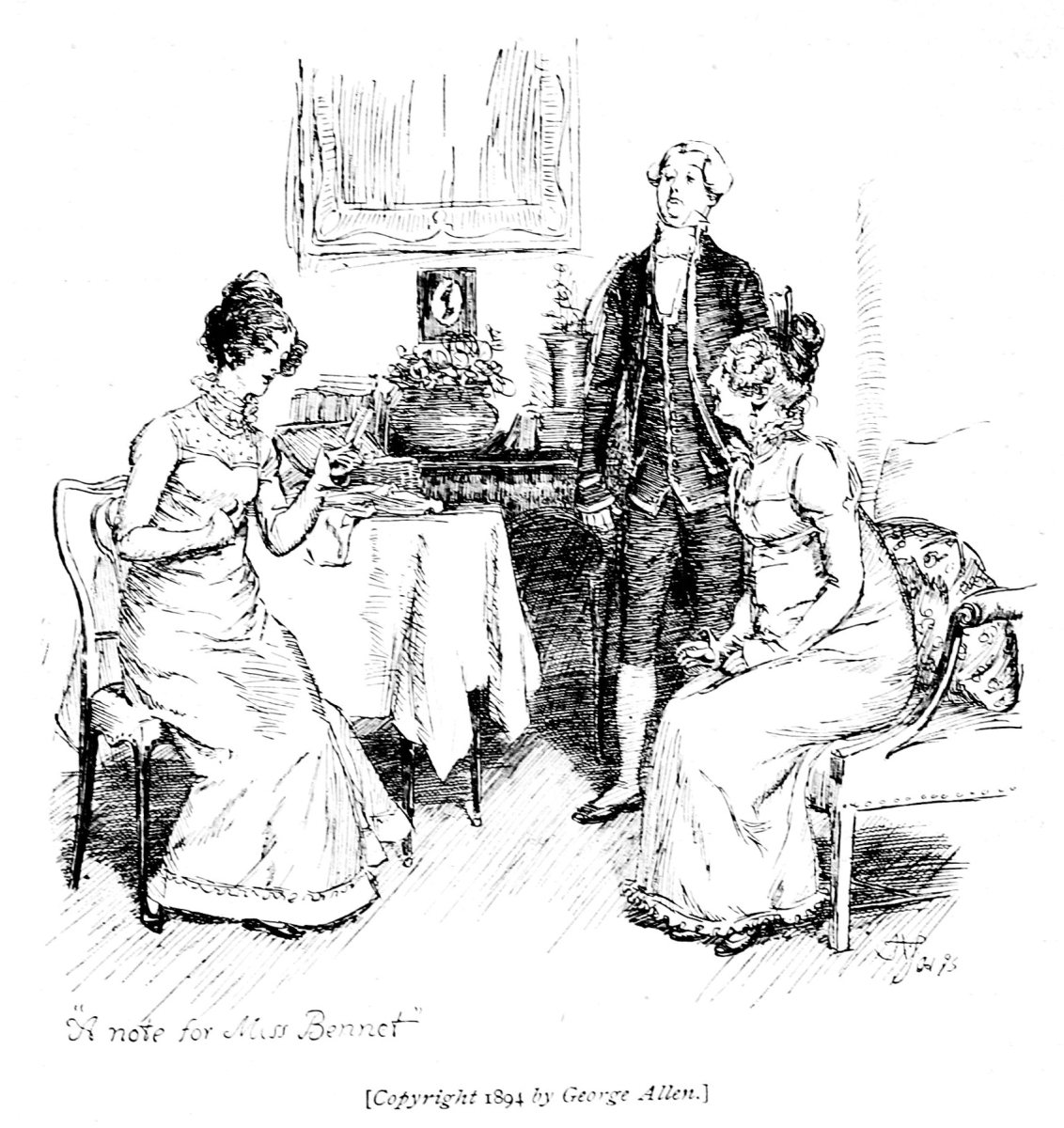
Mrs. Bennet was prevented replying by the entrance of the footman with a note for Miss Bennet; it came from Netherfield, and the servant waited for an answer. Mrs. Bennet’s eyes sparkled with pleasure, and she was eagerly calling out, while her daughter read,—
Mrs. Bennet was stopped from replying when the footman entered with a note for Miss Bennet. The note came from Netherfield, and the servant waited for an answer. Mrs. Bennet’s eyes sparkled with pleasure, and she eagerly called out as her daughter read:
“Well, Jane, who is it from? What is it about? What does he say? Well, Jane, make haste and tell us; make haste, my love.”
“Well, Jane, who is it from? What is it about? What does he say? Well, Jane, hurry up and tell us. Hurry, my love.”
“It is from Miss Bingley,” said Jane, and then read it aloud.
“It’s from Miss Bingley,” Jane said, and then read it aloud.
“My dear friend,
“My dear friend,
“If you are not so compassionate as to dine to-day with Louisa and me, we shall be in danger of hating each other for the rest of our lives; for a whole day’s tête-à-tête between two women can never end without a quarrel. Come as soon as you can on the receipt of this. My brother and the gentlemen are to dine with the officers. Yours ever,
“If you aren't kind enough to dine with Louisa and me today, we risk hating each other forever. After all, a whole day's one-on-one conversation between two women can never end without a quarrel. Come as soon as you can after you receive this letter. My brother and the other gentlemen are dining with the officers. Yours always,
“Caroline Bingley.”
“Caroline Bingley.”
“With the officers!” cried Lydia: “I wonder my aunt did not tell us of that.”
“With the officers!” Lydia exclaimed. “I'm surprised my aunt didn't tell us about that.”
“Dining out,” said Mrs. Bennet; “that is very unlucky.”
“Dining out,” said Mrs. Bennet. “That’s very unfortunate.”
“Can I have the carriage?” said Jane.
“Can I use the carriage?” Jane asked.
“No, my dear, you had better go on horseback, because it seems likely to rain; and then you must stay all night.”
“No, my dear, you should go on horseback because it looks likely to rain. Then you’ll have to stay overnight.”
“That would be a good scheme,” said Elizabeth, “if you were sure that they would not offer to send her home.”
“That would be a good plan,” said Elizabeth, “if you were sure they wouldn’t offer to send her home.”
“Oh, but the gentlemen will have Mr. Bingley’s chaise to go to Meryton; and the Hursts have no horses to theirs.”
“Oh, but the gentlemen will have Mr. Bingley’s carriage to go to Meryton. And the Hursts have no horses for their carriage.”
“I had much rather go in the coach.”
“I’d much rather go in the carriage.”
“But, my dear, your father cannot spare the horses, I am sure. They are wanted in the farm, Mr. Bennet, are not they?”
“But, my dear, I’m sure your father can’t spare the horses. The horses are needed on the farm, aren’t they, Mr. Bennet?”
“They are wanted in the farm much oftener than I can get them.”
“They’re needed on the farm much more often than I can get them.”
“But if you have got them to-day,” said Elizabeth, “my mother’s purpose will be answered.”
“But if you’ve got them today,” said Elizabeth, “my mother will have achieved her goal.”
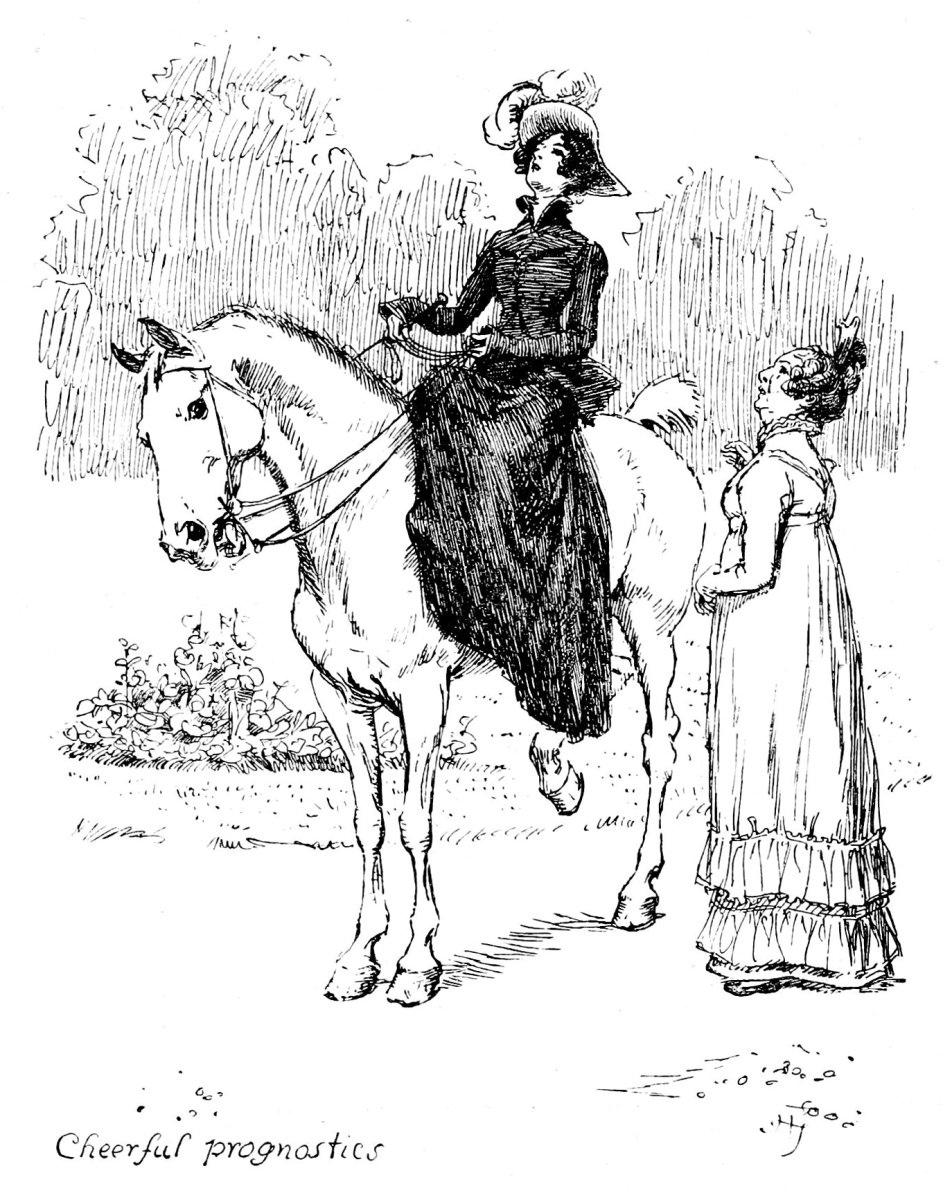
She did at last extort from her father an acknowledgment that the horses were engaged; Jane was therefore obliged to go on horseback, and her mother attended her to the door with many cheerful prognostics of a bad day. Her hopes were answered; Jane had not been gone long before it rained hard. Her sisters were uneasy for her, but her mother was delighted. The rain continued the whole evening without intermission; Jane certainly could not come back.
She finally got her father to admit that the horses were already needed elsewhere. Jane therefore had to go on horseback. Her mother saw her to the door, cheerfully predicting bad weather again and again. Her hopes came true. Jane had not been gone long before heavy rain began to fall. Her sisters were worried about her, but her mother was delighted. The rain continued all evening without stopping. Jane certainly could not come back.
“This was a lucky idea of mine, indeed!” said Mrs. Bennet, more than once, as if the credit of making it rain were all her own. Till the next morning, however, she was not aware of all the felicity of her contrivance. Breakfast was scarcely over when a servant from Netherfield brought the following note for Elizabeth:—
“What a lucky idea I had!” said Mrs. Bennet more than once, as if she deserved all the credit for making it rain. But she did not realize just how well her plan had worked until the next morning. Breakfast was barely over when a servant from Netherfield brought the following note for Elizabeth:
“My dearest Lizzie,
“My dearest Lizzie,
“I find myself very unwell this morning, which, I suppose, is to be imputed to my getting wet through yesterday. My kind friends will not hear of my returning home till I am better. They insist also on my seeing Mr. Jones—therefore do not be alarmed if you should hear of his having been to me—and, excepting a sore throat and a headache, there is not much the matter with me.
“I feel very unwell this morning, probably because I got soaked yesterday. My kind friends refuse to let me return home until I am better. They also insist that I see Mr. Jones. So do not be alarmed if you hear that he has visited me. Apart from a sore throat and a headache, there is not much wrong with me.
“Yours, etc.”
“Yours, etc.”
“Well, my dear,” said Mr. Bennet, when Elizabeth had read the note aloud, “if your daughter should have a dangerous fit of illness—if she should die—it would be a comfort to know that it was all in pursuit of Mr. Bingley, and under your orders.”
“Well, my dear,” said Mr. Bennet after Elizabeth read the note aloud, “if your daughter becomes dangerously ill, if she dies, there would be one comfort. It would all have been in pursuit of Mr. Bingley, and on your orders.”
“Oh, I am not at all afraid of her dying. People do not die of little trifling colds. She will be taken good care of. As long as she stays there, it is all very well. I would go and see her if I could have the carriage.”
“Oh, I’m not at all worried about her dying. People don’t die from minor colds. She’ll be well cared for. As long as she stays there, everything is fine. I would go and see her if I could use the carriage.”
Elizabeth, feeling really anxious, determined to go to her, though the carriage was not to be had: and as she was no horsewoman, walking was her only alternative. She declared her resolution.
Elizabeth, feeling very anxious, decided to go to her, though the carriage was unavailable. Since she could not ride a horse, walking was her only option. She announced her decision.
“How can you be so silly,” cried her mother, “as to think of such a thing, in all this dirt! You will not be fit to be seen when you get there.”
“How can you be so silly,” her mother cried, “to even consider such a thing in all this mud! You won’t look presentable when you get there.”
“I shall be very fit to see Jane—which is all I want.”
“I’ll be perfectly presentable to see Jane. Seeing her is all I want.”
“Is this a hint to me, Lizzy,” said her father, “to send for the horses?”
“Are you hinting, Lizzy,” her father asked, “that I should send for the horses?”
“No, indeed. I do not wish to avoid the walk. The distance is nothing, when one has a motive; only three miles. I shall be back by dinner.”
“No, not at all. I don’t want to avoid the walk. The distance is nothing when you have a reason to go. It’s only three miles. I’ll be back by dinner.”
“I admire the activity of your benevolence,” observed Mary, “but every impulse of feeling should be guided by reason; and, in my opinion, exertion should always be in proportion to what is required.”
“I admire how actively you help others,” Mary remarked, “but reason should guide every emotional impulse. And in my opinion, effort should always be in proportion to what is needed.”
“We will go as far as Meryton with you,” said Catherine and Lydia. Elizabeth accepted their company, and the three young ladies set off together.
“We’ll go with you as far as Meryton,” said Catherine and Lydia. Elizabeth agreed to their company, and the three young women set off together.
“If we make haste,” said Lydia, as they walked along, “perhaps we may see something of Captain Carter, before he goes.”
“If we hurry,” Lydia said as they walked along, “perhaps we might see Captain Carter before he leaves.”
In Meryton they parted: the two youngest repaired to the lodgings of one of the officers’ wives, and Elizabeth continued her walk alone, crossing field after field at a quick pace, jumping over stiles and springing over puddles, with impatient activity, and finding herself at last within view of the house, with weary ancles, dirty stockings, and a face glowing with the warmth of exercise.
They parted in Meryton. The two youngest went to the lodgings of one of the officers’ wives, while Elizabeth continued her walk alone. She hurried impatiently across field after field, jumping over stiles and leaping over puddles. At last the house came into view. Her ankles were tired, her stockings dirty, and her face glowed with the warmth of exercise.
She was shown into the breakfast parlour, where all but Jane were assembled, and where her appearance created a great deal of surprise. That she should have walked three miles so early in the day in such dirty weather, and by herself, was almost incredible to Mrs. Hurst and Miss Bingley; and Elizabeth was convinced that they held her in contempt for it. She was received, however, very politely by them; and in their brother’s manners there was something better than politeness—there was good-humour and kindness. Mr. Darcy said very little, and Mr. Hurst nothing at all. The former was divided between admiration of the brilliancy which exercise had given to her complexion and doubt as to the occasion’s justifying her coming so far alone. The latter was thinking only of his breakfast.
She was shown into the breakfast room, where everyone except Jane had gathered. Her arrival caused great surprise. Mrs. Hurst and Miss Bingley could hardly believe she had walked three miles alone, so early and in such muddy weather. Elizabeth was convinced they looked down on her for it. Still, both women greeted her very politely. Their brother’s manner showed something better than politeness: warmth and kindness. Mr. Darcy said very little, and Mr. Hurst said nothing at all. Mr. Darcy was torn between admiring the glow that exercise had brought to her face and questioning her decision. He doubted whether the circumstances justified her walking so far alone. Mr. Hurst was thinking only of his breakfast.
Her inquiries after her sister were not very favourably answered. Miss Bennet had slept ill, and though up, was very feverish, and not well enough to leave her room. Elizabeth was glad to be taken to her immediately; and Jane, who had only been withheld by the fear of giving alarm or inconvenience, from expressing in her note how much she longed for such a visit, was delighted at her entrance. She was not equal, however, to much conversation; and when Miss Bingley left them together, could attempt little beside expressions of gratitude for the extraordinary kindness she was treated with. Elizabeth silently attended her.
The answers to her questions about her sister were not very encouraging. Miss Bennet had slept badly. Although she was up, she had a high fever and was not well enough to leave her room. Elizabeth was glad to be taken to her immediately, and Jane was delighted to see her. Jane had only held back from saying in her note how much she longed for a visit for one reason. She had feared causing alarm or inconvenience. However, she was too weak for much conversation. When Miss Bingley left them alone, Jane could do little besides express gratitude for the extraordinary kindness shown to her. Elizabeth quietly cared for her.
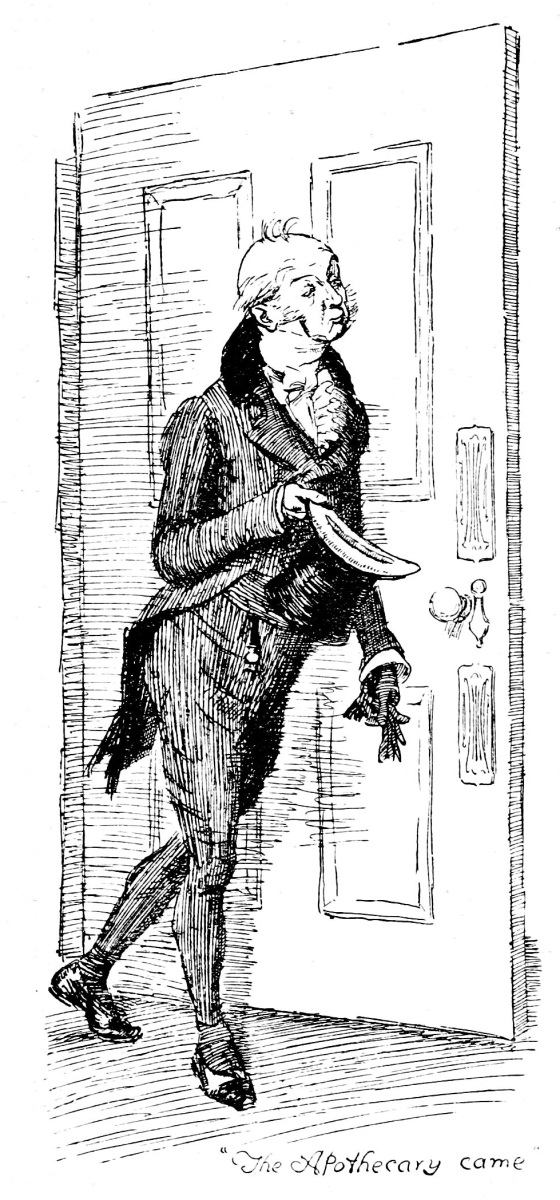
When breakfast was over, they were joined by the sisters; and Elizabeth began to like them herself, when she saw how much affection and solicitude they showed for Jane. The apothecary came; and having examined his patient, said, as might be supposed, that she had caught a violent cold, and that they must endeavour to get the better of it; advised her to return to bed, and promised her some draughts. The advice was followed readily, for the feverish symptoms increased, and her head ached acutely. Elizabeth did not quit her room for a moment, nor were the other ladies often absent; the gentlemen being out, they had in fact nothing to do elsewhere.
After breakfast, the sisters joined them. Elizabeth herself began to like the sisters when she saw how much affection and concern they showed for Jane. The apothecary came and examined Jane. As might be expected, he said she had caught a severe cold and that they must try to overcome it. He advised Jane to go back to bed and promised her some medicine. Jane readily followed his advice, for her fever was getting worse and her head ached badly. Elizabeth did not leave Jane’s room for a moment, and the other ladies were rarely absent. With the gentlemen out, the ladies in fact had nothing to do elsewhere.
When the clock struck three, Elizabeth felt that she must go, and very unwillingly said so. Miss Bingley offered her the carriage, and she only wanted a little pressing to accept it, when Jane testified such concern at parting with her that Miss Bingley was obliged to convert the offer of the chaise into an invitation to remain at Netherfield for the present. Elizabeth most thankfully consented, and a servant was despatched to Longbourn, to acquaint the family with her stay, and bring back a supply of clothes.
When the clock struck three, Elizabeth felt she had to leave and said so very reluctantly. Miss Bingley offered her the carriage, and Elizabeth needed only a little encouragement to accept. But Jane was so upset at the thought of Elizabeth leaving that Miss Bingley had to change her offer. Instead, she invited Elizabeth to stay at Netherfield for the time being. Elizabeth accepted very gratefully. A servant was sent to Longbourn to tell the family she was staying and bring back some clothes.