Chapter 6
THE ladies of Longbourn soon waited on those of Netherfield. The visit was returned in due form. Miss Bennet’s pleasing manners grew on the good-will of Mrs. Hurst and Miss Bingley; and though the mother was found to be intolerable, and the younger sisters not worth speaking to, a wish of being better acquainted with them was expressed towards the two eldest. By Jane this attention was received with the greatest pleasure; but Elizabeth still saw superciliousness in their treatment of everybody, hardly excepting even her sister, and could not like them; though their kindness to Jane, such as it was, had a value, as arising, in all probability, from the influence of their brother’s admiration. It was generally evident, whenever they met, that he did admire her; and to her it was equally evident that Jane was yielding to the preference which she had begun to entertain for him from the first, and was in a way to be very much in love; but she considered with pleasure that it was not likely to be discovered by the world in general, since Jane united with great strength of feeling, a composure of temper and an uniform cheerfulness of manner, which would guard her from the suspicions of the impertinent. She mentioned this to her friend, Miss Lucas.
The ladies of Longbourn soon visited the ladies of Netherfield, who duly returned the visit. Miss Bennet’s pleasant manners steadily won over Mrs. Hurst and Miss Bingley. They found her mother intolerable and her younger sisters not worth speaking to. Still, they expressed a wish to know them, the two eldest sisters, better. Jane received this attention with the greatest pleasure. But Elizabeth still found their treatment of everyone condescending, with hardly even her sister excepted, and could not like them. Still, their kindness to Jane, such as it was, had some value. In all probability, their brother’s admiration for Jane had prompted that kindness. Whenever they met, everyone could generally see that he did admire Jane. And to her, Elizabeth, it was equally clear that Jane’s feelings for him were growing. Jane had preferred him from the beginning and was on her way to being very much in love. But Elizabeth was pleased to think that people in general were unlikely to notice. Jane combined strong feelings with a calm temperament and a consistently cheerful manner. Those qualities would keep prying people from suspecting her feelings. Elizabeth mentioned this to her friend, Miss Lucas.
“It may, perhaps, be pleasant,” replied Charlotte, “to be able to impose on the public in such a case; but it is sometimes a disadvantage to be so very guarded. If a woman conceals her affection with the same skill from the object of it, she may lose the opportunity of fixing him; and it will then be but poor consolation to believe the world equally in the dark. There is so much of gratitude or vanity in almost every attachment, that it is not safe to leave any to itself. We can all begin freely—a slight preference is natural enough; but there are very few of us who have heart enough to be really in love without encouragement. In nine cases out of ten, a woman had better show more affection than she feels. Bingley likes your sister undoubtedly; but he may never do more than like her, if she does not help him on.”
“Perhaps it can be pleasant,” Charlotte replied, “to keep everyone else in the dark in such a case. But being so guarded can sometimes be a disadvantage. If a woman hides her affection just as well from the man she likes, she may lose her chance of winning him. And knowing everyone else is equally in the dark will then be little comfort. Gratitude or vanity plays such a large part in almost every attachment that leaving any attachment to itself is risky. We can all begin freely. A slight preference is natural enough. But very few of us have the courage to be truly in love without encouragement. In nine cases out of ten, a woman would do better to show more affection than she feels. Bingley undoubtedly likes your sister. But he may never do more than like her if she does not encourage him.”
“But she does help him on, as much as her nature will allow. If I can perceive her regard for him, he must be a simpleton indeed not to discover it too.”
“But she does encourage him, as much as her personality allows. If I can see her affection for him, he must be a real fool not to notice it too.”
“Remember, Eliza, that he does not know Jane’s disposition as you do.”
“Remember, Eliza, he doesn’t know Jane’s personality as well as you do.”
“But if a woman is partial to a man, and does not endeavor to conceal it, he must find it out.”
“But if a woman likes a man and doesn't try to hide her feelings, he's bound to notice.”
“Perhaps he must, if he sees enough of her. But though Bingley and Jane meet tolerably often, it is never for many hours together; and as they always see each other in large mixed parties, it is impossible that every moment should be employed in conversing together. Jane should therefore make the most of every half hour in which she can command his attention. When she is secure of him, there will be leisure for falling in love as much as she chooses.”
“Perhaps he must, if he sees enough of her. But although Bingley and Jane meet fairly often, they never spend many hours together. And since they always meet in large groups, they cannot spend every moment talking to each other. Jane should therefore make the most of every half hour when she can hold his attention. Once she is sure of him, she will have plenty of time to fall as deeply in love as she likes.”
“Your plan is a good one,” replied Elizabeth, “where nothing is in question but the desire of being well married; and if I were determined to get a rich husband, or any husband, I dare say I should adopt it. But these are not Jane’s feelings; she is not acting by design. As yet she cannot even be certain of the degree of her own regard, nor of its reasonableness. She has known him only a fortnight. She danced four dances with him at Meryton; she saw him one morning at his own house, and has since dined in company with him four times. This is not quite enough to make her understand his character.”
“Your plan is a good one,” replied Elizabeth, “if the only goal is to marry well. And if I were determined to find a rich husband, or any husband, I dare say I would follow it. But Jane does not feel that way. She is not following a plan. She cannot yet be sure how much she likes him, or whether her feelings are reasonable. She has known him for only two weeks. She danced four dances with him at Meryton. She saw him one morning at his own house, and has since dined with him in company four times. That is not quite enough for her to understand his character.”
“Not as you represent it. Had she merely dined with him, she might only have discovered whether he had a good appetite; but you must remember that four evenings have been also spent together—and four evenings may do a great deal.”
“Not the way you describe it. If she had only dined with him, she might only have learned whether he had a good appetite. But remember, they have also spent four evenings together. And four evenings may make a big difference.”
“Yes: these four evenings have enabled them to ascertain that they both like Vingt-un better than Commerce, but with respect to any other leading characteristic, I do not imagine that much has been unfolded.”
“Yes, these four evenings have let them discover that they both prefer Vingt-un to Commerce. But I don’t imagine they’ve learned much about any other major character trait.”
“Well,” said Charlotte, “I wish Jane success with all my heart; and if she were married to him to-morrow, I should think she had as good a chance of happiness as if she were to be studying his character for a twelvemonth. Happiness in marriage is entirely a matter of chance. If the dispositions of the parties are ever so well known to each other, or ever so similar beforehand, it does not advance their felicity in the least. They always continue to grow sufficiently unlike afterwards to have their share of vexation; and it is better to know as little as possible of the defects of the person with whom you are to pass your life.”
“Well,” said Charlotte, “I wish Jane success with all my heart. If she married him tomorrow, I would think her chances of happiness were just as good. Studying his character for a whole year would give her no better chance. Happiness in marriage is entirely a matter of chance. No matter how well two people know each other’s personalities beforehand, or how similar they are, neither makes them happier. They always grow different enough afterward to have their share of frustrations. And it is better to know as little as possible about the faults of the person you will live with.”
“You make me laugh, Charlotte; but it is not sound. You know it is not sound, and that you would never act in this way yourself.”
“You make me laugh, Charlotte. But your reasoning is flawed. You know your reasoning is flawed, and you would never act this way yourself.”
Occupied in observing Mr. Bingley’s attention to her sister, Elizabeth was far from suspecting that she was herself becoming an object of some interest in the eyes of his friend. Mr. Darcy had at first scarcely allowed her to be pretty: he had looked at her without admiration at the ball; and when they next met, he looked at her only to criticise. But no sooner had he made it clear to himself and his friends that she had hardly a good feature in her face, than he began to find it was rendered uncommonly intelligent by the beautiful expression of her dark eyes. To this discovery succeeded some others equally mortifying. Though he had detected with a critical eye more than one failure of perfect symmetry in her form, he was forced to acknowledge her figure to be light and pleasing; and in spite of his asserting that her manners were not those of the fashionable world, he was caught by their easy playfulness. Of this she was perfectly unaware: to her he was only the man who made himself agreeable nowhere, and who had not thought her handsome enough to dance with.
Busy watching Mr. Bingley’s attention to her sister, Elizabeth had no suspicion that his friend was becoming interested in her. At first, Mr. Darcy had scarcely admitted that she was pretty. He had looked at her without admiration at the ball. When they next met, he looked at her only to find fault. But he had barely convinced himself and his friends that she had hardly a single attractive feature before discovering something else. The beautiful expression of her dark eyes gave her face an unusually intelligent look. Other discoveries followed, equally embarrassing to him. Though his critical eye had found several imperfections in her proportions, he had to admit her figure was graceful and pleasing. And despite his claim that her manners lacked fashionable polish, he was charmed by her relaxed playfulness. Elizabeth knew nothing of his interest. To her, he was simply a man who was pleasant nowhere and had not thought her pretty enough to dance with.
He began to wish to know more of her; and, as a step towards conversing with her himself, attended to her conversation with others. His doing so drew her notice. It was at Sir William Lucas’s, where a large party were assembled.
He began to want to know more about her. As a first step toward speaking with her himself, he listened to her conversations with others. She noticed him listening. This happened at Sir William Lucas’s house, where a large group had gathered.
“What does Mr. Darcy mean,” said she to Charlotte, “by listening to my conversation with Colonel Forster?”
“Why is Mr. Darcy,” she asked Charlotte, “listening to my conversation with Colonel Forster?”
“That is a question which Mr. Darcy only can answer.”
“Only Mr. Darcy can answer that question.”
“But if he does it any more, I shall certainly let him know that I see what he is about. He has a very satirical eye, and if I do not begin by being impertinent myself, I shall soon grow afraid of him.”
“But if he does it again, I’ll certainly let him know I see what he’s up to. He has a very mocking way of looking at people. And if I don’t start by being cheeky myself, I’ll soon become afraid of him.”
On his approaching them soon afterwards, though without seeming to have any intention of speaking, Miss Lucas defied her friend to mention such a subject to him, which immediately provoking Elizabeth to do it, she turned to him and said,—
When he approached them soon afterward, though he seemed to have no intention of speaking, Miss Lucas challenged her friend. She dared Elizabeth to bring up such a subject with him. This immediately spurred Elizabeth to do just that, so she turned to him and said:
“Did not you think, Mr. Darcy, that I expressed myself uncommonly well just now, when I was teasing Colonel Forster to give us a ball at Meryton?”
“Didn't you think I spoke unusually well just now, Mr. Darcy? I mean when I was teasing Colonel Forster to throw a ball at Meryton.”
“With great energy; but it is a subject which always makes a lady energetic.”
“With great enthusiasm. But it’s a topic that always makes a lady enthusiastic.”
“You are severe on us.”
“You’re hard on us.”
“It will be her turn soon to be teased,” said Miss Lucas. “I am going to open the instrument, Eliza, and you know what follows.”
“Soon it’ll be her turn to be teased,” said Miss Lucas. “I’m going to open the piano, Eliza, and you know what comes next.”
“You are a very strange creature by way of a friend!—always wanting me to play and sing before anybody and everybody! If my vanity had taken a musical turn, you would have been invaluable; but as it is, I would really rather not sit down before those who must be in the habit of hearing the very best performers.” On Miss Lucas’s persevering, however, she added, “Very well; if it must be so, it must.” And gravely glancing at Mr. Darcy, “There is a very fine old saying, which everybody here is of course familiar with—‘Keep your breath to cool your porridge,’—and I shall keep mine to swell my song.”
“You are a very strange sort of friend! You always want me to play and sing in front of anyone and everyone! If I had been vain about my music, you would have been invaluable. But as it is, I’d really rather not play for people who must regularly hear the very best performers.” However, when Miss Lucas kept insisting, she added, “Very well. If I must, I must.” Then, glancing solemnly at Mr. Darcy, she said, “There is a very good old saying that everyone here is, of course, familiar with. ‘Save your breath to cool your porridge,’ and I shall save mine to give my song more power.”
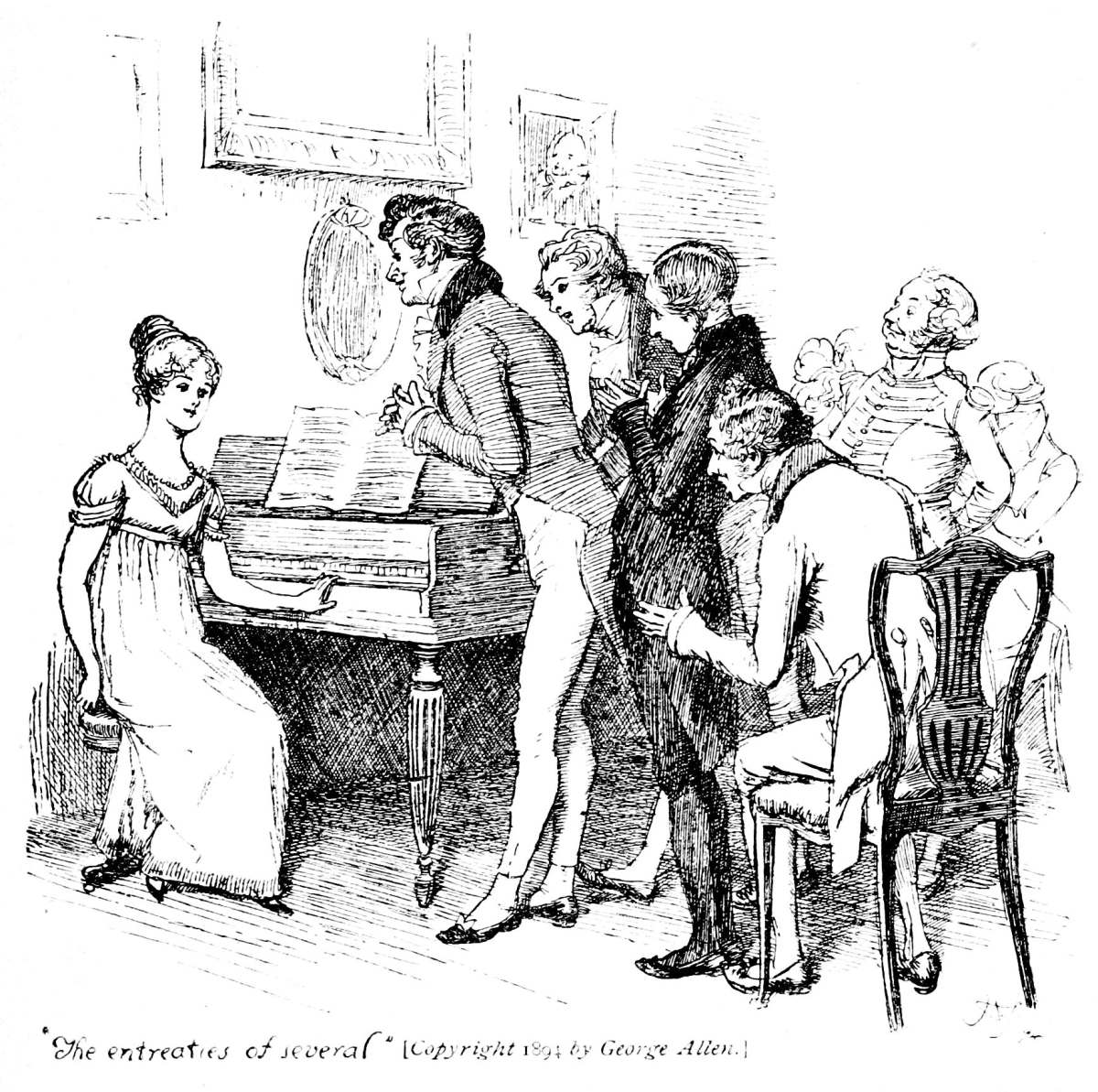
Her performance was pleasing, though by no means capital. After a song or two, and before she could reply to the entreaties of several that she would sing again, she was eagerly succeeded at the instrument by her sister Mary, who having, in consequence of being the only plain one in the family, worked hard for knowledge and accomplishments, was always impatient for display.
Her performance was pleasant, though far from excellent. After a song or two, several people urged her to sing again. Before she could reply, her sister Mary eagerly took her place at the instrument. As the only plain-looking one in the family, Mary had worked hard to gain knowledge and develop her talents. She was always impatient to show them off.
Mary had neither genius nor taste; and though vanity had given her application, it had given her likewise a pedantic air and conceited manner, which would have injured a higher degree of excellence than she had reached. Elizabeth, easy and unaffected, had been listened to with much more pleasure, though not playing half so well; and Mary, at the end of a long concerto, was glad to purchase praise and gratitude by Scotch and Irish airs, at the request of her younger sisters, who with some of the Lucases, and two or three officers, joined eagerly in dancing at one end of the room.
Mary had neither exceptional talent nor taste. Although vanity had made her work hard, it had also made her manner showy, overly scholarly, and conceited. That manner would have spoiled even greater skill than she possessed. Elizabeth was relaxed and natural, and people had enjoyed listening to her much more, though she played less than half as well. After a long concerto, Mary was glad to win praise and gratitude by playing Scotch and Irish tunes. Her younger sisters had requested them. Together with some of the Lucases and two or three officers, her sisters eagerly began dancing at one end of the room.
Mr. Darcy stood near them in silent indignation at such a mode of passing the evening, to the exclusion of all conversation, and was too much engrossed by his own thoughts to perceive that Sir William Lucas was his neighbour, till Sir William thus began:—
Mr. Darcy stood near them, silently indignant at spending the evening this way, with no conversation at all. He was so lost in his thoughts that he did not notice Sir William Lucas standing beside him. He only noticed when Sir William began to speak:
“What a charming amusement for young people this is, Mr. Darcy! There is nothing like dancing, after all. I consider it as one of the first refinements of polished societies.”
“What a delightful activity dancing is for young people, Mr. Darcy! There is nothing like dancing, after all. I think it is one of the finest accomplishments of a cultured society.”
“Certainly, sir; and it has the advantage also of being in vogue amongst the less polished societies of the world: every savage can dance.”
“Certainly, sir. And dancing also has the advantage of being popular in the less refined societies of the world. Every savage can dance.”
Sir William only smiled. “Your friend performs delightfully,” he continued, after a pause, on seeing Bingley join the group; “and I doubt not that you are an adept in the science yourself, Mr. Darcy.”
Sir William only smiled. After a pause, he saw Bingley join the group and continued, “Your friend dances beautifully. And I have no doubt that you’re a skilled dancer yourself, Mr. Darcy.”
“You saw me dance at Meryton, I believe, sir.”
“You saw me dance at Meryton, I think, sir.”
“Yes, indeed, and received no inconsiderable pleasure from the sight. Do you often dance at St. James’s?”
“Yes, indeed, and I enjoyed the sight a great deal. Do you often dance at St. James’s?”
“Never, sir.”
“Never, sir.”
“Do you not think it would be a proper compliment to the place?”
“Don’t you think it would be a fitting tribute to the place?”
“It is a compliment which I never pay to any place if I can avoid it.”
“It’s a compliment I never give any place if I can avoid it.”
“You have a house in town, I conclude?”
“You have a house in town, I assume?”
Mr. Darcy bowed.
Mr. Darcy bowed.
“I had once some thoughts of fixing in town myself, for I am fond of superior society; but I did not feel quite certain that the air of London would agree with Lady Lucas.”
“I once considered settling in London myself, because I enjoy high society. But I wasn’t quite sure London’s air would suit Lady Lucas.”
He paused in hopes of an answer: but his companion was not disposed to make any; and Elizabeth at that instant moving towards them, he was struck with the notion of doing a very gallant thing, and called out to her,—
He paused, hoping for an answer, but his companion had no wish to reply. Just then, Elizabeth moved towards them. He suddenly thought of doing something very gallant and called out to her:
“My dear Miss Eliza, why are not you dancing? Mr. Darcy, you must allow me to present this young lady to you as a very desirable partner. You cannot refuse to dance, I am sure, when so much beauty is before you.” And, taking her hand, he would have given it to Mr. Darcy, who, though extremely surprised, was not unwilling to receive it, when she instantly drew back, and said with some discomposure to Sir William,—
“My dear Miss Eliza, why aren’t you dancing? Mr. Darcy, you must let me introduce this young lady as a very desirable dance partner. I’m sure you cannot refuse to dance when so much beauty stands before you.” He took her hand and was about to offer it to Mr. Darcy. Though extremely surprised, Mr. Darcy was not unwilling to take her hand. But she immediately pulled back and, somewhat flustered, said to Sir William:
“Indeed, sir, I have not the least intention of dancing. I entreat you not to suppose that I moved this way in order to beg for a partner.”
“Really, sir, I have no intention at all of dancing. Please don’t think I came this way to beg for a dance partner.”
Mr. Darcy, with grave propriety, requested to be allowed the honour of her hand, but in vain. Elizabeth was determined; nor did Sir William at all shake her purpose by his attempt at persuasion.
Mr. Darcy, serious and polite, asked for the honor of dancing with her, but she refused. Elizabeth was determined, and Sir William’s attempts to persuade her did not shake her resolve at all.
“You excel so much in the dance, Miss Eliza, that it is cruel to deny me the happiness of seeing you; and though this gentleman dislikes the amusement in general, he can have no objection, I am sure, to oblige us for one half hour.”
“You dance so well, Miss Eliza, that it is cruel to deny me the pleasure of watching you. And although this gentleman generally dislikes dancing, I’m sure he can have no objection to joining us for half an hour.”
“Mr. Darcy is all politeness,” said Elizabeth, smiling.
“Mr. Darcy is perfectly polite,” said Elizabeth, smiling.
“He is, indeed: but considering the inducement, my dear Miss Eliza, we cannot wonder at his complaisance; for who would object to such a partner?”
“He certainly is. But given the incentive, my dear Miss Eliza, we can't be surprised by his willingness to please. After all, who would object to such a partner?”
Elizabeth looked archly, and turned away. Her resistance had not injured her with the gentleman, and he was thinking of her with some complacency, when thus accosted by Miss Bingley,—
Elizabeth gave him a playful look and turned away. Her resistance had not lowered her in the gentleman’s opinion. He was thinking of her with some satisfaction when Miss Bingley addressed him:
“I can guess the subject of your reverie.”
“I can guess what you’re daydreaming about.”
“I should imagine not.”
“I wouldn’t think so.”
“You are considering how insupportable it would be to pass many evenings in this manner,—in such society; and, indeed, I am quite of your opinion. I was never more annoyed! The insipidity, and yet the noise—the nothingness, and yet the self-importance, of all these people! What would I give to hear your strictures on them!”
“You’re thinking how unbearable it would be to spend many evenings like this, with people like these. And I completely agree with you. I have never been more annoyed! All these people are so dull, yet so noisy, so insignificant, yet so full of themselves! What I wouldn’t give to hear your criticisms of them!”
“Your conjecture is totally wrong, I assure you. My mind was more agreeably engaged. I have been meditating on the very great pleasure which a pair of fine eyes in the face of a pretty woman can bestow.”
“Your guess is completely wrong, I assure you. My thoughts were on something more pleasant. I was thinking about the great pleasure a pretty woman’s beautiful eyes can give.”
Miss Bingley immediately fixed her eyes on his face, and desired he would tell her what lady had the credit of inspiring such reflections. Mr. Darcy replied, with great intrepidity,—
Miss Bingley immediately looked straight at his face and asked which lady deserved the credit for inspiring such thoughts. Mr. Darcy replied very boldly:
“Miss Elizabeth Bennet.”
“Miss Elizabeth Bennet.”
“Miss Elizabeth Bennet!” repeated Miss Bingley. “I am all astonishment. How long has she been such a favourite? and pray when am I to wish you joy?”
“Miss Elizabeth Bennet!” repeated Miss Bingley. “I’m completely astonished. How long has she been such a favorite? And when, may I ask, should I congratulate you?”
“That is exactly the question which I expected you to ask. A lady’s imagination is very rapid; it jumps from admiration to love, from love to matrimony, in a moment. I knew you would be wishing me joy.”
“That is exactly the question I expected you to ask. A lady’s imagination moves very quickly. In a moment, it jumps from admiration to love, then from love to marriage. I knew you would want to congratulate me.”
“Nay, if you are so serious about it, I shall consider the matter as absolutely settled. You will have a charming mother-in-law, indeed, and of course she will be always at Pemberley with you.”
“Well, if you’re so serious about it, I’ll consider the matter completely settled. You’ll have a truly charming mother-in-law. And of course she’ll always be at Pemberley with you.”
He listened to her with perfect indifference, while she chose to entertain herself in this manner; and as his composure convinced her that all was safe, her wit flowed along.
He listened with complete indifference while she amused herself this way. His calm convinced her that all was well, so her witty remarks kept flowing.