Chapter 57
THE discomposure of spirits which this extraordinary visit threw Elizabeth into could not be easily overcome; nor could she for many hours learn to think of it less than incessantly. Lady Catherine, it appeared, had actually taken the trouble of this journey from Rosings for the sole purpose of breaking off her supposed engagement with Mr. Darcy. It was a rational scheme, to be sure! but from what the report of their engagement could originate, Elizabeth was at a loss to imagine; till she recollected that his being the intimate friend of Bingley, and her being the sister of Jane, was enough, at a time when the expectation of one wedding made everybody eager for another, to supply the idea. She had not herself forgotten to feel that the marriage of her sister must bring them more frequently together. And her neighbours at Lucas Lodge, therefore, (for through their communication with the Collinses, the report, she concluded, had reached Lady Catherine,) had only set that down as almost certain and immediate which she had looked forward to as possible at some future time.
Elizabeth could not easily recover from the distress caused by this extraordinary visit. For many hours, she could think of little else. Lady Catherine, it seemed, had actually come all the way from Rosings solely to end Elizabeth’s supposed engagement to Mr. Darcy. What a sensible plan, to be sure! But Elizabeth could not imagine how the rumour of their engagement had started. Then she remembered that his close friendship with Bingley and her being Jane’s sister were enough to suggest the idea. With one wedding expected, everyone was eager for another. She herself had not forgotten that her sister’s marriage must bring her and Mr. Darcy together more often. So her neighbours at Lucas Lodge had simply treated that possibility as almost certain and about to happen. (She concluded that the rumour had reached Lady Catherine through their contact with the Collinses.) Yet she had only imagined it as something that might happen at some future time.
In revolving Lady Catherine’s expressions, however, she could not help feeling some uneasiness as to the possible consequence of her persisting in this interference. From what she had said of her resolution to prevent the marriage, it occurred to Elizabeth that she must meditate an application to her nephew; and how he might take a similar representation of the evils attached to a connection with her she dared not pronounce. She knew not the exact degree of his affection for his aunt, or his dependence on her judgment, but it was natural to suppose that he thought much higher of her Ladyship than she could do; and it was certain, that in enumerating the miseries of a marriage with one whose immediate connections were so unequal to his own, his aunt would address him on his weakest side. With his notions of dignity, he would probably feel that the arguments, which to Elizabeth had appeared weak and ridiculous, contained much good sense and solid reasoning.
Still, as Elizabeth thought over Lady Catherine’s words, she felt some uneasiness about the possible consequences of her continued interference. Lady Catherine had spoken of her determination to prevent the marriage. Elizabeth therefore suspected she meant to appeal to her nephew. She dared not predict his response to a similar account of the disadvantages of marrying her. She did not know exactly how fond he was of his aunt or how much he trusted her judgment. But naturally, he probably thought far more highly of her Ladyship than she could. And his aunt would certainly target his greatest weakness by listing the miseries of marrying someone whose close relatives were so far below his own in social standing. With his ideas about dignity, he would probably see much good sense and sound reasoning in those arguments. To Elizabeth, the same arguments had seemed weak and ridiculous.
If he had been wavering before, as to what he should do, which had often seemed likely, the advice and entreaty of so near a relation might settle every doubt, and determine him at once to be as happy as dignity unblemished could make him. In that case he would return no more. Lady Catherine might see him in her way through town; and his engagement to Bingley of coming again to Netherfield must give way.
If he had been unsure what to do before, as had often seemed likely, a close relative’s advice and pleading might settle every doubt. He might decide at once to be as happy as his untarnished dignity allowed. In that case, he would never return. Lady Catherine might see him on her way through town. And his promise to Bingley to visit Netherfield again would have to give way.
“If, therefore, an excuse for not keeping his promise should come to his friend within a few days,” she added, “I shall know how to understand it. I shall then give over every expectation, every wish of his constancy. If he is satisfied with only regretting me, when he might have obtained my affections and hand, I shall soon cease to regret him at all.”
“So, if his friend receives an excuse for his not keeping his promise within a few days,” she added, “I’ll know what that means. I’ll give up every expectation and every wish that he will remain faithful. If he is content just to regret losing me when he could have won my love and married me, I’ll soon stop regretting him at all.”
The surprise of the rest of the family, on hearing who their visitor had been, was very great: but they obligingly satisfied it with the same kind of supposition which had appeased Mrs. Bennet’s curiosity; and Elizabeth was spared from much teasing on the subject.
The rest of the family were very surprised to hear who their visitor had been. But they kindly settled for the same sort of explanation that had satisfied Mrs. Bennet’s curiosity. Elizabeth was therefore spared much teasing about the visit.
The next morning, as she was going down stairs, she was met by her father, who came out of his library with a letter in his hand.
The next morning, as she was going downstairs, she met her father. He came out of his library with a letter in his hand.
“Lizzy,” said he, “I was going to look for you: come into my room.”
“Lizzy,” he said, “I was going to look for you. Come into my room.”
She followed him thither; and her curiosity to know what he had to tell her was heightened by the supposition of its being in some manner connected with the letter he held. It suddenly struck her that it might be from Lady Catherine, and she anticipated with dismay all the consequent explanations.
She followed him there, curious to know what he had to tell her. Her curiosity grew because she thought his news might somehow be connected to the letter he held. She suddenly thought the letter might be from Lady Catherine. She dreaded all the explanations that would follow.
She followed her father to the fireplace, and they both sat down. He then said,—
She followed her father to the fireplace, and they both sat down. Then her father said:
“I have received a letter this morning that has astonished me exceedingly. As it principally concerns yourself, you ought to know its contents. I did not know before that I had two daughters on the brink of matrimony. Let me congratulate you on a very important conquest.”
“I received a letter this morning that surprised me greatly. Since the letter is mainly about you, you should know what it says. I hadn’t realized I had two daughters about to get married. Let me congratulate you on winning over someone so important.”
The colour now rushed into Elizabeth’s cheeks in the instantaneous conviction of its being a letter from the nephew, instead of the aunt; and she was undetermined whether most to be pleased that he explained himself at all, or offended that his letter was not rather addressed to herself, when her father continued,—
Elizabeth blushed, suddenly certain that the letter was from the nephew, not the aunt. She could not decide whether she was more pleased that he had explained himself at all, or offended that he had not written directly to her. As she weighed these feelings, her father continued:
“You look conscious. Young ladies have great penetration in such matters as these; but I think I may defy even your sagacity to discover the name of your admirer. This letter is from Mr. Collins.”
“You look self-conscious. Young ladies are very perceptive about matters like these. But I think even your sharp mind will fail to guess your admirer's name. This letter is from Mr. Collins.”
“From Mr. Collins! and what can he have to say?”
“From Mr. Collins! And what could he have to say?”
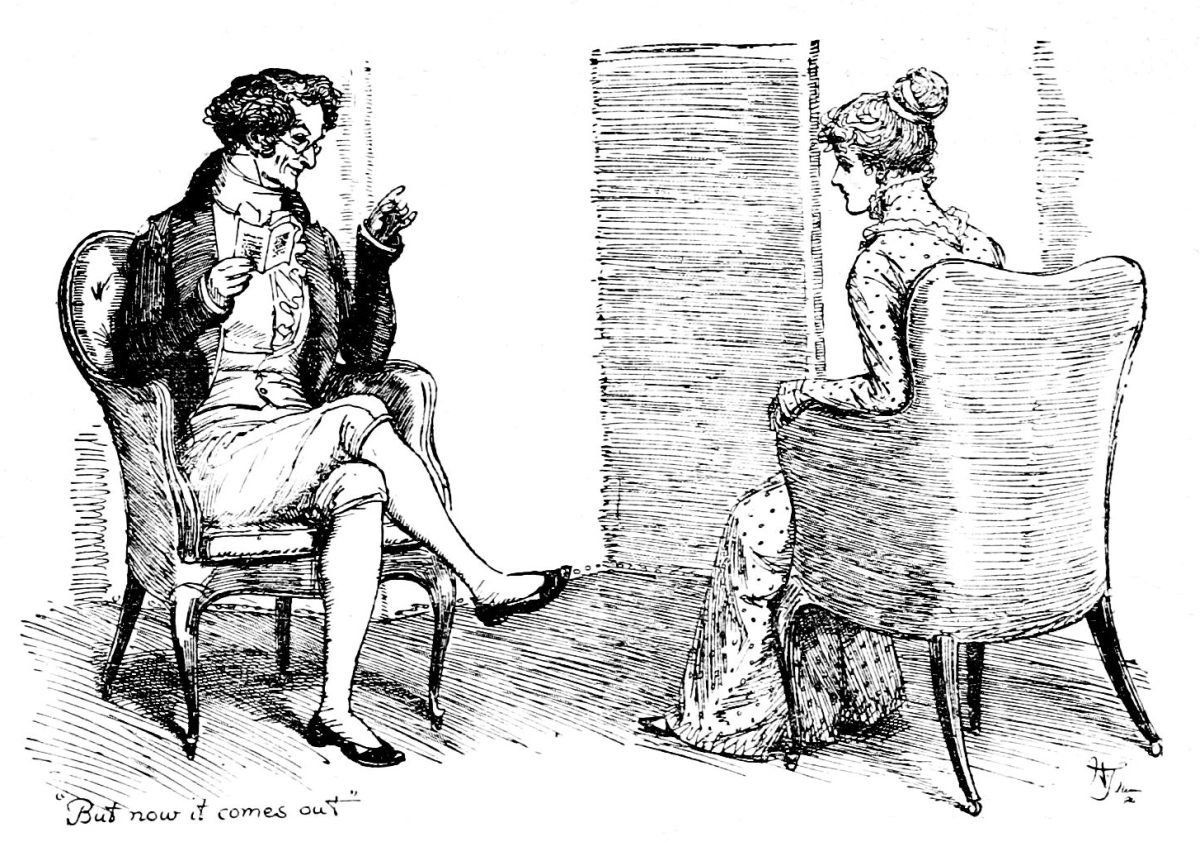
“Something very much to the purpose, of course. He begins with congratulations on the approaching nuptials of my eldest daughter, of which, it seems, he has been told by some of the good-natured, gossiping Lucases. I shall not sport with your impatience by reading what he says on that point. What relates to yourself is as follows:—‘Having thus offered you the sincere congratulations of Mrs. Collins and myself on this happy event, let me now add a short hint on the subject of another, of which we have been advertised by the same authority. Your daughter Elizabeth, it is presumed, will not long bear the name of Bennet, after her eldest sister has resigned it; and the chosen partner of her fate may be reasonably looked up to as one of the most illustrious personages in this land.’ Can you possibly guess, Lizzy, who is meant by this? ‘This young gentleman is blessed, in a peculiar way, with everything the heart of mortal can most desire,—splendid property, noble kindred, and extensive patronage. Yet, in spite of all these temptations, let me warn my cousin Elizabeth, and yourself, of what evils you may incur by a precipitate closure with this gentleman’s proposals, which, of course, you will be inclined to take immediate advantage of.’ Have you any idea, Lizzy, who this gentleman is? But now it comes out. ‘My motive for cautioning you is as follows:—We have reason to imagine that his aunt, Lady Catherine de Bourgh, does not look on the match with a friendly eye.’ Mr. Darcy, you see, is the man! Now, Lizzy, I think I have surprised you. Could he, or the Lucases, have pitched on any man, within the circle of our acquaintance, whose name would have given the lie more effectually to what they related? Mr. Darcy, who never looks at any woman but to see a blemish, and who probably never looked at you in his life! It is admirable!”
“Something very relevant, of course. He begins by congratulating me on my eldest daughter’s approaching marriage. Apparently, some of the kind-hearted, gossiping Lucases have told him about it. I won’t tease you by making you wait while I read what he says about that. Here is the part about you: ‘Having offered you sincere congratulations from Mrs. Collins and myself on this happy event, let me add a brief warning. It concerns another event we have heard about from the same source. Your daughter Elizabeth, we understand, will not keep the name of Bennet long after her eldest sister gives it up. And her chosen husband may reasonably be considered one of the most distinguished men in the country.’ Can you possibly guess, Lizzy, who he means? ‘This young gentleman is especially blessed with everything anyone could most desire: magnificent property, noble relatives, and powerful connections. Yet, despite all these attractions, let me warn my cousin Elizabeth and you. You may bring trouble on yourselves by accepting this gentleman’s proposal too quickly. Of course, you will be inclined to accept it immediately.’ Have you any idea, Lizzy, who this gentleman is? But now he tells us. ‘My reason for warning you is this: We have reason to believe his aunt, Lady Catherine de Bourgh, disapproves of the match.’ Mr. Darcy, you see, is the man! Now, Lizzy, I think I have surprised you. Could he or the Lucases have chosen anyone we know whose name would more clearly prove their story false? Mr. Darcy, who never looks at a woman except to find a fault. And who has probably never looked at you in his life! How wonderful!”
Elizabeth tried to join in her father’s pleasantry, but could only force one most reluctant smile. Never had his wit been directed in a manner so little agreeable to her.
Elizabeth tried to join in her father’s joking, but could only force a single, very reluctant smile. His wit had never been aimed in a way she found so unpleasant.
“Are you not diverted?”
“Aren’t you amused?”
“Oh, yes. Pray read on.”
“Oh, yes. Please keep reading.”
“‘After mentioning the likelihood of this marriage to her Ladyship last night, she immediately, with her usual condescension, expressed what she felt on the occasion; when it became apparent, that, on the score of some family objections on the part of my cousin, she would never give her consent to what she termed so disgraceful a match. I thought it my duty to give the speediest intelligence of this to my cousin, that she and her noble admirer may be aware of what they are about, and not run hastily into a marriage which has not been properly sanctioned.’ Mr. Collins, moreover, adds, ‘I am truly rejoiced that my cousin Lydia’s sad business has been so well hushed up, and am only concerned that their living together before the marriage took place should be so generally known. I must not, however, neglect the duties of my station, or refrain from declaring my amazement, at hearing that you received the young couple into your house as soon as they were married. It was an encouragement of vice; and had I been the rector of Longbourn, I should very strenuously have opposed it. You ought certainly to forgive them as a Christian, but never to admit them in your sight, or allow their names to be mentioned in your hearing.’ That is his notion of Christian forgiveness! The rest of his letter is only about his dear Charlotte’s situation, and his expectation of a young olive-branch. But, Lizzy, you look as if you did not enjoy it. You are not going to be missish, I hope, and pretend to be affronted at an idle report. For what do we live, but to make sport for our neighbours, and laugh at them in our turn?”
“‘Last night, I mentioned the likelihood of this marriage to her Ladyship. With her usual graciousness, she immediately expressed her feelings about it. She had some objections to my cousin’s family. Because of those objections, she would never consent to what she called such a disgraceful match. I thought it my duty to inform my cousin as quickly as possible. Then she and her noble admirer could understand what they were doing. They should not rush into a marriage that has not been properly approved.’ Mr. Collins also adds, ‘I am truly delighted that my cousin Lydia’s sad business has been so successfully hushed up. My only concern is that so many people know the couple lived together before they married. However, I must not neglect my duties as a clergyman. Nor can I avoid expressing my amazement that you welcomed the young couple into your house immediately after their marriage. By welcoming them, you encouraged immoral behavior. Had I been the rector of Longbourn, I would have opposed your decision very strongly. As a Christian, you certainly ought to forgive them. But you should never let them come before you or allow their names to be mentioned in your hearing.’ That is his idea of Christian forgiveness! The rest of his letter is only about his dear Charlotte’s pregnancy and the baby he expects. But, Lizzy, you look as if you are not enjoying this. I hope you are not going to be prudish and pretend to be offended by an idle rumor. After all, what do we live for, except to amuse our neighbours and laugh at them in return?”
“Oh,” cried Elizabeth, “I am exceedingly diverted. But it is so strange!”
“Oh,” exclaimed Elizabeth, “I’m very amused. But it’s so strange!”
“Yes, that is what makes it amusing. Had they fixed on any other man it would have been nothing; but his perfect indifference and your pointed dislike make it so delightfully absurd! Much as I abominate writing, I would not give up Mr. Collins’s correspondence for any consideration. Nay, when I read a letter of his, I cannot help giving him the preference even over Wickham, much as I value the impudence and hypocrisy of my son-in-law. And pray, Lizzy, what said Lady Catherine about this report? Did she call to refuse her consent?”
“Yes, that is what makes it amusing. If they had chosen any other man, it would have been nothing. But his complete indifference and your obvious dislike make it so delightfully absurd! Though I hate writing, I would not give up Mr. Collins’s letters for anything. In fact, when I read one of his letters, I cannot help preferring him even to Wickham. That is saying something, much as I value my son-in-law’s shamelessness and hypocrisy. And tell me, Lizzy, what did Lady Catherine say about this rumor? Did she visit to refuse her consent?”
To this question his daughter replied only with a laugh; and as it had been asked without the least suspicion, she was not distressed by his repeating it. Elizabeth had never been more at a loss to make her feelings appear what they were not. It was necessary to laugh when she would rather have cried. Her father had most cruelly mortified her by what he said of Mr. Darcy’s indifference; and she could do nothing but wonder at such a want of penetration, or fear that, perhaps, instead of his seeing too little, she might have fancied too much.
His daughter answered the question only with a laugh. And because he had asked without the slightest suspicion, she was not upset when he repeated the question. Elizabeth had never found it harder to hide her true feelings. She had to laugh when she would rather have cried. Her father’s comments about Mr. Darcy’s indifference had hurt and embarrassed her deeply. She could only wonder how he could see so little, or fear that perhaps he had not seen too little. Instead, she might have imagined too much.