Chapter 58
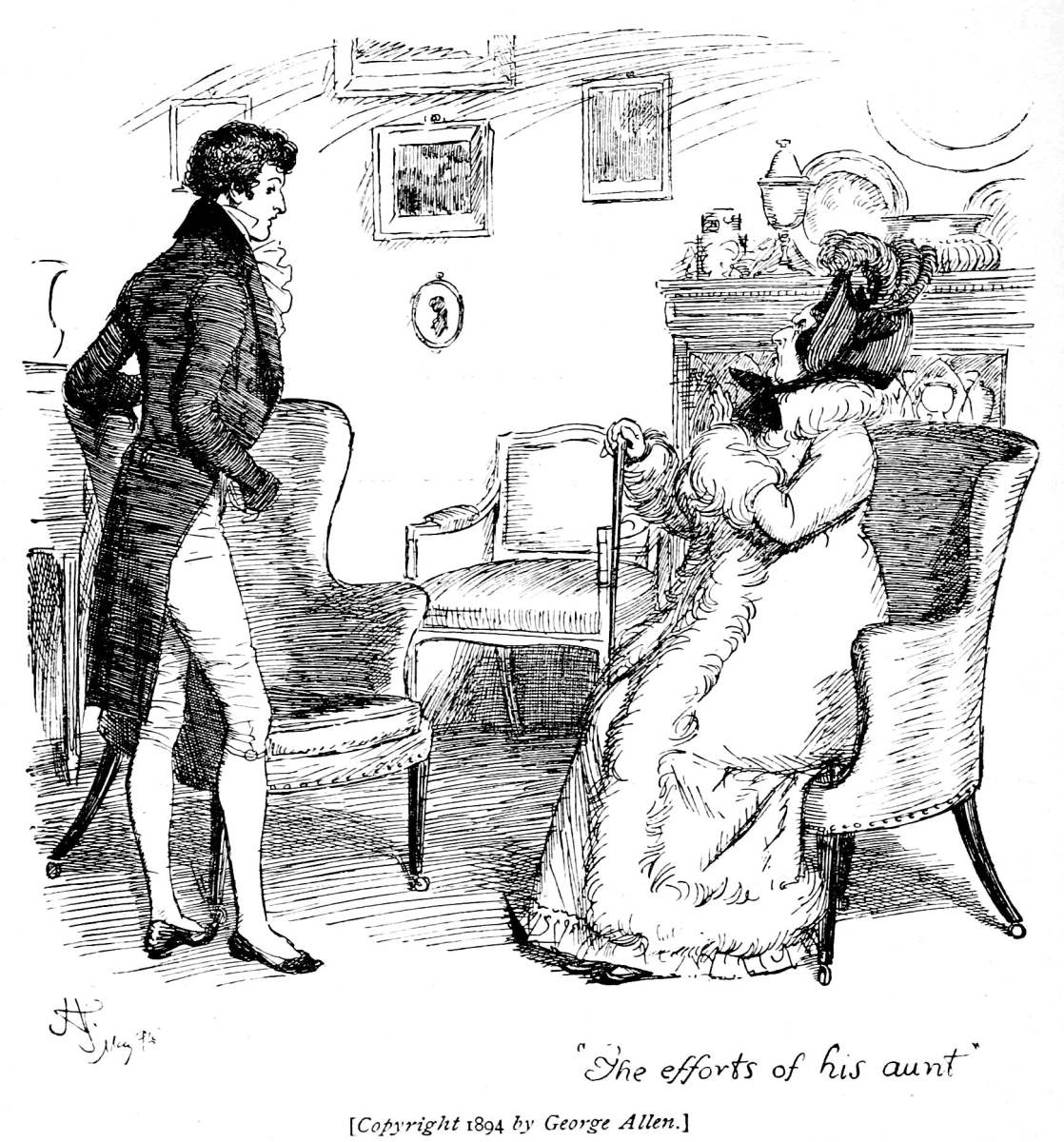
INSTEAD of receiving any such letter of excuse from his friend, as Elizabeth half expected Mr. Bingley to do, he was able to bring Darcy with him to Longbourn before many days had passed after Lady Catherine’s visit. The gentlemen arrived early; and, before Mrs. Bennet had time to tell him of their having seen his aunt, of which her daughter sat in momentary dread, Bingley, who wanted to be alone with Jane, proposed their all walking out. It was agreed to. Mrs. Bennet was not in the habit of walking, Mary could never spare time, but the remaining five set off together. Bingley and Jane, however, soon allowed the others to outstrip them. They lagged behind, while Elizabeth, Kitty, and Darcy were to entertain each other. Very little was said by either; Kitty was too much afraid of him to talk; Elizabeth was secretly forming a desperate resolution; and, perhaps, he might be doing the same.
Elizabeth half expected Mr. Bingley to receive a letter from his friend, excusing himself from coming. Instead, Bingley brought Darcy to Longbourn only a few days after Lady Catherine’s visit. The gentlemen arrived early. Elizabeth dreaded every moment that Mrs. Bennet might tell Darcy they had seen his aunt. But before Mrs. Bennet could mention the visit, Bingley suggested they all go for a walk. He wanted to be alone with Jane. Everyone agreed. Mrs. Bennet was not in the habit of walking, and Mary could never spare the time. But the other five set off together. Bingley and Jane soon let the others get ahead. They stayed behind, leaving Elizabeth, Kitty, and Darcy to entertain one another. All three said very little. Kitty was too afraid of Darcy to talk. Elizabeth was secretly working up the courage to make a desperate decision. And perhaps Darcy was doing the same.
They walked towards the Lucases’, because Kitty wished to call upon Maria; and as Elizabeth saw no occasion for making it a general concern, when Kitty left them she went boldly on with him alone. Now was the moment for her resolution to be executed; and while her courage was high, she immediately said,—
They walked towards the Lucases’ because Kitty wanted to visit Maria. Elizabeth saw no reason to involve everyone. So when Kitty left them, Elizabeth boldly walked on alone with him. Now was the moment to carry out her plan. While her courage was still high, she immediately said:
“Mr. Darcy, I am a very selfish creature, and for the sake of giving relief to my own feelings care not how much I may be wounding yours. I can no longer help thanking you for your unexampled kindness to my poor sister. Ever since I have known it I have been most anxious to acknowledge to you how gratefully I feel it. Were it known to the rest of my family I should not have merely my own gratitude to express.”
“Mr. Darcy, I am a very selfish person. To ease my own feelings, I don’t care how much I may hurt yours. I can no longer hold back from thanking you for your extraordinary kindness to my poor sister. Ever since I learned of your kindness, I have been very eager to tell you how grateful I am. If the rest of my family knew, I would have their gratitude to express as well as my own.”
“I am sorry, exceedingly sorry,” replied Darcy, in a tone of surprise and emotion, “that you have ever been informed of what may, in a mistaken light, have given you uneasiness. I did not think Mrs. Gardiner was so little to be trusted.”
“I’m sorry, terribly sorry,” Darcy replied, his voice full of surprise and emotion. “I’m sorry you were told about something that may have upset you if you misunderstood it. I didn’t think Mrs. Gardiner was so untrustworthy.”
“You must not blame my aunt. Lydia’s thoughtlessness first betrayed to me that you had been concerned in the matter; and, of course, I could not rest till I knew the particulars. Let me thank you again and again, in the name of all my family, for that generous compassion which induced you to take so much trouble, and bear so many mortifications, for the sake of discovering them.”
“You must not blame my aunt. Lydia’s thoughtlessness first let slip that you had been involved in the matter. Of course, I could not rest until I knew the details. Let me thank you again and again, on behalf of all my family, for your generous compassion. Your compassion led you to take so much trouble and endure so much humiliation in order to find them.”
“If you will thank me,” he replied, “let it be for yourself alone. That the wish of giving happiness to you might add force to the other inducements which led me on, I shall not attempt to deny. But your family owe me nothing. Much as I respect them, I believe I thought only of you.”
“If you insist on thanking me,” he replied, “thank me only for your own sake. I won’t deny that wanting to make you happy may have strengthened my other reasons for acting. But your family owes me nothing. Much as I respect them, I believe I thought only of you.”
Elizabeth was too much embarrassed to say a word. After a short pause, her companion added, “You are too generous to trifle with me. If your feelings are still what they were last April, tell me so at once. My affections and wishes are unchanged; but one word from you will silence me on this subject for ever.”
Elizabeth was too embarrassed to say a word. After a short pause, her companion added, “You are too kind to play with my feelings. If you still feel the way you did last April, tell me at once. My feelings and wishes have not changed. But one word from you will stop me from ever speaking of them again.”
Elizabeth, feeling all the more than common awkwardness and anxiety of his situation, now forced herself to speak; and immediately, though not very fluently, gave him to understand that her sentiments had undergone so material a change since the period to which he alluded, as to make her receive with gratitude and pleasure his present assurances. The happiness which this reply produced was such as he had probably never felt before; and he expressed himself on the occasion as sensibly and as warmly as a man violently in love can be supposed to do. Had Elizabeth been able to encounter his eyes, she might have seen how well the expression of heartfelt delight diffused over his face became him: but though she could not look she could listen; and he told her of feelings which, in proving of what importance she was to him, made his affection every moment more valuable.
Elizabeth understood how unusually awkward and anxious he must feel, and now forced herself to speak. At once, though with some difficulty, she explained how deeply her feelings had changed since the time he mentioned. Because of that change, she welcomed his present declarations with gratitude and pleasure. Her reply brought him a happiness he had probably never felt before. He spoke with all the thoughtfulness and warmth one could expect from a man deeply in love. If Elizabeth had been able to meet his eyes, she might have seen how handsome his heartfelt joy made him. But though she could not look at him, she could listen. He told her about his feelings, showing her how much she mattered to him. As he spoke, his love became more precious to her with every moment.
They walked on without knowing in what direction. There was too much to be thought, and felt, and said, for attention to any other objects. She soon learnt that they were indebted for their present good understanding to the efforts of his aunt, who did call on him in her return through London, and there relate her journey to Longbourn, its motive, and the substance of her conversation with Elizabeth; dwelling emphatically on every expression of the latter, which, in her Ladyship’s apprehension, peculiarly denoted her perverseness and assurance, in the belief that such a relation must assist her endeavours to obtain that promise from her nephew which she had refused to give. But, unluckily for her Ladyship, its effect had been exactly contrariwise.
They walked on without knowing where they were going. There was too much to think, feel, and say for them to notice anything else. She soon learned that they owed their present understanding to his aunt’s efforts. His aunt did visit him on her way back through London. She told him about her visit to Longbourn, her reasons for going, and the substance of her conversation with Elizabeth. She especially stressed every remark by Elizabeth that, in her Ladyship’s view, showed stubbornness and shameless confidence. She believed her account would help her get her nephew to make the promise that she had refused to give. But, unfortunately for her Ladyship, her account had exactly the opposite effect.
“It taught me to hope,” said he, “as I had scarcely ever allowed myself to hope before. I knew enough of your disposition to be certain, that had you been absolutely, irrevocably decided against me, you would have acknowledged it to Lady Catherine frankly and openly.”
“It gave me hope,” he said, “in a way I had hardly ever let myself hope before. I knew your character well enough to be certain of one thing. If you had been completely and permanently set against me, you would have told Lady Catherine frankly and openly.”
Elizabeth coloured and laughed as she replied, “Yes, you know enough of my frankness to believe me capable of that. After abusing you so abominably to your face, I could have no scruple in abusing you to all your relations.”
Elizabeth blushed and laughed as she replied, “Yes, you know enough of my honesty to believe me capable of that. After insulting you so horribly to your face, I could have no hesitation about insulting you to all your relatives.”
“What did you say of me that I did not deserve? For though your accusations were ill-founded, formed on mistaken premises, my behaviour to you at the time had merited the severest reproof. It was unpardonable. I cannot think of it without abhorrence.”
“What did you say about me that I did not deserve? Your accusations were unfounded and based on mistaken assumptions. But even so, my behavior toward you at the time deserved the harshest criticism. My behavior was unforgivable. I cannot think of it without disgust.”
“We will not quarrel for the greater share of blame annexed to that evening,” said Elizabeth. “The conduct of neither, if strictly examined, will be irreproachable; but since then we have both, I hope, improved in civility.”
“Let's not argue over who deserves more blame for that evening,” said Elizabeth. “If we judged our behavior strictly, neither of us would be faultless. But since then, I hope we have both learned to be more polite.”
“I cannot be so easily reconciled to myself. The recollection of what I then said, of my conduct, my manners, my expressions during the whole of it, is now, and has been many months, inexpressibly painful to me. Your reproof, so well applied, I shall never forget: ‘Had you behaved in a more gentlemanlike manner.’ Those were your words. You know not, you can scarcely conceive, how they have tortured me; though it was some time, I confess, before I was reasonable enough to allow their justice.”
“I cannot forgive myself so easily. Remembering what I said then, how I acted, my manners, and my words throughout is more painful than I can express. It has been for many months. I will never forget your well-deserved criticism: ‘If you had behaved more like a gentleman.’ Those were your words. You do not know, and can hardly imagine, how those words have tortured me. Though I admit it took some time before I was reasonable enough to accept that your criticism was fair.”
“I was certainly very far from expecting them to make so strong an impression. I had not the smallest idea of their being ever felt in such a way.”
“I certainly never expected them to make such a strong impression. I had no idea they would ever be felt that way.”
“I can easily believe it. You thought me then devoid of every proper feeling, I am sure you did. The turn of your countenance I shall never forget, as you said that I could not have addressed you in any possible way that would induce you to accept me.”
“I can easily believe it. You thought then that I had no decent feelings at all. I’m sure you did. I’ll never forget the look on your face as you spoke. You said that no matter how I had proposed, you would never have accepted me.”
“Oh, do not repeat what I then said. These recollections will not do at all. I assure you that I have long been most heartily ashamed of it.”
“Oh, please don’t repeat what I said then. Bringing up those memories won’t do at all. I assure you, I’ve felt deeply ashamed of what I said for a long time.”
Darcy mentioned his letter. “Did it,” said he,—“did it soon make you think better of me? Did you, on reading it, give any credit to its contents?”
Darcy mentioned his letter. “Did it,” he asked, “did it soon make you think better of me? When you read the letter, did you believe any of what I wrote?”
She explained what its effects on her had been, and how gradually all her former prejudices had been removed.
She explained how it had affected her and how all her earlier prejudices had gradually faded away.
“I knew,” said he, “that what I wrote must give you pain, but it was necessary. I hope you have destroyed the letter. There was one part, especially the opening of it, which I should dread your having the power of reading again. I can remember some expressions which might justly make you hate me.”
“I knew,” he said, “that what I wrote would hurt you, but I had to write it. I hope you have destroyed the letter. There was one part, especially the beginning, that I would dread you being able to read again. I remember some words I used that might give you good reason to hate me.”
“The letter shall certainly be burnt, if you believe it essential to the preservation of my regard; but, though we have both reason to think my opinions not entirely unalterable, they are not, I hope, quite so easily changed as that implies.”
“The letter will certainly be burned if you believe that is necessary to preserve my affection for you. But we both have reason to think my opinions can change. Even so, I hope my opinions don’t change as easily as your request suggests.”
“When I wrote that letter,” replied Darcy, “I believed myself perfectly calm and cool; but I am since convinced that it was written in a dreadful bitterness of spirit.”
“When I wrote that letter,” Darcy replied, “I thought I was completely calm and composed. But I’ve since realized that I wrote it with terrible bitterness.”
“The letter, perhaps, began in bitterness, but it did not end so. The adieu is charity itself. But think no more of the letter. The feelings of the person who wrote and the person who received it are now so widely different from what they were then, that every unpleasant circumstance attending it ought to be forgotten. You must learn some of my philosophy. Think only of the past as its remembrance gives you pleasure.”
“The letter perhaps began with bitterness, but it did not end that way. The goodbye is kindness itself. But think no more about the letter. The writer and the person who received it now feel so differently from how they felt then. So everything unpleasant about the letter ought to be forgotten. You must learn something of my philosophy. Think about the past only when remembering it brings you pleasure.”
“I cannot give you credit for any philosophy of the kind. Your retrospections must be so totally void of reproach, that the contentment arising from them is not of philosophy, but, what is much better, of ignorance. But with me, it is not so. Painful recollections will intrude, which cannot, which ought not to be repelled. I have been a selfish being all my life, in practice, though not in principle. As a child I was taught what was right, but I was not taught to correct my temper. I was given good principles, but left to follow them in pride and conceit. Unfortunately an only son (for many years an only child), I was spoiled by my parents, who, though good themselves, (my father particularly, all that was benevolent and amiable,) allowed, encouraged, almost taught me to be selfish and overbearing, to care for none beyond my own family circle, to think meanly of all the rest of the world, to wish at least to think meanly of their sense and worth compared with my own. Such I was, from eight to eight-and-twenty; and such I might still have been but for you, dearest, loveliest Elizabeth! What do I not owe you! You taught me a lesson, hard indeed at first, but most advantageous. By you, I was properly humbled. I came to you without a doubt of my reception. You showed me how insufficient were all my pretensions to please a woman worthy of being pleased.”
“I cannot give you credit for that kind of philosophy. Your memories must be so completely free of anything to regret. The peace they bring comes not from philosophy but from something much better: ignorance. But with me, things are different. Painful memories force their way in, and I cannot and should not push them away. All my life, I have been selfish in my actions, though not in my principles. As a child, I was taught what was right, but not how to control my temper. I was given good principles, but left to follow them with pride and arrogance. Unfortunately, I was an only son (and for many years an only child). My parents spoiled me, though they were good people themselves (my father especially was kind and warmhearted). They allowed, encouraged, and almost taught me to be selfish and domineering. They taught me to care for no one outside my own family and to look down on everyone else. At least, they taught me to wish to see everyone else as less intelligent and less worthy than myself. That was how I was from eight to twenty-eight. And I might still have been that way but for you, dearest, loveliest Elizabeth! How much I owe you! You taught me a lesson, painful at first, but extremely valuable. You humbled me as I deserved. I came to you without any doubt that you would accept me. You showed me how little all my supposed merits could do to win a woman worth winning.”
“Had you then persuaded yourself that I should?”
“So had you convinced yourself that I would?”
“Indeed I had. What will you think of my vanity? I believed you to be wishing, expecting my addresses.”
“Yes, I had. What will you think of me for being so vain? I believed you wanted and expected me to propose.”
“My manners must have been in fault, but not intentionally, I assure you. I never meant to deceive you, but my spirits might often lead me wrong. How you must have hated me after that evening!”
“I must have behaved badly, but I assure you I didn’t mean to. I never meant to mislead you, but my high spirits might often have led me astray. How you must have hated me after that evening!”
“Hate you! I was angry, perhaps, at first, but my anger soon began to take a proper direction.”
“Hate you! Perhaps I was angry at first. But my anger soon began to turn toward the right target.”
“I am almost afraid of asking what you thought of me when we met at Pemberley. You blamed me for coming?”
“I'm almost afraid to ask what you thought of me when we met at Pemberley. Did you blame me for coming?”
“No, indeed, I felt nothing but surprise.”
“No, really, I was only surprised.”
“Your surprise could not be greater than mine in being noticed by you. My conscience told me that I deserved no extraordinary politeness, and I confess that I did not expect to receive more than my due.”
“Your surprise could not be greater than mine at receiving your attention. I knew I deserved no special politeness. And I admit I did not expect to receive more than I deserved.”
“My object then,” replied Darcy, “was to show you, by every civility in my power, that I was not so mean as to resent the past; and I hoped to obtain your forgiveness, to lessen your ill opinion, by letting you see that your reproofs had been attended to. How soon any other wishes introduced themselves, I can hardly tell, but I believe in about half an hour after I had seen you.”
“My aim then,” Darcy replied, “was to show you every kindness I could. I wanted you to see I was not so petty as to hold the past against you. And I hoped to earn your forgiveness and improve your opinion of me by showing I had taken your criticisms seriously. I can hardly say how soon other wishes came to mind. But I believe it was about half an hour after I saw you.”
He then told her of Georgiana’s delight in her acquaintance, and of her disappointment at its sudden interruption; which naturally leading to the cause of that interruption, she soon learnt that his resolution of following her from Derbyshire in quest of her sister had been formed before he quitted the inn, and that his gravity and thoughtfulness there had arisen from no other struggles than what such a purpose must comprehend.
He then told her how delighted Georgiana had been to meet her, and how disappointed when their acquaintance ended so suddenly. This naturally led them to discuss why their acquaintance had been interrupted. She soon learned that, before leaving the inn, he had already decided to follow her from Derbyshire to find her sister. His serious, thoughtful manner there had come only from the difficulties such a plan must involve.
She expressed her gratitude again, but it was too painful a subject to each to be dwelt on farther.
She thanked him again, but the subject was too painful for both of them to discuss any further.
After walking several miles in a leisurely manner, and too busy to know anything about it, they found at last, on examining their watches, that it was time to be at home.
They walked several miles at a leisurely pace, too absorbed to notice how far they had gone. At last, they checked their watches and realized it was time to be home.
“What could have become of Mr. Bingley and Jane?” was a wonder which introduced the discussion of their affairs. Darcy was delighted with their engagement; his friend had given him the earliest information of it.
“What could have happened to Mr. Bingley and Jane?” This question led to a discussion of their affairs. Darcy was delighted with their engagement. His friend had told him the news right away.
“I must ask whether you were surprised?” said Elizabeth.
“I have to ask, were you surprised?” Elizabeth said.
“Not at all. When I went away, I felt that it would soon happen.”
“Not at all. When I left, I felt it would happen soon.”
“That is to say, you had given your permission. I guessed as much.” And though he exclaimed at the term, she found that it had been pretty much the case.
“So you had given your permission. I thought so.” And though he protested at the word “permission,” she found that he had more or less given it.
“On the evening before my going to London,” said he, “I made a confession to him, which I believe I ought to have made long ago. I told him of all that had occurred to make my former interference in his affairs absurd and impertinent. His surprise was great. He had never had the slightest suspicion. I told him, moreover, that I believed myself mistaken in supposing, as I had done, that your sister was indifferent to him; and as I could easily perceive that his attachment to her was unabated, I felt no doubt of their happiness together.”
“The evening before I left for London,” he said, “I confessed something to him. I believe I should have done so long ago. I told him about everything that had happened to make my earlier interference in his affairs foolish and intrusive. He was very surprised. He had never suspected anything. I also told him I believed I had been wrong to think your sister had no feelings for him. And since I could easily see that his love for her was as strong as ever, I had no doubt they would be happy together.”
Elizabeth could not help smiling at his easy manner of directing his friend.
Elizabeth couldn't help smiling at the casual way he told his friend what to do.
“Did you speak from your own observation,” said she, “when you told him that my sister loved him, or merely from my information last spring?”
“Did you base what you told him about my sister loving him on what you’d seen yourself?” she asked. “Or just on what I told you last spring?”
“From the former. I had narrowly observed her, during the two visits which I had lately made her here; and I was convinced of her affection.”
“From the first. I had watched her closely during my two recent visits to her here. And I was convinced of her affection.”
“And your assurance of it, I suppose, carried immediate conviction to him.”
“And I suppose he believed it immediately because you assured him it was true.”
“It did. Bingley is most unaffectedly modest. His diffidence had prevented his depending on his own judgment in so anxious a case, but his reliance on mine made everything easy. I was obliged to confess one thing, which for a time, and not unjustly, offended him. I could not allow myself to conceal that your sister had been in town three months last winter, that I had known it, and purposely kept it from him. He was angry. But his anger, I am persuaded, lasted no longer than he remained in any doubt of your sister’s sentiments. He has heartily forgiven me now.”
“It did. Bingley is genuinely modest. His lack of confidence kept him from trusting his own judgment in a matter that caused him such anxiety. But his trust in my judgment made everything easy. I had to admit one thing that offended him for a time, and rightly so. I could not hide the fact that your sister had been in town for three months last winter. I had known she was there and had deliberately kept the news from him. He was angry. But I am convinced his anger lasted only as long as he doubted your sister’s feelings. He has now forgiven me completely.”
Elizabeth longed to observe that Mr. Bingley had been a most delightful friend; so easily guided that his worth was invaluable; but she checked herself. She remembered that he had yet to learn to be laughed at, and it was rather too early to begin. In anticipating the happiness of Bingley, which of course was to be inferior only to his own, he continued the conversation till they reached the house. In the hall they parted.
Elizabeth longed to say that Mr. Bingley had been a delightful friend. He was so easily led that his value as a friend was beyond measure. But she held back. She remembered that he had not yet learned to take a joke at his own expense. It was a little too soon to start. He continued talking about Bingley’s future happiness, which, of course, would be second only to his own. He kept up the conversation until they reached the house. They parted in the hall.