Chapter 47
“ HAVE been thinking it over again, Elizabeth,” said her uncle, as they drove from the town; “and really, upon serious consideration, I am much more inclined than I was to judge as your eldest sister does of the matter. It appears to me so very unlikely that any young man should form such a design against a girl who is by no means unprotected or friendless, and who was actually staying in his Colonel’s family, that I am strongly inclined to hope the best. Could he expect that her friends would not step forward? Could he expect to be noticed again by the regiment, after such an affront to Colonel Forster? His temptation is not adequate to the risk.”
“I have been thinking it over again, Elizabeth,” said her uncle, as they drove out of town. “After giving the matter serious thought, I am much more inclined to agree with your eldest sister than before. It seems so unlikely that any young man would plan to take advantage of a girl in her position. She has protection and friends, and was actually staying with his Colonel’s family. So I feel strongly inclined to hope for the best. Could he expect her friends not to intervene? Could he expect the regiment to accept him again after such an insult to Colonel Forster? The temptation is not great enough to justify the risk.”
“Do you really think so?” cried Elizabeth, brightening up for a moment.
“Do you really think so?” Elizabeth exclaimed, brightening for a moment.
“Upon my word,” said Mrs. Gardiner, “I begin to be of your uncle’s opinion. It is really too great a violation of decency, honour, and interest, for him to be guilty of it. I cannot think so very ill of Wickham. Can you, yourself, Lizzie, so wholly give him up, as to believe him capable of it?”
“Honestly,” said Mrs. Gardiner, “I’m beginning to agree with your uncle. Such an act goes too far against decency, honour, and his own interests for him to have committed it. I cannot think so badly of Wickham. Can you yourself, Lizzie, lose all faith in him and believe him capable of it?”
“Not perhaps of neglecting his own interest. But of every other neglect I can believe him capable. If, indeed, it should be so! But I dare not hope it. Why should they not go on to Scotland, if that had been the case?”
“Perhaps not of neglecting his own interests. But I can believe him capable of every other kind of neglect. If only that were really the case! But I dare not hope for it. Why wouldn’t they have gone on to Scotland if that had been the case?”
“In the first place,” replied Mr. Gardiner, “there is no absolute proof that they are not gone to Scotland.”
“First of all,” Mr. Gardiner replied, “there’s no definite proof that they haven’t gone to Scotland.”
“Oh, but their removing from the chaise into a hackney coach is such a presumption! And, besides, no traces of them were to be found on the Barnet road.”
“Oh, but their switching from the carriage to a hired coach is such strong evidence! And besides, no trace of them could be found on the Barnet road.”
“Well, then,—supposing them to be in London—they may be there, though for the purpose of concealment, for no more exceptionable purpose. It is not likely that money should be very abundant on either side; and it might strike them that they could be more economically, though less expeditiously, married in London, than in Scotland.”
“Well, then, suppose they are in London. They may be there to hide, but not for any more objectionable purpose. Neither of them is likely to have much money. And they might think getting married in London would be cheaper, though slower, than getting married in Scotland.”
“But why all this secrecy? Why any fear of detection? Why must their marriage be private? Oh, no, no—this is not likely. His most particular friend, you see by Jane’s account, was persuaded of his never intending to marry her. Wickham will never marry a woman without some money. He cannot afford it. And what claims has Lydia, what attractions has she beyond youth, health, and good humour, that could make him for her sake forego every chance of benefiting himself by marrying well? As to what restraint the apprehensions of disgrace in the corps might throw on a dishonourable elopement with her, I am not able to judge; for I know nothing of the effects that such a step might produce. But as to your other objection, I am afraid it will hardly hold good. Lydia has no brothers to step forward; and he might imagine, from my father’s behaviour, from his indolence and the little attention he has ever seemed to give to what was going forward in his family, that he would do as little and think as little about it, as any father could do, in such a matter.”
“But why all this secrecy? Why fear being found out? Why must their marriage be private? Oh, no, no. This is not likely. From Jane’s account, you can see that his closest friend was convinced he never intended to marry her. Wickham will never marry a woman without some money. He cannot afford to. And what does Lydia have to offer beyond youth, health, and good humour? What could make him give up every chance of improving his position by marrying well, just for her? I cannot judge how much fear of disgrace in his regiment might discourage him from a dishonourable elopement with her. I know nothing of the consequences such an act might have. But as for your other objection, I am afraid it hardly holds up. Lydia has no brothers to step forward. And my father’s behaviour might lead Wickham to expect very little from him. My father is lazy and has always seemed to pay little attention to what happens in his family. So Wickham might imagine that he would do as little, and give the matter as little thought, as any father could.”
“But can you think that Lydia is so lost to everything but love of him, as to consent to live with him on any other terms than marriage?”
“But can you really think Lydia cares so little about anything but her love for him that she would agree to live with him without being married?”
“It does seem, and it is most shocking, indeed,” replied Elizabeth, with tears in her eyes, “that a sister’s sense of decency and virtue in such a point should admit of doubt. But, really, I know not what to say. Perhaps I am not doing her justice. But she is very young: she has never been taught to think on serious subjects; and for the last half year, nay, for a twelvemonth, she has been given up to nothing but amusement and vanity. She has been allowed to dispose of her time in the most idle and frivolous manner, and to adopt any opinions that came in her way. Since the ——shire were first quartered in Meryton, nothing but love, flirtation, and officers, have been in her head. She has been doing everything in her power, by thinking and talking on the subject, to give greater—what shall I call it?—susceptibility to her feelings; which are naturally lively enough. And we all know that Wickham has every charm of person and address that can captivate a woman.”
“It does seem shocking, truly shocking,” replied Elizabeth, with tears in her eyes, “that my sister’s decency and virtue in such a matter should be in doubt. But I really don’t know what to say. Perhaps I am not being fair to her. But she is very young. She has never been taught to think about serious matters. And for the past six months, in fact, for a whole year, she has focused only on amusement and vanity. She has been allowed to spend her time in the most idle and frivolous ways. She has also been allowed to adopt whatever opinions she happened to encounter. Since the ___shire regiment first came to stay in Meryton, she has thought of nothing but love, flirting, and officers. By constantly thinking and talking about these things, she has done everything she can to make herself more emotionally impressionable. What else can I call it? Her feelings are naturally lively enough already. And we all know that Wickham has every charm of appearance and manner that can captivate a woman.”
“But you see that Jane,” said her aunt, “does not think so ill of Wickham, as to believe him capable of the attempt.”
“But you see,” her aunt said, “Jane doesn’t think so badly of Wickham that she believes he could attempt it.”
“Of whom does Jane ever think ill? And who is there, whatever might be their former conduct, that she would believe capable of such an attempt, till it were proved against them? But Jane knows, as well as I do, what Wickham really is. We both know that he has been profligate in every sense of the word; that he has neither integrity nor honour; that he is as false and deceitful as he is insinuating.”
“Who does Jane ever think badly of? No matter what someone had done before, would she believe them capable of such an attempt without proof? But Jane knows just as well as I do what Wickham is really like. We both know that he has been immoral in every sense of the word. He has neither integrity nor honour. He is as dishonest and deceitful as he is skilled at charming people.”
“And do you really know all this?” cried Mrs. Gardiner, whose curiosity as to the mode of her intelligence was all alive.
“And do you really know all this?” exclaimed Mrs. Gardiner. She was eager to find out how the information had reached her.
“I do, indeed,” replied Elizabeth, colouring. “I told you the other day of his infamous behaviour to Mr. Darcy; and you, yourself, when last at Longbourn, heard in what manner he spoke of the man who had behaved with such forbearance and liberality towards him. And there are other circumstances which I am not at liberty—which it is not worth while to relate; but his lies about the whole Pemberley family are endless. From what he said of Miss Darcy, I was thoroughly prepared to see a proud, reserved, disagreeable girl. Yet he knew to the contrary himself. He must know that she was as amiable and unpretending as we have found her.”
“I certainly do,” replied Elizabeth, blushing. “I told you the other day about his disgraceful behaviour towards Mr. Darcy. And you yourself heard how he spoke of Mr. Darcy when you were last at Longbourn. Yet Mr. Darcy had treated him with such patience and generosity. And there are other details I am not free to share. They are not worth relating, but his lies about the whole Pemberley family are endless. From what he said about Miss Darcy, I fully expected a proud, distant, unpleasant girl. Yet he himself knew otherwise. He must know that she was as kind and unassuming as we have found her.”
“But does Lydia know nothing of this? can she be ignorant of what you and Jane seem so well to understand?”
“But does Lydia know nothing about this? Can she be unaware of what you and Jane seem to understand so well?”
“Oh, yes!—that, that is the worst of all. Till I was in Kent, and saw so much both of Mr. Darcy and his relation Colonel Fitzwilliam, I was ignorant of the truth myself. And when I returned home the ——shire was to leave Meryton in a week or fortnight’s time. As that was the case, neither Jane, to whom I related the whole, nor I, thought it necessary to make our knowledge public; for of what use could it apparently be to anyone, that the good opinion, which all the neighbourhood had of him, should then be overthrown? And even when it was settled that Lydia should go with Mrs. Forster, the necessity of opening her eyes to his character never occurred to me. That she could be in any danger from the deception never entered my head. That such a consequence as this should ensue, you may easily believe was far enough from my thoughts.”
“Oh, yes! That is the worst part of all. I didn’t know the truth myself until I went to Kent. There I spent a great deal of time with both Mr. Darcy and his relative, Colonel Fitzwilliam. When I returned home, the ___shire regiment was due to leave Meryton in a week or two. Because they were leaving so soon, neither Jane nor I thought we needed to tell everyone what we knew. I had told Jane the whole story. What good could it apparently do anyone to destroy the good opinion all the neighbourhood had of him then? Even when Lydia’s trip with Mrs. Forster was settled, I never thought of warning her about his character. It never entered my head that she could be in any danger from his deception. You can easily believe that a consequence like this was far from my thoughts.”
“When they all removed to Brighton, therefore, you had no reason, I suppose, to believe them fond of each other?”
“So when they all moved to Brighton, I suppose you had no reason to think they liked each other?”
“Not the slightest. I can remember no symptom of affection on either side; and had anything of the kind been perceptible, you must be aware that ours is not a family on which it could be thrown away. When first he entered the corps, she was ready enough to admire him; but so we all were. Every girl in or near Meryton was out of her senses about him for the first two months: but he never distinguished her by any particular attention; and, consequently, after a moderate period of extravagant and wild admiration, her fancy for him gave way, and others of the regiment, who treated her with more distinction, again became her favourites.”
“Not the slightest. I can't remember any sign of affection on either side. And if there had been any, you know our family would never have failed to notice it. When he first joined the regiment, she was quite ready to admire him. But so were we all. Every girl in or near Meryton was mad about him for the first two months. But he never singled her out for any special attention. So, after a fairly short time of wild and excessive admiration, her interest in him faded. Other men in the regiment, who paid her more attention, became her favourites again.”
It may be easily believed, that however little of novelty could be added to their fears, hopes, and conjectures, on this interesting subject by its repeated discussion, no other could detain them from it long, during the whole of the journey. From Elizabeth’s thoughts it was never absent. Fixed there by the keenest of all anguish, self-reproach, she could find no interval of ease or forgetfulness.
It is easy to believe that discussing the subject repeatedly added little to their fears, hopes, and guesses. Yet no other topic could keep them from returning to it for long throughout the journey. The subject was never absent from Elizabeth’s thoughts. Self-blame, the sharpest of all pains, kept it fixed in her mind. She could not find a moment of relief or forgetfulness.
They travelled as expeditiously as possible; and sleeping one night on the road, reached Longbourn by dinnertime the next day. It was a comfort to Elizabeth to consider that Jane could not have been wearied by long expectations.
They travelled as quickly as possible. After spending one night on the road, they reached Longbourn by dinnertime the next day. Elizabeth found comfort in knowing that Jane could not have been worn out by a long wait.
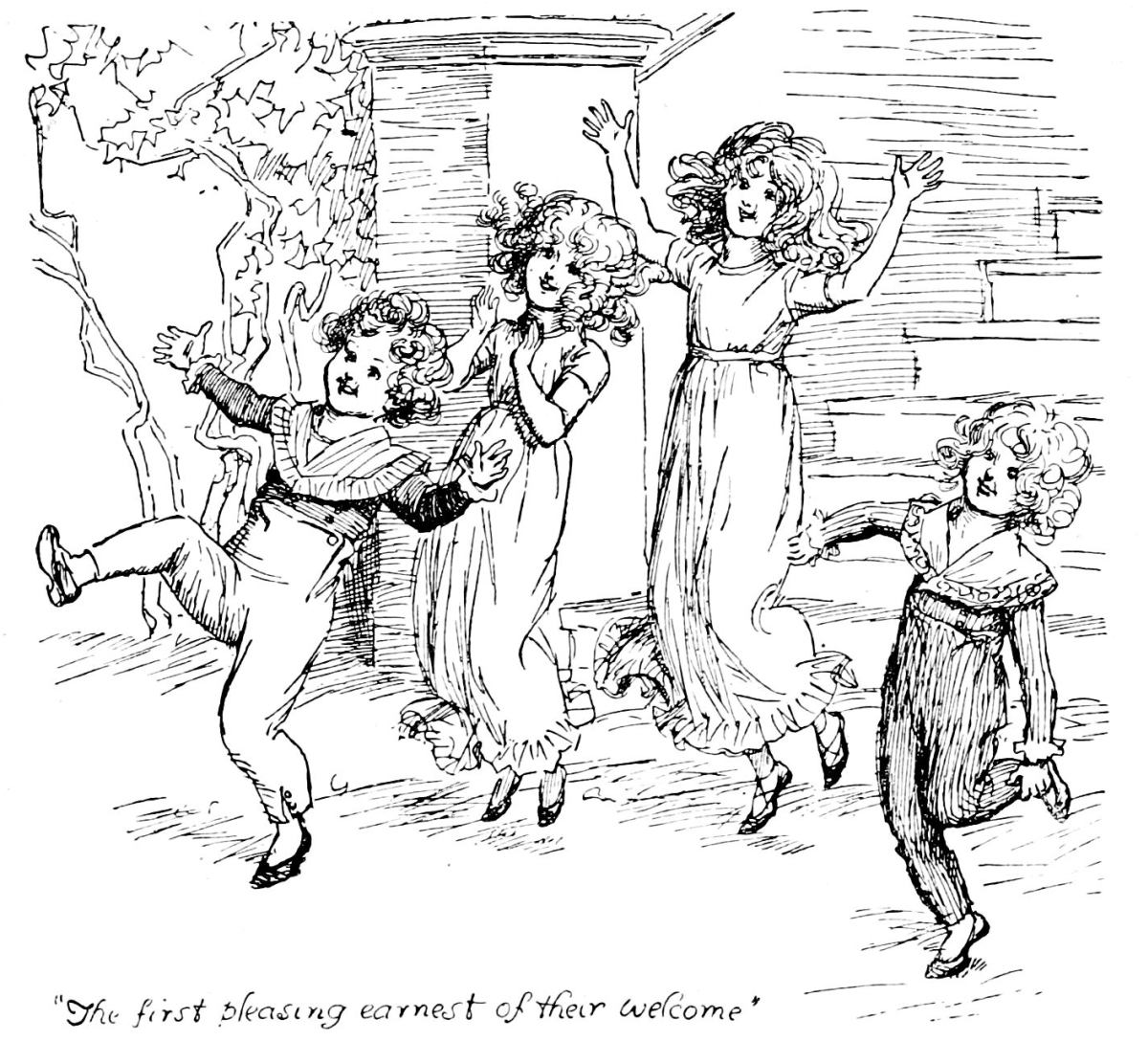
The little Gardiners, attracted by the sight of a chaise, were standing on the steps of the house, as they entered the paddock; and when the carriage drove up to the door, the joyful surprise that lighted up their faces and displayed itself over their whole bodies, in a variety of capers and frisks, was the first pleasing earnest of their welcome.
The Gardiner children had spotted the carriage and stood on the house steps as the visitors entered the paddock. When the carriage pulled up to the door, joyful surprise lit up the children’s faces. They jumped and skipped with delight, their whole bodies expressing their joy. This was the first happy sign of the welcome awaiting the visitors.
Elizabeth jumped out; and after giving each of them a hasty kiss, hurried into the vestibule, where Jane, who came running downstairs from her mother’s apartment, immediately met her.
Elizabeth jumped out, gave each of them a quick kiss, and hurried into the entrance hall. Jane came running downstairs from her mother’s rooms and met Elizabeth there immediately.
Elizabeth, as she affectionately embraced her, whilst tears filled the eyes of both, lost not a moment in asking whether anything had been heard of the fugitives.
Elizabeth hugged her affectionately, tears filling both their eyes. She immediately asked whether there had been any news of the runaways.
“Not yet,” replied Jane. “But now that my dear uncle is come, I hope everything will be well.”
“Not yet,” Jane replied. “But now that my dear uncle has arrived, I hope everything will be all right.”
“Is my father in town?”
“Is my father in town?”
“Yes, he went on Tuesday, as I wrote you word.”
“Yes, he left on Tuesday, as I told you in my letter.”
“And have you heard from him often?”
“And have you heard from him often?”
“We have heard only once. He wrote me a few lines on Wednesday, to say that he had arrived in safety, and to give me his directions, which I particularly begged him to do. He merely added, that he should not write again, till he had something of importance to mention.”
“We’ve only heard from him once. He wrote me a few lines on Wednesday to say he had arrived safely and to give me his address. I had specifically begged him to send it. He only added that he would not write again until he had something important to tell me.”
“And my mother—how is she? How are you all?”
“And how is my mother? How are you all?”
“My mother is tolerably well, I trust; though her spirits are greatly shaken. She is upstairs, and will have great satisfaction in seeing you all. She does not yet leave her dressing-room. Mary and Kitty, thank Heaven! are quite well.”
“My mother is fairly well, I believe, though she is very upset. She is upstairs and will be very pleased to see you all. She still stays in her dressing room. Thank Heaven! Mary and Kitty are quite well.”
“But you—how are you?” cried Elizabeth. “You look pale. How much you must have gone through!”
“But how are you?” Elizabeth exclaimed. “You look pale. You must have been through so much!”
Her sister, however, assured her of her being perfectly well; and their conversation, which had been passing while Mr. and Mrs. Gardiner were engaged with their children, was now put an end to by the approach of the whole party. Jane ran to her uncle and aunt, and welcomed and thanked them both, with alternate smiles and tears.
Her sister, however, assured her that she was perfectly well. Their conversation had taken place while Mr. and Mrs. Gardiner were busy with their children. Now it ended as the whole group approached. Jane ran to her uncle and aunt, welcoming and thanking them both, smiling one moment and crying the next.
When they were all in the drawing-room, the questions which Elizabeth had already asked were of course repeated by the others, and they soon found that Jane had no intelligence to give. The sanguine hope of good, however, which the benevolence of her heart suggested, had not yet deserted her; she still expected that it would all end well, and that every morning would bring some letter, either from Lydia or her father, to explain their proceedings, and, perhaps, announce the marriage.
When everyone was in the drawing room, the others naturally repeated the questions Elizabeth had already asked. They soon found that Jane had no news to share. But Jane’s kind heart still led her to hope for the best. She still expected everything to end well. Each morning, she expected a letter from either Lydia or her father explaining what they were doing. Perhaps the letter would even announce the marriage.
Mrs. Bennet, to whose apartment they all repaired, after a few minutes’ conversation together, received them exactly as might be expected; with tears and lamentations of regret, invectives against the villainous conduct of Wickham, and complaints of her own sufferings and ill-usage; blaming everybody but the person to whose ill-judging indulgence the errors of her daughter must be principally owing.
After a few minutes of conversation together, they all went to Mrs. Bennet’s room. She received them exactly as might be expected, with tears and cries of regret. She condemned Wickham’s villainous behavior and complained of her own suffering and mistreatment. She blamed everyone but herself, though her own foolish indulgence was chiefly responsible for her daughter’s mistakes.
“If I had been able,” said she, “to carry my point in going to Brighton with all my family, this would not have happened: but poor dear Lydia had nobody to take care of her. Why did the Forsters ever let her go out of their sight? I am sure there was some great neglect or other on their side, for she is not the kind of girl to do such a thing, if she had been well looked after. I always thought they were very unfit to have the charge of her; but I was over-ruled, as I always am. Poor, dear child! And now here’s Mr. Bennet gone away, and I know he will fight Wickham, wherever he meets him, and then he will be killed, and what is to become of us all? The Collinses will turn us out, before he is cold in his grave; and if you are not kind to us, brother, I do not know what we shall do.”
“If I had managed,” she said, “to get my way about taking all my family to Brighton, this would not have happened. But poor dear Lydia had nobody to look after her. Why did the Forsters ever let her out of their sight? I am sure they must have neglected her in some way. She is not the kind of girl to do such a thing if she had been properly looked after. I always thought they were quite unfit to be responsible for her. But I was overruled, as I always am. Poor, dear child! And now Mr. Bennet has gone away. I know he will fight Wickham wherever he meets him, and then he will be killed. What will become of us all? The Collinses will throw us out before he is cold in his grave. And if you are not kind to us, brother, I do not know what we shall do.”
They all exclaimed against such terrific ideas; and Mr. Gardiner, after general assurances of his affection for her and all her family, told her that he meant to be in London the very next day, and would assist Mr. Bennet in every endeavour for recovering Lydia.
They all protested at such frightening thoughts. Mr. Gardiner assured her of his affection for her and all her family. He then told her he planned to be in London the very next day. He would help Mr. Bennet in every effort to find Lydia and bring her back.
“Do not give way to useless alarm,” added he: “though it is right to be prepared for the worst, there is no occasion to look on it as certain. It is not quite a week since they left Brighton. In a few days more, we may gain some news of them; and till we know that they are not married, and have no design of marrying, do not let us give the matter over as lost. As soon as I get to town, I shall go to my brother, and make him come home with me to Gracechurch Street, and then we may consult together as to what is to be done.”
“Don’t give in to needless fear,” he added: “though we should prepare for the worst, we need not assume it is certain. They left Brighton less than a week ago. In a few more days, we may hear some news of them. Until we know they are not married and have no intention of marrying, let’s not give up hope. As soon as I get to town, I’ll go to my brother. I’ll make him come home with me to Gracechurch Street. Then we can discuss together what should be done.”
“Oh, my dear brother,” replied Mrs. Bennet, “that is exactly what I could most wish for. And now do, when you get to town, find them out, wherever they may be; and if they are not married already, make them marry. And as for wedding clothes, do not let them wait for that, but tell Lydia she shall have as much money as she chooses to buy them, after they are married. And, above all things, keep Mr. Bennet from fighting. Tell him what a dreadful state I am in—that I am frightened out of my wits; and have such tremblings, such flutterings all over me, such spasms in my side, and pains in my head, and such beatings at my heart, that I can get no rest by night nor by day. And tell my dear Lydia not to give any directions about her clothes till she has seen me, for she does not know which are the best warehouses. Oh, brother, how kind you are! I know you will contrive it all.”
“Oh, my dear brother,” replied Mrs. Bennet, “that is exactly what I wish for most. Now, when you get to town, please find them, wherever they may be. And if they are not married already, make them marry. As for wedding clothes, do not let them wait for those. Tell Lydia she can have as much money as she wants to buy them after they are married. And above all, keep Mr. Bennet from fighting. Tell him what a dreadful state I am in. I am frightened out of my wits. I tremble and feel fluttering all over, with spasms in my side, headaches, and a pounding heart. These troubles leave me no rest, night or day. And tell my dear Lydia not to order any clothes until she has seen me. She does not know which shops are best. Oh, brother, how kind you are! I know you will arrange it all.”
But Mr. Gardiner, though he assured her again of his earnest endeavours in the cause, could not avoid recommending moderation to her, as well in her hopes as her fears; and after talking with her in this manner till dinner was on table, they left her to vent all her feelings on the housekeeper, who attended in the absence of her daughters.
But although Mr. Gardiner again assured her he was making every effort to help, he felt he must urge moderation. She should keep both her hopes and her fears in check. They talked with her like this until dinner was served. Then they left her to pour out all her feelings to the housekeeper, who was attending her while her daughters were away.
Though her brother and sister were persuaded that there was no real occasion for such a seclusion from the family, they did not attempt to oppose it; for they knew that she had not prudence enough to hold her tongue before the servants, while they waited at table, and judged it better that one only of the household, and the one whom they could most trust, should comprehend all her fears and solicitude on the subject.
Though her brother and sister saw no real need for her to withdraw from the family, they did not object. They knew she lacked the sense to keep quiet in front of the servants as they served meals. So they thought it better that one person in the household alone should understand all her fears and worries about the matter. That person was the one they trusted most.
In the dining-room they were soon joined by Mary and Kitty, who had been too busily engaged in their separate apartments to make their appearance before. One came from her books, and the other from her toilette. The faces of both, however, were tolerably calm; and no change was visible in either, except that the loss of her favourite sister, or the anger which she had herself incurred in the business, had given something more of fretfulness than usual to the accents of Kitty. As for Mary, she was mistress enough of herself to whisper to Elizabeth, with a countenance of grave reflection, soon after they were seated at table,—
Mary and Kitty soon joined them in the dining room. Both had been too busy in their own rooms to appear earlier. Mary had been reading, and Kitty had been getting dressed. Both, however, looked fairly calm. Neither showed any change, except that Kitty sounded a little more irritable than usual. This was either because her favourite sister was gone or because she herself had drawn anger over the affair. As for Mary, she had enough self-control to whisper to Elizabeth with a look of serious reflection. They had only just sat down at the table when she said:
“This is a most unfortunate affair, and will probably be much talked of. But we must stem the tide of malice, and pour into the wounded bosoms of each other the balm of sisterly consolation.”
“This is a very unfortunate situation, and people will probably talk about it a great deal. But we must hold back the flood of spiteful gossip and soothe each other’s wounded hearts with sisterly comfort.”
Then perceiving in Elizabeth no inclination of replying, she added, “Unhappy as the event must be for Lydia, we may draw from it this useful lesson:—that loss of virtue in a female is irretrievable, that one false step involves her in endless ruin, that her reputation is no less brittle than it is beautiful, and that she cannot be too much guarded in her behaviour towards the undeserving of the other sex.”
Then, seeing that Elizabeth had no wish to reply, she added, “However unhappy this event must be for Lydia, we may learn a useful lesson from it. A woman can never regain her virtue once she loses it. One wrong step leads to endless ruin. Her reputation is as fragile as it is beautiful. And she can never be too careful in her behaviour towards unworthy men.”
Elizabeth lifted up her eyes in amazement, but was too much oppressed to make any reply. Mary, however, continued to console herself with such kind of moral extractions from the evil before them.
Elizabeth looked up in amazement, but she was too distressed to reply. Mary, however, continued to comfort herself by drawing moral lessons like these from the trouble they faced.
In the afternoon, the two elder Miss Bennets were able to be for half an hour by themselves; and Elizabeth instantly availed herself of the opportunity of making any inquiries which Jane was equally eager to satisfy. After joining in general lamentations over the dreadful sequel of this event, which Elizabeth considered as all but certain, and Miss Bennet could not assert to be wholly impossible, the former continued the subject by saying, “But tell me all and everything about it which I have not already heard. Give me further particulars. What did Colonel Forster say? Had they no apprehension of anything before the elopement took place? They must have seen them together for ever.”
That afternoon, the two eldest Miss Bennets had half an hour alone together. Elizabeth immediately took the chance to ask questions, which Jane was just as eager to answer. Both sisters expressed their distress over the terrible consequences that might follow the elopement. Elizabeth thought those consequences were almost certain, and Miss Bennet could not say they were entirely impossible. Elizabeth then continued, “But tell me everything about it that I haven’t already heard. Give me more details. What did Colonel Forster say? Did no one suspect anything before the elopement? They must have seen the couple together all the time.”
“Colonel Forster did own that he had often suspected some partiality, especially on Lydia’s side, but nothing to give him any alarm. I am so grieved for him. His behaviour was attentive and kind to the utmost. He was coming to us, in order to assure us of his concern, before he had any idea of their not being gone to Scotland: when that apprehension first got abroad, it hastened his journey.”
“Colonel Forster did admit that he had often suspected some affection, especially on Lydia’s side. But he had seen nothing to alarm him. I feel so sorry for him. He was as attentive and kind as possible. He was coming to see us to express his concern, before he suspected they had not gone to Scotland. When that suspicion first spread, he hurried his journey.”
“And was Denny convinced that Wickham would not marry? Did he know of their intending to go off? Had Colonel Forster seen Denny himself?”
“And was Denny sure that Wickham would not marry? Did Denny know they planned to run away? Had Colonel Forster spoken to Denny himself?”
“Yes; but when questioned by him, Denny denied knowing anything of their plan, and would not give his real opinion about it. He did not repeat his persuasion of their not marrying, and from that I am inclined to hope he might have been misunderstood before.”
“Yes, but when him questioned him, Denny denied knowing anything about their plan.”
“And till Colonel Forster came himself, not one of you entertained a doubt, I suppose, of their being really married?”
“And until Colonel Forster came himself, I suppose none of you doubted that they were really married?”
“How was it possible that such an idea should enter our brains? I felt a little uneasy—a little fearful of my sister’s happiness with him in marriage, because I knew that his conduct had not been always quite right. My father and mother knew nothing of that; they only felt how imprudent a match it must be. Kitty then owned, with a very natural triumph on knowing more than the rest of us, that in Lydia’s last letter she had prepared her for such a step. She had known, it seems, of their being in love with each other many weeks.”
“How could such an idea have entered our heads? I felt a little uneasy, a little afraid my sister would not be happy married to him. That was because I knew he had not always behaved quite properly. My father and mother knew nothing of his behavior. They only felt how unwise the marriage must be. Kitty then admitted that Lydia’s last letter had prepared her for such a step. Naturally, Kitty was rather pleased to know more than the rest of us. She had known, it seems, for many weeks that they were in love with each other.”
“But not before they went to Brighton?”
“But not before they went to Brighton?”
“No, I believe not.”
“No, I don’t think so.”
“And did Colonel Forster appear to think ill of Wickham himself? Does he know his real character?”
“And did Colonel Forster himself seem to have a bad opinion of Wickham? Does he know what Wickham is really like?”
“I must confess that he did not speak so well of Wickham as he formerly did. He believed him to be imprudent and extravagant; and since this sad affair has taken place, it is said that he left Meryton greatly in debt: but I hope this may be false.”
“I must admit that he did not speak as well of Wickham as he used to. He thought Wickham was reckless and spent too much money. And since this sad affair happened, people have said that Wickham left Meryton deeply in debt. But I hope that rumor is false.”
“Oh, Jane, had we been less secret, had we told what we knew of him, this could not have happened!”
“Oh, Jane, if we'd been less secretive and shared what we knew about him, this couldn't have happened!”
“Perhaps it would have been better,” replied her sister.
“Perhaps it would have been better,” her sister said.
“But to expose the former faults of any person, without knowing what their present feelings were, seemed unjustifiable.”
“But revealing someone’s past faults without knowing how they felt now seemed unjustifiable.”
“We acted with the best intentions.”
“We acted with the best intentions.”
“Could Colonel Forster repeat the particulars of Lydia’s note to his wife?”
“Could Colonel Forster repeat the details of Lydia’s note to his wife?”
“He brought it with him for us to see.”
“He brought it with him for us to see.”
Jane then took it from her pocket-book, and gave it to Elizabeth. These were the contents:—
Jane then took it out of her pocketbook and gave it to Elizabeth. It read as follows:
“My dear Harriet,
“My dear Harriet,
“You will laugh when you know where I am gone, and I cannot help laughing myself at your surprise to-morrow morning, as soon as I am missed. I am going to Gretna Green, and if you cannot guess with who, I shall think you a simpleton, for there is but one man in the world I love, and he is an angel. I should never be happy without him, so think it no harm to be off. You need not send them word at Longbourn of my going, if you do not like it, for it will make the surprise the greater when I write to them, and sign my name Lydia Wickham. What a good joke it will be! I can hardly write for laughing. Pray make my excuses to Pratt for not keeping my engagement, and dancing with him to-night. Tell him I hope he will excuse me when he knows all, and tell him I will dance with him at the next ball we meet with great pleasure. I shall send for my clothes when I get to Longbourn; but I wish you would tell Sally to mend a great slit in my worked muslin gown before they are packed up. Good-bye. Give my love to Colonel Forster. I hope you will drink to our good journey.
“You will laugh when you know where I have gone. I cannot help laughing myself at how surprised you will be tomorrow morning, as soon as you notice I’m missing. I am going to Gretna Green. If you cannot guess who with, I shall think you a fool. There is only one man in the world I love, and he is an angel. I could never be happy without him, so I see no harm in running away. You need not tell them at Longbourn that I have gone if you do not want to. That will make the surprise even greater when I write to them and sign my name Lydia Wickham. What a good joke it will be! I can hardly write for laughing. Please apologize to Pratt for not keeping my promise to dance with him tonight. Tell him I hope he will forgive me when he knows everything. And tell him I will be very happy to dance with him at the next ball where we meet. I shall send for my clothes when I get to Longbourn. But please tell Sally to mend the large tear in my embroidered muslin dress before my clothes are packed. Goodbye. Give my love to Colonel Forster. I hope you will raise a glass to our safe journey.
“Your affectionate friend, “Lydia Bennet.”
“Your loving friend, “Lydia Bennet.”
“Oh, thoughtless, thoughtless Lydia!” cried Elizabeth when she had finished it. “What a letter is this, to be written at such a moment! But at least it shows that she was serious in the object of her journey. Whatever he might afterwards persuade her to, it was not on her side a scheme of infamy. My poor father! how he must have felt it!”
“Oh, thoughtless, thoughtless Lydia!” cried Elizabeth when she had finished the letter. “What a letter to write at such a moment! But at least the letter shows that she was serious about the purpose of her journey. Whatever he might later persuade her to do, she had no scheme to do anything shameful. My poor father! How he must have suffered!”
“I never saw anyone so shocked. He could not speak a word for full ten minutes. My mother was taken ill immediately, and the whole house in such confusion!”
“I’ve never seen anyone so shocked. He couldn’t say a word for a full ten minutes. My mother fell ill immediately, and the whole house was in such confusion!”
“Oh, Jane,” cried Elizabeth, “was there a servant belonging to it who did not know the whole story before the end of the day?”
“Oh, Jane,” Elizabeth exclaimed, “was there a single servant there who didn't know the whole story by day's end?”
“I do not know: I hope there was. But to be guarded at such a time is very difficult. My mother was in hysterics; and though I endeavoured to give her every assistance in my power, I am afraid I did not do so much as I might have done. But the horror of what might possibly happen almost took from me my faculties.”
“I don’t know. I hope there was. But it’s very difficult to be careful about what you say at such a time. My mother was in hysterics. Although I tried to help her in every way I could, I’m afraid I didn’t do as much as I could have. But the horror of what might happen almost left me unable to think or act.”
“Your attendance upon her has been too much for you. You do not look well. Oh that I had been with you! you have had every care and anxiety upon yourself alone.”
“Taking care of her has been too much for you. You don’t look well. Oh, I wish I had been with you! You’ve had to handle every responsibility and worry all on your own.”
“Mary and Kitty have been very kind, and would have shared in every fatigue, I am sure, but I did not think it right for either of them. Kitty is slight and delicate, and Mary studies so much that her hours of repose should not be broken in on. My aunt Philips came to Longbourn on Tuesday, after my father went away; and was so good as to stay till Thursday with me. She was of great use and comfort to us all, and Lady Lucas has been very kind: she walked here on Wednesday morning to condole with us, and offered her services, or any of her daughters, if they could be of use to us.”
“Mary and Kitty have been very kind. I am sure they would have shared in all the tiring work. But I did not think either of them should. Kitty is slight and delicate. Mary studies so much that her rest should not be interrupted. My aunt Philips came to Longbourn on Tuesday, after my father left. She was kind enough to stay with me until Thursday. She was a great help and comfort to us all, and Lady Lucas has been very kind. She walked here on Wednesday morning to offer her sympathy. She offered her help, or any of her daughters’ help, if they could be useful to us.”
“She had better have stayed at home,” cried Elizabeth: “perhaps she meant well, but, under such a misfortune as this, one cannot see too little of one’s neighbours. Assistance is impossible; condolence, insufferable. Let them triumph over us at a distance, and be satisfied.”
“She should have stayed at home,” Elizabeth exclaimed: “perhaps she meant well. But when we face a misfortune like this, the less we see of our neighbours, the better. They can’t help us, and their sympathy is unbearable. Let them gloat over us from a distance and be satisfied.”
She then proceeded to inquire into the measures which her father had intended to pursue, while in town, for the recovery of his daughter.
She then asked what her father had planned to do in town to bring his daughter back.
“He meant, I believe,” replied Jane, “to go to Epsom, the place where they last changed horses, see the postilions, and try if anything could be made out from them. His principal object must be to discover the number of the hackney coach which took them from Clapham. It had come with a fare from London; and as he thought the circumstance of a gentleman and lady’s removing from one carriage into another might be remarked, he meant to make inquiries at Clapham. If he could anyhow discover at what house the coachman had before set down his fare, he determined to make inquiries there, and hoped it might not be impossible to find out the stand and number of the coach. I do not know of any other designs that he had formed; but he was in such a hurry to be gone, and his spirits so greatly discomposed, that I had difficulty in finding out even so much as this.”
“He planned, I believe,” Jane replied, “to go to Epsom, where they last changed horses. He wanted to speak to the riders who drove the horses and see what he could learn from them. His main aim must be to discover the number of the hired coach that took them from Clapham. The coach had brought a passenger from London. He thought someone might have noticed a gentleman and lady moving from one carriage to another. So he planned to ask questions at Clapham. If he could somehow discover where the coachman had dropped off his previous passenger, he intended to ask questions there. He hoped he might then be able to discover the coach’s number and the stand it operated from. I do not know of any other plans he had made. But he was in such a hurry to leave, and so upset, that I struggled to learn even this much.”