Chapter 38
ON Saturday morning Elizabeth and Mr. Collins met for breakfast a few minutes before the others appeared; and he took the opportunity of paying the parting civilities which he deemed indispensably necessary.
On Saturday morning, Elizabeth and Mr. Collins met for breakfast a few minutes before the others arrived. He took the opportunity to offer the polite farewells he considered absolutely necessary.
“I know not, Miss Elizabeth,” said he, “whether Mrs. Collins has yet expressed her sense of your kindness in coming to us; but I am very certain you will not leave the house without receiving her thanks for it. The favour of your company has been much felt, I assure you. We know how little there is to tempt anyone to our humble abode. Our plain manner of living, our small rooms, and few domestics, and the little we see of the world, must make Hunsford extremely dull to a young lady like yourself; but I hope you will believe us grateful for the condescension, and that we have done everything in our power to prevent you spending your time unpleasantly.”
“I don’t know, Miss Elizabeth,” he said, “whether Mrs. Collins has yet thanked you for your kindness in visiting us. But I am quite certain you won’t leave the house without receiving her thanks. We have greatly appreciated your company, I assure you. We know how little our humble home has to attract visitors. We live simply, have small rooms and few servants, and see little of the world. All this must make Hunsford extremely dull for a young lady like you. But I hope you believe we are grateful that you have been willing to lower yourself to visit us. And I hope you believe we have done everything we can to keep your stay from being unpleasant.”
Elizabeth was eager with her thanks and assurances of happiness. She had spent six weeks with great enjoyment; and the pleasure of being with Charlotte, and the kind attention she had received, must make her feel the obliged. Mr. Collins was gratified; and with a more smiling solemnity replied,—
Elizabeth eagerly thanked him and assured him how happy she had been. She had thoroughly enjoyed her six weeks there. Being with Charlotte and receiving such kind attention must make her the one who should be grateful. Mr. Collins was pleased and, with a broader smile but still a solemn air, replied:
“It gives me the greatest pleasure to hear that you have passed your time not disagreeably. We have certainly done our best; and most fortunately having it in our power to introduce you to very superior society, and from our connection with Rosings, the frequent means of varying the humble home scene, I think we may flatter ourselves that your Hunsford visit cannot have been entirely irksome. Our situation with regard to Lady Catherine’s family is, indeed, the sort of extraordinary advantage and blessing which few can boast. You see on what a footing we are. You see how continually we are engaged there. In truth, I must acknowledge, that, with all the disadvantages of this humble parsonage, I should not think anyone abiding in it an object of compassion, while they are sharers of our intimacy at Rosings.”
“It gives me the greatest pleasure to hear that your time here has not been unpleasant. We have certainly done our best. Fortunately, we have been able to introduce you to people of very high social standing. Our connection with Rosings has also given us frequent opportunities for a change from our humble home life. So I think we may congratulate ourselves that your visit to Hunsford cannot have been entirely tiresome. Our relationship with Lady Catherine’s family is indeed an extraordinary advantage and blessing that few can claim. You see how close we are to them. You see how often we are invited there. In truth, I must admit that this humble parsonage has its disadvantages. But despite all those disadvantages, I would not pity anyone staying here, as long as they share our close relationship with Rosings.”
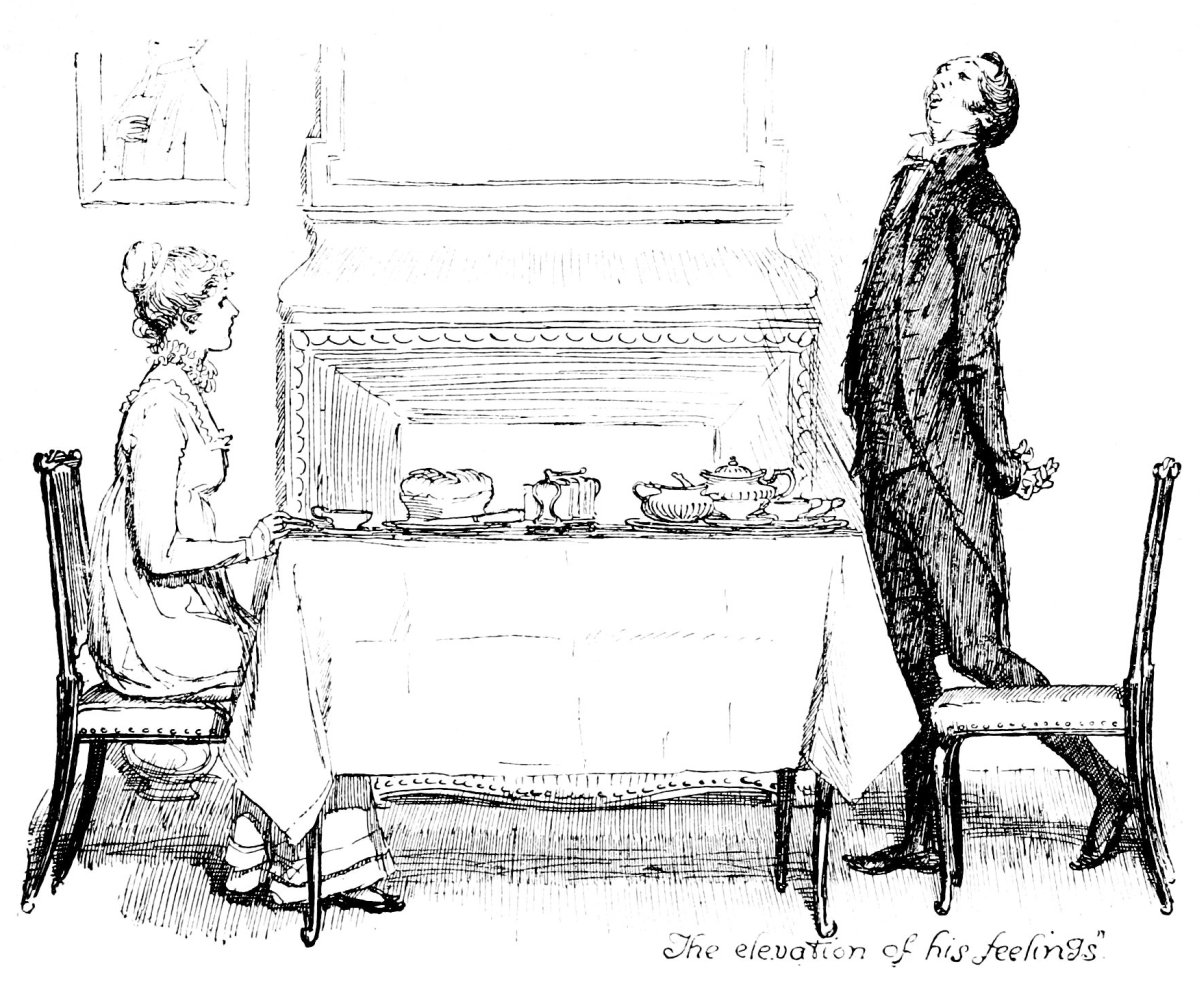
Words were insufficient for the elevation of his feelings; and he was obliged to walk about the room, while Elizabeth tried to unite civility and truth in a few short sentences.
Words could not express his joy, so he had to walk around the room. Meanwhile, Elizabeth tried to be both polite and truthful in a few short sentences.
“You may, in fact, carry a very favourable report of us into Hertfordshire, my dear cousin. I flatter myself, at least, that you will be able to do so. Lady Catherine’s great attentions to Mrs. Collins you have been a daily witness of; and altogether I trust it does not appear that your friend has drawn an unfortunate—but on this point it will be as well to be silent. Only let me assure you, my dear Miss Elizabeth, that I can from my heart most cordially wish you equal felicity in marriage. My dear Charlotte and I have but one mind and one way of thinking. There is in everything a most remarkable resemblance of character and ideas between us. We seem to have been designed for each other.”
“You may, in fact, give a very favorable account of us when you return to Hertfordshire, my dear cousin. At least, I like to think you will be able to. You have seen every day how much attention Lady Catherine pays Mrs. Collins. And overall, I trust your friend does not seem to have made an unfortunate choice. But it would be better to say nothing more on that subject. Just let me assure you, my dear Miss Elizabeth, that I wholeheartedly wish you equal happiness in marriage. My dear Charlotte and I are of one mind and think alike. Our characters and ideas are remarkably similar in every way. We seem to have been made for each other.”
Elizabeth could safely say that it was a great happiness where that was the case, and with equal sincerity could add, that she firmly believed and rejoiced in his domestic comforts. She was not sorry, however, to have the recital of them interrupted by the entrance of the lady from whom they sprang. Poor Charlotte! it was melancholy to leave her to such society! But she had chosen it with her eyes open; and though evidently regretting that her visitors were to go, she did not seem to ask for compassion. Her home and her housekeeping, her parish and her poultry, and all their dependent concerns, had not yet lost their charms.
Elizabeth could safely say that such a situation brought great happiness. She could add, just as sincerely, that she firmly believed in his happiness at home and was glad of it. Still, she was not sorry when the woman responsible for these comforts came in and interrupted his account. Poor Charlotte! How sad to leave her with such company! But she had made her choice with her eyes open. Although she clearly regretted that her visitors were leaving, she did not seem to ask for pity. Her home and housekeeping, her parish and poultry, and all the concerns connected with them had not yet lost their appeal.
At length the chaise arrived, the trunks were fastened on, the parcels placed within, and it was pronounced to be ready. After an affectionate parting between the friends, Elizabeth was attended to the carriage by Mr. Collins; and as they walked down the garden, he was commissioning her with his best respects to all her family, not forgetting his thanks for the kindness he had received at Longbourn in the winter, and his compliments to Mr. and Mrs. Gardiner, though unknown. He then handed her in, Maria followed, and the door was on the point of being closed, when he suddenly reminded them, with some consternation, that they had hitherto forgotten to leave any message for the ladies of Rosings.
At last the carriage arrived. The trunks were secured, the parcels placed inside, and the carriage declared ready. After the friends said an affectionate goodbye, Mr. Collins escorted Elizabeth to the carriage. As they walked down the garden, he asked her to give his best regards to all her family. He also thanked them for their kindness during his winter visit to Longbourn. He sent his regards to Mr. and Mrs. Gardiner too, although he had never met them. Then he helped Elizabeth into the carriage, and Maria followed. The door was just about to close when he suddenly reminded them, with some alarm, of something they had forgotten. They had not yet left any message for the ladies of Rosings.
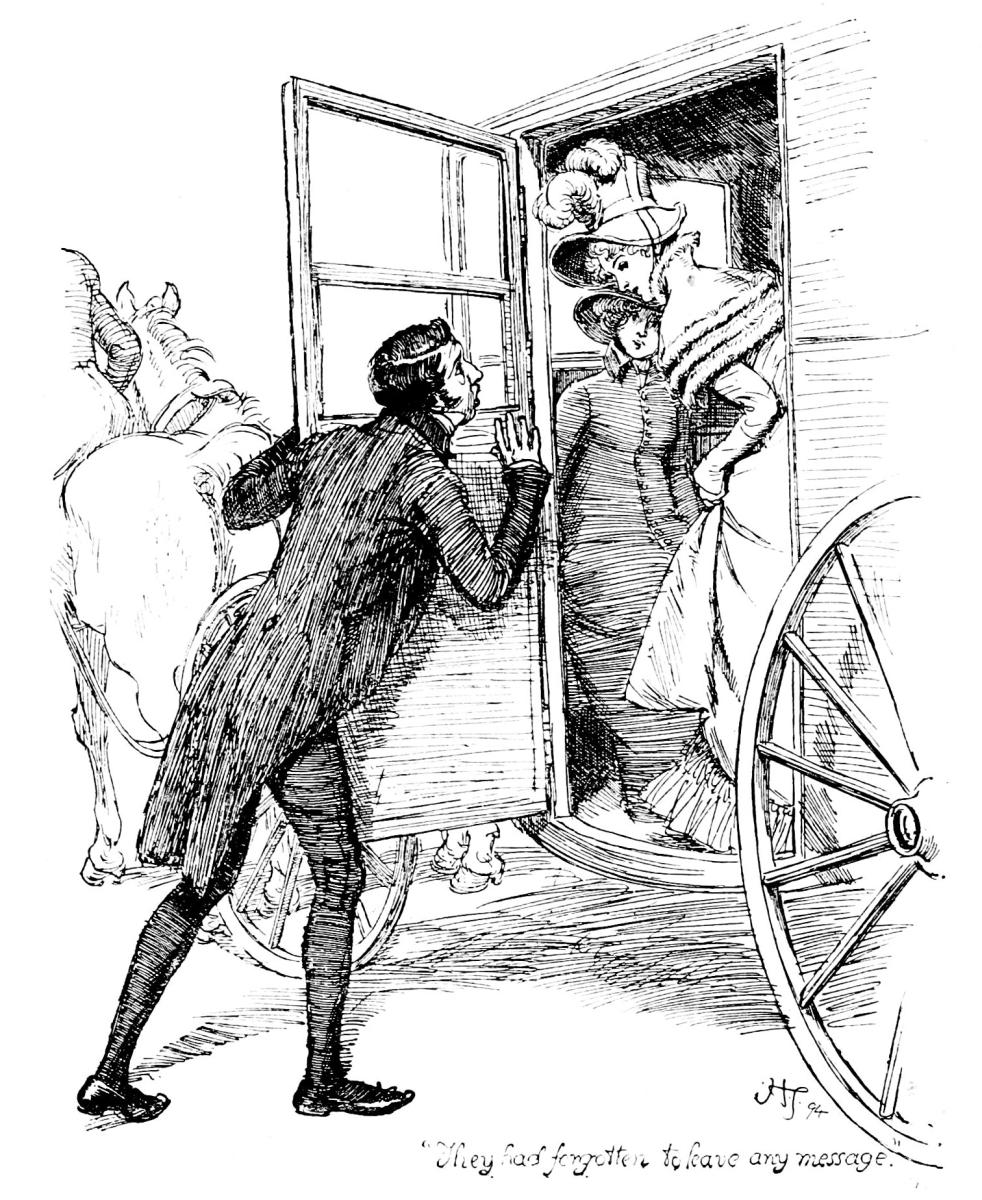
“But,” he added, “you will of course wish to have your humble respects delivered to them, with your grateful thanks for their kindness to you while you have been here.”
“But,” he added, “of course you’ll want to send them your respectful greetings. You’ll also want to express your gratitude for their kindness to you during your stay.”
Elizabeth made no objection: the door was then allowed to be shut, and the carriage drove off.
Elizabeth did not object. The door was then allowed to close, and the carriage drove off.
“Good gracious!” cried Maria, after a few minutes’ silence, “it seems but a day or two since we first came! and yet how many things have happened!”
“Good heavens!” Maria exclaimed after a few minutes of silence. “It feels like only a day or two since we arrived! And yet so much has happened!”
“A great many indeed,” said her companion, with a sigh.
“So many, indeed,” her companion said with a sigh.
“We have dined nine times at Rosings, besides drinking tea there twice! How much I shall have to tell!”
“We’ve had dinner nine times at Rosings, and we’ve had tea there twice! I’ll have so much to tell!”
Elizabeth privately added, “And how much I shall have to conceal!”
Elizabeth added silently, “And how much I’ll have to hide!”
Their journey was performed without much conversation, or any alarm; and within four hours of their leaving Hunsford they reached Mr. Gardiner’s house, where they were to remain a few days.
They made the journey with little conversation and no cause for alarm. Within four hours of leaving Hunsford, they reached Mr. Gardiner’s house, where they would stay for a few days.
Jane looked well, and Elizabeth had little opportunity of studying her spirits, amidst the various engagements which the kindness of her aunt had reserved for them. But Jane was to go home with her, and at Longbourn there would be leisure enough for observation.
Jane looked well, but Elizabeth had little chance to judge her mood. Their aunt had kindly arranged various activities that kept them busy. But Jane was going home with Elizabeth, and at Longbourn there would be plenty of time to observe her.
It was not without an effort, meanwhile, that she could wait even for Longbourn, before she told her sister of Mr. Darcy’s proposals. To know that she had the power of revealing what would so exceedingly astonish Jane, and must, at the same time, so highly gratify whatever of her own vanity she had not yet been able to reason away, was such a temptation to openness as nothing could have conquered, but the state of indecision in which she remained as to the extent of what she should communicate, and her fear, if she once entered on the subject, of being hurried into repeating something of Bingley, which might only grieve her sister further.
Meanwhile, she struggled to wait until she reached Longbourn before telling her sister about Mr. Darcy’s proposal. She knew she could reveal something that would astonish Jane. The news must also deeply flatter whatever vanity she had not yet managed to reason away. The temptation to speak was so strong that only two things held her back. She was still unsure how much to tell. And she feared that, once she began, she might find herself repeating something about Bingley, which might only hurt her sister further.