Chapter 39
IT was the second week in May, in which the three young ladies set out together from Gracechurch Street for the town of ——, in Hertfordshire; and, as they drew near the appointed inn where Mr. Bennet’s carriage was to meet them, they quickly perceived, in token of the coachman’s punctuality, both Kitty and Lydia looking out of a dining-room upstairs. These two girls had been above an hour in the place, happily employed in visiting an opposite milliner, watching the sentinel on guard, and dressing a salad and cucumber.
It was the second week in May when the three young ladies left Gracechurch Street together for the town of ____ in Hertfordshire. As they approached the inn where Mr. Bennet’s carriage was to meet them, they quickly spotted Kitty and Lydia. Both girls were looking out of an upstairs dining room, a sign that the coachman had arrived on time. Kitty and Lydia had been there for over an hour. They had happily spent the time visiting the hat shop opposite, watching the soldier on guard, and preparing salad and cucumber.
After welcoming their sisters, they triumphantly displayed a table set out with such cold meat as an inn larder usually affords, exclaiming, “Is not this nice? is not this an agreeable surprise?”
After welcoming their sisters, they proudly showed off a table laid with the cold meats usually available at an inn. They exclaimed, “Isn’t this nice? Isn’t this a lovely surprise?”
“And we mean to treat you all,” added Lydia; “but you must lend us the money, for we have just spent ours at the shop out there.” Then showing her purchases,—“Look here, I have bought this bonnet. I do not think it is very pretty; but I thought I might as well buy it as not. I shall pull it to pieces as soon as I get home, and see if I can make it up any better.”
“And we plan to treat you all,” Lydia added. “But you must lend us the money, because we’ve just spent ours at the shop out there.” Then she showed them her purchases. “Look, I bought this bonnet. I don’t think it’s very pretty, but I thought I might as well buy it as not. I’ll take it apart as soon as I get home and see if I can make it look any better.”
And when her sisters abused it as ugly, she added, with perfect unconcern, “Oh, but there were two or three much uglier in the shop; and when I have bought some prettier-coloured satin to trim it with fresh, I think it will be very tolerable. Besides, it will not much signify what one wears this summer, after the ——shire have left Meryton, and they are going in a fortnight.”
And when her sisters called it ugly, she added, completely unbothered, “Oh, but there were two or three much uglier ones in the shop. And when I’ve bought some satin in a prettier colour to redo the trim, I think it will look quite acceptable. Besides, what we wear this summer won’t matter much after the ____shire regiment leaves Meryton. And the regiment is leaving in two weeks.”
“Are they, indeed?” cried Elizabeth, with the greatest satisfaction.
“Are they really?” exclaimed Elizabeth, feeling utterly delighted.
“They are going to be encamped near Brighton; and I do so want papa to take us all there for the summer! It would be such a delicious scheme, and I dare say would hardly cost anything at all. Mamma would like to go, too, of all things! Only think what a miserable summer else we shall have!”
“They’re going to camp near Brighton. And I so want papa to take us all there for the summer! It would be such a wonderful plan, and I’m sure it would hardly cost anything at all. Mamma would love to go, too, more than anything! Just think what a miserable summer we’ll have otherwise!”
“Yes,” thought Elizabeth; “that would be a delightful scheme, indeed, and completely do for us at once. Good Heaven! Brighton and a whole campful of soldiers, to us, who have been overset already by one poor regiment of militia, and the monthly balls of Meryton!”
“Yes,” thought Elizabeth. “That would be a delightful plan, indeed. It would finish us off completely, all at once. Good heavens! Brighton and a whole camp full of soldiers, for us! We’ve already been thrown into confusion by one poor regiment of militia and the monthly balls in Meryton!”
“Now I have got some news for you,” said Lydia, as they sat down to table. “What do you think? It is excellent news, capital news, and about a certain person that we all like.”
“Now I have some news for you,” said Lydia, as they sat down at the table. “What do you think? It’s excellent news, wonderful news, and it’s about a certain person we all like.”
Jane and Elizabeth looked at each other, and the waiter was told that he need not stay. Lydia laughed, and said,—
Jane and Elizabeth looked at each other, and the waiter was told he didn't need to stay. Lydia laughed and said:
“Ay, that is just like your formality and discretion. You thought the waiter must not hear, as if he cared! I dare say he often hears worse things said than I am going to say. But he is an ugly fellow! I am glad he is gone. I never saw such a long chin in my life. Well, but now for my news: it is about dear Wickham; too good for the waiter, is not it? There is no danger of Wickham’s marrying Mary King—there’s for you! She is gone down to her uncle at Liverpool; gone to stay. Wickham is safe.”
“Yes, that’s just like you, always so proper and discreet. You thought the waiter mustn’t hear, as if he cared! I dare say he often hears worse things than I’m going to say. But he’s an ugly man! I’m glad he’s gone. I’ve never seen such a long chin in my life. Well, now for my news: it’s about dear Wickham. Too good for the waiter to hear, isn’t it? There’s no danger of Wickham marrying Mary King. How about that! She’s gone to her uncle’s in Liverpool, and she’s gone to stay. Wickham is safe.”
“And Mary King is safe!” added Elizabeth; “safe from a connection imprudent as to fortune.”
“And Mary King is safe!” Elizabeth added. “Safe from a financially unwise marriage.”
“She is a great fool for going away, if she liked him.”
“She’s a real fool for leaving if she liked him.”
“But I hope there is no strong attachment on either side,” said Jane.
“But I hope neither of them has strong feelings for the other,” said Jane.
“I am sure there is not on his. I will answer for it, he never cared three straws about her. Who could about such a nasty little freckled thing?”
“I’m sure there’s nothing on his side. I can guarantee he never cared a bit about her. Who could care about such a nasty little freckled thing?”
Elizabeth was shocked to think that, however incapable of such coarseness of expression herself, the coarseness of the sentiment was little other than her own breast had formerly harboured and fancied liberal!
Elizabeth was shocked. Though she could never be so crude in her expression, the crude sentiment hardly differed from her own earlier feelings. She had even thought those feelings open-minded!
As soon as all had ate, and the elder ones paid, the carriage was ordered; and, after some contrivance, the whole party, with all their boxes, workbags, and parcels, and the unwelcome addition of Kitty’s and Lydia’s purchases, were seated in it.
As soon as everyone had eaten and the older ones had paid, the carriage was called for. After some maneuvering, the whole party squeezed in with all their boxes, sewing bags, and parcels. Kitty’s and Lydia’s purchases were an unwelcome addition to the load.
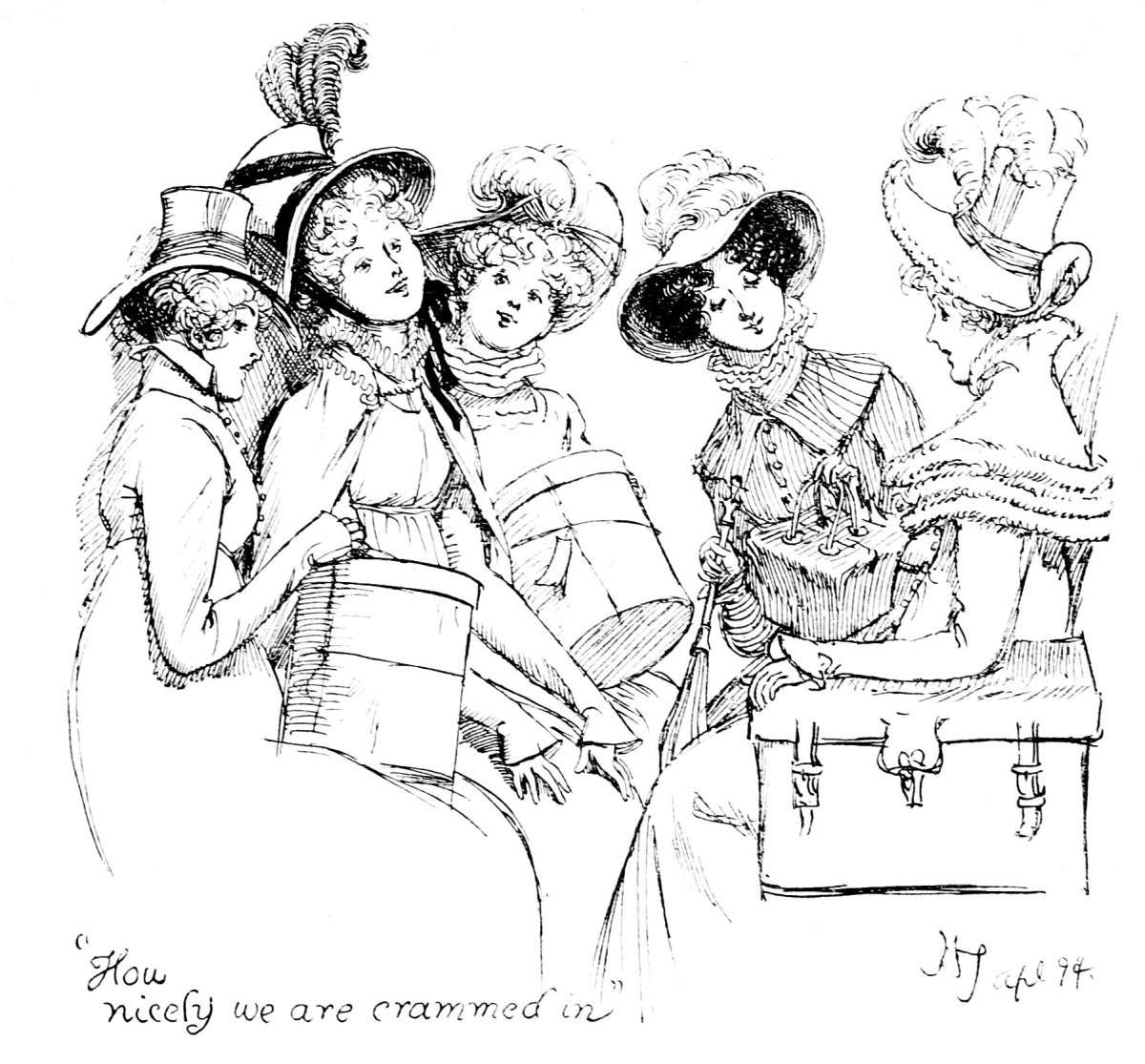
“How nicely we are crammed in!” cried Lydia. “I am glad I brought my bonnet, if it is only for the fun of having another band-box! Well, now let us be quite comfortable and snug, and talk and laugh all the way home. And in the first place, let us hear what has happened to you all since you went away. Have you seen any pleasant men? Have you had any flirting? I was in great hopes that one of you would have got a husband before you came back. Jane will be quite an old maid soon, I declare. She is almost three-and-twenty! Lord! how ashamed I should be of not being married before three-and-twenty! My aunt Philips wants you so to get husbands you can’t think. She says Lizzy had better have taken Mr. Collins; but I do not think there would have been any fun in it. Lord! how I should like to be married before any of you! and then I would chaperon you about to all the balls. Dear me! we had such a good piece of fun the other day at Colonel Forster’s! Kitty and me were to spend the day there, and Mrs. Forster promised to have a little dance in the evening; (by-the-bye, Mrs. Forster and me are such friends!) and so she asked the two Harringtons to come: but Harriet was ill, and so Pen was forced to come by herself; and then, what do you think we did? We dressed up Chamberlayne in woman’s clothes, on purpose to pass for a lady,—only think what fun! Not a soul knew of it, but Colonel and Mrs. Forster, and Kitty and me, except my aunt, for we were forced to borrow one of her gowns; and you cannot imagine how well he looked! When Denny, and Wickham, and Pratt, and two or three more of the men came in, they did not know him in the least. Lord! how I laughed! and so did Mrs. Forster. I thought I should have died. And that made the men suspect something, and then they soon found out what was the matter.”
“How nicely we’re all squeezed in!” cried Lydia. “I’m glad I brought my bonnet, if only for the fun of having another hatbox! Well, now let’s get comfortable and cozy, and talk and laugh all the way home. First, let’s hear what’s happened to you all since you went away. Have you met any pleasant men? Have you done any flirting? I had such high hopes that one of you would have found a husband before coming back. Jane will be an old maid soon, I declare. She’s almost twenty-three! Lord! How ashamed I’d be if I weren’t married before twenty-three! You can’t imagine how much my aunt Philips wants you to find husbands. She says Lizzy should have accepted Mr. Collins. But I don’t think there would have been any fun in that. Lord! How I’d love to be married before any of you! Then I would chaperon you at all the balls. Dear me! We had such fun the other day at Colonel Forster’s! Kitty and me were going to spend the day there. Mrs. Forster promised to arrange a little dance that evening. (By the way, Mrs. Forster and me are such friends!) So she invited the two Harringtons. But Harriet was ill, so Pen had to come by herself. And then, what do you think we did? We dressed Chamberlayne in women’s clothes so he could pass for a lady. Just think how funny! Not a soul knew except Colonel and Mrs. Forster, Kitty and me, and my aunt. We had to tell my aunt because we needed to borrow one of her gowns. You can’t imagine how good he looked! When Denny, Wickham, Pratt, and two or three more of the men came in, they didn’t recognize him at all. Lord! How I laughed! And so did Mrs. Forster. I thought I would die laughing. And that made the men suspect something, and then they soon discovered what was going on.”
With such kind of histories of their parties and good jokes did Lydia, assisted by Kitty’s hints and additions, endeavour to amuse her companions all the way to Longbourn. Elizabeth listened as little as she could, but there was no escaping the frequent mention of Wickham’s name.
With stories like these about their parties and good jokes, Lydia tried to entertain her companions all the way to Longbourn. Kitty helped with reminders and added details. Elizabeth listened as little as she could, but there was no escaping the frequent mention of Wickham’s name.
Their reception at home was most kind. Mrs. Bennet rejoiced to see Jane in undiminished beauty; and more than once during dinner did Mr. Bennet say voluntarily to Elizabeth,——
They received a very warm welcome at home. Mrs. Bennet was delighted to see Jane looking as beautiful as ever. And more than once during dinner, Mr. Bennet said to Elizabeth, without prompting:
“I am glad you are come back, Lizzy.”
“I’m glad you’re back, Lizzy.”
Their party in the dining-room was large, for almost all the Lucases came to meet Maria and hear the news; and various were the subjects which occupied them: Lady Lucas was inquiring of Maria, across the table, after the welfare and poultry of her eldest daughter; Mrs. Bennet was doubly engaged, on one hand collecting an account of the present fashions from Jane, who sat some way below her, and on the other, retailing them all to the younger Miss Lucases; and Lydia, in a voice rather louder than any other person’s, was enumerating the various pleasures of the morning to anybody who would hear her.
The dining room was crowded, because almost all the Lucases had come to meet Maria and hear the news. They had plenty of subjects to discuss. Lady Lucas was asking Maria across the table about her eldest daughter’s health and poultry. Mrs. Bennet was busy with two tasks at once. She was gathering news of the latest fashions from Jane, who sat some distance farther down the table. At the same time, she was passing all this news on to the younger Miss Lucases. Meanwhile, Lydia was listing the morning’s various pleasures to anyone who would listen. Her voice was rather louder than anyone else’s.
“Oh, Mary,” said she, “I wish you had gone with us, for we had such fun! as we went along Kitty and me drew up all the blinds, and pretended there was nobody in the coach; and I should have gone so all the way, if Kitty had not been sick; and when we got to the George, I do think we behaved very handsomely, for we treated the other three with the nicest cold luncheon in the world, and if you would have gone, we would have treated you too. And then when we came away it was such fun! I thought we never should have got into the coach. I was ready to die of laughter. And then we were so merry all the way home! we talked and laughed so loud, that anybody might have heard us ten miles off!”
“Oh, Mary,” she said, “I wish you had come with us, because we had such fun! As we rode along, Kitty and I pulled up all the blinds and pretended nobody was in the coach. I would have kept that up the whole way if Kitty hadn't felt sick. And when we got to the George, I really think we were very generous. We treated the other three to the nicest cold lunch in the world. And if you had come, we would have treated you too. And then, when we left, we had such fun! I thought we'd never manage to get into the coach. I was ready to die laughing. And then we had such a good time all the way home! We talked and laughed so loudly that anyone could have heard us ten miles away!”
To this, Mary very gravely replied, “Far be it from me, my dear sister, to depreciate such pleasures. They would doubtless be congenial with the generality of female minds. But I confess they would have no charms for me. I should infinitely prefer a book.”
Mary replied very seriously, “My dear sister, I would never belittle such pleasures. Most women would undoubtedly enjoy them. But I admit those pleasures would hold no appeal for me. I would much rather read a book.”
But of this answer Lydia heard not a word. She seldom listened to anybody for more than half a minute, and never attended to Mary at all.
But Lydia heard none of the answer. She rarely listened to anyone for more than half a minute, and never listened to Mary at all.
In the afternoon Lydia was urgent with the rest of the girls to walk to Meryton, and see how everybody went on; but Elizabeth steadily opposed the scheme. It should not be said, that the Miss Bennets could not be at home half a day before they were in pursuit of the officers. There was another reason, too, for her opposition. She dreaded seeing Wickham again, and was resolved to avoid it as long as possible. The comfort to her, of the regiment’s approaching removal, was indeed beyond expression. In a fortnight they were to go, and once gone, she hoped there could be nothing more to plague her on his account.
That afternoon Lydia urged the other girls to walk to Meryton and see how everyone was doing. But Elizabeth firmly opposed the plan. No one should say the Miss Bennets could not spend half a day at home without chasing after the officers. Elizabeth had another reason for objecting, too. She dreaded seeing Wickham again and was determined to avoid him as long as possible. The relief to her at the regiment’s approaching departure was beyond words. The regiment would leave in two weeks. Once the soldiers were gone, she hoped nothing more would trouble her on Wickham’s account.
She had not been many hours at home, before she found that the Brighton scheme, of which Lydia had given them a hint at the inn, was under frequent discussion between her parents. Elizabeth saw directly that her father had not the smallest intention of yielding; but his answers were at the same time so vague and equivocal, that her mother, though often disheartened, had never yet despaired of succeeding at last.
Within a few hours of arriving home, she found that her parents often discussed the plan to visit Brighton. Lydia had hinted at the plan at the inn. Elizabeth saw at once that her father had no intention at all of giving in. But his answers were so vague and unclear that her mother, though often discouraged, had never lost hope of eventually succeeding.