Chapter 28
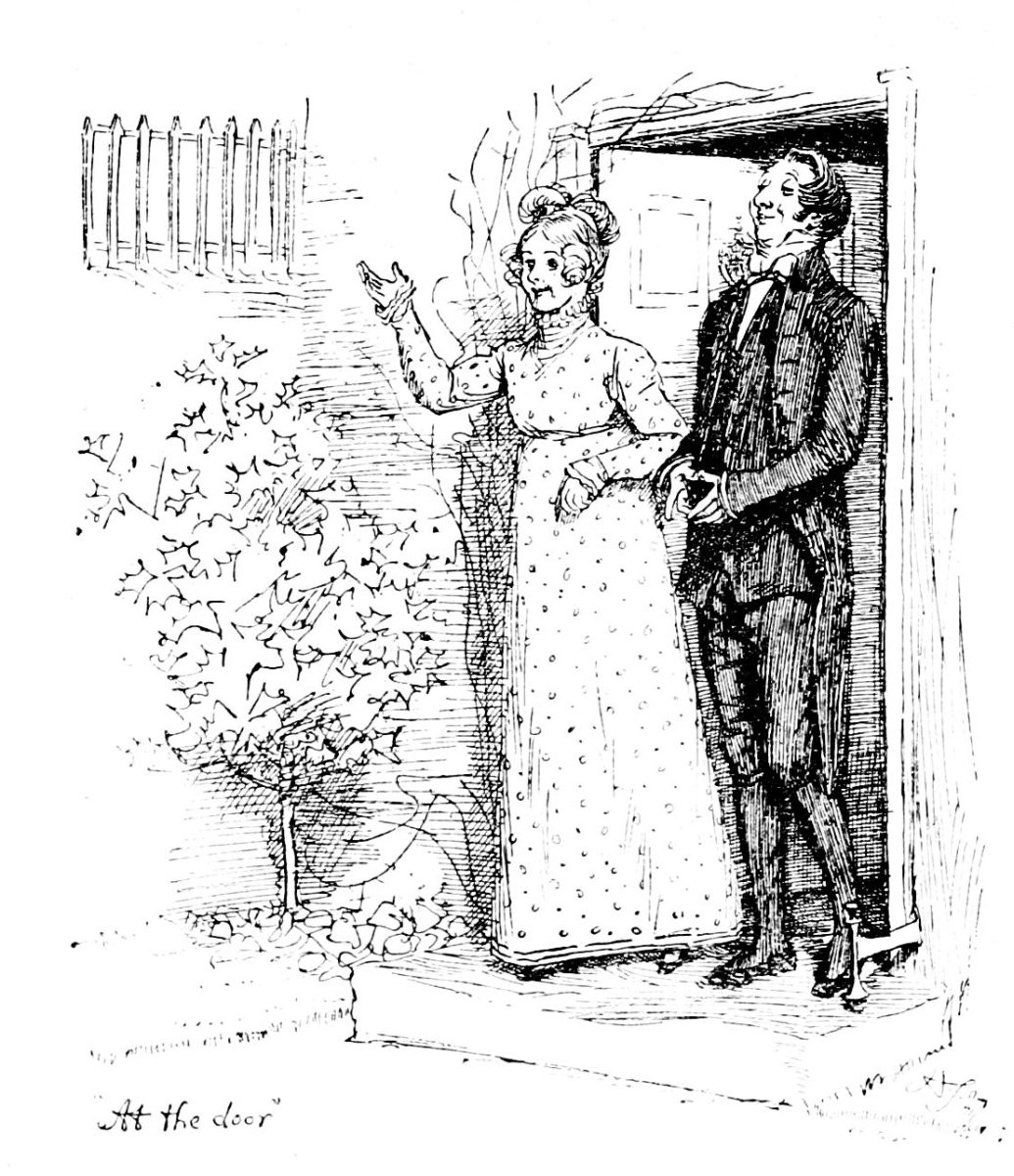
EVERY object in the next day’s journey was new and interesting to Elizabeth; and her spirits were in a state of enjoyment; for she had seen her sister looking so well as to banish all fear for her health, and the prospect of her northern tour was a constant source of delight.
Everything Elizabeth saw on the next day’s journey was new and interesting to her, and she was in high spirits. Her sister had looked so well that Elizabeth no longer had any fears about her health. And the thought of her upcoming tour of the north was a constant source of delight.
When they left the high road for the lane to Hunsford, every eye was in search of the Parsonage, and every turning expected to bring it in view. The paling of Rosings park was their boundary on one side. Elizabeth smiled at the recollection of all that she had heard of its inhabitants.
When they turned off the main road onto the lane to Hunsford, everyone looked for the Parsonage. At every bend, they expected the house to come into view. The fence around Rosings park ran along one side of the lane. Elizabeth smiled as she remembered all she had heard about the people who lived at Rosings.
At length the Parsonage was discernible. The garden sloping to the road, the house standing in it, the green pales and the laurel hedge, everything declared they were arriving. Mr. Collins and Charlotte appeared at the door, and the carriage stopped at the small gate, which led by a short gravel walk to the house, amidst the nods and smiles of the whole party. In a moment they were all out of the chaise, rejoicing at the sight of each other. Mrs. Collins welcomed her friend with the liveliest pleasure, and Elizabeth was more and more satisfied with coming, when she found herself so affectionately received. She saw instantly that her cousin’s manners were not altered by his marriage: his formal civility was just what it had been; and he detained her some minutes at the gate to hear and satisfy his inquiries after all her family. They were then, with no other delay than his pointing out the neatness of the entrance, taken into the house; and as soon as they were in the parlour, he welcomed them a second time, with ostentatious formality, to his humble abode, and punctually repeated all his wife’s offers of refreshment.
At last, the Parsonage came into view. The garden sloped toward the road, with the house standing within it. The green fence and laurel hedge all showed that they were arriving. Mr. Collins and Charlotte appeared at the door, and the carriage stopped at the small gate. A short gravel path led from the gate to the house. Everyone nodded and smiled. In a moment, they were all out of the carriage, delighted to see one another. Mrs. Collins welcomed her friend with great pleasure. Elizabeth felt increasingly glad she had come when she found herself welcomed so affectionately. She saw at once that marriage had not changed her cousin’s manners. His stiff politeness was just as it had been. He kept her at the gate for several minutes while she listened to and answered questions about her whole family. Then he took them into the house, pausing only to point out how neat the entrance was. As soon as they entered the sitting room, he welcomed them a second time to his humble home with showy formality. He also carefully repeated all his wife’s offers of refreshments.
Elizabeth was prepared to see him in his glory; and she could not help fancying that in displaying the good proportion of the room, its aspect, and its furniture, he addressed himself particularly to her, as if wishing to make her feel what she had lost in refusing him. But though everything seemed neat and comfortable, she was not able to gratify him by any sigh of repentance; and rather looked with wonder at her friend, that she could have so cheerful an air with such a companion. When Mr. Collins said anything of which his wife might reasonably be ashamed, which certainly was not seldom, she involuntarily turned her eye on Charlotte. Once or twice she could discern a faint blush; but in general Charlotte wisely did not hear. After sitting long enough to admire every article of furniture in the room, from the sideboard to the fender, to give an account of their journey, and of all that had happened in London, Mr. Collins invited them to take a stroll in the garden, which was large and well laid out, and to the cultivation of which he attended himself. To work in his garden was one of his most respectable pleasures; and Elizabeth admired the command of countenance with which Charlotte talked of the healthfulness of the exercise, and owned she encouraged it as much as possible. Here, leading the way through every walk and cross walk, and scarcely allowing them an interval to utter the praises he asked for, every view was pointed out with a minuteness which left beauty entirely behind. He could number the fields in every direction, and could tell how many trees there were in the most distant clump. But of all the views which his garden, or which the country or the kingdom could boast, none were to be compared with the prospect of Rosings, afforded by an opening in the trees that bordered the park nearly opposite the front of his house. It was a handsome modern building, well situated on rising ground.
Elizabeth was ready to see him at his proudest. As he showed off the room’s pleasing proportions, its outlook, and its furniture, she could not help imagining he meant it particularly for her. It was as if he wanted her to feel what she had lost by refusing him. But although everything looked neat and comfortable, she could not reward him with a single sigh of regret. Instead, she wondered how her friend could look so cheerful with such a companion. Whenever Mr. Collins said something his wife might reasonably be ashamed of, Elizabeth instinctively glanced at Charlotte. This certainly happened often. Once or twice, Elizabeth noticed a faint blush, but Charlotte generally had the wisdom to hear nothing. They sat long enough to admire every piece of furniture in the room, from the sideboard to the fireplace guard. They also described their journey and everything that had happened in London. Then Mr. Collins invited them to stroll in the garden. It was large and well planned, and he tended it himself. Gardening was one of his more respectable pleasures. Elizabeth admired Charlotte’s straight face as she spoke of how healthy the exercise was. Charlotte admitted that she encouraged him to garden as much as possible. Mr. Collins led them along every path and crossing, scarcely giving them time to offer the praise he requested. He pointed out every view in such minute detail that beauty was entirely forgotten. He could count the fields in every direction and say how many trees stood in the most distant group. But no view from his garden, or anywhere in the countryside or the kingdom, could compare with the view of Rosings. An opening in the trees bordering the park revealed it, almost directly opposite the front of his house. It was a handsome modern building, well placed on rising ground.
From his garden, Mr. Collins would have led them round his two meadows; but the ladies, not having shoes to encounter the remains of a white frost, turned back; and while Sir William accompanied him, Charlotte took her sister and friend over the house, extremely well pleased, probably, to have the opportunity of showing it without her husband’s help. It was rather small, but well built and convenient; and everything was fitted up and arranged with a neatness and consistency, of which Elizabeth gave Charlotte all the credit. When Mr. Collins could be forgotten, there was really a great air of comfort throughout, and by Charlotte’s evident enjoyment of it, Elizabeth supposed he must be often forgotten.
From his garden, Mr. Collins would have taken them around his two meadows. But the ladies turned back, since their shoes were unsuitable for walking through the frost that remained. While Sir William went with Mr. Collins, Charlotte showed her sister and friend around the house. She was probably extremely pleased to have the chance to show them around without her husband’s help. The house was rather small, but well built and practical. Everything was furnished and arranged neatly and harmoniously, and Elizabeth gave Charlotte all the credit. When Mr. Collins could be forgotten, the whole house really did feel very comfortable. Judging by Charlotte’s obvious enjoyment of her home, Elizabeth supposed he must often be forgotten.
She had already learnt that Lady Catherine was still in the country. It was spoken of again while they were at dinner, when Mr. Collins joining in, observed,—
She had already learned that Lady Catherine was still in the country. The subject came up again at dinner, and Mr. Collins joined in, saying:
“Yes, Miss Elizabeth, you will have the honour of seeing Lady Catherine de Bourgh on the ensuing Sunday at church, and I need not say you will be delighted with her. She is all affability and condescension, and I doubt not but you will be honoured with some portion of her notice when service is over. I have scarcely any hesitation in saying that she will include you and my sister Maria in every invitation with which she honours us during your stay here. Her behaviour to my dear Charlotte is charming. We dine at Rosings twice every week, and are never allowed to walk home. Her Ladyship’s carriage is regularly ordered for us. I should say, one of her Ladyship’s carriages, for she has several.”
“Yes, Miss Elizabeth, you will have the honour of seeing Lady Catherine de Bourgh at church next Sunday. I need hardly say how delighted you will be with her. She is all friendliness and gracious attention to those beneath her. I have no doubt she will honour you with some attention after the service. I can say with almost complete confidence that she will include you and my sister Maria in every invitation. I mean every invitation she honours us with during your stay here. Her behaviour towards my dear Charlotte is charming. We dine at Rosings twice every week, and we are never allowed to walk home. Her Ladyship always orders her carriage for us. I should say, one of her Ladyship’s carriages, for she has several.”
“Lady Catherine is a very respectable, sensible woman, indeed,” added Charlotte, “and a most attentive neighbour.”
“Lady Catherine really is a very respectable, sensible woman,” Charlotte added. “And she’s a very attentive neighbour.”
“Very true, my dear, that is exactly what I say. She is the sort of woman whom one cannot regard with too much deference.”
“Very true, my dear. That is exactly what I say. She is the kind of woman you can never show too much respect.”
The evening was spent chiefly in talking over Hertfordshire news, and telling again what had been already written; and when it closed, Elizabeth, in the solitude of her chamber, had to meditate upon Charlotte’s degree of contentment, to understand her address in guiding, and composure in bearing with, her husband, and to acknowledge that it was all done very well. She had also to anticipate how her visit would pass, the quiet tenour of their usual employments, the vexatious interruptions of Mr. Collins, and the gaieties of their intercourse with Rosings. A lively imagination soon settled it all.
They spent most of the evening discussing Hertfordshire news and repeating what had already been written in letters. When the evening ended, Elizabeth reflected, alone in her room, on how content Charlotte was. She considered Charlotte’s skill in managing her husband and her calm patience with him. She had to admit that Charlotte handled it all very well. Elizabeth also imagined how her visit would unfold: their quiet daily routines, Mr. Collins’s irritating interruptions, and their lively social visits to Rosings. Her lively imagination soon worked it all out.
About the middle of the next day, as she was in her room getting ready for a walk, a sudden noise below seemed to speak the whole house in confusion; and, after listening a moment, she heard somebody running upstairs in a violent hurry, and calling loudly after her. She opened the door, and met Maria in the landing-place, who, breathless with agitation, cried out,—
Around midday the next day, she was in her room getting ready for a walk. A sudden noise downstairs suggested the whole house was in confusion. After listening for a moment, she heard someone rushing upstairs and calling loudly for her. She opened the door and met Maria on the landing. Breathless with excitement, Maria cried out:
“Oh, my dear Eliza! pray make haste and come into the dining-room, for there is such a sight to be seen! I will not tell you what it is. Make haste, and come down this moment.”
“Oh, my dear Eliza! Please hurry and come into the dining room. There’s such a sight to see! I won’t tell you what it is. Hurry and come downstairs right now.”
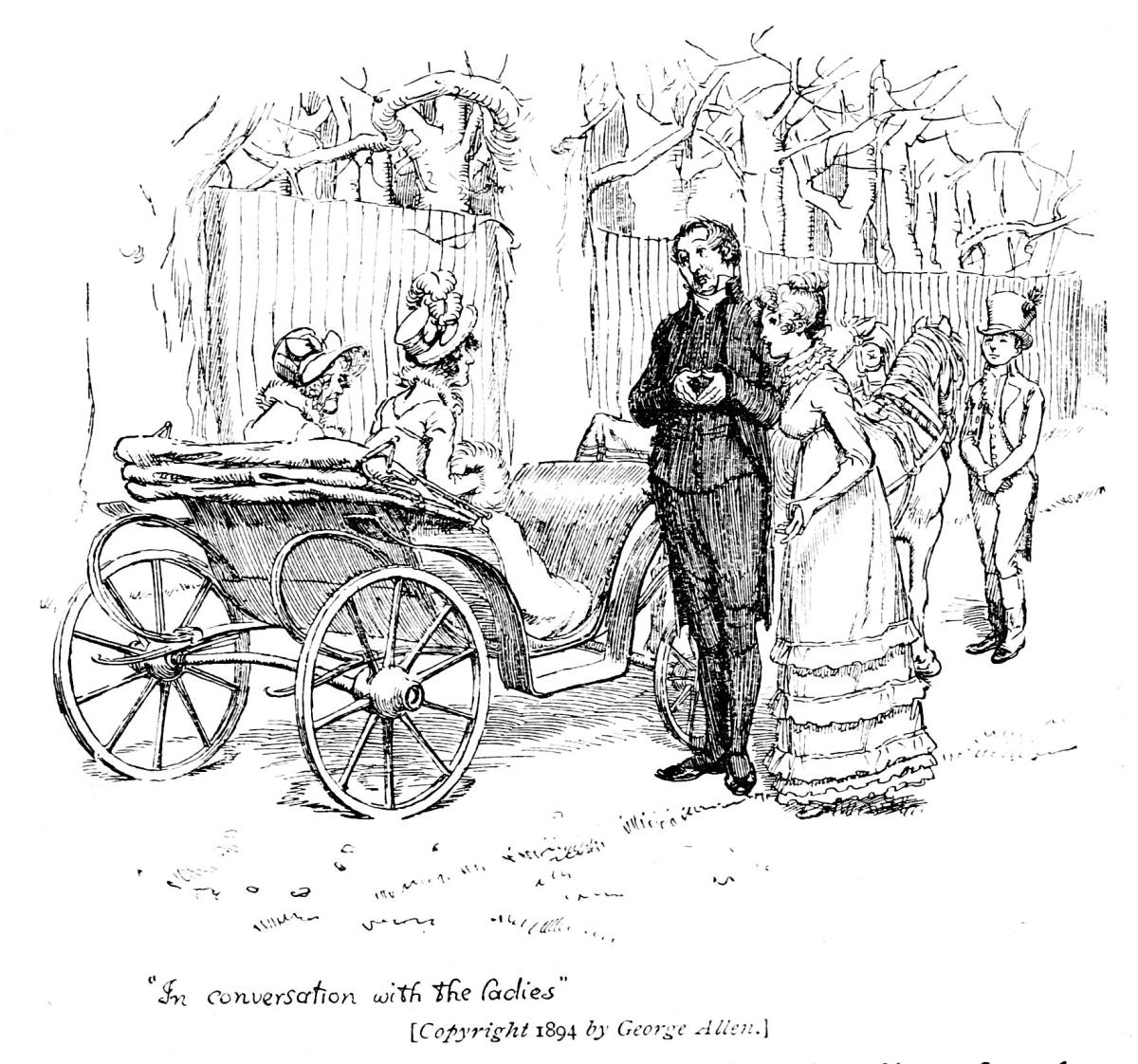
Elizabeth asked questions in vain; Maria would tell her nothing more; and down they ran into the dining-room which fronted the lane, in quest of this wonder; it was two ladies, stopping in a low phaeton at the garden gate.
Elizabeth asked questions, but got no answers. Maria would tell her nothing more. They ran downstairs into the dining room, which faced the lane, to see this wonder. It turned out to be two ladies stopping at the garden gate in a low, open carriage.
“And is this all?” cried Elizabeth. “I expected at least that the pigs were got into the garden, and here is nothing but Lady Catherine and her daughter!”
“And is this all?” Elizabeth exclaimed. “I expected at least that the pigs had gotten into the garden. But it’s only Lady Catherine and her daughter!”
“La! my dear,” said Maria, quite shocked at the mistake, “it is not Lady Catherine. The old lady is Mrs. Jenkinson, who lives with them. The other is Miss De Bourgh. Only look at her. She is quite a little creature. Who would have thought she could be so thin and small!”
“Oh! my dear,” said Maria, quite shocked at the mistake, “that’s not Lady Catherine. The old lady is Mrs. Jenkinson, who lives with them. The other woman is Miss De Bourgh. Just look at her. She’s such a tiny little thing. Who would have thought she could be so thin and small!”
“She is abominably rude to keep Charlotte out of doors in all this wind. Why does she not come in?”
“She is terribly rude to keep Charlotte outside in all this wind. Why doesn’t she come in?”
“Oh, Charlotte says she hardly ever does. It is the greatest of favours when Miss De Bourgh comes in.”
“Oh, Charlotte says she hardly ever does. Miss De Bourgh is doing them the greatest favor when she comes in.”
“I like her appearance,” said Elizabeth, struck with other ideas. “She looks sickly and cross. Yes, she will do for him very well. She will make him a very proper wife.”
“I like how she looks,” said Elizabeth, as other thoughts struck her. “She looks sickly and bad-tempered. Yes, she’ll suit him very well. She’ll make him a very suitable wife.”
Mr. Collins and Charlotte were both standing at the gate in conversation with the ladies; and Sir William, to Elizabeth’s high diversion, was stationed in the doorway, in earnest contemplation of the greatness before him, and constantly bowing whenever Miss De Bourgh looked that way.
Mr. Collins and Charlotte were standing at the gate, talking with the ladies. To Elizabeth’s great amusement, Sir William stood in the doorway, gazing earnestly at the greatness before him. He kept bowing whenever Miss De Bourgh looked his way.
At length there was nothing more to be said; the ladies drove on, and the others returned into the house. Mr. Collins no sooner saw the two girls than he began to congratulate them on their good fortune, which Charlotte explained by letting them know that the whole party was asked to dine at Rosings the next day.
Finally, there was nothing more to say. The ladies drove on, and the others went back into the house. As soon as Mr. Collins saw the two girls, he began congratulating them on their good fortune. Charlotte explained that everyone in their group had been invited to dinner at Rosings the next day.