Chapter 29
MR. COLLINS’S triumph, in consequence of this invitation, was complete. The power of displaying the grandeur of his patroness to his wondering visitors, and of letting them see her civility towards himself and his wife, was exactly what he had wished for; and that an opportunity of doing it should be given so soon was such an instance of Lady Catherine’s condescension as he knew not how to admire enough.
MR. COLLINS’S triumph was complete because of this invitation. He could show his amazed visitors the grandeur of his patroness. He could also show them how politely she treated him and his wife. This was exactly what he had wished for. Lady Catherine had graciously given him this opportunity so soon that he could not admire her kindness enough.
“I confess,” said he, “that I should not have been at all surprised by her Ladyship’s asking us on Sunday to drink tea and spend the evening at Rosings. I rather expected, from my knowledge of her affability, that it would happen. But who could have foreseen such an attention as this? Who could have imagined that we should receive an invitation to dine there (an invitation, moreover, including the whole party) so immediately after your arrival?”
“I admit,” he said, “I wouldn’t have been at all surprised if her Ladyship had invited us to Rosings on Sunday. We could have had tea and spent the evening there. Knowing how friendly she is, I rather expected such an invitation. But who could have expected such special attention as this? Who could have imagined we would be invited to dinner there so soon after your arrival? And that the invitation would include the whole party?”
“I am the less surprised at what has happened,” replied Sir William, “from that knowledge of what the manners of the great really are, which my situation in life has allowed me to acquire. About the court, such instances of elegant breeding are not uncommon.”
“I am less surprised by what has happened,” replied Sir William, “because I know how the upper classes really behave. My position in society has given me that knowledge. At court, such examples of refined manners are not uncommon.”
Scarcely anything was talked of the whole day or next morning but their visit to Rosings. Mr. Collins was carefully instructing them in what they were to expect, that the sight of such rooms, so many servants, and so splendid a dinner, might not wholly overpower them.
All that day and the next morning, they talked of almost nothing but their visit to Rosings. Mr. Collins carefully explained what they should expect. He did this so the grand rooms, the many servants, and the splendid dinner might not completely overwhelm them.
When the ladies were separating for the toilette, he said to Elizabeth,—
As the ladies went off to get dressed, he said to Elizabeth:
“Do not make yourself uneasy, my dear cousin, about your apparel. Lady Catherine is far from requiring that elegance of dress in us which becomes herself and daughter. I would advise you merely to put on whatever of your clothes is superior to the rest—there is no occasion for anything more. Lady Catherine will not think the worse of you for being simply dressed. She likes to have the distinction of rank preserved.”
“Do not worry about your clothes, my dear cousin. Lady Catherine is far from expecting us to dress as elegantly as she and her daughter should. I would advise you simply to wear the best clothes you have. There is no need for anything more. Lady Catherine will not think less of you for dressing simply. She likes to keep the differences in social rank clear.”
While they were dressing, he came two or three times to their different doors, to recommend their being quick, as Lady Catherine very much objected to be kept waiting for her dinner. Such formidable accounts of her Ladyship, and her manner of living, quite frightened Maria Lucas, who had been little used to company; and she looked forward to her introduction at Rosings with as much apprehension as her father had done to his presentation at St. James’s.
While they were dressing, he came to each of their doors two or three times to urge them to hurry. Lady Catherine strongly objected to being kept waiting for dinner. These intimidating descriptions of her Ladyship and her way of life quite frightened Maria Lucas, who rarely mixed in company. She anticipated her introduction at Rosings with as much anxiety as her father had felt before his presentation at St. James’s.
As the weather was fine, they had a pleasant walk of about half a mile across the park. Every park has its beauty and its prospects; and Elizabeth saw much to be pleased with, though she could not be in such raptures as Mr. Collins expected the scene to inspire, and was but slightly affected by his enumeration of the windows in front of the house, and his relation of what the glazing altogether had originally cost Sir Lewis de Bourgh.
The weather was fine, so they enjoyed a walk of about half a mile across the park. Every park has its beauty and its views, and Elizabeth found much to admire. Still, she could not feel the delight Mr. Collins expected the scenery to inspire. She was only slightly impressed by his count of the windows at the front of the house. Nor was she much moved by his account of what all the window glass had originally cost Sir Lewis de Bourgh.
When they ascended the steps to the hall, Maria’s alarm was every moment increasing, and even Sir William did not look perfectly calm. Elizabeth’s courage did not fail her. She had heard nothing of Lady Catherine that spoke her awful from any extraordinary talents or miraculous virtue, and the mere stateliness of money and rank she thought she could witness without trepidation.
As they climbed the steps to the hall, Maria grew more frightened with every moment. Even Sir William did not look entirely calm. Elizabeth remained brave. Nothing she had heard about Lady Catherine suggested extraordinary talents or astonishing goodness that would inspire awe. And Elizabeth thought she could face the grandeur of wealth and rank alone without trembling.
From the entrance hall, of which Mr. Collins pointed out, with a rapturous air, the fine proportion and finished ornaments, they followed the servants through an antechamber to the room where Lady Catherine, her daughter, and Mrs. Jenkinson were sitting. Her Ladyship, with great condescension, arose to receive them; and as Mrs. Collins had settled it with her husband that the office of introduction should be hers, it was performed in a proper manner, without any of those apologies and thanks which he would have thought necessary.
In the entrance hall, Mr. Collins enthusiastically pointed out the room’s fine proportions and beautifully finished decorations. From there, they followed the servants through a waiting room into the room where Lady Catherine, her daughter, and Mrs. Jenkinson sat. Her Ladyship graciously lowered herself to rise and welcome them. Mrs. Collins had agreed with her husband that she would make the introductions, so she handled them properly. She offered none of the apologies and thanks that Mr. Collins would have thought necessary.
In spite of having been at St. James’s, Sir William was so completely awed by the grandeur surrounding him, that he had but just courage enough to make a very low bow, and take his seat without saying a word; and his daughter, frightened almost out of her senses, sat on the edge of her chair, not knowing which way to look. Elizabeth found herself quite equal to the scene, and could observe the three ladies before her composedly. Lady Catherine was a tall, large woman, with strongly-marked features, which might once have been handsome. Her air was not conciliating, nor was her manner of receiving them such as to make her visitors forget their inferior rank. She was not rendered formidable by silence: but whatever she said was spoken in so authoritative a tone as marked her self-importance, and brought Mr. Wickham immediately to Elizabeth’s mind; and, from the observation of the day altogether, she believed Lady Catherine to be exactly what he had represented.
Although Sir William had been to St. James’s, the grandeur around him left him completely awestruck. He barely had the courage to bow very low and sit down without a word. His daughter, almost out of her senses with fright, sat on the edge of her chair, unsure where to look. Elizabeth felt quite at ease and calmly observed the three ladies before her. Lady Catherine was a tall, large woman with striking features that might once have been handsome. She was not welcoming, and her greeting did nothing to make her visitors forget their lower social rank. It was not silence that made her intimidating. Rather, everything she said carried an authoritative tone that revealed her sense of her own importance. Her tone immediately brought Mr. Wickham to Elizabeth’s mind. From everything Elizabeth had observed that day, she believed Lady Catherine was exactly as he had described her.
When, after examining the mother, in whose countenance and deportment she soon found some resemblance of Mr. Darcy, she turned her eyes on the daughter, she could almost have joined in Maria’s astonishment at her being so thin and so small. There was neither in figure nor face any likeness between the ladies. Miss de Bourgh was pale and sickly: her features, though not plain, were insignificant; and she spoke very little, except in a low voice, to Mrs. Jenkinson, in whose appearance there was nothing remarkable, and who was entirely engaged in listening to what she said, and placing a screen in the proper direction before her eyes.
She first studied the mother and soon noticed some resemblance to Mr. Darcy in her face and manner. Then she turned to the daughter and could almost share Maria’s astonishment at how thin and small she was. The two women looked nothing alike, either in build or in face. Miss de Bourgh was pale and sickly. Her features, though not unattractive, were unremarkable. She spoke very little, and then only in a low voice to Mrs. Jenkinson. There was nothing remarkable about Mrs. Jenkinson’s appearance. She was entirely occupied with listening to Miss de Bourgh and positioning a screen to shield the young woman’s eyes.
After sitting a few minutes, they were all sent to one of the windows to admire the view, Mr. Collins attending them to point out its beauties, and Lady Catherine kindly informing them that it was much better worth looking at in the summer.
After sitting for a few minutes, they were all sent to one of the windows to admire the view. Mr. Collins went with them to point out its beauties. Lady Catherine kindly informed them that the view was much more worth seeing in summer.
The dinner was exceedingly handsome, and there were all the servants, and all the articles of plate which Mr. Collins had promised; and, as he had likewise foretold, he took his seat at the bottom of the table, by her Ladyship’s desire, and looked as if he felt that life could furnish nothing greater. He carved and ate and praised with delighted alacrity; and every dish was commended first by him, and then by Sir William, who was now enough recovered to echo whatever his son-in-law said, in a manner which Elizabeth wondered Lady Catherine could bear. But Lady Catherine seemed gratified by their excessive admiration, and gave most gracious smiles, especially when any dish on the table proved a novelty to them. The party did not supply much conversation. Elizabeth was ready to speak whenever there was an opening, but she was seated between Charlotte and Miss de Bourgh—the former of whom was engaged in listening to Lady Catherine, and the latter said not a word to her all the dinnertime. Mrs. Jenkinson was chiefly employed in watching how little Miss de Bourgh ate, pressing her to try some other dish and fearing she was indisposed. Maria thought speaking out of the question, and the gentlemen did nothing but eat and admire.
The dinner was extremely lavish, with all the servants and all the silverware Mr. Collins had promised. Just as he had also predicted, he sat at the foot of the table at her Ladyship’s request. He looked as if he felt life could offer nothing greater. He carved, ate, and praised everything with delighted enthusiasm. Every dish was praised first by him and then by Sir William. Sir William had now recovered enough to echo whatever his son-in-law said. Elizabeth wondered how Lady Catherine could bear their praise. But Lady Catherine seemed pleased by their excessive admiration and smiled most graciously. She smiled especially when any dish on the table was new to them. There was little conversation among the guests. Elizabeth was ready to speak whenever an opportunity arose, but she sat between Charlotte and Miss de Bourgh. Charlotte was busy listening to Lady Catherine, and Miss de Bourgh said nothing to Elizabeth throughout dinner. Mrs. Jenkinson spent most of her time watching how little Miss de Bourgh ate. She urged Miss de Bourgh to try another dish and worried that she was unwell. Maria thought speaking was out of the question, and the gentlemen did nothing but eat and admire.
When the ladies returned to the drawing-room, there was little to be done but to hear Lady Catherine talk, which she did without any intermission till coffee came in, delivering her opinion on every subject in so decisive a manner as proved that she was not used to have her judgment controverted. She inquired into Charlotte’s domestic concerns familiarly and minutely, and gave her a great deal of advice as to the management of them all; told her how everything ought to be regulated in so small a family as hers, and instructed her as to the care of her cows and her poultry. Elizabeth found that nothing was beneath this great lady’s attention which could furnish her with an occasion for dictating to others. In the intervals of her discourse with Mrs. Collins, she addressed a variety of questions to Maria and Elizabeth, but especially to the latter, of whose connections she knew the least, and who, she observed to Mrs. Collins, was a very genteel, pretty kind of girl. She asked her at different times how many sisters she had, whether they were older or younger than herself, whether any of them were likely to be married, whether they were handsome, where they had been educated, what carriage her father kept, and what had been her mother’s maiden name? Elizabeth felt all the impertinence of her questions, but answered them very composedly. Lady Catherine then observed,—
When the ladies returned to the drawing room, there was little to do but listen to Lady Catherine talk. She spoke without a pause until coffee arrived, giving her opinion on every subject. Her tone was so firm that she clearly was not used to having her judgment challenged. She asked Charlotte detailed questions about her household, with no ceremony, and gave her plenty of advice on managing everything. She told Charlotte how everything should be arranged in such a small household as hers. She also instructed her on caring for her cows and poultry. Elizabeth saw that no detail was beneath this great lady’s notice if it offered a chance to order others around. Between her remarks to Mrs. Collins, Lady Catherine asked Maria and Elizabeth a variety of questions. She focused especially on Elizabeth, whose family connections she knew least about. She remarked to Mrs. Collins that Elizabeth was a very well-mannered, pretty sort of girl. At different points, she asked Elizabeth how many sisters she had and whether they were older or younger than her. She asked whether any were likely to marry, whether they were good-looking, and where they had been educated. She also asked what carriage her father owned and what her mother’s maiden name had been. Elizabeth fully recognized how intrusive these questions were, but answered very calmly. Lady Catherine then remarked:
“Your father’s estate is entailed on Mr. Collins, I think? For your sake,” turning to Charlotte, “I am glad of it; but otherwise I see no occasion for entailing estates from the female line. It was not thought necessary in Sir Lewis de Bourgh’s family. Do you play and sing, Miss Bennet?”
“Your father’s estate is legally required to pass to Mr. Collins, I believe?” She turned to Charlotte. “For your sake, I’m glad of that arrangement. But otherwise, I see no reason to prevent women from inheriting estates. Such a restriction wasn’t thought necessary in Sir Lewis de Bourgh’s family. Do you play and sing, Miss Bennet?”
“A little.”
“A little.”
“Oh then—some time or other we shall be happy to hear you. Our instrument is a capital one, probably superior to —— you shall try it some day. Do your sisters play and sing?”
“Oh, then we'd be happy to hear you play sometime. Our instrument is excellent, probably better than... You shall try it someday. Do your sisters play and sing?”
“One of them does.”
“One of them does.”
“Why did not you all learn? You ought all to have learned. The Miss Webbs all play, and their father has not so good an income as yours. Do you draw?”
“Why didn’t you all learn? You should all have learned. The Miss Webbs all play, and their father’s income is lower than yours. Do you draw?”
“No, not at all.”
“No, not at all.”
“What, none of you?”
“What, none of you?”
“Not one.”
“Not one.”
“That is very strange. But I suppose you had no opportunity. Your mother should have taken you to town every spring for the benefit of masters.”
“That is very strange. But I suppose you never had the chance. Your mother should have taken you to town every spring for lessons with teachers.”
“My mother would have no objection, but my father hates London.”
“My mother wouldn’t mind, but my father hates London.”
“Has your governess left you?”
“Has your governess left you?”
“We never had any governess.”
“We never had a governess.”
“No governess! How was that possible? Five daughters brought up at home without a governess! I never heard of such a thing. Your mother must have been quite a slave to your education.”
“No governess! How was that possible? Five daughters raised at home without a governess! I’ve never heard of such a thing. Your mother must have been quite a slave to your education.”
Elizabeth could hardly help smiling, as she assured her that had not been the case.
Elizabeth could barely keep from smiling as she assured her that wasn't what had happened.
“Then who taught you? who attended to you? Without a governess, you must have been neglected.”
“Then who taught you? Who looked after you? Without a governess, you must have been neglected.”
“Compared with some families, I believe we were; but such of us as wished to learn never wanted the means. We were always encouraged to read, and had all the masters that were necessary. Those who chose to be idle certainly might.”
“Compared with some families, I believe we were. But those of us who wanted to learn always had the means. We were always encouraged to read and had all the teachers we needed. Those who chose to be idle certainly could be.”
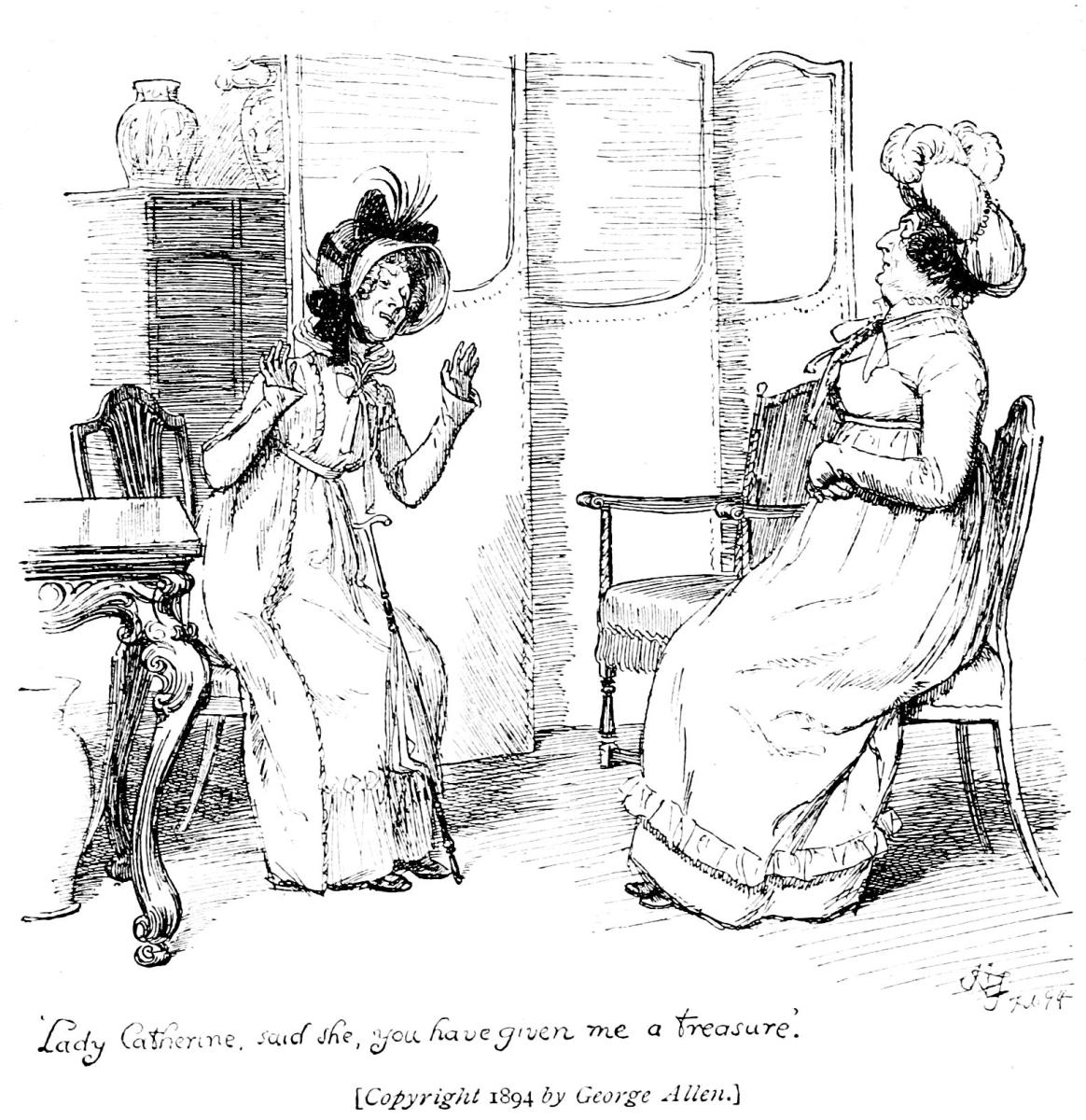
“Ay, no doubt: but that is what a governess will prevent; and if I had known your mother, I should have advised her most strenuously to engage one. I always say that nothing is to be done in education without steady and regular instruction, and nobody but a governess can give it. It is wonderful how many families I have been the means of supplying in that way. I am always glad to get a young person well placed out. Four nieces of Mrs. Jenkinson are most delightfully situated through my means; and it was but the other day that I recommended another young person, who was merely accidentally mentioned to me, and the family are quite delighted with her. Mrs. Collins, did I tell you of Lady Metcalfe’s calling yesterday to thank me? She finds Miss Pope a treasure. ‘Lady Catherine,’ said she, ‘you have given me a treasure.’ Are any of your younger sisters out, Miss Bennet?”
“Yes, no doubt. But that is what a governess will prevent. If I had known your mother, I would have urged her most strongly to hire one. I always say that education achieves nothing without steady, regular instruction, and only a governess can provide that. It is amazing how many families I have helped find governesses. I am always glad to find a young person a good position. Four nieces of Mrs. Jenkinson have excellent positions thanks to me. And just the other day, I recommended another young person who happened to be mentioned to me. The family is quite delighted with her. Mrs. Collins, did I tell you that Lady Metcalfe called yesterday to thank me? She finds Miss Pope a treasure. ‘Lady Catherine,’ she said, ‘you have given me a treasure.’ Have any of your younger sisters started going out into society, Miss Bennet?”
“Yes, ma’am, all.”
“Yes, ma’am, all of them.”
“All! What, all five out at once? Very odd! And you only the second. The younger ones out before the elder are married! Your younger sisters must be very young?”
“All of you! What, all five already attending society events? Very strange! And you’re only the second oldest. The younger ones attending before their older sisters are married! Your younger sisters must be very young?”
“Yes, my youngest is not sixteen. Perhaps she is full young to be much in company. But really, ma’am, I think it would be very hard upon younger sisters that they should not have their share of society and amusement, because the elder may not have the means or inclination to marry early. The last born has as good a right to the pleasures of youth as the first. And to be kept back on such a motive! I think it would not be very likely to promote sisterly affection or delicacy of mind.”
“Yes, my youngest is not yet sixteen. Perhaps she is a little too young to socialize much. But really, ma’am, I think it would be very unfair to deny younger sisters their share of society and amusement. They should not miss out because their older sisters may lack the means or desire to marry early. The youngest has just as much right to the pleasures of youth as the oldest. And to be held back for such a reason! I think that would be unlikely to encourage sisterly affection or sensitivity.”
“Upon my word,” said her Ladyship, “you give your opinion very decidedly for so young a person. Pray, what is your age?”
“Well, really,” said her Ladyship, “you express your opinions very firmly for someone so young. Tell me, how old are you?”
“With three younger sisters grown up,” replied Elizabeth, smiling, “your Ladyship can hardly expect me to own it.”
“With three younger sisters already grown up,” Elizabeth replied, smiling, “your Ladyship can hardly expect me to admit it.”
Lady Catherine seemed quite astonished at not receiving a direct answer; and Elizabeth suspected herself to be the first creature who had ever dared to trifle with so much dignified impertinence.
Lady Catherine seemed quite astonished that she had not received a direct answer. And Elizabeth suspected she was the first person ever to dare to tease someone so grandly rude.
“You cannot be more than twenty, I am sure,—therefore you need not conceal your age.”
“I'm sure you can't be older than twenty. So you don't need to hide your age.”
“I am not one-and-twenty.”
“I’m not twenty-one yet.”
When the gentlemen had joined them, and tea was over, the card tables were placed. Lady Catherine, Sir William, and Mr. and Mrs. Collins sat down to quadrille; and as Miss De Bourgh chose to play at cassino, the two girls had the honour of assisting Mrs. Jenkinson to make up her party. Their table was superlatively stupid. Scarcely a syllable was uttered that did not relate to the game, except when Mrs. Jenkinson expressed her fears of Miss De Bourgh’s being too hot or too cold, or having too much or too little light. A great deal more passed at the other table. Lady Catherine was generally speaking—stating the mistakes of the three others, or relating some anecdote of herself. Mr. Collins was employed in agreeing to everything her Ladyship said, thanking her for every fish he won, and apologizing if he thought he won too many. Sir William did not say much. He was storing his memory with anecdotes and noble names.
Once the gentlemen had joined them and tea was over, the card tables were set up. Lady Catherine, Sir William, and Mr. and Mrs. Collins sat down to play quadrille. As Miss De Bourgh chose to play cassino, the two girls had the honour of joining her and Mrs. Jenkinson. Their table was extraordinarily dull. Hardly a word was spoken that did not concern the game. The only exceptions came when Mrs. Jenkinson worried that Miss De Bourgh was too hot or too cold. She also worried that Miss De Bourgh had too much or too little light. There was much more conversation at the other table. Lady Catherine did most of the talking, pointing out the other three players’ mistakes or telling stories about herself. Mr. Collins kept busy agreeing with everything her Ladyship said and thanking her for every counter he won. He also apologized if he thought he had won too many. Sir William said little. He was filling his memory with stories and the names of noble people.
When Lady Catherine and her daughter had played as long as they chose, the tables were broken up, the carriage was offered to Mrs. Collins, gratefully accepted, and immediately ordered. The party then gathered round the fire to hear Lady Catherine determine what weather they were to have on the morrow. From these instructions they were summoned by the arrival of the coach; and with many speeches of thankfulness on Mr. Collins’s side, and as many bows on Sir William’s, they departed. As soon as they had driven from the door, Elizabeth was called on by her cousin to give her opinion of all that she had seen at Rosings, which, for Charlotte’s sake, she made more favourable than it really was. But her commendation, though costing her some trouble, could by no means satisfy Mr. Collins, and he was very soon obliged to take her Ladyship’s praise into his own hands.
When Lady Catherine and her daughter had played as long as they wanted, the card games ended. Mrs. Collins was offered the carriage, gratefully accepted, and the carriage was ordered at once. The party then gathered around the fire to hear Lady Catherine decide what the next day’s weather would be. The coach’s arrival interrupted these instructions and called them away. Mr. Collins gave many speeches of thanks, and Sir William made just as many bows before they left. As soon as they had driven away, Elizabeth’s cousin asked for her opinion of all she had seen at Rosings. For Charlotte’s sake, Elizabeth gave a more favourable opinion than she really held. But although praising Rosings took some effort, her praise could not possibly satisfy Mr. Collins. He very soon had to take over the task of praising Lady Catherine himself.