Chapter 21
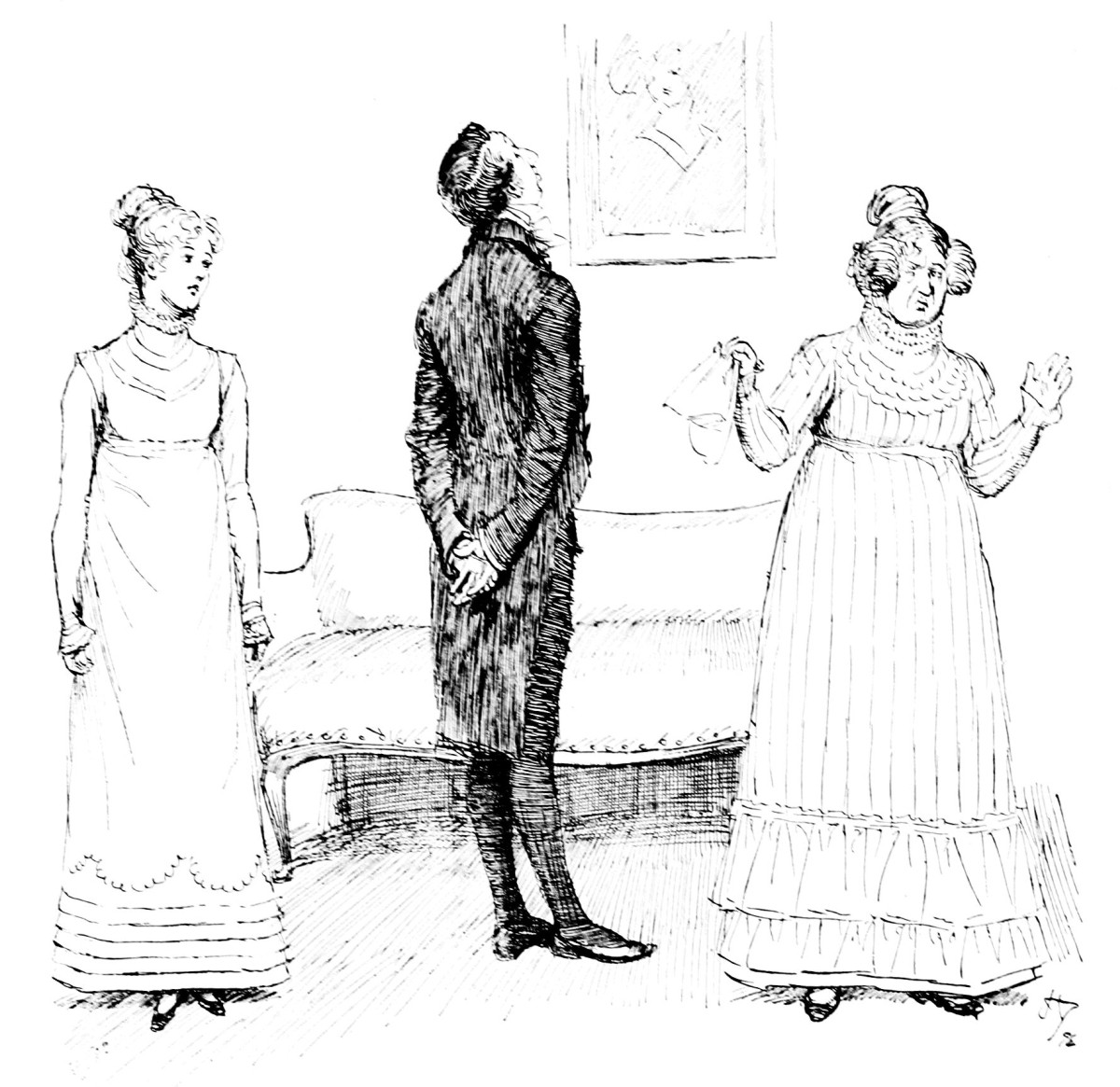
THE discussion of Mr. Collins’s offer was now nearly at an end, and Elizabeth had only to suffer from the uncomfortable feelings necessarily attending it, and occasionally from some peevish allusion of her mother. As for the gentleman himself, his feelings were chiefly expressed, not by embarrassment or dejection, or by trying to avoid her, but by stiffness of manner and resentful silence. He scarcely ever spoke to her; and the assiduous attentions which he had been so sensible of himself were transferred for the rest of the day to Miss Lucas, whose civility in listening to him was a seasonable relief to them all, and especially to her friend.
The discussion of Mr. Collins’s proposal was now nearly over. Elizabeth had only to endure the uncomfortable feelings that naturally followed, and occasionally some irritable remark from her mother. As for the gentleman himself, his feelings appeared chiefly in his stiff manner and resentful silence. He was not embarrassed or downcast, nor did he try to avoid her. He hardly ever spoke to her. For the rest of the day, he gave Miss Lucas the devoted attention he had been so conscious of giving Elizabeth. Miss Lucas’s politeness in listening to him brought welcome relief to them all, especially to her friend.
The morrow produced no abatement of Mrs. Bennet’s ill humour or ill health. Mr. Collins was also in the same state of angry pride. Elizabeth had hoped that his resentment might shorten his visit, but his plan did not appear in the least affected by it. He was always to have gone on Saturday, and to Saturday he still meant to stay.
The next day brought no improvement in Mrs. Bennet’s bad mood or poor health. Mr. Collins remained just as angry and full of wounded pride. Elizabeth had hoped his resentment might shorten his visit, but his plans seemed entirely unchanged. He had always planned to leave on Saturday, and he still intended to stay until then.
After breakfast, the girls walked to Meryton, to inquire if Mr. Wickham were returned, and to lament over his absence from the Netherfield ball. He joined them on their entering the town, and attended them to their aunt’s, where his regret and vexation and the concern of everybody were well talked over. To Elizabeth, however, he voluntarily acknowledged that the necessity of his absence had been self-imposed.
After breakfast, the girls walked to Meryton to ask if Mr. Wickham had returned. They also wanted to express their disappointment that he had missed the Netherfield ball. He joined them as they entered the town and walked with them to their aunt’s house. There, his regret and frustration, along with everyone else’s disappointment, were discussed at length. With Elizabeth, however, he freely admitted that his absence had been his own choice.
“I found,” said he, “as the time drew near, that I had better not meet Mr. Darcy;—that to be in the same room, the same party with him for so many hours together, might be more than I could bear, and that scenes might arise unpleasant to more than myself.”
“As the time drew near,” he said, “I realized I had better not meet Mr. Darcy. Being in the same room, at the same gathering, for so many hours might be more than I could bear. And there might be unpleasant scenes that would upset others as well as me.”
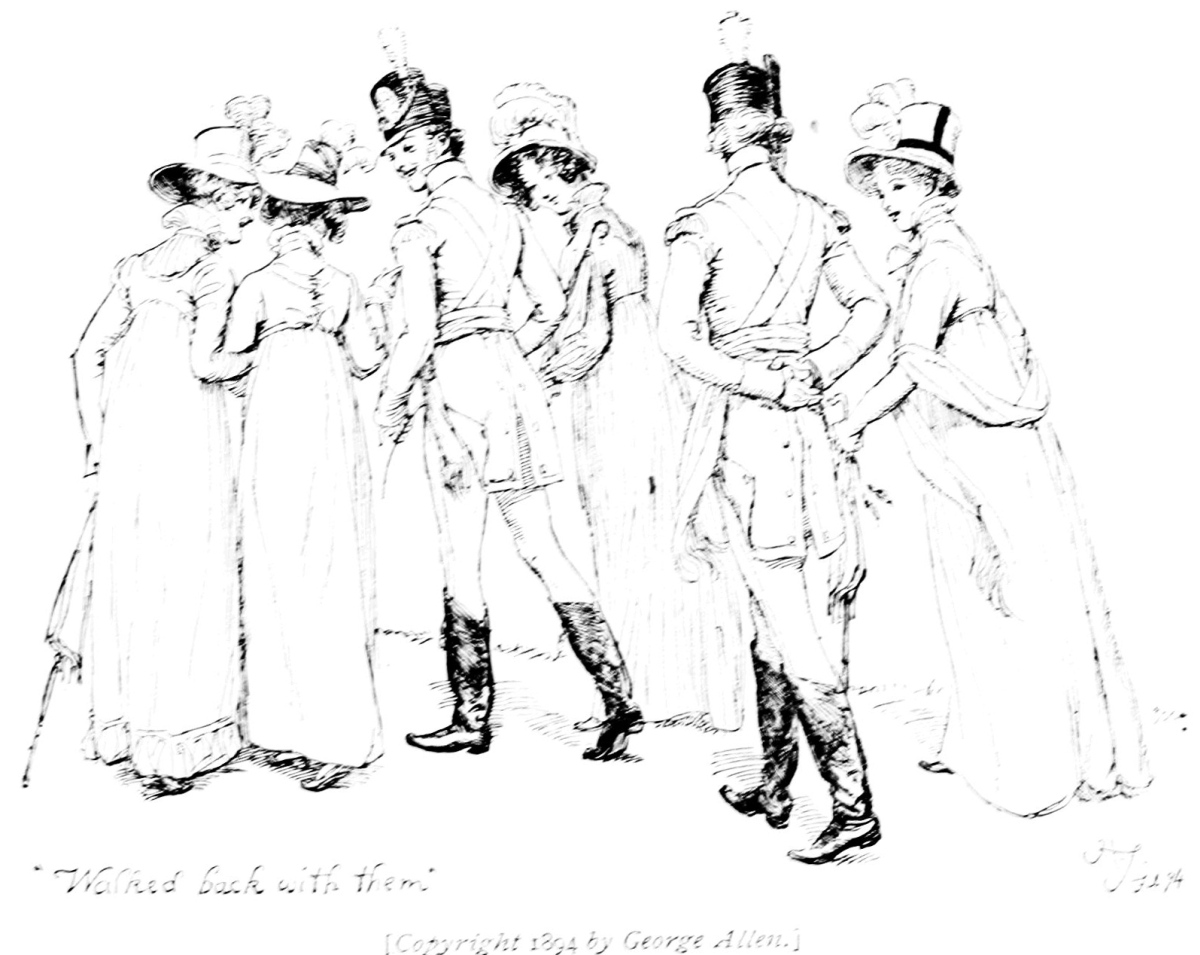
She highly approved his forbearance; and they had leisure for a full discussion of it, and for all the commendations which they civilly bestowed on each other, as Wickham and another officer walked back with them to Longbourn, and during the walk he particularly attended to her. His accompanying them was a double advantage: she felt all the compliment it offered to herself; and it was most acceptable as an occasion of introducing him to her father and mother.
She greatly admired his restraint. They had plenty of time to discuss it fully and exchange all their polite compliments. Wickham and another officer were walking back to Longbourn with them, and Wickham paid her special attention along the way. His company offered two advantages. She felt fully flattered by his decision to join them. She also warmly welcomed the chance to introduce him to her father and mother.
Soon after their return, a letter was delivered to Miss Bennet; it came from Netherfield, and was opened immediately. The envelope contained a sheet of elegant, little, hot-pressed paper, well covered with a lady’s fair, flowing hand; and Elizabeth saw her sister’s countenance change as she read it, and saw her dwelling intently on some particular passages. Jane recollected herself soon; and putting the letter away, tried to join, with her usual cheerfulness, in the general conversation: but Elizabeth felt an anxiety on the subject which drew off her attention even from Wickham; and no sooner had he and his companion taken leave, than a glance from Jane invited her to follow her upstairs. When they had gained their own room, Jane, taking out her letter, said, “This is from Caroline Bingley: what it contains has surprised me a good deal. The whole party have left Netherfield by this time, and are on their way to town; and without any intention of coming back again. You shall hear what she says.”
Soon after their return, a letter arrived for Miss Bennet from Netherfield, and she opened it immediately. Inside was a small sheet of elegant, smooth paper, covered in a lady’s neat, flowing handwriting. Elizabeth saw her sister’s expression change as she read and noticed her studying certain passages closely. Jane soon composed herself and put the letter away. She tried to join the conversation with her usual cheerfulness. But Elizabeth was so anxious about the letter that it distracted her even from Wickham. As soon as he and his companion left, Jane gave Elizabeth a look, inviting her to follow her upstairs. Once they were in their own room, Jane took out the letter and said, “This is from Caroline Bingley. What she says has surprised me a great deal. The whole party have left Netherfield by now and are on their way to London. They have no intention of coming back. Let me read you what she says.”
She then read the first sentence aloud, which comprised the information of their having just resolved to follow their brother to town directly, and of their meaning to dine that day in Grosvenor Street, where Mr. Hurst had a house. The next was in these words:—“‘I do not pretend to regret anything I shall leave in Hertfordshire except your society, my dearest friend; but we will hope, at some future period, to enjoy many returns of that delightful intercourse we have known, and in the meanwhile may lessen the pain of separation by a very frequent and most unreserved correspondence. I depend on you for that.’” To these high-flown expressions Elizabeth listened with all the insensibility of distrust; and though the suddenness of their removal surprised her, she saw nothing in it really to lament: it was not to be supposed that their absence from Netherfield would prevent Mr. Bingley’s being there; and as to the loss of their society, she was persuaded that Jane must soon cease to regard it in the enjoyment of his.
She then read the first sentence aloud. It said they had just decided to follow their brother to town immediately. They planned to dine that day in Grosvenor Street, where Mr. Hurst had a house. The next sentence read: “‘I cannot pretend I will miss anything in Hertfordshire except your company, my dearest friend. But let us hope that someday we will often enjoy the delightful companionship we have shared. Meanwhile, we may ease the pain of separation by writing very often and sharing our thoughts without reserve. I am counting on you for that.’” Elizabeth listened to these grand expressions with the indifference of someone who did not trust them. Although their sudden departure surprised her, she saw nothing in it to regret. There was no reason to suppose their absence from Netherfield would keep Mr. Bingley from being there. As for losing their company, Elizabeth was certain Jane would soon stop minding that loss while enjoying his.
“It is unlucky,” said she, after a short pause, “that you should not be able to see your friends before they leave the country. But may we not hope that the period of future happiness, to which Miss Bingley looks forward, may arrive earlier than she is aware, and that the delightful intercourse you have known as friends will be renewed with yet greater satisfaction as sisters? Mr. Bingley will not be detained in London by them.”
“It’s a shame,” she said after a short pause, “that you won’t be able to see your friends before they leave the country. But can’t we hope that the happiness Miss Bingley looks forward to may come sooner than she expects? And that you may enjoy each other’s company even more as sisters than you have as friends? They won’t keep Mr. Bingley in London.”
“Caroline decidedly says that none of the party will return into Hertfordshire this winter. I will read it to you.
“Caroline says firmly that no one in the group will return to Hertfordshire this winter. I'll read it to you.
“‘When my brother left us yesterday, he imagined that the business which took him to London might be concluded in three or four days; but as we are certain it cannot be so, and at the same time convinced that when Charles gets to town he will be in no hurry to leave it again, we have determined on following him thither, that he may not be obliged to spend his vacant hours in a comfortless hotel. Many of my acquaintance are already there for the winter: I wish I could hear that you, my dearest friend, had any intention of making one in the crowd, but of that I despair. I sincerely hope your Christmas in Hertfordshire may abound in the gaieties which that season generally brings, and that your beaux will be so numerous as to prevent your feeling the loss of the three of whom we shall deprive you.’
“‘When my brother left us yesterday, he thought his business in London might be finished in three or four days. But we are certain it cannot be finished so soon. We are also convinced that once Charles reaches London, he will be in no hurry to leave again. So we have decided to join him there, so he need not spend his free hours in an uncomfortable hotel. Many people I know are already there for the winter. I wish I could hear that you, my dearest friend, planned to join them, but I have no hope of that. I sincerely hope your Christmas in Hertfordshire will be full of the celebrations the season usually brings. I hope, too, that you will have so many admirers you will not miss the three we are taking away.’
“It is evident by this,” added Jane, “that he comes back no more this winter.”
“This makes it clear,” Jane added, “that he won’t come back again this winter.”
“It is only evident that Miss Bingley does not mean he should.”
“All that's clear is that Miss Bingley doesn't want him to do so.”
“Why will you think so? It must be his own doing; he is his own master. But you do not know all. I will read you the passage which particularly hurts me. I will have no reserves from you. ‘Mr. Darcy is impatient to see his sister; and to confess the truth, we are scarcely less eager to meet her again. I really do not think Georgiana Darcy has her equal for beauty, elegance, and accomplishments; and the affection she inspires in Louisa and myself is heightened into something still more interesting from the hope we dare to entertain of her being hereafter our sister. I do not know whether I ever before mentioned to you my feelings on this subject, but I will not leave the country without confiding them, and I trust you will not esteem them unreasonable. My brother admires her greatly already; he will have frequent opportunity now of seeing her on the most intimate footing; her relations all wish the connection as much as his own; and a sister’s partiality is not misleading me, I think, when I call Charles most capable of engaging any woman’s heart. With all these circumstances to favour an attachment, and nothing to prevent it, am I wrong, my dearest Jane, in indulging the hope of an event which will secure the happiness of so many?’ What think you of this sentence, my dear Lizzy?” said Jane, as she finished it. “Is it not clear enough? Does it not expressly declare that Caroline neither expects nor wishes me to be her sister; that she is perfectly convinced of her brother’s indifference; and that if she suspects the nature of my feelings for him she means (most kindly!) to put me on my guard. Can there be any other opinion on the subject?”
“Why do you insist on thinking that? It must be his own decision. He is free to do as he likes. But you do not know all. I will read you the passage that hurts me most. I will keep nothing from you. ‘Mr. Darcy is eager to see his sister. And to tell the truth, we are almost as eager to see her again. I really do not think anyone equals Georgiana Darcy in beauty, elegance, and talents. Louisa and I are very fond of her. Our affection has become something even more meaningful because we dare to hope she will someday be our sister. I do not know whether I have ever mentioned my feelings about this to you before. But I will not leave the country without sharing them, and I trust you will not think them unreasonable. My brother already admires her greatly. He will now have frequent opportunities to spend time with her on very close terms. Her relatives all want the match as much as his own family does. I think I am not merely being a biased sister when I say Charles could easily win any woman’s heart. All these circumstances encourage an attachment, and nothing stands in its way. So am I wrong, my dearest Jane, to cherish the hope of a marriage that would make so many people happy?’ What do you think of this sentence, my dear Lizzy?” said Jane, as she finished reading it. “Isn’t it clear enough? Doesn’t Caroline plainly say that she neither expects nor wants me to be her sister? That she is completely convinced her brother has no feelings for me? And that if she suspects my feelings for him, she means (most kindly!) to warn me against hoping? Can there be any other way to understand her words?”
“Yes, there can; for mine is totally different. Will you hear it?”
“Yes, there can, because mine is completely different. Do you want to hear it?”
“Most willingly.”
“I’d be very happy to.”
“You shall have it in a few words. Miss Bingley sees that her brother is in love with you and wants him to marry Miss Darcy. She follows him to town in the hope of keeping him there, and tries to persuade you that he does not care about you.”
“I’ll explain in a few words. Miss Bingley sees that her brother is in love with you. But she wants him to marry Miss Darcy. She follows him to town, hoping to keep him there. And she tries to convince you that he doesn’t care about you.”
Jane shook her head.
Jane shook her head.
“Indeed, Jane, you ought to believe me. No one who has ever seen you together can doubt his affection; Miss Bingley, I am sure, cannot: she is not such a simpleton. Could she have seen half as much love in Mr. Darcy for herself, she would have ordered her wedding clothes. But the case is this:—we are not rich enough or grand enough for them; and she is the more anxious to get Miss Darcy for her brother, from the notion that when there has been one inter-marriage, she may have less trouble in achieving a second; in which there is certainly some ingenuity, and I dare say it would succeed if Miss de Bourgh were out of the way. But, my dearest Jane, you cannot seriously imagine that, because Miss Bingley tells you her brother greatly admires Miss Darcy, he is in the smallest degree less sensible of your merit than when he took leave of you on Tuesday; or that it will be in her power to persuade him that, instead of being in love with you, he is very much in love with her friend.”
“Really, Jane, you ought to believe me. No one who has ever seen you together can doubt his love for you. Miss Bingley certainly cannot. She is not such a fool. If she had seen half as much love for herself in Mr. Darcy, she would have ordered her wedding clothes. But here is the problem: we are not rich enough or important enough for them. And Miss Bingley is all the more eager for her brother to marry Miss Darcy for another reason. She thinks that after one marriage between the families, arranging a second may be easier. There is certainly some cleverness in her plan. And I dare say her plan would succeed if Miss de Bourgh were out of the way. But, my dearest Jane, you cannot seriously believe Miss Bingley’s claims about her brother’s great admiration for Miss Darcy mean this: that he values your qualities any less than when he said goodbye to you on Tuesday. Nor can you believe Miss Bingley can convince him that he loves her friend rather than you.”
“If we thought alike of Miss Bingley,” replied Jane, “your representation of all this might make me quite easy. But I know the foundation is unjust. Caroline is incapable of wilfully deceiving anyone; and all that I can hope in this case is, that she is deceived herself.”
“If we agreed about Miss Bingley,” Jane replied, “your explanation of all this might put me completely at ease. But I know your explanation rests on an unfair assumption. Caroline is incapable of deliberately deceiving anyone. And all I can hope is that Caroline herself has been misled.”
“That is right. You could not have started a more happy idea, since you will not take comfort in mine: believe her to be deceived, by all means. You have now done your duty by her, and must fret no longer.”
“That’s right. You couldn’t have come up with a happier idea, since you won’t take comfort in mine. By all means, believe she’s been deceived. You’ve now done your duty toward her, and you must stop worrying.”
“But, my dear sister, can I be happy, even supposing the best, in accepting a man whose sisters and friends are all wishing him to marry elsewhere?”
“But, my dear sister, even if everything goes well, can I be happy marrying him? His sisters and friends all want him to marry someone else.”
“You must decide for yourself,” said Elizabeth; “and if, upon mature deliberation, you find that the misery of disobliging his two sisters is more than equivalent to the happiness of being his wife, I advise you, by all means, to refuse him.”
“You must decide for yourself,” said Elizabeth. “And if, after careful thought, you find that upsetting his two sisters would outweigh the happiness of being his wife, then by all means, I advise you to refuse him.”
“How can you talk so?” said Jane, faintly smiling; “you must know, that, though I should be exceedingly grieved at their disapprobation, I could not hesitate.”
“How can you say that?” said Jane, smiling faintly. “You must know that, though their disapproval would upset me deeply, I would not hesitate.”
“I did not think you would; and that being the case, I cannot consider your situation with much compassion.”
“I didn’t think you would. So I can’t feel much sympathy for your situation.”
“But if he returns no more this winter, my choice will never be required. A thousand things may arise in six months.”
“But if he doesn’t return this winter, I’ll never have to choose. A thousand things could happen in six months.”
The idea of his returning no more Elizabeth treated with the utmost contempt. It appeared to her merely the suggestion of Caroline’s interested wishes; and she could not for a moment suppose that those wishes, however openly or artfully spoken, could influence a young man so totally independent of everyone.
Elizabeth utterly dismissed the idea that he would never return. To her, the idea seemed to come only from Caroline’s self-serving wishes. She could not believe for a moment that those wishes could influence a young man so completely independent of everyone. It made no difference how openly or cleverly Caroline expressed them.
She represented to her sister, as forcibly as possible, what she felt on the subject, and had soon the pleasure of seeing its happy effect. Jane’s temper was not desponding; and she was gradually led to hope, though the diffidence of affection sometimes overcame the hope, that Bingley would return to Netherfield, and answer every wish of her heart.
She explained her feelings on the subject to her sister as strongly as she could. She was soon pleased to see the good effect of her words. Jane was not naturally gloomy, and she gradually began to hope that Bingley would return to Netherfield. She hoped he would fulfill every wish of her heart, though the uncertainty of love sometimes overcame her hope.
They agreed that Mrs. Bennet should only hear of the departure of the family, without being alarmed on the score of the gentleman’s conduct; but even this partial communication gave her a great deal of concern, and she bewailed it as exceedingly unlucky that the ladies should happen to go away just as they were all getting so intimate together. After lamenting it, however, at some length, she had the consolation of thinking that Mr. Bingley would be soon down again, and soon dining at Longbourn; and the conclusion of all was the comfortable declaration, that, though he had been invited only to a family dinner, she would take care to have two full courses.
They agreed to tell Mrs. Bennet only that the family had left, without alarming her about the gentleman’s behavior. But even this limited news upset her greatly. She complained that the ladies’ departure was terribly unlucky, just as they were all becoming so close. After complaining at some length, however, she comforted herself with the thought that Mr. Bingley would soon return. He would soon be dining at Longbourn, too. She ended with the reassuring declaration that, although he had been invited only to a family dinner, she would serve two full courses.