Chapter 22
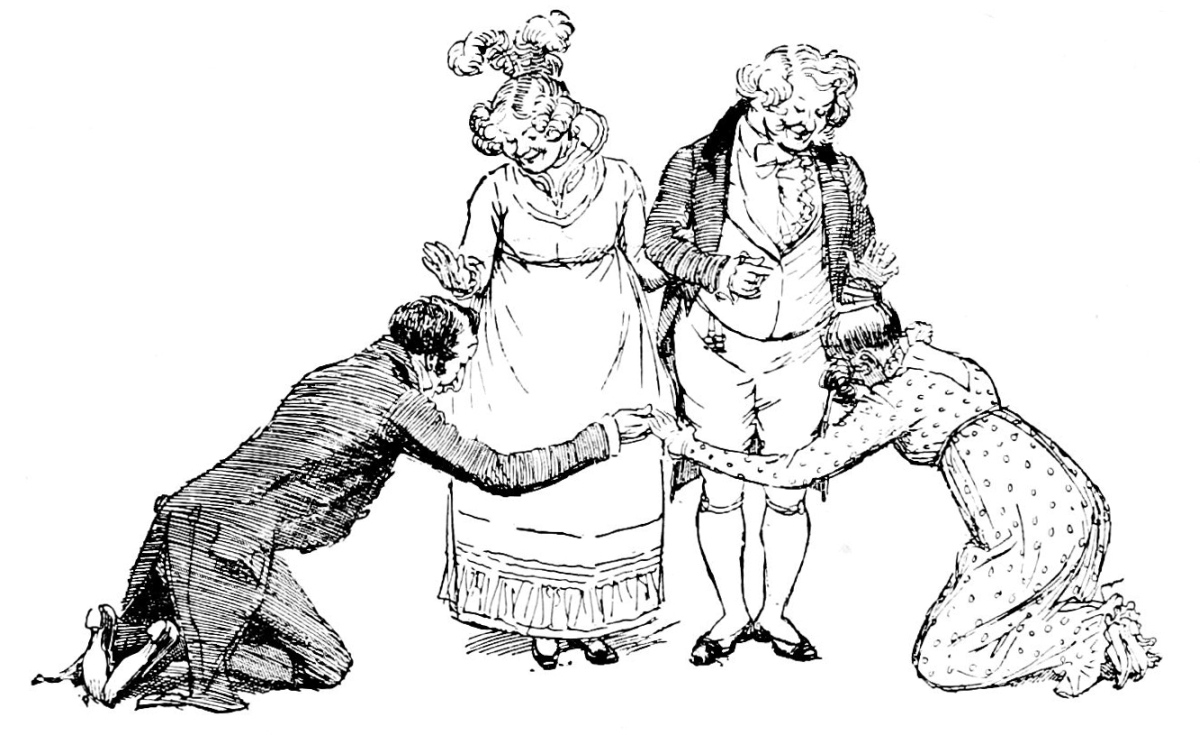
THE Bennets were engaged to dine with the Lucases; and again, during the chief of the day, was Miss Lucas so kind as to listen to Mr. Collins. Elizabeth took an opportunity of thanking her. “It keeps him in good humour,” said she, “and I am more obliged to you than I can express.”
The Bennets had agreed to dine with the Lucases. Once again, Miss Lucas kindly listened to Mr. Collins for most of the day. Elizabeth found a chance to thank her. “Listening to him keeps him in a good mood,” she said, “and I am more grateful to you than I can say.”
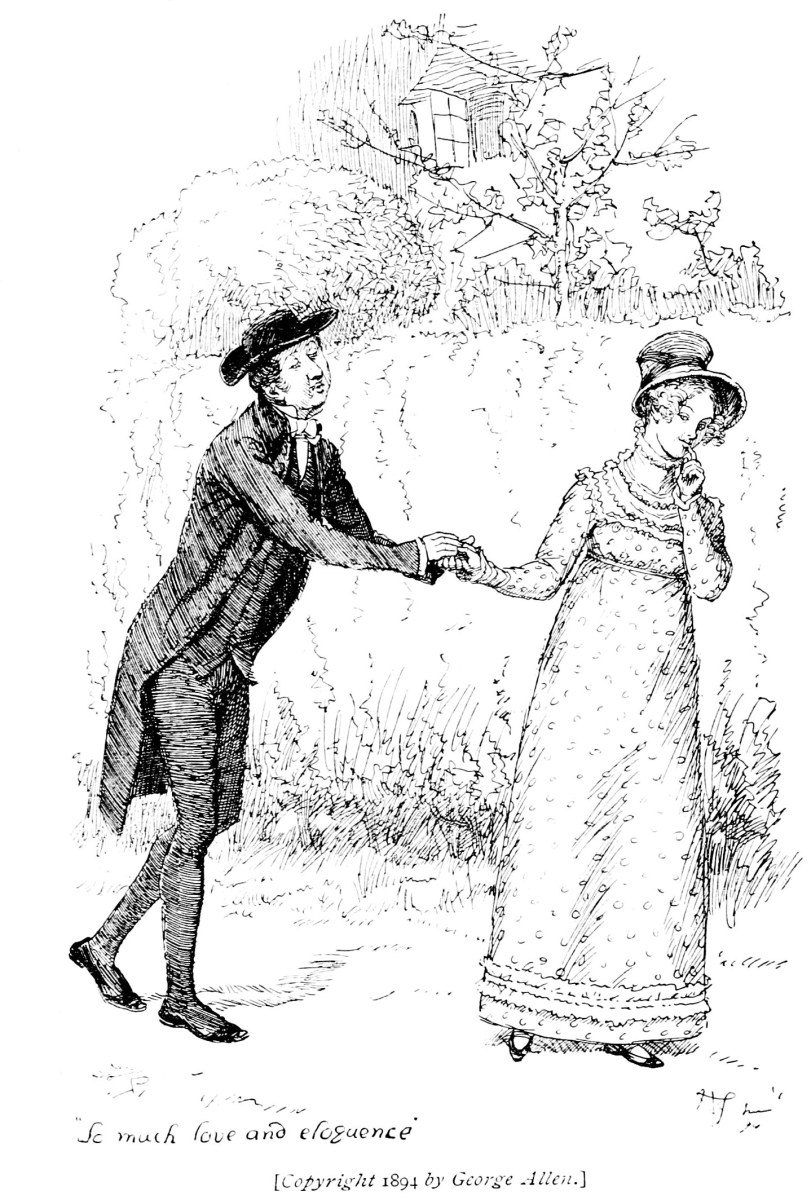
Charlotte assured her friend of her satisfaction in being useful, and that it amply repaid her for the little sacrifice of her time. This was very amiable; but Charlotte’s kindness extended farther than Elizabeth had any conception of:—its object was nothing less than to secure her from any return of Mr. Collins’s addresses, by engaging them towards herself. Such was Miss Lucas’s scheme; and appearances were so favourable, that when they parted at night, she would have felt almost sure of success if he had not been to leave Hertfordshire so very soon. But here she did injustice to the fire and independence of his character; for it led him to escape out of Longbourn House the next morning with admirable slyness, and hasten to Lucas Lodge to throw himself at her feet. He was anxious to avoid the notice of his cousins, from a conviction that, if they saw him depart, they could not fail to conjecture his design, and he was not willing to have the attempt known till its success could be known likewise; for, though feeling almost secure, and with reason, for Charlotte had been tolerably encouraging, he was comparatively diffident since the adventure of Wednesday. His reception, however, was of the most flattering kind. Miss Lucas perceived him from an upper window as he walked towards the house, and instantly set out to meet him accidentally in the lane. But little had she dared to hope that so much love and eloquence awaited her there.
Charlotte assured her friend that she was happy to be useful. That pleasure more than made up for the little time she had given up. This was very kind, but Charlotte’s kindness went much further than Elizabeth imagined. Her aim was nothing less than to spare Elizabeth any renewed courtship from Mr. Collins by directing his attentions toward herself. Such was Miss Lucas’s plan, and the signs were so encouraging that she would have felt almost certain of success when they parted that night, if he had not been leaving Hertfordshire so soon. But Charlotte underestimated his passion and independence. Those qualities led him to slip out of Longbourn House the next morning with admirable cunning. He hurried to Lucas Lodge to throw himself at her feet. He was anxious to escape his cousins’ notice because he felt certain they would guess his purpose if they saw him leave. He did not want his attempt known until he could also announce its success. Although he felt almost certain of success, he was rather less confident since Wednesday’s adventure. His hopes were reasonable, for Charlotte had been fairly encouraging. His welcome, however, was as flattering as he could have wished. Miss Lucas spotted him from an upstairs window as he approached the house. She immediately went out to meet him “by chance” in the lane. But she had hardly dared to hope that so much love and eloquence awaited her there.
In as short a time as Mr. Collins’s long speeches would allow, everything was settled between them to the satisfaction of both; and as they entered the house, he earnestly entreated her to name the day that was to make him the happiest of men; and though such a solicitation must be waived for the present, the lady felt no inclination to trifle with his happiness. The stupidity with which he was favoured by nature must guard his courtship from any charm that could make a woman wish for its continuance; and Miss Lucas, who accepted him solely from the pure and disinterested desire of an establishment, cared not how soon that establishment were gained.
They settled everything to their mutual satisfaction as quickly as Mr. Collins’s long speeches allowed. As they entered the house, he earnestly begged her to set a wedding date and make him the happiest of men. Though she had to put off that request for now, she had no wish to toy with his happiness. The stupidity nature had kindly given him ensured his courtship had no charm that could make a woman want it prolonged. Miss Lucas accepted him solely from the pure and selfless desire for a home and financial security. She did not care how soon she gained them.
Sir William and Lady Lucas were speedily applied to for their consent; and it was bestowed with a most joyful alacrity. Mr. Collins’s present circumstances made it a most eligible match for their daughter, to whom they could give little fortune; and his prospects of future wealth were exceedingly fair. Lady Lucas began directly to calculate, with more interest than the matter had ever
Sir William and Lady Lucas were soon asked for their consent, and they gave it eagerly and joyfully. Mr. Collins’s current circumstances made him an excellent match for their daughter, who could receive little money from her parents. His chances of future wealth were also very good. Lady Lucas immediately began to calculate, with more interest than the subject had ever
excited before, how many years longer Mr. Bennet was likely to live; and Sir William gave it as his decided opinion, that whenever Mr. Collins should be in possession of the Longbourn estate, it would be highly expedient that both he and his wife should make their appearance at St. James’s. The whole family in short were properly overjoyed on the occasion. The younger girls formed hopes of coming out a year or two sooner than they might otherwise have done; and the boys were relieved from their apprehension of Charlotte’s dying an old maid. Charlotte herself was tolerably composed. She had gained her point, and had time to consider of it. Her reflections were in general satisfactory. Mr. Collins, to be sure, was neither sensible nor agreeable: his society was irksome, and his attachment to her must be imaginary. But still he would be her husband. Without thinking highly either of men or of matrimony, marriage had always been her object: it was the only honourable provision for well-educated young women of small fortune, and, however uncertain of giving happiness, must be their pleasantest preservative from want. This preservative she had now obtained; and at the age of twenty-seven, without having ever been handsome, she felt all the good luck of it. The least agreeable circumstance in the business was the surprise it must occasion to Elizabeth Bennet, whose friendship she valued beyond that of any other person. Elizabeth would wonder, and probably would blame her; and though her resolution was not to be shaken, her feelings must be hurt by such a disapprobation. She resolved to give her the information herself; and therefore charged Mr. Collins, when he returned to Longbourn to dinner, to drop no hint of what had passed before any of the family. A promise of secrecy was of course very dutifully given, but it could not be kept without difficulty; for the curiosity excited by his long absence burst forth in such very direct questions on his return, as required some ingenuity to evade, and he was at the same time exercising great self-denial, for he was longing to publish his prosperous love.
excited before, how many more years Mr. Bennet was likely to live. Sir William firmly declared that once Mr. Collins inherited the Longbourn estate, he and his wife should be presented at St. James’s. In short, the whole family was suitably overjoyed by the occasion. The younger girls hoped to begin coming out into society a year or two earlier than they otherwise might. The boys no longer feared that Charlotte would die an old maid. Charlotte herself was fairly calm. She had achieved her aim and had time to think it over. On the whole, her reflections satisfied her. Mr. Collins certainly had neither good sense nor charm. His company was tiresome, and his affection for her must be imaginary. But he would still be her husband. Although she thought little of either men or marriage, marriage had always been her goal. For well-educated young women with little money, marriage was the only respectable way to secure a living. However uncertain marriage was to bring happiness, it must be their most pleasant protection against poverty. Charlotte had now secured that protection. At twenty-seven, without ever having been beautiful, she fully appreciated her good luck. The least pleasant part was the surprise her engagement must cause Elizabeth Bennet. Charlotte valued Elizabeth’s friendship more than anyone else’s. Elizabeth would be astonished and would probably blame her. Although disapproval could not shake Charlotte’s decision, it was bound to hurt her feelings. She decided to tell Elizabeth herself. So, when Mr. Collins returned to Longbourn for dinner, she instructed him to give the family no hint of their engagement. He of course very dutifully promised secrecy, but keeping his promise proved difficult. His long absence had stirred curiosity, and on his return the family asked very direct questions. He needed some ingenuity to avoid answering them. At the same time, he was showing great self-restraint, for he longed to announce his success in love.
As he was to begin his journey too early on the morrow to see any of the family, the ceremony of leave-taking was performed when the ladies moved for the night; and Mrs. Bennet, with great politeness and cordiality, said how happy they should be to see him at Longbourn again, whenever his other engagements might allow him to visit them.
He was leaving too early the next morning to see any of the family. So they said their goodbyes when the ladies went to bed. Mrs. Bennet said, very politely and warmly, how happy they would be to see him at Longbourn again. He was welcome whenever his other commitments allowed him to visit.
“My dear madam,” he replied, “this invitation is particularly gratifying, because it is what I have been hoping to receive; and you may be very certain that I shall avail myself of it as soon as possible.”
“My dear madam,” he replied, “I’m especially pleased by your invitation because I’ve been hoping to receive it. And you can be quite sure I’ll accept as soon as possible.”
They were all astonished; and Mr. Bennet, who could by no means wish for so speedy a return, immediately said,—
They were all astonished. And Mr. Bennet, who certainly did not want such a quick return, immediately said:
“But is there not danger of Lady Catherine’s disapprobation here, my good sir? You had better neglect your relations than run the risk of offending your patroness.”
“But isn’t there a risk that Lady Catherine might disapprove, my good sir? You’d be better off neglecting your relatives than risking offending your patroness.”
“My dear sir,” replied Mr. Collins, “I am particularly obliged to you for this friendly caution, and you may depend upon my not taking so material a step without her Ladyship’s concurrence.”
“My dear sir,” replied Mr. Collins, “I’m very grateful for your friendly warning. And you can count on me not to take such an important step without her Ladyship’s approval.”
“You cannot be too much on your guard. Risk anything rather than her displeasure; and if you find it likely to be raised by your coming to us again, which I should think exceedingly probable, stay quietly at home, and be satisfied that we shall take no offence.”
“You cannot be too careful. Risk anything rather than upset her. If you think visiting us again is likely to upset her, stay quietly at home. I think she would very likely be upset by another visit. And rest assured that we will not be offended.”
“Believe me, my dear sir, my gratitude is warmly excited by such affectionate attention; and, depend upon it, you will speedily receive from me a letter of thanks for this as well as for every other mark of your regard during my stay in Hertfordshire. As for my fair cousins, though my absence may not be long enough to render it necessary, I shall now take the liberty of wishing them health and happiness, not excepting my cousin Elizabeth.”
“Believe me, my dear sir, I am deeply grateful for your affectionate care. You can be sure I will soon send you a letter of thanks for this kindness. I will also thank you for every other kindness you have shown me during my stay in Hertfordshire. As for my lovely cousins, I may not be away long enough to need to wish them well. Still, I will take the liberty of wishing them health and happiness now, including my cousin Elizabeth.”
With proper civilities, the ladies then withdrew; all of them equally surprised to find that he meditated a quick return. Mrs. Bennet wished to understand by it that he thought of paying his addresses to one of her younger girls, and Mary might have been prevailed on to accept him. She rated his abilities much higher than any of the others: there was a solidity in his reflections which often struck her; and though by no means so clever as herself, she thought that, if encouraged to read and improve himself by such an example as hers, he might become a very agreeable companion. But on the following morning every hope of this kind was done away. Miss Lucas called soon after breakfast, and in a private conference with Elizabeth related the event of the day before.
After the usual polite remarks, the ladies left, all equally surprised to learn that he planned to return so soon. Mrs. Bennet hoped his plans meant he intended to court one of her younger daughters. Mary might have been persuaded to accept him. She thought much more highly of his abilities than any of the others did. She was often struck by the soundness of his observations. Although he was nowhere near as clever as she was, she thought he might become a very pleasant companion. But he would need encouragement to read and improve himself, following her example. The next morning, however, all hopes of this kind came to an end. Miss Lucas called soon after breakfast and privately told Elizabeth what had happened the day before.
The possibility of Mr. Collins’s fancying himself in love with her friend had once occurred to Elizabeth within the last day or two: but that Charlotte could encourage him seemed almost as far from possibility as that she could encourage him herself; and her astonishment was consequently so great as to overcome at first the bounds of decorum, and she could not help crying out,—
Once in the last day or two, Elizabeth had considered whether Mr. Collins might imagine himself in love with her friend. But Charlotte encouraging him seemed almost as unlikely as Elizabeth encouraging him herself. So Elizabeth was so astonished that, at first, she forgot her manners and could not help crying out:
“Engaged to Mr. Collins! my dear Charlotte, impossible!”
“Engaged to Mr. Collins! My dear Charlotte, that’s impossible!”
The steady countenance which Miss Lucas had commanded in telling her story gave way to a momentary confusion here on receiving so direct a reproach; though, as it was no more than she expected, she soon regained her composure, and calmly replied,—
Miss Lucas had kept her expression steady while telling her story. But such direct criticism briefly left her flustered. Still, since she had expected nothing less, she soon regained her composure and calmly replied:
“Why should you be surprised, my dear Eliza? Do you think it incredible that Mr. Collins should be able to procure any woman’s good opinion, because he was not so happy as to succeed with you?”
“Why should you be surprised, my dear Eliza? Do you think Mr. Collins couldn’t possibly win any woman’s approval just because he failed to win yours?”
But Elizabeth had now recollected herself; and, making a strong effort for it, was able to assure her, with tolerable firmness, that the prospect of their relationship was highly grateful to her, and that she wished her all imaginable happiness.
But Elizabeth had now regained her composure. With a great effort, she managed to speak fairly firmly. She assured her that she was very pleased at the prospect of their becoming relatives. She also wished her every possible happiness.
“I see what you are feeling,” replied Charlotte; “you must be surprised, very much surprised, so lately as Mr. Collins was wishing to marry you. But when you have had time to think it all over, I hope you will be satisfied with what I have done. I am not romantic, you know. I never was. I ask only a comfortable home; and, considering Mr. Collins’s character, connections, and situation in life, I am convinced that my chance of happiness with him is as fair as most people can boast on entering the marriage state.”
“I can see how you feel,” Charlotte replied. “You must be surprised, very surprised, since Mr. Collins wanted to marry you so recently. But when you have had time to think everything over, I hope you will be satisfied with my decision. You know I’m not romantic. I never have been. All I ask for is a comfortable home. Considering Mr. Collins’s character, connections, and position in life, I’m convinced my chances of happiness with him are good. They are as good as most people can claim when they marry.”
Elizabeth quietly answered “undoubtedly;” and, after an awkward pause, they returned to the rest of the family. Charlotte did not stay much longer; and Elizabeth was then left to reflect on what she had heard. It was a long time before she became at all reconciled to the idea of so unsuitable a match. The strangeness of Mr. Collins’s making two offers of marriage within three days was nothing in comparison of his being now accepted. She had always felt that Charlotte’s opinion of matrimony was not exactly like her own; but she could not have supposed it possible that, when called into action, she would have sacrificed every better feeling to worldly advantage. Charlotte, the wife of Mr. Collins, was a most humiliating picture! And to the pang of a friend disgracing herself, and sunk in her esteem, was added the distressing conviction that it was impossible for that friend to be tolerably happy in the lot she had chosen.
Elizabeth quietly answered “without a doubt.” After an awkward pause, they returned to the rest of the family. Charlotte did not stay much longer, leaving Elizabeth to think over what she had heard. It took Elizabeth a long time to begin accepting the idea of such an unsuitable marriage. Mr. Collins had proposed twice in three days, but that seemed far less strange than Charlotte’s acceptance. Elizabeth had always known that Charlotte’s views on marriage were not quite like her own. But she had never imagined Charlotte would sacrifice every finer feeling for material advantages when faced with the choice. Charlotte as Mr. Collins’s wife was a deeply humiliating thought! Elizabeth felt the pain of seeing a friend disgrace herself and fall in her esteem. Added to that pain was the distressing certainty that Charlotte could not be even reasonably happy in the life she had chosen.