Chapter 19
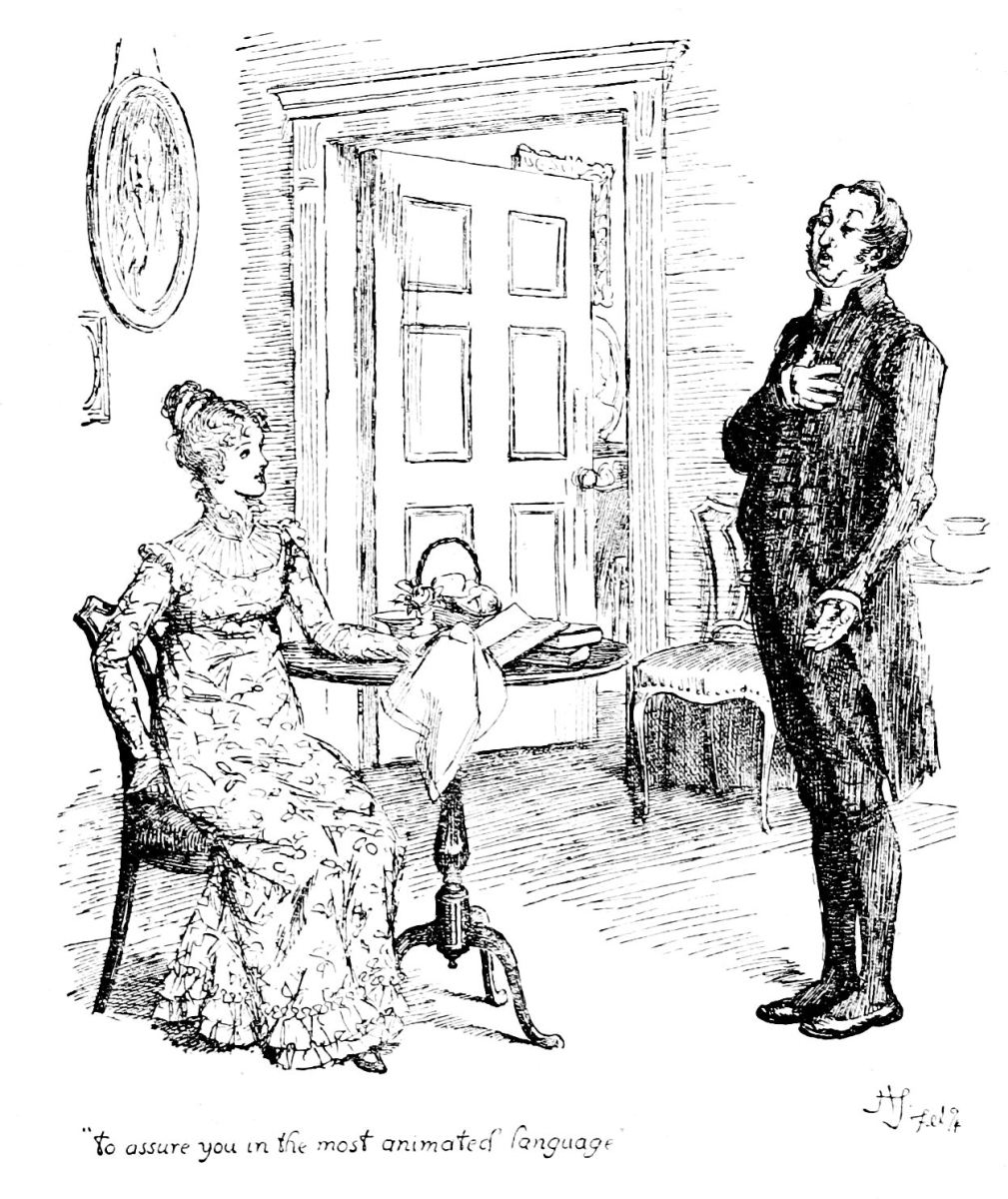
THE next day opened a new scene at Longbourn. Mr. Collins made his declaration in form. Having resolved to do it without loss of time, as his leave of absence extended only to the following Saturday, and having no feelings of diffidence to make it distressing to himself even at the moment, he set about it in a very orderly manner, with all the observances which he supposed a regular part of the business. On finding Mrs. Bennet, Elizabeth, and one of the younger girls together, soon after breakfast, he addressed the mother in these words,—
The next day brought a new scene at Longbourn. Mr. Collins formally proposed marriage. He had decided not to waste time, since his leave of absence lasted only until the following Saturday. Nor did he feel any shyness that might make the proposal uncomfortable for him, even at the moment itself. So he proceeded in a very orderly way, following all the formalities he thought were a necessary part of proposing. Soon after breakfast, he found Mrs. Bennet, Elizabeth, and one of the younger girls together. He addressed Mrs. Bennet in these words:
“May I hope, madam, for your interest with your fair daughter Elizabeth, when I solicit for the honour of a private audience with her in the course of this morning?”
“Madam, may I hope you will encourage your lovely daughter Elizabeth to agree to my request? I would like the honor of speaking privately with her sometime this morning.”
Before Elizabeth had time for anything but a blush of surprise, Mrs. Bennet instantly answered,—
Before Elizabeth could do more than blush in surprise, Mrs. Bennet immediately answered:
“Oh dear! Yes, certainly. I am sure Lizzy will be very happy—I am sure she can have no objection. Come, Kitty, I want you upstairs.” And gathering her work together, she was hastening away, when Elizabeth called out,—
“Oh dear! Yes, certainly. I’m sure Lizzy will be very happy. I’m sure she can have no objection. Come, Kitty, I want you upstairs.” She gathered her sewing and was hurrying away when Elizabeth called out:
“Dear ma’am, do not go. I beg you will not go. Mr. Collins must excuse me. He can have nothing to say to me that anybody need not hear. I am going away myself.”
“Dear ma’am, please don’t go. I beg you to stay. Mr. Collins will have to excuse me. He can have nothing to say to me that anyone else couldn’t hear. I’m leaving myself.”
“No, no, nonsense, Lizzy. I desire you will stay where you are.” And upon Elizabeth’s seeming really, with vexed and embarrassed looks, about to escape, she added, “Lizzy, I insist upon your staying and hearing Mr. Collins.”
“No, no, nonsense, Lizzy. I want you to stay where you are.” Elizabeth looked upset and embarrassed and seemed genuinely about to leave. So she added, “Lizzy, I insist that you stay and listen to Mr. Collins.”
Elizabeth would not oppose such an injunction; and a moment’s consideration making her also sensible that it would be wisest to get it over as soon and as quietly as possible, she sat down again, and tried to conceal, by incessant employment, the feelings which were divided between distress and diversion. Mrs. Bennet and Kitty walked off, and as soon as they were gone, Mr. Collins began,—
Elizabeth would not resist such an order. After a moment’s thought, she also realized it would be wisest to get it over with quickly and quietly. So she sat down again and kept herself constantly busy, trying to hide her mixed feelings of distress and amusement. Mrs. Bennet and Kitty left, and as soon as they were gone, Mr. Collins began:
“Believe me, my dear Miss Elizabeth, that your modesty, so far from doing you any disservice, rather adds to your other perfections. You would have been less amiable in my eyes had there not been this little unwillingness; but allow me to assure you that I have your respected mother’s permission for this address. You can hardly doubt the purport of my discourse, however your natural delicacy may lead you to dissemble; my attentions have been too marked to be mistaken. Almost as soon as I entered the house I singled you out as the companion of my future life. But before I am run away with by my feelings on this subject, perhaps it will be advisable for me to state my reasons for marrying—and, moreover, for coming into Hertfordshire with the design of selecting a wife, as I certainly did.”
“Believe me, my dear Miss Elizabeth, your modesty does you no harm. Instead, it adds to your other fine qualities. You would have been less charming in my eyes had you not shown this slight reluctance. But let me assure you that I have your respected mother’s permission to propose to you. You can hardly doubt what I mean, however much your natural reserve may lead you to pretend otherwise. My attentions have been too obvious to misunderstand. Almost as soon as I entered the house, I chose you as my future wife. But before my feelings carry me away, perhaps I should explain my reasons for marrying. I should also explain why I came to Hertfordshire intending to choose a wife, as I certainly did.”
The idea of Mr. Collins, with all his solemn composure, being run away with by his feelings, made Elizabeth so near laughing that she could not use the short pause he allowed in any attempt to stop him farther, and he continued,—
The thought of Mr. Collins, with all his solemn calm, being carried away by his feelings almost made Elizabeth laugh. So she could not use his brief pause to try again to stop him, and he continued:
“My reasons for marrying are, first, that I think it a right thing for every clergyman in easy circumstances (like myself) to set the example of matrimony in his parish; secondly, that I am convinced it will add very greatly to my happiness; and, thirdly, which perhaps I ought to have mentioned earlier, that it is the particular advice and recommendation of the very noble lady whom I have the honour of calling patroness. Twice has she condescended to give me her opinion (unasked too!) on this subject; and it was but the very Saturday night before I left Hunsford,—between our pools at quadrille, while Mrs. Jenkinson was arranging Miss De Bourgh’s footstool,—that she said, ‘Mr. Collins, you must marry. A clergyman like you must marry. Choose properly, choose a gentlewoman for my sake, and for your own; let her be an active, useful sort of person, not brought up high, but able to make a small income go a good way. This is my advice. Find such a woman as soon as you can, bring her to Hunsford, and I will visit her.’ Allow me, by the way, to observe, my fair cousin, that I do not reckon the notice and kindness of Lady Catherine de Bourgh as among the least of the advantages in my power to offer. You will find her manners beyond anything I can describe; and your wit and vivacity, I think, must be acceptable to her, especially when tempered with the silence and respect which her rank will inevitably excite. Thus much for my general intention in favour of matrimony; it remains to be told why my views were directed to Longbourn instead of my own neighbourhood, where I assure you there are many amiable young women. But the fact is, that being, as I am, to inherit this estate after the death of your honoured father (who, however, may live many years longer), I could not satisfy myself without resolving to choose a wife from among his daughters, that the loss to them might be as little as possible when the melancholy event takes place—which, however, as I have already said, may not be for several years. This has been my motive, my fair cousin, and I flatter myself it will not sink me in your esteem. And now nothing remains for me but to assure you in the most animated language of the violence of my affection. To fortune I am perfectly indifferent, and shall make no demand of that nature on your father, since I am well aware that it could not be complied with; and that one thousand pounds in the 4 per cents., which will not be yours till after your mother’s decease, is all that you may ever be entitled to. On that head, therefore, I shall be uniformly silent: and you may assure yourself that no ungenerous reproach shall ever pass my lips when we are married.”
“My reasons for marrying are, first, that every clergyman with a comfortable income (like myself) should, I think, set an example. He should marry for the benefit of his parish. Secondly, I am convinced that marriage will add greatly to my happiness. Thirdly, perhaps I should have mentioned earlier that the very noble lady I am honored to call my patroness particularly recommends it. Twice she has been kind enough to give me her opinion on marriage, without even being asked! The second time was just the Saturday evening before I left Hunsford, between rounds of quadrille. Mrs. Jenkinson was arranging Miss De Bourgh’s footstool when Lady Catherine said, ‘Mr. Collins, you must marry. A clergyman like you must marry. Choose well, choose a woman of good family for my sake, and for your own. She should be an energetic, useful person, not raised in luxury, but able to make a small income stretch far. This is my advice. Find such a woman as soon as you can, bring her to Hunsford, and I will visit her.’ “By the way, my lovely cousin, allow me to point out one advantage I can offer. I count Lady Catherine de Bourgh’s attention and kindness among the more important ones. Her manners are beyond anything I can describe. I think she is bound to appreciate your wit and liveliness. Especially when you temper them with the silence and respect her rank will inevitably inspire. “So much for my general reasons for wanting to marry. Now I must explain why I looked to Longbourn rather than my own neighborhood. I assure you there are many pleasant young women there. But the fact is that I am to inherit this estate after your respected father’s death. He may, however, live many years longer. Because I am his heir, I could not feel satisfied without deciding to choose a wife from among his daughters. My purpose was to make their loss as small as possible when that sad event occurs. As I have already said, however, his death may not come for several years. This has been my motive, my lovely cousin, and I trust it will not lower me in your opinion. “And now I have only to assure you, in the most passionate language, of the intensity of my affection. I am completely indifferent to money and shall ask your father for none, since I know he could not provide any. I also know that you may never be entitled to more than one thousand pounds invested at four percent. That money will not be yours until after your mother’s death. I shall therefore never mention the subject. You may be certain that, when we are married, I shall never make an unkind remark about your lack of money.”
It was absolutely necessary to interrupt him now.
He absolutely had to be interrupted now.
“You are too hasty, sir,” she cried. “You forget that I have made no answer. Let me do it without further loss of time. Accept my thanks for the compliment you are paying me. I am very sensible of the honour of your proposals, but it is impossible for me to do otherwise than decline them.”
“You are rushing ahead, sir,” she cried. “You forget that I haven’t given you an answer. Let me answer now, without further delay. Thank you for the compliment you are paying me. I know your proposal is a great honor, but I have no choice but to refuse.”
“I am not now to learn,” replied Mr. Collins, with a formal wave of the hand, “that it is usual with young ladies to reject the addresses of the man whom they secretly mean to accept, when he first applies for their favour; and that sometimes the refusal is repeated a second or even a third time. I am, therefore, by no means discouraged by what you have just said, and shall hope to lead you to the altar ere long.”
“I already know,” replied Mr. Collins, with a formal wave of his hand, “that young ladies commonly reject a man’s first proposal while secretly intending to accept him. Sometimes they refuse a second or even a third time. So I am not at all discouraged by what you have just said. I still hope to lead you to the altar before long.”
“Upon my word, sir,” cried Elizabeth, “your hope is rather an extraordinary one after my declaration. I do assure you that I am not one of those young ladies (if such young ladies there are) who are so daring as to risk their happiness on the chance of being asked a second time. I am perfectly serious in my refusal. You could not make me happy, and I am convinced that I am the last woman in the world who would make you so. Nay, were your friend Lady Catherine to know me, I am persuaded she would find me in every respect ill qualified for the situation.”
“Honestly, sir,” cried Elizabeth, “your hope is rather extraordinary after what I have told you. I assure you, I am not one of those young ladies who dare to gamble their happiness on another proposal. (If such young ladies even exist.) I am completely serious about refusing you. You could not make me happy, and I am convinced I am the last woman in the world to make you happy. Besides, if your friend Lady Catherine knew me, I am sure she would find me unsuitable in every way to be your wife.”
“Were it certain that Lady Catherine would think so,” said Mr. Collins, very gravely—“but I cannot imagine that her Ladyship would at all disapprove of you. And you may be certain that when I have the honour of seeing her again I shall speak in the highest terms of your modesty, economy, and other amiable qualifications.”
“If we knew for certain that Lady Catherine would think so,” said Mr. Collins very seriously. “But I cannot imagine that her Ladyship would disapprove of you at all. And you can be certain I will praise you highly when I next have the honour of seeing her. I will speak of your modesty, your careful spending, and your other admirable qualities.”
“Indeed, Mr. Collins, all praise of me will be unnecessary. You must give me leave to judge for myself, and pay me the compliment of believing what I say. I wish you very happy and very rich, and by refusing your hand, do all in my power to prevent your being otherwise. In making me the offer, you must have satisfied the delicacy of your feelings with regard to my family, and may take possession of Longbourn estate whenever it falls, without any self-reproach. This matter may be considered, therefore, as finally settled.” And rising as she thus spoke, she would have quitted the room, had not Mr. Collins thus addressed her,—
“Really, Mr. Collins, there is no need to praise me at all. You must let me judge for myself and do me the courtesy of believing what I say. I wish you great happiness and wealth. By refusing to marry you, I am doing all I can to keep you from being unhappy or poor. By proposing to me, you must have satisfied your sense of duty toward my family. You may therefore inherit the Longbourn estate when the time comes without feeling any guilt. So you may consider this matter finally settled.” As she said this, she rose to leave the room. She would have left if Mr. Collins had not spoken to her as follows:
“When I do myself the honour of speaking to you next on the subject, I shall hope to receive a more favourable answer than you have now given me; though I am far from accusing you of cruelty at present, because I know it to be the established custom of your sex to reject a man on the first application, and, perhaps, you have even now said as much to encourage my suit as would be consistent with the true delicacy of the female character.”
“When I next have the honour of speaking to you about this, I hope you will give me a more favourable answer. Though you have refused me now, I am far from accusing you of cruelty. Because I know women customarily reject a man the first time he proposes. And perhaps you have already encouraged my proposal as much as a woman's proper modesty allows.”
“Really, Mr. Collins,” cried Elizabeth, with some warmth, “you puzzle me exceedingly. If what I have hitherto said can appear to you in the form of encouragement, I know not how to express my refusal in such a way as may convince you of its being one.”
“Really, Mr. Collins,” Elizabeth exclaimed, with some irritation, “you completely puzzle me. If anything I’ve said so far seems encouraging to you, I don’t know how to make my refusal clear.”
“You must give me leave to flatter myself, my dear cousin, that your refusal of my addresses are merely words of course. My reasons for believing it are briefly these:—It does not appear to me that my hand is unworthy of your acceptance, or that the establishment I can offer would be any other than highly desirable. My situation in life, my connections with the family of De Bourgh, and my relationship to your own, are circumstances highly in my favour; and you should take it into further consideration that, in spite of your manifold attractions, it is by no means certain that another offer of marriage may ever be made you. Your portion is unhappily so small, that it will in all likelihood undo the effects of your loveliness and amiable qualifications. As I must, therefore, conclude that you are not serious in your rejection of me, I shall choose to attribute it to your wish of increasing my love by suspense, according to the usual practice of elegant females.”
“You must allow me to flatter myself, my dear cousin, that your refusal of my proposal is merely a formality. My reasons for believing so are simple. I see no reason to think I am unworthy of your acceptance. Nor do I think the home and lifestyle I offer could be anything but highly desirable. My position in society, my connections with the De Bourgh family, and my relationship to your family strongly favor me. You should also consider that, despite your many attractions, you may never receive another marriage proposal. Unfortunately, your inheritance is so small that it will very likely outweigh your beauty and pleasant qualities. I must therefore conclude that you are not serious about rejecting me. Instead, I choose to believe you want to deepen my love by keeping me in suspense. That is, after all, the usual practice of refined women.”
“I do assure you, sir, that I have no pretensions whatever to that kind of elegance which consists in tormenting a respectable man. I would rather be paid the compliment of being believed sincere. I thank you again and again for the honour you have done me in your proposals, but to accept them is absolutely impossible. My feelings in every respect forbid it. Can I speak plainer? Do not consider me now as an elegant female intending to plague you, but as a rational creature speaking the truth from her heart.”
“I assure you, sir, I make no claim to the kind of elegance that involves tormenting a respectable man. I would rather you paid me the compliment of believing I am sincere. I thank you again and again for the honor of your marriage proposal, but I absolutely cannot accept. All my feelings are against it. Can I speak more plainly? Do not think of me as an elegant woman trying to torment you. Think of me instead as a rational person speaking the truth from her heart.”
“You are uniformly charming!” cried he, with an air of awkward gallantry; “and I am persuaded that, when sanctioned by the express authority of both your excellent parents, my proposals will not fail of being acceptable.”
“You are always charming!” he cried, with an awkward attempt at gallantry. “And I’m sure you will accept my proposal once both your excellent parents have given their explicit approval.”
To such perseverance in wilful self-deception Elizabeth would make no reply, and immediately and in silence withdrew; determined, that if he persisted in considering her repeated refusals as flattering encouragement, to apply to her father, whose negative might be uttered in such a manner as must be decisive, and whose behaviour at least could not be mistaken for the affectation and coquetry of an elegant female.
Elizabeth would not answer such stubborn, deliberate self-deception. She immediately left in silence. If he kept treating her repeated refusals as flattering encouragement, she was determined to turn to her father. Her father could deliver a refusal that would settle the matter. At least his behavior could not be mistaken for the coyness and flirtation of a refined woman.