Chapter 16
AS no objection was made to the young people’s engagement with their aunt, and all Mr. Collins’s scruples of leaving Mr. and Mrs. Bennet for a single evening during his visit were most steadily resisted, the coach conveyed him and his five cousins at a suitable hour to Meryton; and the girls had the pleasure of hearing, as they entered the drawing-room, that Mr. Wickham had accepted their uncle’s invitation, and was then in the house.
No one objected to the young people’s plans with their aunt. Mr. Collins felt he should not leave Mr. and Mrs. Bennet even for one evening during his visit. But all his objections were firmly opposed. So, at a suitable hour, the coach took him and his five cousins to Meryton. As the girls entered the drawing room, they were delighted to hear that Mr. Wickham had accepted their uncle’s invitation. He was already in the house.
When this information was given, and they had all taken their seats, Mr. Collins was at leisure to look around him and admire, and he was so much struck with the size and furniture of the apartment, that he declared he might almost have supposed himself in the small summer breakfast parlour at Rosings; a comparison that did not at first convey much gratification; but when Mrs. Philips understood from him what Rosings was, and who was its proprietor, when she had listened to the description of only one of Lady Catherine’s drawing-rooms, and found that the chimney-piece alone had cost eight hundred pounds, she felt all the force of the compliment, and would hardly have resented a comparison with the housekeeper’s room.
Once this information had been shared and everyone had sat down, Mr. Collins had time to look around and admire. He was so impressed by the room’s size and furniture that he declared it almost reminded him of Rosings. He might almost have imagined himself in the small summer breakfast room there. At first, Mrs. Philips was not particularly pleased by the comparison. But then he explained what Rosings was and who owned it. She listened to his description of just one of Lady Catherine’s drawing rooms. When she learned that the fireplace mantel alone had cost eight hundred pounds, she fully appreciated the compliment. She would hardly have minded being compared to the housekeeper’s room.
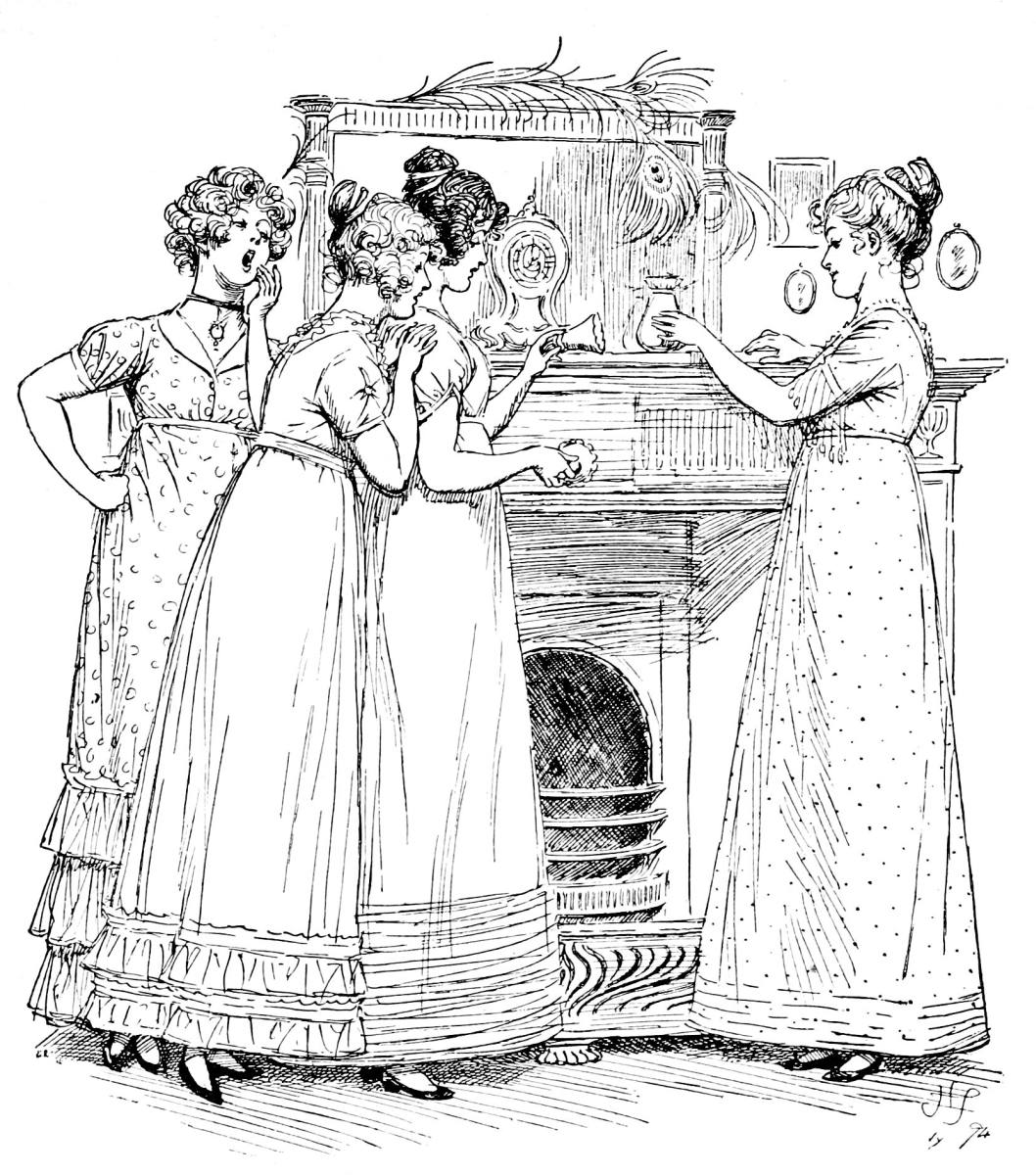
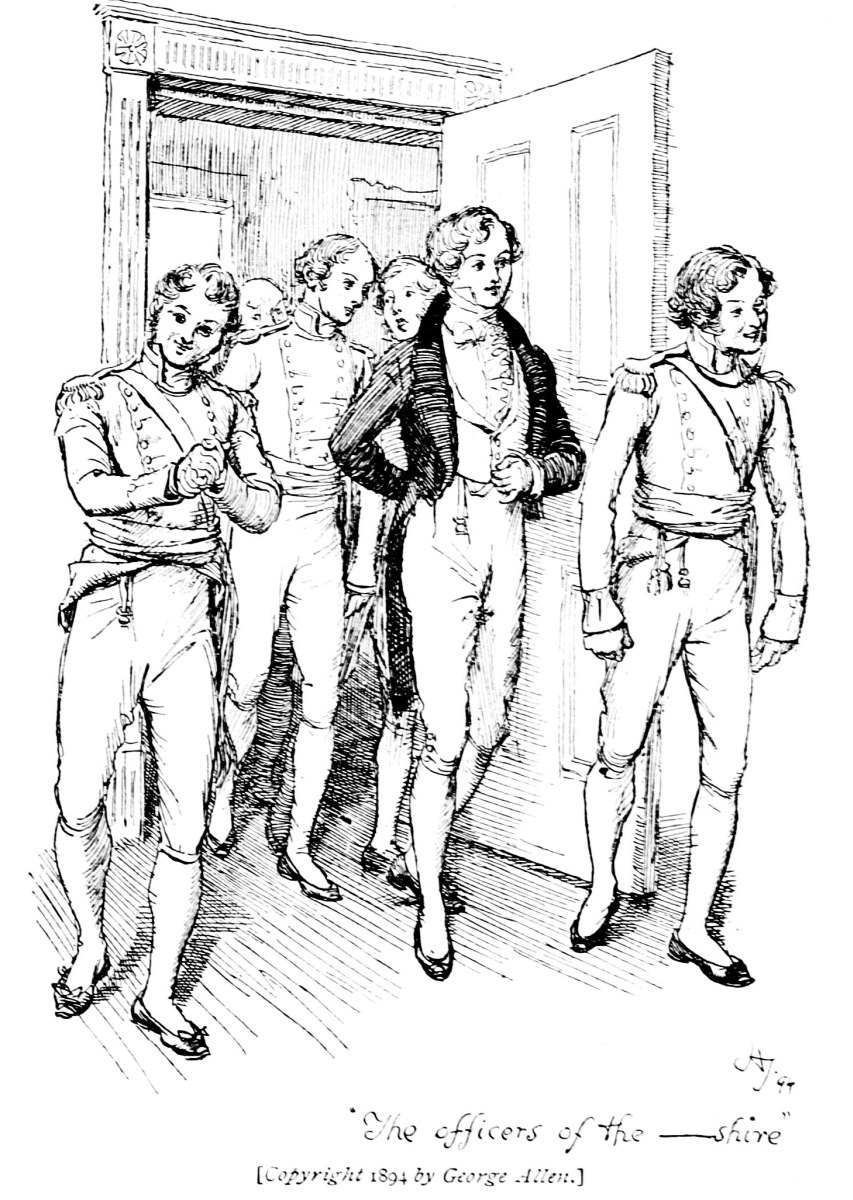
In describing to her all the grandeur of Lady Catherine and her mansion, with occasional digressions in praise of his own humble abode, and the improvements it was receiving, he was happily employed until the gentlemen joined them; and he found in Mrs. Philips a very attentive listener, whose opinion of his consequence increased with what she heard, and who was resolving to retail it all among her neighbours as soon as she could. To the girls, who could not listen to their cousin, and who had nothing to do but to wish for an instrument, and examine their own indifferent imitations of china on the mantel-piece, the interval of waiting appeared very long. It was over at last, however. The gentlemen did approach: and when Mr. Wickham walked into the room, Elizabeth felt that she had neither been seeing him before, nor thinking of him since, with the smallest degree of unreasonable admiration. The officers of the ——shire were in general a very creditable, gentlemanlike set and the best of them were of the present party; but Mr. Wickham was as far beyond them all in person, countenance, air, and walk, as they were superior to the broad-faced stuffy uncle Philips, breathing port wine, who followed them into the room.
He happily described Lady Catherine’s grandeur and her mansion to Mrs. Philips until the gentlemen joined them. Occasionally, he turned aside to praise his own humble home and the improvements being made to it. Mrs. Philips listened very attentively, and her opinion of his importance grew with everything she heard. She was already planning to repeat it all to her neighbours as soon as she could. To the girls, the wait seemed very long. They could not listen to their cousin. They could only wish for a musical instrument and examine their own mediocre imitations of china on the mantelpiece. At last, however, the wait ended. The gentlemen came in. When Mr. Wickham entered the room, Elizabeth felt that her admiration had not been the least bit unreasonable. Neither her first impression nor her thoughts of him since had exaggerated his appeal. The officers of the ____shire regiment were generally a very respectable, gentlemanly group. The best of them were among the guests that evening. But Mr. Wickham surpassed them all in looks, expression, manner, and walk. He was as far above them as they were above the broad-faced, stuffy uncle Philips. Her uncle followed them into the room, his breath smelling of port wine.
Mr. Wickham was the happy man towards whom almost every female eye was turned, and Elizabeth was the happy woman by whom he finally seated himself; and the agreeable manner in which he immediately fell into conversation, though it was only on its being a wet night, and on the probability of a rainy season, made her feel that the commonest, dullest, most threadbare topic might be rendered interesting by the skill of the speaker.
Mr. Wickham was the lucky man who drew almost every woman’s eye. And Elizabeth was the lucky woman he finally sat beside. He immediately began talking in such a pleasant way, though only about the wet night and the likelihood of a rainy season. His conversation made her feel that even the most ordinary, dull, worn-out topic could become interesting in a skilled speaker’s hands.
With such rivals for the notice of the fair as Mr. Wickham and the officers, Mr. Collins seemed to sink into insignificance; to the young ladies he certainly was nothing; but he had still at intervals a kind listener in Mrs. Philips, and was, by her watchfulness, most abundantly supplied with coffee and muffin.
With Mr. Wickham and the officers competing for the ladies’ attention, Mr. Collins seemed to fade into insignificance. To the young ladies, he certainly counted for nothing. But Mrs. Philips still listened kindly to him from time to time. She also made sure he had more than enough coffee and muffins.
When the card tables were placed, he had an opportunity of obliging her, in return, by sitting down to whist.
Once the card tables were set up, he had a chance to return her favor by sitting down to play whist.
“I know little of the game at present,” said he, “but I shall be glad to improve myself; for in my situation of life——” Mrs. Philips was very thankful for his compliance, but could not wait for his reason.
“I don’t know much about the game yet,” he said, “but I’d be glad to learn. Because of my position in life...” Mrs. Philips was very grateful that he had agreed, but she could not wait to hear his reason.
Mr. Wickham did not play at whist, and with ready delight was he received at the other table between Elizabeth and Lydia. At first there seemed danger of Lydia’s engrossing him entirely, for she was a most determined talker; but being likewise extremely fond of lottery tickets, she soon grew too much interested in the game, too eager in making bets and exclaiming after prizes, to have attention for anyone in particular. Allowing for the common demands of the game, Mr. Wickham was therefore at leisure to talk to Elizabeth, and she was very willing to hear him, though what she chiefly wished to hear she could not hope to be told, the history of his acquaintance with Mr. Darcy. She dared not even mention that gentleman. Her curiosity, however, was unexpectedly relieved. Mr. Wickham began the subject himself. He inquired how far Netherfield was from Meryton; and, after receiving her answer, asked in a hesitating manner how long Mr. Darcy had been staying there.
Mr. Wickham did not play whist, and he was warmly welcomed at the other table, between Elizabeth and Lydia. At first, Lydia seemed likely to claim all his attention, for she was a very determined talker. But she also loved the card game lottery tickets. Soon she was too absorbed in playing, placing bets, and calling out over prizes to pay attention to anyone in particular. Apart from the attention the game required, Mr. Wickham was therefore free to talk to Elizabeth. She was very willing to listen, though she could not hope to hear what she most wanted to know. She wanted to hear the history of his acquaintance with Mr. Darcy. She did not dare even mention that gentleman. Her curiosity, however, was unexpectedly satisfied. Mr. Wickham brought up the subject himself. He asked how far Netherfield was from Meryton. After she answered, he hesitantly asked how long Mr. Darcy had been staying there.
“About a month,” said Elizabeth; and then, unwilling to let the subject drop, added, “he is a man of very large property in Derbyshire, I understand.”
“About a month,” said Elizabeth. Not wanting to drop the subject, she added, “I understand he owns a great deal of property in Derbyshire.”
“Yes,” replied Wickham; “his estate there is a noble one. A clear ten thousand per annum. You could not have met with a person more capable of giving you certain information on that head than myself—for I have been connected with his family, in a particular manner, from my infancy.”
“Yes,” replied Wickham. “His estate there is magnificent. It brings in a net income of ten thousand pounds a year. You could not have met anyone better able to give you reliable information about his estate than me. That is because I have had a special connection with his family since I was a baby.”
Elizabeth could not but look surprised.
Elizabeth couldn’t help looking surprised.
“You may well be surprised, Miss Bennet, at such an assertion, after seeing, as you probably might, the very cold manner of our meeting yesterday. Are you much acquainted with Mr. Darcy?”
“You may well be surprised by such a claim, Miss Bennet. After all, you probably saw how coldly we greeted each other yesterday. Do you know Mr. Darcy well?”
“As much as I ever wish to be,” cried Elizabeth, warmly. “I have spent four days in the same house with him, and I think him very disagreeable.”
“As much as I ever want to be,” Elizabeth said heatedly. “I’ve spent four days in the same house with him. And I think he’s very unpleasant.”
“I have no right to give my opinion,” said Wickham, “as to his being agreeable or otherwise. I am not qualified to form one. I have known him too long and too well to be a fair judge. It is impossible for me to be impartial. But I believe your opinion of him would in general astonish—and, perhaps, you would not express it quite so strongly anywhere else. Here you are in your own family.”
“I have no right to give my opinion,” said Wickham, “on whether he is pleasant or not. I’m not qualified to judge. I have known him too long and too well to judge him fairly. It’s impossible for me to be impartial. But I believe your opinion of him would surprise most people. And perhaps you wouldn’t express your opinion quite so strongly anywhere else. Here you are with your own family.”
“Upon my word I say no more here than I might say in any house in the neighbourhood, except Netherfield. He is not at all liked in Hertfordshire. Everybody is disgusted with his pride. You will not find him more favourably spoken of by anyone.”
“Honestly, I’m saying no more here than I might say in any other house nearby, except Netherfield. He is not at all liked in Hertfordshire. Everyone is disgusted by his pride. You won’t hear anyone speak more favorably of him.”
“I cannot pretend to be sorry,” said Wickham, after a short interruption, “that he or that any man should not be estimated beyond their deserts; but with him I believe it does not often happen. The world is blinded by his fortune and consequence, or frightened by his high and imposing manners, and sees him only as he chooses to be seen.”
“I cannot pretend to be sorry,” said Wickham after a brief interruption, “when he or any man gets no more credit than he deserves. But with him, I believe people rarely keep their praise within those limits. The world is blinded by his wealth and status, or intimidated by his proud and imposing manner. People see him only as he chooses to be seen.”
“I should take him, even on my slight acquaintance, to be an ill-tempered man.”
“I would think him bad-tempered, even though I barely know him.”
Wickham only shook his head.
Wickham just shook his head.
“I wonder,” said he, at the next opportunity of speaking, “whether he is likely to be in this country much longer.”
“I wonder,” he said when he next had a chance to speak, “if he’s likely to stay in this area much longer.”
“I do not at all know; but I heard nothing of his going away when I was at Netherfield. I hope your plans in favour of the ——shire will not be affected by his being in the neighbourhood.”
“I don’t know at all. But I heard nothing about him leaving when I was at Netherfield. I hope his being nearby won’t affect your plans in favour of the ___shire.”
“Oh no—it is not for me to be driven away by Mr. Darcy. If he wishes to avoid seeing me he must go. We are not on friendly terms, and it always gives me pain to meet him, but I have no reason for avoiding him but what I might proclaim to all the world—a sense of very great ill-usage, and most painful regrets at his being what he is. His father, Miss Bennet, the late Mr. Darcy, was one of the best men that ever breathed, and the truest friend I ever had; and I can never be in company with this Mr. Darcy without being grieved to the soul by a thousand tender recollections. His behaviour to myself has been scandalous; but I verily believe I could forgive him anything and everything, rather than his disappointing the hopes and disgracing the memory of his father.”
“Oh no. It is not for me to be driven away by Mr. Darcy. If he wishes to avoid seeing me, he must leave. We are not on friendly terms, and meeting him always pains me. But my only reasons for avoiding him are ones I could announce to the whole world. He has treated me very badly, and I deeply regret that he is the kind of man he is. His father, Miss Bennet, the late Mr. Darcy, was one of the best men who ever lived. He was also the truest friend I ever had. Whenever I am with this Mr. Darcy, a thousand tender memories fill me with deep sorrow. His behavior toward me has been disgraceful. But I truly believe I could forgive him anything except disappointing his father’s hopes and dishonoring his father’s memory.”
Elizabeth found the interest of the subject increase, and listened with all her heart; but the delicacy of it prevented further inquiry.
Elizabeth grew more interested in the subject and listened with her whole heart. But the subject was too sensitive for her to ask more questions.
Mr. Wickham began to speak on more general topics, Meryton, the neighbourhood, the society, appearing highly pleased with all that he had yet seen, and speaking of the latter, especially, with gentle but very intelligible gallantry.
Mr. Wickham began to talk about more general topics: Meryton, the neighbourhood, and the local social life. He seemed very pleased with all he had seen so far. He spoke of the local social life, especially, with subtle but unmistakable flirtatious charm.
“It was the prospect of constant society, and good society,” he added, “which was my chief inducement to enter the ——shire. I know it to be a most respectable, agreeable corps; and my friend Denny tempted me further by his account of their present quarters, and the very great attentions and excellent acquaintance Meryton had procured them. Society, I own, is necessary to me. I have been a disappointed man, and my spirits will not bear solitude. I must have employment and society. A military life is not what I was intended for, but circumstances have now made it eligible. The church ought to have been my profession—I was brought up for the church; and I should at this time have been in possession of a most valuable living, had it pleased the gentleman we were speaking of just now.”
“The prospect of regular company, and good company,” he added, “was my main reason for joining the _____shire regiment. I know it is a very respectable, pleasant regiment. My friend Denny encouraged me further by describing where they are now stationed. He also described the generous hospitality and excellent acquaintances they had found in Meryton. I admit that I need company. I have suffered disappointments, and my spirits cannot stand being alone. I must have work and company. A military life was not what I was meant for, but circumstances have now made it a suitable choice. The church ought to have been my profession. I was brought up to become a clergyman. By now, I would have held a very well-paid church position, if the gentleman we just discussed had wished it.”
“Indeed!”
“Really!”
“Yes—the late Mr. Darcy bequeathed me the next presentation of the best living in his gift. He was my godfather, and excessively attached to me. I cannot do justice to his kindness. He meant to provide for me amply, and thought he had done it; but when the living fell, it was given elsewhere.”
“Yes, the late Mr. Darcy left me the right to the next vacancy in his best-paid church position. He had the power to appoint someone to that position. He was my godfather and was extremely fond of me. I cannot fully express how kind he was to me. He meant to provide generously for me and thought he had done so. But when the position became vacant, someone else was appointed.”
“Good heavens!” cried Elizabeth; “but how could that be? How could his will be disregarded? Why did not you seek legal redress?”
“Good heavens!” cried Elizabeth. “But how could that happen? How could his will be ignored? Why didn’t you take legal action?”
“There was just such an informality in the terms of the bequest as to give me no hope from law. A man of honour could not have doubted the intention, but Mr. Darcy chose to doubt it—or to treat it as a merely conditional recommendation, and to assert that I had forfeited all claim to it by extravagance, imprudence, in short, anything or nothing. Certain it is that the living became vacant two years ago, exactly as I was of an age to hold it, and that it was given to another man; and no less certain is it, that I cannot accuse myself of having really done anything to deserve to lose it. I have a warm unguarded temper, and I may perhaps have sometimes spoken my opinion of him, and to him, too freely. I can recall nothing worse. But the fact is, that we are very different sort of men, and that he hates me.”
“The terms of the bequest were too loosely worded to give me any hope of a legal claim. A man of honour could not have doubted the intention, but Mr. Darcy chose to doubt it. Or he chose to treat the bequest as only a recommendation, subject to conditions. He claimed I had lost all right to it through extravagance, poor judgment, in short, anything or nothing. What is certain is that the church position became vacant two years ago, just as I was old enough to hold it. And the position was given to another man. It is equally certain that I cannot accuse myself of really doing anything to deserve losing it. I have a passionate, impulsive temper. And I may perhaps sometimes have expressed my opinion of him, and to him, too freely. I can remember nothing worse. But the fact is that we are very different kinds of men, and he hates me.”
“This is quite shocking! He deserves to be publicly disgraced.”
“This is really shocking! He deserves to be publicly shamed.”
“Some time or other he will be—but it shall not be by me. Till I can forget his father, I can never defy or expose him.”
“Sooner or later he will be, but not by me. Until I can forget his father, I can never challenge or expose him.”
Elizabeth honoured him for such feelings, and thought him handsomer than ever as he expressed them.
Elizabeth respected him for those feelings. And as he expressed them, she thought he looked more handsome than ever.
“But what,” said she, after a pause, “can have been his motive? what can have induced him to behave so cruelly?”
“But what,” she said after a pause, “could his motive have been? What could have made him behave so cruelly?”
“A thorough, determined dislike of me—a dislike which I cannot but attribute in some measure to jealousy. Had the late Mr. Darcy liked me less, his son might have borne with me better; but his father’s uncommon attachment to me irritated him, I believe, very early in life. He had not a temper to bear the sort of competition in which we stood—the sort of preference which was often given me.”
“A deep, lasting dislike of me. I can only put that dislike down partly to jealousy. If the late Mr. Darcy had liked me less, his son might have tolerated me better. But I believe his father’s unusually strong affection for me irritated him from a very early age. He did not have the temperament to handle the rivalry between us, or the preference often shown to me.”
“I had not thought Mr. Darcy so bad as this—though I have never liked him, I had not thought so very ill of him—I had supposed him to be despising his fellow-creatures in general, but did not suspect him of descending to such malicious revenge, such injustice, such inhumanity as this!”
“I had not thought Mr. Darcy was as bad as this. Though I have never liked him, I had not thought so badly of him. I had assumed he looked down on people in general. But I never suspected he could stoop to such spiteful revenge, such injustice, such cruelty as this!”
After a few minutes’ reflection, however, she continued, “I do remember his boasting one day, at Netherfield, of the implacability of his resentments, of his having an unforgiving temper. His disposition must be dreadful.”
After thinking for a few minutes, however, she continued, “I do remember him boasting one day at Netherfield about never letting go of his grudges. He said he had an unforgiving nature. He must have a dreadful character.”
“I will not trust myself on the subject,” replied Wickham; “I can hardly be just to him.”
“I won’t trust myself to discuss the subject,” Wickham replied. “I can hardly be fair to him.”
Elizabeth was again deep in thought, and after a time exclaimed, “To treat in such a manner the godson, the friend, the favourite of his father!” She could have added, “A young man, too, like you, whose very countenance may vouch for your being amiable.” But she contented herself with—“And one, too, who had probably been his own companion from childhood, connected together, as I think you said, in the closest manner.”
Elizabeth was deep in thought again. After a while she exclaimed, “To treat his father’s godson, friend, and favourite in such a way!” She could have added, “And a young man like you, whose face alone may show how kind you are.” But she said only, “And someone who had probably been his own companion since childhood. The two of you were very close, as I think you said.”
“We were born in the same parish, within the same park; the greatest part of our youth was passed together: inmates of the same house, sharing the same amusements, objects of the same parental care. My father began life in the profession which your uncle, Mr. Philips, appears to do so much credit to; but he gave up everything to be of use to the late Mr. Darcy, and devoted all his time to the care of the Pemberley property. He was most highly esteemed by Mr. Darcy, a most intimate, confidential friend. Mr. Darcy often acknowledged himself to be under the greatest obligations to my father’s active superintendence; and when, immediately before my father’s death, Mr. Darcy gave him a voluntary promise of providing for me, I am convinced that he felt it to be as much a debt of gratitude to him as of affection to myself.”
“We were born in the same parish, on the same estate. We spent most of our youth together. We lived in the same house, shared the same amusements, and received the same parental care. My father began his career in the profession your uncle, Mr. Philips, seems to practice with such distinction. But he gave up everything to serve the late Mr. Darcy. He devoted all his time to managing the Pemberley property. Mr. Darcy valued him very highly as a close, trusted friend. Mr. Darcy often admitted how deeply he was indebted to my father for his active management. Just before my father’s death, Mr. Darcy freely promised him that he would provide for me. I am convinced he made that promise as much out of gratitude to him as out of affection for me.”
“How strange!” cried Elizabeth. “How abominable! I wonder that the very pride of this Mr. Darcy has not made him just to you. If from no better motive, that he should not have been too proud to be dishonest,—for dishonesty I must call it.”
“How strange!” exclaimed Elizabeth. “How awful! I’m surprised that this Mr. Darcy’s own pride hasn’t made him treat you fairly. If nothing else, he should have been too proud to be dishonest. And I must call his behavior dishonest.”
“It is wonderful,” replied Wickham; “for almost all his actions may be traced to pride; and pride has often been his best friend. It has connected him nearer with virtue than any other feeling. But we are none of us consistent; and in his behaviour to me there were stronger impulses even than pride.”
“It is surprising,” replied Wickham, “because almost everything he does can be traced to pride. And pride has often been his best friend. Pride has brought him closer to virtue than any other feeling. But none of us are consistent. And in his treatment of me, there were motives even stronger than pride.”
“Can such abominable pride as his have ever done him good?”
“Can such awful pride as his ever have done him any good?”
“Yes; it has often led him to be liberal and generous; to give his money freely, to display hospitality, to assist his tenants, and relieve the poor. Family pride, and filial pride, for he is very proud of what his father was, have done this. Not to appear to disgrace his family, to degenerate from the popular qualities, or lose the influence of the Pemberley House, is a powerful motive. He has also brotherly pride, which, with some brotherly affection, makes him a very kind and careful guardian of his sister; and you will hear him generally cried up as the most attentive and best of brothers.”
“Yes, it has often led him to be generous, giving money freely, welcoming guests, helping his tenants, and supporting the poor. Pride in his family and pride as a son have prompted these acts. He is very proud of the man his father was. He has a strong motive to avoid appearing to disgrace his family or fall short of their well-liked qualities. He also wants to preserve the influence of Pemberley House. He has pride as a brother too, along with some brotherly affection. Together, these feelings make him a very kind and careful guardian of his sister. And you will generally hear him praised as the most attentive and best of brothers.”
“What sort of a girl is Miss Darcy?”
“What is Miss Darcy like?”
He shook his head. “I wish I could call her amiable. It gives me pain to speak ill of a Darcy; but she is too much like her brother,—very, very proud. As a child, she was affectionate and pleasing, and extremely fond of me; and I have devoted hours and hours to her amusement. But she is nothing to me now. She is a handsome girl, about fifteen or sixteen, and, I understand, highly accomplished. Since her father’s death her home has been London, where a lady lives with her, and superintends her education.”
He shook his head. “I wish I could call her kind and pleasant. It pains me to speak badly of a Darcy. But she is too much like her brother, very, very proud. As a child, she was affectionate and charming, and extremely fond of me. I spent hours and hours entertaining her. But she means nothing to me now. She is a beautiful girl, about fifteen or sixteen, and I understand she is very well educated and talented. Since her father’s death, she has lived in London. A lady lives with her there and oversees her education.”
After many pauses and many trials of other subjects, Elizabeth could not help reverting once more to the first, and saying,—
After many pauses and attempts to discuss other subjects, Elizabeth could not help returning to the original topic. She said:
“I am astonished at his intimacy with Mr. Bingley. How can Mr. Bingley, who seems good-humour itself, and is, I really believe, truly amiable, be in friendship with such a man? How can they suit each other? Do you know Mr. Bingley?”
“I’m astonished that he’s so close to Mr. Bingley. Mr. Bingley seems to be good nature itself, and I really believe he is genuinely kind. How can he be friends with such a man? How can the two of them get along? Do you know Mr. Bingley?”
“Not at all.”
“Not at all.”
“He is a sweet-tempered, amiable, charming man. He cannot know what Mr. Darcy is.”
“He is a kind, friendly, charming man. He cannot know what Mr. Darcy is really like.”
“Probably not; but Mr. Darcy can please where he chooses. He does not want abilities. He can be a conversible companion if he thinks it worth his while. Among those who are at all his equals in consequence, he is a very different man from what he is to the less prosperous. His pride never deserts him; but with the rich he is liberal-minded, just, sincere, rational, honourable, and, perhaps, agreeable,—allowing something for fortune and figure.”
“Probably not, but Mr. Darcy can be pleasant when he chooses. He does not lack ability. He can be good company if he thinks making conversation is worth his time. With people anywhere near his own social standing, he is very different from how he is with those less wealthy. He never loses his pride. But with the rich, he is open-minded, fair, sincere, sensible, honourable, and perhaps even pleasant. That is, if you make some allowance for his wealth and good looks.”
The whist party soon afterwards breaking up, the players gathered round the other table, and Mr. Collins took his station between his cousin Elizabeth and Mrs. Philips. The usual inquiries as to his success were made by the latter. It had not been very great; he had lost every point; but when Mrs. Philips began to express her concern thereupon, he assured her, with much earnest gravity, that it was not of the least importance; that he considered the money as a mere trifle, and begged she would not make herself uneasy.
The whist game ended soon afterward, and the players gathered around the other table. Mr. Collins took his place between his cousin Elizabeth and Mrs. Philips. Mrs. Philips asked the usual questions about how well he had done. He had not done very well. He had lost every point. But when Mrs. Philips began to express her concern, he assured her, earnestly and solemnly, that losing did not matter at all. He considered the money a mere trifle and begged her not to worry.
“I know very well, madam,” said he, “that when persons sit down to a card table they must take their chance of these things,—and happily I am not in such circumstances as to make five shillings any object. There are, undoubtedly, many who could not say the same; but, thanks to Lady Catherine de Bourgh, I am removed far beyond the necessity of regarding little matters.”
“I know very well, madam,” he said, “that people must accept the risk of such losses when they play cards. And fortunately, my finances are such that five shillings means nothing to me. Many people certainly could not say the same. But thanks to Lady Catherine de Bourgh, I am well beyond needing to worry about such small matters.”
Mr. Wickham’s attention was caught; and after observing Mr. Collins for a few moments, he asked Elizabeth in a low voice whether her relations were very intimately acquainted with the family of De Bourgh.
Mr. Wickham’s attention was caught, and he watched Mr. Collins for a few moments. Then he quietly asked Elizabeth whether her relatives knew the De Bourgh family very well.
“Lady Catherine de Bourgh,” she replied, “has very lately given him a living. I hardly know how Mr. Collins was first introduced to her notice, but he certainly has not known her long.”
“Lady Catherine de Bourgh,” she replied, “has very recently given him a paid position as a parish clergyman. I hardly know how Mr. Collins first came to her attention. But he certainly hasn’t known her long.”
“You know of course that Lady Catherine de Bourgh and Lady Anne Darcy were sisters; consequently that she is aunt to the present Mr. Darcy.”
“Of course you know that Lady Catherine de Bourgh and Lady Anne Darcy were sisters. So Lady Catherine is the aunt of the current Mr. Darcy.”
“No, indeed, I did not. I knew nothing at all of Lady Catherine’s connections. I never heard of her existence till the day before yesterday.”
“No, I really didn’t. I knew nothing at all about Lady Catherine’s connections. I’d never even heard of her until the day before yesterday.”
“Her daughter, Miss de Bourgh, will have a very large fortune, and it is believed that she and her cousin will unite the two estates.”
“Her daughter, Miss de Bourgh, will have a very large fortune. And people believe she and her cousin will marry, bringing the two estates together.”
This information made Elizabeth smile, as she thought of poor Miss Bingley. Vain indeed must be all her attentions, vain and useless her affection for his sister and her praise of himself, if he were already self-destined to another.
The news made Elizabeth smile as she thought of poor Miss Bingley. All her attentions must be pointless if he had already decided to marry someone else. In that case, her affection for his sister and her praise of him must be pointless and useless too.
“Mr. Collins,” said she, “speaks highly both of Lady Catherine and her daughter; but, from some particulars that he has related of her Ladyship, I suspect his gratitude misleads him; and that, in spite of her being his patroness, she is an arrogant, conceited woman.”
“Mr. Collins,” she said, “speaks highly of both Lady Catherine and her daughter. But some details he has shared about Lady Catherine make me suspect his gratitude clouds his judgment. And I suspect that, although she is his patron and supports him, she is an arrogant, conceited woman.”
“I believe her to be both in a great degree,” replied Wickham; “I have not seen her for many years; but I very well remember that I never liked her, and that her manners were dictatorial and insolent. She has the reputation of being remarkably sensible and clever; but I rather believe she derives part of her abilities from her rank and fortune, part from her authoritative manner, and the rest from the pride of her nephew, who chooses that everyone connected with him should have an understanding of the first class.”
“I believe she is both to a great extent,” replied Wickham. “I have not seen her for many years. But I remember very well that I never liked her, and that she was bossy and rude. She has a reputation for being remarkably sensible and clever. But I rather suspect her supposed abilities come partly from her rank and wealth, partly from her commanding manner. The rest comes from her nephew’s pride. He insists that everyone connected with him must have a first-rate mind.”
Elizabeth allowed that he had given a very rational account of it, and they continued talking together with mutual satisfaction till supper put an end to cards, and gave the rest of the ladies their share of Mr. Wickham’s attentions. There could be no conversation in the noise of Mrs. Philips’s supper party, but his manners recommended him to everybody. Whatever he said, was said well; and whatever he did, done gracefully. Elizabeth went away with her head full of him. She could think of nothing but of Mr. Wickham, and of what he had told her, all the way home; but there was not time for her even to mention his name as they went, for neither Lydia nor Mr. Collins were once silent. Lydia talked incessantly of lottery tickets, of the fish she had lost and the fish she had won; and Mr. Collins, in describing the civility of Mr. and Mrs. Philips, protesting that he did not in the least regard his losses at whist, enumerating all the dishes at supper, and repeatedly fearing that he crowded his cousins, had more to say than he could well manage before the carriage stopped at Longbourn House.
Elizabeth agreed that he had given a very reasonable explanation, and both enjoyed their conversation until supper ended the card games. Then the other ladies had their share of Mr. Wickham’s attention. The noise at Mrs. Philips’s supper party made conversation impossible, but his manners won everyone over. Whatever he said, he said well, and whatever he did, he did gracefully. Elizabeth left with her head full of him. All the way home, she could think of nothing but Mr. Wickham and what he had told her. But she had no chance even to mention his name, because neither Lydia nor Mr. Collins stopped talking. Lydia talked endlessly about lottery tickets and the fish-shaped counters she had lost and won. Mr. Collins described how courteous Mr. and Mrs. Philips had been. He insisted that he did not care at all about his losses at whist and listed every dish at supper. He also repeatedly expressed his fear that he was crowding his cousins. He had more to say than he could fit in before the carriage stopped at Longbourn House.