Chapter 17
ELIZABETH related to Jane, the next day, what had passed between Mr. Wickham and herself. Jane listened with astonishment and concern: she knew not how to believe that Mr. Darcy could be so unworthy of Mr. Bingley’s regard; and yet it was not in her nature to question the veracity of a young man of such amiable appearance as Wickham. The possibility of his having really endured such unkindness was enough to interest all her tender feelings; and nothing therefore remained to be done but to think well of them both, to defend the conduct of each, and throw into the account of accident or mistake whatever could not be otherwise explained.
The next day, Elizabeth told Jane what had happened between her and Mr. Wickham. Jane listened with astonishment and concern. She could hardly believe that Mr. Darcy could be so unworthy of Mr. Bingley’s respect. Yet she was not naturally inclined to doubt a young man who seemed as pleasant as Wickham. The possibility that he had really suffered such unkindness was enough to stir all her sympathy. So Jane could only think well of both men and defend each man’s conduct. Whatever could not otherwise be explained, she put down to chance or misunderstanding.
“They have both,” said she, “been deceived, I dare say, in some way or other, of which we can form no idea. Interested people have perhaps misrepresented each to the other. It is, in short, impossible for us to conjecture the causes or circumstances which may have alienated them, without actual blame on either side.”
“They have both,” she said, “probably been deceived in some way we can’t imagine. Perhaps people with something to gain have given each a false impression of the other. In short, we can’t possibly guess what drove them apart when neither may actually be to blame.”
“Very true, indeed; and now, my dear Jane, what have you got to say in behalf of the interested people who have probably been concerned in the business? Do clear them, too, or we shall be obliged to think ill of somebody.”
“Very true indeed. Now, my dear Jane, what can you say in defense of those with something to gain? They were probably involved in the whole business. Do clear them, too, or we’ll have to think badly of somebody.”
“Laugh as much as you choose, but you will not laugh me out of my opinion. My dearest Lizzy, do but consider in what a disgraceful light it places Mr. Darcy, to be treating his father’s favourite in such a manner,—one whom his father had promised to provide for. It is impossible. No man of common humanity, no man who had any value for his character, could be capable of it. Can his most intimate friends be so excessively deceived in him? Oh no.”
“Laugh as much as you like, but you won’t make me change my mind by laughing at me. My dearest Lizzy, just consider how disgraceful Mr. Darcy’s behavior would be. He would be treating his father’s favorite badly, someone his father had promised to provide for. It’s impossible. No man with ordinary human kindness, no man who cared about his reputation, could behave like that. Could his closest friends be so completely mistaken about him? Oh no.”
“I can much more easily believe Mr. Bingley’s being imposed on than that Mr. Wickham should invent such a history of himself as he gave me last night; names, facts, everything mentioned without ceremony. If it be not so, let Mr. Darcy contradict it. Besides, there was truth in his looks.”
“I can much more easily believe Mr. Bingley was deceived than that Mr. Wickham invented the story he told me about himself last night. He gave names, facts, everything, without any fuss. If his story isn't true, let Mr. Darcy contradict it. Besides, he looked as though he was telling the truth.”
“It is difficult, indeed—it is distressing. One does not know what to think.”
“It really is difficult. It’s upsetting. You don’t know what to think.”
“I beg your pardon;—one knows exactly what to think.”
“Excuse me. Anyone knows exactly what to think.”
But Jane could think with certainty on only one point,—that Mr. Bingley, if he had been imposed on, would have much to suffer when the affair became public.
But Jane could be certain of only one thing. If Mr. Bingley had been deceived, he would suffer greatly when the matter became public.
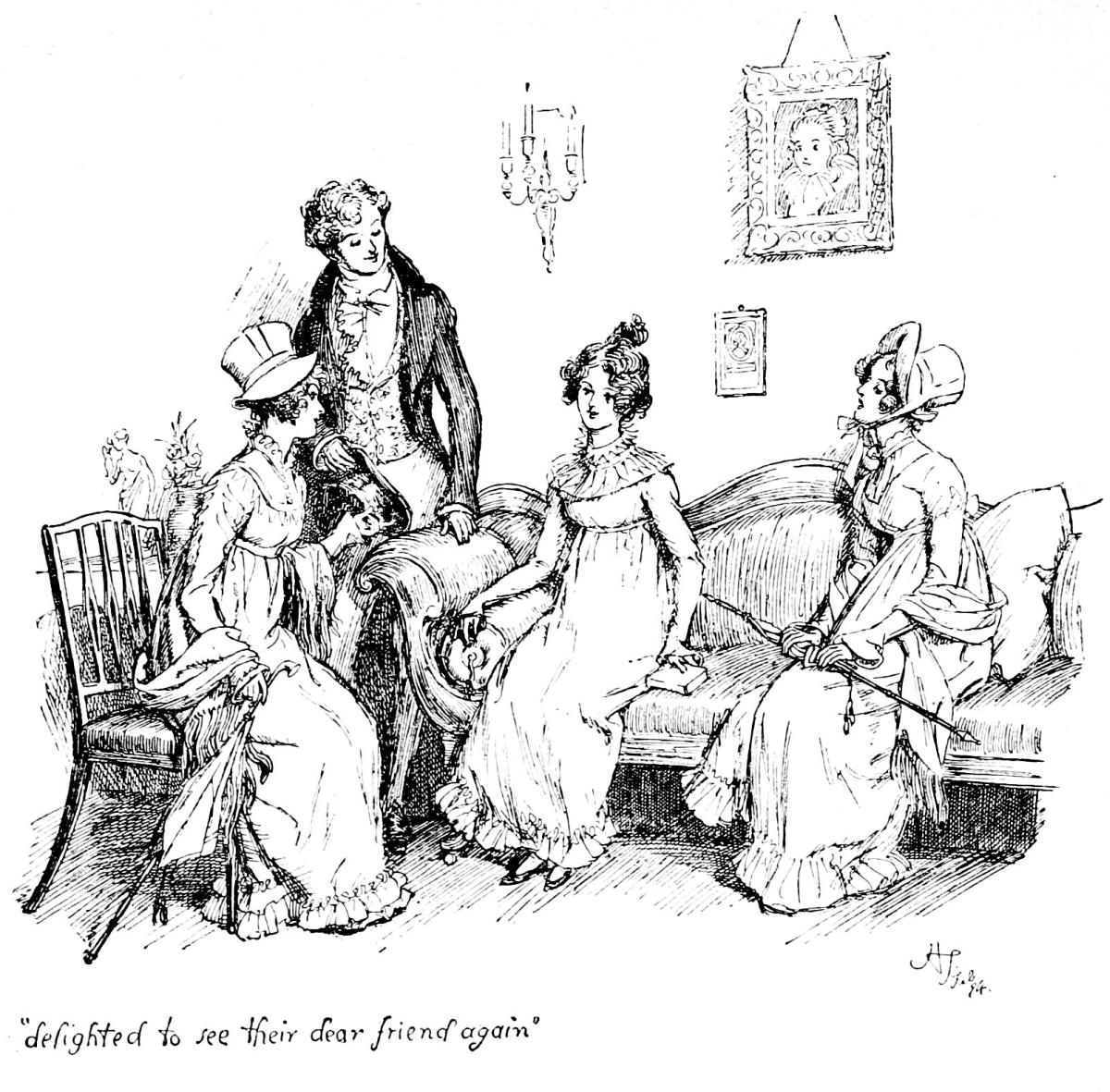
The two young ladies were summoned from the shrubbery, where this conversation passed, by the arrival of some of the very persons of whom they had been speaking; Mr. Bingley and his sisters came to give their personal invitation for the long expected ball at Netherfield, which was fixed for the following Tuesday. The two ladies were delighted to see their dear friend again, called it an age since they had met, and repeatedly asked what she had been doing with herself since their separation. To the rest of the family they paid little attention; avoiding Mrs. Bennet as much as possible, saying not much to Elizabeth, and nothing at all to the others. They were soon gone again, rising from their seats with an activity which took their brother by surprise, and hurrying off as if eager to escape from Mrs. Bennet’s civilities.
The two young ladies were called in from their conversation among the shrubs when some of the people they had discussed arrived. Mr. Bingley and his sisters had come to invite them personally to the long-awaited ball at Netherfield. The ball was set for the following Tuesday. Bingley’s sisters were delighted to see their dear friend again and said it had been ages since they had met. They repeatedly asked what she had been doing since they had last seen her. They paid little attention to the rest of the family. They avoided Mrs. Bennet as much as possible, said little to Elizabeth, and said nothing at all to the others. The visitors soon left again. The sisters rose from their seats so quickly that their brother was taken by surprise. They hurried off as if eager to escape Mrs. Bennet’s polite attentions.
The prospect of the Netherfield ball was extremely agreeable to every female of the family. Mrs. Bennet chose to consider it as given in compliment to her eldest daughter, and was particularly flattered by receiving the invitation from Mr. Bingley himself, instead of a ceremonious card. Jane pictured to herself a happy evening in the society of her two friends, and the attentions of their brother; and Elizabeth thought with pleasure of dancing a great deal with Mr. Wickham, and of seeing a confirmation of everything in Mr. Darcy’s look and behaviour. The happiness anticipated by Catherine and Lydia depended less on any single event, or any particular person; for though they each, like Elizabeth, meant to dance half the evening with Mr. Wickham, he was by no means the only partner who could satisfy them, and a ball was, at any rate, a ball. And even Mary could assure her family that she had no disinclination for it.
Every woman in the family was delighted at the prospect of the Netherfield ball. Mrs. Bennet chose to see it as a celebration in honor of her eldest daughter. She was especially flattered that Mr. Bingley had invited her himself rather than sending a formal invitation card. Jane imagined a happy evening with her two friends, enjoying the attention of their brother. Elizabeth looked forward to dancing a great deal with Mr. Wickham. She also expected Mr. Darcy’s expression and behavior to confirm everything she had heard. Catherine and Lydia’s hopes for the evening depended less on any single event or particular person. Like Elizabeth, they each intended to dance half the evening with Mr. Wickham. But he was by no means the only partner who would please them, and a ball was, after all, a ball. Even Mary could assure her family that she had no objection to going.
“While I can have my mornings to myself,” said she, “it is enough. I think it is no sacrifice to join occasionally in evening engagements. Society has claims on us all; and I profess myself one of those who consider intervals of recreation and amusement as desirable for everybody.”
“As long as I can have my mornings to myself,” she said, “I am satisfied. I don’t think joining in occasional evening activities is any sacrifice. We all have social obligations. And I count myself among those who believe everyone should have time for rest and amusement.”
Elizabeth’s spirits were so high on the occasion, that though she did not often speak unnecessarily to Mr. Collins, she could not help asking him whether he intended to accept Mr. Bingley’s invitation, and if he did, whether he would think it proper to join in the evening’s amusement; and she was rather surprised to find that he entertained no scruple whatever on that head, and was very far from dreading a rebuke, either from the Archbishop or Lady Catherine de Bourgh, by venturing to dance.
Elizabeth was in such high spirits that she could not help asking Mr. Collins about Mr. Bingley’s invitation. She rarely spoke to Mr. Collins unless necessary, but now she asked whether he intended to accept. If he did, would he think it proper to join in the evening’s entertainment? She was rather surprised to find that he had no doubts at all about dancing. Nor was he at all afraid that either the Archbishop or Lady Catherine de Bourgh would scold him for daring to dance.
“I am by no means of opinion, I assure you,” said he, “that a ball of this kind, given by a young man of character, to respectable people, can have any evil tendency; and I am so far from objecting to dancing myself, that I shall hope to be honoured with the hands of all my fair cousins in the course of the evening; and I take this opportunity of soliciting yours, Miss Elizabeth, for the two first dances especially; a preference which I trust my cousin Jane will attribute to the right cause, and not to any disrespect for her.”
“I certainly do not believe,” he said, “that a ball like this can have any harmful effects. Not when a young man of good character hosts it for respectable people. Far from objecting to dancing myself, I hope to have the honor of dancing with all my lovely cousins tonight. And I would especially like to ask you, Miss Elizabeth, for the first two dances. I trust my cousin Jane will understand the true reason for my preference, and not take it as disrespect.”
Elizabeth felt herself completely taken in. She had fully proposed being engaged by Wickham for those very dances; and to have Mr. Collins instead!—her liveliness had been never worse timed. There was no help for it, however. Mr. Wickham’s happiness and her own was perforce delayed a little longer, and Mr. Collins’s proposal accepted with as good a grace as she could. She was not the better pleased with his gallantry, from the idea it suggested of something more. It now first struck her, that she was selected from among her sisters as worthy of being the mistress of Hunsford Parsonage, and of assisting to form a quadrille table at Rosings, in the absence of more eligible visitors. The idea soon reached to conviction, as she observed his increasing civilities towards herself, and heard his frequent attempt at a compliment on her wit and vivacity; and though more astonished than gratified herself by this effect of her charms, it was not long before her mother gave her to understand that the probability of their marriage was exceedingly agreeable to her. Elizabeth, however, did not choose to take the hint, being well aware that a serious dispute must be the consequence of any reply. Mr. Collins might never make the offer, and, till he did, it was useless to quarrel about him.
Elizabeth felt completely caught out. She had fully intended to dance those very dances with Wickham. And now she had Mr. Collins instead! Her playfulness could not have come at a worse moment. There was nothing to be done, however. Mr. Wickham’s happiness and her own would have to wait a little longer. She accepted Mr. Collins’s invitation as gracefully as she could. His attentions pleased her even less because they suggested something more. For the first time, she realized that she had been chosen from among her sisters to run Hunsford Parsonage. She would also help fill a table for quadrille, the card game, at Rosings when more suitable visitors were absent. The idea soon became a certainty as she noticed his increasing attentions to her. She also heard his frequent attempts to compliment her wit and liveliness. Although this effect of her charms surprised her more than it pleased her, her mother soon made her feelings clear. The prospect of their marriage was extremely pleasing to her. Elizabeth, however, chose not to take the hint. She knew very well that any reply would lead to a serious argument. Mr. Collins might never propose, and until he did, there was no point in quarrelling about him.
If there had not been a Netherfield ball to prepare for and talk of, the younger Miss Bennets would have been in a pitiable state at this time; for, from the day of the invitation to the day of the ball, there was such a succession of rain as prevented their walking to Meryton once. No aunt, no officers, no news could be sought after; the very shoe-roses for Netherfield were got by proxy. Even Elizabeth might have found some trial of her patience in weather which totally suspended the improvement of her acquaintance with Mr. Wickham; and nothing less than a dance on Tuesday could have made such a Friday, Saturday, Sunday, and Monday endurable to Kitty and Lydia.
Without the Netherfield ball to prepare for and talk about, the younger Miss Bennets would have been miserable. From the invitation until the ball, rain kept them from walking to Meryton even once. They could not visit their aunt, seek out the officers, or gather any news. Even the decorative roses for their shoes at Netherfield had to be bought by someone else. Even Elizabeth might have found her patience tested by weather that completely prevented her from getting to know Mr. Wickham better. Only the prospect of dancing on Tuesday could have made such a Friday, Saturday, Sunday, and Monday bearable for Kitty and Lydia.