Chapter 14
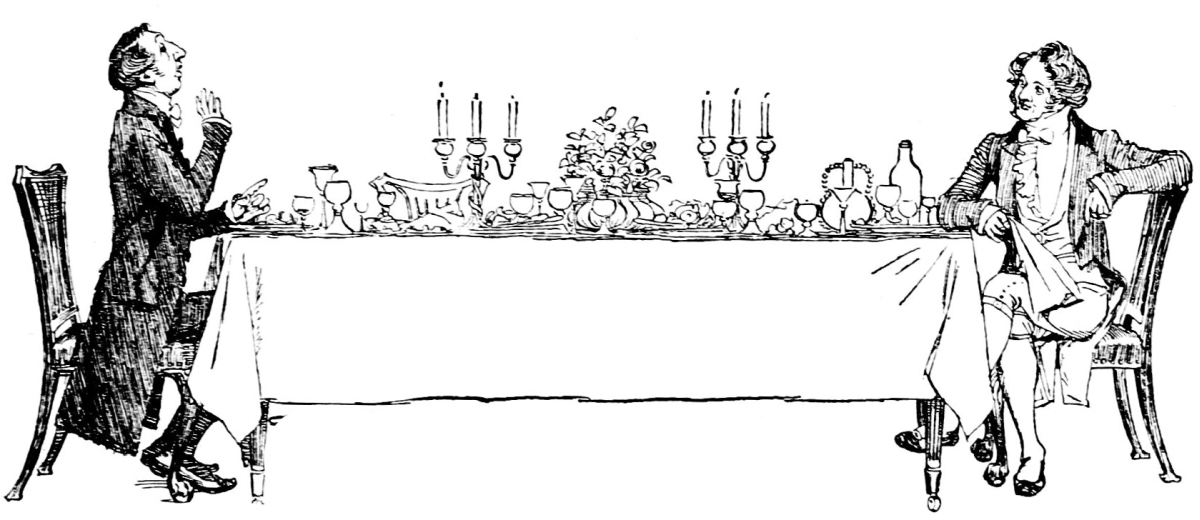
DURING dinner, Mr. Bennet scarcely spoke at all; but when the servants were withdrawn, he thought it time to have some conversation with his guest, and therefore started a subject in which he expected him to shine, by observing that he seemed very fortunate in his patroness. Lady Catherine de Bourgh’s attention to his wishes, and consideration for his comfort, appeared very remarkable. Mr. Bennet could not have chosen better. Mr. Collins was eloquent in her praise. The subject elevated him to more than usual solemnity of manner; and with a most important aspect he protested that he had never in his life witnessed such behaviour in a person of rank—such affability and condescension, as he had himself experienced from Lady Catherine. She had been graciously pleased to approve of both the discourses which he had already had the honour of preaching before her. She had also asked him twice to dine at Rosings, and had sent for him only the Saturday before, to make up her pool of quadrille in the evening. Lady Catherine was reckoned proud by many people, he knew, but he had never seen anything but affability in her. She had always spoken to him as she would to any other gentleman; she made not the smallest objection to his joining in the society of the neighbourhood, nor to his leaving his parish occasionally for a week or two to visit his relations. She had even condescended to advise him to marry as soon as he could, provided he chose with discretion; and had once paid him a visit in his humble parsonage, where she had perfectly approved all the alterations he had been making, and had even vouchsafed to suggest some herself,—some shelves in the closets upstairs.
During dinner, Mr. Bennet scarcely spoke at all. But after the servants left, he thought it was time to talk with his guest. So he raised a subject on which he expected Mr. Collins to shine. He remarked that Mr. Collins seemed very fortunate in his patroness. Lady Catherine de Bourgh seemed remarkably attentive to his wishes and concerned for his comfort. Mr. Bennet could not have chosen a better subject. Mr. Collins praised her eloquently. The subject made his manner even more solemn than usual. With an air of great importance, he declared that he had never seen such behaviour in anyone of high rank. No one had shown him such friendliness or such willingness to set aside differences in rank as Lady Catherine. She had graciously approved of both sermons he had already had the honour of preaching before her. She had also invited him to dine at Rosings twice. Only the previous Saturday, she had sent for him to complete her group for an evening game of quadrille. He knew many people thought Lady Catherine proud, but he had never found her anything but friendly. She had always spoken to him as she would to any other gentleman. She made not the slightest objection to his socializing in the neighbourhood. Nor did she object when he occasionally left his parish for a week or two to visit his relatives. She had even been kind enough to advise him to marry as soon as possible, provided he chose wisely. Once, she had visited his humble parsonage and entirely approved of all the changes he had been making. She had even graciously suggested some changes herself: some shelves in the upstairs closets.
“That is all very proper and civil, I am sure,” said Mrs. Bennet, “and I dare say she is a very agreeable woman. It is a pity that great ladies in general are not more like her. Does she live near you, sir?”
“That is all very proper and polite, I’m sure,” said Mrs. Bennet. “And I expect she is a very pleasant woman. It’s a pity that upper-class ladies in general aren’t more like her. Does she live near you, sir?”
“The garden in which stands my humble abode is separated only by a lane from Rosings Park, her Ladyship’s residence.”
“My humble home stands in a garden. Only a lane separates the garden from Rosings Park, her Ladyship’s home.”
“I think you said she was a widow, sir? has she any family?”
“I think you said she was a widow, sir? Does she have any family?”
“She has one only daughter, the heiress of Rosings, and of very extensive property.”
“She has just one daughter, who will inherit Rosings and a great deal of other property.”
“Ah,” cried Mrs. Bennet, shaking her head, “then she is better off than many girls. And what sort of young lady is she? Is she handsome?”
“Ah,” exclaimed Mrs. Bennet, shaking her head, “then she is better off than many girls. And what kind of young woman is she? Is she pretty?”
“She is a most charming young lady, indeed. Lady Catherine herself says that, in point of true beauty, Miss de Bourgh is far superior to the handsomest of her sex; because there is that in her features which marks the young woman of distinguished birth. She is unfortunately of a sickly constitution, which has prevented her making that progress in many accomplishments which she could not otherwise have failed of, as I am informed by the lady who superintended her education, and who still resides with them. But she is perfectly amiable, and often condescends to drive by my humble abode in her little phaeton and ponies.”
“She is a truly charming young lady. Lady Catherine herself says Miss de Bourgh’s true beauty far surpasses that of even the most beautiful women. This is because her features show that she comes from a distinguished family. Unfortunately, her poor health has kept her from developing many skills she would otherwise certainly have mastered. The lady who oversaw her education told me this, and she still lives with the family. But Miss de Bourgh is perfectly sweet-natured. She often does me the honor of driving past my humble home in her little pony-drawn carriage.”
“Has she been presented? I do not remember her name among the ladies at court.”
“Has she been formally presented at court? I don’t remember her name among the ladies at court.”
“Her indifferent state of health unhappily prevents her being in town; and by that means, as I told Lady Catherine myself one day, has deprived the British Court of its brightest ornament. Her Ladyship seemed pleased with the idea; and you may imagine that I am happy on every occasion to offer those little delicate compliments which are always acceptable to ladies. I have more than once observed to Lady Catherine, that her charming daughter seemed born to be a duchess; and that the most elevated rank, instead of giving her consequence, would be adorned by her. These are the kind of little things which please her Ladyship, and it is a sort of attention which I conceive myself peculiarly bound to pay.”
“Unfortunately, her poor health prevents her from coming to London. As I told Lady Catherine myself one day, her absence has deprived the British Court of its brightest jewel. Her Ladyship seemed pleased with the thought. And you can imagine how happy I am to offer those small, tasteful compliments whenever I can. Such compliments are always welcome to ladies. More than once, I have told Lady Catherine that her charming daughter seemed born to be a duchess. Even the highest rank would not make her more important. Instead, she would bring distinction to the rank. These are the little things that please her Ladyship. And I consider myself especially obliged to pay her this kind of attention.”
“You judge very properly,” said Mr. Bennet; “and it is happy for you that you possess the talent of flattering with delicacy. May I ask whether these pleasing attentions proceed from the impulse of the moment, or are the result of previous study?”
“You judge very well,” said Mr. Bennet. “And you’re fortunate to have a talent for subtle flattery. May I ask whether these charming compliments come to you on the spot, or do you prepare them beforehand?”
“They arise chiefly from what is passing at the time; and though I sometimes amuse myself with suggesting and arranging such little elegant compliments as may be adapted to ordinary occasions, I always wish to give them as unstudied an air as possible.”
“They mostly arise from whatever is happening at the time. Though I sometimes entertain myself by composing and arranging little elegant compliments that might suit everyday occasions, I always want the compliments to sound as spontaneous as possible.”
Mr. Bennet’s expectations were fully answered. His cousin was as absurd as he had hoped; and he listened to him with the keenest enjoyment, maintaining at the same time the most resolute composure of countenance, and, except in an occasional glance at Elizabeth, requiring no partner in his pleasure.
Mr. Bennet’s expectations were fully met. His cousin was as ridiculous as he had hoped. He listened with the greatest enjoyment while keeping his face perfectly serious. Apart from an occasional glance at Elizabeth, he needed no one to share his amusement.
By tea-time, however, the dose had been enough, and Mr. Bennet was glad to take his guest into the drawing-room again, and when tea was over, glad to invite him
By tea-time, however, Mr. Bennet had had enough. He was glad to take his guest back into the drawing-room. And when tea was over, he was glad to invite him
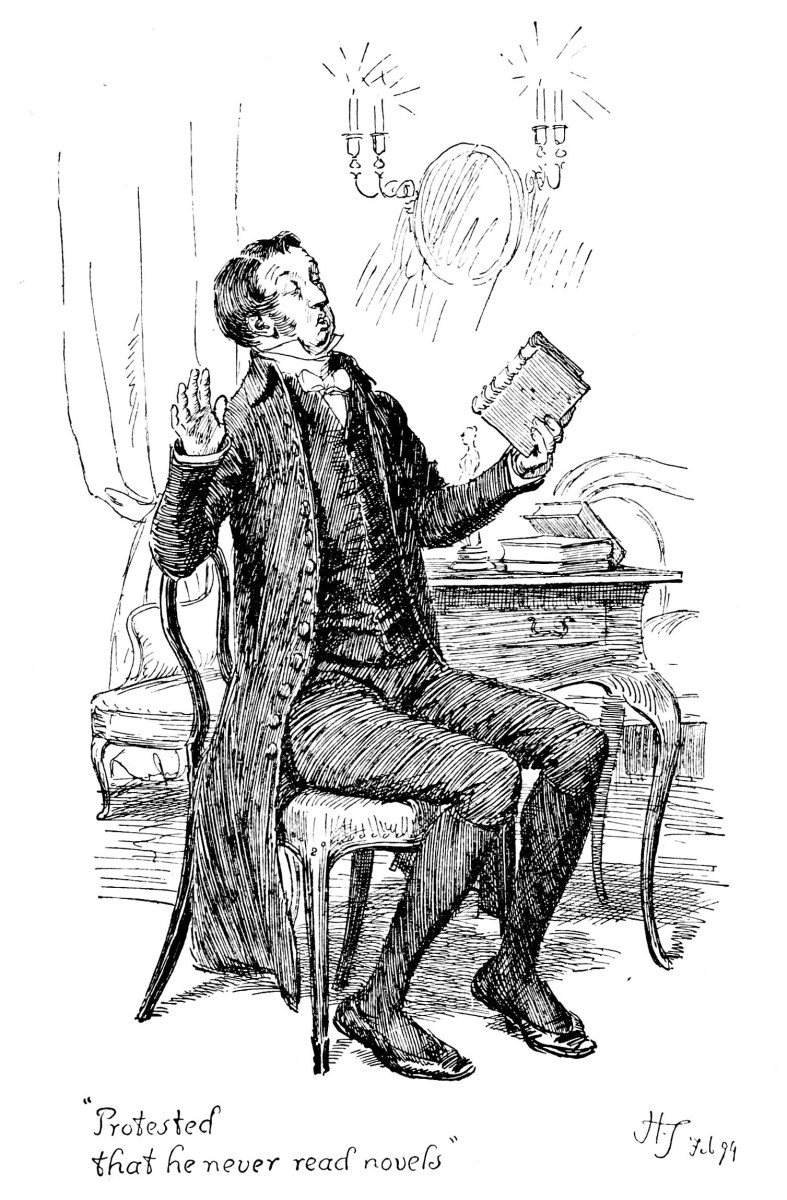
to read aloud to the ladies. Mr. Collins readily assented, and a book was produced; but on beholding it (for everything announced it to be from a circulating library) he started back, and, begging pardon, protested that he never read novels. Kitty stared at him, and Lydia exclaimed. Other books were produced, and after some deliberation he chose “Fordyce’s Sermons.” Lydia gaped as he opened the volume; and before he had, with very monotonous solemnity, read three pages, she interrupted him with,—
to read aloud to the ladies. Mr. Collins readily agreed, and someone brought a book. But he drew back when he saw it, since everything about the book showed it came from a lending library. Apologizing, he declared that he never read novels. Kitty stared at him, and Lydia cried out. Other books were brought, and after some thought he chose “Fordyce’s Sermons.” Lydia yawned as he opened the book. Before he had read three pages in a very solemn, monotonous voice, she interrupted him with:
“Do you know, mamma, that my uncle Philips talks of turning away Richard? and if he does, Colonel Forster will hire him. My aunt told me so herself on Saturday. I shall walk to Meryton to-morrow to hear more about it, and to ask when Mr. Denny comes back from town.”
“Did you know, mamma, that my uncle Philips is talking about dismissing Richard? If he does, Colonel Forster will hire Richard. My aunt told me so herself on Saturday. I’ll walk to Meryton tomorrow to hear more about Richard and ask when Mr. Denny is coming back from town.”
Lydia was bid by her two eldest sisters to hold her tongue; but Mr. Collins, much offended, laid aside his book, and said,—
Lydia’s two eldest sisters told her to hold her tongue. But Mr. Collins, deeply offended, put down his book and said:
“I have often observed how little young ladies are interested by books of a serious stamp, though written solely for their benefit. It amazes me, I confess; for certainly there can be nothing so advantageous to them as instruction. But I will no longer importune my young cousin.”
“I have often noticed how little interest young ladies take in serious books, though written entirely for their benefit. I admit their lack of interest amazes me, because surely nothing could benefit them more than instruction. But I will no longer trouble my young cousin.”
Then, turning to Mr. Bennet, he offered himself as his antagonist at backgammon. Mr. Bennet accepted the challenge, observing that he acted very wisely in leaving the girls to their own trifling amusements. Mrs. Bennet and her daughters apologized most civilly for Lydia’s interruption, and promised that it should not occur again, if he would resume his book; but Mr. Collins, after assuring them that he bore his young cousin no ill-will, and should never resent her behaviour as any affront, seated himself at another table with Mr. Bennet, and prepared for backgammon.
Then he turned to Mr. Bennet and offered to play backgammon against him. Mr. Bennet accepted the challenge. He remarked that Mr. Collins was very wise to leave the girls to their own trivial amusements. Mrs. Bennet and her daughters apologized very politely for Lydia’s interruption. They promised there would be no more interruptions if he would return to his book. But Mr. Collins assured them that he held no grudge against his young cousin. He would never take her behavior as an insult. He then sat down at another table with Mr. Bennet and prepared to play backgammon.