Chapter 10
The Voyage to the Sky
Twice a year, some very large birds, called Kupakki or post birds, are wont to show themselves on the planet Nazar.
Twice a year, some very large birds called Kupakki, or post birds, appear on the planet Nazar.
They come and go at certain regular periods, which has given rise to various opinions. Some think, that insects, of which great multitudes appear at the same periods, and which the birds are very fond of eating, entice them down to the planet. This is my own notion. The circumstance, that when these insects disappear, the birds return to the firmament, places the opinion almost beyond all doubt. It is the same instinct, which leads certain species of birds on our earth to migrate at regular periods.
They come and go at regular intervals, which has given rise to various opinions. Some think that insects draw the birds down to the planet. The insects appear in great numbers at the same times, and the birds are very fond of eating them. This is my own view. The birds return to the sky when the insects disappear, which puts this view almost beyond doubt. It is the same instinct that leads certain species of birds on Earth to migrate at regular intervals.
Others believe, that these birds are trained like hawks and other birds of prey, to fetch booty from other lands. This conjecture is grounded upon the great care with which they lay down their burdens, when their flight is finished. This supposition is somewhat strengthened by the fact, that they become tame and gentle just before they begin their flight, suffering themselves to be thrown into nets, under which they lie immovable. Meanwhile they are fed with insects till the regular period arrives. Then a long box, just large enough to hold a tree or man, is fastened to a rope, which is again tied to the legs of the bird. On the banishment day, food is withheld from them, the nets are raised, and the kupakkis wing their way to the firmament.
Others believe these birds are trained like hawks and other birds of prey to bring back plunder from other lands. They base this theory on the great care with which the birds put down their burdens after a flight. The theory is also somewhat supported by the birds’ behavior just before they begin their flight. They become tame and gentle, letting themselves be caught in nets, where they lie motionless. Meanwhile, they are fed insects until the appointed time arrives. Then a long box, just large enough to hold a tree or a man, is fastened to a rope. The rope is tied to the bird’s legs. On the day of banishment, the birds are not fed. The nets are raised, and the kupakkis fly into the sky.
Two citizens of Potu had been doomed to banishment with myself. One was a metaphysician, who had offended the law by making some sage remarks upon the nature of spirits; the other was a fanatic, who, by starting doubts concerning the holiness of religion and the uniting force of the civil law, was suspected to have designed the overthrow of both. This latter would not regulate himself by the public ordinances, because, he said, all civil obedience was inconsistent with his conscience. Thus three of us, namely, a project-maker, a metaphysician, and a fanatic, were, on the first day of the Birch month, shut up in boxes.
Two citizens of Potu had been sentenced to banishment along with me. One was a metaphysician who had broken the law by making some wise remarks about the nature of spirits. The other was a fanatic who had raised doubts about the holiness of religion and the power of civil law to unite people. He was suspected of intending to overthrow both religion and civil law. The fanatic refused to obey public regulations because, he said, all obedience to civil authority was against his conscience. So, on the first day of the Birch month, the three of us were shut up in boxes: a project-maker, a metaphysician, and a fanatic.
I never knew what became of my fellow-sufferers. As for myself, I was enclosed, with food sufficient for a few days. Shortly after, my kupakki, finding nothing to eat, started off with amazing speed.
I never learned what happened to the others who suffered with me. I was shut in with enough food for a few days. Shortly afterward, my kupakki found nothing to eat and set off at amazing speed.
It is generally believed, under ground, that the distance between the planet Nazar and the firmament is about four hundred miles. I had no means of determining how long my passage was, but conjectured it to be about twenty-four hours.
People underground generally believe that the planet Nazar is about four hundred miles from the sky. I had no way to determine how long my journey took, but I guessed it was about twenty-four hours.
I heard nothing, during this time, but the heavy and monotonous flapping of the kupakki's wings. At last, there sounded in my ears a confounding noise, which announced that we could not be far from land.
During this time, I heard nothing but the heavy, steady flapping of the kupakki's wings. At last, I heard a bewildering noise that told me we could not be far from land.
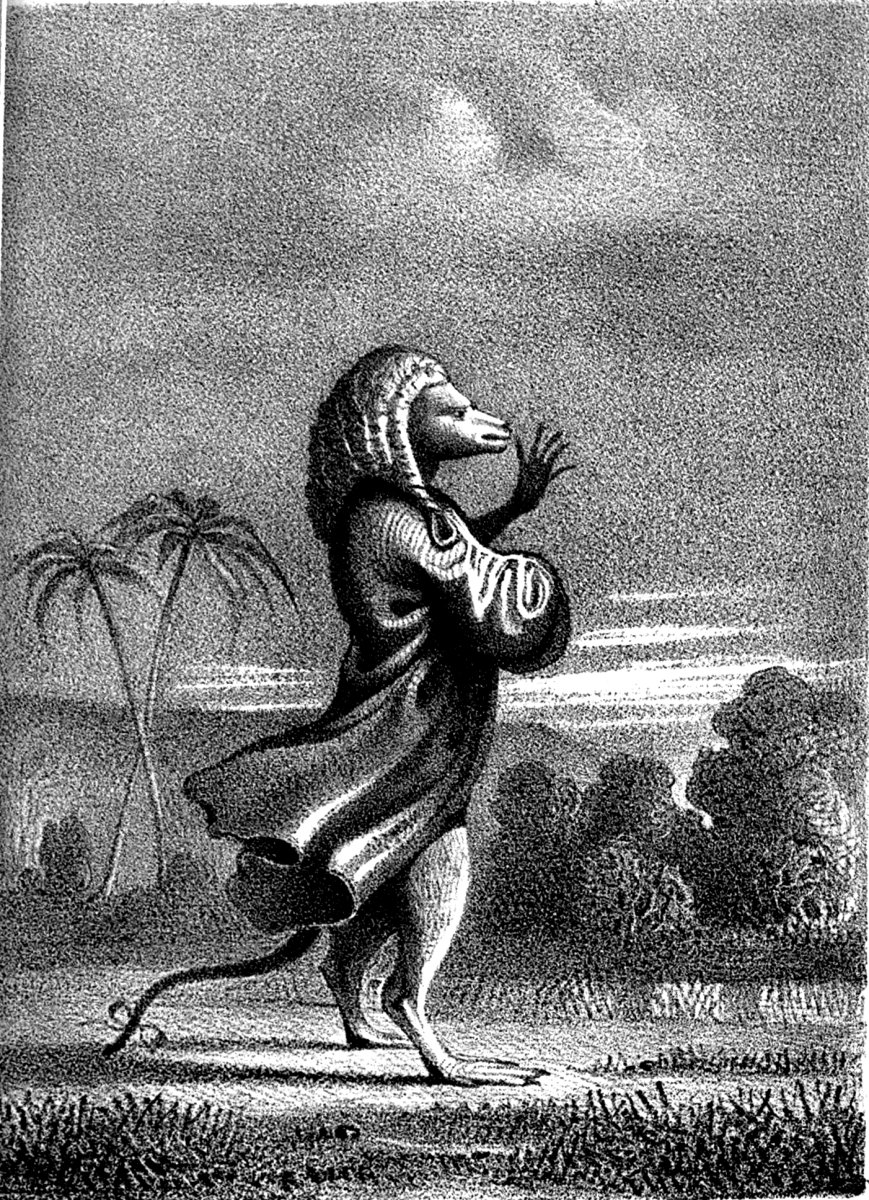
I now observed that the bird had really been trained, for he set the box, with so much care on the ground, that I did not feel the slightest jar. The box was immediately opened, and I rose up in the midst of a great multitude of monkeys, who, to my astonishment, conversed together in an intelligent language rather than chattered, and walked to and fro, in measured and dignified paces. They were dressed in cloths of varied colors. A number of them advanced towards me with much politeness, and handed me from the box.
I now saw that the bird really had been trained. He set the box on the ground so carefully that I felt no jolt at all. The box was opened immediately, and I stood up among a great crowd of monkeys. To my astonishment, they spoke to one another in an intelligent language instead of chattering. They walked back and forth with measured, dignified steps. They wore clothes of many colors. Several of them approached me politely and helped me out of the box.
They seemed to be surprised at my figure, particularly when they discovered I had no tail. Their amazement was not at all lessened by the fact, that I resembled them (laying aside the tail) more nearly than did any stranger they had hitherto seen.
They seemed surprised by my appearance, especially when they discovered I had no tail. They were no less amazed because, apart from the tail, I resembled them more closely than any stranger they had seen before.
At the time of my arrival the water was very high, owing to the nearness of Nazar. This planet has the same effect upon the tides of the firmament, as our moon has upon those of the earth.
When I arrived, the water was very high because Nazar was nearby. This planet affects the tides of the firmament just as our moon affects the tides of the earth.
I was led to a very large building, ornamented in the richest style. The presence of a guard at the door convinced me that it was the residence of no common monkey. It was, as I afterwards learnt, the residence of the mayor of the monkeys.
I was taken to a very large, richly decorated building. A guard at the door convinced me that no ordinary monkey lived there. I later learned that it was the home of the monkeys' mayor.
A number of teachers were selected to instruct me in their language.
Several teachers were chosen to teach me their language.
In three months I was enabled to speak with considerable readiness. Then I expected to procure for myself the admiration of all, for my prompt ingenuity and superior memory. But my teachers declared me to be sluggish and dull of apprehension, and in their impatience often threatened to abandon their charge. As, on the planet Nazar, I had been ironically named Skabba, or the untimely, for my quick perceptions, so here I was called Kakidoran, which signifies, idle and stupid. Those only are respected here, who can comprehend and express any thing instantaneously. I amused myself during the course of my studies by walking about the city, in which I met on all sides notable signs of splendor and luxury.
In three months, I could speak fairly fluently. I expected everyone to admire me for my quick wit and excellent memory. But my teachers said I was slow and dull-witted. They often grew impatient and threatened to give up teaching me. On the planet Nazar, I had been ironically called Skabba, meaning “the untimely,” because I understood things quickly. Here, I was called Kakidoran, which means “idle and stupid.” Only those who can understand and express anything instantly are respected here. During my studies, I amused myself by walking around the city, where I saw striking signs of splendor and luxury everywhere.
When I had finished my education, that is, when I could speak fluently, I was carried to the capital city Martinia, from which the whole country takes its name. The object of the mayor evidently was, to insinuate himself into the favor of a certain counsellor, by presenting to him a strange and unprecedented animal.
When I finished my education, that is, when I could speak fluently, I was taken to the capital, Martinia. The whole country takes its name from the city. The mayor evidently hoped to win the favor of a certain counsellor by presenting me to him as a strange animal unlike any seen before.
The government of Martinia is aristocratical. The state is administered by a great council, selected from the body of the old nobility.
Martinia has an aristocratic government. A great council chosen from the old nobility governs the state.
Before proceeding to the house of the lord, to whom I was to be offered, the mayor led me to a hotel, where we could make ourselves presentable to his excellency. Several servants, called maskatti, or dressers, joined us for this purpose. One took the mayor's sword to burnish it; another tied different colored bands to his tail. I will here remark, that nothing lays nearer to a monkey's heart than the adornment of his tail.
Before taking me to the lord’s house, where I was to be presented to him, the mayor led me to a hotel. There we could make ourselves presentable to his excellency. Several servants, called maskatti, or dressers, joined us to help. One took the mayor’s sword to polish it. Another tied bands of different colors to his tail. I should mention that nothing is closer to a monkey’s heart than decorating his tail.
When my conductor was polished, dressed and adorned, we departed for the president's palace, followed by three servants.
When my guide was groomed, dressed, and adorned, we set off for the president's palace, followed by three servants.
On coming to the entrance, the mayor loosed his shoes, that he might not soil the marble floor. After waiting for a long time, with not a little impatience, we were suffered to enter the reception hall. Here the president sat in a golden chair.
At the entrance, the mayor took off his shoes so he would not dirty the marble floor. We waited a long time, growing quite impatient, before we were allowed into the reception hall. The president sat there in a golden chair.
As soon as he saw us, the president burst out in a terrific laugh. I concluded either that he was seized by delirium, or that silly and insane laughter was a peculiarity of great people in Martinia. In short, I took his lordship to be a fool.
As soon as he saw us, the president burst into loud laughter. I concluded that he was either delirious or that foolish, insane laughter was common among important people in Martinia. In short, I took his lordship for a fool.
I afterwards expressed this opinion to the mayor; but he assured me that the president was a monkey of remarkable natural powers; that his mind was so comprehensive, that he not only determined matters of the highest importance at table, with his glass in hand, but even wrote or dictated a new statute between the courses.
I later shared this opinion with the mayor. But he assured me that the president was a monkey with remarkable natural abilities. His mind was so wide-ranging that he could decide matters of the highest importance at dinner, with a glass in hand. He could even write or dictate a new law between courses.
His excellency tattled to me half an hour, his tongue wagging, the while, with an agility immeasurably superior to that of our European barbers.
His Excellency chatted to me for half an hour. All the while, his tongue wagged far more nimbly than those of our European barbers.
Then turning to my companion, he said, he would take me among his subordinate attendants, since he perceived, from my sluggish disposition, that I must have been born in the land of stupidity, where
Then he turned to my companion and said he would take me on as a junior attendant. My sluggish nature told him that I must have been born in the land of stupidity, where
Long-eared mortals, in perpetual fogs, Oft lose their way to mire in horrid bogs:—
Long-eared mortals, in endless fog, Often lose their way and get stuck in dreadful bogs.
and consequently that I was unfit for any office of trust and respectability. "I have, indeed," urged the mayor, "observed a natural obtuseness in this man; nevertheless, when he is allowed time to think, he judges by no means badly."
and therefore I was unfit for any position of trust and respectability. "I have noticed that this man is naturally slow to understand," the mayor argued. "But when he is given time to think, his judgment is by no means bad."
"Of what use is that," replied the president; "here we need nimble officers, for the immense diversity of our affairs does not give us time to think."
"What use is that?" replied the president. "We need quick officers here because our affairs are so varied that we have no time to think."
The president, having spoken thus, very gravely, and carefully examined my body, and directed me to lift a heavy weight from the floor. Seeing that I did this with ease, he remarked: "Nature, although she has stinted you in the faculties of the soul, has compensated, in some measure, by granting to you a degree of bodily strength."
After speaking, the president examined my body very seriously and carefully. He told me to lift a heavy weight from the floor. When he saw that I lifted it easily, he remarked: "Although nature has given you limited mental abilities, she has partly made up for it by giving you some physical strength."
I now received orders to go out and wait in the court. Soon after the mayor followed, and as he passed, told me that his excellency had determined to include me in his train.
I was then ordered to go out and wait in the courtyard. Soon afterward, the mayor came out. As he passed, he told me that his excellency had decided to include me in his entourage.
I concluded from his lordship's undervaluing opinion of me, that my situation could not be very elevated; still, I was curious to know my fate, and therefore asked the mayor if he knew what I was to be entrusted with. The mayor answered: "His excellency, with special grace, has appointed you for his chief porteur, with a yearly pay of twenty-five stercolatus." (A stercolatu is about one dollar of our money.) "Furthermore, he will not require your services for any but himself and her grace, his lady." This answer was like a thunder-stroke to me; but I was sensible that it was useless to object.
From his lordship's low opinion of me, I concluded that my position could not be very high. Still, I was curious about my fate, so I asked the mayor if he knew what my duties would be. The mayor answered: "His excellency has graciously appointed you his chief porteur, with a yearly salary of twenty-five stercolatus." (A stercolatu is worth about one dollar in our money.) "Furthermore, he will require your services only for himself and her grace, his wife." The answer struck me like a thunderbolt, but I knew it was useless to object.
A porteur carries their employer from place to place in a chair.
I was carried to a chamber, where a supper of dried fruits was laid; after eating a little, my bed was pointed out to me.
I was taken to a room where a supper of dried fruit had been laid out. After I ate a little, someone showed me my bed.
I threw myself upon the bed, but my mind was so agitated, that I could not for a time close my eyes in sleep. The pride and contempt with which the monkeys regarded me, provoked me almost to rage. A more than Spartan patience was needed to listen with indifference to their sneers. At last I slumbered. How long I know not, for in the firmament there is no division of night and day. It is never dark, except at a certain period, when the planet Nazar comes between the firmament and the subterranean sun.
I threw myself onto the bed, but I was so agitated that I could not sleep for some time. The monkeys looked at me with such pride and contempt that I was almost furious. It would have taken more than Spartan patience to listen to their sneers without reacting. At last I fell asleep. I do not know how long I slept, for in the firmament there is no division between night and day. It is never dark there, except at a certain time, when the planet Nazar passes between the firmament and the subterranean sun.
On awakening, I found at my side a mean looking monkey, who asserted that he was my colleague: He had brought with him a false tail, which he fixed upon me, and then tied to it some ribbons of various colors. He told me that in half an hour the president would be ready to set out for the Academy, and that I must prepare myself to begin my duties. The ceremony of promoting a doctor was to take place.
When I woke up, I found a shabby-looking monkey beside me. He claimed to be my colleague. He had brought a false tail, which he attached to me. Then he tied ribbons of various colors to it. He told me the president would leave for the Academy in half an hour. I had to get ready to begin my duties. A ceremony to award a doctorate was to take place.
We bore the president to the Academy in a golden sedan, and were suffered to remain in the hall during the performance.
We carried the president to the Academy in a golden sedan chair. We were allowed to stay in the hall during the performance.
At the entrance of the president, all the doctors and masters of art rose and turned their tails towards him. To a dweller on the earth, such salutations would probably have appeared unseemly and ridiculous, as such a movement with us is expressive of indifference or dislike.
When the president entered, all the doctors and masters of art stood and turned their tails toward him. To someone from Earth, such greetings would probably have seemed improper and ridiculous. Among us, such a gesture expresses indifference or dislike.
But every land has its own customs. I have seen so many strange ceremonies and varied usages, that I have come to observe, rather than laugh at them.
But every land has its own customs. I have seen so many strange ceremonies and different customs that I now observe them rather than laugh at them.
The act of promotion, on this occasion, was performed with the following ceremonies. The candidate was placed in the middle of the hall. Then three officers, each with a pail of cold water, approached him with measured steps. Each in turn dashed his bucket of water in the candidate's face. The sufferer is obliged to receive this bath without distorting his countenance, on pain of forfeiting his degree. Odorous oils were then sprinkled over him, and finally a powerful vomit was given to him. When this last dose had produced its usual effect upon the candidate, he was pronounced to be a lawfully graduated doctor.
On this occasion, the degree was awarded with the following ceremonies. The candidate was placed in the middle of the hall. Then three officers approached him with measured steps, each carrying a bucket of cold water. Each officer in turn threw his bucket of water in the candidate's face. The sufferer had to take this bath without changing his expression, or he would lose his degree. Fragrant oils were then sprinkled over him. Finally, he was given a powerful medicine to make him vomit. When the medicine had its usual effect, he was declared a lawfully graduated doctor.
I turned to a learned doctor, who stood near me, and humbly asked him the meaning of all I had seen.
I turned to a learned doctor standing nearby and humbly asked him what everything I had seen meant.
First expressing his pity for my ignorance, the sneering pedant condescended to inform me, that the ceremony of the water was significant of the preparation for a new course of life and duty; the ointment, of elevation above the mass; and the vomit, of the extermination of prejudice and error.
The sneering pedant first expressed pity for my ignorance. Then he condescended to explain that the water ceremony signified preparation for a new life and new duties. The ointment signified elevation above the masses, and the vomit, the elimination of prejudice and error.
I fancied, but I did not say so, that my dignified instructor in the mysteries needed a fresh vomit.
I thought, but did not say, that my dignified instructor in the mysteries needed another dose of something to make him vomit.
The Martinianic religion is not at all practical. There are two hundred and thirty speculations concerning the form and being of God, and three hundred and ninety-six of the nature and qualities of the soul. There are many churches and theological seminaries, but in neither is taught the way to live and die well. The people are all critics, who go to be amused by the art and delicacy of the holy teachers. The more obscure and involved the propositions of their preachers, the more are they praised. The Martinians are indifferent to every thing they can easily understand.
The Martinianic religion is not practical at all. There are 230 speculations about God’s form and being, and 396 about the nature and qualities of the soul. There are many churches and theological schools, but neither teaches how to live and die well. The people are all critics. They go to be entertained by the skill and subtlety of their holy teachers. The more obscure and complicated their preachers’ ideas, the more praise they receive. The Martinians are indifferent to anything they can easily understand.
Martinia is the paradise of project-makers. The more inconsistent and useless a scheme, the surer is it of general approbation.
Martinia is a paradise for people who come up with schemes. The more inconsistent and useless a scheme is, the more certain it is to win general approval.
When I once spoke with an enthusiastic monkey, of the earth and its inhabitants, he fell upon the notion, to bore through to the surface, and make a convenient and easy way of communication.
Once, I spoke with an enthusiastic monkey about the earth and its inhabitants. He came up with the idea of boring through to the surface to create a convenient, easy way to communicate.
He prepared a long and eloquently worded plan on this subject, which pleased and excited every body.
He wrote a long, eloquent plan on the subject. It pleased and excited everyone.
A company was formed, and named the "Subterranean Boring Company" its originator, Hiho Pop-coq, was made its president. The stock was seized on with avidity, and the project was not abandoned until a multitude of families had been ruined, and the public affairs brought into the greatest disorder; and even then the scheme was dropped, less from its supposed impracticability, than from the length of time required to accomplish it.
A company was formed and named the "Subterranean Boring Company". Its founder, Hiho Pop-coq, became its president. Investors eagerly bought the stock. The project was not abandoned until many families had been ruined and public affairs had fallen into utter disorder. Even then, it was dropped less because it seemed impractical than because it would take so long to complete.
The author of it was not only left unpunished, but was overwhelmed with the general applause, for the originality and boldness of his attempt.
The author was not punished. Instead, everyone praised him for the originality and boldness of his attempt.
The Martinians are used to console themselves on such occasions, by repeating the following couplet:
On such occasions, the Martinians usually comfort themselves by repeating this couplet:
"The project ended in defeat; The notion was, however, neat."
"The project failed. But the idea was neat."
When I had thoroughly studied the character of this people, I determined to take advantage of their weaknesses, and by some outrageous proposal, to gain their respect, and thereby better my condition.
After studying the character of these people closely, I decided to take advantage of their weaknesses. I would make some outrageous proposal to gain their respect and improve my situation.
I revealed my intention to a shrewd old monkey, who encouraged me in these words:
I told a shrewd old monkey what I intended to do, and he encouraged me with these words:
Who would succeed in Martinianic land, Must quit the useful, to propose the grand; Hazard those deeds, that to the gallows pave, Thy fortune's made! Here's honor for the knave.
Anyone who wants to succeed in Martinianic land Must abandon the useful and propose grand schemes. Risk deeds that lead to the gallows, And your fortune is made! Honor for the scoundrel.
After due deliberation, my choice became fixed upon that ornament for the head, called wigs by us.
After careful thought, I settled on the head ornament we call a wig.
I had previously noticed that the land contained a multitude of goats; with the hair of these creatures I proposed to manufacture my wigs.
I had already noticed that the land had many goats. I planned to use their hair to make my wigs.
My step-father had been engaged in the trade, and as I had, with the inquisitiveness of youth, observed the process, I could bungle at it.
My stepfather had worked in the trade. As a curious young man, I had watched him work, so I could make a clumsy attempt at it myself.
I made a goat's-hair wig for myself, and adorned with it, presented myself to the president.
I made myself a wig out of goat hair and wore it when I went to see the president.
This dignitary was astonished at the new and uncommon decoration. He seized it from my head, and placing it on his own, hastened in a very undignified manner to the mirror.
The dignitary was amazed by the new and unusual decoration. He snatched it from my head and put it on his own. Then he hurried to the mirror in a very undignified way.
So enraptured was he at the sight of the pompous protuberance, that he shrieked out: "Divine art, how like a God am I!"—he sent immediately for her Grace to partake in his joy.
He was so delighted by the sight of the grand bulge that he cried out: "Divine art, how like a god I am!" He immediately sent for Her Grace to share his joy.
She was not less pleased than her lord. She embraced him, kissed him, and assured him that she had never seen him more handsome.
She was just as pleased as her husband. She hugged and kissed him, assuring him that she had never seen him look more handsome.
The president addressed himself to me with much less haughtiness than usual. "O Kakidoran!" he exclaimed, "if this discovery of yours pleases the Council as well as it does me, your fortune is made. You may hope for the most honorable reward the State can give."
The president spoke to me much less arrogantly than usual. "Oh, Kakidoran!" he exclaimed. "If the Council is as pleased with your discovery as I am, your fortune is made. You may hope for the highest honor the State can give."
I gracefully thanked his Excellency, and immediately wrote a petition, which I requested him to lay before the Council.
I thanked his Excellency graciously and immediately wrote a petition. I asked him to present it to the Council.
His Excellency took the petition together with the wig, and departed. I understood that all the cases which were to come before the Council on this day, had been laid aside, so inquisitive were all to hear and examine my project. The work was accepted, and an appropriate reward was adjudged to me. I was called up to the council-chamber on my entrance, an old monkey stood up, and, after thanking me in the name of the whole republic, proclaimed that my work should be rewarded as its merits deserved. He then demanded, what length of time I should need to fabricate another such head ornament? I replied, that it was reward enough for me, that my curious workmanship had gained the approbation of the great men who composed the Council; for the rest, I bound myself to make another wig in two days, and also to manufacture wigs enough for the whole city in a month, provided I might count upon the assistance of a number of monkeys, accustomed to work. This proposal, however, made the president hot about the ears, and he exclaimed with much eagerness: "It is not fit, my dear Kakidoran, that this ornament should be common to the whole town, for being worn by all without distinction, it will become ordinary and vulgar. The nobility must necessarily be distinguished from the common people."
His Excellency took the petition and the wig and left. I learned that all the cases scheduled for the Council that day had been set aside. Everyone was so eager to hear about and examine my project. The work was accepted, and I was granted an appropriate reward. I was called before the Council. When I entered the chamber, an old monkey stood up and thanked me in the name of the whole republic. He announced that my work would be rewarded according to its merits. He then asked how long I would need to make another such head ornament. I replied that it was reward enough for my unusual workmanship to have won the approval of the great men on the Council. I also promised to make another wig in two days. I could make enough wigs for the whole city in a month, if I could count on help from several monkeys accustomed to work. This proposal, however, made the president angry. He exclaimed eagerly: "My dear Kakidoran, it is not fitting for the whole town to have this ornament. If everyone wears it without distinction, it will become ordinary and vulgar. The nobility must be distinguished from the common people."
All the members of the Council concurred in his opinion, and the city marshal was charged to take heed that none might wear wigs, except the nobility. This order having been promulgated, the citizens thronged about the council-chamber to obtain titles and charters, which some bought with their money and others procured through the influence of their friends; so that in a short time full half the city were made nobles. But when petition after petition poured in from the provinces, that the like favor should be extended to them, the Council, being possessed with a righteous fear of riot and civil war, finally determined to allow every one, without distinction of rank, to wear a wig. I thus had the pleasure to see the whole Martinianic nation wigged before I left that country. And, truly, it can scarcely be imagined what a funny and ridiculous appearance the wigged monkeys presented! The whole nation made so much of my project and its accomplishment, that a new era was established; and from this time the wig-age commenced in the Martinianic annals.
All the Council members agreed with him, and the city marshal was ordered to make sure that only nobles wore wigs. Once the order was announced, citizens crowded around the council chamber to obtain titles and charters. Some bought them, while others obtained them through the influence of their friends. As a result, a full half of the city became nobles in a short time. But petitions then poured in from the provinces, asking for the same privilege. Fearing riots and civil war, the Council finally decided to let everyone wear a wig, regardless of rank. So I had the pleasure of seeing the whole Martinianic nation wearing wigs before I left the country. And truly, it is hard to imagine how funny and ridiculous the wigged monkeys looked! The whole nation thought so highly of my project and its success that it established a new era. From then on, the wig-age began in the Martinianic annals.
In the meantime, I was loaded with praises and panegyrics, wrapped in a purple cloak, and returned from the court-house in the president's own sedan, the same porteur, who had formerly been my companion, serving me now as a horse. From that day I dined continually at the table of his Excellency.
Meanwhile, I was showered with praise and wrapped in a purple cloak. I returned from the courthouse in the president's own sedan chair. The same porteur who had once been my companion now served as my horse. From that day on, I always dined at his Excellency's table.
With this glittering preamble to my fortunes, I commenced in earnest the work I had promised, and soon finished wigs enough for the whole Council; and after sweating for a month—a patent of nobility was brought to me, couched in the following words:
With this glittering start to my fortunes, I began the work I had promised in earnest. I soon finished enough wigs for the whole Council. After a month of hard work, a patent of nobility was brought to me. It read as follows:
"In consideration of the most excellent and very useful discovery, through which Kakidoran, born in Europe, has made himself worthy of the gratitude of the whole Martinianic nation, we have resolved to advance him to the rank of nobility, so that he, and all his descendants shall be regarded as true noblemen, and enjoy all the prerogatives and rights, of which the nobility of Martinia are in possession. Furthermore, we have determined to dignify him with a new name; he shall therefore from this day, be no longer called Kakidoran, but Kikidorian. Moreover, since his new dignity requires a richer style of living, we grant him a yearly pension of two hundred patarer. Given in the council-chamber of Martinia, the fourth day of the month Merian, under the great seal of the Council."
"In recognition of his excellent and very useful discovery, Kakidoran, who was born in Europe, has earned the gratitude of the whole Martinianic nation. We have therefore decided to raise him to the rank of nobility. He and all his descendants shall be regarded as true noblemen. They shall enjoy all the privileges and rights held by the nobility of Martinia. We have also decided to honor him with a new name. From this day, he shall no longer be called Kakidoran, but Kikidorian. His new rank requires a more lavish way of life, so we grant him a yearly pension of two hundred patarer. Given in the council chamber of Martinia, on the fourth day of the month Merian, under the great seal of the Council."
Thus I suddenly became changed from a simple porteur to a respectable nobleman, and lived for a long while in great splendor and honor. When it was known that I was high in the favor of the president, everybody sought my good will and protection. It is the fashion among the poets of Martinia to panegyrize the tails of eminent monkeys, as it is with us to eulogize the beauty of women. Several poets commended the beauty of my tail, although I had none. To say everything on this subject in a few words—their fawning servility towards me was so extreme, that a certain man of high rank and station, did not hesitate, nor did he feel himself shamed, to promise me that his wife should make herself agreeable to me in every possible way, provided that I would recompense him by recommending him to the president.
I was suddenly transformed from a simple porter into a respectable nobleman. For a long time, I lived in great splendor and honor. When people learned that I was in the president’s favor, everyone sought my goodwill and protection. Poets in Martinia praise the tails of prominent monkeys, just as our poets praise the beauty of women. Several poets praised the beauty of my tail, although I had none. In short, their flattery and servility toward me were extreme. One man of high rank did not hesitate or feel ashamed to make me a promise. He promised that his wife would make herself agreeable to me in every possible way, provided I recommended him to the president in return.
When I had lived in this land for the space of two years, at first a porteur and latterly a nobleman, an incident, entirely unexpected, occurred, which was nearly fatal to me. I had, up to this period, been in special favor with his Excellency; and her Grace, the president's lady, had evinced so much kindness to me, that I was regarded the first among all her favorites. She was distinguished for her virtue; but, when in the lapse of time, I perceived one after another ambiguity in her expressions, I began to feel a kind of mistrust, especially when I observed that
I had lived in this land for two years, first as a porteur and later as a nobleman. Then something entirely unexpected happened, and it nearly cost me my life. Until then, I had been in special favor with his Excellency. Her Grace, the president's wife, had also been so kind to me that I was regarded as her foremost favorite. She was known for her virtue. But over time, I noticed one ambiguous remark after another and began to feel suspicious, especially when I observed that
Sometimes she'd smile with wanton grace, Then unto sudden tears give place, While gazing, silent, on my face With mild devotion. Her's all the art of tenderness, That pleases while it wounds no less: Her breasts, half-covered, now confess Their strange emotion. Then sighs that can no reason find, Or used to make my reason blind:— Her hands upon her breast entwined— Ah, female charms! Her face would lose its rosy hue For lily's, washed in morning dew; Aurora's purple blazed anew, In love's alarms.
Sometimes she would smile playfully, Then suddenly burst into tears, While gazing silently at my face With gentle devotion. She knew every art of tenderness, Which pleased me even as it hurt me: Her half-covered breasts now revealed Their strange emotion. Then came sighs without any reason, Or meant to make me lose my reason: Her hands clasped over her breast. Ah, the charms of women! Her face would lose its rosy color And turn pale as a lily wet with morning dew. Then Aurora's purple would blaze again In the excitement of love.
My suspicions finally became certainties, when a chambermaid brought to me, one day, the following note:
My suspicions were finally confirmed when a chambermaid brought me the following note one day:
"Dearest Kikidorian,—
"Dearest Kikidorian,
"The feeling which I owe to my rank and high descent, and the modesty natural to my sex, have until now hindered the sparks of love which have long secretly burned in my bosom, from breaking forth in open flame: but I am weary of the combat, and my heart can no longer resist its bewitching enemy. Have pity for a female, from whom only the utmost degree of burning love could have been able to extort a confession.
"Until now, my sense of duty to my rank and noble birth, and the modesty natural to my sex, have held me back. They have kept the sparks of love that have long burned secretly in my heart from bursting into open flame. But I am tired of the struggle, and my heart can no longer resist its enchanting enemy. Have pity on a woman who could only have been driven to confess by the most intense, burning love.
Ptarnnsa."
Ptarnnsa."
I cannot describe how singularly I felt at this entirely unexpected declaration of love: but as I held it far better to expose myself to the revenge of a furious female, than to sin against the order of nature, by a shameful intimacy with a creature that did not belong to my race, I immediately wrote an answer in the following words:
I cannot describe how strange I felt at this completely unexpected declaration of love. But I thought it far better to face the revenge of a furious woman than to sin against the order of nature. A shameful intimacy with a creature that did not belong to my race would be such a sin. So I immediately wrote the following reply:
"Gracious Lady,—
"Dear Lady,
"The constant favor his Excellency, your husband, has shown to me; the undeserved benefits he has bestowed upon me; the moral impossibility of fulfilling your gracious desires; and many other reasons, that I will not name, move me to submit to the anger of my gracious lady, rather than consent to an action that would stigmatize me as the most ungrateful and the lowest among all two-legged creatures. Besides, what is desired of me, would be more bitter to satisfy than death itself. This action, if I yielded to it, would effect the ruin and dishonor of one of the most respected families in the State, and my willingness would injure, before all others, that person who has desired it. With the most solemn and sincere assurances of gratitude I must here declare, gracious lady, that under no circumstances can I fulfil your wishes in this respect, although to all other commands I promise a blind obedience.
"Your husband, his Excellency, has always favored me and given me benefits I did not deserve. I cannot morally do what you ask. For these and many other reasons I will not name, I would rather face your anger, gracious lady. If I agreed, I would be branded the most ungrateful and lowest of all two-legged creatures. Besides, doing what you ask would be more bitter than death itself. If I gave in, the action would ruin and dishonor one of the most respected families in the State. My willingness would harm you, the person who asked it of me, more than anyone else. With the most solemn and sincere assurances of gratitude, I must tell you, gracious lady, that I cannot grant this wish under any circumstances. Yet I promise to obey all your other commands without question."
Kikidorian."
Kikidorian."
Underneath I wrote the following admonition:
Underneath, I wrote the following warning:
"Think of this heavy sin; Fly ere it be too late: Shall vice, the pander, newly in, Bow virtue to the gate? Let Cupid not ensnare you— His cunning wiles beware you, The sweets of sin soon vanish— Its pains, ah! who can banish."
"Think of this grave sin. Flee before it is too late. Shall vice, the seducer, newly arrived, Lead virtue to the gate? Do not let Cupid trap you. Beware of his cunning tricks. The pleasures of sin soon fade. But its pain, ah, who can make it go away?"
This letter I sent to the lady, and it had the effect that I expected; her love was changed to the bitterest hatred:—
I sent this letter to the lady, and it had the effect I expected: her love turned to the bitterest hatred.
In vain her glowing tongue would vie, To tell her frightful agony. Despairing shame her accents clip;— They freeze upon her snowy lip. No tears did flow; such pain oft dries The blessed current of the eyes: Fell vengeance from her black orbs glanced, While like a fury, she advanced.
Her burning tongue tried in vain To describe her terrible agony. Desperate shame cut her words short. They froze on her pale lips. No tears flowed. Such pain often dries The blessed stream of tears. Fierce vengeance flashed from her dark eyes As she advanced like a fury.
Nevertheless, she restrained her fury, until she recovered the love-letter she had written to me. As soon as she had secured it, she hired some persons to testify by oath, that, in the absence of his Excellency, I had attempted to violate her. This fable was represented with so much art and speciousness, that the president did not doubt its truth, and I was ordered to be put in prison. In this, my despairing condition, I saw no other means of deliverance than to confess the crime, with which I had been charged, and supplicate the president for mercy: which being done, my life was conceded, but I was doomed to perpetual imprisonment. My charter of nobility was immediately taken from me, and I was sent to the galleys as a slave. My destination was to one of the ships belonging to the republic, which then lay ready to sail for Mezendares, or the Land-of-wonders. Thence were brought the wares that Martinia cannot produce. This ship, on board of which my evil fortune had now cast me, was propelled both by sails and oars; at each oar two slaves were chained: consequently I was attached to another unfortunate. I was consoled, however, by the prospect of a voyage, during which I hoped to find new food and nourishment for my insatiable inquisitiveness, although I did not believe all that the seamen told of the curious things I should see. Several interpreters accompanied us; these being made use of by the Mezendaric merchants in the course of their commercial negotiations.
Nevertheless, she held back her fury until she recovered the love letter she had written to me. As soon as she had it, she hired some people to swear that I had attempted to rape her while his Excellency was away. The story was presented so skillfully and convincingly that the president did not doubt it. He ordered me to be put in prison. In my despair, I saw only one way to escape. I confessed to the crime and begged the president for mercy. My life was spared, but I was sentenced to imprisonment for life. My charter of nobility was immediately taken from me, and I was sent to the galleys as a slave. I was assigned to a ship belonging to the republic. It was ready to sail for Mezendares, or the Land-of-wonders, which supplied goods that Martinia could not produce. The ship on which my bad fortune had placed me was powered by both sails and oars. Two slaves were chained to each oar, so I was tied to another unfortunate man. The prospect of a voyage comforted me, however. I hoped it would provide fresh nourishment for my insatiable curiosity. Still, I did not believe everything the sailors told me about the curious things I would see. Several interpreters accompanied us. The Mezendaric merchants used them in their business negotiations.