Chapter 7
The Potuan Constitution
In the kingdom of Potu the crown is inherited, as with us, by the eldest son of the king, whose power is absolute. The government, however, is rather fatherly than tyrannical. Justice is not meted and bounded by law alone, but is the result of principle, a principle of the widest philosophic comprehension. Thus, monarchy and liberty are closely united, which otherwise would be inimical to each other. The ruler seeks to maintain, as far as possible, an equality among his subjects. Honors are not limited to any class; but the poorer and more ignorant are called upon to receive their opinions from and submit to the decisions of the richer and more intelligent: the young are to respect the aged.
In the kingdom of Potu, as in our own country, the king’s eldest son inherits the crown. The king has absolute power. However, his rule is more like that of a father than a tyrant. Justice is not determined by law alone. It also rests on a principle of the broadest philosophical scope. Thus, monarchy and liberty, which would otherwise be opposed, are closely united. The ruler seeks to maintain as much equality among his subjects as possible. Honors are not reserved for any class. But the poorer and less educated are expected to adopt the opinions of the richer and more intelligent and accept their decisions. The young are expected to respect their elders.
The annals of Potu show that some centuries ago, certain classes were highly favored by the laws to the exclusion of the great body of the people; frequent disturbances had been the result of this favoritism, till a citizen of the town Keba, proposed an alteration in the laws, by which all distinctions of class were abolished, and while the office of king should still remain hereditary, all the other officers of government should be subject to the will of the people, all of whom should be allowed to vote, who could read and write, at least, their names.
The records of Potu show that, some centuries ago, the laws greatly favored certain classes over most of the people. This favoritism caused frequent disturbances. Then a citizen of Keba proposed changing the laws to abolish all class distinctions. The office of king would remain hereditary, but all other government officials would be subject to the people’s will. Everyone who could read and write at least their own name would be allowed to vote.
According to the custom of the subterraneans in such affairs, this intelligent and patriotic citizen was led to the market-place, with a rope about his neck: his proposition was considered, and after grave deliberation was adopted, as conducive to the general interest.
Following the subterraneans' custom in such cases, they led this intelligent and patriotic citizen to the marketplace with a rope around his neck. They considered his proposal and, after serious deliberation, adopted it as serving the common good.
The mover was then carried in triumph through the city, honored by the grateful shouts of the people.
The mover was then carried triumphantly through the city as the grateful people shouted in his honor.
He, who has the most numerous offspring, is regarded as the most deserving citizen; he is honored above all others, without exception.
The man with the most children is regarded as the most deserving citizen. He is honored above everyone else, without exception.
Such men are looked upon as heroes, and their memory is sainted by posterity. They only receive the name, which on the earth is awarded to the disturbers and enemies of the race—the name of—great!
Such men are seen as heroes, and future generations honor their memory as sacred. They alone receive the title that, on earth, is given to those who disturb and harm the human race: great!
It is very easy to conceive of the degree in which Alexander and Julius Cæsar would be prized by this people; both of whom not only had no children themselves, but murdered millions of the offspring of others.
It is easy to imagine how highly these people would value Alexander and Julius Cæsar. Neither had children of his own, and both murdered millions of other people's children.
I remember to have read the following inscription on the tomb of a Keban peasant:
I remember reading the following inscription on the tomb of a Keban peasant:
"Here lies Jorktan the great, the hero of his time, father of thirty children."
"Here lies Jorktan the Great, the hero of his time and father of thirty children."
Among the court officers the Kadori, or grand-chamberlain, is the superior. Next after him comes the Smizian, or treasurer. In my time, the seven-branched widow, Kahagna, filled the latter place. She was a virtuous and industrious woman; although her duties were many and important, she nursed her child herself. I remarked once, that I thought this to be troublesome and unfit for so great a lady. I was replied to in this wise: "For what purpose has nature given breasts to woman? for the ornament of the body alone,—or for the nourishment of their children?"
The Kadori, or grand chamberlain, is the highest-ranking court officer. Next comes the Smizian, or treasurer. In my time, the seven-branched widow Kahagna held that position. She was a virtuous and hardworking woman. Although her duties were many and important, she nursed her child herself. I once remarked that I thought nursing was troublesome and unsuitable for such a great lady. I was told: "Why has nature given women breasts? Are they only to adorn their bodies, or are they to nourish their children?"
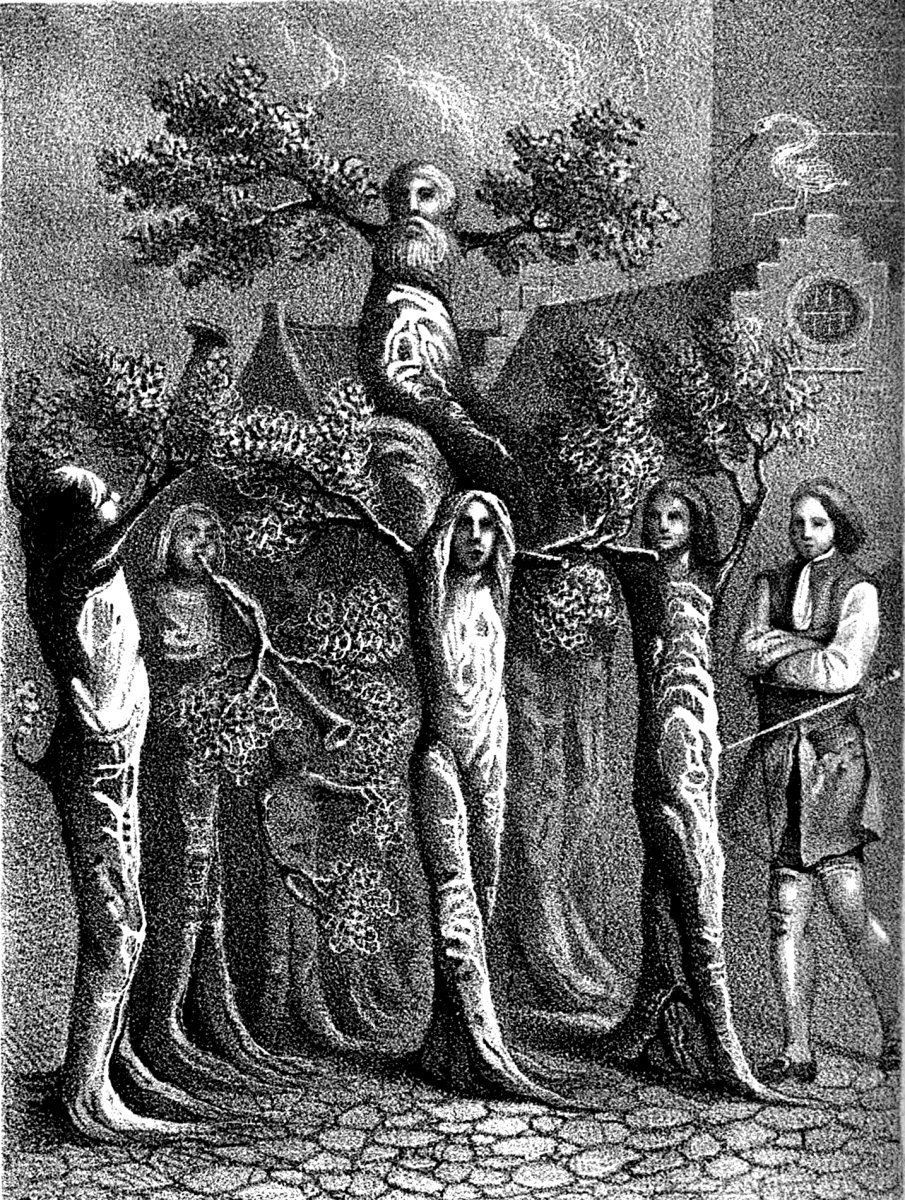
The crown prince was a child of six years; his governor was the wisest tree in the kingdom. I have seen an abstract of moral philosophy and policy, written by him for the use of the prince, the title of which is Mahalda Libal Helit, which in the subterranean language means, The Country's Rudder. It contains many fundamental and useful precepts, of which I recollect the following:
The crown prince was six years old. His tutor was the wisest tree in the kingdom. I have seen a summary of moral philosophy and government that he wrote for the prince. Its title is Mahalda Libal Helit, which means The Country's Rudder in the subterranean language. It contains many fundamental and useful principles. I remember the following:
"1st. Neither praise nor blame should be too hastily credited; judgment should be deferred until accurate knowledge of the matter is obtained.
"1st. Do not be too quick to believe either praise or blame. Wait until you know the facts before making a judgment.
"2d. When a tree is accused of any crime, and the accusation is supported, then the life of the culprit must be examined, his good and evil actions must be compared, and judgment be given according to the preponderance of either.
"2d. When a tree is accused of a crime and the accusation is supported, his life must be examined. His good and bad actions must be compared. Judgment must be based on which outweighs the other.
"3d. The king must be accurately acquainted with the opinions of his subjects, and must strive to keep union among them.
"3d. The king must know his subjects' opinions accurately and strive to keep them united.
"4th. Punishment is not less necessary than reward. The former restrains evil; the latter promotes good.
"4th. Punishment is just as necessary as reward. Punishment restrains evil. Reward promotes good.
"5th. Sound reason teaches that especial regard should be had to the fitness of candidates to public offices; but, though piety and honesty go to form the greatest merit, yet, as the appearance of these virtues is often imposed on us for the reality, no tree should be severely judged till he gets into office, when he will show himself what he is.
"5th. Sound reason teaches that candidates for public office should be judged especially by their fitness for the job. Though piety and honesty are the greatest merits, their appearance is often mistaken for the real thing. So no tree should be judged harshly until he takes office. Then he will show what he really is.
"6th. To make a treasurer of a poor man, or a bankrupt, is to make a hungry wolf purveyor of the kitchen. The case of a rich miser is still stronger; the bankrupt or the penniless may set bounds to their peculation; the miser never has enough.
"6th. Making a poor man or a bankrupt man treasurer is like putting a hungry wolf in charge of the kitchen. A rich miser is an even worse choice. The bankrupt or penniless man may limit how much he steals, but the miser never has enough.
"7th. When the prevalence of vice renders a reformation necessary, great care and deliberation must be used; to banish at once, and in a mass, old and rooted faults, would be like prescribing laxative and restringent medicines at the same time to an invalid.
"7th. When vice becomes so widespread that reform is necessary, great care and thought are needed. To eliminate all long-standing, deeply rooted faults at once would be like giving a sick person laxatives and constipating medicines at the same time.
"8th. They who boldly promise everything, and take upon themselves many duties, are either fools who know not their own powers or the importance of affairs, or are mean and unjust citizens who regard their own and not their country's welfare."
"8th. Those who boldly promise everything and take on many duties are either fools or selfish, unjust citizens. The fools do not know their own abilities or understand how important the matters are. The selfish, unjust citizens care about their own welfare, not their country’s."