Chapter 8
Potu's Academies
In this kingdom are three academies; one in Potu, one in Keba, and one in Nahami.
The kingdom has three academies: one in Potu, one in Keba, and one in Nahami.
The sciences taught in them are history, political economy, mathematics, and jurisprudence. Their theological creed is so short that it can be written on two pages. It contains this doctrine simply, that God, the creator of all things, shall be loved and honored; and that He will, in an other life, reward us for our virtues and punish us for our vices. Theology forms no part of an academical course, as it is forbidden by law to discuss these matters. Neither is medicine numbered among the studies; for, as the trees live moderately, there is no such thing as internal disease.
The subjects taught in them are history, political economy, mathematics, and law. Their religious creed is so short that it fits on two pages. It simply says that God, the creator of all things, should be loved and honored. It also says that he will reward us for our virtues and punish us for our vices in another life. Theology is not part of the academic curriculum because the law forbids discussion of these matters. Medicine is not among the subjects either. Because the trees live moderately, they suffer no internal diseases.
The students are employed in solving complicated and difficult questions, and he who most elegantly and clearly explains his question, is entitled to a reward. No one studies more than one science, and thus each gets a full knowledge of his peculiar subject.
The students work on complicated and difficult questions. Whoever explains their question most elegantly and clearly earns a reward. No one studies more than one science, so each gains a full knowledge of their own subject.
The teachers themselves are obliged to give, each year, a proof of their learning. The teachers of philosophy are required to solve some problem in morals; the historians, to elaborate some passage in history; the jurists, to elucidate some intricate point of law; these last are the only professors expected to be good orators. I told them that the study of rhetoric was common to all students in our colleges, and that all studies were merged in it. They disapproved of this, saying, that should all mechanics strive to make a masterly shoe, the work of most would be bad, and the shoemakers alone would win the prize.
Each year, the teachers themselves must demonstrate their learning. Philosophy teachers must solve a problem in morals. Historians must explain a passage in history, and law professors must clarify a difficult point of law. Only the law professors are expected to be good speakers. I told them that all students in our colleges studied rhetoric, and that all other studies were absorbed into it. They disapproved of this. They said that if all craftspeople tried to make a masterful shoe, most would do a poor job. Only the shoemakers would win the prize.
Besides these academies, there are preparatory gymnasiums, where great pains are taken to discover the bent of the young, that they may be brought up in that science to which they are best fitted. While I was at the seminary of Keba, the bishop had four sons there, preparing for a military course; four others, whose father was a counsellor, were learning mechanical arts, and two maidens were studying navigation. The rank and sex of the scholars are entirely overlooked, in their regard to fitness and propriety.
Besides these academies, there are preparatory schools. They take great care to discover the talents of young people, so they can study the subject best suited to them. While I was at the seminary of Keba, the bishop had four sons there preparing for military careers. Four other students, whose father was a counsellor, were learning mechanical arts, and two young women were studying navigation. The students’ rank and sex are entirely overlooked when deciding what is suitable and proper for them.
He who challenges another to fight, loses forever his right to use weapons, and is condemned to live under guardianship, as one who cannot curb his passions or temper his judgment. I observed that the names of parties who go to law, are kept secret from the judge, he not being an inhabitant of the place where the trial is carried on. The object of this singular law is to prevent all partiality and bribery on the part of the judge, by withholding from him all knowledge of the influence or property of the litigants.
Anyone who challenges another person to a fight loses the right to carry weapons forever. They are placed under guardianship, as someone unable to control their passions or exercise sound judgment. I noticed that the names of people involved in lawsuits are kept secret from the judge. The judge does not live in the place where the trial is held. This unusual law aims to prevent all bias and bribery by keeping the judge from knowing the parties' influence or wealth.
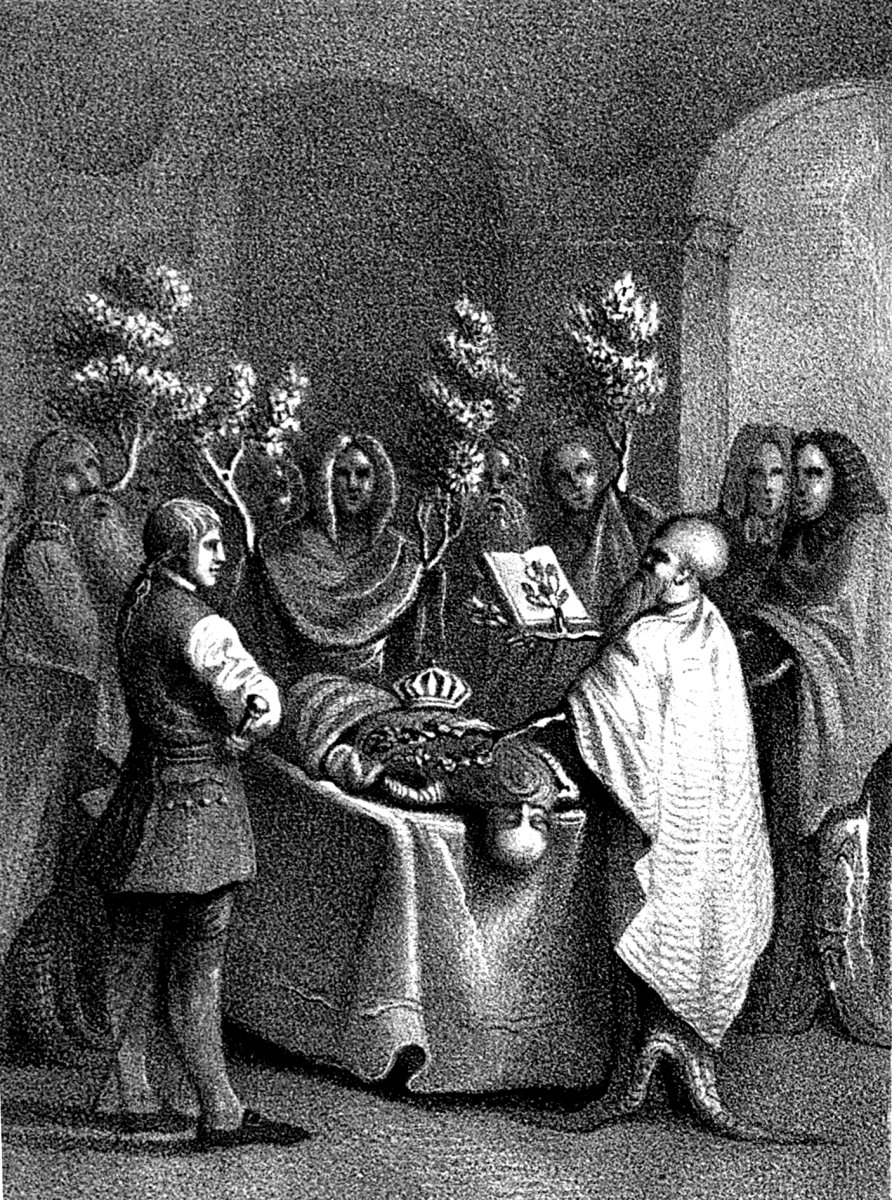
Justice is executed without regard to persons. The king, indeed, is not required to appear in court, but after death, his memory is put to the bar of public opinion, and his life is vindicated or condemned through the peoples' advocates. This trial takes place before the Senate, and judgment is freely pronounced according to the weight of the evidence. A herald proclaims the decision, which is inscribed on the king's monument. The words used in these trials are: Praiseworthy,—good,—not bad,—moderate,—tolerable. Sentence must be pronounced by one of these words.
Justice is carried out without regard to a person's status. The king is not required to appear in court. But after his death, his memory is judged by public opinion. The people's advocates defend or condemn his life. The trial takes place before the Senate, which freely passes judgment according to the weight of the evidence. A herald announces the decision, which is inscribed on the king's monument. The words used in these trials are: praiseworthy, good, not bad, moderate, tolerable. The judgment must use one of these words.
The Potuans give the following reason for this custom. The living king cannot be brought to justice without causing rebellion. As long as he lives, the people owe to him blind obedience and constant reverence. But when the king is dead, the bond between them is dissolved, and, his memory belonging to them, they are bound to justify it as his virtues and vices principally affected themselves.
The Potuans give the following reason for this custom. A living king cannot be brought to justice without causing a rebellion. As long as he lives, the people owe him blind obedience and constant reverence. But when the king dies, the bond between them ends. His memory belongs to the people, and they must judge it, since his virtues and vices affected them most.
The Potuanic annals show that for centuries only one king has received the last degree of judgment—tolerable—or, in their tongue: Rip-fac-si. This was King Mikleta. Although the Potuans are well versed in arms, and defend themselves bravely, when attacked, they never make war on others.
The Potuanic records show that only one king in centuries has received the lowest rating, tolerable, or Rip-fac-si in their language. This was King Mikleta. The Potuans are skilled in arms and defend themselves bravely when attacked, but they never make war on others.
But this king excited by a miserable desire to extend the borders of his empire, entered into an offensive war with his neighbors, and subdued many of them.
But this king was driven by a wretched desire to expand his empire. He went to war against his neighbors and conquered many of them.
The Potuans gained, indeed, in power and wealth, but they suffered more from the loss of friendship and the increase of fear and envy in the conquered. The honorable regard for justice and equity, to which they had hitherto owed their prosperity and supremacy, began from that time to fade. On the death of Mikleta, however, the people recovered from their folly, and showed their regret for it, while at the same time they regained the good will of their neighbors, by putting a blot upon the memory of their ruler.
The Potuans did gain power and wealth. But they suffered more from losing the friendship of the conquered peoples, whose fear and envy grew. From then on, the Potuans’ honorable respect for justice and fairness began to fade. They had owed their prosperity and supremacy to that respect. After Mikleta’s death, however, the people recovered from their folly. They showed their regret by disgracing their ruler’s memory, and in doing so regained their neighbors’ goodwill.
But, to return to myself. I took but little pleasure in associating with my companions, a set of absurd trees, who constantly ridiculed me for my quick perception.
But to return to my own story. I took little pleasure in spending time with my companions. They were a group of absurd trees who constantly ridiculed me for my quick perception.
This quality, I have already said, I was blamed for, very early in my career but by learned trees, with grave and dignified complaisance. These saplings, on the contrary, pestered me with silly nicknames. For example, they took a malicious delight in calling me Skabba, which means an untimely or unripe thing.
As I have already said, learned trees blamed me for this quality early in my career. But they did so with grave and dignified courtesy. These saplings, on the other hand, pestered me with silly nicknames. For example, they took malicious delight in calling me Skabba, which means something untimely or unripe.