The Life of Tommaso, Called Giottino
PAINTER OF FLORENCE
Painter of Florence
When those arts that proceed from design come into competition and their craftsmen work in rivalry, without doubt the good intellects, exercising themselves with much study, discover new things every day in order to satisfy the various tastes of men; and some, speaking for the present of painting, executing works obscure and unusual and demonstrating in them the difficulty of making them, make known by the shadows the brightness of their genius. Others, fashioning the sweet and delicate, thinking these to be likely to be more pleasing to the eyes of all who behold them by reason of their having more relief, easily attract to themselves the minds of the greater part of men. Others, again, painting with unity and lowering the tones of the colours, reducing to their proper places the lights and shades of their figures, deserve very great praise, and reveal the thoughts of the intellect with beautiful dexterity of mind; even as they were ever revealed with a sweet manner in the works of Tommaso di Stefano, called Giottino, who, being born in the year 1324 and having learnt from his father the first principles of painting, resolved while still very young to attempt, in so far as he might be able with assiduous study, to be an imitator of the manner of Giotto rather than of that of his father Stefano. In this attempt he succeeded so well that he gained thereby, besides the manner, which was much more beautiful than that of his master, the surname of Giottino, which never left him; nay, by reason both of the manner and of the name it was the opinion of many, who, however, were in very great error, that he was the son of Giotto; but in truth it is not so, it being certain, or to speak more exactly, believed (it being impossible for such things to be affirmed by any man) that he was the son of Stefano, painter of Florence.
When the arts based on design compete, and their practitioners work as rivals, talented minds undoubtedly discover new things every day through dedicated study. They do so to satisfy people’s varied tastes. Speaking of painting for the present, some artists create obscure and unusual works that show how difficult they were to make. Through their shadows, they reveal the brilliance of their genius. Others create sweet and delicate works, believing that their greater sense of depth will make them more pleasing to everyone who sees them. Such artists easily attract the admiration of most people. Still others paint with unity, softening their colors and placing the lights and shadows of their figures where they belong. They deserve great praise and express the thoughts of the intellect with beautiful mental skill. That sweet manner was always evident in the works of Tommaso di Stefano, known as Giottino. He was born in 1324 and learned the basics of painting from his father. While still very young, he resolved to imitate Giotto’s style rather than his father Stefano’s, as far as he could through constant study. He succeeded so well that he gained a style much more beautiful than his master’s, along with the name Giottino. The name stayed with him for the rest of his life. Because of both his style and his name, many believed he was Giotto’s son, but they were very much mistaken. In truth, he was not Giotto’s son. It is certain, or more precisely believed, that he was the son of Stefano, a painter of Florence. No one can be sure of such things.
He was, then, so diligent in painting and so greatly devoted to it, that, although many of his works are not to be found, those nevertheless that have been found are good and in a beautiful manner, for the reason that the draperies, the hair, the beards, and all the rest of his work were made and harmonized with so great softness and diligence, that it is seen that without doubt he added harmony to this art and had it much more perfect than his master Giotto and his father Stefano. In his youth Giottino painted a chapel near the side-door of S. Stefano al Ponte Vecchio in Florence, wherein, although it is to-day much spoilt by damp, the little that has remained shows the dexterity and the genius of the craftsman. Next, he made the two Saints, Cosimo and Damiano, for the Frati Ermini in the Canto alla Macine, but little is seen of them to-day, for they too have been ruined by time. And he wrought in fresco a chapel in the old S. Spirito in that city, which was afterwards ruined in the burning of that church; and in fresco, over the principal door of the church, the story of the Sending of the Holy Spirit; and on the square before the said church, on the way to the Canto alla Cuculia, on the corner of the convent, he painted that shrine that is still seen there, with Our Lady and other Saints round her, wherein both the heads and the other parts lean strongly towards the modern manner, for the reason that he sought to vary and to blend the flesh-colours, and to harmonize all the figures with grace and judgment by means of a variety of colours and draperies. In like manner he wrought the stories of Constantine with much diligence in the Chapel of S. Silvestro in S. Croce, showing very beautiful ideas in the gestures of the figures; and then, behind an ornament of marble made for the tomb of Messer Bertino de' Bardi, a man who at that time had held honourable military rank, he made this Messer Bertino in armour, after the life, issuing from a sepulchre on his knees, being summoned with the sound of the trumpets of the Judgment by two angels, who are in the air accompanying a beautifully-wrought Christ in the clouds. On the right hand of the entrance of the door of S. Pancrazio the same man made a Christ who is bearing His Cross, and some Saints near Him, that have exactly the manner of Giotto. In S. Gallo (which convent was without the Gate called by the same name, and was destroyed in the siege) in a cloister, there was a Pietà painted in fresco, whereof there is a copy in the aforesaid S. Pancrazio, on a pillar beside the principal chapel. In S. Maria Novella, in the Chapel of S. Lorenzo de' Giuochi, as one enters by the door on the left, on the front wall, he wrought in fresco a S. Cosimo and a S. Damiano, and, in Ognissanti, a S. Christopher and a S. George, which were spoilt by the malice of time, and then restored by other painters by reason of the ignorance of a Provost little conversant with such matters. In the said church there has remained whole the arch that is over the door of the sacristy, wherein there is in fresco a Madonna with the Child in her arms by the hand of Tommaso, which is a good work, by reason of his having wrought it with diligence.
He was so diligent and devoted to painting that, although many of his works cannot be found, those that have been found are good and beautifully executed. He rendered and harmonized the draperies, hair, beards, and everything else with such softness and care that he undoubtedly brought harmony to the art. He also brought the art to a much greater perfection than his master Giotto and his father Stefano. In his youth, Giottino painted a chapel near the side door of S. Stefano al Ponte Vecchio in Florence. Although damp has badly damaged it, what little remains shows the artist's skill and genius. Next, he painted the two Saints, Cosimo and Damiano, for the Frati Ermini in the Canto alla Macine. Little of these paintings can be seen today, for time has ruined them too. He also painted a chapel in fresco in the old S. Spirito in Florence. The chapel was later destroyed when the church burned. Over the main door of the church, he painted a fresco of the Sending of the Holy Spirit. In the square before the church, on the way to the Canto alla Cuculia, he painted a shrine on the corner of the convent. It can still be seen there, with Our Lady and other Saints around her. Both the heads and the other parts strongly anticipate the modern style. He sought to vary and blend the flesh tones and to harmonize all the figures with grace and judgment through varied colors and draperies. He likewise painted the stories of Constantine with great care in the Chapel of S. Silvestro in S. Croce. He showed very beautiful ideas in the gestures of the figures. Then, behind a marble ornament made for the tomb of Messer Bertino de' Bardi, he painted Messer Bertino from life, wearing armor. Messer Bertino had held an honorable military rank at that time. He appears rising on his knees from a tomb, summoned by two angels sounding the trumpets of the Judgment. The angels are in the air, accompanying a beautifully rendered Christ in the clouds. To the right of the entrance to S. Pancrazio, Giottino painted Christ bearing his Cross, with some Saints near him. These figures are exactly in Giotto's style. In a cloister at S. Gallo, there was a Pietà painted in fresco. The convent stood outside the gate of the same name and was destroyed during the siege. A copy of the Pietà is in S. Pancrazio, on a pillar beside the main chapel. In S. Maria Novella, in the Chapel of S. Lorenzo de' Giuochi, he painted a fresco of S. Cosimo and S. Damiano. It is on the front wall as one enters by the door on the left. In Ognissanti, he painted a S. Christopher and a S. George. These were damaged by the ravages of time and then restored by other painters because of the ignorance of a Provost who knew little about such matters. In the same church, the arch over the sacristy door has remained intact. On it is a fresco by Tommaso of a Madonna holding the Child in her arms. It is a good work because he painted it with care.
By means of these works Giottino had acquired so good a name, imitating his master both in design and in invention, as it has been told, that there was said to be in him the spirit of Giotto himself, both because of the vividness of his colouring and of his mastery in draughtsmanship; and in the year 1343, on July 2, when the Duke of Athens was driven out by the people and when he had renounced the sovereignty and restored their liberty to the Florentines, Giottino was forced by the twelve Reformers of the State, and in particular by the prayers of Messer Agnolo Acciaiuoli, then a very great citizen, who had great influence with him, to paint in contempt, on the tower of the Palace of the Podestà, the said Duke and his followers, who were Messer Ceritieri Visdomini, Messer Maladiasse, his Conservator, and Messer Ranieri da San Gimignano, all with the cap of Justice ignominiously on their heads. Round the head of the Duke were many beasts of prey and other sorts, signifying his nature and his character; and one of those his counsellors had in his hand the Palace of the Priors of the city, and was handing it to him, like a disloyal traitor to his country. And all had below them the arms and emblems of their families, and some writings which can hardly be read to-day because they have been eaten away by time. In this work, both by reason of the draughtsmanship and of the great diligence wherewith it was executed, the manner of the craftsman gave universal pleasure to all. Afterwards, at the Campora, a seat of the Black Friars without the Porta a S. Piero Gattolini, he made a S. Cosimo and a S. Damiano, which were spoilt in the whitewashing of the church; and on the bridge of Romiti in Valdarno he painted in fresco the shrine that is built over the middle, with his own hand and in a beautiful manner.
Through these works, Giottino gained a fine reputation by imitating his master in both design and invention, as already described. People said that the spirit of Giotto himself lived in him, because of his vivid coloring and masterful drawing. On July 2, 1343, the people drove out the Duke of Athens. The Duke renounced his sovereignty and restored the Florentines’ liberty. The twelve Reformers of the State then compelled Giottino to paint the Duke and his followers in a humiliating manner on the tower of the Palace of the Podestà. Messer Agnolo Acciaiuoli especially urged him to do this. He was then a very prominent citizen and had great influence with Giottino. The Duke’s followers were Messer Ceritieri Visdomini, Messer Maladiasse, his Conservator, and Messer Ranieri da San Gimignano. All were shown wearing the cap of Justice as a mark of disgrace. Around the Duke’s head were many beasts of prey and other animals, representing his nature and character. One of his counselors held the Palace of the Priors of the city in his hand and was handing it to the Duke, like a disloyal traitor to his country. Beneath each figure were the arms and emblems of his family, along with inscriptions. The inscriptions can hardly be read today because time has worn them away. The artist’s style in this work pleased everyone, both for its drawing and for the great care with which it was executed. Later, at the Campora, a house of the Black Friars outside the Porta a S. Piero Gattolini, he painted a S. Cosimo and a S. Damiano. The paintings were ruined when the church was whitewashed. He also painted the shrine built over the middle of the bridge of Romiti in Valdarno. He painted the fresco himself, in a beautiful manner.
It is found recorded by many who wrote thereon that Tommaso applied himself to sculpture and wrought a figure in marble on the Campanile of S. Maria del Fiore in Florence, four braccia high and facing the place where the Orphans now dwell. In S. Giovanni Laterano in Rome, likewise, he brought to fine completion a scene wherein he represented the Pope in several capacities, which is now seen to have been eaten away and corroded by time; and in the house of the Orsini he painted a hall full of famous men; with a very beautiful S. Louis on a pillar in the Araceli, on the right hand beside the altar.
Many writers record that Tommaso devoted himself to sculpture. He carved a marble figure four braccia high on the Campanile of S. Maria del Fiore in Florence. It faces the place where the Orphans now live. In S. Giovanni Laterano in Rome, he also completed a fine scene depicting the Pope in several roles. Time has now eaten away and corroded the scene. In the house of the Orsini, he painted a hall full of famous men. He also painted a very beautiful S. Louis on a pillar in the Araceli, to the right of the altar.
In the lower church of S. Francesco at Assisi, in an arch over the pulpit (there being no other space that was not painted) he wrought the Coronation of Our Lady, with many angels round her, so gracious, so beautiful in the expressions of the faces, and so sweet and delicate in manner, that they show, with the usual harmony of colour which was something peculiar to this painter, that he had proved himself the peer of all who had lived up to that time; and round this arch he made some stories of S. Nicholas. In like manner, in the Monastery of S. Chiara in the same city, in the middle of the church, he painted a scene in fresco, wherein is S. Chiara supported in the air by two angels who appear real; she is restoring to life a child that was dead, while round her are standing many women all full of wonder, with great beauty in the faces and in the very gracious head-dresses and costumes of those times that they are wearing. In the same city of Assisi, over the gate of the city that leads to the Duomo—namely, in an arch on the inner side—he made a Madonna with the Child in her arms, with so great diligence that she appears alive, and a S. Francis and another Saint, both very beautiful; both of which works, although the story of S. Chiara remained unfinished by reason of Tommaso having fallen sick and returned to Florence, are perfect and most worthy of all praise.
In the lower church of S. Francesco at Assisi, he painted the Coronation of Our Lady in an arch above the pulpit. There was no other space left unpainted. He surrounded her with many angels, whose faces are gracious and beautiful, and whose manner is sweet and delicate. Together with the harmonious colors characteristic of this painter, they show that he had proved himself the equal of all who had lived before him. Around the arch he painted some stories of S. Nicholas. Similarly, in the Monastery of S. Chiara in the same city, he painted a fresco in the middle of the church. It shows S. Chiara suspended in the air by two angels who look real. She is bringing a dead child back to life. Around her stand many women, all full of wonder. Their faces are very beautiful, as are the graceful headdresses and costumes of their time. In the same city of Assisi, he painted a Madonna with the Child in her arms. She is above the city gate leading to the Duomo, in an arch on the inner side. He painted her with such care that she looks alive. He also painted a S. Francis and another Saint, both very beautiful. The scene of S. Chiara remained unfinished because Tommaso fell ill and returned to Florence. Even so, both works are perfect and most worthy of all praise.
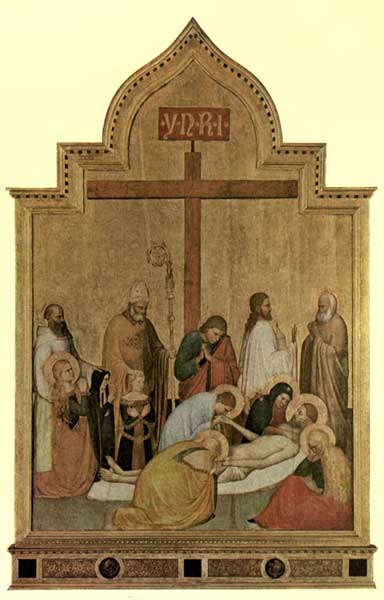
It is said that Tommaso was melancholic in temperament and very solitary, but with respect to art devoted and very studious, as it is clearly seen from a panel in the Church of S. Romeo in Florence, wrought by him in distemper with so great diligence and love that there has never been seen a better work on wood by his hand. In this panel, which is placed in the tramezzo of the church, on the right hand, is a Dead Christ with the Maries and Nicodemus, accompanied by other figures, who are bewailing His death with bitterness and with very sweet and affectionate movements, wringing their hands with diverse gestures, and beating themselves in a manner that in the air of the faces there is shown very clearly their sharp sorrow at the so great cost of our sins. And it is something marvellous to consider, not that he penetrated with his genius to such a height of imagination, but that he could express it so well with the brush. Wherefore this work is consummately worthy of praise, not so much by reason of the subject and of the invention, as because in it the craftsman has shown, in some heads that are weeping, that although the lineaments of those that are weeping are distorted in the brows, in the eyes, in the nose, and in the mouth, this, however, neither spoils nor alters a certain beauty which is wont to suffer much in weeping when the painters do not know well how to avail themselves of the good methods of art. But it is no great thing that Giottino should have executed this panel with so much consideration, since in his labours he ever aimed rather at fame and glory than at any other reward, being free from the greed of gain, that makes our present masters less diligent and good. And even as he did not seek to have great riches, so he did not trouble himself much about the comforts of life—nay, living poorly, he sought to satisfy others rather than himself; wherefore, taking little care of himself and enduring fatigue, he died of consumption at the age of thirty-two, and was given burial by his relatives at the Martello Gate without S. Maria Novella, beside the tomb of Bontura.
It is said that Tommaso was melancholic and very solitary, but devoted to art and a careful student of it. His devotion is clear in a panel he painted in tempera for the Church of S. Romeo in Florence. He worked on it with such care and love that no better work on wood by his hand has ever been seen. The panel hangs on the right side of the church’s tramezzo, or partition. It shows the dead Christ with the Maries, Nicodemus, and other figures. They mourn his death bitterly, yet their movements are gentle and affectionate. They wring their hands in different ways and beat themselves. Their faces clearly show their sharp sorrow at the terrible cost of our sins. What is remarkable is not that his genius led him to imagine such a scene, but that he could express it so well with a brush. This work deserves the highest praise, not so much for its subject or composition as for the artist’s skill in painting the weeping faces. Although the brows, eyes, noses, and mouths of those who weep are distorted, they still retain a certain beauty. This beauty often suffers greatly in paintings of weeping figures when painters do not know how to use good artistic methods. Yet it is hardly surprising that Giottino painted this panel with such care. In his work he always sought fame and glory rather than any other reward. He was free from the greed for profit that makes our present masters less diligent and less skilled. Just as he did not seek great riches, he also cared little for the comforts of life. Indeed, he lived in poverty and sought to satisfy others rather than himself. Because he took little care of himself and endured hard labor, he died of consumption at the age of thirty-two. His relatives buried him at the Martello Gate, outside S. Maria Novella, beside the tomb of Bontura.
See note on p. 57.
Disciples of Giottino, who left more fame than wealth, were Giovanni Tossicani of Arezzo, Michelino, Giovanni dal Ponte, and Lippo, who were passing good masters of this art, but above all Giovanni Tossicani, who made many works throughout all Tuscany after Tommaso and in the same manner as his, and in particular the Chapel of S. Maria Maddalena, belonging to the Tuccerelli, in the Pieve of Arezzo, and a S. James on a pillar in the Pieve of the township of Empoli. In the Duomo of Pisa, also, he wrought some panels which have since been removed in order to make room for the modern. The last work that he made was in a chapel of the Vescovado of Arezzo, for the Countess Giovanna, wife of Tarlato da Pietramala—namely, a very beautiful Annunciation, with S. James and S. Philip; which work, by reason of the back of the wall being turned to the north, was little less than completely spoilt by damp, when Maestro Agnolo di Lorenzo of Arezzo restored the Annunciation, and shortly afterwards Giorgio Vasari, still a youth, restored the S. James and S. Philip, to his own great profit, having learnt much, at that time when he had not the advantage of other masters, by studying Giovanni's method of painting and the shadows and colours of that work, spoilt as it was. In this chapel there are still read these words in an epitaph of marble, in memory of the Countess who had it built and painted:
Giottino left more fame than wealth. His disciples were Giovanni Tossicani of Arezzo, Michelino, Giovanni dal Ponte, and Lippo. They were all very good masters of the art, but Giovanni Tossicani was the best of them. After Tommaso, Giovanni made many works throughout Tuscany in Tommaso’s style. Among them were the Chapel of S. Maria Maddalena, belonging to the Tuccerelli, in the Pieve of Arezzo, and a S. James on a pillar in the Pieve of the township of Empoli. He also painted some panels in the Duomo of Pisa. These were later removed to make room for modern works. His last work was in a chapel of the Vescovado of Arezzo, for the Countess Giovanna, wife of Tarlato da Pietramala. It was a very beautiful Annunciation, with S. James and S. Philip. Because the back of the wall faced north, damp had almost completely ruined the work when Maestro Agnolo di Lorenzo of Arezzo restored the Annunciation. Shortly afterward, Giorgio Vasari, still a youth, restored the S. James and S. Philip. This helped him greatly. At the time, he did not have the benefit of other masters, but he learned much by studying Giovanni’s painting method and the shadows and colors of the work, damaged as it was. In this chapel, the following words can still be read on a marble epitaph. They commemorate the Countess who had the chapel built and painted:
ANNO DOMINI 1335, DE MENSE AUGUSTI, HANC CAPELLAM CONSTITUI FECIT NOBILIS DOMINA COMITISSA JOANNA DE SANCTA FLORA, UXOR NOBILIS MILITIS DOMINI TARLATI DE PETRAMALA, AD HONOREM BEATÆ MARIÆ VIRGINIS.
In August 1335, the noble Countess Joanna de Sancta Flora had this chapel built. She was the wife of the noble knight Lord Tarlati de Petramala. She had it built in honor of the Blessed Virgin Mary.
Of the works of the other disciples of Giottino there is no mention made, seeing that they were but ordinary and little like those of the master and of Giovanni Tossicani, their fellow-disciple. Tommaso drew very well, as it may be seen in our book, in certain drawings wrought by his hand with much diligence.
No mention is made of the works of Giottino’s other disciples. Their work was ordinary and bore little resemblance to that of their master and their fellow disciple, Giovanni Tossicani. Tommaso drew very well, as can be seen in our book, which contains drawings he made with great care.