The Life of Giovanni dal Ponte
PAINTER OF FLORENCE
Painter of Florence
Although there is no truth and not much confidence to be placed in the ancient proverb that the prodigal's purse is never empty, and although, on the contrary, it is very true that he who does not live a well-ordered life in his own degree lives at the last in want and dies miserably, it is seen, nevertheless, that fortune sometimes aids rather those who squander without restraint than those who are in all things careful and self-restrained; and when the favour of fortune ceases, there often comes death, to make up for her defection and for the bad management of men, supervening at the very moment when such men would begin with infinite dismay to recognize how miserable a thing it is to have squandered in youth and to want in old age, living and labouring in poverty, as would have happened to Giovanni da Santo Stefano a Ponte of Florence, if, after having consumed his patrimony and much gain which had been brought to his hands rather by fortune than by his merits, with some inheritances that came to him from an unexpected source, he had not finished at one and the same time the course of his life and all his means.
There is little truth or reason to trust in the old proverb that a spendthrift’s purse is never empty. On the contrary, anyone who fails to live within their means will eventually suffer want and die miserably. Yet fortune sometimes helps those who spend without restraint more than those who are careful and self-controlled in all things. And when fortune’s favor ends, death often comes to make up for her desertion and people’s poor management. It arrives just as such people would begin to realize, with immense dismay, how miserable it is to spend freely in youth and live and work in poverty in old age. This would have happened to Giovanni da Santo Stefano a Ponte of Florence if he had not died just as his means ran out. He had spent his inherited wealth, much money that had come to him through luck rather than merit, and some inheritances from an unexpected source.
This man, then, who was a disciple of Buonamico Buffalmacco, and who imitated him more in attending to the pleasures of life than in seeking to become an able painter, was born in the year 1307, and after being in early youth a disciple of Buffalmacco, he made his first works in the Chapel of S. Lorenzo, in the Pieve of Empoli, painting there in fresco many scenes of the life of that Saint, with so great diligence that he was summoned to Arezzo in the year 1344, a better development being expected after so fine a beginning; and there he painted the Assumption of Our Lady in a chapel in S. Francesco. And a little time afterwards, being in some credit in that city for lack of other painters, he painted the Chapel of S. Onofrio in the Pieve, with that of S. Antonio, which to-day is spoilt by damp. He also made some other pictures that were in S. Giustina and in S. Matteo, but these were thrown to the ground by Duke Cosimo, together with the said churches, in the making of fortifications for that city; and exactly in that place, at the foot of the abutment of an ancient bridge beside the said S. Giustina, where the stream entered the city, there were then found a head of Appius Cæcus and one of his son, both in marble and very beautiful, with an ancient epitaph, likewise very beautiful, which are all now in the guardaroba of the said Lord Duke.
This man was born in 1307 and became a pupil of Buonamico Buffalmacco in his youth. He followed Buffalmacco’s example more in enjoying life than in trying to become a skilled painter. His first works were in the Chapel of S. Lorenzo, in the Pieve of Empoli. There he painted many fresco scenes from the life of that saint. He worked with such care that he was summoned to Arezzo in 1344. After so fine a beginning, people expected him to improve further. There he painted the Assumption of Our Lady in a chapel in S. Francesco. A little later, he had gained some standing in the city, largely because there were no other painters. He then painted the Chapel of S. Onofrio in the Pieve, as well as the Chapel of S. Antonio, which is now damaged by damp. He also painted some other pictures in S. Giustina and S. Matteo. But Duke Cosimo had the pictures and both churches torn down while building fortifications for the city. At that very spot, two beautiful marble heads were found, one of Appius Cæcus and one of his son. They lay at the foot of the abutment of an ancient bridge beside S. Giustina, where the stream entered the city. A beautiful ancient epitaph was also found there. All are now in the guardaroba of the said Lord Duke.
Guardaroba, the room or rooms where valuables were stored, including clothes, linen, art treasures, and furniture.
Giovanni, having returned to Florence at the time when there was finished the closing of the middle arch of the Ponte a S. Trinita, painted many figures both within and without a chapel built over one pier and dedicated to S. Michelagnolo, and in particular all the front wall; which chapel, together with the bridge, was carried away by the flood of the year 1557. It is by reason of these works that some maintain, besides what has been said about him at the beginning, that he was ever afterwards called Giovanni dal Ponte. In Pisa, also, in the year 1355, he made some scenes in fresco behind the altar of the principal chapel of S. Paolo a Ripa d'Arno, which are now all spoilt by damp and by time. Giovanni also painted the Chapel of the Scali in S. Trinita in Florence, with another that is beside it, and one of the stories of S. Paul by the side of the principal chapel, where is the tomb of Maestro Paolo, the astrologer. In S. Stefano al Ponte Vecchio he painted a panel, with other pictures in distemper and in fresco both within and without Florence, which brought him considerable credit.
Giovanni returned to Florence when the middle arch of the Ponte a S. Trinita was being completed. He painted many figures inside and outside a chapel built over one of the bridge’s piers. The chapel was dedicated to S. Michelagnolo, and Giovanni painted the entire front wall. The flood of 1557 swept away both the chapel and the bridge. Besides what has already been said about him at the beginning, some maintain that these works earned him the lasting name Giovanni dal Ponte. In Pisa, in 1355, he painted fresco scenes behind the altar of the principal chapel of S. Paolo a Ripa d'Arno. Damp and time have now ruined them all. Giovanni also painted the Chapel of the Scali in S. Trinita in Florence, as well as the chapel beside it. He painted one of the stories of S. Paul beside the principal chapel, where Maestro Paolo, the astrologer, is buried. In S. Stefano al Ponte Vecchio, he painted a panel. He also painted other pictures in distemper and fresco, both in and outside Florence. These works brought him considerable credit.
He gave contentment to his friends, but more in his pleasures than in his works, and he was the friend of men of learning, and in particular of all those who pursued the studies of his own profession in order to become excellent therein; and although he had not sought to have in himself that which he desired in others, yet he never ceased to encourage others to work valiantly. Finally, having lived fifty-nine years, Giovanni was seized by pleurisy and in a few days departed this life, wherein, had he survived a little longer, he would have suffered many discomforts, there being left in his house scarce as much as sufficed to give him decent burial in S. Stefano al Ponte Vecchio. His works date about 1365.
He pleased his friends more through his pleasures than through his work. He was a friend to learned men, especially all those who studied his own profession to become excellent at it. Although he had not sought to attain that excellence himself, he never stopped encouraging others to work bravely. Finally, at the age of fifty-nine, Giovanni fell ill with pleurisy and died a few days later. Had he lived a little longer, he would have suffered many hardships. There was hardly enough left in his house to pay for a decent burial in S. Stefano al Ponte Vecchio. His works date from around 1365.
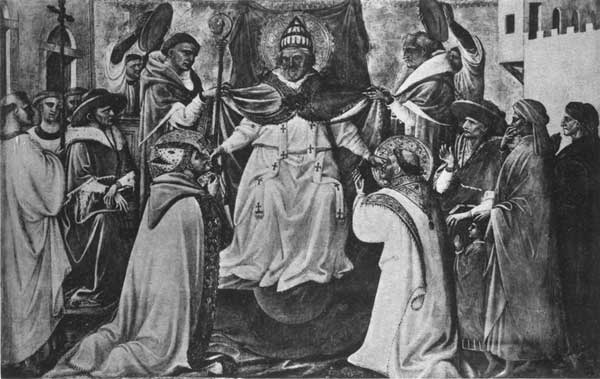
In our book of drawings by diverse ancients and moderns there is a drawing in water-colour by the hand of Giovanni, wherein is a S. George on horseback who is slaying the Dragon, and a skeleton, which bear witness to the method and manner that he had in drawing.
Our book of drawings by various ancient and modern artists includes a watercolor drawing by Giovanni. It shows Saint George on horseback slaying the Dragon, as well as a skeleton. The drawing shows Giovanni’s method and style.