Taddeo Gaddi's Life
PAINTER OF FLORENCE
Painter of Florence
It is a beautiful and truly useful and praiseworthy action to reward talent largely in every place, and to honour him who has it, seeing that an infinity of intellects which might otherwise slumber, roused by this encouragement, strive with all industry not only to learn their art but to become excellent therein, in order to advance themselves and to attain to a rank both profitable and honourable; whence there may follow honour for their country, glory for themselves, and riches and nobility for their descendants, who, upraised by such beginnings, very often become both very rich and very noble, even as the descendants of the painter Taddeo Gaddi did by reason of his work. This Taddeo di Gaddo Gaddi, a Florentine, after the death of Giotto—who had held him at his baptism and had been his master for twenty-four years after the death of Gaddo, as it is written by Cennino di Drea Cennini, painter of Colle di Valdelsa—remained among the first in the art of painting and greater than all his fellow-disciples both in judgment and in genius; and he wrought his first works, with a great facility given to him by nature rather than acquired by art, in the Church of S. Croce in Florence, in the chapel of the sacristy, where, together with his companions, disciples of the dead Giotto, he made some stories of S. Mary Magdalene, with beautiful figures and with most beautiful and extravagant costumes of those times. And in the Chapel of the Baroncelli and Bandini, where Giotto had formerly wrought the panel in distemper, he made by himself in fresco, on one wall, some stories of Our Lady which were held very beautiful. He also painted over the door of the said sacristy the story of Christ disputing with the Doctors in the Temple, which was afterwards half ruined when the elder Cosimo de' Medici, in making the noviciate, the chapel, and the antechamber in front of the sacristy, placed a cornice of stone over the said door. In the same church he painted in fresco the Chapel of the Bellacci, and also that of S. Andrea by the side of one of the three of Giotto, wherein he made the scene of Jesus Christ taking Andrew and Peter from their nets, and the crucifixion of the former Apostle, a work greatly commended and extolled both then when it was finished and still at the present day. Over the side-door, below the burial-place of Carlo Marsuppini of Arezzo, he made a Dead Christ with the Maries, wrought in fresco, which was very much praised; and below the tramezzo that divides the church, on the left hand, above the Crucifix of Donato, he painted in fresco a story of S. Francis, representing a miracle that he wrought in restoring to life a boy who was killed by falling from a terrace, together with his apparition in the air. And in this story he portrayed Giotto his master, Dante the poet, Guido Cavalcanti, and, some say, himself. Throughout the said church, also, in diverse places, he made many figures which are known by painters from the manner. For the Company of the Temple he painted the shrine that is at the corner of the Via del Crocifisso, containing a very beautiful Deposition from the Cross.
It is a beautiful, truly useful, and praiseworthy act to reward talent generously everywhere and honor those who possess it. Such encouragement awakens countless minds that might otherwise remain dormant. It inspires them to work diligently, not only to learn their art but to excel in it. They strive to advance and achieve a position that brings both profit and honor. This may bring honor to their country, glory to themselves, and wealth and nobility to their descendants. Raised by such beginnings, those descendants very often become both very rich and very noble. So it was with the descendants of the painter Taddeo Gaddi, thanks to his work. Taddeo di Gaddo Gaddi was a Florentine. Giotto had been his godfather at baptism and, after Gaddo's death, his master for twenty-four years. This is recorded by Cennino di Drea Cennini, a painter from Colle di Valdelsa. After Giotto's death, Taddeo remained among the leading painters. He surpassed all his fellow pupils in both judgment and genius. He produced his first works with great ease, a gift of nature rather than a skill acquired through art. These works were in the sacristy chapel of the Church of S. Croce in Florence. There, with his companions, who had also been pupils of the late Giotto, he painted scenes from the life of S. Mary Magdalene. They included beautiful figures and the very beautiful, extravagant costumes of the time. In the Chapel of the Baroncelli and Bandini, Giotto had earlier painted the panel in tempera. On one wall, Taddeo painted fresco scenes of Our Lady by himself. These were considered very beautiful. He also painted Christ disputing with the Doctors in the Temple above the door of the sacristy. The painting was later half ruined when the elder Cosimo de' Medici built the novitiate, chapel, and antechamber in front of the sacristy. Cosimo placed a stone cornice above the door. In the same church, Taddeo painted frescoes in the Chapel of the Bellacci. He also painted the Chapel of S. Andrea, beside one of Giotto's three chapels. There he depicted Jesus Christ taking Andrew and Peter from their nets, and the crucifixion of Andrew. The work was greatly praised both when it was finished and to this day. Above the side door, below the tomb of Carlo Marsuppini of Arezzo, Taddeo painted a fresco of the Dead Christ with the Maries. It was greatly praised. Below the tramezzo that divides the church, on the left, Taddeo painted a fresco above Donato's Crucifix. It showed a miracle of S. Francis, who appeared in the air and restored a boy to life. The boy had been killed by a fall from a terrace. In this scene Taddeo portrayed his master Giotto, the poet Dante, Guido Cavalcanti, and, some say, himself. He also painted many figures in various places throughout the church. Painters recognize these figures by their style. For the Company of the Temple, he painted the shrine at the corner of the Via del Crocifisso. It contains a very beautiful Deposition from the Cross.
See the note on p. 57.
In the cloister of S. Spirito he wrought two scenes in the little arches beside the Chapter-house, in one of which he made Judas selling Christ, and in the other the Last Supper that He held with the Apostles. And in the same convent, over the door of the refectory, he painted a Crucifix and some Saints, which give us to know that among the others who worked here he was truly an imitator of the manner of Giotto, which he held ever in the greatest veneration. In S. Stefano del Ponte Vecchio he painted the panel and the predella of the high-altar with great diligence; and on a panel in the Oratory of S. Michele in Orto he made a very good picture of a Dead Christ being lamented by the Maries and laid to rest very devoutly by Nicodemus in the Sepulchre.
In the cloister of S. Spirito, he painted two scenes in the small arches beside the Chapter-house. One showed Judas selling Christ, and the other showed the Last Supper he shared with the Apostles. In the same convent, he painted a Crucifix and some Saints above the refectory door. These paintings show that, among the others who worked there, he truly imitated the style of Giotto. He always held Giotto's style in the highest regard. In S. Stefano del Ponte Vecchio, he painted the high altar's panel and predella with great care. On a panel in the Oratory of S. Michele in Orto, he painted a very good picture of the dead Christ. The Maries mourn him, while Nicodemus lays him to rest in the Sepulchre with great devotion.
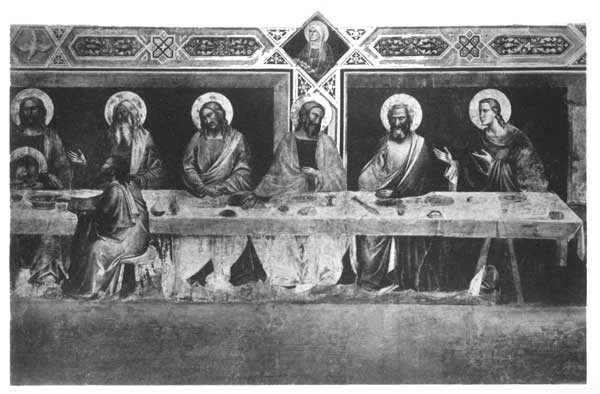
In the Church of the Servite Friars he painted the Chapel of S. Niccolò, belonging to those of the palace, with stories of that Saint, wherein he showed very good judgment and grace in a boat that he painted, demonstrating that he had complete understanding of the tempestuous agitation of the sea and of the fury of the storm; and while the mariners are emptying the ship and jettisoning the cargo, S. Nicholas appears in the air and delivers them from that peril. This work, having given pleasure and having been much praised, was the reason that he was made to paint the chapel of the high-altar in that church, wherein he made in fresco some stories of Our Lady, and another figure of Our Lady on a panel in distemper, with many Saints wrought in lively fashion. In like manner, in the predella of the said panel, he made some other stories of Our Lady with little figures, whereof there is no need to make particular mention, seeing that in the year 1467 everything was destroyed when Lodovico, Marquis of Mantua, made in that place the tribune that is there to-day and the choir of the friars, with the design of Leon Battista Alberti, causing the panel to be carried into the Chapter-house of that convent; in the refectory of which Taddeo made, just above the wooden seats, the Last Supper of Jesus Christ with the Apostles, and above that a Crucifix with many saints.
In the Church of the Servite Friars, he painted the Chapel of S. Niccolò, which belonged to those of the palace. He painted scenes from the life of that Saint. In his painting of a boat, he showed very good judgment and grace. He demonstrated a complete understanding of the churning sea and the fury of the storm. As the sailors bail out the ship and throw the cargo overboard, S. Nicholas appears in the air and saves them from danger. The work pleased people and was much praised. As a result, he was commissioned to paint the chapel of the high altar in the same church. There he painted some scenes from the life of Our Lady in fresco. He also painted another image of Our Lady on a panel in distemper, with many vividly rendered Saints. On the predella of the panel, he painted other scenes from the life of Our Lady, using small figures. There is no need to describe these works in detail, since everything was destroyed in 1467. In that year Lodovico, Marquis of Mantua, had the tribune now there and the friars’ choir built in that place. Leon Battista Alberti supplied the design, and Lodovico had the panel moved to the Chapter-house of the convent. In the convent’s refectory, Taddeo painted the Last Supper of Jesus Christ with the Apostles, just above the wooden seats. Above the Last Supper, he painted a Crucifix with many saints.
Having given the last touch to these works, Taddeo Gaddi was summoned to Pisa, where, for Gherardo and Bonaccorso Gambacorti, he wrought in fresco the principal chapel of S. Francesco, painting with beautiful colours many figures and stories of that Saint and of S. Andrew and S. Nicholas. Next, on the vaulting and on the front wall is Pope Honorius, who is confirming the Order; here Taddeo is portrayed from the life, in profile, with a cap wrapped round his head, and at the foot of this scene are written these words:
After putting the finishing touches on these works, Taddeo Gaddi was summoned to Pisa. There, for Gherardo and Bonaccorso Gambacorti, he painted frescoes in the main chapel of S. Francesco. Using beautiful colours, he painted many figures and scenes from the lives of that Saint and of S. Andrew and S. Nicholas. Next, on the vault and the front wall, he painted Pope Honorius confirming the Order. In this scene, Taddeo is portrayed from life, in profile, with a cap wrapped around his head. At the foot of the scene are written these words:
MAGISTER TADDEUS GADDUS DE FLORENTIA PINXIT HANC HISTORIAM SANCTI FRANCISCI ET SANCTI ANDREÆ ET SANCTI NICOLAI, ANNO DOMINI MCCCXLII, DE MENSE AUGUSTI.
Master Taddeo Gaddi of Florence painted this scene of Saint Francis, Saint Andrew, and Saint Nicholas in the year of our Lord 1342, in the month of August.
Besides this, in the cloister also of the same convent he made in fresco a Madonna with her Child in her arms, very well coloured, and in the middle of the church, on the left hand as one enters, a S. Louis the Bishop, seated, to whom S. Gherardo da Villamagna, who had been a friar of this Order, is recommending a Fra Bartolommeo, then Prior of the said convent. In the figures of this work, seeing that they were taken from nature, there are seen liveliness and infinite grace, in that simple manner which was in some respects better than that of Giotto, above all in expressing supplication, joy, sorrow, and other similar emotions, which, when well expressed, ever bring very great honour to the painter.
He also painted a fresco in the cloister of the same convent. It showed the Madonna holding her Child and was very well colored. In the middle of the church, on the left as one enters, he painted S. Louis the Bishop seated. S. Gherardo da Villamagna is recommending Fra Bartolommeo to him. S. Gherardo had been a friar of this Order, and Fra Bartolommeo was then Prior of the convent. Because the figures were drawn from life, they show liveliness and infinite grace. Their simple style was in some respects better than Giotto’s, especially in expressing supplication, joy, sorrow, and similar emotions. When such emotions are well expressed, they always bring great honor to the painter.
Next, having returned to Florence, Taddeo continued for the Commune the work of Orsanmichele and refounded the piers of the Loggia, building them with stone dressed and well shaped, whereas before they had been made of bricks, without, however, altering the design that Arnolfo left, with directions that there should be made over the Loggia a palace with two vaults for storing the provisions of grain that the people and Commune of Florence used to make. To the end that this work might be finished, the Guild of Porta S. Maria, to which the charge of the fabric had been given, ordained that there should be paid thereunto the tax of the square of the grain-market and some other taxes of very small importance. But what was far more important, it was well ordained with the best counsel that each of the Guilds of Florence should make one pier by itself, with the Patron Saint of the Guild in a niche therein, and that every year, on the festival of each Saint the Consuls of that Guild should go to church to make offering, and should hold there the whole of that day the standard with their insignia, but that the offering, none the less, should be to the Madonna for the succour of the needy poor. And because, during the great flood of the year 1333, the waters had swept away the parapets of the Ponte Rubaconte, thrown down the Castle of Altafronte, left nothing of the Ponte Vecchio but the two piers in the middle, and completely ruined the Ponte a S. Trinita except one pier that remained all shattered, as well as half the Ponte alla Carraia, bursting also the weir of Ognissanti, those who then ruled the city determined no longer to allow the dwellers on the other side of the Arno to have to return to their homes with so great inconvenience as was caused by their having to cross in boats. Wherefore, having sent for Taddeo Gaddi, for the reason that Giotto his master had gone to Milan, they caused him to make the model and design of the Ponte Vecchio, giving him instructions that he should have it brought to completion as strong and as beautiful as might be possible; and he, sparing neither cost nor labour, made it with such strength in the piers and with such magnificence in the arches, all of stone squared with the chisel, that it supports to-day twenty-two shops on either side, which make in all forty-four, with great profit to the Commune, which drew from them eight hundred florins yearly in rents. The extent of the arches from one side to the other is thirty-two braccia, that of the street in the middle is sixteen braccia, and that of the shops on either side eight braccia. For this work, which cost sixty thousand florins of gold, not only did Taddeo then deserve infinite praise, but even to-day he is more than ever commended for it, for the reason that, besides many other floods, it was not moved in the year 1557, on September 13, by that which threw down the Ponte a S. Trinita and two arches of that of the Carraia, and shattered in great part the Rubaconte, together with much other destruction that is very well known. And truly there is no man of judgment who can fail to be amazed, not to say marvel, considering that the said Ponte Vecchio in so great an emergency could sustain unmoved the onset of the waters and of the beams and the wreckage made above, and that with so great firmness.
After returning to Florence, Taddeo continued the work on Orsanmichele for the Commune. He rebuilt the Loggia’s piers in carefully dressed and shaped stone. Before, they had been made of brick. He did not, however, alter the design Arnolfo had left. Arnolfo had directed that a palace with two vaulted chambers be built above the Loggia. These chambers were to store the grain provisions kept by the people and Commune of Florence. To help finish the work, the Guild of Porta S. Maria directed that certain revenues be paid toward it. The guild, which had been given charge of the building, assigned it the tax from the grain-market square and some other very minor taxes. But a far more important measure was wisely decided upon: each of Florence’s Guilds would build one pier. Each pier would have a statue of the Guild’s Patron Saint in a niche. Every year, on the saint’s feast day, the Guild’s Consuls would go to church to make an offering. They would also keep their standard, bearing their insignia, there throughout the day. The offering, however, would be made to the Madonna to help the needy poor. During the great flood of 1333, the waters had swept away the parapets of the Ponte Rubaconte and destroyed the Castle of Altafronte. They left nothing of the Ponte Vecchio except its two middle piers. They completely ruined the Ponte a S. Trinita, except for one shattered pier, and destroyed half the Ponte alla Carraia. They also broke the weir of Ognissanti. The city’s rulers therefore decided not to let those living across the Arno continue to suffer the inconvenience of crossing by boat to reach their homes. They sent for Taddeo Gaddi, since his master Giotto had gone to Milan. They had Taddeo make a model and design for the Ponte Vecchio. They instructed him to have the bridge completed as strongly and beautifully as possible. Sparing neither expense nor labor, he made its piers so strong and its arches so magnificent, all from chisel-cut stone, that it still supports twenty-two shops on each side today. These forty-four shops brought great profit to the Commune, which received eight hundred florins a year in rent. The arches span thirty-two braccia from one side to the other. The street in the middle is sixteen braccia wide, and the shops on each side are eight braccia deep. The bridge cost sixty thousand gold florins. Taddeo deserved endless praise for it at the time, and today he is praised even more. Besides surviving many other floods, the bridge stood unmoved in the flood of September 13, 1557. That flood destroyed the Ponte a S. Trinita and two arches of the Ponte alla Carraia. It also badly damaged the Rubaconte and caused much other destruction that is well known. Truly, anyone with good judgment must be astonished, if not amazed, that the Ponte Vecchio stood so firm in such a crisis. It resisted the force of the water, the beams, and the wreckage swept down from above without moving.
At the same time Taddeo directed the founding of the Ponte a S. Trinita, which was finished less happily in the year 1346, at the cost of twenty thousand florins of gold; I say less happily, because, not having been made like the Ponte Vecchio, it was entirely ruined by the said flood of the year 1557. In like manner, under the direction of Taddeo there was made at the said time the wall of the Costa a S. Gregorio, with piles driven in below, including two piers of the bridge in order to gain additional ground for the city on the side of the Piazza de' Mozzi, and to make use of it, as they did, to make the mills that are there.
At the same time, Taddeo directed the laying of the foundations for the Ponte a S. Trinita. The bridge was completed less happily in 1346, at a cost of twenty thousand gold florins. I say less happily because it was not built like the Ponte Vecchio. As a result, the flood of 1557 completely destroyed it. At the same time, Taddeo also directed the construction of the wall of the Costa a S. Gregorio. Piles were driven into the ground beneath it, and the wall enclosed two piers of the bridge. This was done to gain more land for the city on the Piazza de' Mozzi side and to build mills there, as they did.
While all these works were being made by the direction and design of Taddeo, seeing that he did not therefore stop painting, he decorated the Tribunal of the Mercanzia Vecchia, wherein, with poetical invention, he represented the Tribunal of Six (which is the number of the chief men of that judicial body), who are standing watching the tongue being torn from Falsehood by Truth, who is clothed with a veil over the nude, while Falsehood is draped in black; with these verses below:
While all these works were being made under Taddeo's direction and from his designs, he continued to paint. He decorated the Tribunal of the Mercanzia Vecchia with an imaginative scene. It shows the Tribunal of Six, matching the number of chief men in that judicial body. They stand watching Truth tear the tongue from Falsehood. Truth is nude except for a veil, while Falsehood is dressed in black. Below the scene are these verses:
LA PURA VERITÀ, PER UBBIDIRE ALLA SANTA GIUSTIZIA, CHE NON TARDA, CAVA LA LINGUA ALLA FALSA BUGIARDA.
PURE TRUTH, OBEYING HOLY JUSTICE, WHICH DOES NOT DELAY, PULLS OUT THE LYING WOMAN'S TONGUE.
And below the scene are these verses:
Below the scene are these verses:
TADDEO DIPINSE QUESTO BEL RIGESTRO; DISCEPOL FU DI GIOTTO IL BUON MAESTRO.
TADDEO PAINTED THIS BEAUTIFUL SCENE. HE WAS A STUDENT OF GIOTTO, THE GOOD MASTER.
Taddeo received a commission for some works in fresco in Arezzo, which he carried to the greatest perfection in company with his disciple Giovanni da Milano. Of these we still see one in the Company of the Holy Spirit, a scene on the wall over the high-altar, containing the Passion of Christ, with many horses, and the Thieves on the Cross, a work held very beautiful by reason of the thought that he showed in placing Him on the Cross. Therein are some figures with vivid expressions which show the rage of the Jews, some pulling Him by the legs with a rope, others offering the sponge, and others in various attitudes, such as the Longinus who is piercing His side, and the three soldiers who are gambling for His raiment, in the faces of whom there is seen hope and fear as they throw the dice. The first of these, in armour, is standing in an uncomfortable attitude awaiting his turn, and shows himself so eager to throw that he appears not to be feeling the discomfort; the other, raising his eyebrows, with his mouth and with his eyes wide open, is watching the dice, in suspicion, as it were, of fraud, and shows clearly to anyone who studies him the desire and the wish that he has to win. The third, who is throwing the dice, having spread the garment on the ground, appears to be announcing with a grin his intention of casting them. In like manner, throughout the walls of the church are seen some stories of S. John the Evangelist, and throughout the city other works made by Taddeo, which are recognized as being by his hand by anyone who has judgment in art. In the Vescovado, also, behind the high-altar, there are still seen some stories of S. John the Baptist, which are wrought with such marvellous manner and design that they cause him to be held in admiration. In the Chapel of S. Sebastiano in S. Agostino, beside the sacristy, he made the stories of that martyr, and a Disputation of Christ with the Doctors, so well wrought and finished that it is a miracle to see the beauty in the changing colours of various sorts and the grace in the pigments of these works, which are finished to perfection.
Taddeo was commissioned to paint some frescoes in Arezzo. Working with his pupil Giovanni da Milano, he brought them to the highest perfection. One can still be seen in the Company of the Holy Spirit, on the wall above the high altar. It depicts the Passion of Christ, with many horses and the thieves on their crosses. The work is considered very beautiful because of the thought Taddeo gave to placing Christ on the cross. Some figures have vivid expressions that show the fury of the Jews. Some are pulling Christ by the legs with a rope, while others offer him the sponge. Still others appear in various poses, including Longinus piercing his side and three soldiers gambling for his clothing. The soldiers’ faces show hope and fear as they throw the dice. The first, dressed in armor, stands awkwardly as he waits his turn. He is so eager to throw that he seems not to feel his discomfort. The second raises his eyebrows and watches the dice with his mouth and eyes wide open, as if suspecting fraud. Anyone who studies him can clearly see how much he wants to win. The third, who is throwing the dice, has spread the garment on the ground. With a grin, he seems to announce his intention to throw. Scenes from the life of S. John the Evangelist can also be seen throughout the walls of the church. Other works by Taddeo can be found throughout the city. Anyone with judgment in art will recognize them as his work. In the Vescovado, behind the high altar, scenes from the life of S. John the Baptist can still be seen. Their style and design are so marvelous that they inspire admiration for Taddeo. In the Chapel of S. Sebastiano in S. Agostino, beside the sacristy, he painted scenes from that martyr’s life. He also painted Christ disputing with the Doctors. These works are so skillfully painted and finished that their beauty is a marvel to see. Their various changing colors are beautiful, their pigments are graceful, and the works are finished to perfection.
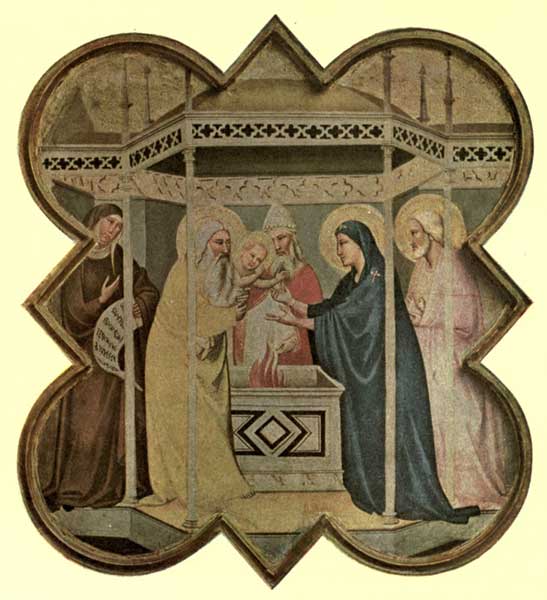
In the Church of the Sasso della Vernia in the Casentino he painted the chapel wherein S. Francis received the Stigmata, assisted in the minor details by Jacopo di Casentino, who became his disciple by reason of this visit. This work finished, he returned to Florence together with Giovanni, the Milanese, and there, both within the city and without, they made very many panels and pictures of importance; and in process of time he gained so much, turning all into capital, that he laid the foundation of the wealth and the nobility of his family, being ever held a prudent and far-sighted man.
In the Church of the Sasso della Vernia in the Casentino, he painted the chapel where St. Francis received the Stigmata. Jacopo di Casentino helped him with the minor details and became his disciple as a result of this visit. When the work was finished, he returned to Florence with Giovanni, the Milanese. There, both inside and outside the city, they produced many important panels and pictures. Over time, he earned a great deal and invested all of it, laying the foundation for his family’s wealth and noble status. He was always regarded as a prudent and far-sighted man.
He also painted the Chapter-house in S. Maria Novella, being commissioned by the Prior of the place, who suggested the subject to him. It is true, indeed, that by reason of the work being large and of there being unveiled, at that time when the bridges were being made, the Chapter-house of S. Spirito, to the very great fame of Simone Memmi, who had painted it, there came to the said Prior a desire to call Simone to the half of this work; wherefore, having discussed the whole matter with Taddeo, he found him well contented therewith, for the reason that he had a surpassing love for Simone, because he had been his fellow-disciple under Giotto and ever his loving friend and companion. Oh! minds truly noble! seeing that without emulation, ambition, or envy, ye loved one another like brothers, each rejoicing as much in the honour and profit of his friend as in his own! The work was divided, therefore, and three walls were given to Simone, as I said in his Life, and Taddeo had the left-hand wall and the whole vaulting, which was divided by him into four sections or quarters in accordance with the form of the vaulting itself. In the first he made the Resurrection of Christ, wherein it appears that he wished to attempt to make the splendour of the Glorified Body give forth light, as we perceive in a city and in some mountainous crags; but he did not follow this up in the figures and in the rest, doubting, perchance, that he was not able to carry it out by reason of the difficulty that he recognized therein. In the second section he made Jesus Christ delivering S. Peter from shipwreck, wherein the Apostles who are manning the boat are certainly very beautiful; and among other things, one who is fishing with a line on the shore of the sea (a subject already used by Giotto in the mosaics of the Navicella in S. Pietro) is depicted with very great and vivid feeling. In the third he painted the Ascension of Christ, and in the fourth the coming of the Holy Spirit, where there are seen many beautiful attitudes in the figures of the Jews who are seeking to gain entrance through the door. On the wall below are the Seven Sciences, with their names and with those figures below them that are appropriate to each. Grammar, in the guise of a woman, with a door, teaching a child, has the writer Donato seated below her. After Grammar follows Rhetoric, and at her feet is a figure that has two hands on books, while it draws a third hand from below its mantle and holds it to its mouth. Logic has the serpent in her hand below a veil, and at her feet Zeno of Elea, who is reading. Arithmetic is holding the tables of the abacus, and below her is sitting Abraham, its inventor. Music has the musical instruments, and below her is sitting Tubal-Cain, who is beating with two hammers on an anvil and is standing with his ears intent on that sound. Geometry has the square and the compasses, and below, Euclid. Astrology has the celestial globe in her hands, and below her feet, Atlas. In the other part are sitting seven Theological Sciences, and each has below her that estate or condition of man that is most appropriate to her—Pope, Emperor, King, Cardinals, Dukes, Bishops, Marquises, and others; and in the face of the Pope is the portrait of Clement V. In the middle and highest place is S. Thomas Aquinas, who was adorned with all the said sciences, holding below his feet some heretics—Arius, Sabellius, and Averroes; and round him are Moses, Paul, John the Evangelist, and some other figures, that have above them the four Cardinal Virtues and the three Theological, with an infinity of other details depicted by Taddeo with no little design and grace, insomuch that it can be said to have been the best conceived as well as the best preserved of all his works.
He also painted the chapter house in S. Maria Novella. The prior commissioned him and suggested the subject. The work was large, and just as the scaffolding was being built, the chapter house of S. Spirito was unveiled. Its painter, Simone Memmi, won very great fame for it. The prior therefore wanted to bring Simone in to paint half the work at S. Maria Novella. He discussed the whole matter with Taddeo, who was happy to agree. Taddeo loved Simone dearly because they had studied together under Giotto and had always been loving friends and companions. Oh, truly noble minds! Without rivalry, ambition, or envy, you loved one another like brothers. Each of you rejoiced as much in his friend’s honor and profit as in his own! The work was divided, and Simone was given three walls, as I said in his Life. Taddeo received the left-hand wall and the whole vaulted ceiling. He divided the ceiling into four sections, following the shape of the vault. In the first section, he painted the Resurrection of Christ. He seems to have tried to show light shining from the glorified body, as we can see on a city and some rocky mountain crags. But he did not carry this effect through to the figures and the rest of the scene. Perhaps he doubted that he could manage it, because he recognized how difficult it was. In the second section, he painted Jesus Christ saving S. Peter from shipwreck. The Apostles handling the boat are certainly very beautiful. Among other details, a man fishing with a line on the seashore is portrayed with great, vivid feeling. Giotto had already used this subject in the mosaics of the Navicella in S. Pietro. In the third section, Taddeo painted the Ascension of Christ. In the fourth, he painted the coming of the Holy Spirit. There are many beautiful poses among the Jewish figures trying to enter through the door. On the wall below are the Seven Sciences, with their names and appropriate figures beneath each one. Grammar appears as a woman with a door, teaching a child. The writer Donato sits below her. Next comes Rhetoric. At her feet is a figure with two hands on books, drawing a third hand from beneath its cloak and holding it to its mouth. Logic holds a serpent beneath a veil, and Zeno of Elea sits reading at her feet. Arithmetic holds the tables of the abacus, with Abraham, its inventor, sitting below her. Music has musical instruments, and Tubal-Cain sits below her, striking an anvil with two hammers. He is standing with his ears intent on the sound. Geometry has a square and compasses, with Euclid below her. Astrology holds a celestial globe, with Atlas beneath her feet. In the other part sit seven Theological Sciences. Below each is the rank or condition of person most appropriate to her: Pope, Emperor, King, Cardinals, Dukes, Bishops, Marquises, and others. The Pope’s face is a portrait of Clement V. In the central and highest place is S. Thomas Aquinas, who was adorned with all these sciences. Beneath his feet are some heretics: Arius, Sabellius, and Averroes. Around him are Moses, Paul, John the Evangelist, and some other figures. Above them are the four Cardinal Virtues and the three Theological Virtues. Taddeo painted countless other details with considerable skill in design and grace. The work can be said to be the best conceived and the best preserved of all his works.
In the same S. Maria Novella, over the tramezzo of the church, he also made a S. Jerome robed as a Cardinal, having such a devotion for that Saint that he chose him as the protector of his house; and below this, after the death of Taddeo, his son caused a tomb to be made for their descendants, covered with a slab of marble bearing the arms of the Gaddi. For these descendants, by reason of the excellence of Taddeo and of their merits, Cardinal Jerome has obtained from God most honourable offices in the Church—Clerkships of the Chamber, Bishoprics, Cardinalates, Provostships, and Knighthoods, all most honourable; and all these descendants of Taddeo, of whatsoever degree, have ever esteemed and favoured the beautiful intellects inclined to the matters of sculpture and painting, and have given them assistance with every effort.
In the same S. Maria Novella, he also painted S. Jerome dressed as a Cardinal above the church’s tramezzo. He was so devoted to the saint that he chose him as the protector of his house. After Taddeo’s death, his son had a tomb built below the painting for their descendants. It was covered with a marble slab bearing the Gaddi arms. Because of Taddeo’s excellence and his descendants’ merits, Cardinal Jerome has obtained from God the most honorable offices in the Church for them. These include Clerkships of the Chamber, Bishoprics, Cardinalates, Provostships, and Knighthoods, all most honorable. All Taddeo’s descendants, whatever their rank, have always valued and supported gifted minds drawn to sculpture and painting. They have made every effort to help them.
See the note on p. 57.
Finally, having come to the age of fifty and being smitten with a most violent fever, Taddeo passed from this life in the year 1350, leaving his son Agnolo and Giovanni to apply themselves to painting, recommending them to Jacopo di Casentino for ways of life and to Giovanni da Milano for instruction in the art. After the death of Taddeo this Giovanni, besides many other works, made a panel which was placed on the altar of S. Gherardo da Villamagna in S. Croce, fourteen years after he had been left without his master, and likewise the panel of the high-altar of Ognissanti, where the Frati Umiliati had their seat, which was held very beautiful, and the tribune of the high-altar at Assisi, wherein he made a Crucifix, with Our Lady and S. Chiara, and stories of Our Lady on the walls and sides. Afterwards he betook himself to Milan, where he wrought many works in distemper and in fresco, and there finally he died.
Finally, at the age of fifty, Taddeo was struck by a violent fever and died in 1350. He left his sons Agnolo and Giovanni to pursue painting. He entrusted their upbringing to Jacopo di Casentino and their artistic training to Giovanni da Milano. After Taddeo’s death, Giovanni da Milano produced many works. Fourteen years after his master’s death, he made a panel for the altar of S. Gherardo da Villamagna in S. Croce. He also made the panel for the high altar of Ognissanti, where the Frati Umiliati were based. The panel was considered very beautiful. He also worked on the tribune of the high altar at Assisi. There he painted a Crucifix with Our Lady and S. Chiara, and scenes from the life of Our Lady on the walls and sides. Afterward, he went to Milan, where he produced many works in distemper and fresco. He died there.
Taddeo, then, adhered constantly to the manner of Giotto, but did not better it much save in the colouring, which he made fresher and more vivacious than that of Giotto, the latter having applied himself so ardently to improving the other departments and difficulties of this art, that although he gave attention to this, he could not, however, attain to the privilege of doing it, whereas Taddeo, having seen that which Giotto had made easy and having learnt it, had time to add something and to improve the colouring.
Taddeo, then, consistently followed Giotto’s style, but improved it little except in his use of color. He made his colors fresher and more vivid than Giotto’s. Giotto had devoted himself so eagerly to improving other areas and tackling other difficulties of the art. Although he paid attention to color, he could not achieve the same improvement. Taddeo, however, had seen and learned what Giotto had made easier. As a result, he had time to add something and improve the use of color.
Taddeo was buried by Agnolo and Giovanni, his sons, in the first cloister of S. Croce, in that tomb which he had made for Gaddo his father, and he was much honoured with verses by the men of culture of that time, as a man who had been greatly deserving for his ways of life and for having brought to completion with beautiful design, besides his pictures, many buildings of great convenience to his city, and besides what has been mentioned, for having carried out with solicitude and diligence the construction of the Campanile of S. Maria del Fiore, from the design left by Giotto his master; which campanile was built in such a manner that stones could not be put together with more diligence, nor could a more beautiful tower be made, with regard either to ornament, or cost, or design. The epitaph that was made for Taddeo was this that is to be read here:
Taddeo’s sons, Agnolo and Giovanni, buried him in the first cloister of S. Croce. They laid him in the tomb he had made for his father, Gaddo. The learned men of his time greatly honored him in verse. They praised his way of life and the many buildings he had beautifully designed and completed for the convenience of his city, in addition to his paintings. Besides the works already mentioned, they praised him for overseeing the construction of the Campanile of S. Maria del Fiore with care and diligence, following the design left by his master, Giotto. The stones of the campanile could not have been laid more carefully, nor could a more beautiful tower have been made, whether in its ornament, cost, or design. The epitaph written for Taddeo was as follows:
HOC UNO DICI POTERAT FLORENTIA FELIX VIVENTE; AT CERTA EST NON POTUISSE MORI.
While this man lived, Florence could be called happy because of him alone. But Florence is certain that he could not have died.
Taddeo was very resolute in draughtsmanship, as it may be seen in our book, wherein is drawn by his hand the scene that he wrought in the Chapel of S. Andrea, in S. Croce at Florence.
Taddeo drew with great confidence, as can be seen in our book. It contains his drawing of the scene he created in the Chapel of S. Andrea, in S. Croce at Florence.