Pietro Laurati's Life
[PIETRO LORENZETTI],
[Pietro Lorenzetti],
PAINTER OF SIENA
Painter of Siena
Pietro Laurati, an excellent painter of Siena, proved in his life how great is the contentment of the truly able, who feel that their works are prized both at home and abroad, and who see themselves sought after by all men, for the reason that in the course of his life he was sent for and held dear throughout all Tuscany, having first become known through the scenes that he painted in fresco for the Scala, a hospital in Siena, wherein he imitated in such wise the manner of Giotto, then spread throughout all Tuscany, that it was believed with great reason that he was destined, as afterwards came to pass, to become a better master than Cimabue and Giotto and the others had been; for the figures that represent the Virgin ascending the steps of the Temple, accompanied by Joachim and Anna, and received by the priest, and then in the Marriage, are so beautifully adorned, so well draped, and so simply wrapped in their garments, that they show majesty in the air of the heads, and a most beautiful manner in their bearing. By reason of this work, which was the first introduction into Siena of the good method of painting, giving light to the many beautiful intellects which have flourished in that city in every age, Pietro was invited to Monte Oliveto di Chiusuri, where he painted a panel in distemper that is placed to-day in the portico below the church. In Florence, next, opposite to the left-hand door of the Church of S. Spirito, on the corner where to-day there is a butcher, he painted a shrine which, by reason of the softness of the heads and of the sweetness that is seen in it, deserves the highest praise from every discerning craftsman.
Pietro Laurati, an excellent painter from Siena, showed how much satisfaction truly talented artists can enjoy. They see their work valued both at home and abroad, and find themselves sought after by everyone. Throughout his life, Pietro was summoned and cherished throughout all Tuscany. He first became known for fresco scenes he painted for the Scala, a hospital in Siena. In these, he imitated Giotto’s style, which had by then spread throughout all Tuscany. There was good reason to believe that he would become a better master than Cimabue, Giotto, and the others had been. And so it proved. The figures in the scenes of the Virgin ascending the Temple steps and of her Marriage are beautifully adorned. On the steps, Joachim and Anna accompany her, and the priest receives her. The figures are so well draped and so simply wrapped in their garments that their heads have a majestic air. Their bearing, too, has a most beautiful style. This work first introduced good painting methods to Siena. It enlightened the many brilliant minds that have flourished in the city in every age. Because of this work, Pietro was invited to Monte Oliveto di Chiusuri. There he painted a panel in distemper, which is now in the portico below the church. Next, in Florence, he painted a shrine opposite the left-hand door of the Church of S. Spirito. It stands on a corner where there is now a butcher. The softness of the heads and the sweetness visible in the shrine deserve the highest praise from every discerning craftsman.
Going from Florence to Pisa, he wrought in the Campo Santo, on the wall that is beside the principal door, all the lives of the Holy Fathers, with expressions so lively and attitudes so beautiful that he equalled Giotto and gained thereby very great praise, having expressed in certain heads, both with drawing and with colour, all that vivacity that the manner of those times was able to show. From Pisa he went to Pistoia, where he made a Madonna with some angels round her, very well grouped, on a panel in distemper, for the Church of S. Francesco; and in the predella that ran below this panel, in certain scenes, he made certain little figures so lively and so vivid that in those times it was something marvellous; wherefore, since they satisfied himself no less than others, he thought fit to place thereon his name, with these words: PETRUS LAURATI DE SENIS.
He went from Florence to Pisa, where he painted the lives of all the Holy Fathers in the Campo Santo. He painted them on the wall beside the main door. Their expressions were so lively and their poses so beautiful that he equalled Giotto and won great praise. In some of the faces, his drawing and colouring captured all the vitality that the style of the time could convey. From Pisa he went to Pistoia, where he painted a Madonna with some angels well grouped around her. He painted the work in distemper on a panel for the Church of S. Francesco. In scenes on the predella beneath the panel, he painted small figures so lively and vivid that they were marvellous for the time. He was as pleased with them as others were, so he decided to add his name there, with these words: PETRUS LAURATI DE SENIS.
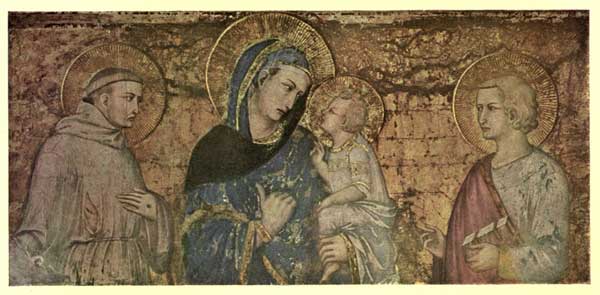
Pietro was summoned, next, in the year 1355, by Messer Guglielmo, arch-priest, and by the Wardens of Works of the Pieve of Arezzo, who were then Margarito Boschi and others; and in that church, built long before with better design and manner than any other that had been made in Tuscany up to that time, and all adorned with squared stone and with carvings, as it has been said, by the hand of Margaritone, he painted in fresco the apse and the whole great niche of the chapel of the high-altar, making there twelve scenes from the life of Our Lady with figures large as life, beginning with the expulsion of Joachim from the Temple, up to the Nativity of Jesus Christ. In these scenes, wrought in fresco, may be recognized almost the same inventions (the lineaments, the air of the heads, and the attitudes of the figures) which had been characteristic of and peculiar to Giotto, his master. And although all this work is beautiful, what he painted on the vaulting of this niche is without doubt better than all the rest, for in representing the Madonna ascending into Heaven, besides making the Apostles each four braccia high, wherein he showed greatness of spirit and was the first to try to give grandness to the manner, he gave so beautiful an air to the heads and so great loveliness to the vestments that in those times nothing more could have been desired. Likewise, in the faces of a choir of angels who are flying in the air round the Madonna, dancing with graceful movements, and appearing to sing, he painted a gladness truly angelic and divine, above all because he made the angels sounding diverse instruments, with their eyes all fixed and intent on another choir of angels, who, supported by a cloud in the form of an almond, are bearing the Madonna to Heaven, with beautiful attitudes and all surrounded by rainbows. This work, seeing that it rightly gave pleasure, was the reason that he was commissioned to make in distemper the panel for the high-altar of the aforesaid Pieve; wherein, in five parts, with figures as far as the knees and large as life, he made Our Lady with the Child in her arms, and S. John the Baptist and S. Matthew on the one side, and on the other the Evangelist and S. Donatus, with many little figures in the predella and in the border of the panel above, all truly beautiful and executed in very good manner. This panel, after I had rebuilt the high-altar of the aforesaid Pieve completely anew, at my own expense and with my own hand, was set up over the altar of S. Cristofano at the foot of the church. Nor do I wish to grudge the labour of saying in this place, with this occasion and not wide of the subject, that I, moved by Christian piety and by the affection that I bear towards this venerable and ancient collegiate church, and for the reason that in it, in my earliest childhood, I learnt my first lessons, and that it contains the remains of my fathers: moved, I say, by these reasons, and by it appearing to me that it was wellnigh deserted, I have restored it in a manner that it can be said that it has returned from death to life; for besides changing it from a dark to a well-lighted church by increasing the windows that were there before and by making others, I have also removed the choir, which, being in front, used to occupy a great part of the church, and to the great satisfaction of those reverend canons I have placed it behind the high-altar. This new altar, standing by itself, has on the panel in front a Christ calling Peter and Andrew from their nets, and on the side towards the choir it has, on another panel, S. George slaying the Dragon. On the sides are four pictures, and in each of these are two saints as large as life. Then above, and below in the predella, there is an infinity of other figures, which, for brevity's sake, are not enumerated. The ornamental frame of this altar is thirteen braccia high, and the predella is two braccia high. And because within it is hollow, and one ascends to it by a staircase through an iron wicket very conveniently arranged, there are preserved in it many venerable relics, which can be seen from without through two gratings that are in the front part; and among others there is the head of S. Donatus, Bishop and Protector of that city, and in a coffer of variegated marble, three braccia long, which I have had restored, are the bones of four Saints. And the predella of the altar, which surrounds it all right round in due proportion, has in front of it the tabernacle, or rather ciborium, of the Sacrament, made of carved wood and all gilt, about three braccia high; which tabernacle is in the round and can be seen as well from the side of the choir as from in front. And because I have spared no labour and no expense, considering myself bound to act thus in honour of God, this work, in my judgment, has in all those ornaments of gold, of carvings, of paintings, of marbles, of travertines, of variegated marbles, of porphyries, and of other stones, the best that could be got together by me in that place.
In 1355, Pietro was next summoned by Messer Guglielmo, the archpriest, and the Wardens of Works of the Pieve of Arezzo. The wardens then included Margarito Boschi and others. The church had been built long before, with better design and workmanship than any other church built in Tuscany up to that time. As already mentioned, it was covered with squared stone and carvings by Margaritone. There Pietro painted frescoes in the apse and throughout the great niche of the high altar chapel. He made twelve scenes from the life of Our Lady, with life-size figures. They began with Joachim’s expulsion from the Temple and continued to the Nativity of Jesus Christ. In these frescoes one can recognize almost the same artistic ideas that were characteristic of his master Giotto. These appear in the features, expressions, and poses of the figures. Although all the work is beautiful, the painting on the vault of the niche is undoubtedly the best. Pietro represented the Madonna ascending into Heaven, with each Apostle standing four braccia high. In doing so, he showed greatness of spirit and was the first to try to give grandeur to the style. He gave the heads such beautiful expressions and the garments such loveliness that, in those times, nothing more could have been desired. He also painted a truly angelic and divine joy in the faces of a choir of angels. They fly around the Madonna, dancing gracefully and appearing to sing. This joy is especially evident because the angels playing various instruments all gaze intently at another choir of angels. Supported by an almond-shaped cloud, these angels bear the Madonna to Heaven. Their poses are beautiful, and they are surrounded by rainbows. Because this work rightly pleased its viewers, Pietro was commissioned to paint a panel in distemper for the high altar of the same Pieve. In five sections, he painted life-size figures shown down to the knees. Our Lady holds the Child in her arms. S. John the Baptist and S. Matthew stand on one side, and the Evangelist and S. Donatus on the other. He also painted many small figures in the predella and the upper border of the panel. All are truly beautiful and executed in a very good style. After I completely rebuilt the high altar of the Pieve at my own expense and with my own hand, the panel was placed above the altar of S. Cristofano at the foot of the church. Here I am willing to take the trouble to say something appropriate to the occasion and not beside the subject. Christian piety moved me to restore this venerable and ancient collegiate church, as did my affection for it. I learned my first lessons there in my earliest childhood, and it contains the remains of my fathers. These reasons moved me, and so did my impression that the church was almost deserted. I have restored it so that it can be said to have returned from death to life. I enlarged the existing windows and made new ones, changing the dark church into a well-lit one. I also removed the choir, which had occupied much of the church in front, and placed it behind the high altar. This greatly pleased the reverend canons. The new altar stands on its own. Its front panel shows Christ calling Peter and Andrew from their nets. On the side facing the choir, another panel shows S. George slaying the Dragon. There are four pictures on the sides, each with two life-size saints. Above and below, in the predella, there are countless other figures, which I will not list for the sake of brevity. The altar’s ornamental frame is thirteen braccia high, and the predella is two braccia high. The altar is hollow inside, and a conveniently arranged staircase leads into it through a small iron gate. Many venerable relics are kept there, visible from outside through two gratings at the front. Among them is the head of S. Donatus, Bishop and Protector of that city. The bones of four Saints lie in a coffer of variegated marble, three braccia long, which I had restored. The predella surrounds the altar in proper proportion. In front of it stands the tabernacle, or rather the ciborium, of the Sacrament. It is made of carved wood, entirely gilded, and about three braccia high. The tabernacle is worked in the round and can be seen from the choir side as well as from the front. I have spared no labor or expense, considering myself obliged to act in this way in honor of God. In my judgment, the work contains the best I could gather in that place. Its ornaments include gold, carvings, paintings, marble, travertine, variegated marble, porphyry, and other stones.
But returning now to Pietro Laurati; that panel finished whereof there has been talk above, he wrought in S. Pietro at Rome many works which were afterwards destroyed in making the new building of S. Pietro. He also wrought some works in Cortona and in Arezzo, besides those that have been mentioned, and some others in the Church of S. Fiora e Lucilla, a monastery of Black Friars, and in particular, in a chapel, a S. Thomas who is putting his hand on the wound in the breast of Christ.
But to return to Pietro Laurati, after finishing the panel mentioned above, he made many works in S. Pietro in Rome. These were later destroyed when the new S. Pietro was built. He also made some works in Cortona and Arezzo, besides those already mentioned. He made others in the Church of S. Fiora e Lucilla, a monastery of Black Friars. In one chapel, he depicted S. Thomas putting his hand on the wound in Christ’s breast.
A disciple of Pietro was Bartolommeo Bologhini of Siena, who wrought many panels in Siena and other places in Italy, and in Florence there is one by his hand on the altar of the Chapel of S. Silvestro in S. Croce. The pictures of these men date about the year of our salvation 1350; and in my book, so many times cited, there is seen a drawing by the hand of Pietro, wherein a shoemaker who is sewing, with simple but very natural lineaments, shows very great expression and the characteristic manner of Pietro, the portrait of whom, by the hand of Bartolommeo Bologhini, was in a panel in Siena, when I copied it from the original in the manner that is seen above.
One of Pietro’s pupils was Bartolommeo Bologhini of Siena. He painted many panels in Siena and other places in Italy. One of his panels is in Florence, on the altar of the Chapel of S. Silvestro in S. Croce. The paintings of these men date from around the year of our salvation 1350. In my book, which I have mentioned so often, there is a drawing by Pietro of a shoemaker sewing. The shoemaker’s features are simple but very natural, and show great expression and Pietro’s characteristic style. A portrait of Pietro by Bartolommeo Bologhini was in a panel in Siena. I copied it from the original, as shown above.
]
]