The Life of Andrea Pisano
SCULPTOR AND ARCHITECT
Sculptor and Architect
The art of painting never flourished at any time without the sculptors also pursuing their exercise with excellence, and to this the works of all ages bear witness for the close observer, because these two arts are truly sisters, born at one and the same time, and fostered and governed by one and the same soul. This is seen in Andrea Pisano, who, practising sculpture in the time of Giotto, made so great improvement in this art, that both in practice and in theory he was esteemed the greatest man that the Tuscans had had up to his times in this profession, and above all in casting in bronze. Wherefore his works were honoured and rewarded in such a manner by all who knew him, and above all by the Florentines, that it was no hardship to him to change country, relatives, property and friends. He received much assistance from the difficulties experienced in sculpture by the masters who had lived before him, whose sculptures were so uncouth and worthless that whosoever saw them in comparison with those of this man judged the last a miracle. And that these early works were rude, witness is borne, as it has been said elsewhere, by some that are over the principal door of S. Paolo in Florence and some in stone that are in the Church of Ognissanti, which are so made that they move those who view them rather to laughter than to any marvel or pleasure. And it is certain that the art of sculpture can recover itself much better, in the event of the essence of statuary being lost (since men have the living and the natural model, which is wholly rounded, as that art requires), than can the art of painting; it being not so easy and simple to recover the beautiful outlines and the good manner, in order to bring the art to the light, for these are the elements that produce majesty, beauty, grace and adornment in the works that the painters make. In one respect fortune was favourable to the labours of Andrea, because there had been brought to Pisa, as it has been said elsewhere, by means of the many victories that the Pisans had at sea, many antiquities and sarcophagi that are still round the Duomo and the Campo Santo, and these brought him such great assistance and gave him such great light as could not be obtained by Giotto, for the reason that the ancient paintings had not been preserved as much as the sculptures. And although statues are often destroyed by fires and by the ruin and fury of war, and buried or transported to diverse places, nevertheless it is easy for the experienced to recognize the difference in the manner of all countries; as, for example, the Egyptian is slender and lengthy in its figures, the Greek is scientific and shows much study in the nudes, while the heads have almost all the same expression, and the most ancient Tuscan is laboured in the hair and somewhat uncouth. That of the Romans (I call Romans, for the most part, those who, after the subjugation of Greece, betook themselves to Rome, whither all that there was of the good and of the beautiful in the world was carried)—that, I say, is so beautiful, by reason of the expressions, the attitudes, and the movements both of the nude and of the draped figures, that it may be said that they wrested the beautiful from all the other provinces and moulded it into one single manner, to the end that it might be, as it is, the best—nay, the most divine of all.
Painting has never flourished without sculptors also practicing their art with excellence. A close observer can see this in works from every age. The two arts are truly sisters, born at the same time and nurtured and governed by the same soul. Andrea Pisano shows this connection. He practiced sculpture in Giotto’s time and advanced the art so greatly that he was considered the greatest Tuscan sculptor up to his day, both in practice and in theory, and especially in bronze casting. All who knew him honored and rewarded his work, especially the Florentines. So it was no hardship for him to leave his country, relatives, property, and friends. He also benefited greatly from the difficulties faced by earlier sculptors. Their works were so crude and worthless that anyone who compared them with Andrea’s judged his work a miracle. As I have said elsewhere, some early works above the main door of S. Paolo in Florence show how crude they were. So do some stone sculptures in the Church of Ognissanti. They are made in such a way that viewers are more likely to laugh than to feel wonder or pleasure. If the essence of sculpture is lost, the art can certainly recover more easily than painting. Sculptors have living nature as a model, and it is fully rounded, as their art requires. Painters cannot recover beautiful outlines and a good style so easily or simply and thus bring their art back to light. Yet these are the qualities that give paintings majesty, beauty, grace, and adornment. Fortune favored Andrea’s work in one respect. As I have said elsewhere, the Pisans won many victories at sea and brought many antiquities and sarcophagi to Pisa. These still stand around the Duomo and the Campo Santo. They gave Andrea great help and guidance that Giotto could not obtain, because ancient paintings had not been preserved as well as sculptures. Statues are often destroyed by fire or by the ruin and fury of war, and they are buried or moved to various places. Nevertheless, experienced observers can easily recognize the differences between the styles of all countries. Egyptian figures, for example, are slender and elongated. The Greek style is scientific and shows much study of the nude, while the heads nearly all have the same expression. The most ancient Tuscan style shows painstaking work in the hair and is somewhat crude. The Roman style is beautiful in its expressions, poses, and movements, in both nude and draped figures. By Romans, I mean mostly those who went to Rome after the subjugation of Greece. Everything good and beautiful in the world was carried there. It may be said that the Romans took what was beautiful from all the other provinces and shaped it into a single style. They did so to make it the best, indeed the most divine of all, as it is.
All these beautiful manners and arts being spent in the time of Andrea, that alone was in use which had been brought by the Goths and by the uncivilized Greeks into Tuscany. Wherefore he, having studied the new method of design of Giotto and those few antiquities that were known to him, refined in great part the grossness of so miserable a manner with his judgment, in such wise that he began to work better and to give much greater beauty to statuary than any other had yet done in that art up to his times. Therefore, his genius and his good skill and dexterity becoming known, he was assisted by many in his country, and while still young he was commissioned to make for S. Maria a Ponte some little figures in marble, which brought him so good a name that he was sought out with very great insistence to come to work in Florence for the Office of Works of S. Maria del Fiore, which, after a beginning had been made with the façade containing the three doors, was suffering from a dearth of masters to make the scenes that Giotto had designed for the beginning of the said fabric. Andrea, then, betook himself to Florence, for the service of the said Office of Works. And because the Florentines desired at that time to gain the friendship and love of Pope Boniface VIII, who was then Supreme Pontiff of the Church of God, they wished that, before anything else, Andrea should make a portrait in marble of the said Pontiff, from the life. Wherefore, putting his hand to this work, he did not rest until he had finished the figure of the Pope, with a S. Peter and a S. Paul who are one on either side of him; which three figures were placed in the façade of S. Maria del Fiore, where they still are. Andrea then made certain little figures of prophets for the middle door of the said church, in some shrines or rather niches, from which it is seen that he had brought great betterment to the art, and that he was in advance, both in excellence and design, of all those who had worked up to then on the said fabric. Wherefore it was resolved that all the works of importance should be given to him to do, and not to others; and so, no long time after, he was commissioned to make the four statues of the principal Doctors of the Church, S. Jerome, S. Ambrose, S. Augustine, and S. Gregory. And these being finished and acquiring for him favour and fame with the Wardens of Works—nay, with the whole city—he was commissioned to make two other figures in marble of the same size, which were S. Stephen and S. Laurence, now standing in the said façade of S. Maria del Fiore, at the outermost corners. By the hand of Andrea, likewise, is the Madonna in marble, three braccia and a half high, with the Child in her arms, which stands on the altar of the little Church of the Company of the Misericordia, on the Piazza di S. Giovanni in Florence; which was a work much praised in those times, and above all because he accompanied it with two angels, one on either side, each two braccia and a half high. Round this work there has been made in our own day a frame of wood, very well wrought by Maestro Antonio, called Il Carota; and below, a predella full of most beautiful figures coloured in oil by Ridolfo, son of Domenico Ghirlandajo. In like manner, that half-length Madonna in marble that is over the side door of the same Misericordia, in the façade of the Cialdonai, is by the hand of Andrea, and it was much praised, because he imitated therein the good ancient manner, contrary to his wont, which was ever far distant from it, as some drawings testify that are in our book, wrought by his hand, wherein are drawn all the stories of the Apocalypse.
By Andrea’s time, all these beautiful styles and arts had died out. The only style still in use was the one the Goths and the uncivilized Greeks had brought to Tuscany. Andrea studied Giotto’s new method of design and the few antiquities known to him. Using his judgment, he greatly refined the crudity of that miserable style. He began to work better and give sculpture much greater beauty than anyone in the art had done before him. As Andrea’s talent, skill, and dexterity became known, many people in his country helped him. While he was still young, he was commissioned to make some small marble figures for S. Maria a Ponte. They earned him such a good reputation that he was urgently sought to work in Florence. His services were wanted by the Office of Works of S. Maria del Fiore. Work had begun on the façade with its three doors, but there were too few masters to make the scenes Giotto had designed for the beginning of the building. Andrea therefore went to Florence to serve the Office of Works. At that time, the Florentines wanted to win the friendship and affection of Pope Boniface VIII, then the Supreme Pontiff of the Church of God. So they wanted Andrea, before doing anything else, to make a marble portrait of the Pope from life. Andrea began the work and did not rest until he had finished the Pope’s figure, with a S. Peter and a S. Paul, one on either side. The three figures were placed on the façade of S. Maria del Fiore, where they remain. Andrea then made some small figures of prophets for the middle door of the church. They stood in shrines, or rather niches. These figures show that he had greatly improved the art and surpassed everyone who had worked on the building before him, both in skill and design. It was therefore decided that all important work should be given to him rather than to others. Soon afterward, he was commissioned to make four statues of the principal Doctors of the Church: S. Jerome, S. Ambrose, S. Augustine, and S. Gregory. When these statues were finished, they won him the favor and acclaim of the Wardens of Works, and indeed of the whole city. He was then commissioned to make two more marble figures of the same size, S. Stephen and S. Laurence. They now stand at the outermost corners of the façade of S. Maria del Fiore. Andrea also made the marble Madonna holding the Child, which stands on the altar of the little Church of the Company of the Misericordia. The church is on the Piazza di S. Giovanni in Florence. The Madonna is three and a half braccia high. The work was much praised at the time, especially because Andrea placed two angels beside her, each two and a half braccia high. In our own day, a wooden frame has been made around the work, finely crafted by Maestro Antonio, called Il Carota. Below it is a predella full of beautiful figures painted in oil by Ridolfo, son of Domenico Ghirlandajo. Andrea also made the half-length marble Madonna above the side door of the same Misericordia, on the façade of the Cialdonai. It was much praised because he imitated the fine ancient style in it. This was unusual for him, since his own style was always far removed from the ancient one. Some drawings in our book, made by his hand, bear witness to this. They depict all the stories of the Apocalypse.
Now, seeing that Andrea had applied himself in his youth to the study of architecture, there came occasion for him to be employed in this by the Commune of Florence; for Arnolfo being dead and Giotto absent, he was commissioned to make the design of the Castle of Scarperia, which is in the Mugello, at the foot of the mountains. Some say, although I would not indeed vouch for it as true, that Andrea stayed a year in Venice, and there wrought, in sculpture, some little figures in marble that are in the façade of S. Marco, and that at the time of Messer Piero Gradenigo, Doge of that Republic, he made the design of the Arsenal; but seeing that I know nothing about it save that which I find to have been written by some without authority, I leave each one to think in his own way about this matter. Andrea having returned from Venice to Florence, the city, fearful of the coming of the Emperor, caused a part of the walls to be raised with lime post-haste to the height of eight braccia, employing in this Andrea, in that portion that is between San Gallo and the Porta al Prato; and in other places he made bastions, stockades, and other ramparts of earth and of wood, very strong.
Andrea had studied architecture in his youth, and the Commune of Florence had occasion to employ him in that field. Arnolfo had died and Giotto was away, so Andrea was commissioned to design the Castle of Scarperia. The castle stands in the Mugello, at the foot of the mountains. Some say that Andrea spent a year in Venice. I would not vouch for the truth of this. They say he sculpted some small marble figures on the façade of S. Marco. They also say he designed the Arsenal during the time of Messer Piero Gradenigo, Doge of that Republic. But I know nothing about these claims except what I have found written by some without authority. So I leave each reader to decide what to think. After Andrea returned from Venice to Florence, the city feared the Emperor’s arrival. It therefore had part of its walls quickly raised to a height of eight braccia, using lime mortar. Andrea was employed on the section between San Gallo and the Porta al Prato. Elsewhere, he built bastions, stockades, and other very strong defenses of earth and wood.
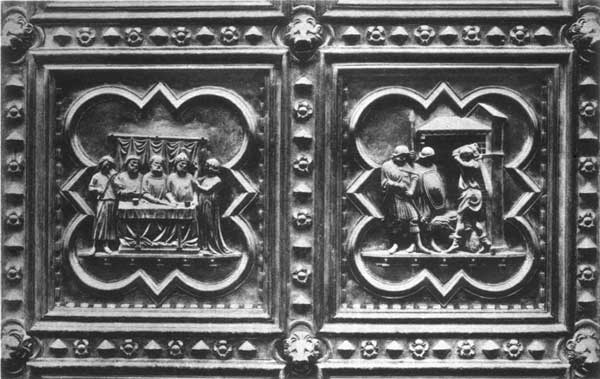
Now because, three years before, he had shown himself to his own great credit to be an able man in the casting of bronze, having sent to the Pope in Avignon, by means of Giotto, his very great friend, who was then staying at that Court, a very beautiful cross cast in bronze, he was commissioned to complete in bronze one of the doors of the Church of S. Giovanni, for which Giotto had already made a very beautiful design; this was given to him, I say, to complete, by reason of his having been judged, among so many who had worked up to then, the most able, the most practised and the most judicious master not only of Tuscany but of all Italy. Wherefore, putting his hand to this, with a mind determined not to consent to spare either time, or labour, or diligence in executing a work of so great importance, fortune was so propitious to him in the casting, for those times when the secrets were not known that are known to-day, that within the space of twenty-two years he brought it to that perfection which is seen; and what is more, he also made during that same time not only the shrine of the high-altar of S. Giovanni, with two angels, one on either side of it, that were held something very beautiful, but also, after the design of Giotto, those little figures in marble that act as adornment for the door of the Campanile of S. Maria del Fiore, and round the same Campanile, in certain mandorle, the seven planets, the seven virtues, and the seven works of mercy, little figures in half-relief that were then much praised. He also made during the same time the three figures, each four braccia high, that were set up in the niches of the said Campanile, beneath the windows that face the spot where the Orphans now are—that is, towards the south; which figures were thought at that time more than passing good. But to return to where I left off: I say that in the said bronze door are little scenes in low relief of the life of S. John the Baptist, that is, from his birth up to his death, wrought happily and with much diligence. And although it seems to many that in these scenes there do not appear that beautiful design and that great art which are now put into figures, yet Andrea deserves nothing but the greatest praise, in that he was the first to put his hand to the complete execution of such a work, which afterwards enabled the others who lived after him to make whatever of the beautiful, of the difficult and of the good is to be seen at the present day in the other two doors and in the external ornaments. This work was placed in the middle door of that church, and stood there until the time when Lorenzo Ghiberti made that one which is there at the present day; for then it was removed and placed opposite the Misericordia, where it still stands. I will not forbear to say that Andrea was assisted in making this door by Nino, his son, who was afterwards a much better master than his father had been, and that it was completely finished in the year 1339, that is, not only made smooth and polished all over, but also gilded by fire; and it is believed that it was cast in metal by some Venetian masters, very expert in the founding of metals, and of this there is found record in the books of the Guild of the Merchants of Calimara, Wardens of the Works of S. Giovanni.
Three years earlier, Andrea had demonstrated his skill at casting bronze, earning himself great credit. He had sent a beautiful bronze cross to the Pope in Avignon through his close friend Giotto, who was then staying at the papal court. Andrea was therefore commissioned to complete one of the doors of the Church of S. Giovanni in bronze. Giotto had already made a beautiful design for it. Andrea received the commission because he was judged the most able, experienced, and judicious master among all who had worked up to that time, not only in Tuscany but in all Italy. Andrea began the work determined to spare no time, labor, or care on such an important undertaking. He was fortunate in the casting, especially for an age when the secrets known today were still unknown. Within twenty-two years, he brought the door to the perfection we see. During that same time, he also made the shrine of the high altar of S. Giovanni, with an angel on either side. The angels were considered very beautiful. Following Giotto’s design, Andrea also made the small marble figures that adorn the door of the Campanile of S. Maria del Fiore. Around the same Campanile, he made small figures in half-relief representing the seven planets, the seven virtues, and the seven works of mercy. These were set in mandorle and were much praised at the time. He also made three figures, each four braccia high, which were placed in niches of the Campanile. They stood beneath the windows facing the place where the Orphans now are, on the south side. These figures were considered more than ordinarily good at the time. But to return to the bronze door, it contains small scenes in low relief from the life of S. John the Baptist, from his birth to his death. They were skillfully and carefully made. Many people think the scenes lack the beautiful design and great artistry now found in figures. Even so, Andrea deserves nothing but the highest praise. He was the first to undertake and complete such a work. His achievement enabled later artists to create all the beauty, technical skill, and excellence now seen in the other two doors and their exterior ornaments. Andrea’s door was placed in the central doorway of the church. It remained there until Lorenzo Ghiberti made the door now in that position. Andrea’s door was then moved opposite the Misericordia, where it still stands. I must add that Andrea was assisted by his son Nino, who later became a much better master than his father. The door was completely finished in 1339. It had been smoothed and polished all over and also gilded by fire. It is believed that some Venetian masters, highly skilled in metal founding, cast it in metal. A record of this is found in the books of the Guild of the Merchants of Calimara, Wardens of the Works of S. Giovanni.
While the said door was making, Andrea made not only the other works aforesaid but also many others, and in particular the model of the Church of S. Giovanni at Pistoia, which was founded in the year 1337. In that same year, on January 25, in excavating the foundations of this church, there was found the body of the Blessed Atto, once Bishop of that city, who had been buried in that place one hundred and thirty-seven years. The architecture, then, of this church, which is round, was passing good for those times. In the principal church of the said city of Pistoia there is also a tomb of marble by the hand of Andrea, with the body of the sarcophagus full of little figures, and some larger figures above; in which tomb is laid to rest the body of Messer Cino d' Angibolgi, Doctor of Laws, and a very famous scholar in his time, as Messer Francesco Petrarca testifies in that sonnet:
While the door was being made, Andrea produced not only the other works already mentioned but also many more. Among them was the design for the Church of S. Giovanni at Pistoia, founded in 1337. On January 25 of that year, workers found the body of the Blessed Atto while digging the church’s foundations. He had once been Bishop of Pistoia and had been buried there for 137 years. The church is round, and its architecture was very good for its time. In the principal church of Pistoia, there is also a marble tomb by Andrea. Its sarcophagus is covered with small figures, with larger figures above. The tomb holds the body of Messer Cino d' Angibolgi, a Doctor of Laws and a very famous scholar in his day. Messer Francesco Petrarca attests to his fame in that sonnet:
Piangete, donne, e con voi pianga Amore;
Weep, women, and let Love weep with you.
and also in the fourth chapter of the Triumph of Love, where he says:
and also in the fourth chapter of the Triumph of Love, where he says:
Ecco Cin da Pistoia, Guitton d'Arezzo, Che di non esser primo par ch'ira aggia.
Here is Cin da Pistoia, and Guitton d'Arezzo, Who seems angry that he is not first.
In that tomb there is seen the portrait of Messer Cino himself in marble, by the hand of Andrea; he is teaching a number of his scholars, who are round him, with an attitude and manner so beautiful that, although to-day it might not be prized, in those days it must have been a marvellous thing.
In that tomb is a marble portrait of Messer Cino himself, made by Andrea. He is teaching a number of his students, who are gathered around him. His pose and manner are so beautiful that, although the portrait might not be valued today, it must have seemed marvelous in those days.
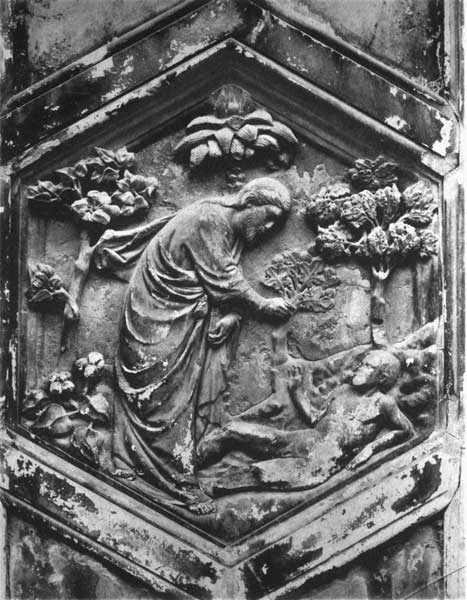
Andrea was also made use of in matters of architecture by Gualtieri, Duke of Athens and Tyrant of the Florentines, who made him enlarge the square, and caused him, in order to safeguard himself in his palace, to secure all the lower windows on the first floor (where to-day is the Sala de' Dugento) with iron bars, square and very strong. The said Duke also added, opposite S. Pietro Scheraggio, the walls of rustic work that are beside the palace, in order to enlarge it; and in the thickness of the wall he made a secret staircase, in order to ascend and descend unseen. And at the foot of the said wall of rustic work he made a great door, which serves to-day for the Customs-house, and above that his arms, and all with the design and counsel of Andrea; and although these arms were chiselled out by the Council of Twelve, which took pains to efface every memorial of that Duke, there remained none the less in the square shield the form of the lion rampant with two tails, as anyone can see who examines it with diligence. For the same Duke Andrea built many towers round the walls of the city, and he not only made a magnificent beginning for the Porta a S. Friano and brought it to the completion that is seen, but also made the walls for the vestibules of all the gates of the city, and the lesser gates for the convenience of the people. And because the Duke had it in his mind to make a fortress on the Costa di S. Giorgio, Andrea made the model for it, which afterwards was not used, for the reason that the work was never given a beginning, the Duke having been driven out in the year 1343. Nevertheless, there was effected in great part the desire of that Duke to bring the palace to the form of a strong castle, because, to that which had been made originally, he added the great mass which is seen to-day, enclosing within its circuit the houses of the Filipetri, the tower and the houses of the Amidei and Mancini, and those of the Bellalberti. And because, having made a beginning with so great a fabric and with the thick walls and barbicans, he had not all the material that was essential equally in readiness, he held back the construction of the Ponte Vecchio, which was being worked on with all haste as a work of necessity, and availed himself of the stone hewn and the wood prepared for it, without the least scruple. And although Taddeo Gaddi was not perhaps inferior in the matters of architecture to Andrea Pisano, the Duke would not avail himself of him in these buildings, by reason of his being a Florentine, but only of Andrea. The same Duke Gualtieri wished to pull down S. Cecilia, in order to see from his palace the Strada Romana and the Mercato Nuovo, and likewise to destroy S. Pietro Scheraggio for his own convenience, but he had not leave to do this from the Pope; and meanwhile, as it has been said above, he was driven out by the fury of the people.
Gualtieri, Duke of Athens and tyrant of the Florentines, also employed Andrea as an architect. He had Andrea enlarge the square. To protect himself in his palace, he also had Andrea secure all the lower windows on the first floor with strong square iron bars. The Sala de' Dugento is there today. To enlarge the palace, the Duke added the rustic masonry walls beside it, opposite S. Pietro Scheraggio. Within the thick wall, he had a secret staircase built so that he could go up and down unseen. At the foot of the rustic wall he had a great door made, which now serves the Customs-house. He placed his coat of arms above it. All this was done according to Andrea's design and advice. The Council of Twelve later had the coat of arms chiselled away, as it sought to erase every reminder of the Duke. Even so, the shape of the rampant lion with two tails remained in the square shield. Anyone who looks closely can see it. For the same Duke, Andrea built many towers along the city walls. He also made a magnificent start on the Porta a S. Friano and brought it to the state of completion seen today. He built the walls of the vestibules at all the city gates, as well as smaller gates for the people's convenience. The Duke intended to build a fortress on the Costa di S. Giorgio, so Andrea made a model for it. But the model was never used, because work on the fortress never began. The Duke was driven out in 1343. Nevertheless, the Duke largely achieved his wish to turn the palace into a strong castle. To the original building, he added the great structure seen today. Within its walls, he enclosed the houses of the Filipetri, the tower and houses of the Amidei and Mancini, and those of the Bellalberti. He had begun this enormous building, with its thick walls and barbicans, before all the necessary materials were ready. So he held up construction of the Ponte Vecchio, which was being built with all speed because it was needed. Without the least scruple, he took the cut stone and prepared timber meant for the bridge. Although Taddeo Gaddi was perhaps no less skilled in architecture than Andrea Pisano, the Duke would not employ him on these buildings because he was a Florentine. He employed only Andrea. The same Duke Gualtieri wanted to pull down S. Cecilia so he could see the Strada Romana and the Mercato Nuovo from his palace. He also wanted to destroy S. Pietro Scheraggio for his own convenience. But the Pope would not give him permission. Meanwhile, as noted above, the fury of the people drove him out.
Deservedly then did Andrea gain, by the honourable labours of so many years, not only very great rewards but also the citizenship; for he was made a citizen of Florence by the Signoria, and was given offices and magistracies in the city, and his works were esteemed both while he lived and after his death, there being found no one who could surpass him in working, until there came Niccolò Aretino, Jacopo della Quercia of Siena, Donatello, Filippo di Ser Brunellesco, and Lorenzo Ghiberti, who executed the sculptures and other works that they made in such a manner that people recognized in how great error they had lived up to that time; for these men recovered with their works that excellence which had been hidden and little known by men for many and many a year. The works of Andrea date about the year of our salvation 1340.
Andrea deservedly earned great rewards and citizenship through his many years of honorable work. The Signoria made him a citizen of Florence and gave him offices and magistracies in the city. His works were admired both during his life and after his death. No one could surpass him in his work until Niccolò Aretino, Jacopo della Quercia of Siena, Donatello, Filippo di Ser Brunellesco, and Lorenzo Ghiberti came along. Their sculptures and other works made people recognize how mistaken they had been until then. Through their work, these men restored an excellence that had been hidden and little known for many, many years. Andrea's works date from around the year of our salvation 1340.
Andrea left many disciples; among others, Tommaso Pisano, architect and sculptor, who finished the Chapel of the Campo Santo and added the finishing touch to the Campanile of the Duomo—namely, that final part wherein are the bells. Tommaso is believed to have been the son of Andrea, this being found written in the panel of the high-altar of S. Francesco in Pisa, wherein there is, carved in half-relief, a Madonna, with other Saints made by him, and below these his name and that of his father.
Andrea had many disciples, including Tommaso Pisano, an architect and sculptor. Tommaso finished the Chapel of the Campo Santo and completed the Campanile of the Duomo by adding the final section, where the bells are. Tommaso is believed to have been Andrea's son. Their relationship is recorded on the high altar panel of S. Francesco in Pisa. The panel depicts a Madonna and other Saints carved by Tommaso in half-relief. Below the figures are his name and his father's name.
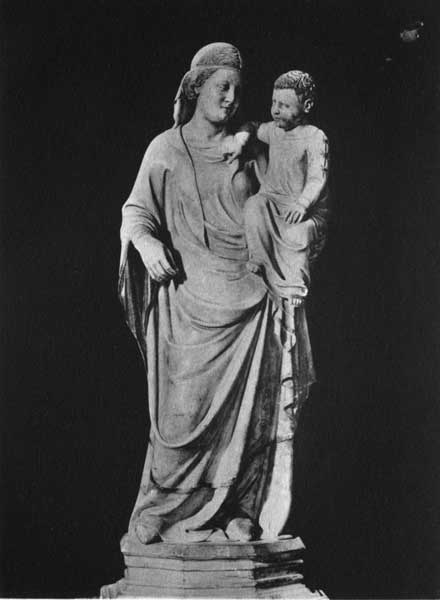
Andrea was survived by Nino, his son, who applied himself to sculpture; and his first work was in S. Maria Novella, where he finished a Madonna in marble begun by his father, which is within the side door, beside the Chapel of the Minerbetti. Next, having gone to Pisa, he made in the Spina a half-length figure in marble of Our Lady, who is suckling an infant Jesus Christ wrapped in certain delicate draperies. For this Madonna an ornamental frame of marble was made in the year 1522, by the agency of Messer Jacopo Corbini, and another frame, much greater and more beautiful, was made then for another Madonna of marble, which was of full length and by the hand of the same Nino; in the attitude of which Madonna the mother is seen handing a rose with much grace to her Son, who is taking it in a childlike manner, so beautiful that it may be said that Nino was beginning to rob the stone of its hardness and to reduce it to the softness of flesh, giving it lustre by means of the highest polish. This figure is between a S. John and a S. Peter in marble, the head of the latter being a portrait of Andrea from the life. Besides this, for an altar in S. Caterina, also in Pisa, Nino made two statues of marble—that is, a Madonna, and an Angel who is bringing her the Annunciation, wrought, like his other works, with so great diligence that it can be said that they are the best that were made in those times. Below this Madonna receiving the Annunciation Nino carved these words on the base: ON THE FIRST DAY OF FEBRUARY, 1370; and below the Angel: THESE FIGURES NINO MADE, THE SON OF ANDREA PISANO. He also made other works in that city and in Naples, whereof it is not needful to make mention.
Andrea was survived by his son Nino, who took up sculpture. His first work was in S. Maria Novella, where he finished a marble Madonna begun by his father. It stands inside the side door, beside the Chapel of the Minerbetti. Nino then went to Pisa, where he made a half-length marble figure of Our Lady in the Spina. She is nursing the infant Jesus Christ, who is wrapped in delicate draperies. In 1522, an ornamental marble frame was made for this Madonna through the efforts of Messer Jacopo Corbini. At the same time, a much larger and more beautiful frame was made for another marble Madonna by Nino. This full-length figure shows the mother gracefully offering a rose to her Son, who takes it like a child. The figure is so beautiful that Nino may be said to have begun stripping the stone of its hardness. He made it as soft as flesh and gave it a glow through the finest polishing. The figure stands between marble statues of S. John and S. Peter. The head of S. Peter is a portrait of Andrea made from life. For an altar in S. Caterina, also in Pisa, Nino made two marble statues. One is a Madonna, and the other is an Angel bringing her the Annunciation. Like his other works, they were made with such care that they can be called the best made in those times. On the base below the Madonna receiving the Annunciation, Nino carved these words: ON THE FIRST DAY OF FEBRUARY, 1370. Below the Angel, he carved: THESE FIGURES NINO MADE, THE SON OF ANDREA PISANO. He also made other works in Pisa and Naples, but there is no need to mention them.
Andrea died at the age of seventy-five, in the year 1345, and was buried by Nino in S. Maria del Fiore, with this epitaph:
Andrea died in 1345 at the age of seventy-five. Nino buried him in S. Maria del Fiore with this epitaph:
INGENTI ANDREAS JACET HIC PISANUS IN URNA, MARMORE QUI POTUIT SPIRANTES DUCERE VULTUS, ET SIMULACRA DEUM MEDIIS IMPONERE TEMPLIS EX ÆRE, EX AURO CANDENTI, ET PULCRO ELEPHANTO.
Here lies Andrea Pisano in a great urn. He could carve lifelike faces from marble and place statues of gods in the middle of temples, made of bronze, gleaming gold, and beautiful ivory.