Margaritone's Life
PAINTER, SCULPTOR, AND ARCHITECT, OF AREZZO
Painter, Sculptor, and Architect from Arezzo
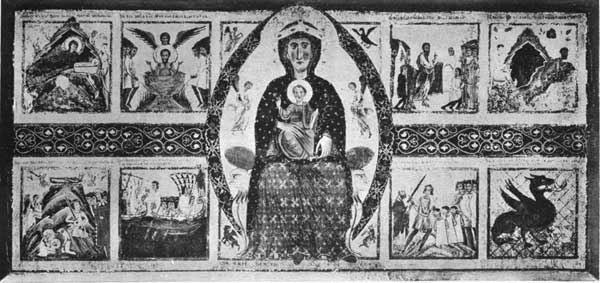
Among the old painters who were much alarmed by the praises rightly given by men to Cimabue and to his disciple Giotto, whose good work in painting was making their glory shine throughout all Italy, was one Margaritone, painter of Arezzo, who, with the others who in that unhappy century were holding the highest rank in painting, recognized that their works were little less than wholly obscuring his own fame. Margaritone, then, being held excellent among the other painters of these times who were working after the Greek manner, wrought many panels in distemper at Arezzo, and he painted in fresco—in even more pictures, but in a long time and with much fatigue—almost the whole Church of S. Clemente, Abbey of the Order of Camaldoli, which is to-day all in ruins and thrown down, together with many other buildings and a strong fortress called S. Chimenti, for the reason that Duke Cosimo de' Medici, not only on that spot but right round that city, pulled down many buildings and the old walls (which were restored by Guido Pietramalesco, formerly Bishop and Patron of that city); in order to rebuild the latter with connecting wings and bastions, much stronger and smaller than they were, and in consequence more easy to guard and with few men. There were, in the said pictures, many figures both small and great, and although they were wrought after the Greek manner, it was recognized, none the less, that they had been made with good judgment and lovingly; to which witness is borne by works by the same man's hand which have survived in that city, and above all a panel that is now in S. Francesco, in the Chapel of the Conception, with a modern frame, wherein is a Madonna held by these friars in great veneration. He made in the same church, also after the Greek manner, a great Crucifix which is now placed in that chapel where there is the Office of the Wardens of Works; this is wrought on the planking, with the Cross outlined, and of this sort he made many in that city. For the Nuns of S. Margherita he wrought a work that is to-day set up against the tramezzo of the church—namely, a canvas fixed on a panel, wherein are scenes with small figures from the life of Our Lady and of S. John the Baptist, in considerably better manner than the large, and executed with more diligence and grace. This work is notable, not only because the said small figures are so well made that they look like miniatures, but also because it is a marvel to see that a work on canvas has been preserved for three hundred years. He made throughout the whole city an infinity of pictures, and at Sargiano, a convent of the Frati de' Zoccoli, a S. Francis portrayed from nature on a panel, whereon he placed his name, as on a work, in his judgment, wrought better than was his wont. Next, having made a large Crucifix on wood, painted after the Greek manner, he sent it to Florence to Messer Farinata degli Uberti, a most famous citizen, for the reason that he had, among other noble deeds, freed his country from imminent ruin and peril. This Crucifix is to-day in S. Croce, between the Chapel of the Peruzzi and that of the Giugni. In S. Domenico in Arezzo, a church and convent built by the Lords of Pietramala in the year 1275, as their arms still prove, he wrought many works, and then returned to Rome (where he had already been held very dear by Pope Urban IV), to the end that he might do certain works in fresco at his commission in the portico of S. Pietro; these were in the Greek manner, and passing good for those times.
Among the old painters alarmed by the praise rightly given to Cimabue and his pupil Giotto was Margaritone, a painter from Arezzo. Their fine paintings were spreading their glory throughout Italy. Like the other painters who held the highest rank in that unhappy century, Margaritone saw that their works were almost entirely eclipsing his own fame. Margaritone was considered excellent among the painters of his time who worked in the Greek manner. He painted many panels in distemper in Arezzo. He also painted even more pictures in fresco, covering almost the whole Church of S. Clemente, an abbey of the Order of Camaldoli. This took him a long time and much labor. The church now lies in ruins, demolished along with many other buildings and a strong fortress called S. Chimenti. Duke Cosimo de' Medici pulled down many buildings and the old walls there and all around the city. Guido Pietramalesco, formerly Bishop and Patron of Arezzo, had restored the walls. The Duke demolished them so that he could rebuild them with connecting wings and bastions. The new walls were much stronger and smaller, and therefore easier to guard with few men. The frescoes contained many large and small figures. Although they were painted in the Greek manner, they were recognized as the work of a thoughtful and devoted artist. Other works by Margaritone that survive in Arezzo bear witness to this. Above all, there is a panel now in S. Francesco, in the Chapel of the Conception. It has a modern frame and depicts a Madonna whom the friars hold in great reverence. In the same church, Margaritone also made a large Crucifix in the Greek manner. It is now in the chapel where the Office of the Wardens of Works is located. The Crucifix is painted on planking cut to the outline of the Cross. He made many of this kind in the city. For the Nuns of S. Margherita, he made a work now set against the tramezzo of the church. It is a canvas fixed to a panel, with scenes from the lives of Our Lady and S. John the Baptist. Its small figures are painted in a considerably better manner than his large ones, with greater care and grace. The work is notable because the small figures are so well made that they look like miniatures. It is also remarkable that a work on canvas has survived for three hundred years. Margaritone painted countless pictures throughout the city. At Sargiano, a convent of the Frati de' Zoccoli, he painted S. Francis from life on a panel. He put his name on it because he judged it better than his usual work. He next made a large wooden Crucifix, painted in the Greek manner, and sent it to Florence to Messer Farinata degli Uberti. Farinata was a most famous citizen who, among other noble deeds, had saved his country from imminent ruin and danger. The Crucifix is now in S. Croce, between the Chapel of the Peruzzi and that of the Giugni. Margaritone made many works in S. Domenico in Arezzo. The Lords of Pietramala built this church and convent in 1275, as their arms still show. He then returned to Rome, where Pope Urban IV had already held him in great affection. He returned to paint certain frescoes commissioned by the Pope in the portico of S. Pietro. They were in the Greek manner and very good for those times.
See note on p. 57.
Next, having made a S. Francis on a panel at Ganghereto, a place above Terra Nuova in Valdarno, his spirit grew exalted and he gave himself to sculpture, and that with so much zeal that he succeeded much better than he had done in painting, because, although his first sculptures were in Greek manner, as four wooden figures show that are in a Deposition from the Cross in the Prieve, and some other figures in the round placed in the Chapel of S. Francesco over the baptismal font, none the less he adopted a better manner after he had seen in Florence the works of Arnolfo and of the other then most famous sculptors. Wherefore, having returned to Arezzo in the year 1275, in the wake of the Court of Pope Gregory, who passed through Florence on his return from Avignon to Rome, there came to him opportunity to make himself more known, for the reason that this Pope died in Arezzo, after having presented thirty thousand crowns to the Commune to the end that there might be finished the building of the Vescovado, formerly begun by Maestro Lapo and little advanced, and the Aretines, besides making the Chapel of S. Gregorio (where Margaritone afterwards made a panel) in the Vescovado, in memory of the said Pontiff, also ordained that a tomb of marble should be made for him by the same man in the said Vescovado. Putting his hand to the work, he brought it to completion, including therein the portrait of the Pope from nature, done both in marble and in painting, in a manner that it was held the best work that he had ever yet made. Next, work being resumed on the building of the Vescovado, Margaritone carried it very far on, following the design of Lapo; but he did not, however, deliver it finished, because a few years later, in the year 1289, the wars between the Florentines and the Aretines were renewed, by the fault of Guglielmino Ubertini, Bishop and Lord of Arezzo, assisted by the Tarlati da Pietramala and by the Pazzi di Valdarno, although evil came to them thereby, for they were routed and slain at Campaldino; and there was spent in that war all the money left by the Pope for the building of the Vescovado. And therefore the Aretines ordained that in place of this there should serve the impost paid by the district (thus do they call a tax), as a particular revenue for that work; which impost has lasted up to our own day, and continues to last.
Next, he painted St. Francis on a panel at Ganghereto, a place above Terra Nuova in Valdarno. His spirit grew exalted, and he turned to sculpture. He pursued it with such zeal that he succeeded far better than he had in painting. His first sculptures were in the Greek manner. This can be seen in four wooden figures in a Deposition from the Cross in the Prieve. It can also be seen in some figures in the round in the Chapel of S. Francesco, above the baptismal font. Nevertheless, he adopted a better manner after seeing works by Arnolfo and other leading sculptors of the time in Florence. In 1275, he returned to Arezzo in the company of Pope Gregory’s court. The Pope had passed through Florence on his return from Avignon to Rome. An opportunity soon arose for Margaritone to become better known, because the Pope died in Arezzo. Before his death, Gregory had given thirty thousand crowns to the Commune. The money was intended to finish the Vescovado, which Maestro Lapo had begun but made little progress on. In memory of the Pope, the people of Arezzo built the Chapel of S. Gregorio in the Vescovado. Margaritone later painted a panel for the chapel. They also commissioned him to make a marble tomb for the Pope in the Vescovado. He completed the tomb, including portraits of the Pope made from life in both marble and paint. It was considered the best work he had yet made. Next, work resumed on the Vescovado. Following Lapo’s design, Margaritone made great progress, but he did not finish the building. A few years later, in 1289, war broke out again between the Florentines and the Aretines. Guglielmino Ubertini, Bishop and Lord of Arezzo, was responsible, with the support of the Tarlati da Pietramala and the Pazzi di Valdarno. But disaster came upon them, for they were routed and killed at Campaldino. All the money the Pope had left for the Vescovado was spent on the war. The Aretines therefore decreed that the impost paid by the district should replace it. They call a tax an impost. It was to provide a separate income for the building work. This impost has lasted into our own day and is still in force.
Now returning to Margaritone: from what is seen in his works, as regards painting, he was the first who considered what a man must do when he works on panels of wood, to the end that they may stay firm in the joinings, and that they may not show fissures and cracks opening out after they have been painted; for he was used to put over the whole surface of the panels a canvas of linen cloth, attached with a strong glue made from shreds of parchment and boiled over a fire; and then over the said canvas he spread gesso, as is seen in many panels by him and by others. He wrought, besides, on gesso mingled with the same glue, friezes and diadems in relief and other ornaments in the round; and he was the inventor of the method of applying Armenian bole, and of spreading gold-leaf thereon and burnishing it. All these things, never seen before, are seen in many of his works, and in particular in the Pieve of Arezzo, in an altar-front wherein are stories of S. Donatus, and in S. Agnesa and S. Niccolò in the same city.
Now, returning to Margaritone: his paintings show that he was the first to consider how to prepare wooden panels for painting. He wanted their joints to remain firm, so that cracks and fissures would not open after they were painted. He covered the entire surface of each panel with linen canvas. He attached it with a strong glue made by boiling scraps of parchment over a fire. He then spread gesso over the canvas, as can be seen in many panels by him and others. He also mixed gesso with the same glue to make raised friezes, diadems, and other three-dimensional ornaments. He invented the method of applying Armenian bole, laying gold leaf over it, and burnishing the gold. All these techniques, never seen before, can be seen in many of his works. They appear in particular in the Pieve of Arezzo, on an altar-front showing stories of S. Donatus, and in S. Agnesa and S. Niccolò in the same city.
Finally, he wrought many works in his own country, which went abroad; some of which are at Rome, in S. Giovanni and in S. Pietro, and some at Pisa, in S. Caterina, where, in the tramezzo of the church, there is set up over an altar a panel with S. Catherine on it, and many scenes from her life with little figures, and a S. Francis with many scenes on a panel, on a ground of gold. And in the upper Church of S. Francesco d'Assisi there is a Crucifix by his hand, painted in the Greek manner, on a beam that crosses the church. All which works were in great esteem among the people of that age, although to-day by us they are not esteemed save as old things, good when art was not, as it is to-day, at its height. And seeing that Margaritone applied himself also to architecture, although I have not made mention of any buildings made with his design, because they are not of importance, I will yet not forbear to say that he, according to what I find, made the design and model of the Palazzo de' Governatori in the city of Ancona, after the Greek manner, in the year 1270; and what is more, he made in sculpture, on the principal front, eight windows, whereof each one has, in the space in the middle, two columns that support in the middle two arches, over which each window has a scene in half-relief that reaches from the said small arches up to the top of the window; a scene, I say, from the Old Testament, carved in a kind of stone that is found in that district. Under the said windows, on the façade, there are certain words that are understood rather at discretion than because they are either in good form or rightly written, wherein there is read the date and in whose time this work was made. By the hand of the same man, also, was the design of the Church of S. Ciriaco in Ancona. Margaritone died at the age of seventy-seven, disgusted, so it is said, to have lived so long, seeing the age changed and the honours with the new craftsmen. He was buried in the Duomo Vecchio without Arezzo, in a tomb of travertine, now gone to ruin in the destruction of that church; and there was made for him this epitaph:
Finally, he made many works in his own country that were sent elsewhere. Some are in Rome, in S. Giovanni and S. Pietro, and others are in Pisa, in S. Caterina. There, above an altar in the church’s tramezzo, stands a panel depicting S. Catherine and many scenes from her life with small figures. There is also a panel depicting S. Francis and many scenes, against a gold background. In the upper Church of S. Francesco d'Assisi, a Crucifix by his hand hangs on a beam crossing the church. It is painted in the Greek manner. People of that age held all these works in great esteem. Today, however, we value them only as old works that were good when art had not yet reached its present height. Margaritone also devoted himself to architecture. I have not mentioned any buildings made from his designs, because they are not important. But I will say that, according to what I have found, he designed and made a model for the Palazzo de' Governatori in the city of Ancona in 1270. He did this in the Greek manner. What is more, he sculpted eight windows on the main façade. Each window has two columns in its central space, supporting two arches in the middle. Above the arches, each window has a scene in half-relief, reaching to the top of the window. Each scene depicts a subject from the Old Testament and is carved from a kind of stone found in that district. Beneath the windows, on the façade, are some words whose meaning must be guessed at rather than clearly read, since they are neither well phrased nor correctly written. They give the date of the work and say whose time it was made in. The same man also designed the Church of S. Ciriaco in Ancona. Margaritone died at the age of seventy-seven. It is said that he was disgusted to have lived so long, having seen the age change and honors pass to the new craftsmen. He was buried in the Duomo Vecchio outside Arezzo, in a travertine tomb that fell into ruin when the church was destroyed. This epitaph was written for him:
See note on p. 57.
HIC JACET ILLE BONUS PICTURA MARGARITONUS, CUI REQUIEM DOMINUS TRADAT UBIQUE PIUS.
Here lies Margaritonus, that good painter. May the merciful Lord grant him rest everywhere.
The portrait of Margaritone, by the hand of Spinello, is in the Story of the Magi, in the said Duomo, and was copied by me before that church was pulled down.
Spinello’s portrait of Margaritone is in the Story of the Magi in the Duomo mentioned above. I copied the portrait before the church was demolished.