Giotto's Life
PAINTER, SCULPTOR, AND ARCHITECT, OF FLORENCE
Painter, Sculptor, and Architect of Florence
That very obligation which the craftsmen of painting owe to nature, who serves continually as model to those who are ever wresting the good from her best and most beautiful features and striving to counterfeit and to imitate her, should be owed, in my belief, to Giotto, painter of Florence, for the reason that, after the methods of good paintings and their outlines had lain buried for so many years under the ruins of the wars, he alone, although born among inept craftsmen, by the gift of God revived that art, which had come to a grievous pass, and brought it to such a form as could be called good. And truly it was a very great miracle that that age, gross and inept, should have had strength to work in Giotto in a fashion so masterly, that design, whereof the men of those times had little or no knowledge, was restored completely to life by means of him. And yet this great man was born at the village of Vespignano, in the district of Florence, fourteen miles distant from that city, in the year 1276, from a father named Bondone, a tiller of the soil and a simple fellow. He, having had this son, to whom he gave the name Giotto, reared him conformably to his condition; and when he had come to the age of ten, he showed in all his actions, although childish still, a vivacity and readiness of intelligence much out of the ordinary, which rendered him dear not only to his father but to all those also who knew him, both in the village and beyond. Now Bondone gave some sheep into his charge, and he, going about the holding, now in one part and now in another, to graze them, and impelled by a natural inclination to the art of design, was for ever drawing, on stones, on the ground, or on sand, something from nature, or in truth anything that came into his fancy. Wherefore Cimabue, going one day on some business of his own from Florence to Vespignano, found Giotto, while his sheep were browsing, portraying a sheep from nature on a flat and polished slab, with a stone slightly pointed, without having learnt any method of doing this from others, but only from nature; whence Cimabue, standing fast all in a marvel, asked him if he wished to go to live with him. The child answered that, his father consenting, he would go willingly. Cimabue then asking this from Bondone, the latter lovingly granted it to him, and was content that he should take the boy with him to Florence; whither having come, in a short time, assisted by nature and taught by Cimabue, the child not only equalled the manner of his master, but became so good an imitator of nature that he banished completely that rude Greek manner and revived the modern and good art of painting, introducing the portraying well from nature of living people, which had not been used for more than two hundred years. If, indeed, anyone had tried it, as has been said above, he had not succeeded very happily, nor as well by a great measure as Giotto, who portrayed among others, as is still seen to-day in the Chapel of the Palace of the Podestà at Florence, Dante Alighieri, a contemporary and his very great friend, and no less famous as poet than was in the same times Giotto as painter, so much praised by Messer Giovanni Boccaccio in the preface to the story of Messer Forese da Rabatta and of Giotto the painter himself. In the same chapel are the portraits, likewise by the same man's hand, of Ser Brunetto Latini, master of Dante, and of Messer Corso Donati, a great citizen of those times.
Painters owe a debt to nature, which continually serves as their model. They draw what is good from her finest and most beautiful features, striving to reproduce and imitate her. I believe they owe the same debt to Giotto, the Florentine painter. For many years, the methods and principles of good painting had lain buried beneath the ruins of war. Yet Giotto alone, though born among inept craftsmen, revived the art through God’s gift. Painting had fallen into a dreadful state, but he brought it to a form that could be called good. It was truly a great miracle that an age so crude and inept could produce such mastery in Giotto. Through him, the art of drawing, of which people of that time knew little or nothing, was brought completely back to life. This great man was born in 1276 in the village of Vespignano, in the district of Florence, fourteen miles from the city. His father, Bondone, was a farmer and a simple man. He named his son Giotto and raised him according to his humble circumstances. By the age of ten, Giotto showed an unusual liveliness and quickness of mind in everything he did, though he was still a child. These qualities made him dear not only to his father but to everyone who knew him, both in the village and beyond. Bondone put some sheep in Giotto’s care, and the boy led them to graze in different parts of the land. Drawn by a natural inclination to the art of drawing, he was always sketching on stones, the ground, or in the sand. He drew things from nature, or indeed anything that came into his imagination. One day Cimabue was traveling from Florence to Vespignano on business when he came upon Giotto. While his sheep grazed, the boy was drawing one of them from life on a flat, smooth slab with a slightly pointed stone. He had learned no method from anyone else, but only from nature. Cimabue stopped in amazement and asked whether Giotto would like to go and live with him. The boy replied that he would gladly go if his father agreed. Cimabue then asked Bondone, who lovingly agreed and was happy to let him take the boy to Florence. There, helped by his natural gifts and taught by Cimabue, the boy soon matched his master’s style. He became such a skilled imitator of nature that he completely banished the crude Greek style. He revived the modern and good art of painting, introducing the practice of drawing living people well from life. This had not been practiced for more than two hundred years. If anyone had tried it, as I have said above, they had not succeeded very well, or nearly as well as Giotto. Among others, he painted Dante Alighieri, whose portrait can still be seen today in the Chapel of the Palace of the Podestà in Florence. Dante was Giotto’s contemporary and a very close friend. He was no less famous as a poet in his time than Giotto was as a painter. Messer Giovanni Boccaccio praised Giotto highly in his preface to the story of Messer Forese da Rabatta and Giotto himself. In the same chapel are portraits, also painted by Giotto, of Ser Brunetto Latini, Dante’s teacher, and Messer Corso Donati, a great citizen of those times.
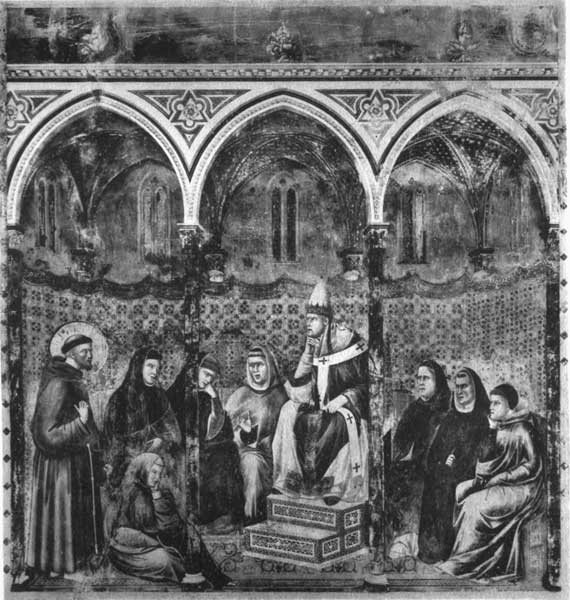
The first pictures of Giotto were in the chapel of the high-altar in the Badia of Florence, wherein he made many works held beautiful, but in particular a Madonna receiving the Annunciation, for the reason that in her he expressed vividly the fear and the terror that the salutation of Gabriel inspired in Mary the Virgin, who appears, all full of the greatest alarm, to be wishing almost to turn to flight. By the hand of Giotto, likewise, is the panel on the high-altar of the said chapel, which has been preserved there to our own day, and is still preserved there, more because of a certain reverence that is felt for the work of so great a man than for any other reason. And in S. Croce there are four chapels by the same man's hand: three between the sacristy and the great chapel, and one on the other side. In the first of the three, which is that of Messer Ridolfo de' Bardi, and is that wherein are the bell-ropes, is the life of S. Francis, in the death of whom a good number of friars show very naturally the expression of weeping. In the next, which is that of the family of Peruzzi, are two stories of the life of S. John the Baptist, to whom the chapel is dedicated; wherein great vivacity is seen in the dancing and leaping of Herodias, and in the promptness of some servants bustling at the service of the table. In the same are two marvellous stories of S. John the Evangelist—namely, when he brings Drusiana back to life, and when he is carried off into Heaven. In the third, which is that of the Giugni, dedicated to the Apostles, there are painted by the hand of Giotto the stories of the martyrdom of many of them. In the fourth, which is on the other side of the church, towards the north, and belongs to the Tosinghi and to the Spinelli, and is dedicated to the Assumption of Our Lady, Giotto painted her Birth, her Marriage, her Annunciation, the Adoration of the Magi, and when she presents Christ as a little Child to Simeon, which is something very beautiful, seeing that, besides a great affection that is seen in that old man as he receives Christ, the action of the child, stretching out its arms in fear of him and turning in terror towards its mother, could not be more touching or more beautiful. Next, in the death of the Madonna herself, there are the Apostles, and a good number of angels with torches in their hands, all very beautiful. In the Chapel of the Baroncelli, in the said church, is a panel in distemper by the hand of Giotto, wherein is executed with much diligence the Coronation of Our Lady, with a very great number of little figures and a choir of angels and saints, very diligently wrought. And because in that work there are written his name and the date in letters of gold, craftsmen who will consider at what time Giotto, with no glimmer of the good manner, gave a beginning to the good method of drawing and of colouring, will be forced to hold him in the highest veneration. In the same Church of S. Croce, over the marble tomb of Carlo Marsuppini of Arezzo, there is a Crucifix, with the Madonna, S. John, and Magdalene at the foot of the Cross; and on the other side of the church, exactly opposite this, over the burial-place of Lionardo Aretino, facing the high-altar, there is an Annunciation, which has been recoloured by modern painters, with small judgment on the part of him who has had this done. In the refectory, on a Tree of the Cross, are stories of S. Louis and a Last Supper by the same man's hand; and on the wardrobes in the sacristy are scenes with little figures from the life of Christ and of S. Francis. He wrought, also, in the Church of the Carmine, in the Chapel of S. Giovanni Battista, all the life of that Saint, divided into a number of pictures; and in the Palace of the Guelph party, in Florence, there is a story of the Christian Faith, painted perfectly in fresco by his hand; and therein is the portrait of Pope Clement IV, who created that magisterial body, giving it his arms, which it has always held and holds still.
Giotto’s first paintings were in the chapel of the high altar in the Badia of Florence. He created many works there that were considered beautiful. One in particular showed the Madonna receiving the Annunciation. In her, he vividly expressed the fear and terror that Gabriel’s greeting inspired in the Virgin Mary. She appears so alarmed that she almost seems ready to flee. Giotto also painted the panel on the high altar of that chapel. It has been preserved there to our own day, and remains there still, chiefly out of reverence for the work of so great a man. In S. Croce there are four chapels decorated by Giotto. Three are between the sacristy and the great chapel, and one is on the other side. The first of the three is the chapel of Messer Ridolfo de' Bardi, where the bell ropes hang. It depicts the life of S. Francis. In the scene of his death, a good number of friars show very natural expressions of grief. The next chapel belongs to the Peruzzi family. It is dedicated to S. John the Baptist and contains two scenes from his life. Herodias dances and leaps with great vivacity, while some servants hurry attentively to serve the table. In the same chapel are two marvelous scenes from the life of S. John the Evangelist. In one he brings Drusiana back to life, and in the other he is carried into Heaven. The third chapel belongs to the Giugni and is dedicated to the Apostles. There Giotto painted scenes of the martyrdom of many of them. The fourth chapel is on the other side of the church, toward the north. It belongs to the Tosinghi and the Spinelli and is dedicated to the Assumption of Our Lady. Giotto painted her Birth, her Marriage, her Annunciation, and the Adoration of the Magi. He also painted her presenting Christ as a small child to Simeon. This is very beautiful. The old man shows great affection as he receives Christ. The child stretches out his arms in fear of Simeon and turns in terror toward his mother. His action could not be more touching or more beautiful. In the scene of the Madonna’s own death are the Apostles and a good number of angels holding torches. All are very beautiful. In the Baroncelli Chapel in the same church is a panel painted in distemper by Giotto. It shows the Coronation of Our Lady, executed with great care. There are a great many small figures and a choir of angels and saints, all very carefully painted. His name and the date are written on the work in gold letters. So craftsmen who consider when Giotto began the good method of drawing and coloring, without even a glimmer of the good style to guide him, will be compelled to hold him in the highest reverence. In the same Church of S. Croce, above the marble tomb of Carlo Marsuppini of Arezzo, is a Crucifix. The Madonna, S. John, and Magdalene stand at the foot of the Cross. On the other side of the church, directly opposite it, is an Annunciation. It hangs above the burial place of Lionardo Aretino and faces the high altar. Modern painters have recolored it, showing little judgment on the part of the person who had this done. In the refectory, on a Tree of the Cross, are scenes of S. Louis and a Last Supper, also by Giotto. On the wardrobes in the sacristy are scenes with small figures from the lives of Christ and S. Francis. Giotto also painted the entire life of S. Giovanni Battista in the chapel dedicated to that saint in the Church of the Carmine. He divided the life into a number of pictures. In the Palace of the Guelph party in Florence is a scene of the Christian Faith, painted perfectly in fresco by Giotto. It includes a portrait of Pope Clement IV, who created that governing body and gave it his coat of arms. The body has always kept the arms and still bears them.
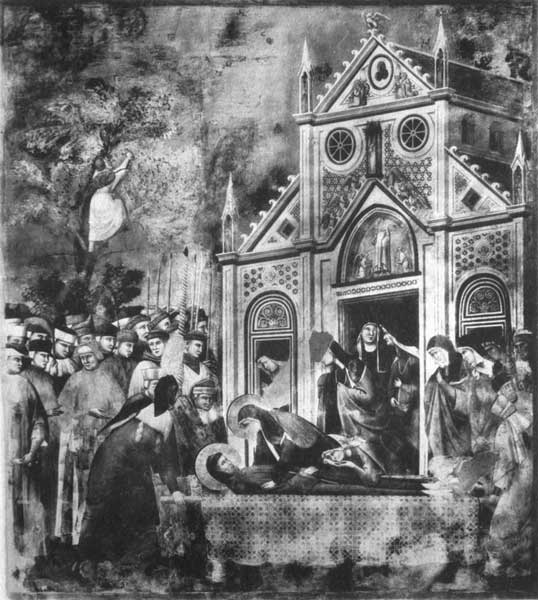
After these works, departing from Florence in order to go to finish in Assisi the works begun by Cimabue, in passing through Arezzo he painted in the Pieve the Chapel of S. Francesco, which is above the place of baptism; and on a round column, near a Corinthian capital that is both ancient and very beautiful, he portrayed from nature a S. Francis and a S. Dominic; and in the Duomo without Arezzo he painted the Stoning of S. Stephen in a little chapel, with a beautiful composition of figures. These works finished, he betook himself to Assisi, a city of Umbria, being called thither by Fra Giovanni di Muro della Marca, then General of the Friars of S. Francis; where, in the upper church, he painted in fresco, under the gallery that crosses the windows, on both sides of the church, thirty-two scenes of the life and acts of S. Francis—that is, sixteen on each wall—so perfectly that he acquired thereby very great fame. And in truth there is seen great variety in that work, not only in the gestures and attitudes of each figure but also in the composition of all the scenes; not to mention that it enables us very beautifully to see the diversity of the costumes of those times, and certain imitations and observations of the things of nature. Among others, there is one very beautiful scene, wherein a thirsty man, in whom the desire for water is vividly seen, is drinking, bending down on the ground by a fountain with very great and truly marvellous expression, in a manner that it seems almost a living person that is drinking. There are also many other things there most worthy of consideration, about which, in order not to be tedious, I do not enlarge further. Let it suffice that this whole work acquired for Giotto very great fame, by reason of the excellence of the figures and of the order, proportion, liveliness, and facility which he had from nature, and which he had made much greater by means of study, and was able to demonstrate clearly in all his works. And because, besides that which Giotto had from nature, he was most diligent and went on ever thinking out new ideas and wresting them from nature, he well deserved to be called the disciple of nature and not of others. The aforesaid scenes being finished, he painted in the same place, but in the lower church, the upper part of the walls at the sides of the high-altar, and all the four angles of the vaulting above in the place where lies the body of S. Francis; and all with inventions both fanciful and beautiful. In the first is S. Francis glorified in Heaven, surrounded by those virtues which are essential for him who wishes to be perfectly in the grace of God. On one side Obedience is placing a yoke on the neck of a friar who is before her on his knees, and the bands of the yoke are drawn by certain hands towards Heaven; and, enjoining silence with one finger to her lips, she has her eyes on Jesus Christ, who is shedding blood from His side. And in company with this virtue are Prudence and Humility, in order to show that where there is true obedience there are ever humility and prudence, which enable us to carry out every action well. In the second angle is Chastity, who, standing in a very strong fastness, is refusing to be conquered either by kingdoms or crowns or palms that some are presenting to her. At her feet is Purity, who is washing naked figures; and Force is busy leading people to wash and purify themselves. Near to Chastity, on one side, is Penitence, who is chasing Love away with a Discipline, and putting to flight Impurity. In the third space is Poverty, who is walking with bare feet on thorns, and has a dog that is barking at her from behind, and about her a boy who is throwing stones at her, and another who is busy pushing some thorns with a stick against her legs. And this Poverty is seen here being espoused by S. Francis, while Jesus Christ is holding her hand, there being present, not without mystic meaning, Hope and Compassion. In the fourth and last of the said spaces is a S. Francis, also glorified, in the white tunic of a deacon, and shown triumphant in Heaven in the midst of a multitude of angels who are forming a choir round him, with a standard whereon is a Cross with seven stars; and on high is the Holy Spirit. Within each of these angles are some Latin words that explain the scenes. In like manner, besides the said four angles, there are pictures on the side walls which are very beautiful and truly to be held in great price, both by reason of the perfection that is seen in them and because they were wrought with so great diligence that up to our own day they have remained fresh. In these pictures is the portrait of Giotto himself, very well made, and over the door of the sacristy, by the same man's hand and also in fresco, there is a S. Francis who is receiving the Stigmata, so loving and devout that to me it appears the most excellent picture that Giotto made in these works, which are all truly beautiful and worthy of praise.
After these works, Giotto left Florence to finish the works Cimabue had begun in Assisi. Passing through Arezzo, he painted the Chapel of S. Francesco in the Pieve, above the baptismal font. On a round column near an ancient and very beautiful Corinthian capital, he painted S. Francis and S. Dominic from life. In the Duomo outside Arezzo, he painted the Stoning of S. Stephen in a small chapel. Its figures were beautifully arranged. After finishing these works, Giotto went to Assisi, a city in Umbria. Fra Giovanni di Muro della Marca, then General of the Friars of S. Francis, had summoned him there. In the upper church, Giotto painted thirty-two fresco scenes of the life and deeds of S. Francis. They were beneath the gallery crossing the windows, with sixteen on each wall. He painted them so perfectly that they brought him great fame. The work shows great variety in the gestures and poses of each figure and in the composition of every scene. It also gives a beautiful view of the variety of costumes worn at the time. And it includes imitations of things in nature and details drawn from observation. Among the scenes is a very beautiful one showing a thirsty man drinking. He is bent down on the ground beside a fountain, and his desire for water is vividly apparent. His expression is so powerful and truly marvelous that he seems almost like a living person drinking. There are many other things there well worth considering, but I will say no more about them, to avoid becoming tedious. It is enough to say that the whole work brought Giotto great fame. This was due to the excellence of its figures and to his sense of order, proportion, liveliness, and ease. He had these qualities by nature, greatly improved them through study, and could demonstrate them clearly in all his works. Besides his natural gifts, Giotto was extremely diligent. He continually thought of new ideas and drew them from nature. He therefore deserved to be called a disciple of nature rather than of others. After finishing those scenes, Giotto painted in the lower church at the same site. He painted the upper walls on either side of the high altar and all four sections of the vault above. S. Francis's body lies beneath the vault. All these paintings were imaginatively and beautifully conceived. In the first section, S. Francis is glorified in Heaven. He is surrounded by the virtues essential to anyone who wishes to be perfectly in God's grace. On one side, Obedience places a yoke on the neck of a friar kneeling before her. Hands draw the straps of the yoke toward Heaven. She holds a finger to her lips, urging silence, and looks at Jesus Christ, whose side is shedding blood. Prudence and Humility accompany her. They show that true obedience always comes with humility and prudence, which allow us to perform every action well. In the second section, Chastity stands in a very strong fortress. She refuses to be conquered by the kingdoms, crowns, or palms that some people offer her. At her feet, Purity washes naked figures, while Force leads people to be washed and purified. Beside Chastity is Penitence, who chases Love away with a Discipline and puts Impurity to flight. In the third section, Poverty walks barefoot on thorns. A dog barks behind her, one boy throws stones at her, and another pushes thorns against her legs with a stick. S. Francis is marrying Poverty, while Jesus Christ holds her hand. Hope and Compassion are present too, and their presence has a mystical meaning. In the fourth and last section, S. Francis is again glorified. He wears the white tunic of a deacon and is shown triumphant in Heaven. A multitude of angels forms a choir around him. He has a standard bearing a Cross with seven stars, and the Holy Spirit is above him. Latin words in each section explain the scenes. Besides the four sections of the vault, there are pictures on the side walls. They are very beautiful and truly deserve to be highly valued. They are perfect, and they were painted with such care that they have remained fresh to our own day. Among them is a very well-made portrait of Giotto himself. Above the sacristy door, Giotto also painted a fresco of S. Francis receiving the Stigmata. It is so loving and devout that it seems to me the finest of Giotto's paintings in this work. All of them are truly beautiful and worthy of praise.
Having finished, then, for the last, the said S. Francis, he returned to Florence, where, on arriving there, he painted, on a panel that was to be sent to Pisa, a S. Francis on the tremendous rock of La Vernia, with extraordinary diligence, seeing that, besides certain landscapes full of trees and cliffs, which was something new in those times, there are seen in the attitude of a S. Francis, who is kneeling and receiving the Stigmata with much readiness, a most ardent desire to receive them and infinite love towards Jesus Christ, who, being surrounded in the sky by seraphim, is granting them to him with an expression so vivid that anything better cannot be imagined. In the lower part of the same panel there are three very beautiful scenes of the life of the same Saint. This panel, which to-day is seen in S. Francesco in Pisa on a pillar beside the high-altar, and is held in great veneration as a memorial of so great a man, was the reason that the Pisans, having just finished the building of the Campo Santo after the design of Giovanni, son of Niccola Pisano, as has been said above, gave to Giotto the painting of part of the inner walls, to the end that, since this so great fabric was all incrusted on the outer side with marbles and with carvings made at very great cost, and roofed over with lead, and also full of sarcophagi and ancient tombs once belonging to the heathens and brought to Pisa from various parts of the world, even so it might be adorned within, on the walls, with the noblest painting. Having gone to Pisa, then, for this purpose, Giotto made in fresco, on the first part of a wall in that Campo Santo, six large stories of the most patient Job. And because he judiciously reflected that the marbles of that part of the building where he had to work were turned towards the sea, and that, all being saline marbles, they are ever damp by reason of the south-east winds and throw out a certain salt moisture, even as the bricks of Pisa do for the most part, and that therefore the colours and the paintings fade and corrode, he caused to be made over the whole surface where he wished to work in fresco, to the end that his work might be preserved as long as possible, a coating, or in truth an intonaco or incrustation—that is to say, with lime, gypsum, and powdered brick all mixed together; so suitably that the pictures which he afterwards made thereon have been preserved up to the present day. And they would be still better if the negligence of those who should have taken care of them had not allowed them to be much injured by the damp, because the fact that this was not provided for, as was easily possible, has been the reason that these pictures, having suffered from damp, have been spoilt in certain places, and the flesh-colours have been blackened, and the intonaco has peeled off; not to mention that the nature of gypsum, when it has been mixed with lime, is to corrode in time and to grow rotten, whence it arises that afterwards, perforce, it spoils the colours, although it appears at the beginning to take a good and firm hold. In these scenes, besides the portrait of Messer Farinata degli Uberti, there are many beautiful figures, and above all certain villagers, who, in carrying the grievous news to Job, could not be more full of feeling nor show better than they do the grief that they felt over the lost cattle and over the other misadventures. Likewise there is amazing grace in the figure of a man-servant who is standing with a fan beside Job, who is covered with ulcers and almost abandoned by all; and although he is well done in every part, he is marvellous in the attitude that he strikes in chasing the flies from his leprous and stinking master with one hand, while with the other he is holding his nose in disgust, in order not to notice the stench. In like manner, the other figures in these scenes and the heads both of the males and of the women are very beautiful; and the draperies are wrought to such a degree of softness that it is no marvel if this work acquired for him so great fame, both in that city and abroad, that Pope Benedict IX of Treviso sent one of his courtiers into Tuscany to see what sort of man was Giotto, and of what kind his works, having designed to have some pictures made in S. Pietro. This courtier, coming in order to see Giotto and to hear what other masters there were in Florence excellent in painting and in mosaic, talked to many masters in Siena. Then, having received drawings from them, he came to Florence, and having gone into the shop of Giotto, who was working, declared to him the mind of the Pope and in what way it was proposed to make use of his labour, and at last asked him for some little drawing, to the end that he might send it to His Holiness. Giotto, who was most courteous, took a paper, and on that, with a brush dipped in red, holding his arm fast against his side in order to make a compass, with a turn of the hand he made a circle, so true in proportion and circumference that to behold it was a marvel. This done, he smiled and said to the courtier: "Here is your drawing." He, thinking he was being derided, said: "Am I to have no other drawing but this?" "'Tis enough and to spare," answered Giotto. "Send it, together with the others, and you will see if it will be recognized." The envoy, seeing that he could get nothing else, left him, very ill-satisfied and doubting that he had been fooled. All the same, sending to the Pope the other drawings and the names of those who had made them, he also sent that of Giotto, relating the method that he had followed in making his circle without moving his arm and without compasses. Wherefore the Pope and many courtiers that were versed in the arts recognized by this how much Giotto surpassed in excellence all the other painters of his time. This matter having afterwards spread abroad, there was born from it the proverb that is still wont to be said to men of gross wits: "Tu sei più tondo che l' O di Giotto!" ("Thou art rounder than Giotto's circle"). This proverb can be called beautiful not only from the occasion that gave it birth, but also for its significance, which consists in the double meaning; tondo being used, in Tuscany, both for the perfect shape of a circle and for slowness and grossness of understanding.
Having finally finished the S. Francis mentioned above, Giotto returned to Florence. On arriving there, he painted a panel of S. Francis on the great rock of La Vernia, to be sent to Pisa. He worked on it with extraordinary care. It includes landscapes full of trees and cliffs, which was new in those days. S. Francis kneels, eagerly receiving the Stigmata. His pose shows a most ardent desire to receive them and boundless love for Jesus Christ. Christ, surrounded by seraphim in the sky, grants them to him. His expression is so vivid that nothing better can be imagined. At the bottom of the same panel are three very beautiful scenes from the saint’s life. Today the panel can be seen in S. Francesco in Pisa, on a pillar beside the high altar. It is greatly revered as a memorial to so great a man. It also led the Pisans to commission Giotto to paint part of the inner walls of the Campo Santo. They had just finished building it to the design of Giovanni, son of Niccola Pisano, as mentioned above. The exterior of this great building was entirely covered with marble and carvings made at enormous expense. It had a lead roof and was full of ancient sarcophagi and tombs. These had once belonged to pagans and had been brought to Pisa from various parts of the world. The Pisans wanted the interior walls to be adorned with the noblest painting. Giotto therefore went to Pisa and painted six large fresco scenes of the most patient Job on one section of a wall in the Campo Santo. He wisely considered that the marble in that part of the building faced the sea. The marble was all of a salty kind and was always damp because of the southeast winds. It gave off a salty moisture, as most bricks in Pisa also do. This caused the colors and paintings to fade and deteriorate. To preserve his work as long as possible, Giotto had the whole surface prepared for fresco. He used a coating, or rather an intonaco or plaster layer, made from lime, gypsum, and powdered brick mixed together. It was so well suited to the purpose that the pictures he painted on it have survived to this day. They would be in still better condition if those responsible for them had not neglected them. Their neglect allowed damp to damage the paintings badly. The damp could easily have been dealt with, but because it was not, parts of the pictures have been spoiled. The flesh colors have turned black, and the intonaco has peeled off. Moreover, when gypsum is mixed with lime, it naturally decays and crumbles over time. As a result, it inevitably damages the colors, although at first it seems to hold well and firmly. These scenes contain a portrait of Messer Farinata degli Uberti and many beautiful figures. Especially notable are the villagers bringing Job the grievous news. They could not show more feeling or better express their grief over the lost cattle and the other misfortunes. There is also remarkable grace in the figure of a servant standing with a fan beside Job. Job is covered with sores and has been abandoned by almost everyone. The servant is well painted in every part, but his pose is marvelous. With one hand he chases flies from his leprous, stinking master. With the other he holds his nose in disgust, so that he will not smell the stench. The other figures in these scenes are also very beautiful, as are the heads of both the men and the women. The draperies are painted with such softness that it is no wonder the work brought Giotto great fame in Pisa and elsewhere. His fame was so great that Pope Benedict IX of Treviso sent a courtier to Tuscany. The pope intended to have some pictures made in S. Pietro, and he wanted to learn what kind of man Giotto was and what his works were like. The courtier came to see Giotto and to learn which other masters in Florence excelled in painting and mosaic. He spoke with many masters in Siena and received drawings from them. Then he went to Florence and entered Giotto’s workshop, where Giotto was working. He explained the pope’s wishes and how the pope proposed to employ him. Finally, he asked Giotto for a small drawing to send to His Holiness. Giotto, who was most courteous, took a sheet of paper and a brush dipped in red paint. He held his arm firmly against his side to use it like a compass. Then, with a turn of his hand, he drew a circle so perfectly proportioned and round that it was a wonder to behold. He smiled and said to the courtier: "Here is your drawing." Thinking he was being mocked, the courtier said: "Am I to have no other drawing but this?" "It is more than enough," answered Giotto. "Send it with the others, and you will see whether it is recognized." The envoy saw that he could get nothing else. He left, very dissatisfied and suspecting that he had been made a fool of. Nevertheless, when he sent the other drawings and their makers’ names to the pope, he also sent Giotto’s drawing. He described how Giotto had drawn the circle without moving his arm and without a compass. From this, the pope and many courtiers knowledgeable about the arts recognized how far Giotto surpassed all the other painters of his time. The story later spread, giving rise to a proverb still used for slow-witted people: "Tu sei più tondo che l' O di Giotto!" ("You are rounder than Giotto’s circle"). The proverb is beautiful not only because of the story behind it, but also because of its double meaning. In Tuscany, tondo refers both to the perfect shape of a circle and to slowness and dullness of understanding.
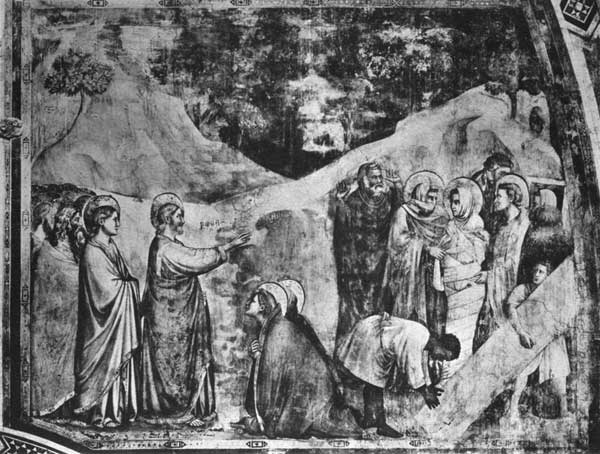
The aforesaid Pope then made him come to Rome, where, honouring him much and appreciating his talents, he made him paint five scenes from the life of Christ in the apse of S. Pietro, and the chief panel in the sacristy, which were all executed by him with so great diligence that there never issued from his hands any more finished work in distemper. Wherefore he well deserved that the Pope, holding himself to have been well served, should cause to be given to him six hundred ducats of gold, besides granting him so many favours that they were talked of throughout all Italy.
The Pope mentioned above then summoned him to Rome. The Pope honored him greatly and, appreciating his talents, commissioned him to paint five scenes from the life of Christ in the apse of S. Pietro. He also commissioned him to paint the main panel in the sacristy. The artist completed all these works with such care that he never produced more finely finished work in distemper. The Pope considered himself well served, and the artist deserved the six hundred gold ducats the Pope had given to him. The Pope also granted him so many favors that they were talked about throughout all Italy.
About this time—in order to withhold nothing worthy of remembrance in connection with art—there was in Rome one Oderigi d'Agobbio, who was much the friend of Giotto and an excellent illuminator for those days. This man, being summoned for this purpose by the Pope, illuminated many books for the library of the palace, which are now in great part eaten away by time. And in my book of ancient drawings are some remains from the very hand of this man, who in truth was an able man; although a much better master than Oderigi was Franco Bolognese, who wrought a number of works excellently in that manner for the same Pope and for the same library, about the same time, as can be seen in the said book, wherein I have designs by his hand both in painting and in illumination, and among them an eagle very well done, and a very beautiful lion that is tearing a tree. Of these two excellent illuminators Dante makes mention in the eleventh canto of the Purgatorio, where he is talking of the vainglorious, in these verses:
About this time, there was a man in Rome named Oderigi d'Agobbio. I mention him so as not to leave out anything worth remembering about art. He was a close friend of Giotto and an excellent illuminator for his day. The Pope summoned him to illuminate books for the palace library, and he illuminated many. Time has now eaten away much of his work. My book of ancient drawings contains some surviving examples by his own hand. He was truly a skilled man. Although Oderigi was skilled, Franco Bolognese was a much better master. Around the same time, Franco produced a number of excellent works in the same style for the same Pope and library. This can be seen in my book, which contains designs by his hand in both painting and illumination. Among them are a very well executed eagle and a very beautiful lion tearing a tree. Dante mentions these two excellent illuminators in the eleventh canto of the Purgatorio. He does so in the following verses, where he speaks of those who take vain pride in themselves:
O, dissi a lui, non se' tu Oderigi, L'onor d'Agobbio, e l'onor di quell'arte Che alluminare è chiamata in Parigi? Frate, diss'egli, più ridon le carte Che pennelleggia Franco Bolognese; L'onor è tutto suo, e mio in parte.
“Oh,” I said to him, “aren’t you Oderigi, the pride of Agobbio and of the art called illumination in Paris?” “Brother,” he said, “the pages shine brighter when Franco Bolognese paints them. The honor is all his, and mine only in part.”
The Pope, having seen these works, and the manner of Giotto pleasing him infinitely, ordered him to make scenes from the Old Testament and the New right round S. Pietro; wherefore, for a beginning, Giotto made in fresco the Angel that is over the organ, seven braccia high, and many other paintings, whereof part have been restored by others in our own days, and part, in founding the new walls, have been either destroyed or removed from the old edifice of S. Pietro, up to the space below the organ; such as a Madonna on a wall, which, to the end that it might not be thrown to the ground, was cut right out of the wall and made fast with beams and iron bars and thus removed, and afterwards built in, by reason of its beauty, in the place that pleased the pious love that is borne towards everything excellent in art by Messer Niccolò Acciaiuoli, doctor of Florence, who richly adorned this work of Giotto with stucco-work and also with modern paintings. By his hand, also, was the Navicella in mosaic that is over the three doors of the portico in the court of S. Pietro, which is truly marvellous and deservedly praised by all beautiful minds, because in it, besides the design, there is the grouping of the Apostles, who are travailing in diverse manners through the sea-tempest, while the winds are blowing into a sail, which has so high a relief that a real one would not have more; and moreover it is difficult to have to make with those pieces of glass a unity such as that which is seen in the lights and shadows of so great a sail, which could only be equalled by the brush with great difficulty and by making every possible effort; not to mention that in a fisherman, who is fishing from a rock with a line, there is seen an attitude of extreme patience proper to that art, and in his face the hope and the wish to make a catch. Under this work are three little arches in fresco, of which, since they are for the greater part spoilt, I will say no more. The praises universally given by craftsmen to this work are well deserved.
The Pope saw these works and was immensely pleased with Giotto’s style. He ordered Giotto to paint scenes from the Old and New Testaments all around S. Pietro. To begin, Giotto painted the angel above the organ in fresco, seven braccia high, as well as many other paintings. In our own day, some of these have been restored by others. Others were destroyed or removed from the old building of S. Pietro when the new walls were built, up to the area below the organ. Among them was a Madonna painted on a wall. To save it from destruction, the painting was cut out of the wall, secured with beams and iron bars, and moved. Because it was so beautiful, it was later built into a place chosen by Messer Niccolò Acciaiuoli, a doctor of Florence. His choice showed the reverent love he bore for everything excellent in art. He richly adorned Giotto’s work with stucco and modern paintings. Giotto also made the Navicella, the mosaic above the three doors of the portico in the court of S. Pietro. It is truly marvelous and deservedly praised by all people of fine judgment. Besides the design itself, there is the grouping of the Apostles, struggling in different ways through a storm at sea. The winds blow into a sail shown in such high relief that a real sail could have no more. Moreover, it is difficult to use pieces of glass to create the unity seen in the light and shadow of so large a sail. Even a brush could match this only with great difficulty and every possible effort. There is also a fisherman fishing with a line from a rock. His posture shows the extreme patience proper to his art, and his face shows his hope and desire to make a catch. Below this work are three small arches painted in fresco. Since they are mostly ruined, I will say no more about them. The praise craftsmen everywhere give this work is well deserved.
Giotto, having afterwards painted on a panel a large Crucifix coloured in distemper, for the Minerva, a church of the Preaching Friars, returned to his own country, having been abroad six years. But no long time after, by reason of the death of Pope Benedict IX, Clement V was created Pope in Perugia, and Giotto was forced to betake himself with that Pope to the place where he brought his Court, to Avignon, in order to do certain works there; and having gone there, he made, not only in Avignon but in many other places in France, many very beautiful panels and pictures in fresco, which pleased the Pontiff and the whole Court infinitely. Wherefore, the work dispatched, the Pope dismissed him lovingly and with many gifts, and he returned home no less rich than honoured and famous; and among the rest he brought back the portrait of that Pope, which he gave afterwards to Taddeo Gaddi, his disciple. And this return of Giotto to Florence was in the year 1316. But it was not granted to him to stay long in Florence, because, being summoned to Padua by the agency of the Signori della Scala, he painted a very beautiful chapel in the Santo, a church built in those times. From there he went to Verona, where, for Messer Cane, he made certain pictures in his palace, and in particular the portrait of that lord; and a panel for the Friars of S. Francis. These works completed, in returning to Tuscany he was forced to stay in Ferrara, and he painted at the behest of those Signori d'Este, in their palace and in S. Agostino, some works that are still seen there to-day. Meanwhile, it coming to the ears of Dante, poet of Florence, that Giotto was in Ferrara, he so contrived that he brought him to Ravenna, where he was living in exile; and he caused him to make round the Church of S. Francesco, for the Signori da Polenta, some scenes in fresco that are passing good. Next, having gone from Ravenna to Urbino, there too he wrought some works. Then, chancing to pass through Arezzo, he could not but comply with the wish of Piero Saccone, who had been much his friend; wherefore he made for him in fresco, on a pillar in the principal chapel of the Vescovado, a S. Martin who has cut his cloak in half and is giving one part of it to a beggar, who is standing before him almost wholly naked. Then, having made for the Abbey of S. Fiore a large Crucifix painted in distemper on wood, which is to-day in the middle of that church, he returned finally to Florence, where, among many other works, he made some pictures in the Convent of the Nuns of Faenza, both in fresco and in distemper, that are not in existence to-day, by reason of the destruction of that convent. In the year 1322, likewise—Dante, very much his friend, having died in the year before, to his great sorrow—he went to Lucca, and at the request of Castruccio, then Lord of that city, his birthplace, he made a panel in S. Martino with a Christ in air and four Saints, Protectors of that city—namely, S. Peter, S. Regulus, S. Martin, and S. Paulinus—who appear to be recommending a Pope and an Emperor, who, according to what is believed by many, are Frederick of Bavaria and the Anti-Pope Nicholas V. Some, likewise, believe that Giotto designed the castle and fortress of Giusta, which is impregnable, at San Frediano, in the same city of Lucca.
Giotto later painted a large Crucifix in distemper on a panel for the Minerva, a church of the Preaching Friars. He then returned to his own country, having been abroad for six years. Not long afterward, Pope Benedict IX died, and Clement V was elected Pope in Perugia. Giotto was compelled to follow the Pope to Avignon, where Clement established his court, to carry out certain works. Giotto made many beautiful panels and frescoes, not only in Avignon but in many other places in France. They greatly pleased the Pope and the whole court. When the work was finished, the Pope sent him off affectionately, with many gifts. Giotto returned home wealthy, honored, and famous. Among other things, he brought back a portrait of the Pope, which he later gave to his pupil Taddeo Gaddi. Giotto returned to Florence in 1316. But he was not allowed to stay long in Florence. The Signori della Scala arranged for him to be summoned to Padua, where he painted a beautiful chapel in the Santo. The church had been built around that time. From there he went to Verona, where he painted several pictures in the palace of Messer Cane. These included a portrait of Messer Cane himself. He also painted a panel for the Friars of S. Francis. After completing these works, Giotto had to stop in Ferrara on his way back to Tuscany. At the request of the Signori d'Este, he painted works in their palace and in S. Agostino. They can still be seen there today. Meanwhile, Dante, the Florentine poet, heard that Giotto was in Ferrara. Dante arranged to bring him to Ravenna, where he was living in exile. For the Signori da Polenta, Dante had Giotto paint some very good fresco scenes around the Church of S. Francesco. Giotto then went from Ravenna to Urbino, where he also produced some works. Later, while passing through Arezzo, he felt obliged to honor the wishes of his good friend Piero Saccone. For him, Giotto painted a fresco on a pillar in the main chapel of the Vescovado. It shows S. Martin cutting his cloak in half and giving one part to a beggar standing before him, almost naked. Giotto then painted a large Crucifix in distemper on wood for the Abbey of S. Fiore. It stands in the middle of the church today. Finally, he returned to Florence. Among many other works, he made frescoes and distemper paintings in the Convent of the Nuns of Faenza. They no longer exist because the convent was destroyed. In 1322, Giotto went to Lucca. Dante, a very close friend of Giotto, had died the year before, causing him great sorrow. At the request of Castruccio, then Lord of Lucca, his birthplace, Giotto painted a panel in S. Martino. It shows Christ in the air and four saints who protect the city: S. Peter, S. Regulus, S. Martin, and S. Paulinus. The saints appear to be commending a Pope and an Emperor to Christ. Many believe these figures are Frederick of Bavaria and the Anti-Pope Nicholas V. Some also believe that Giotto designed the impregnable castle and fortress of Giusta at San Frediano, in Lucca.
Afterwards, Giotto having returned to Florence, Robert, King of Naples, wrote to Charles, King of Calabria, his first-born son, who chanced to be in Florence, that he should send him Giotto to Naples at all costs, for the reason that, having finished the building of S. Chiara, a convent of nuns and a royal church, he wished that it should be adorned by him with noble paintings. Giotto, then, hearing himself summoned by a King so greatly renowned and famous, went more than willingly to serve him, and, on arriving, painted many scenes from the Old Testament and the New in some chapels of the said convent. And the scenes from the Apocalypse that he made in one of the said chapels are said to have been inventions of Dante; and this may be also true of those at Assisi, so greatly renowned, whereof there has been enough said above. And although Dante at that time was dead, they may have held discourse on these matters, as often comes to pass between friends.
After Giotto returned to Florence, Robert, King of Naples, wrote to his eldest son, Charles, King of Calabria. Charles happened to be in Florence, and Robert told him to send Giotto to Naples at all costs. Robert had finished building S. Chiara, a convent of nuns and a royal church. He wanted Giotto to adorn it with noble paintings. Giotto was summoned by a king of such great renown, so he went more than willingly to serve him. After arriving, he painted many scenes from the Old and New Testaments in some of the convent’s chapels. The scenes from the Apocalypse that Giotto painted in one chapel are said to have been Dante’s inventions. The same may be true of the famous scenes at Assisi, which have been discussed enough above. Although Dante was dead by then, he and Giotto may have discussed these matters, as friends often do.
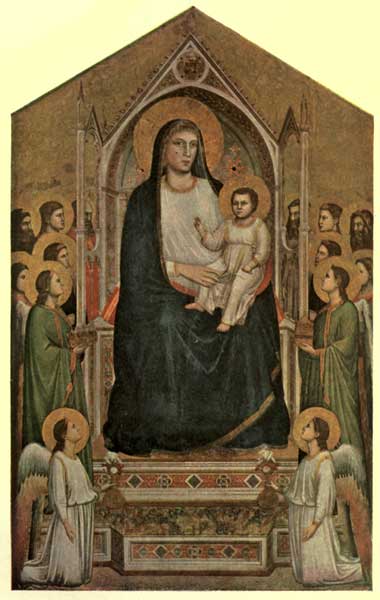
But to return to Naples; Giotto made many works in the Castel dell'Uovo, and in particular the chapel, which much pleased that King, by whom he was so greatly beloved that many times, while working, Giotto found himself entertained by the King in person, who took pleasure in seeing him at work and in hearing his discourse. And Giotto, who had ever some jest on his tongue and some witty repartee in readiness, would entertain him with his hand, in painting, and with pleasant discourse, in his jesting. Wherefore, the King saying to him one day that he wished to make him the first man in Naples, Giotto answered, "And for that end am I lodged at the Porta Reale, in order to be the first in Naples." Another time, the King saying to him, "Giotto, an I were you, now that it is hot, I would give over painting for a little;" he answered, "And I, i' faith, an I were you." Being then very dear to the King, he made for him a good number of pictures in a hall (that King Alfonso I pulled down in order to make the Castle), and also in the Incoronata; and among others in the said hall were the portraits of many famous men, and among them that of Giotto himself. Now the King having one day out of caprice besought him to paint his realm for him, Giotto, so it is said, painted for him an ass saddled, that had at its feet a new pack-saddle, and was sniffing at it and making semblance of desiring it; and on both the old pack-saddle and the new one were the royal crown and the sceptre of sovereignty; wherefore Giotto, being asked by the King what such a picture signified, answered that such were his subjects and such the kingdom, wherein every day a new lord was desired.
But to return to Naples, Giotto made many works in the Castel dell'Uovo, especially the chapel, which greatly pleased the King. The King loved Giotto so much that he often kept him company while he worked. He enjoyed watching Giotto paint and listening to him talk. Giotto always had a joke on his tongue and a witty reply ready. He entertained the King with his painting and his pleasant, joking conversation. So one day, when the King said he wished to make Giotto the first man in Naples, Giotto replied, "That is why I am lodged at the Porta Reale, so that I may be the first in Naples." Another time the King said, "Giotto, if I were you, now that it is hot, I would stop painting for a while." Giotto replied, "And I, indeed, if I were you." Because Giotto was so dear to the King, he made a good number of pictures for him in a hall. King Alfonso I later pulled the hall down to build the Castle. Giotto also made pictures in the Incoronata. Among the pictures in the hall were portraits of many famous men, including Giotto himself. One day, on a whim, the King asked Giotto to paint his kingdom for him. Giotto, so it is said, painted a saddled donkey with a new pack-saddle at its feet. The donkey was sniffing at the new saddle and seemed to want it. Both the old and the new pack-saddles bore the royal crown and the sceptre of sovereignty. The King asked Giotto what the picture meant. Giotto answered that such were his subjects and such was his kingdom, where a new lord was desired every day.
Departing from Naples in order to go to Rome, Giotto stopped at Gaeta, where he was forced to paint some scenes from the Old Testament in the Nunziata, which are now spoilt by time, but yet not so completely that there may not be seen in them very well the portrait of Giotto himself, near a large and very beautiful Crucifix. This work finished, not being able to refuse this to Signor Malatesta, he first occupied himself in his service for some days in Rome, and afterwards he betook himself to Rimini, of which city the said Malatesta was lord; and there, in the Church of S. Francesco, he made very many pictures, which were afterwards thrown to the ground and destroyed by Gismondo, son of Pandolfo Malatesta, who rebuilt the whole said church anew. In the cloisters of the said place, also, opposite to the wall of the church, he painted in fresco the story of the Blessed Michelina, which was one of the most beautiful and excellent works that Giotto ever made, by reason of the many and beautiful ideas that he had in working thereon; for besides the beauty of the draperies, and the grace and vivacity of the heads, which are miraculous, there is a young woman therein as beautiful as ever a woman can be, who, in order to clear herself from the false charge of adultery, is taking oath over a book in a most wonderful attitude, holding her eyes fixed on those of her husband, who was making her take the oath by reason of mistrust in a black son born from her, whom he could in no way bring himself to believe to be his. She, even as the husband is showing disdain and distrust in his face, is making clear with the purity of her brow and of her eyes, to those who are most intently gazing on her, her innocence and simplicity, and the wrong that he is doing to her in making her take oath and in proclaiming her wrongly as a harlot.
On his way from Naples to Rome, Giotto stopped at Gaeta. There he was compelled to paint some Old Testament scenes in the Nunziata. Time has damaged them, but not so badly that Giotto’s own portrait cannot still be seen clearly near a large and very beautiful Crucifix. After finishing this work, Giotto spent several days in Rome working for Signor Malatesta, unable to refuse his request. He then went to Rimini, where Malatesta was lord. In the Church of S. Francesco, Giotto made many paintings. These were later torn down and destroyed by Gismondo, son of Pandolfo Malatesta, who rebuilt the whole church. In the church cloisters, on a wall opposite the church, Giotto also painted a fresco of the story of the Blessed Michelina. It was one of his most beautiful and excellent works, because of the many beautiful ideas he brought to it. Besides the beautiful draperies and the miraculous grace and liveliness of the faces, the fresco contains a young woman as beautiful as any woman could be. To clear herself of a false charge of adultery, she takes an oath over a book in a most remarkable pose. Her eyes are fixed on her husband, who made her swear because he doubted her. She had given birth to a black son, and he could not bring himself to believe the child was his. As the husband’s face shows disdain and distrust, the purity of her brow and eyes reveals her innocence and simplicity to those watching her most closely. It also shows the wrong he does her by making her swear and falsely calling her a harlot.
In like manner, very great feeling was that which he expressed in a sick man stricken with certain sores, seeing that all the women who are round him, overcome by the stench, are making certain grimaces of disgust, the most gracious in the world. The foreshortenings, next, that are seen in another picture among a quantity of beggars that he portrayed, are very worthy of praise and should be held in great price among craftsmen, because from them there came the first beginning and method of making them, not to mention that it cannot be said that they are not passing good for early work. But above everything else that is in this work, most marvellous is the gesture that the aforesaid Blessed Michelina is making towards certain usurers, who are disbursing to her the money from the sale of her possessions for giving to the poor, seeing that in her there is shown contempt of money and of the other things of this earth, which appear to disgust her, and, in them, the personification of human avarice and greed. Very beautiful, too, is the figure of one who, while counting the money, appears to be making sign to the notary who is writing, considering that, although he has his eyes on the notary, he is yet keeping his hands on the money, thus revealing his love of it, his avarice, and his distrust. In like manner, the three figures that are upholding the garments of S. Francis in the sky, representing Obedience, Patience, and Poverty, are worthy of infinite praise, above all because there is in the manner of the draperies a natural flow of folds that gives us to know that Giotto was born in order to give light to painting. Besides this, he portrayed Signor Malatesta on a ship in this work, so naturally that he appears absolutely alive; and some mariners and other people, in their promptness, their expressions, and their attitudes—and particularly a figure that is speaking with some others and spits into the sea, putting one hand up to his face—give us to know the excellence of Giotto. And certainly, among all the works of painting made by this master, this may be said to be one of the best, for the reason that there is not one figure in so great a number that does not show very great craftsmanship, and that is not placed in some characteristic attitude. And therefore it is no marvel that Signor Malatesta did not fail to reward him magnificently and to praise him.
Similarly, he expressed great feeling in his portrayal of a sick man covered in sores. All the women around him are overcome by the stench, making the most charming grimaces of disgust. In another picture, he portrayed a group of beggars with foreshortened forms. These are very worthy of praise and should be highly valued by artists, because they were the first steps toward a method of foreshortening. Besides, they cannot be called anything less than very good for such early work. But the most marvelous thing in this work is Blessed Michelina's gesture toward some moneylenders. They are paying her the money from the sale of her possessions, which she intends to give to the poor. Her gesture shows her contempt for money and other earthly things, which seem to disgust her. The moneylenders, meanwhile, embody human avarice and greed. Particularly beautiful is the figure of one man who, while counting the money, appears to signal to the notary who is writing. Although he has his eyes on the notary, he keeps his hands on the money. This reveals his love of money, his greed, and his distrust. The three figures holding up the garments of S. Francis in the sky represent Obedience, Patience, and Poverty. They are worthy of endless praise, especially because their draperies fall in natural folds. These folds show us that Giotto was born to bring light to painting. In this work, he also portrayed Signor Malatesta on a ship so naturally that he seems completely alive. Some sailors and other people also show Giotto's excellence through their readiness, expressions, and poses. One figure in particular speaks with others and spits into the sea, raising one hand to his face. Certainly, this may be called one of the best paintings by this master. Among all the many figures, every one shows great skill and has a distinctive pose. It is therefore no wonder that Signor Malatesta rewarded him magnificently and praised him.
Having finished his labours for that lord, he complied with the request of a Prior of Florence who was then at S. Cataldo d'Arimini, and made a S. Thomas Aquinas, reading to his friars, without the door of the church. Departing thence, he returned to Ravenna and painted a chapel in fresco in S. Giovanni Evangelista, which is much extolled. Having next returned to Florence with very great honour and ample means, he painted a Crucifix on wood and in distemper for S. Marco, larger than life and on a ground of gold, which was placed on the right hand in the church. And he made another like it in S. Maria Novella, whereon Puccio Capanna, his pupil, worked in company with him; and this is still to-day over the principal door, on the right as you enter the church, over the tomb of the Gaddi. And in the same church, over the tramezzo, he made a S. Louis for Paolo di Lotto Ardinghelli, and at the foot thereof the portrait of him and of his wife, from the life.
After finishing his work for that lord, he fulfilled a request from a Prior of Florence who was then at S. Cataldo d'Arimini. Outside the church door, he painted S. Thomas Aquinas reading to his friars. He then returned to Ravenna and painted a fresco in a chapel in S. Giovanni Evangelista. The fresco is much praised. He next returned to Florence with great honor and ample means. For S. Marco, he painted a Crucifix in distemper on wood, larger than life and set against a gold background. It was placed on the right side of the church. He painted another like it in S. Maria Novella, working alongside his pupil Puccio Capanna. This Crucifix is still above the tomb of the Gaddi, over the principal door on the right as you enter the church. In the same church, above the tramezzo, he painted a S. Louis for Paolo di Lotto Ardinghelli. At its foot he painted portraits of Paolo and his wife from life.
See the note on p. 57.
Afterwards, in the year 1327, Guido Tarlati da Pietramala, Bishop and Lord of Arezzo, died at Massa di Maremma in returning from Lucca, where he had been to visit the Emperor, and after his body had been brought to Arezzo and the most magnificent funeral honours had been paid to it, Piero Saccone and Dolfo da Pietramala, the brother of the Bishop, determined that there should be made for him a tomb in marble worthy of the greatness of so notable a man, who had been a lord both spiritual and temporal, and head of the Ghibelline party in Tuscany. Wherefore, having written to Giotto that he should make the design of a tomb very rich and with all possible adornment, and having sent him the measurements, they prayed him afterwards that he should place at their disposal the sculptor who was the most excellent, according to his opinion, of all that were in Italy, because they were relying wholly on his judgment. Giotto, who was most courteous, made the design and sent it to them; and after this design, as will be told in the proper place, the said tomb was made. And because the said Piero Saccone had infinite love for the talent of this man, having taken Borgo a San Sepolcro no long time after he had received the said design, he brought from there to Arezzo a panel with little figures by the hand of Giotto, which afterwards fell to pieces; and Baccio Gondi, nobleman of Florence, a lover of these noble arts and of every talent, being Commissary of Arezzo, sought out the pieces of this panel with great diligence, and having found some brought them to Florence, where he holds them in great veneration, together with some other works that he has by the hand of the same Giotto, who wrought so many that their number is almost beyond belief. And not many years ago, chancing to be at the Hermitage of Camaldoli, where I have wrought many works for those reverend Fathers, I saw in a cell, whither it had been brought by the Very Reverend Don Antonio da Pisa, then General of the Congregation of Camaldoli, a very beautiful little Crucifix on a ground of gold, with the name of Giotto in his own hand; which Crucifix, according to what I hear from the Reverend Don Silvano Razzi, monk of Camaldoli, is kept to-day in the cell of the Superior of the Monastery of the Angeli, as being a very rare work and by the hand of Giotto, in company with a most beautiful little picture by Raffaello da Urbino.
In 1327, Guido Tarlati da Pietramala, Bishop and Lord of Arezzo, died at Massa di Maremma while returning from Lucca. He had gone there to visit the Emperor. His body was brought to Arezzo, where he received the most magnificent funeral honors. Piero Saccone and Dolfo da Pietramala, the Bishop’s brother, then decided to commission a marble tomb for him. They wanted it to be worthy of so notable a man. He had been both a spiritual and a temporal lord, and head of the Ghibelline party in Tuscany. They wrote to Giotto, asking him to design a richly decorated tomb with every possible adornment. They sent him the measurements and then asked him to make available the sculptor he considered the best in all Italy. They relied entirely on his judgment. Giotto, who was most courteous, made the design and sent it to them. The tomb was made from his design, as will be told in the proper place. Piero Saccone had boundless admiration for Giotto’s talent. Not long after receiving the design, he captured Borgo a San Sepolcro. From there he brought to Arezzo a panel with small figures painted by Giotto. The panel later fell to pieces. Baccio Gondi, a Florentine nobleman who loved these noble arts and every kind of talent, later became Commissary of Arezzo. He searched diligently for the pieces of the panel. He found some and brought them to Florence, where he holds them in great veneration. He keeps them with other works by Giotto, who produced so many that their number is almost beyond belief. Not many years ago, I happened to be at the Hermitage of Camaldoli, where I have made many works for those reverend Fathers. In a cell I saw a very beautiful small Crucifix on a gold ground, with Giotto’s name in his own hand. The Very Reverend Don Antonio da Pisa, then General of the Congregation of Camaldoli, had brought it there. The Reverend Don Silvano Razzi, a monk of Camaldoli, tells me that the Crucifix is now kept in the cell of the Superior of the Monastery of the Angeli. It is valued there as a very rare work by Giotto, alongside a most beautiful small picture by Raffaello da Urbino.
For the Frati Umiliati of Ognissanti in Florence, Giotto painted a chapel and four panels, in one of which there was the Madonna, with many angels round her and the Child in her arms, and a large Crucifix on wood, whereof Puccio Capanna took the design and wrought many of them afterwards throughout all Italy, having much practice in the manner of Giotto. In the tramezzo of the said church, when this book of the Lives of the Painters, Sculptors, and Architects was printed the first time, there was a little panel in distemper painted by Giotto with infinite diligence, wherein was the death of Our Lady, with the Apostles round her and with a Christ who is receiving her soul into His arms. This work was much praised by the craftsmen of painting, and in particular by Michelagnolo Buonarroti, who declared, as was said another time, that the quality of this painted story could not be more like to the truth than it is. This little panel, I say, having come into notice from the time when the book of these Lives was first published, was afterwards carried off by someone unknown, who, perhaps out of love for art and out of piety, it seeming to him that it was little esteemed, became, as said our poet, impious. And truly it was a miracle in those times that Giotto had so great loveliness in his painting, considering, above all, that he learnt the art in a certain measure without a master.
For the Frati Umiliati of Ognissanti in Florence, Giotto painted a chapel and four panels. One panel showed the Madonna with the Child in her arms and many angels around her. He also painted a large Crucifix on wood. Puccio Capanna copied its design and later made many such Crucifixes throughout Italy, having practiced Giotto’s style extensively. In the tramezzo of the same church, there was a small panel painted in tempera by Giotto with immense care. It was there when this book of the Lives of the Painters, Sculptors, and Architects was first printed. It showed the death of Our Lady, with the Apostles around her and Christ receiving her soul into his arms. Painters greatly praised the work, especially Michelagnolo Buonarroti. As I have said before, he declared that the scene could not be more true to life. This small panel, I say, attracted attention after the Lives was first published. Later, someone unknown carried it off. Perhaps, out of love for art and piety, the thief thought it was not sufficiently valued. But in doing so, as our poet said, he became impious. Truly, it was a miracle in those times that Giotto’s painting had such beauty. This is especially so considering that he learned his art, to some extent, without a master.
See the note on p. 57.
After these works, in the year 1334, on July 9, he put his hand to the Campanile of S. Maria del Fiore, whereof the foundation was a platform of strong stone, in a pit sunk twenty braccia deep from which water and gravel had been removed; upon this platform he made a good mass of concrete, that reached to the height of twelve braccia above the first foundation, and the rest—namely, the other eight braccia—he caused to be made of masonry. And at this beginning and foundation there officiated the Bishop of the city, who, in the presence of all the clergy and all the magistrates, solemnly laid the first stone. This work, then, being carried on with the said model, which was in the German manner that was in use in those times, Giotto designed all the scenes that were going into the ornamentation, and marked out the model with white, black, and red colours in all those places wherein the marbles and the friezes were to go, with much diligence. The circuit round the base was one hundred braccia—that is, twenty-five braccia for each side—and the height, one hundred and forty-four braccia. And if that is true, and I hold it as of the truest, which Lorenzo di Cione Ghiberti has left in writing, Giotto made not only the model of this campanile, but also part of those scenes in marble wherein are the beginnings of all the arts, in sculpture and in relief. And the said Lorenzo declares that he saw models in relief by the hand of Giotto, and in particular those of these works; which circumstance can be easily believed, design and invention being father and mother of all these arts and not of one alone. This campanile was destined, according to the model of Giotto, to have a spire, or rather a pyramid, four-sided and fifty braccia high, as a completion to what is now seen; but, for the reason that it was a German idea and in an old manner, modern architects have never done aught but advise that it should not be made, the work seeming to be better as it is. For all these works Giotto was not only made citizen of Florence, but was given a pension of one hundred florins yearly by the Commune of Florence, which was something very great in those times; and he was made overseer over this work, which was carried on after him by Taddeo Gaddi, for he did not live so long as to be able to see it finished.
After these works, on July 9, 1334, Giotto began work on the Campanile of S. Maria del Fiore. Its foundation was a platform of strong stone, laid in a pit twenty braccia deep, cleared of water and gravel. On this platform he built a solid mass of concrete, rising twelve braccia above the first foundation. He had the remaining eight braccia built of masonry. The Bishop of the city officiated at the start of the foundation. In the presence of all the clergy and magistrates, he solemnly laid the first stone. The work followed the model, which was in the German style used at the time. Giotto designed all the scenes intended to decorate the campanile. He carefully marked the model in white, black, and red wherever the marble and friezes were to go. The base measured one hundred braccia around, with twenty-five braccia on each side. The height was one hundred and forty-four braccia. Lorenzo di Cione Ghiberti left a written account that I believe to be entirely true. If it is true, Giotto made more than the model for the campanile. He also made some of the marble scenes depicting the beginnings of all the arts, in sculpture and relief. Lorenzo says he saw relief models made by Giotto, especially those for these works. This is easy to believe, since design and invention are the father and mother of all these arts, not just one. Giotto’s model called for the campanile to be completed with a spire, or rather a four-sided pyramid, fifty braccia high. But modern architects have consistently advised against building it. They consider it a German idea in an old style, and think the work looks better as it is. For all these works, Giotto was not only made a citizen of Florence. The Commune of Florence also gave him a yearly pension of one hundred florins, a very great sum in those days. He was made overseer of the campanile. After him, Taddeo Gaddi continued the work, for Giotto did not live long enough to see it finished.
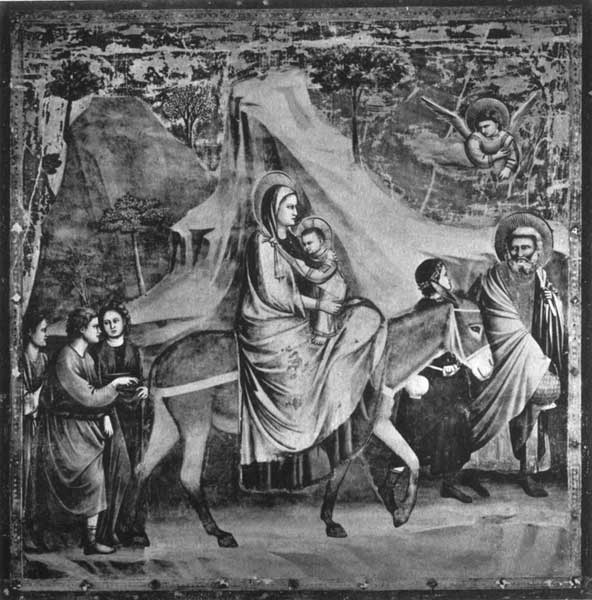
Now, while this work continued to be carried forward, he made a panel for the Nuns of S. Giorgio, and three half-length figures in an arch over the inner side of the door of the Badia in Florence, now covered with whitewash in order to give more light to the church. And in the Great Hall of the Podestà of Florence he painted the Commune (an idea stolen by many), representing it as sitting in the form of Judge, sceptre in hand, and over its head he placed the balanced scales as symbol of the just decisions administered by it, accompanying it with four Virtues, that are, Strength with courage, Wisdom with the laws, Justice with arms, and Temperance with words; this work is beautiful as a picture, and characteristic and appropriate in invention.
While this work continued, he painted a panel for the Nuns of S. Giorgio. He also painted three half-length figures in an arch above the inside of the door of the Badia in Florence. These figures are now covered with whitewash to give the church more light. In the Great Hall of the Podestà of Florence, he painted the Commune, an idea that many others stole. He depicted the Commune as a seated judge, holding a sceptre. Above its head he placed balanced scales, symbolizing its just decisions. He accompanied the Commune with four Virtues: Strength with courage, Wisdom with the laws, Justice with arms, and Temperance with words. The painting is beautiful, and its design is distinctive and appropriate.
Afterwards, having gone again to Padua, besides many other works and chapels that he painted there, he made a Mundane Glory in the precincts of the Arena, which gained him much honour and profit. In Milan, also, he wrought certain works, that are scattered throughout that city and held most beautiful even to this day. Finally, having returned from Milan, no long time passed before he gave up his soul to God, having wrought so many most beautiful works in his life, and having been no less good as Christian than he was excellent as painter. He died in the year 1336, to the great grief of all his fellow-citizens—nay, of all those who had known him or even only heard his name—and he was buried, even as his virtues deserved, with great honour, having been loved by all while he lived, and in particular by the men excellent in all the professions, seeing that, besides Dante, of whom we have spoken above, he was much honoured by Petrarca, both he and his works, so greatly that it is read in Petrarca's testament that he left to Signor Francesco da Carrara, Lord of Padua, among other things held by him in the highest veneration, a picture by the hand of Giotto containing a Madonna, as something rare and very dear to him. And the words of that clause in the testament run thus:
Afterward, he returned to Padua, where he painted many other works and chapels. He also painted a Mundane Glory within the Arena, which brought him much honor and profit. In Milan, too, he produced works scattered throughout the city. They are considered very beautiful even today. After he returned from Milan, he soon gave his soul to God. In his lifetime, he had created so many very beautiful works. He had been no less good a Christian than he was an excellent painter. He died in 1336, to the great grief of all his fellow citizens. Indeed, all who had known him or even just heard his name grieved. He was buried with great honor, as his virtues deserved. During his life, he had been loved by all, especially by those who excelled in every profession. Besides Dante, whom we mentioned above, Petrarca greatly honored both him and his works. In his will, Petrarca left Signor Francesco da Carrara, Lord of Padua, a painting of a Madonna by Giotto. Petrarca included it among other things he held in the highest esteem, as something rare and very dear to him. The words of that clause in the will are as follows:
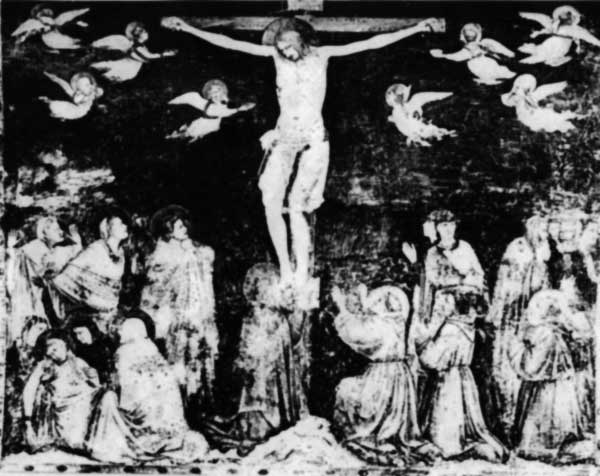
"Transeo ad dispositionem aliarum rerum; et prædicto igitur domino meo Paduano, quia et ipse per Dei gratiam non eget, et ego nihil aliud habeo dignum se, mitto tabulam meam sive historiam Beatæ Virginis Mariæ, opus Jocti pictoris egregii, quæ mihi ab amico meo Michæle Vannis de Florentia missa est, in cujus pulchritudinem ignorantes non intelligunt, magistri autem artis stupent; hanc iconam ipsi domino lego, ut ipsa Virgo benedicta sibi sit propitia apud filium suum Jesum Christum."
"I now turn to the distribution of my other possessions. By God’s grace, my lord of Padua is in need of nothing. And I have nothing else worthy of him. So I send him my painting depicting the Blessed Virgin Mary, a work by the excellent painter Jocti. My friend Michæle Vannis of Florence sent it to me. Those who know nothing of art do not understand its beauty, but masters of the art marvel at it. I leave this painting to my lord so that the Blessed Virgin may favor him before her son, Jesus Christ."
And the same Petrarch, in a Latin epistle in the fifth book of his Familiar Letters, says these words:
And Petrarch himself writes the following in a Latin letter in the fifth book of his Familiar Letters:
"Atque (ut a veteribus ad nova, ab externis ad nostra transgrediar) duos ego novi pictores egregios, nec formosos, Joctum Florentinum civem, cujus inter modernos fama ingens est, et Simonem Senensem. Novi scultores aliquot," etc.
“And, to move from the ancients to modern times, and from foreigners to our own people, I know two excellent painters who are not handsome. One is Joctum, a citizen of Florence, who is very famous among modern painters. The other is Simonem of Siena. I know several sculptors,” etc.
Giotto was buried in S. Maria del Fiore, on the left side as you enter the church, where there is a slab of white marble in memory of so great a man. And, as was told in the Life of Cimabue, a commentator of Dante, who lived at the same time as Giotto, said: "Giotto was and is the most eminent among painters in the same city of Florence, and his works bear testimony for him in Rome, in Naples, in Avignon, in Florence, in Padua, and in many other parts of the world."
Giotto was buried in S. Maria del Fiore, on the left as you enter the church. A white marble slab there honors this great man. As mentioned in the Life of Cimabue, a commentator on Dante lived at the same time as Giotto. The commentator said: "Giotto was and is the most eminent painter in the city of Florence. His works bear witness to his greatness in Rome, Naples, Avignon, Florence, Padua, and many other parts of the world."
His disciples were Taddeo Gaddi, held by him at baptism, as has been said, and Puccio Capanna of Florence, who, working at Rimini in the Church of S. Cataldo, belonging to the Preaching Friars, painted perfectly in fresco the hull of a ship which appears to be sinking in the sea, with men who are throwing things into the sea, one of whom is Puccio himself portrayed from life among a good number of mariners. The same man painted many works after the death of Giotto in the Church of S. Francesco at Assisi, and in the Church of S. Trinita in Florence, near the side-door towards the river, he painted the Chapel of the Strozzi, wherein is the Coronation of the Madonna in fresco, with a choir of angels which draw very much to the manner of Giotto; and on the sides are stories of S. Lucia, very well wrought. In the Badia of Florence he painted the Chapel of S. Giovanni Evangelista, belonging to the family of Covoni, beside the sacristry; and in Pistoia he wrought in fresco the principal chapel of the Church of S. Francesco and the Chapel of S. Lodovico, with the stories of those Saints, passing well painted. In the middle of the Church of S. Domenico, in the same city, there are a Crucifix, a Madonna, and a S. John, wrought with much sweetness, and at their feet a complete human skeleton, wherein (and this was something unusual in those times) Puccio showed that he had sought to find the foundations of art. In this work there is read his name, written by himself in this fashion: PUCCIO DI FIORENZA ME FECE. In the arch over the door of S. Maria Nuova in the said church there are three half-length figures by his hand, Our Lady with the Child in her arms, and S. Peter on one side, and on the other S. Francis. He also painted in the aforesaid city of Assisi, in the lower Church of S. Francesco, some scenes of the Passion of Jesus Christ in fresco, with good and very resolute mastery, and in the chapel of the Church of S. Maria degli Angeli he wrought in fresco a Christ in Glory, with the Virgin praying to Him for the Christian people; this work, which is passing good, has been all blackened by the smoke of the lamps and the candles that are burning there continually in great quantity. And in truth, in so far as it can be judged, Puccio had the manner and the whole method of working of his master Giotto, and knew how to make good use of it in the works that he wrought, even if, as some have it, he did not live long, having fallen sick and died by reason of labouring too much in fresco. By his hand, in so far as is known, is the Chapel of S. Martino in the same church, with the stories of that Saint, wrought in fresco for Cardinal Gentile. There is seen, also, in the middle of the street called Portica, a Christ at the Column, and in a square picture there is Our Lady, with S. Catherine and S. Clara, one on either side of her. There are works by his hand scattered about in many other places, such as a panel with the Passion of Christ, and stories of S. Francis, in the tramezzo of the church in Bologna; and many others, in short, that are passed by for the sake of brevity. I will say, indeed, that in Assisi, where most of his works are, and where it appears to me that he assisted Giotto in painting, I have found that they hold him as their fellow-citizen, and that there are still to-day in that city some of the family of the Capanni. Wherefore it may easily be believed that he was born in Florence, having written so himself, and that he was a disciple of Giotto, but that afterwards he took a wife in Assisi, that there he had children, and that now he has descendants there. But because it is of little importance to know this exactly, it is enough to say that he was a good master.
His disciples included Taddeo Gaddi, whose baptism he had sponsored, as mentioned earlier, and Puccio Capanna of Florence. In the Church of S. Cataldo at Rimini, which belonged to the Preaching Friars, Puccio painted a masterful fresco. It shows the hull of a ship that appears to be sinking at sea, with men throwing things overboard. Among the many sailors, Puccio painted a portrait of himself from life. After Giotto’s death, Puccio painted many works in the Church of S. Francesco at Assisi. In the Church of S. Trinita in Florence, he painted the Strozzi Chapel, near the side door facing the river. There he painted a fresco of the Coronation of the Madonna, with a choir of angels. The angels closely follow Giotto’s style. On the sides are very well executed scenes from the life of S. Lucia. In the Badia of Florence, Puccio painted the Chapel of S. Giovanni Evangelista, which belonged to the Covoni family. It stands beside the sacristy. In Pistoia, he painted the main chapel and the Chapel of S. Lodovico in the Church of S. Francesco. These frescoes show scenes from the lives of those saints and are very well painted. In the middle of the Church of S. Domenico in the same city, there is a Crucifix, a Madonna, and a S. John. All are painted with great sweetness. At their feet is a complete human skeleton. In painting it, Puccio showed that he had sought to discover the foundations of art, which was unusual at the time. On this work he wrote his name: PUCCIO DI FIORENZA ME FECE. In the arch over the door of S. Maria Nuova in the same church are three half-length figures by Puccio. They show Our Lady holding the Child, with S. Peter on one side and S. Francis on the other. Puccio also painted frescoes of scenes from the Passion of Jesus Christ in the lower Church of S. Francesco at Assisi. He painted them with skill and great confidence. In the chapel of the Church of S. Maria degli Angeli, he painted a fresco of Christ in Glory. It shows the Virgin praying to him on behalf of the Christian people. This very good work has been completely blackened by smoke. Great numbers of lamps and candles burn there constantly. In truth, as far as one can judge, Puccio had mastered the style and working methods of his teacher Giotto. He knew how to put them to good use in his works. Yet, according to some, he did not live long. They say he fell ill and died because he worked too hard painting frescoes. As far as is known, Puccio painted the Chapel of S. Martino in the same church. He painted its frescoes of scenes from that saint’s life for Cardinal Gentile. In the middle of the street called Portica, there is also a Christ at the Column. In a square picture there is Our Lady, with S. Catherine and S. Clara on either side. Works by Puccio are scattered in many other places. Among them is a panel showing the Passion of Christ and scenes from the life of S. Francis. It is in the tramezzo of the church in Bologna. For the sake of brevity, I pass over many other works. I will say, however, that the people of Assisi regard Puccio as a fellow citizen. Most of his works are there, and it seems to me that he helped Giotto paint there. I have also found that some members of the Capanni family still live in the city today. So it is easy to believe that Puccio was born in Florence, as he himself wrote, and was Giotto’s disciple. He may then have married in Assisi, had children there, and still have descendants there. But it matters little to know this exactly. It is enough to say that he was a good master.
See the note on p. 57.
Likewise a disciple of Giotto and a very masterly painter was Ottaviano da Faenza, who painted many works at Ferrara in S. Giorgio, the seat of the Monks of Monte Oliveto; and in Faenza, where he lived and died, he painted, in the arch over the door of S. Francesco, a Madonna, S. Peter and S. Paul, and many other works in his said birthplace and in Bologna.
Ottaviano da Faenza was also a disciple of Giotto and a highly skilled painter. He painted many works in Ferrara at S. Giorgio, the home of the Monks of Monte Oliveto. In Faenza, where he lived and died, he painted a Madonna, S. Peter and S. Paul in the arch over the door of S. Francesco. He painted many other works in his native city and in Bologna.
A disciple of Giotto, also, was Pace da Faenza, who stayed with him long and assisted him in many works; and in Bologna there are some scenes in fresco by his hand on the façade of S. Giovanni Decollato. This Pace was an able man, particularly in making little figures, as can be seen to this day in the Church of S. Francesco at Forlì, in a Tree of the Cross, and in a little panel in distemper, wherein is the life of Christ, with four little scenes from the life of Our Lady, all very well wrought. It is said that he wrought in fresco, in the Chapel of S. Antonio at Assisi, some stories of the life of that Saint, for a Duke of Spoleto who is buried in that place together with his son, both having died fighting in certain suburbs of Assisi, according to what is seen in a long inscription that is on the sarcophagus of the said tomb. In the old book of the Company of Painters it is found that the same man had another disciple, Francesco, called di Maestro Giotto, of whom I have nothing else to relate.
Pace da Faenza was also a disciple of Giotto. He stayed with Giotto for a long time and helped him with many works. In Bologna, Pace painted some fresco scenes on the façade of S. Giovanni Decollato. He was a skilled artist, especially at painting small figures. This can still be seen in the Church of S. Francesco at Forlì. There he painted a Tree of the Cross and a small panel in distemper showing the life of Christ. The panel also includes four small scenes from the life of Our Lady. All are very well executed. Pace is said to have painted frescoes of scenes from the life of S. Antonio in the saint’s chapel at Assisi. He painted them for a Duke of Spoleto, who is buried there with his son. Both died fighting in certain suburbs of Assisi, according to a long inscription on the tomb’s sarcophagus. The old book of the Company of Painters records that Pace had another disciple, Francesco, called di Maestro Giotto. I have nothing else to relate about him.
Guglielmo of Forlì was also a disciple of Giotto, and besides many other works he painted the chapel of the high-altar in S. Domenico at Forlì, his native city. Disciples of Giotto, also, were Pietro Laurati and Simon Memmi of Siena, Stefano, a Florentine, and Pietro Cavallini, a Roman; but, seeing that of all these there is account in the Life of each one of them, let it suffice to have said in this place that they were disciples of Giotto, who drew very well for his time and for that manner, whereunto witness is borne by many sheets of parchment drawn by his hand in water-colour, outlined with the pen, in chiaroscuro, with the high lights in white, which are in our book of drawings, and are truly a marvel in comparison with those of the masters that lived before him.
Guglielmo of Forlì was also a disciple of Giotto. Among his many other works, he painted the high altar chapel in S. Domenico in Forlì, his native city. Giotto’s disciples also included Pietro Laurati and Simon Memmi of Siena, Stefano, a Florentine, and Pietro Cavallini, a Roman. But since each is discussed in his own Life, it is enough to say here that they were Giotto’s disciples. Giotto drew very well for his time and in the style of his day. Many sheets of parchment drawn by his hand bear witness to this. They are in our book of drawings, painted in watercolor, outlined in pen, and rendered in chiaroscuro, with white highlights. Compared with the drawings of the masters who lived before him, they are truly marvelous.
Giotto, as it has been said, was very ingenious and humorous, and very witty in his sayings, whereof there is still vivid memory in that city; for besides that which Messer Giovanni Boccaccio wrote about him, Franco Sacchetti, in his three hundred Stories, relates many of them that are very beautiful. Of these I will not forbear to write down some with the very words of Franco himself, to the end that, together with the story itself, there may be seen certain modes of speech and expressions of those times. He says in one, then, to give it its heading:
As I have said, Giotto was very inventive, humorous, and witty in his remarks. His wit is still vividly remembered in that city. Messer Giovanni Boccaccio wrote about him, and Franco Sacchetti also recounts many delightful examples in his three hundred Stories. I cannot resist sharing some of them in Franco’s own words. This will let readers see not only the stories but also some of the speech and expressions of those times. Here is the heading of one of his stories:
"To Giotto, a great painter, is given a buckler to paint by a man of small account. He, making a jest of it, paints it in such a fashion that the other is put to confusion."
"A man of little importance gives Giotto, a great painter, a shield to paint. Giotto makes a joke of the task and paints the shield in a way that embarrasses the man."
The story: "Everyone must have heard already who was Giotto, and how great a painter he was above every other. A clownish fellow, having heard his fame and having need, perchance for doing watch and ward, to have a buckler of his painted, went off incontinent to the shop of Giotto, with one who carried his buckler behind him, and, arriving where he found Giotto, said, 'God save thee, master, I would have thee paint my arms on this buckler.' Giotto, considering the man and the way of him, said no other word save this, 'When dost thou want it?' And he told him; and Giotto said, 'Leave it to me'; and off he went. And Giotto, being left alone, ponders to himself, 'What meaneth this? Can this fellow have been sent to me in jest? Howsoever it may be, never was there brought to me a buckler to paint, and he who brings it is a simple manikin and bids me make him his arms as if he were of the blood-royal of France; i' faith, I must make him a new fashion of arms.' And so, pondering within himself, he put the said buckler before him, and, having designed what seemed good to him, bade one of his disciples finish the painting, and so he did; which painting was a helmet, a gorget, a pair of arm-pieces, a pair of iron gauntlets, a cuirass and a back-piece, a pair of thigh-pieces, a pair of leg-pieces, a sword, a dagger, and a lance. The great man, who knew not what he was in for, on arriving, comes forward and says, 'Master, is it painted, that buckler?' Said Giotto, 'Of a truth, it is; go, someone, and bring it down.' The buckler coming, that would-be gentleman begins to look at it and says to Giotto, 'What filthy mess is this that thou hast painted for me?' Said Giotto, 'And it will seem to thee a right filthy business in the paying.' Said he, 'I will not pay four farthings for it.' Said Giotto, 'And what didst thou tell me that I was to paint?' And he answered, 'My arms.' Said Giotto,' And are they not here? Is there one wanting?' Said the fellow, 'Well, well!' Said Giotto, 'Nay, 'tis not well, God help thee! And a great booby must thou be, for if one asked thee, "Who art thou?" scarce wouldst thou be able to tell; and here thou comest and sayest, "Paint me my arms!" An thou hadst been one of the Bardi, that were enough. What arms dost thou bear? Whence art thou? Who were thy ancestors? Out upon thee! Art not ashamed of thyself? Begin first to come into the world before thou pratest of arms as if thou wert Dusnam of Bavaria. I have made thee a whole suit of armour on thy buckler; if there be one piece wanting, name it, and I will have it painted.' Said he, 'Thou dost use vile words to me, and hast spoilt me a buckler;' and taking himself off, he went to the justice and had Giotto summoned. Giotto appeared and had him summoned, claiming two florins for the painting, and the other claimed them from him. The officers, having heard the pleadings, which Giotto made much the better, judged that the other should take his buckler so painted, and should give six lire to Giotto, since he was in the right. Wherefore he was constrained to take his buckler and go, and was dismissed; and so, not knowing his measure, he had his measure taken."
The story: "Everyone must already have heard who Giotto was and how much greater a painter he was than all others. A foolish fellow had heard of his fame and needed a buckler painted, perhaps for guard duty. He went straight to Giotto's workshop, with a servant carrying his buckler behind him. When he found Giotto, he said, 'God save you, master. I would like you to paint my arms on this buckler.' Giotto looked the man over and considered his manner. He said only, 'When do you want it?' The man told him, and Giotto said, 'Leave it with me.' Then the man went away. Left alone, Giotto thought to himself, 'What does this mean? Could someone have sent this fellow to me as a joke? In any case, no one has ever brought me a buckler to paint before. And the man who brings it is a nobody. Yet he tells me to paint his arms as if he were of the royal blood of France. By my faith, I must make him a new kind of arms.' So Giotto set the buckler before him and drew the design he thought best. He told one of his pupils to finish the painting, and the pupil did so. The painting showed a helmet, a gorget, arm pieces, iron gauntlets, a breastplate and backplate, thigh pieces, leg pieces, a sword, a dagger, and a lance. The great man had no idea what awaited him. When he arrived, he came forward and said, 'Master, is the buckler painted?' Giotto said, 'Indeed it is. Someone, go and bring it down.' When the buckler arrived, the would be gentleman looked at it and said to Giotto, 'What filthy mess have you painted for me?' Giotto said, 'It will seem a real dirty business to you when you pay for it.' The man said, 'I will not pay four farthings for it.' Giotto said, 'And what did you tell me to paint?' He answered, 'My arms.' Giotto said, 'And are they not here? Is even one missing?' The fellow said, 'Well, well!' Giotto said, 'No, it is not well, God help you! You must be a great fool. If someone asked you, "Who are you?" you could hardly tell them. Yet you come here and say, "Paint me my arms!" If you were one of the Bardi, that would be enough. What arms do you bear? Where are you from? Who were your ancestors? Get out! Are you not ashamed of yourself? First make a name for yourself in the world. Then you can talk about arms as if you were Dusnam of Bavaria. I have painted a whole suit of armor on your buckler. If any piece is missing, name it, and I will have it painted.' The man said, 'You insult me and have spoiled my buckler.' He went off to the court and had Giotto summoned. Giotto appeared and brought a claim against the man for two florins for the painting. The man, in turn, claimed two florins from Giotto. The officers heard both cases. Giotto argued his case much better, and they judged that he was in the right. They ordered the man to take his painted buckler and give Giotto six lire. So he was forced to take his buckler and go, and was dismissed. Not knowing his own measure, he had his measure taken."
It is said that Giotto, while working in his boyhood under Cimabue, once painted a fly on the nose of a figure that Cimabue himself had made, so true to nature that his master, returning to continue the work, set himself more than once to drive it away with his hand, thinking that it was real, before he perceived his mistake. Many other tricks played by Giotto and many witty retorts could I relate, but I wish that these, which deal with matters pertinent to art, should be enough for me to have told in this place, leaving the rest to the said Franco and others.
It is said that Giotto once painted a fly on the nose of a figure Cimabue had painted. Giotto was still a boy, working under Cimabue. The fly looked so real that when his master returned to continue the work, he tried several times to brush it away. He thought it was a real fly before he realized his mistake. I could tell of many other tricks Giotto played and many witty replies he made. But I will let these stories about art suffice here, leaving the rest to Franco, mentioned earlier, and others.
Finally, seeing that there remained memory of Giotto not only in the works that issued from his hands, but in those also that issued from the hand of the writers of those times, he having been the man who recovered the true method of painting, which had been lost for many years before him; therefore, by public decree and by the effort and particular affection of the elder Lorenzo de' Medici, the Magnificent, in admiration of the talent of so great a man his portrait was placed in S. Maria del Fiore, carved in marble by Benedetto da Maiano, an excellent sculptor, together with the verses written below, made by that divine man, Messer Angelo Poliziano, to the end that those who should become excellent in any profession whatsoever might be able to cherish a hope of obtaining, from others, such memorials as these that Giotto deserved and obtained in liberal measure from his goodness:
Finally, Giotto was remembered not only through his own works, but also in the writings of his time. He had restored the true method of painting, which had been lost for many years before him. In admiration of his great talent, a portrait of Giotto was placed in S. Maria del Fiore by public decree. The elder Lorenzo de' Medici, the Magnificent, worked to bring this about out of his particular affection for Giotto. The portrait was carved in marble by Benedetto da Maiano, an excellent sculptor. Below it were verses by that divine man, Messer Angelo Poliziano. The memorial was intended to give those who excelled in any profession hope of receiving similar honors from others. Giotto deserved such honors for his goodness and received them in abundance:
Ille ego sum, per quem pictura extincta revixit, Cui quam recta manus, tam fuit et facilis. Naturæ deerat nostræ quod defuit arti; Plus licuit nulli pingere, nec melius. Miraris turrim egregiam sacro ære sonantem? Hæc quoque de modulo crevit ad astra meo. Denique sum Jottus, quid opus fuit illa referre? Hoc nomen longi carminis instar erit.
I am the man who brought painting back to life after it had died. My hand was as skilled as it was sure. My art lacked only what nature herself lacked. No one was able to paint more or better. Do you admire the magnificent tower ringing with sacred bells? It, too, rose to the stars from my design. In short, I am Jottus. Why did I need to tell you all this? My name alone will serve as a long poem.
And to the end that those who come after may be able to see drawings by the very hand of Giotto, and from these to recognize all the more the excellence of so great a man, in our aforesaid book there are some that are marvellous, sought out by me with no less diligence than labour and expense.
So that future generations may see drawings by Giotto himself and better recognize his excellence, our book mentioned earlier contains some marvelous examples. I sought them out with great diligence, labor, and expense.