The Life of Agnolo Gaddi
PAINTER OF FLORENCE
Painter of Florence
How honourable and profitable it is to be excellent in a noble art is manifestly seen in the talent and management of Taddeo Gaddi, who, having acquired very good means as well as fame with his industry and labours, left the affairs of his family so well arranged, when he passed to the other life, that Agnolo and Giovanni, his sons, were easily able to give a beginning to the very great riches and to the exaltation of the house of Gaddi, to-day very noble in Florence and in great repute throughout all Christendom. And in truth it has been very reasonable, seeing that Gaddo, Taddeo, Agnolo, and Giovanni adorned many honoured churches with their talent and their art, that their successors have been since adorned by the Holy Roman Church and by the Supreme Pontiffs of the same with the greatest ecclesiastical dignities.
The talent and management of Taddeo Gaddi clearly show how honorable and profitable excellence in a noble art can be. Through his hard work, he gained both considerable wealth and fame. When he died, he left his family’s affairs in such good order that his sons, Agnolo and Giovanni, could easily begin building the great wealth and high standing of the Gaddi family. Today the family is very noble in Florence and highly respected throughout Christendom. Gaddo, Taddeo, Agnolo, and Giovanni adorned many honored churches with their talent and art. It is therefore only fitting that their successors have since been honored with the highest ecclesiastical offices by the Holy Roman Church and its Supreme Pontiffs.
Taddeo, then, of whom we have already written the Life, left his sons Agnolo and Giovanni in company with many of his disciples, hoping that Agnolo, in particular, would become very excellent in painting; but he, who in his youth showed promise of surpassing his father by a great measure, did not succeed further in justifying the opinion that had already been conceived of him, for the reason that, being born and bred in easy circumstances, which are often an impediment to study, he was given more to traffic and to trading than to the art of painting; which should not appear a thing new or strange, seeing that avarice very often bars the way to many intellects which would ascend to the greatest height of excellence, if the desire of gain did not impede their path in their earliest and best years. Working as a youth in S. Jacopo tra' Fossi in Florence, Agnolo wrought a little scene, with figures little more than a braccio high, of Christ raising Lazarus on the fourth day after death, wherein, imagining the corruption of that body, which had been dead three days, with much thought he made the grave-clothes which held him bound discoloured by the decay of the flesh, and round the eyes certain livid and yellowish marks in the flesh, that seems half living and half dead; not without stupefaction in the Apostles and in other figures, who, with attitudes varied and beautiful, and with their draperies to their noses in order not to feel the stench of that corrupt body, are no less afraid and awestruck at such a marvellous miracle than Mary and Martha are joyful and content to see life returning to the dead body of their brother. This work was judged so excellent that many deemed the talent of Agnolo to be destined to surpass all the disciples of Taddeo, and even Taddeo himself; but the event proved otherwise, because, even as in youth the will conquers every difficulty in order to acquire fame, so a certain negligence that the years bring with them often causes a man, instead of advancing, to go backwards, as did Agnolo. Having given so great a proof of his talent, he was commissioned by the family of Soderini, who had great hopes of him, to paint the principal chapel of the Carmine, and he painted therein all the life of Our Lady, so much less well than he had done the resurrection of Lazarus, that he gave every man to know that he had little wish to attend with every effort to the art of painting; for the reason that in all that great work there is nothing else of the good save one scene, wherein, round Our Lady, in a room, are many maidens who are wearing diverse costumes and head-dresses, according to the diversity of the use of those times, and are engaged in diverse exercises: this one is spinning, that one is sewing, that other is winding thread, one is weaving, and others working in other ways, all passing well conceived and executed by Agnolo.
Taddeo, whose life we have already described, left his sons Agnolo and Giovanni among his many pupils. He hoped that Agnolo, in particular, would become an excellent painter. In his youth, Agnolo showed promise of far surpassing his father. But he did not go on to fulfill the high expectations already formed of him. Born and raised in comfortable circumstances, which often hinder study, he gave more attention to business and trade than to painting. This should not seem new or strange. Greed often holds back many minds that would reach the greatest heights of excellence, if the desire for profit did not obstruct them in their earliest and best years. As a young man working in S. Jacopo tra' Fossi in Florence, Agnolo painted a small scene of Christ raising Lazarus on the fourth day after his death. Its figures were little more than a braccio high. Imagining the decay of a body that had been dead for three days, he carefully painted the grave clothes binding Lazarus as stained by decaying flesh. Around Lazarus's eyes he placed bluish and yellowish marks, making the flesh seem half alive and half dead. The Apostles and other figures are astonished. They stand in varied and beautiful poses, holding their clothes to their noses to escape the stench of the decaying body. They are no less afraid and awestruck by the extraordinary miracle than Mary and Martha are joyful and content to see life return to their brother's dead body. The work was judged so excellent that many thought Agnolo's talent would surpass that of all Taddeo's pupils, and even Taddeo himself. But events proved otherwise. Just as a young person's determination overcomes every difficulty in the pursuit of fame, a certain carelessness that comes with age often makes a man go backward instead of advancing. So it was with Agnolo. After Agnolo had given such great proof of his talent, the Soderini family commissioned him to paint the principal chapel of the Carmine. They had great hopes for him, and he painted the whole life of Our Lady there. But he did it so much less well than the resurrection of Lazarus that everyone could see he had little desire to devote his full effort to painting. In that whole great work, only one scene is good. It shows many young women around Our Lady in a room. They wear different costumes and headdresses, in keeping with the varied customs of those times, and are occupied in different tasks. One is spinning, another sewing, another winding thread, one weaving, and others working in other ways. All are very well conceived and executed by Agnolo.
For the noble family of the Alberti, likewise, he painted in fresco the principal chapel of the Church of S. Croce, making therein all that came to pass in the discovery of the Cross, and he executed that work with much mastery of handling but not with much design, for only the colouring is beautiful and good enough. Next, in painting in fresco some stories of S. Louis in the Chapel of the Bardi in the same church, he acquitted himself much better. And because he used to work by caprice, now with more zeal and now with less, working in S. Spirito, also in Florence, within the door that leads from the square into the convent, he made in fresco, over another door, a Madonna with the Child in her arms, and S. Augustine and S. Nicholas, so well that the said figures appear as if made only yesterday.
For the noble Alberti family, he also painted the main chapel of the Church of S. Croce in fresco. There he depicted everything that happened in the discovery of the Cross. He handled the work with great skill, but its design was not very good. Only the coloring was beautiful and good enough. He did much better when he next painted some scenes from the life of S. Louis in fresco. These were in the Chapel of the Bardi in the same church. He worked according to his whims, sometimes with more enthusiasm and sometimes with less. At S. Spirito, also in Florence, he painted a fresco above a door inside the entrance from the square to the convent. It showed a Madonna holding the Child, with S. Augustine and S. Nicholas. He painted the figures so well that they look as if they were painted only yesterday.
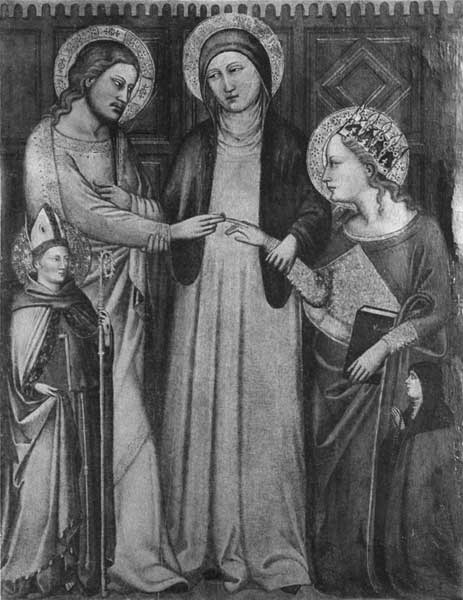
And because in a certain manner there had come to Agnolo, by way of inheritance, the secret of working in mosaic, and he had at home the instruments and all the materials that his grandfather Gaddo had used in this, he would make something in mosaic when it pleased him, merely to pass time and by reason of that convenience of material, rather than for aught else. Now, seeing that time had eaten away many of those marbles that cover the eight faces of the roof of S. Giovanni, and that the damp penetrating within had therefore spoilt much of the mosaic which Andrea Tafi had wrought there at a former time, the Consuls of the Guild of Merchants determined, to the end that the rest might not be spoilt, to rebuild the greater part of that covering with marble, and in like manner to have the mosaic restored. Wherefore, the direction and commission for the whole being given to Agnolo, he, in the year 1346, had it recovered with new marbles and the pieces laid over each other at the joinings, with unexampled diligence, to the breadth of two fingers, cutting each slab to the half of its thickness; then, joining them together with cement made of mastic and wax melted together, he fitted them with so great diligence that from that time onwards neither the roof nor the vaulting has received any damage from the rains. Agnolo, having afterwards restored the mosaic, brought it about by means of his counsel and of a design very well conceived that there was rebuilt, round the said church, all the upper cornice of marble below the roof, in that form wherein it now remains; which cornice was much smaller than it is and very commonplace. Under direction of the same man there was also made the vaulting of the Great Hall of the Palace of the Podestà, which before was directly under the roof, to the end that, besides the adornment, fire might not again be able to do it damage, as it had done a long time before. After this, by the counsel of Agnolo, there were made round the said Palace the battlements that are there to-day, which before were in no wise there.
In a way, Agnolo had inherited the secret of working in mosaic. He also had at home the tools and materials his grandfather Gaddo had used for the work. So, when he felt like it, he would make a mosaic. He did this merely to pass the time and because the materials were at hand, rather than for any other reason. Time had worn away many of the marble slabs covering the eight faces of the roof of S. Giovanni. Damp had penetrated the roof and damaged much of the mosaic Andrea Tafi had made there earlier. To prevent further damage, the Consuls of the Guild of Merchants decided to rebuild most of the marble covering. They also decided to have the mosaic restored. Agnolo was given charge of the whole project. In 1346, he had the roof covered with new marble slabs. He took extraordinary care to overlap the slabs at their joints by two fingers’ breadth, cutting each slab to half its thickness. He then joined them with a cement of melted mastic and wax. He fitted them so carefully that from then on neither the roof nor the vaulting suffered any damage from rain. After restoring the mosaic, Agnolo advised that the upper marble cornice around the church be rebuilt. He also provided a very well conceived design for it. The cornice had been much smaller and very ordinary. It was rebuilt in the form it has today. Agnolo also directed the construction of the vaulting in the Great Hall of the Palace of the Podestà. Before then, the hall had been directly beneath the roof. The vaulting was intended to adorn the hall and prevent fire from damaging it again, as it had long before. After this, on Agnolo’s advice, the battlements now seen around the Palace were built. There had been no battlements there before.
The while that these works were executing, he did not desert his painting entirely, and painted in distemper, in the panel that he made for the high-altar of S. Pancrazio, Our Lady, S. John the Baptist, and the Evangelist, and beside them the Saints Nereus, Archileus, and Pancratius, brothers, with other Saints. But the best of this work—nay, all that is seen therein of the good—is the predella alone, which is all full of little figures, divided into eight stories of the Madonna and of S. Reparata. Next, in 1348, he painted the panel of the high-altar of S. Maria Maggiore, also in Florence, for Barone Cappelli, making therein a passing good dance of angels round a Coronation of Our Lady. A little afterwards, in the Pieve of the district of Prato, rebuilt under direction of Giovanni Pisano in the year 1312, as it has been said above, Agnolo painted in fresco, in the chapel wherein was deposited the Girdle of Our Lady, many scenes of her life; and in other churches of that district, which was full of monasteries and convents held in great honour, he made other works in plenty. In Florence, next, he painted the arch over the door of S. Romeo; and in Orto S. Michele he wrought in distemper a Disputation of the Doctors with Christ in the Temple. And at the same time, many houses having been pulled down in order to enlarge the Piazza de' Signori, and in particular the Church of S. Romolo, this was rebuilt with the design of Agnolo. There are many panels by his hand throughout the churches in the said city, and many of his works may also be recognized in the domain, which were wrought by him with much profit to himself, although he worked more in order to do as his forefathers had done than for any love of it, having his mind directed on commerce, which brought him better profit; as it is seen when his sons, not wishing any longer to be painters, gave themselves over completely to commerce, holding a house open for this purpose in Venice together with their father, who, from a certain time onward, did not work save for his own pleasure, and, in a certain manner, in order to pass time. Having thus acquired great wealth by means of trading and by means of his art, Agnolo died in the sixty-third year of his life, overcome by a malignant fever which in a few days made an end of him.
While these works were underway, Agnolo did not give up painting entirely. For the high altar of S. Pancrazio, he painted a panel in distemper. It showed Our Lady, S. John the Baptist, and the Evangelist. Beside them were the brothers Saints Nereus, Archileus, and Pancratius, along with other saints. But the best part of the work, indeed, the only good part, is the predella. It is filled with small figures and divided into eight scenes from the lives of the Madonna and S. Reparata. Next, in 1348, he painted the high altar panel of S. Maria Maggiore, also in Florence, for Barone Cappelli. In it, he painted a fairly good dance of angels around the Coronation of Our Lady. A little later, Agnolo painted many scenes from Our Lady’s life in fresco. These were in the chapel where her Girdle was kept, in the Pieve of the district of Prato. As mentioned above, the Pieve had been rebuilt in 1312 under Giovanni Pisano’s direction. Agnolo also made many works for other churches in the district, which was full of highly respected monasteries and convents. Next, in Florence, he painted the arch over the door of S. Romeo. In Orto S. Michele, he painted the Disputation of the Doctors with Christ in the Temple in distemper. At the same time, many houses were pulled down to enlarge the Piazza de' Signori. The Church of S. Romolo was also pulled down and rebuilt to Agnolo’s design. Many panels by Agnolo can be found in churches throughout the city. Many more of his works can be recognized in the surrounding territory. He made considerable profit from them, although he worked more to follow his forefathers than out of any love of painting. His mind was on commerce, which brought him greater profit. This can be seen in the actions of his sons, who no longer wished to be painters and devoted themselves entirely to commerce. They kept a trading house in Venice with their father. From a certain point onward, Agnolo worked only for his own pleasure and, in a way, to pass the time. Having acquired great wealth through trade and his art, Agnolo died in his sixty-third year. A malignant fever overcame him and killed him within a few days.
His disciples were Maestro Antonio da Ferrara, who made many beautiful works in S. Francesco at Urbino, and at Città di Castello; and Stefano da Verona, who painted in fresco most perfectly, as it is seen in many places at Verona, his native city, and also in many of his works at Mantua. This man, among other things, was excellent in giving very beautiful expressions to the faces of children, of women, and of old men, as it may be seen in his works, which were all imitated and copied by that Piero da Perugia, illuminator, who illuminated all the books that are in the library of Pope Pius in the Duomo at Siena, and was a practised colourist in fresco. A disciple of Agnolo, also, was Michele da Milano, as was Giovanni Gaddi, his brother, who made, in the cloister of S. Spirito where are the little arches of Gaddo and of Taddeo, the Disputation of Christ in the Temple with the Doctors, the Purification of the Virgin, the Temptation of Christ in the Wilderness, and the Baptism of John; and finally, having created very great expectation, he died. A pupil of the same Agnolo in painting was Cennino di Drea Cennini of Colle di Valdelsa, who, having very great affection for the art, wrote a book describing the methods of working in fresco, in distemper, in size, and in gum, and, besides, how illuminating is done, and all the methods of applying gold; which book is in the hands of Giuliano, goldsmith of Siena, an excellent master and a friend of these arts. And in the beginning of this his book he treated of the nature of colours, both the minerals and the earth-colours, according as he learnt from Agnolo his master, wishing, for the reason perchance that he did not succeed in learning to paint perfectly, at least to know the nature of the colours, the distempers, the sizes, and the application of gesso, and what colours we must guard against as harmful in making the mixtures, and in short many other considerations whereof there is no need to discourse, there being to-day a perfect knowledge of all those matters which he held as great and very rare secrets in those times. But I will not forbear to say that he makes no mention (and perchance they may not have been in use) of some earth-colours, such as dark red earths, cinabrese, and certain vitreous greens. Since then there have been also discovered umber, which is an earth-colour, giallo santo, the smalts both for fresco and for oils, and some vitreous greens and yellows, wherein the painters of that age were lacking. He treated finally of mosaics, and of grinding colours in oils in order to make grounds of red, blue, green, and in other manners; and of the mordants for the application of gold, but not then for figures. Besides the works that he wrought in Florence with his master, there is a Madonna with certain saints by his hand under the loggia of the hospital of Bonifazio Lupi, coloured in such a manner that it has been very well preserved up to our own day.
His pupils included Maestro Antonio da Ferrara, who made many beautiful works in S. Francesco at Urbino and at Città di Castello. Another was Stefano da Verona, who painted frescoes with great perfection. This can be seen in many places in Verona, his native city, and in many of his works at Mantua. Among his other talents, Stefano was excellent at giving beautiful expressions to the faces of children, women, and old men. This can be seen in his works, all of which were imitated and copied by Piero da Perugia. Piero was an illuminator who illuminated all the books in Pope Pius’s library in the Duomo at Siena. He was also a skilled colourist in fresco. Michele da Milano was also a pupil of Agnolo, as was his brother Giovanni Gaddi. In the cloister of S. Spirito, where the little arches of Gaddo and Taddeo are, Giovanni painted several scenes. These were the Disputation of Christ in the Temple with the Doctors, the Purification of the Virgin, the Temptation of Christ in the Wilderness, and the Baptism of John. At last, having raised very great expectations, he died. Another pupil of Agnolo in painting was Cennino di Drea Cennini of Colle di Valdelsa. Cennino loved the art and wrote a book describing the methods of working in fresco, distemper, size, and gum. He also explained illumination and all the methods of applying gold. The book is in the hands of Giuliano, a goldsmith of Siena, an excellent master and a friend of these arts. At the beginning of the book, Cennino discussed the nature of colours, both mineral pigments and earth colours, as he had learned about them from his master Agnolo. Perhaps he had not succeeded in learning to paint perfectly. For that reason, he may at least have wished to understand colours, distempers, sizes, and the application of gesso. He also wished to know which colours must be avoided as harmful in mixtures. He discussed many other matters as well, but there is no need to go into them. Today, all those matters that he regarded as great and very rare secrets are perfectly understood. But I must note that he makes no mention of some earth colours, such as dark red earths, cinabrese, and certain vitreous greens. Perhaps they were not yet in use. Since then, other colours have been discovered: umber, an earth colour, giallo santo, smalts for both fresco and oil painting, and some vitreous greens and yellows. The painters of Cennino’s age lacked these colours. Finally, he discussed mosaics and the grinding of colours in oil to make red, blue, green, and other grounds. He also discussed mordants for applying gold, though not at that time for figures. Besides the works he made in Florence with his master, Cennino painted a Madonna with certain saints under the loggia of the hospital of Bonifazio Lupi. Its colours have allowed it to remain very well preserved up to our own day.
A yellow lake pigment made from the unripe berries of the spin cervino, a kind of brier.
This Cennino, in the first chapter of his said book, speaking of himself, uses these very words: "I, Cennino di Drea Cennini, of Colle di Valdelsa, was instructed in the said art for twelve years by Agnolo di Taddeo of Florence, my master, who learnt the said art from Taddeo, his father, who was held at baptism by Giotto and was his disciple for four-and-twenty years; which Giotto transmuted the art of painting from Greek into Latin, and brought it to the modern manner, and had it for certain more perfected than anyone ever had it." These are the very words of Cennino, to whom it appeared that even as those who translate any work from Greek into Latin confer very great benefit on those who do not understand Greek, so, too, did Giotto in transforming the art of painting from a manner not understood or known by anyone, save perchance as very rude, to a beautiful, facile, and very pleasing manner, understood and known as good by all who have judgment and the least grain of reason.
In the first chapter of his book, Cennino speaks of himself in these words: "I, Cennino di Drea Cennini, of Colle di Valdelsa, studied this art for twelve years under my master, Agnolo di Taddeo of Florence. Agnolo learned the art from his father, Taddeo, whose godfather was Giotto and who was Giotto’s pupil for twenty-four years. Giotto transformed the art of painting from Greek into Latin and brought it into the modern style. He certainly brought painting closer to perfection than anyone ever had." These are Cennino’s own words. Translators confer a great benefit on those who do not understand Greek when they translate a work into Latin. Cennino believed that Giotto did the same for painting. Before Giotto, no one understood or recognized its style, except perhaps as something very crude. Giotto transformed it into a beautiful, effortless, and highly pleasing style. All who have judgment and the least grain of reason understand and recognize it as good.
All these disciples of Agnolo did him very great honour, and he was buried by his sons, to whom it is said that he left the sum of fifty thousand florins or more, in S. Maria Novella, in the tomb that he himself had made for himself and for his descendants, in the year of our salvation 1387. The portrait of Agnolo, made by himself, is seen in the Chapel of the Alberti, in S. Croce, beside a door in the scene wherein, the Emperor Heraclius is bearing the Cross; it is painted in profile, with a little beard, and with a rose-coloured cap on his head according to the use of those times. He was not excellent in draughtsmanship, in so far as is shown by some drawings by his hand that are in our book.
All these disciples brought Agnolo great honor. His sons buried him in S. Maria Novella in 1387. He is said to have left them fifty thousand florins or more. He was buried in the tomb he had made for himself and his descendants. A self-portrait of Agnolo can be seen in the Chapel of the Alberti in S. Croce. It is beside a door, in the scene where the Emperor Heraclius carries the Cross. Agnolo is shown in profile, with a small beard and a rose-colored cap, as was customary at the time. He was not an excellent draftsman, judging by some drawings by his hand in our book.
The end