The Life of Giovanni Cimabue
PAINTER OF FLORENCE
Painter of Florence
By the infinite flood of evils which had laid prostrate and submerged poor Italy there had not only been ruined everything that could truly claim the name of building, but there had been blotted out (and this was of graver import) the whole body of the craftsmen, when, by the will of God, in the city of Florence, in the year 1240, there was born, to give the first light to the art of painting, Giovanni, surnamed Cimabue, of the family, noble in those times, of Cimabue. He, while growing up, being judged by his father and by others to have a beautiful and acute intelligence, was sent, to the end that he might exercise himself in letters, to a master in S. Maria Novella, his relative, who was then teaching grammar to the novices of that convent; but Cimabue, in place of attending to his letters, would spend the whole day, as one who felt himself led thereto by nature, in drawing, on books and other papers, men, horses, houses, and diverse other things of fancy; to which natural inclination fortune was favourable, for certain Greek painters had been summoned to Florence by those who then governed the city, for nothing else but to restore to Florence the art of painting, which was rather out of mind than out of fashion, and they began, among the other works undertaken in the city, the Chapel of the Gondi, whereof to-day the vaulting and the walls are little less than eaten away by time, as may be seen in S. Maria Novella beside the principal chapel, where it stands. Wherefore Cimabue, having begun to take his first steps in this art which pleased him, playing truant often from school, would stand the livelong day watching these masters at work, in a manner that, being judged by his father and by these painters to be in such wise fitted for painting that there could be hoped for him, applying himself to this profession, an honourable success, to his own no small satisfaction he was apprenticed by the said father to these men; whereupon, exercising himself without ceasing, in a short time nature assisted him so greatly that he surpassed by a long way, both in drawing and in colouring, the manner of the masters who were teaching him. For they, giving no thought to making any advance, had made those works in that fashion wherein they are seen to-day—that is, not in the good ancient manner of the Greeks but in that rude modern manner of those times; and because, although he imitated these Greeks, he added much perfection to the art, relieving it of a great part of their rude manner, he gave honour to his country with his name and with the works that he made, to which witness is borne in Florence by the pictures that he wrought, such as the front of the altar in S. Cecilia, and in S. Croce a panel with a Madonna, which was and still is placed against a pilaster on the right within the choir. After this, he made a S. Francis on a small panel on a gold ground, and portrayed him from nature (which was something new in those times) as best he knew, and round him all the stories of his life, in twenty small pictures full of little figures on a gold ground.
The endless flood of evils that had overwhelmed poor Italy had ruined everything that truly deserved to be called a building. More seriously, it had also wiped out the entire body of craftsmen. Then, by the will of God, Giovanni, known as Cimabue, was born in Florence in 1240. He belonged to the Cimabue family, which was noble in those days, and was born to bring the first light to painting. As Cimabue grew up, his father and others judged him to have a fine and sharp mind. His father therefore sent him to study letters with a relative who taught grammar to the novices at S. Maria Novella. But instead of attending to his studies, Cimabue spent the whole day drawing men, horses, houses, and other imaginary things. He drew them on books and loose papers, as if nature itself led him to do so. Fortune favored this natural inclination. Those who then governed Florence had summoned some Greek painters solely to restore the art of painting to the city. The art had been forgotten rather than fallen out of fashion. Among their other work in Florence, the painters began the Chapel of the Gondi. Its vault and walls are now almost eaten away by time, as can be seen at S. Maria Novella, beside the main chapel. Cimabue had begun to take his first steps in painting, an art that pleased him. He often skipped school and stood watching the masters work all day. His father and the painters judged him so suited to painting that they hoped he would succeed with distinction in the profession. So his father apprenticed him to them, much to Cimabue's satisfaction. He practiced constantly, and nature helped him so greatly that he soon far surpassed his teachers in drawing and coloring. The Greek painters gave no thought to making progress. They had made their works in the style still visible today, not the good ancient Greek style but the crude modern style of their own times. Although Cimabue imitated the Greeks, he brought the art much closer to perfection and freed it from much of their crude style. With his name and his works, he brought honor to his country. His pictures in Florence bear witness to this achievement. They include the altar front in S. Cecilia and a panel of the Madonna in S. Croce. The panel was placed against a pilaster on the right inside the choir, where it remains. After this, he painted S. Francis on a small panel with a gold background. He portrayed the saint from life, as best he could, which was something new in those times. Around him he painted all the stories of his life in twenty small pictures, full of little figures against a gold background.
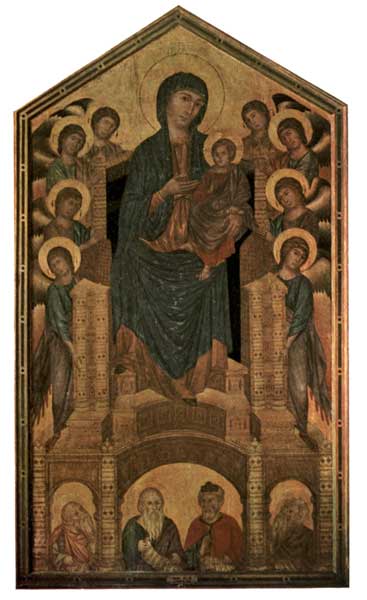
Having next undertaken to make a large panel for the monks of Vallombrosa, in the Abbey of S. Trinita in Florence, he showed in that work (using therein great diligence, so as to rise equal to the esteem which had already been conceived of him) better inventions and a beautiful method in the attitude of a Madonna, whom he made with the Child in her arms and with many angels round her in adoration, on a gold ground; which panel, being finished, was placed by these monks over the high-altar of the said church, and being afterwards removed, in order to give that place to the panel by Alesso Baldovinetti which is there to-day, it was placed in a smaller chapel in the left-hand aisle of the said church.
He next undertook to paint a large panel for the monks of Vallombrosa at the Abbey of S. Trinita in Florence. He worked with great care, seeking to live up to the high regard he had already earned. In this work, he showed greater inventiveness and a beautiful handling of the Madonna’s pose. He painted her holding the Child, surrounded by many angels in adoration, against a gold background. When the panel was finished, the monks placed it over the church’s high altar. Later, they moved it to a smaller chapel in the church’s left aisle. They did this to make room for the panel by Alesso Baldovinetti that is there today.
Working next in fresco on the Hospital of the Porcellana, at the corner of the Via Nuova which goes into the Borg' Ognissanti, on the façade which has in the middle the principal door, and making on one side the Annunciation of the Virgin by the Angel, and on the other Jesus Christ with Cleophas and Luke, figures as large as life, he swept away that ancient manner, making the draperies, the vestments, and everything else in this work, a little more lively and more natural and softer than the manner of these Greeks, all full of lines and profiles both in mosaic and in painting; which manner, rough, rude, and vulgar, the painters of those times, not by means of study, but by a certain convention, had taught one to the other for many and many a year, without ever thinking of bettering their draughtsmanship, of beauty of colouring, or of any invention that might be good.
Next, he painted a fresco on the Hospital of the Porcellana, at the corner of Via Nuova, which leads into Borg' Ognissanti. He painted it on the façade with the main door in the middle. On one side, he depicted the Angel announcing to the Virgin that she would bear a child. On the other, he painted Jesus Christ with Cleophas and Luke. The figures were life-size. In this work, he swept away the old style. He made the drapery, clothing, and everything else a little livelier, more natural, and softer than in the Greek style. That style was full of lines and outlines, both in mosaics and in paintings. It was rough, crude, and vulgar. For many years, painters had passed it on to one another by convention rather than through study. They never thought of improving their drawing, making their colors beautiful, or coming up with any good new ideas.
Cimabue, being summoned again after this work by the same Prior who had caused him to make the works in S. Croce, made him a large Crucifix on wood, which is still seen to-day in the church; which work was the reason, it appearing to the Prior that he had been well served, that he took him to S. Francesco in Pisa, their convent, in order to make a S. Francis on a panel, which was held by these people to be a most rare work, there being seen therein a certain greater quality of excellence, both in the air of the heads and in the folds of the draperies, than had been shown in the Greek manner up to that time by anyone who had wrought anything, not only in Pisa, but in all Italy. Cimabue having next made for the same church on a large panel the image of Our Lady, with the Child in her arms and with many angels round her, also on a ground of gold, it was after no long time removed from where it had been set up the first time, in order to make there the marble altar that is there at present, and was placed within the church beside the door on the left hand; and for this work he was much praised and rewarded by the people of Pisa. In the same city of Pisa, at the request of the then Abbot of S. Paolo in Ripa d'Arno, he made a S. Agnes on a little panel, and round her, with little figures, all the stories of her life; which little panel is to-day over the altar of the Virgins in the said church.
After this work, Cimabue was summoned again by the Prior who had commissioned his works in S. Croce. Cimabue made him a large Crucifix on wood, which can still be seen in the church today. The Prior was pleased with the work, so he took Cimabue to their convent of S. Francesco in Pisa. There he was to paint a S. Francis on a panel. The people there considered it an exceptionally fine work. Both the expression of the heads and the folds of the drapery showed greater excellence than anyone working in the Greek manner had achieved until then, not only in Pisa but in all Italy. Cimabue next painted Our Lady with the Child in her arms on a large panel for the same church. Many angels surrounded her, and the background was also gold. Before long, the panel was moved from its original place to make room for the marble altar now there. It was placed inside the church beside the door on the left. The people of Pisa gave Cimabue much praise and reward for the work. In the same city of Pisa, Cimabue painted a S. Agnes on a small panel at the request of the Abbot of S. Paolo in Ripa d'Arno. Around her, he painted all the stories of her life in small figures. The panel is now above the altar of the Virgins in that church.
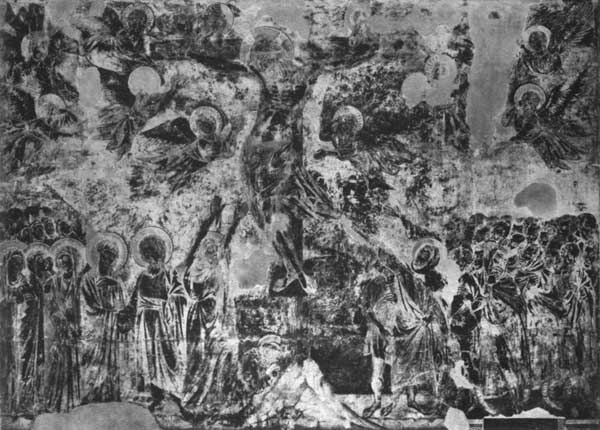
By reason of these works, then, the name of Cimabue being very famous everywhere, he was brought to Assisi, a city of Umbria, where, in company with certain Greek masters, in the lower Church of S. Francesco, he painted part of the vaulting, and on the walls the life of Jesus Christ and that of S. Francis. In these pictures he surpassed by a long way those Greek painters; wherefore, growing in courage, he began by his own self to paint the upper church in fresco, and in the chief apse, over the choir, on four sides, he made certain stories of Our Lady—namely, her death; when her soul is borne by Christ to Heaven upon a throne of clouds; and when, in the midst of a choir of angels, He crowns her, with a great number of saints below, both male and female, now eaten away by time and by dust. Next, in the sections of the vaulting of the said church, which are five, he painted in like manner many scenes. In the first, over the choir, he made the four Evangelists, larger than life, and so well that to-day there is still recognized in them much that is good, and the freshness of the colours in the flesh shows that painting began to make great progress in fresco work through the labours of Cimabue. The second section he made full of golden stars on a ground of ultramarine. In the third he made in certain medallions Jesus Christ, the Virgin His mother, S. John the Baptist, and S. Francis—namely, in every medallion one of these figures, and in every quarter segment of the vaulting a medallion. And between this and the fifth section he painted the fourth with golden stars, as above, on a ground of ultramarine. In the fifth he painted the four Doctors of the Church, and beside each one of these one of the four chief Religious Orders—a work truly laborious and executed with infinite diligence. The vaulting finished, he wrought, also in fresco, the upper walls of the whole left-hand side of the church, making towards the high-altar, between the windows and right up to the vaulting, eight scenes from the Old Testament, commencing from the beginning of Genesis and following the most notable events. And in the space that is round the windows, up to the point where they end in the gallery that encircles the interior of the wall of the church, he painted the remainder of the Old Testament in eight other scenes. And opposite this work, in sixteen other scenes corresponding to these, he painted the acts of Our Lady and of Jesus Christ. And on the end wall over the principal door, and round the rose window of the church, he made her Ascension into Heaven and the Holy Spirit descending on the Apostles. This work, truly very great and rich and most excellently executed, must have, in my judgment, amazed the world in those times, seeing, above all, that painting had lain so long in such great darkness; and to me, who saw it again in the year 1563, it appeared very beautiful, thinking how in so great darkness Cimabue could see so great light. But of all these pictures (and to this we should give consideration), those on the roof, as being less injured by dust and by other accidents, have been preserved much better than the others. These works finished, Giovanni put his hand to painting the lower walls—namely, those that are from the windows downwards—and made certain works upon them, but being called to Florence on some business of his own, he did not carry this work further; but it was finished, as will be told in the proper place, by Giotto, many years afterwards.
These works made Cimabue famous everywhere, so he was brought to Assisi, a city in Umbria. There, with several Greek masters, he painted part of the vaulting in the lower Church of S. Francesco. On the walls, he painted the lives of Jesus Christ and S. Francis. In these pictures he far surpassed the Greek painters. Encouraged by this success, he began painting the upper church in fresco on his own. In the main apse, above the choir, he painted scenes from the life of Our Lady on four sides. These showed her death, Christ carrying her soul to Heaven on a throne of clouds, and Christ crowning her amid a choir of angels. A great number of male and female saints appeared below. These paintings have now been worn away by time and dust. He also painted many scenes in the five sections of the church’s vaulting. In the first section, above the choir, he painted the four Evangelists, larger than life. They were so well painted that much of their quality can still be recognized today. The fresh colors of the flesh show that painting began to make great progress in fresco through Cimabue’s efforts. He filled the second section with golden stars against an ultramarine background. In the third, he painted Jesus Christ, the Virgin his mother, S. John the Baptist, and S. Francis in medallions. Each figure had a separate medallion, and each quarter of the vault had one medallion. Between this section and the fifth, he painted the fourth with golden stars on an ultramarine background, as before. In the fifth, he painted the four Doctors of the Church, with one of the four chief Religious Orders beside each. This was a truly laborious work, carried out with infinite care. Once the vaulting was finished, he painted the upper walls along the whole left side of the church, also in fresco. Toward the high altar, between the windows and up to the vaulting, he painted eight scenes from the Old Testament. He began with the start of Genesis and followed the most notable events. In the space around the windows, down to the gallery that encircles the church’s interior walls, he painted the rest of the Old Testament in eight more scenes. Opposite these, he painted sixteen corresponding scenes showing the deeds of Our Lady and Jesus Christ. On the end wall above the main door, around the church’s rose window, he painted her Ascension into Heaven and the Holy Spirit descending on the Apostles. In my judgment, this work must have amazed the world at the time. It was truly vast, rich, and excellently executed, especially considering that painting had lain in such great darkness for so long. When I saw it again in 1563, it seemed very beautiful to me. I reflected on how Cimabue could see so much light amid such darkness. But we should remember that, of all these pictures, those on the vaulting have been preserved much better than the others. They have suffered less damage from dust and other causes. When these works were finished, Giovanni began painting the lower walls, from the windows downward, and completed some works there. But he was called to Florence on business of his own and went no further with the work. Giotto finished it many years later, as I shall tell in the proper place.
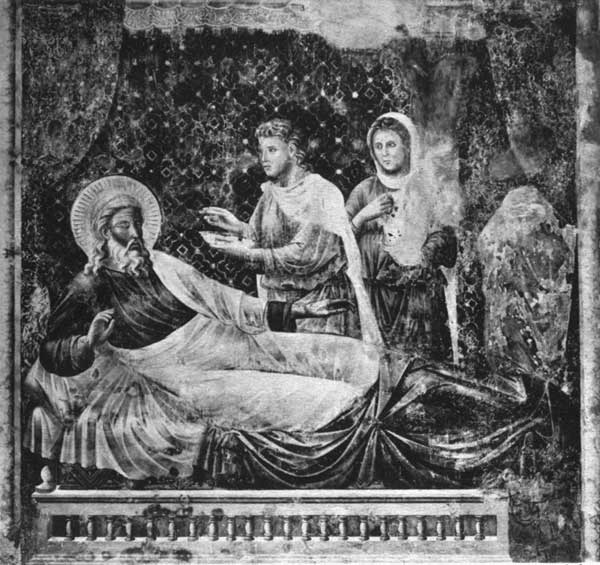
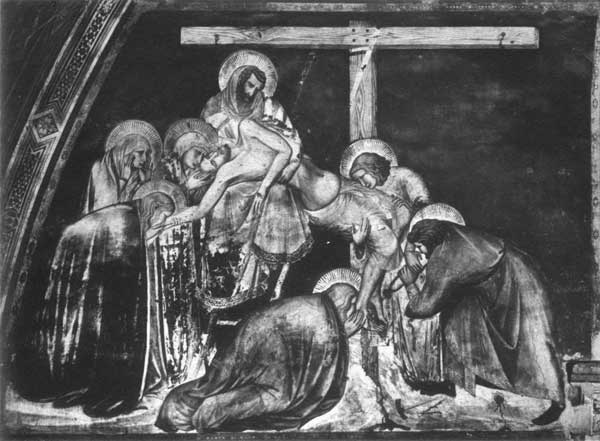
Having returned, then, to Florence, Cimabue painted in the cloister of S. Spirito (wherein there is painted in the Greek manner, by other masters, the whole side facing the church) three small arches by his own hand, from the life of Christ, and truly with much design. And at the same time he sent certain works wrought by himself in Florence to Empoli, which works are still held to-day in great veneration in the Pieve of that township. Next, he made for the Church of S. Maria Novella the panel of Our Lady that is set on high between the Chapel of the Rucellai and that of the Bardi da Vernia; which work was of greater size than any figure that had been made up to that time. And certain angels that are round it show that, although he still had the Greek manner, he was going on approaching in part to the line and method of the modern. Wherefore this work caused so great marvel to the people of that age, by reason of there not having been seen up to then anything better, that it was borne in most solemn procession from the house of Cimabue to the church, with much rejoicing and with trumpets, and he was thereby much rewarded and honoured. It is said, and it may be read in certain records of old painters, that while Cimabue was painting the said panel in certain gardens close to the Porta S. Pietro, there passed through Florence King Charles the Elder of Anjou, and that, among the many signs of welcome made to him by the men of this city, they brought him to see Cimabue's panel; whereupon, for the reason that it had not yet been seen by anyone, in the showing it to the King there flocked together to it all the men and all the women of Florence, with the utmost rejoicing and in the greatest crowd in the world. Wherefore, by reason of the joy that the neighbours had thereby, they called that place the Borgo Allegri; which place, although enclosed in time within the walls, has ever after retained the same name.
After returning to Florence, Cimabue painted three small arches in the cloister of S. Spirito. Other masters had painted the whole side facing the church in the Greek style. Cimabue painted the arches himself with scenes from the life of Christ, showing great skill in design. At the same time, he sent to Empoli some works he had made in Florence. They are still held in great veneration in the Pieve of that town. Next, he painted a panel of Our Lady for the Church of S. Maria Novella. It stands high between the Chapel of the Rucellai and the Chapel of the Bardi da Vernia. The figure was larger than any made up to that time. Certain angels around Our Lady show that Cimabue still used the Greek style. Yet they also show that he was beginning to adopt some of the outlines and methods of modern art. People of that age were amazed by the work because they had never seen anything better. So it was carried from Cimabue's house to the church in a solemn procession, with great rejoicing and trumpets. Cimabue was richly rewarded and honored for it. According to stories and records of old painters, King Charles the Elder of Anjou once passed through Florence. Cimabue was then painting the panel in gardens near the Porta S. Pietro. Among the many ways the people of the city welcomed the king, they took him to see the panel. No one else had yet seen it. So, when it was shown to the king, all the men and women of Florence flocked to see it. They came with the greatest rejoicing and in the largest crowd in the world. The neighbors were so joyful that they called the place Borgo Allegri. Though the area was later enclosed within the city walls, it has kept that name ever since.
In S. Francesco in Pisa, where he wrought, as has been said above, certain other works, there is in the cloister, beside the door that leads into the church, in a corner, a small panel in distemper by the hand of Cimabue, wherein is a Christ on the Cross, with certain angels round Him, who, weeping, are taking with their hands certain words that are written round the head of Christ and are presenting them to the ears of a Madonna who stands weeping on the right, and on the other side to S. John the Evangelist, who is on the left, all grieving. And the words to the Virgin are: MULIER, ECCE FILIUS TUUS; and those to S. John: ECCE MATER TUA; and those that an angel standing apart holds in his hand, say: EX ILLA HORA ACCEPIT EAM DISCIPULUS IN SUAM. Wherein it is to be observed that Cimabue began to give light and to open the way to invention, assisting art with words in order to express his conception; which was certainly something whimsical and new.
As mentioned above, Cimabue made several other works in S. Francesco in Pisa. In a corner of the cloister, beside the door leading into the church, is a small panel he painted in distemper. It shows Christ on the Cross, surrounded by angels. The weeping angels hold words written around Christ’s head and present them to the ears of two grieving figures. On the right is a weeping Madonna, and on the left is S. John the Evangelist. The words presented to the Virgin are: MULIER, ECCE FILIUS TUUS. Those presented to S. John are: ECCE MATER TUA. An angel standing apart holds the words: EX ILLA HORA ACCEPIT EAM DISCIPULUS IN SUAM. In this work, Cimabue began to shed light on invention and open the way for it. He used words to help his art express his idea, which was certainly whimsical and new.
Now because, by means of these works, Cimabue had acquired a very great name, together with much profit, he was appointed as architect, in company with Arnolfo Lapi, a man then excellent in architecture, for the building of S. Maria del Fiore in Florence. But at length, having lived sixty years, he passed to the other life in the year 1300, having little less than resurrected painting. He left many disciples, and among others Giotto, who was afterwards an excellent painter; which Giotto dwelt, after Cimabue, in his master's own house in the Via del Cocomero. Cimabue was buried in S. Maria del Fiore, with that epitaph made for him by one of the Nini:
These works brought Cimabue great fame and much profit. As a result, he was appointed architect for the building of S. Maria del Fiore in Florence. He served alongside Arnolfo Lapi, who was then an outstanding architect. But in 1300, at the age of sixty, Cimabue died, having almost single-handedly revived painting. He left many pupils, including Giotto, who later became an excellent painter. After Cimabue's death, Giotto lived in his master's own house in the Via del Cocomero. Cimabue was buried in S. Maria del Fiore, with an epitaph written for him by one of the Nini:
CREDIDIT UT CIMABOS PICTURÆ CASTRA TENERE, SIC TENUIT, VIVENS: NUNC TENET ASTRA POLI.
Cimabue believed he ruled the field of painting, and he did while he lived. Now he holds the stars of heaven.
I will not refrain from saying that if to the glory of Cimabue there had not been contrasted the greatness of Giotto, his disciple, his fame would have been greater, as Dante demonstrates in his Commedia, wherein, alluding in the eleventh canto of the Purgatorio to this very inscription on the tomb, he said:
I must add that Cimabue’s fame would have been greater if his student Giotto’s greatness had not overshadowed his glory. Dante shows this in his Commedia. In the eleventh canto of the Purgatorio, he alludes to this very inscription on the tomb, saying:
Credette Cimabue nella pittura Tener lo campo, ed hora ha Giotto il grido, Si che la fama di colui s' oscura.
Cimabue thought he was the greatest painter, But now Giotto is the one everyone praises, So Cimabue's fame has faded.
In explanation of these verses, a commentator of Dante, who wrote at the time when Giotto was alive and ten or twelve years after the death of Dante himself—that is, about the year of Christ 1334—says, speaking of Cimabue, precisely these words: "Cimabue was a painter of Florence in the time of the author, very noble beyond the knowledge of man, and withal so arrogant and so disdainful that if there were found by anyone any failing or defect in his work, or if he himself had seen one (even as it comes to pass many times that the craftsman errs, through a defect in the material whereon he works, or through some lack in the instrument wherewith he labours), incontinently he would destroy that work, however costly it might be. Giotto was and is the most exalted among the painters of the same city of Florence, and his works bear testimony for him in Rome, in Naples, in Avignon, in Florence, in Padua, and in many parts of the world." This commentary is now in the hands of the Very Reverend Don Vincenzio Borghini, Prior of the Innocenti, a man not only most famous for his nobility, goodness, and learning, but also endowed with such love and understanding for all the finer arts that he has deserved to be elected by the Lord Duke Cosimo, most properly, as his Lieutenant in our Academy of Design.
To explain these verses, a commentator on Dante wrote the following words about Cimabue. The commentator wrote while Giotto was alive, ten or twelve years after Dante’s death, around the year 1334: "Cimabue was a Florentine painter in the author’s time. He was exceptionally noble beyond human understanding, but also so arrogant and disdainful that he would immediately destroy any work found to have a flaw. He did this whether someone else found the flaw or he saw it himself, and however costly the work might be. A craftsman often makes mistakes because of a defect in the material or a fault in the tool he uses. Giotto was and remains the greatest painter of the same city of Florence. His works speak for him in Rome, Naples, Avignon, Florence, Padua, and many parts of the world." This commentary is now in the hands of the Very Reverend Don Vincenzio Borghini, Prior of the Innocenti. He is famous not only for his nobility, goodness, and learning. He also has such love and understanding of all the finer arts that Lord Duke Cosimo rightly chose him as his Lieutenant in our Academy of Design.
But to return to Cimabue: Giotto, truly, obscured his fame not otherwise than as a great light does the splendour of one much less, for the reason that although Cimabue was, as it were, the first cause of the renovation of the art of painting, yet Giotto, his pupil, moved by laudable ambition and assisted by Heaven and by nature, was he who, rising higher with his thought, opened the gate of truth to those who have brought her to that perfection and majesty wherein we see her in her own century, which, being used to see every day the marvels, the miracles, nay, the impossibilities wrought by the craftsmen in that art, is now brought to such a pitch that nothing that men do, be it even more Divine than human, causes it in any way to marvel. Well is it with those whose labours deserve all praise, if, in place of being praised and admired, they do not thereby incur blame and many times even disgrace.
But to return to Cimabue: Giotto truly overshadowed his fame, just as a great light outshines a much smaller one. Although Cimabue was, in a sense, the first cause of painting’s revival, his pupil Giotto reached higher in his thinking. Driven by praiseworthy ambition and aided by Heaven and nature, Giotto opened the gate of truth. Through it came those who brought painting to the perfection and majesty we see in our own century. People now see the wonders, miracles, even impossibilities created by painters every day. They have grown so used to them that nothing anyone does amazes them, even if it is more divine than human. Those whose work deserves all praise are fortunate if, instead of being praised and admired, they do not incur blame and often even disgrace.
The portrait of Cimabue, by the hand of Simone Sanese, is to be seen in the Chapter-house of S. Maria Novella, made in profile in the story of the Faith, in a figure that has the face thin, the beard small, reddish, and pointed, with a cap according to the use of those times—that is, wound round and round and under the throat in lovely fashion. He who is beside him is Simone himself, the author of that work, who portrayed himself with two mirrors in order to make his head in profile, placing the one opposite to the other. And that soldier clad in armour who is between them is said to be Count Guido Novello, then Lord of Poppi. There remains for me to say of Cimabue that in the beginning of our book, where I have put together drawings from the own hand of all those who have made drawings from his time to ours, there are to be seen certain small things made by his hand in the way of miniature, wherein, although to-day perchance they appear rather rude than otherwise, it is seen how much excellence was given by his work to draughtsmanship.
A portrait of Cimabue by Simone Sanese can be seen in the Chapter-house of S. Maria Novella. It shows him in profile in the scene of the Faith. His face is thin, and his beard is small, reddish, and pointed. He wears a cap in the fashion of the time, wound round and round and neatly under his throat. Beside him is Simone himself, the artist who made the work. Simone used two mirrors, placed opposite each other, to paint his own head in profile. The soldier in armour between them is said to be Count Guido Novello, then Lord of Poppi. One thing remains for me to say about Cimabue. At the beginning of our book, I have gathered drawings by all those who made drawings from his time to ours. Among them are some small miniatures by Cimabue. Although they may appear rather crude today, they show how much his work contributed to the excellence of draughtsmanship.