The Life of Ambrogio Lorenzetti
PAINTER OF SIENA
Painter of Siena
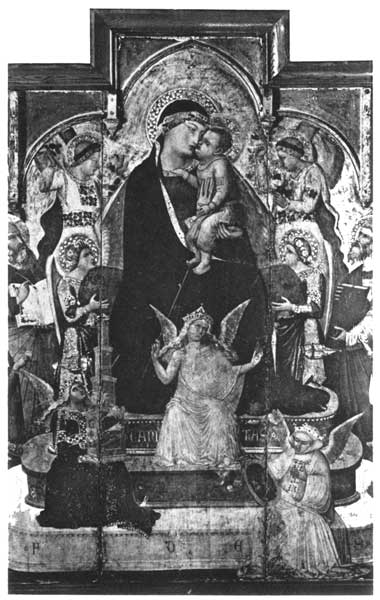
If that debt is great, as without doubt it is, which craftsmen of fine genius should acknowledge to nature, much greater should that be that is due from us to them, seeing that they, with great solicitude, fill the cities with noble and useful buildings and with lovely historical compositions, gaining for themselves, for the most part, fame and riches with their works; as did Ambrogio Lorenzetti, painter of Siena, who showed beautiful and great invention in grouping and placing his figures thoughtfully in historical scenes. That this is true is proved by a scene in the Church of the Friars Minor in Siena, painted by him very gracefully in the cloister, wherein there is represented in what manner a youth becomes a friar, and how he and certain others go to the Soldan, and are there beaten and sentenced to the gallows and hanged on a tree, and finally beheaded, with the addition of a terrible tempest. In this picture, with much art and dexterity, he counterfeited in the travailing of the figures the turmoil of the air and the fury of the rain and of the wind, wherefrom the modern masters have learnt the method and the principle of this invention, by reason of which, since it was unknown before, he deserved infinite commendation. Ambrogio was a practised colourist in fresco, and he handled colours in distemper with great dexterity and facility, as it is still seen in the panels executed by him in Siena for the little hospital called Mona Agnesa, where he painted and finished a scene with new and beautiful composition. And at the great hospital, on one front, he made in fresco the Nativity of Our Lady and the scene when she is going with the virgins to the Temple. For the Friars of S. Augustine in the same city he painted their Chapter-house, where the Apostles are seen represented on the vaulting, with scrolls in their hands whereon is written that part of the Creed which each one of them made; and below each is a little scene containing in painting that same subject that is signified above by the writing. Near this, on the main front, are three stories of S. Catherine the martyr, who is disputing with the tyrant in a temple, and, in the middle, the Passion of Christ, with the Thieves on the Cross, and the Maries below, who are supporting the Virgin Mary who has swooned; which works were finished by him with much grace and with beautiful manner.
If artists of great genius owe a great debt to nature, as they undoubtedly do, we owe them an even greater one. With great care, they fill cities with noble and useful buildings and beautiful scenes from history. Through their work, they also gain, for the most part, fame and riches. Ambrogio Lorenzetti, a painter of Siena, was one such artist. He showed beautiful and great invention in grouping and arranging his figures thoughtfully in historical scenes. A scene he painted gracefully in the cloister of the Church of the Friars Minor in Siena proves this. It shows how a young man becomes a friar and goes with certain others to the Soldan. There they are beaten, sentenced to the gallows, hanged on a tree, and finally beheaded. Ambrogio also added a terrible storm. With great skill and dexterity, he used the figures’ struggles to portray the turmoil of the air and the fury of the rain and wind. Modern masters have learned from him the method and principle behind this invention. Since it was unknown before, he deserved endless praise for it. Ambrogio was a skilled fresco colorist, and he handled tempera colors with great dexterity and ease. This can still be seen in the panels he made in Siena for the little hospital called Mona Agnesa. There he painted and finished a scene with a new and beautiful composition. At the great hospital, he painted frescoes on one front, showing the Nativity of Our Lady and her journey to the Temple with the virgins. For the Friars of S. Augustine in the same city, he painted their Chapter-house. The Apostles appear on the vaulted ceiling, holding scrolls. On each scroll is written the part of the Creed that the apostle holding it composed. Below each apostle is a little painted scene depicting the same subject described in the writing above. Nearby, on the main front, are three stories of S. Catherine the martyr, who is disputing with the tyrant in a temple. In the middle is the Passion of Christ, with the Thieves on the Cross and the Maries below. The Maries are supporting the Virgin Mary, who has fainted. Ambrogio finished these works with great grace and in a beautiful style.
In a large hall of the Palazzo della Signoria in Siena he painted the War of Asinalunga, and after it the Peace and its events, wherein he fashioned a map, perfect for those times; and in the same palace he made eight scenes in terra-verde, highly finished. It is said that he also sent to Volterra a panel in distemper which was much praised in that city. And painting a chapel in fresco and a panel in distemper at Massa, in company with others, he gave them proof how great, both in judgment and in genius, was his worth in the art of painting; and in Orvieto he painted in fresco the principal Chapel of S. Maria. After these works, proceeding to Florence, he made a panel in S. Procolo, and in a chapel he painted the stories of S. Nicholas with little figures, in order to satisfy certain of his friends, who desired to see his method of working; and, being much practised, he executed this work in so short a time that there accrued to him fame and infinite repute. And this work, on the predella of which he made his own portrait, brought it about that in the year 1335 he was summoned to Cortona by order of Bishop Ubertini, then lord of that city, where he wrought certain works in the Church of S. Margherita, built a short time before for the Friars of S. Francis on the summit of the hill, and in particular the half of the vaulting and the walls, so well that, although to-day they are wellnigh eaten away by time, there are seen notwithstanding most beautiful effects in the figures; and it is clear that he was deservedly commended for them.
In a large hall of the Palazzo della Signoria in Siena, he painted the War of Asinalunga. After that, he painted the Peace and its events, including a map that was perfect for its time. In the same palace, he also painted eight highly finished scenes in terra-verde. It is said that he sent a panel painted in distemper to Volterra, where it was much praised. At Massa, he worked with others to paint a chapel in fresco and a panel in distemper. There he showed them the greatness of his judgment and genius as a painter. In Orvieto, he painted the principal Chapel of S. Maria in fresco. After these works, he went to Florence and painted a panel in S. Procolo. In a chapel, he also painted the stories of S. Nicholas using small figures. He did this to satisfy certain friends who wanted to see his method of working. Because he was so practiced, he finished the work in a very short time, winning fame and immense repute. He painted his own portrait on the work’s predella. As a result of this work, he was summoned to Cortona in 1335 by order of Bishop Ubertini, then lord of the city. There he worked in the Church of S. Margherita. The church had recently been built for the Friars of S. Francis on the summit of the hill. He painted part of the church, including half the vaulting and the walls, so well that, although time has now almost worn them away, the figures still show most beautiful effects. Clearly, he deserved the praise he received for them.
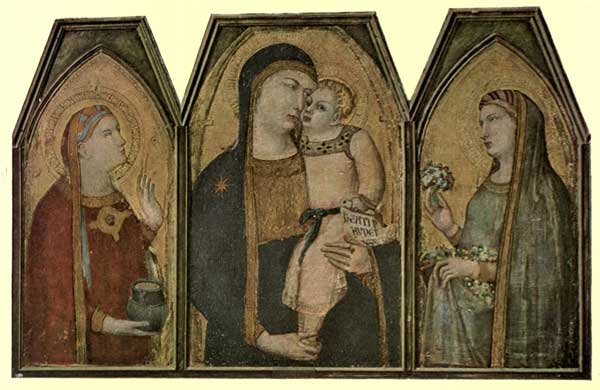
This work finished, Ambrogio returned to Siena, where he lived honourably the remainder of his life, not only by reason of being an excellent master in painting, but also because, having given attention in his youth to letters, they were a useful and pleasant accompaniment to him in his painting, and so great an ornament to his whole life that they rendered him no less popular and beloved than did his profession of painting; wherefore he was not only intimate with men of learning and of taste, but he was also employed, to his great honour and advantage, in the government of his Republic. The ways of Ambrogio were in all respects worthy of praise, and rather those of a gentleman and a philosopher than of a craftsman; and what most demonstrates the wisdom of men, he had ever a mind disposed to be content with that which the world and time brought, wherefore he supported with a mind temperate and calm the good and the evil that came to him from fortune. And truly it cannot be told to what extent courteous ways and modesty, with the other good habits, are an honourable accompaniment to all the arts, and in particular to those that are derived from the intellect and from noble and exalted talents; wherefore every man should make himself no less beloved with his ways than with the excellence of his art.
When the work was finished, Ambrogio returned to Siena, where he lived honorably for the rest of his life. This was not only because he was an excellent painter. He had also studied literature in his youth, and it proved useful and pleasurable alongside his painting. His learning brought such distinction to his whole life that it made him as popular and beloved as his painting did. As a result, he was close to learned and cultivated people. He also served in the government of his Republic, to his great honor and advantage. Ambrogio’s conduct was praiseworthy in every respect. He behaved more like a gentleman and a philosopher than a craftsman. And, in a way that best demonstrates a person’s wisdom, he was always content with whatever the world and time brought him. He therefore bore both good and bad fortune with a calm and even temper. Indeed, it is impossible to say how much courtesy, modesty, and other good habits honor all the arts. This is especially true of arts that spring from intellect and noble, exalted talents. Therefore, everyone should strive to be loved as much for their conduct as for the excellence of their art.
Finally, at the end of his life, Ambrogio made a panel at Monte Oliveto di Chiusuri with great credit to himself, and a little afterwards, being eighty-three years of age, he passed happily and in the Christian faith to a better life. His works date about 1340.
Finally, near the end of his life, Ambrogio painted a panel at Monte Oliveto di Chiusuri, earning great credit. A little later, at the age of eighty-three, he passed happily to a better life in the Christian faith. His works date from around 1340.
As it has been said, the portrait of Ambrogio, by his own hand, is seen in the predella of his panel in S. Procolo, with a cap on his head. And what was his worth in draughtsmanship is seen in our book, wherein are some passing good drawings by his hand.
As mentioned, Ambrogio painted his own portrait in the predella of his panel in S. Procolo. He is wearing a cap. His skill as a draftsman can be seen in our book, which contains some very good drawings by him.