Chapter 9
More Confusion
THERE was no use in arguing with a person like this. I promptly put such a strain on my memory that by and by even the shoal water and the countless crossing-marks began to stay with me. But the result was just the same. I never could more than get one knotty thing learned before another presented itself. Now I had often seen pilots gazing at the water and pretending to read it as if it were a book; but it was a book that told me nothing. A time came at last, however, when Mr. Bixby seemed to think me far enough advanced to bear a lesson on water-reading. So he began—
There was no point arguing with a person like this. I immediately pushed my memory so hard that eventually even the shallow water and countless crossing marks began to stick. But the result was just the same. I could never learn one difficult thing before another came up. I had often seen pilots staring at the water and pretending to read it like a book. But it was a book that told me nothing. At last, though, Mr. Bixby seemed to think I was ready for a lesson in reading the water. So he began:
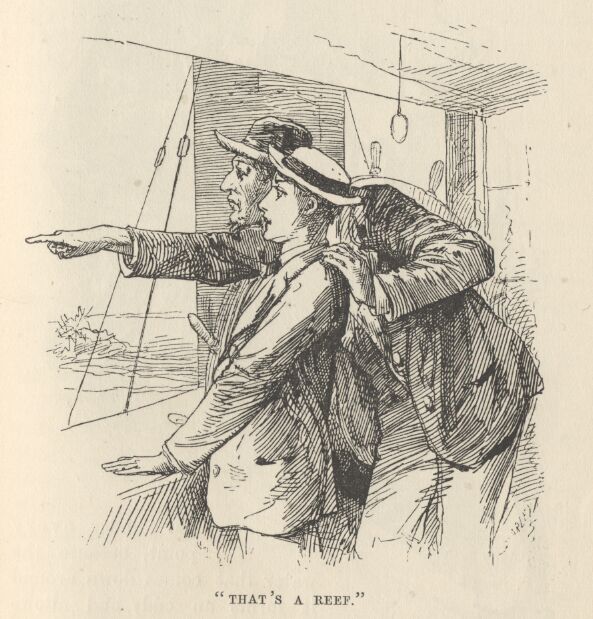
'Do you see that long slanting line on the face of the water? Now, that's a reef. Moreover, it's a bluff reef. There is a solid sand-bar under it that is nearly as straight up and down as the side of a house. There is plenty of water close up to it, but mighty little on top of it. If you were to hit it you would knock the boat's brains out. Do you see where the line fringes out at the upper end and begins to fade away?'
'Do you see that long slanting line on the water's surface? That's a reef. What's more, it's a bluff reef. There's a solid sandbar beneath it, almost as steep as the side of a house. There's plenty of water close to the sandbar, but very little over it. If you hit it, you'd knock the boat's brains out. Do you see where the line starts to spread out and fade at the upper end?'
'Yes, sir.'
'Yes, sir.'
'Well, that is a low place; that is the head of the reef. You can climb over there, and not hurt anything. Cross over, now, and follow along close under the reef—easy water there—not much current.'
'Well, that's a low spot at the head of the reef. You can cross over it without damaging anything. Cross over now and follow close along the reef. The water is calm there, with little current.'
I followed the reef along till I approached the fringed end. Then Mr. Bixby said—
I followed the reef until I neared its fringed end. Then Mr. Bixby said:
'Now get ready. Wait till I give the word. She won't want to mount the reef; a boat hates shoal water. Stand by—wait—WAIT—keep her well in hand. NOW cramp her down! Snatch her! snatch her!'
'Now get ready. Wait until I give the word. She won't want to go over the reef. A boat hates shallow water. Get ready. Wait. WAIT. Keep her under control. NOW turn the wheel hard! Swing her! Swing her!'
He seized the other side of the wheel and helped to spin it around until it was hard down, and then we held it so. The boat resisted, and refused to answer for a while, and next she came surging to starboard, mounted the reef, and sent a long, angry ridge of water foaming away from her bows.
He grabbed the other side of the wheel and helped turn it all the way. Then we held it there. For a while, the boat resisted and would not turn. Then it surged to starboard, rode up onto the reef, and sent a long, angry ridge of foaming water away from its bow.
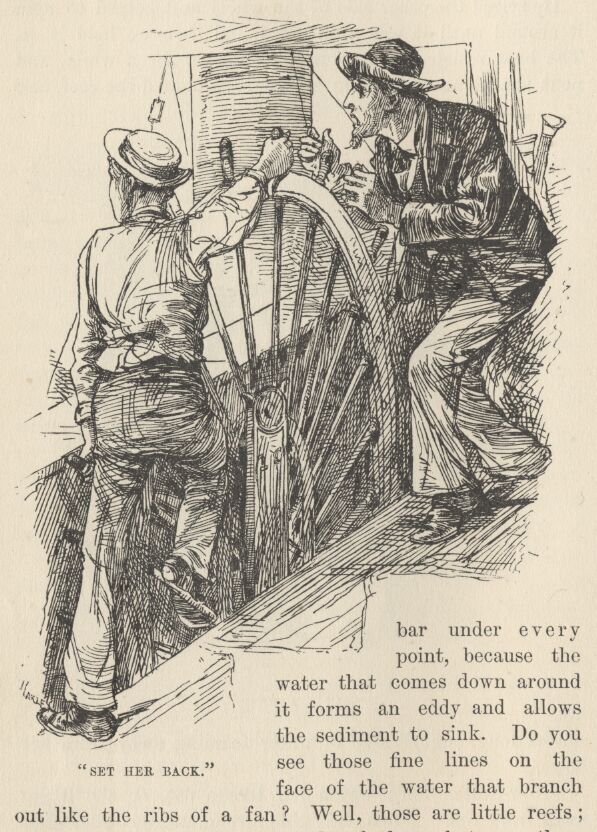
'Now watch her; watch her like a cat, or she'll get away from you. When she fights strong and the tiller slips a little, in a jerky, greasy sort of way, let up on her a trifle; it is the way she tells you at night that the water is too shoal; but keep edging her up, little by little, toward the point. You are well up on the bar, now; there is a bar under every point, because the water that comes down around it forms an eddy and allows the sediment to sink. Do you see those fine lines on the face of the water that branch out like the ribs of a fan. Well, those are little reefs; you want to just miss the ends of them, but run them pretty close. Now look out—look out! Don't you crowd that slick, greasy-looking place; there ain't nine feet there; she won't stand it. She begins to smell it; look sharp, I tell you! Oh blazes, there you go! Stop the starboard wheel! Quick! Ship up to back! Set her back!
'Now watch her. Watch her like a cat, or she'll get away from you. When she fights hard and the tiller slips a little with a jerky, greasy motion, ease up on her. That's how she tells you at night that the water is too shallow. But keep edging her up toward the point, little by little. You are well up on the sandbar now. There's a sandbar under every point because the water flowing around it forms an eddy, letting the sediment sink. Do you see those fine lines on the surface, branching out like the ribs of a fan? Those are little reefs. You want to just miss their ends, but pass pretty close to them. Now watch out, watch out! Don't get too close to that slick, greasy-looking patch. There aren't nine feet of water there. She can't make it through. She's beginning to sense it. Pay attention, I tell you! Oh, blazes, there you go! Stop the starboard wheel! Quick! Set the controls to reverse! Back her up!'
The engine bells jingled and the engines answered promptly, shooting white columns of steam far aloft out of the 'scape pipes, but it was too late. The boat had 'smelt' the bar in good earnest; the foamy ridges that radiated from her bows suddenly disappeared, a great dead swell came rolling forward and swept ahead of her, she careened far over to larboard, and went tearing away toward the other shore as if she were about scared to death. We were a good mile from where we ought to have been, when we finally got the upper hand of her again.
The engine bells jingled, and the engines responded promptly, shooting white columns of steam high from the escape pipes. But it was too late. The boat had really 'smelt' the sandbar. The foamy ridges spreading from her bow suddenly disappeared. A great, smooth swell rolled forward and swept past her. She tilted far over to the left and tore toward the other shore as if she were scared to death. When we finally got control of her again, we were a good mile from where we should have been.
During the afternoon watch the next day, Mr. Bixby asked me if I knew how to run the next few miles. I said—
During the afternoon watch the next day, Mr. Bixby asked if I knew how to navigate the next few miles. I said:
'Go inside the first snag above the point, outside the next one, start out from the lower end of Higgins's wood-yard, make a square crossing and—'
'Go inside the first snag above the point, then outside the next one. Start from the lower end of Higgins's wood-yard, cross straight over, and...'
'That's all right. I'll be back before you close up on the next point.'
'That's all right. I'll be back before you get close to the next point.'
But he wasn't. He was still below when I rounded it and entered upon a piece of river which I had some misgivings about. I did not know that he was hiding behind a chimney to see how I would perform. I went gaily along, getting prouder and prouder, for he had never left the boat in my sole charge such a length of time before. I even got to 'setting' her and letting the wheel go, entirely, while I vaingloriously turned my back and inspected the stem marks and hummed a tune, a sort of easy indifference which I had prodigiously admired in Bixby and other great pilots. Once I inspected rather long, and when I faced to the front again my heart flew into my mouth so suddenly that if I hadn't clapped my teeth together I should have lost it. One of those frightful bluff reefs was stretching its deadly length right across our bows! My head was gone in a moment; I did not know which end I stood on; I gasped and could not get my breath; I spun the wheel down with such rapidity that it wove itself together like a spider's web; the boat answered and turned square away from the reef, but the reef followed her! I fled, and still it followed, still it kept—right across my bows! I never looked to see where I was going, I only fled. The awful crash was imminent—why didn't that villain come! If I committed the crime of ringing a bell, I might get thrown overboard. But better that than kill the boat. So in blind desperation I started such a rattling 'shivaree' down below as never had astounded an engineer in this world before, I fancy. Amidst the frenzy of the bells the engines began to back and fill in a furious way, and my reason forsook its throne—we were about to crash into the woods on the other side of the river. Just then Mr. Bixby stepped calmly into view on the hurricane deck. My soul went out to him in gratitude. My distress vanished; I would have felt safe on the brink of Niagara, with Mr. Bixby on the hurricane deck. He blandly and sweetly took his tooth-pick out of his mouth between his fingers, as if it were a cigar—we were just in the act of climbing an overhanging big tree, and the passengers were scudding astern like rats—and lifted up these commands to me ever so gently—
But he wasn't. He was still below when I rounded it and entered a stretch of river I was uneasy about. I didn't know he was hiding behind a chimney to see how I would do. I went merrily along, growing prouder and prouder. He had never left me in sole charge of the boat for so long before. I even began 'setting' her on course and letting go of the wheel entirely. Then I turned my back with great pride, inspected the marks at the stern, and hummed a tune. I had greatly admired that kind of casual indifference in Bixby and other great pilots. Once, I spent rather too long inspecting. When I faced forward again, my heart leaped into my mouth so suddenly that I would have lost it if I hadn't clapped my teeth together. One of those frightening bluff reefs stretched its deadly length right across our bow! I lost my head at once. I didn't know which end I was standing on. I gasped and couldn't catch my breath. I spun the wheel down so fast that its spokes blurred together like a spider's web. The boat responded and turned straight away from the reef, but the reef followed her! I fled, and still it followed. It stayed right across my bow! I never looked to see where I was going. I just fled. The terrible crash was about to happen. Why didn't that villain come! If I committed the crime of ringing a bell, I might get thrown overboard. But that was better than destroying the boat. So, in blind desperation, I set the bells rattling down below in a 'shivaree' such as no engineer in this world had ever heard before, I imagine. Amid the frenzy of bells, the engines began going backward and forward furiously, and I lost my reason. We were about to crash into the woods on the other side of the river. Just then Mr. Bixby calmly appeared on the hurricane deck. My soul went out to him in gratitude. My distress vanished. I would have felt safe on the brink of Niagara with Mr. Bixby on the hurricane deck. He calmly and sweetly took his toothpick from his mouth between his fingers, as if it were a cigar. We were just about to climb an overhanging big tree, and the passengers were scurrying toward the stern like rats. Then he gave me these commands ever so gently:
'Stop the starboard. Stop the larboard. Set her back on both.'
'Stop the right engine. Stop the left engine. Reverse both engines.'
The boat hesitated, halted, pressed her nose among the boughs a critical instant, then reluctantly began to back away.
The boat hesitated and stopped, pressing its bow into the branches for a tense moment. Then it reluctantly began to back away.
'Stop the larboard. Come ahead on it. Stop the starboard. Come ahead on it. Point her for the bar.'
'Stop the port engine. Run it forward. Stop the starboard engine. Run it forward. Point the boat toward the sandbar.'
I sailed away as serenely as a summer's morning. Mr. Bixby came in and said, with mock simplicity—
I sailed away as calmly as a summer morning. Mr. Bixby came in and said, pretending to be innocent:
'When you have a hail, my boy, you ought to tap the big bell three times before you land, so that the engineers can get ready.'
'When someone hails you, my boy, tap the big bell three times before you land, so the engineers can get ready.'
I blushed under the sarcasm, and said I hadn't had any hail.
I blushed at the sarcasm and said I hadn't had any hail.
'Ah! Then it was for wood, I suppose. The officer of the watch will tell you when he wants to wood up.'
'Ah! Then it was for wood, I suppose. The officer on watch will tell you when he wants to take on wood.'
I went on consuming and said I wasn't after wood.
I kept consuming and said I wasn't looking for wood.
'Indeed? Why, what could you want over here in the bend, then? Did you ever know of a boat following a bend up-stream at this stage of the river?'
'Really? Then why would you want to be over here in the bend? Have you ever known a boat to follow a bend upstream when the river is at this level?'
'No sir,—and I wasn't trying to follow it. I was getting away from a bluff reef.'
'No, sir, and I wasn't trying to follow it. I was getting away from a bluff reef.'
'No, it wasn't a bluff reef; there isn't one within three miles of where you were.'
'No, it wasn't a bluff reef. There isn't one within three miles of where you were.'
'But I saw it. It was as bluff as that one yonder.'
'But I saw it. It was as steep as that one over there.'
'Just about. Run over it!'
'Almost. Go over it!'
'Do you give it as an order?'
'Are you giving it as an order?'
'Yes. Run over it.'
'Yes. Go over it.'
'If I don't, I wish I may die.'
'If I don't, I hope I die.'
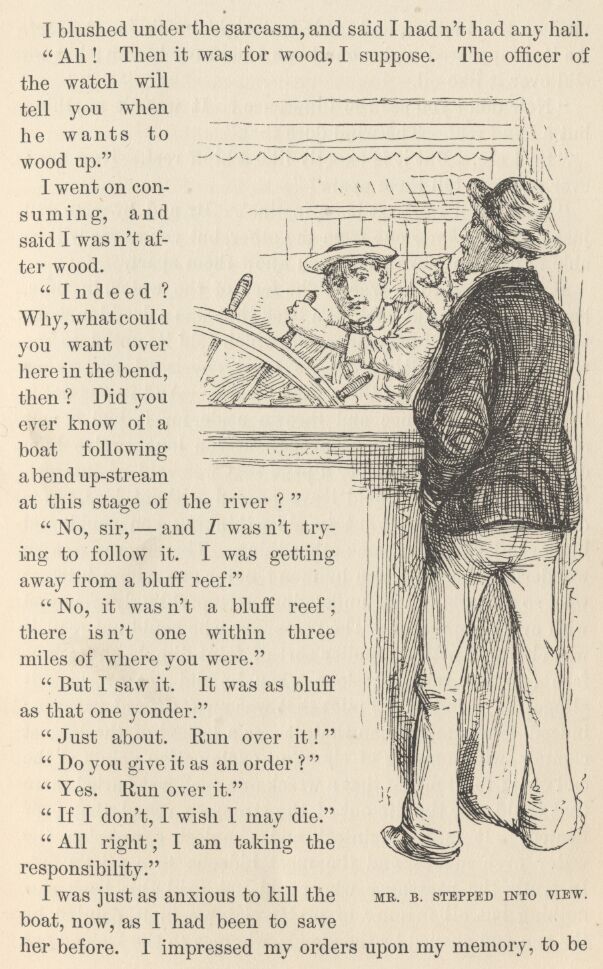
'All right; I am taking the responsibility.' I was just as anxious to kill the boat, now, as I had been to save her before. I impressed my orders upon my memory, to be used at the inquest, and made a straight break for the reef. As it disappeared under our bows I held my breath; but we slid over it like oil.
'All right. I'm taking responsibility.' Now I was just as eager to wreck the boat as I had been to save her before. I memorized my orders so I could use them at the inquest, and headed straight for the reef. As the reef disappeared beneath our bow, I held my breath. But we slid over it like oil.
'Now don't you see the difference? It wasn't anything but a wind reef. The wind does that.'
'Now do you see the difference? It was only a wind reef. The wind does that.'
'So I see. But it is exactly like a bluff reef. How am I ever going to tell them apart?'
'I see. But it looks exactly like a bluff reef. How am I ever going to tell them apart?'
'I can't tell you. It is an instinct. By and by you will just naturally know one from the other, but you never will be able to explain why or how you know them apart'
'I can't tell you. It's instinct. Before long, you'll just naturally know one from the other. But you'll never be able to explain why or how you can tell them apart'
It turned out to be true. The face of the water, in time, became a wonderful book—a book that was a dead language to the uneducated passenger, but which told its mind to me without reserve, delivering its most cherished secrets as clearly as if it uttered them with a voice. And it was not a book to be read once and thrown aside, for it had a new story to tell every day. Throughout the long twelve hundred miles there was never a page that was void of interest, never one that you could leave unread without loss, never one that you would want to skip, thinking you could find higher enjoyment in some other thing. There never was so wonderful a book written by man; never one whose interest was so absorbing, so unflagging, so sparkingly renewed with every reperusal. The passenger who could not read it was charmed with a peculiar sort of faint dimple on its surface (on the rare occasions when he did not overlook it altogether); but to the pilot that was an italicized passage; indeed, it was more than that, it was a legend of the largest capitals, with a string of shouting exclamation points at the end of it; for it meant that a wreck or a rock was buried there that could tear the life out of the strongest vessel that ever floated. It is the faintest and simplest expression the water ever makes, and the most hideous to a pilot's eye. In truth, the passenger who could not read this book saw nothing but all manner of pretty pictures in it painted by the sun and shaded by the clouds, whereas to the trained eye these were not pictures at all, but the grimmest and most dead-earnest of reading-matter.
It turned out to be true. In time, the surface of the water became a wonderful book. To the untrained passenger, it was written in a dead language. But to me, it spoke freely, revealing its deepest secrets as clearly as if it had a voice. And it was not a book to read once and put aside. It had a new story to tell every day. Along the whole twelve hundred miles, not one page lacked interest. You could not leave a single page unread without losing something. You would never want to skip one in hopes of finding greater pleasure elsewhere. No book written by a person was ever so wonderful. None was so absorbing, so endlessly interesting, or so brilliantly renewed with every reading. A passenger who could not read the book was charmed by a faint dimple on the surface. That is, on the rare occasions when the passenger noticed it at all. But to the pilot, the dimple was an italicized passage. It was more than that. It was a warning in the largest capital letters, followed by a string of shouting exclamation points. It meant that a wreck or a rock lay hidden there. It could tear the life out of the strongest vessel ever to float. The dimple is the faintest and simplest expression the water ever makes. It is also the most hideous to a pilot's eye. In truth, the passenger who could not read this book saw only pretty pictures of every kind. The sun painted them, and the clouds shaded them. But to the trained eye, they were not pictures at all. They were the grimmest, most deadly serious reading matter.
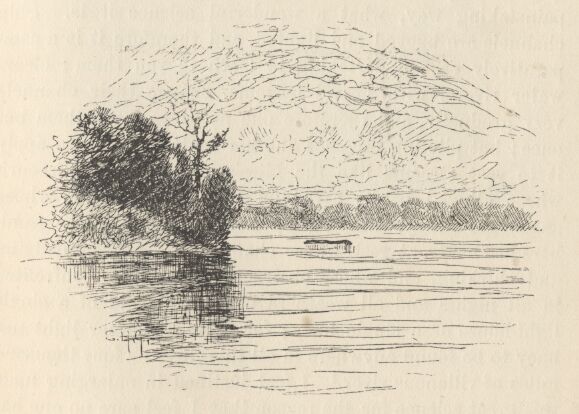
Now when I had mastered the language of this water and had come to know every trifling feature that bordered the great river as familiarly as I knew the letters of the alphabet, I had made a valuable acquisition. But I had lost something, too. I had lost something which could never be restored to me while I lived. All the grace, the beauty, the poetry had gone out of the majestic river! I still keep in mind a certain wonderful sunset which I witnessed when steamboating was new to me. A broad expanse of the river was turned to blood; in the middle distance the red hue brightened into gold, through which a solitary log came floating, black and conspicuous; in one place a long, slanting mark lay sparkling upon the water; in another the surface was broken by boiling, tumbling rings, that were as many-tinted as an opal; where the ruddy flush was faintest, was a smooth spot that was covered with graceful circles and radiating lines, ever so delicately traced; the shore on our left was densely wooded, and the somber shadow that fell from this forest was broken in one place by a long, ruffled trail that shone like silver; and high above the forest wall a clean-stemmed dead tree waved a single leafy bough that glowed like a flame in the unobstructed splendor that was flowing from the sun. There were graceful curves, reflected images, woody heights, soft distances; and over the whole scene, far and near, the dissolving lights drifted steadily, enriching it, every passing moment, with new marvels of coloring.
Once I had mastered the language of the water, I knew every tiny feature along the great river as well as the letters of the alphabet. I had gained something valuable. But I had lost something, too, something I could never recover as long as I lived. All the grace, beauty, and poetry had gone out of the majestic river! I still remember a wonderful sunset I saw when steamboating was new to me. A broad stretch of the river had turned blood red. In the middle distance, the red brightened into gold. A single log floated through it, black and easy to see. In one place, a long, slanting mark sparkled on the water. In another, churning rings broke the surface, showing as many colors as an opal. Where the red glow was faintest, a smooth patch was covered with graceful circles and lines spreading outward. They were traced ever so delicately. The shore on our left was thickly wooded. In one place, a long, rippling trail shone like silver through the dark shadow of the forest. High above the wall of trees stood a dead tree with a bare trunk. Its single leafy branch waved and glowed like a flame in the full sunlight. There were graceful curves, reflections, wooded heights, and soft distances. Over the whole scene, far and near, the fading light drifted steadily, enriching it with new wonders of color every moment.
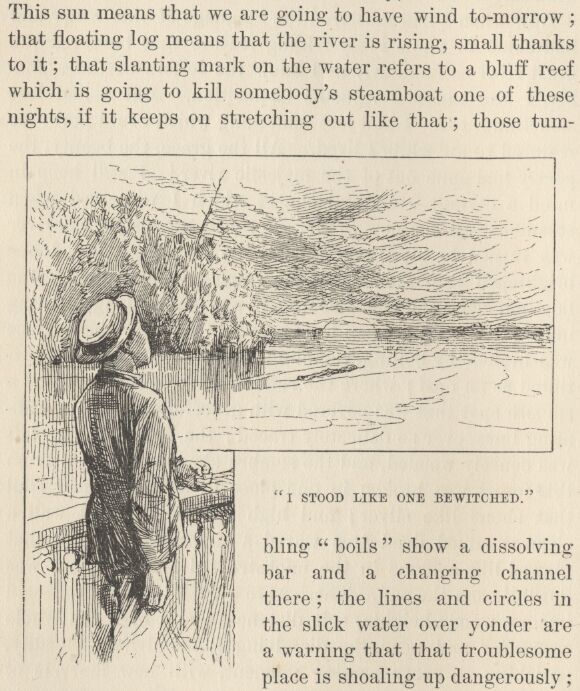
I stood like one bewitched. I drank it in, in a speechless rapture. The world was new to me, and I had never seen anything like this at home. But as I have said, a day came when I began to cease from noting the glories and the charms which the moon and the sun and the twilight wrought upon the river's face; another day came when I ceased altogether to note them. Then, if that sunset scene had been repeated, I should have looked upon it without rapture, and should have commented upon it, inwardly, after this fashion: This sun means that we are going to have wind to-morrow; that floating log means that the river is rising, small thanks to it; that slanting mark on the water refers to a bluff reef which is going to kill somebody's steamboat one of these nights, if it keeps on stretching out like that; those tumbling 'boils' show a dissolving bar and a changing channel there; the lines and circles in the slick water over yonder are a warning that that troublesome place is shoaling up dangerously; that silver streak in the shadow of the forest is the 'break' from a new snag, and he has located himself in the very best place he could have found to fish for steamboats; that tall dead tree, with a single living branch, is not going to last long, and then how is a body ever going to get through this blind place at night without the friendly old landmark.
I stood there as if spellbound. I took it all in, speechless with delight. The world was new to me, and I had never seen anything like this at home. But as I have said, a day came when I began to stop noticing the beauty and charm that the moon, sun, and twilight brought to the river’s surface. Another day came when I stopped noticing them altogether. After that, if I had seen that sunset scene again, I would have felt no delight. Instead, I would have thought to myself: That sun means we’ll have wind tomorrow. That floating log means the river is rising, though we can hardly thank the log for it. That slanting mark on the water points to a bluff reef. If the reef keeps stretching out like that, it will destroy somebody’s steamboat one of these nights. Those churning 'boils' show that a sandbar is breaking up and the channel is changing there. The lines and circles in the smooth water over there warn that the troublesome spot is becoming dangerously shallow. That silver streak in the forest’s shadow is the 'break' caused by a new snag. The snag has settled in the very best place it could have found to fish for steamboats. That tall dead tree, with its single living branch, won’t last much longer. Then how will anyone ever get through this blind stretch at night without the friendly old landmark?
No, the romance and the beauty were all gone from the river. All the value any feature of it had for me now was the amount of usefulness it could furnish toward compassing the safe piloting of a steamboat. Since those days, I have pitied doctors from my heart. What does the lovely flush in a beauty's cheek mean to a doctor but a 'break' that ripples above some deadly disease. Are not all her visible charms sown thick with what are to him the signs and symbols of hidden decay? Does he ever see her beauty at all, or doesn't he simply view her professionally, and comment upon her unwholesome condition all to himself? And doesn't he sometimes wonder whether he has gained most or lost most by learning his trade?
No, all the romance and beauty were gone from the river. Now, I valued each feature only for how useful it was in safely piloting a steamboat. Since then, I have felt deep pity for doctors. To a doctor, what is the lovely flush in a beautiful woman's cheek but a 'break' rippling above some deadly disease? Aren't all her visible charms filled with what he sees as signs and symbols of hidden decay? Does he ever see her beauty at all? Or does he simply view her professionally and think to himself about her unhealthy condition? And doesn't he sometimes wonder whether learning his trade has brought him more gain or loss?