Chapter 10
Completing My Education
WHOSOEVER has done me the courtesy to read my chapters which have preceded this may possibly wonder that I deal so minutely with piloting as a science. It was the prime purpose of those chapters; and I am not quite done yet. I wish to show, in the most patient and painstaking way, what a wonderful science it is. Ship channels are buoyed and lighted, and therefore it is a comparatively easy undertaking to learn to run them; clear-water rivers, with gravel bottoms, change their channels very gradually, and therefore one needs to learn them but once; but piloting becomes another matter when you apply it to vast streams like the Mississippi and the Missouri, whose alluvial banks cave and change constantly, whose snags are always hunting up new quarters, whose sandbars are never at rest, whose channels are for ever dodging and shirking, and whose obstructions must be confronted in all nights and all weathers without the aid of a single light-house or a single buoy; for there is neither light nor buoy to be found anywhere in all this three or four thousand miles of villainous river.{footnote [True at the time referred to; not true now (1882).]} I feel justified in enlarging upon this great science for the reason that I feel sure no one has ever yet written a paragraph about it who had piloted a steamboat himself, and so had a practical knowledge of the subject. If the theme were hackneyed, I should be obliged to deal gently with the reader; but since it is wholly new, I have felt at liberty to take up a considerable degree of room with it.
Anyone who has been kind enough to read my preceding chapters may wonder why I discuss piloting as a science in such detail. That was the main purpose of those chapters, and I am not quite finished yet. I want to show, as patiently and carefully as I can, what a wonderful science piloting is. Ship channels have buoys and lights, so learning to navigate them is comparatively easy. Clear rivers with gravel bottoms change their channels very gradually, so you need to learn them only once. But piloting is another matter on vast rivers like the Mississippi and the Missouri. Their alluvial banks are constantly caving in and changing. Their snags are always looking for new places to settle, and their sandbars are never still. Their channels are forever dodging and shifting. Pilots must face these obstacles on every night and in all kinds of weather, without a single lighthouse or buoy to help them. There is not a light or buoy anywhere along these three or four thousand miles of villainous river.{footnote [True at the time described, but not true now (1882).]} I feel justified in saying so much about this great science. I am sure no one has ever written a paragraph about piloting who had piloted a steamboat himself and so had practical knowledge of the subject. If the subject were worn out, I would have to go easy on the reader. But since the subject is entirely new, I have felt free to devote considerable space to it.
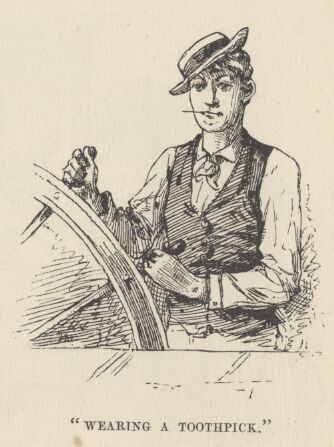
When I had learned the name and position of every visible feature of the river; when I had so mastered its shape that I could shut my eyes and trace it from St. Louis to New Orleans; when I had learned to read the face of the water as one would cull the news from the morning paper; and finally, when I had trained my dull memory to treasure up an endless array of soundings and crossing-marks, and keep fast hold of them, I judged that my education was complete: so I got to tilting my cap to the side of my head, and wearing a tooth-pick in my mouth at the wheel. Mr. Bixby had his eye on these airs. One day he said—
I learned the name and position of every visible feature of the river. I knew its shape so well that I could close my eyes and trace it from St. Louis to New Orleans. I learned to read the surface of the water as easily as someone reads the news in the morning paper. Finally, I trained my dull memory to store and retain an endless collection of depth measurements and crossing-marks. Then I decided my education was complete. So I began tilting my cap to one side and keeping a toothpick in my mouth while at the wheel. Mr. Bixby noticed my airs. One day he said:
'What is the height of that bank yonder, at Burgess's?'
'How high is that bank over there, at Burgess's?'
'How can I tell, sir. It is three-quarters of a mile away.'
'How can I tell, sir? It is three-quarters of a mile away.'
'Very poor eye—very poor. Take the glass.'
'Very poor eyesight. Very poor. Take the glass.'
I took the glass, and presently said—'I can't tell. I suppose that that bank is about a foot and a half high.'
I took the glass and soon said, 'I can't tell. I suppose that bank is about a foot and a half high.'
'Foot and a half! That's a six-foot bank. How high was the bank along here last trip?'
'A foot and a half! That's a six-foot bank. How high was the bank here on the last trip?'
'I don't know; I never noticed.'
'I don't know. I never noticed.'
'You didn't? Well, you must always do it hereafter.'
'You didn't? Well, you must always do it from now on.'
'Why?'
'Why?'
'Because you'll have to know a good many things that it tells you. For one thing, it tells you the stage of the river—tells you whether there's more water or less in the river along here than there was last trip.'
'Because you'll need to know many things it tells you. For one thing, it tells you the river's level. It tells you whether there's more or less water here than there was on the last trip.'
'The leads tell me that.' I rather thought I had the advantage of him there.
'The leads tell me that.' I thought I had the advantage over him there.
'Yes, but suppose the leads lie? The bank would tell you so, and then you'd stir those leadsmen up a bit. There was a ten-foot bank here last trip, and there is only a six-foot bank now. What does that signify?'
'Yes, but what if the sounding leads lie? The bank would tell you, and then you'd hurry the leadsmen along. There was a ten-foot bank here on the last trip, and now there's only a six-foot bank. What does that mean?'
'That the river is four feet higher than it was last trip.'
'That the river is four feet higher than it was on the last trip.'
'Very good. Is the river rising or falling?'
'All right. Is the river rising or falling?'
'Rising.'
'Rising.'
'No it ain't.'
'No, it isn't.'
'I guess I am right, sir. Yonder is some drift-wood floating down the stream.'
'I think I'm right, sir. There's some driftwood floating down the stream over there.'
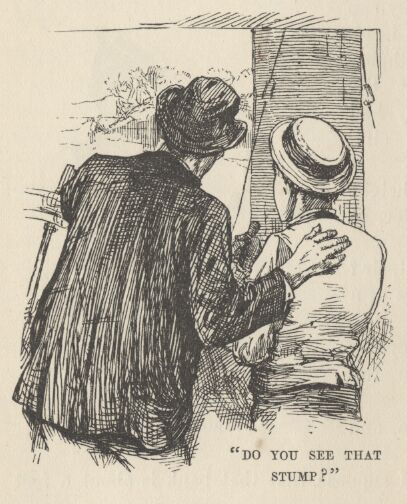
'A rise starts the drift-wood, but then it keeps on floating a while after the river is done rising. Now the bank will tell you about this. Wait till you come to a place where it shelves a little. Now here; do you see this narrow belt of fine sediment That was deposited while the water was higher. You see the driftwood begins to strand, too. The bank helps in other ways. Do you see that stump on the false point?'
'When the river rises, it sets the driftwood moving. But the driftwood keeps floating for a while after the river stops rising. The bank will tell you about this. Wait until you come to a place where the bank slopes gently. Here, do you see this narrow strip of fine sediment? It was deposited when the water was higher. You can see the driftwood starting to get stranded, too. The bank helps in other ways. Do you see that stump on the false point?'
'Ay, ay, sir.'
'Yes, sir.'
'Well, the water is just up to the roots of it. You must make a note of that.'
'Well, the water is just up to its roots. Make a note of that.'
'Why?'
'Why?'
'Because that means that there's seven feet in the chute of 103.'
'Because that means there are seven feet of water in the chute at 103.'
'But 103 is a long way up the river yet.'
'But 103 is still a long way up the river.'
'That's where the benefit of the bank comes in. There is water enough in 103 now, yet there may not be by the time we get there; but the bank will keep us posted all along. You don't run close chutes on a falling river, up-stream, and there are precious few of them that you are allowed to run at all down-stream. There's a law of the United States against it. The river may be rising by the time we get to 103, and in that case we'll run it. We are drawing—how much?'
'That's where the bank helps. There's enough water in 103 now, but there may not be by the time we get there. But the bank will keep us informed all along the way. You don't travel upstream through narrow chutes when the river is falling. And there are very few narrow chutes you're allowed to travel through downstream at all. There's a United States law against it. The river may be rising by the time we get to 103. If it is, we'll take that chute. How much water are we drawing?'
'Six feet aft,—six and a half forward.'
'Six feet at the back, six and a half feet at the front.'
'Well, you do seem to know something.'
'Well, you do seem to know something.'
'But what I particularly want to know is, if I have got to keep up an everlasting measuring of the banks of this river, twelve hundred miles, month in and month out?'
'But what I really want to know is this: Do I have to keep measuring this river's banks, all twelve hundred miles, month after month?'
'Of course!'
'Of course!'
My emotions were too deep for words for a while. Presently I said—'
For a while, my feelings were too deep for words. Then I said: '
And how about these chutes. Are there many of them?'
And what about these chutes? Are there many of them?'
'I should say so. I fancy we shan't run any of the river this trip as you've ever seen it run before—so to speak. If the river begins to rise again, we'll go up behind bars that you've always seen standing out of the river, high and dry like the roof of a house; we'll cut across low places that you've never noticed at all, right through the middle of bars that cover three hundred acres of river; we'll creep through cracks where you've always thought was solid land; we'll dart through the woods and leave twenty-five miles of river off to one side; we'll see the hind-side of every island between New Orleans and Cairo.'
‘I should say so. I don’t think we’ll travel any part of the river this trip the way you’ve seen it traveled before, so to speak. If the river starts to rise again, we’ll go up behind sandbars you’ve always seen high and dry, like a house roof. We’ll cut across low spots you’ve never noticed, right through sandbars that cover three hundred acres of river. We’ll creep through narrow passages where you’ve always thought the land was solid. We’ll dart through the woods and leave twenty-five miles of river off to one side. We’ll see the back side of every island between New Orleans and Cairo.’
'Then I've got to go to work and learn just as much more river as I already know.'
'Then I've got to get to work and learn just as much more of the river as I already know.'
'Just about twice as much more, as near as you can come at it.'
'Just about twice as much more, as best as you can estimate.'
'Well, one lives to find out. I think I was a fool when I went into this business.'
'Well, you live and learn. I think I was a fool to go into this business.'
'Yes, that is true. And you are yet. But you'll not be when you've learned it.'
'Yes, that's true. And you still are. But you won't be once you've learned it.'
'Ah, I never can learn it.'
'Ah, I can never learn it.'
'I will see that you do.'
'I will make sure you do.'
By and by I ventured again—
After a while, I ventured again:
'Have I got to learn all this thing just as I know the rest of the river—shapes and all—and so I can run it at night?'
'Do I have to learn all of this, shapes and all, just like the rest of the river, so I can navigate it at night?'
'Yes. And you've got to have good fair marks from one end of the river to the other, that will help the bank tell you when there is water enough in each of these countless places—like that stump, you know. When the river first begins to rise, you can run half a dozen of the deepest of them; when it rises a foot more you can run another dozen; the next foot will add a couple of dozen, and so on: so you see you have to know your banks and marks to a dead moral certainty, and never get them mixed; for when you start through one of those cracks, there's no backing out again, as there is in the big river; you've got to go through, or stay there six months if you get caught on a falling river. There are about fifty of these cracks which you can't run at all except when the river is brim full and over the banks.'
'Yes. And you need clear, reliable markers all along the river. Together with the banks, they tell you when there is enough water in each of these countless places. Like that stump, you know. When the river first starts to rise, you can navigate half a dozen of the deepest places. When it rises another foot, you can navigate another dozen. The next foot opens up a couple of dozen more, and so on. So you see, you have to know your banks and markers with absolute certainty. You must never mix them up. Once you start through one of those cracks, you can't back out, as you can in the big river. You have to get through. If you get caught when the river is falling, you could be stuck there for six months. There are about fifty of these cracks you can't navigate at all unless the river is full to the brim and over its banks.'
'This new lesson is a cheerful prospect.'
'This new lesson sounds promising.'
'Cheerful enough. And mind what I've just told you; when you start into one of those places you've got to go through. They are too narrow to turn around in, too crooked to back out of, and the shoal water is always up at the head; never elsewhere. And the head of them is always likely to be filling up, little by little, so that the marks you reckon their depth by, this season, may not answer for next.'
'Cheerful enough. And remember what I just told you. When you enter one of those places, you have to go through. They are too narrow to turn around in and too crooked to back out of. The shallow water is always at the head, never anywhere else. And the head is always likely to be filling up little by little. So the marks you use to judge its depth this season may not work next season.'
'Learn a new set, then, every year?'
'So, learn a new set every year?'
'Exactly. Cramp her up to the bar! What are you standing up through the middle of the river for?'
'Exactly. Steer her sharply toward the sandbar! Why are you heading upstream through the middle of the river?'
The next few months showed me strange things. On the same day that we held the conversation above narrated, we met a great rise coming down the river. The whole vast face of the stream was black with drifting dead logs, broken boughs, and great trees that had caved in and been washed away. It required the nicest steering to pick one's way through this rushing raft, even in the day-time, when crossing from point to point; and at night the difficulty was mightily increased; every now and then a huge log, lying deep in the water, would suddenly appear right under our bows, coming head-on; no use to try to avoid it then; we could only stop the engines, and one wheel would walk over that log from one end to the other, keeping up a thundering racket and careening the boat in a way that was very uncomfortable to passengers. Now and then we would hit one of these sunken logs a rattling bang, dead in the center, with a full head of steam, and it would stun the boat as if she had hit a continent. Sometimes this log would lodge, and stay right across our nose, and back the Mississippi up before it; we would have to do a little craw-fishing, then, to get away from the obstruction. We often hit white logs, in the dark, for we could not see them till we were right on them; but a black log is a pretty distinct object at night. A white snag is an ugly customer when the daylight is gone.
The next few months showed me strange things. On the same day we had the conversation just described, we met a great flood coming down the river. The whole vast surface was black with drifting dead logs, broken branches, and huge trees that had fallen into the river and washed away. It took the most careful steering to pick our way through this rushing raft, even in daylight, when crossing from point to point. At night it was much harder. Every now and then a huge log, lying deep in the water, would suddenly appear right under our bow, coming straight at us. Then there was no use trying to avoid it. We could only stop the engines and let one paddle wheel roll over the log from one end to the other. The wheel made a thundering racket and tipped the boat in a way that made the passengers very uncomfortable. Now and then we would hit one of these submerged logs dead center, at full speed, with a rattling bang. The blow would stun the boat as if she had hit a continent. Sometimes the log would get stuck across our bow and make the Mississippi pile up in front of it. Then we had to back up like a crawfish to get free. We often hit white logs in the dark because we could not see them until we were right on top of them. But a black log is fairly easy to see at night. A white snag is an ugly customer after daylight is gone.
Of course, on the great rise, down came a swarm of prodigious timber-rafts from the head waters of the Mississippi, coal barges from Pittsburgh, little trading scows from everywhere, and broad-horns from 'Posey County,' Indiana, freighted with 'fruit and furniture'—the usual term for describing it, though in plain English the freight thus aggrandized was hoop-poles and pumpkins. Pilots bore a mortal hatred to these craft; and it was returned with usury. The law required all such helpless traders to keep a light burning, but it was a law that was often broken. All of a sudden, on a murky night, a light would hop up, right under our bows, almost, and an agonized voice, with the backwoods 'whang' to it, would wail out—
Of course, when the river rose high, a swarm of enormous timber rafts came down from the Mississippi headwaters. Coal barges came from Pittsburgh, and small trading scows came from everywhere. Broad-horns from 'Posey County,' Indiana, came loaded with 'fruit and furniture.' That was the usual description, though in plain English the grandly named cargo was hoop-poles and pumpkins. Pilots hated these boats, and the people on them hated pilots even more. The law required all such helpless traders to keep a light burning, but they often broke it. On a murky night, a light would suddenly pop up almost directly under our bow. Then a voice with a backwoods 'whang' would wail in agony:
'Whar'n the —— you goin' to! Cain't you see nothin', you dash-dashed aig-suckin', sheep-stealin', one-eyed son of a stuffed monkey!'
'Where the hell are you going? Can't you see anything, you blasted egg-sucking, sheep-stealing, one-eyed son of a stuffed monkey!'
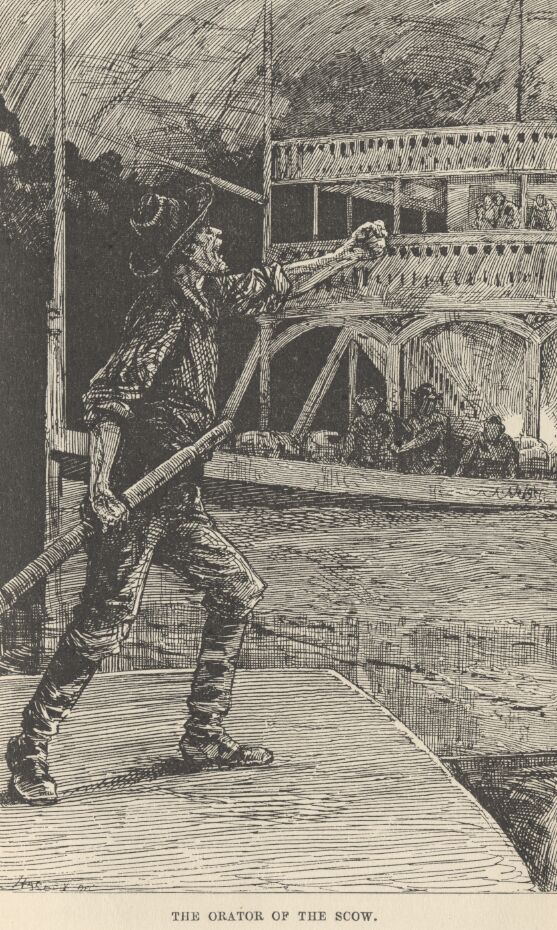
Then for an instant, as we whistled by, the red glare from our furnaces would reveal the scow and the form of the gesticulating orator as if under a lightning-flash, and in that instant our firemen and deck-hands would send and receive a tempest of missiles and profanity, one of our wheels would walk off with the crashing fragments of a steering-oar, and down the dead blackness would shut again. And that flatboatman would be sure to go into New Orleans and sue our boat, swearing stoutly that he had a light burning all the time, when in truth his gang had the lantern down below to sing and lie and drink and gamble by, and no watch on deck.
Then, for an instant as we whistled past, the red glow from our furnaces lit up the scow and the wildly gesturing speaker, as if in a flash of lightning. In that instant, our firemen and deckhands would exchange a storm of objects and curses with the men on the scow. One of our paddle wheels would carry away a steering oar, smashing it to pieces. Then complete darkness would close in again. The flatboatman would be sure to go to New Orleans and sue our boat. He would swear up and down that he had kept a light burning the whole time. In truth, his crew had taken the lantern below to sing, tell lies, drink, and gamble by its light. They had left no one on watch on deck.
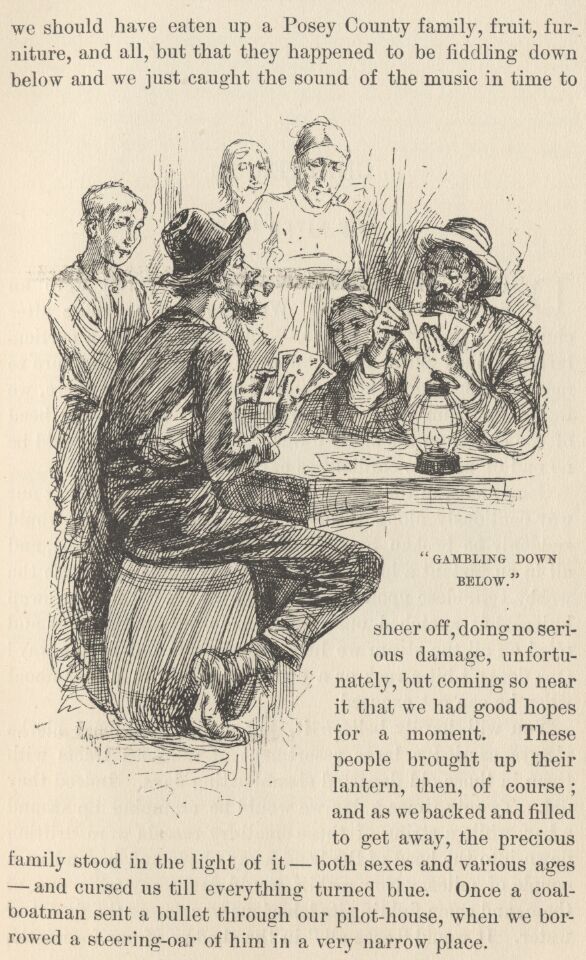
Once, at night, in one of those forest-bordered crevices (behind an island) which steamboatmen intensely describe with the phrase 'as dark as the inside of a cow,' we should have eaten up a Posey County family, fruit, furniture, and all, but that they happened to be fiddling down below, and we just caught the sound of the music in time to sheer off, doing no serious damage, unfortunately, but coming so near it that we had good hopes for a moment. These people brought up their lantern, then, of course; and as we backed and filled to get away, the precious family stood in the light of it—both sexes and various ages—and cursed us till everything turned blue. Once a coalboatman sent a bullet through our pilot-house, when we borrowed a steering oar of him in a very narrow place.
Once, at night, we were in a narrow, forest-lined channel behind an island. Steamboatmen describe such places as 'as dark as the inside of a cow.' We nearly ran over a Posey County family, fruit, furniture, and all. But they happened to be playing a fiddle below deck. We caught the sound just in time to steer away. Unfortunately, we did no serious damage, though we came so close that we had good hopes for a moment. The family brought up their lantern then, of course. As we maneuvered back and forth to get away, the precious family stood in its light. They were men and women of various ages, and they cursed us till everything turned blue. Another time, a coalboatman sent a bullet through our pilot-house. We had borrowed a steering oar from him in a very narrow spot.