Chapter 6
A Trainee Pilot's Experience
WHAT with lying on the rocks four days at Louisville, and some other delays, the poor old 'Paul Jones' fooled away about two weeks in making the voyage from Cincinnati to New Orleans. This gave me a chance to get acquainted with one of the pilots, and he taught me how to steer the boat, and thus made the fascination of river life more potent than ever for me.
After four days stuck on the rocks at Louisville and some other delays, the poor old 'Paul Jones' wasted about two weeks on the voyage from Cincinnati to New Orleans. The long trip gave me a chance to get to know one of the pilots. He taught me how to steer the boat, making river life even more fascinating to me.
It also gave me a chance to get acquainted with a youth who had taken deck passage—more's the pity; for he easily borrowed six dollars of me on a promise to return to the boat and pay it back to me the day after we should arrive. But he probably died or forgot, for he never came. It was doubtless the former, since he had said his parents were wealthy, and he only traveled deck passage because it was cooler.{footnote [1. 'Deck' Passage, i.e. steerage passage.]}
It also gave me a chance to meet a young man who had bought deck passage. That was a pity. He easily borrowed six dollars from me, promising to return to the boat and pay me back the day after we arrived. But he probably died or forgot, because he never came. He must have died, since he said his parents were wealthy and he traveled on deck only because it was cooler.{footnote [1. 'Deck' passage means steerage passage.]}
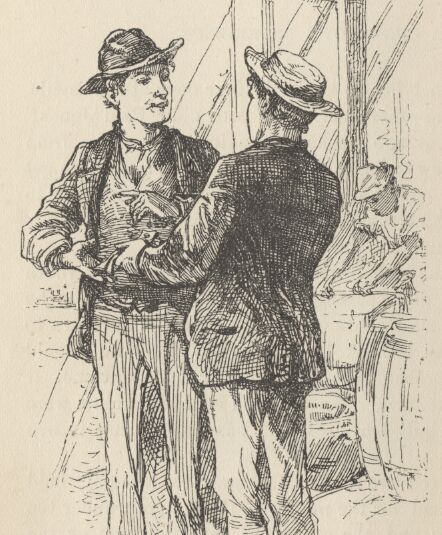
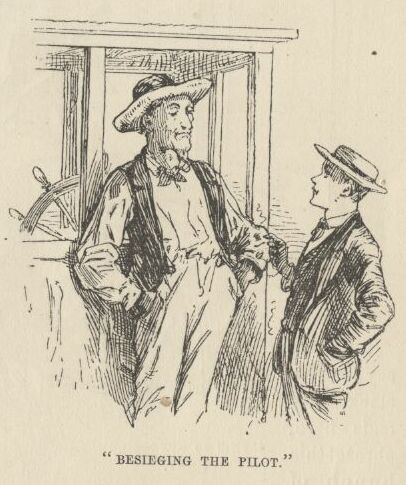
I soon discovered two things. One was that a vessel would not be likely to sail for the mouth of the Amazon under ten or twelve years; and the other was that the nine or ten dollars still left in my pocket would not suffice for so imposing an exploration as I had planned, even if I could afford to wait for a ship. Therefore it followed that I must contrive a new career. The 'Paul Jones' was now bound for St. Louis. I planned a siege against my pilot, and at the end of three hard days he surrendered. He agreed to teach me the Mississippi River from New Orleans to St. Louis for five hundred dollars, payable out of the first wages I should receive after graduating. I entered upon the small enterprise of 'learning' twelve or thirteen hundred miles of the great Mississippi River with the easy confidence of my time of life. If I had really known what I was about to require of my faculties, I should not have had the courage to begin. I supposed that all a pilot had to do was to keep his boat in the river, and I did not consider that that could be much of a trick, since it was so wide.
I soon discovered two things. First, a ship probably wouldn’t sail for the mouth of the Amazon for another ten or twelve years. Second, even if I could afford to wait, the nine or ten dollars left in my pocket wouldn’t cover the grand expedition I had planned. So I had to come up with a new career. The 'Paul Jones' was now heading for St. Louis. I laid siege to my pilot, and after three hard days he surrendered. He agreed to teach me the Mississippi River from New Orleans to St. Louis for five hundred dollars. I would pay him out of my first wages after graduating. I began the small task of 'learning' twelve or thirteen hundred miles of the great Mississippi River with the easy confidence of youth. If I had really known what I was about to demand of my abilities, I wouldn’t have had the courage to begin. I thought all a pilot had to do was keep his boat in the river. And since the river was so wide, I didn’t think that could be much of a trick.
The boat backed out from New Orleans at four in the afternoon, and it was 'our watch' until eight. Mr. Bixby, my chief, 'straightened her up,' plowed her along past the sterns of the other boats that lay at the Levee, and then said, 'Here, take her; shave those steamships as close as you'd peel an apple.' I took the wheel, and my heart-beat fluttered up into the hundreds; for it seemed to me that we were about to scrape the side off every ship in the line, we were so close. I held my breath and began to claw the boat away from the danger; and I had my own opinion of the pilot who had known no better than to get us into such peril, but I was too wise to express it. In half a minute I had a wide margin of safety intervening between the 'Paul Jones' and the ships; and within ten seconds more I was set aside in disgrace, and Mr. Bixby was going into danger again and flaying me alive with abuse of my cowardice. I was stung, but I was obliged to admire the easy confidence with which my chief loafed from side to side of his wheel, and trimmed the ships so closely that disaster seemed ceaselessly imminent. When he had cooled a little he told me that the easy water was close ashore and the current outside, and therefore we must hug the bank, up-stream, to get the benefit of the former, and stay well out, down-stream, to take advantage of the latter. In my own mind I resolved to be a down-stream pilot and leave the up-streaming to people dead to prudence.
The boat backed out of New Orleans at four in the afternoon, and it was 'our watch' until eight. Mr. Bixby, my chief, 'straightened her up' and steered her past the sterns of the other boats at the Levee. Then he said, 'Here, take her. Shave those steamships as close as you'd peel an apple.' I took the wheel, and my heart started racing into the hundreds. We were so close that I thought we were about to scrape the side off every ship in the line. I held my breath and began struggling to steer the boat away from danger. I had my own opinion of a pilot who knew no better than to get us into such peril. But I was too wise to say so. In half a minute, I had put a wide margin of safety between the 'Paul Jones' and the ships. Within ten seconds more, I was pushed aside in disgrace. Mr. Bixby was steering back into danger and tearing me to pieces for my cowardice. I was stung, but I had to admire his easy confidence. He moved casually from side to side at the wheel, passing so close to the ships that disaster seemed constantly imminent. When he had cooled down a little, he told me that the calm water was close to shore and the current farther out. So we had to hug the bank going upstream to take advantage of the calm water. Going downstream, we had to stay well out to take advantage of the current. I silently resolved to be a downstream pilot and leave upstream travel to people with no sense of caution.
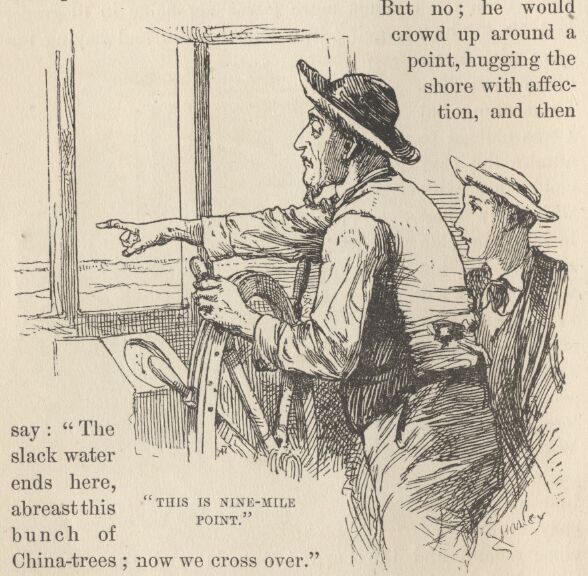
Now and then Mr. Bixby called my attention to certain things. Said he, 'This is Six-Mile Point.' I assented. It was pleasant enough information, but I could not see the bearing of it. I was not conscious that it was a matter of any interest to me. Another time he said, 'This is Nine-Mile Point.' Later he said, 'This is Twelve-Mile Point.' They were all about level with the water's edge; they all looked about alike to me; they were monotonously unpicturesque. I hoped Mr. Bixby would change the subject. But no; he would crowd up around a point, hugging the shore with affection, and then say: 'The slack water ends here, abreast this bunch of China-trees; now we cross over.' So he crossed over. He gave me the wheel once or twice, but I had no luck. I either came near chipping off the edge of a sugar plantation, or I yawed too far from shore, and so dropped back into disgrace again and got abused.
Now and then Mr. Bixby pointed things out to me. He said, 'This is Six-Mile Point.' I agreed. It was pleasant enough to know, but I could not see why it mattered. I did not feel it was of any interest to me. Another time he said, 'This is Nine-Mile Point.' Later he said, 'This is Twelve-Mile Point.' All three points were about level with the water's edge, and they all looked about alike to me. They were monotonously unattractive. I hoped Mr. Bixby would change the subject. But no. He would steer close around a point, hugging the shore affectionately, and then say: 'The slack water ends here, alongside this bunch of China-trees; now we cross over.' So he crossed over. He gave me the wheel once or twice, but I had no luck. I either came close to clipping the edge of a sugar plantation or veered too far from shore. So I fell back into disgrace and got scolded again.
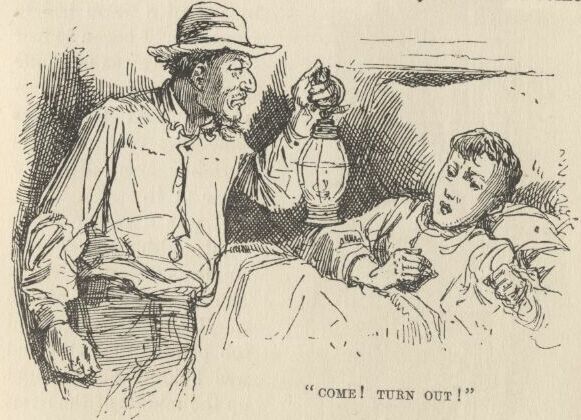
The watch was ended at last, and we took supper and went to bed. At midnight the glare of a lantern shone in my eyes, and the night watchman said—
The watch finally ended. We ate supper and went to bed. At midnight, a lantern's glare shone in my eyes, and the night watchman said:
'Come! turn out!'
'Come on! Get up!'
And then he left. I could not understand this extraordinary procedure; so I presently gave up trying to, and dozed off to sleep. Pretty soon the watchman was back again, and this time he was gruff. I was annoyed. I said:—
And then he left. I couldn't understand this strange behavior, so I soon gave up trying and drifted off to sleep. Before long, the watchman came back, and this time he was gruff. I was annoyed. I said:
'What do you want to come bothering around here in the middle of the night for. Now as like as not I'll not get to sleep again to-night.'
'Why do you have to come around bothering me in the middle of the night? Now I probably won't get back to sleep tonight.'
The watchman said—
The watchman said:
'Well, if this an't good, I'm blest.'
'Well, if this isn't good, I'll be darned.'
The 'off-watch' was just turning in, and I heard some brutal laughter from them, and such remarks as 'Hello, watchman! an't the new cub turned out yet? He's delicate, likely. Give him some sugar in a rag and send for the chambermaid to sing rock-a-by-baby to him.'
The 'off-watch' crew was just going to bed. I heard some cruel laughter and remarks like, 'Hello, watchman! Isn't the new cub up yet? He's probably delicate. Give him some sugar in a rag and send for the chambermaid to sing rock-a-bye baby to him.'
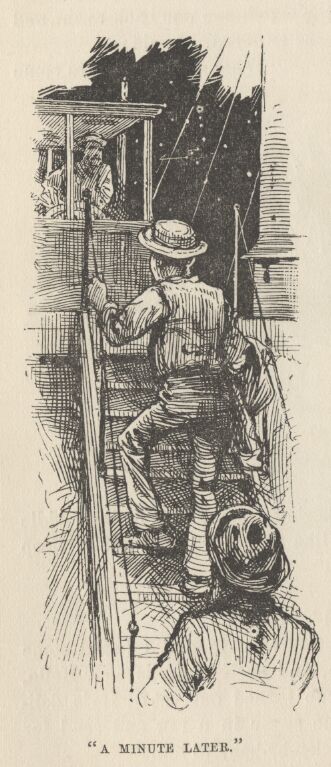
About this time Mr. Bixby appeared on the scene. Something like a minute later I was climbing the pilot-house steps with some of my clothes on and the rest in my arms. Mr. Bixby was close behind, commenting. Here was something fresh—this thing of getting up in the middle of the night to go to work. It was a detail in piloting that had never occurred to me at all. I knew that boats ran all night, but somehow I had never happened to reflect that somebody had to get up out of a warm bed to run them. I began to fear that piloting was not quite so romantic as I had imagined it was; there was something very real and work-like about this new phase of it.
Around this time, Mr. Bixby appeared. About a minute later, I was climbing the pilot-house steps, partly dressed and carrying the rest of my clothes. Mr. Bixby was close behind, commenting. Getting up in the middle of the night to go to work was something new. It was a detail of piloting that had never occurred to me at all. I knew boats ran all night. But somehow I had never stopped to think that someone had to get out of a warm bed to run them. I began to fear that piloting was not quite as romantic as I had imagined. This new side of it felt very real and much like work.
It was a rather dingy night, although a fair number of stars were out. The big mate was at the wheel, and he had the old tub pointed at a star and was holding her straight up the middle of the river. The shores on either hand were not much more than half a mile apart, but they seemed wonderfully far away and ever so vague and indistinct. The mate said:—
It was a rather gloomy night, although quite a few stars were out. The big mate was at the wheel. He had the old boat aimed at a star and was steering her straight up the middle of the river. The shores on either side were only a little more than half a mile apart. But they seemed wonderfully far away, vague, and indistinct. The mate said:
'We've got to land at Jones's plantation, sir.'
'We have to land at Jones's plantation, sir.'
The vengeful spirit in me exulted. I said to myself, I wish you joy of your job, Mr. Bixby; you'll have a good time finding Mr. Jones's plantation such a night as this; and I hope you never will find it as long as you live.
My vengeful spirit rejoiced. I said to myself, Good luck with your job, Mr. Bixby. You'll have a great time finding Mr. Jones's plantation on a night like this. And I hope you never do find it as long as you live.
Mr. Bixby said to the mate:—
Mr. Bixby said to the mate:
'Upper end of the plantation, or the lower?'
'At the upper end of the plantation, or the lower end?'
'Upper.'
'Upper.'
'I can't do it. The stumps there are out of water at this stage: It's no great distance to the lower, and you'll have to get along with that.'
'I can't do it. The stumps there are above the water at this water level. It's not far to the lower one, and you'll have to make do with that.'
'All right, sir. If Jones don't like it he'll have to lump it, I reckon.'
'All right, sir. If Jones doesn't like it, I guess he'll have to put up with it.'
And then the mate left. My exultation began to cool and my wonder to come up. Here was a man who not only proposed to find this plantation on such a night, but to find either end of it you preferred. I dreadfully wanted to ask a question, but I was carrying about as many short answers as my cargo-room would admit of, so I held my peace. All I desired to ask Mr. Bixby was the simple question whether he was ass enough to really imagine he was going to find that plantation on a night when all plantations were exactly alike and all the same color. But I held in. I used to have fine inspirations of prudence in those days.
Then the mate left. My excitement began to fade, and my wonder grew. Here was a man who planned to find this plantation on such a night. He even planned to find whichever end of the plantation you preferred. I desperately wanted to ask a question. But I had already received about as many short answers as my cargo hold could contain, so I kept quiet. All I wanted to ask Mr. Bixby was a simple question. Was he really fool enough to think he could find that plantation on a night when all plantations looked exactly alike and were all the same color? But I held back. In those days, I sometimes had wonderful flashes of good sense.
Mr. Bixby made for the shore and soon was scraping it, just the same as if it had been daylight. And not only that, but singing—
Mr. Bixby headed for the shore and soon was scraping along it, just as if it were daylight. And he was singing, too:
'Father in heaven, the day is declining,' etc.
'Father in heaven, the day is ending,' etc.
It seemed to me that I had put my life in the keeping of a peculiarly reckless outcast. Presently he turned on me and said:—
I felt I had placed my life in the hands of an especially reckless outcast. Soon he turned to me and said:
'What's the name of the first point above New Orleans?'
'What's the name of the first point upstream from New Orleans?'
I was gratified to be able to answer promptly, and I did. I said I didn't know.
I was pleased that I could answer right away, and I did. I said I didn't know.
'Don't know?'
'Don't know?'
This manner jolted me. I was down at the foot again, in a moment. But I had to say just what I had said before.
His manner startled me. In a moment, I was back at the bottom again. But I had to say exactly what I had said before.
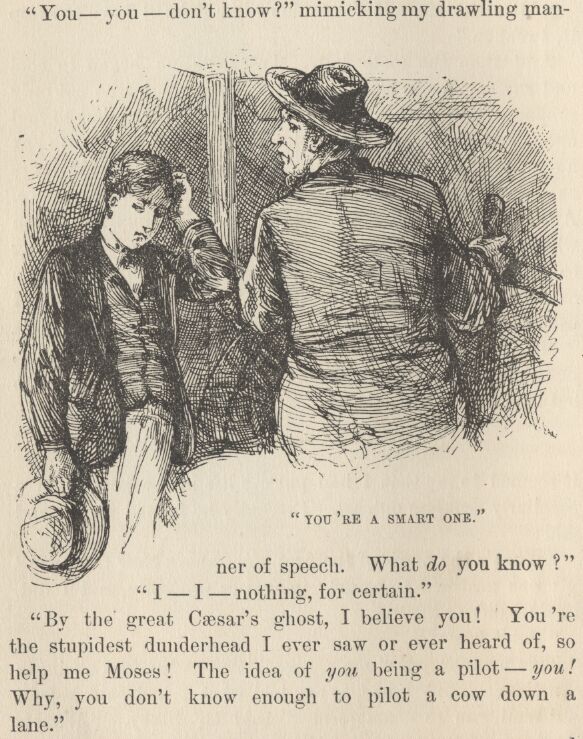
'Well, you're a smart one,' said Mr. Bixby. 'What's the name of the next point?'
'Well, you're a smart one,' said Mr. Bixby. 'What's the name of the next point?'
Once more I didn't know.
Once again, I didn't know.
'Well, this beats anything. Tell me the name of any point or place I told you.'
'Well, this beats everything. Tell me the name of any point or place I told you about.'
I studied a while and decided that I couldn't.
I thought for a while and decided I couldn't.
'Look here! What do you start out from, above Twelve-Mile Point, to cross over?'
'Look here! Above Twelve-Mile Point, where do you start from to cross over?'
'I—I—don't know.'
'I, I, don't know.'
'You—you—don't know?' mimicking my drawling manner of speech. 'What do you know?'
'You, you, don't know?' They mimicked my slow way of speaking. 'What do you know?'
'I—I—nothing, for certain.'
'I, I, nothing for certain.'
'By the great Caesar's ghost, I believe you! You're the stupidest dunderhead I ever saw or ever heard of, so help me Moses! The idea of you being a pilot—you! Why, you don't know enough to pilot a cow down a lane.'
'By Caesar's ghost, I believe you! You're the stupidest fool I've ever seen or heard of, so help me Moses! You, a pilot! You don't know enough to lead a cow down a lane.'
Oh, but his wrath was up! He was a nervous man, and he shuffled from one side of his wheel to the other as if the floor was hot. He would boil a while to himself, and then overflow and scald me again.
Oh, but he was furious! He was a nervous man, and he shuffled from one side of his wheel to the other as if the floor were hot. He would boil silently for a while, then overflow and scald me again.
'Look here! What do you suppose I told you the names of those points for?'
'Look here! Why do you think I told you the names of those points?'
I tremblingly considered a moment, and then the devil of temptation provoked me to say:—
I trembled as I thought for a moment, and then the devil of temptation urged me to say:
'Well—to—to—be entertaining, I thought.'
'Well, to, to, be entertaining, I thought.'
This was a red rag to the bull. He raged and stormed so (he was crossing the river at the time) that I judge it made him blind, because he ran over the steering-oar of a trading-scow. Of course the traders sent up a volley of red-hot profanity. Never was a man so grateful as Mr. Bixby was: because he was brim full, and here were subjects who would talk back. He threw open a window, thrust his head out, and such an irruption followed as I never had heard before. The fainter and farther away the scowmen's curses drifted, the higher Mr. Bixby lifted his voice and the weightier his adjectives grew. When he closed the window he was empty. You could have drawn a seine through his system and not caught curses enough to disturb your mother with. Presently he said to me in the gentlest way—
This was like waving a red flag at a bull. He was crossing the river at the time, and he raged and stormed so much that I suppose it blinded him. He ran over the steering oar of a trading scow. Of course, the traders let loose a volley of scorching curses. No man was ever as grateful as Mr. Bixby. He was full to bursting, and here were people who would talk back. He threw open a window and stuck his head out. What poured out of him was like nothing I had ever heard before. As the scowmen’s curses grew fainter and drifted farther away, Mr. Bixby raised his voice higher and made his adjectives stronger. When he closed the window, he was empty. You could have dragged a fishing net through his system and not caught enough curses to upset your mother. Soon he said to me in the gentlest way:
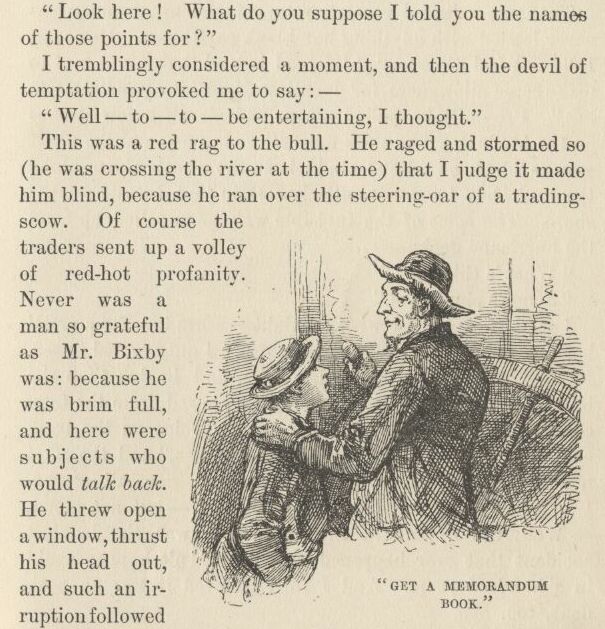
'My boy, you must get a little memorandum book, and every time I tell you a thing, put it down right away. There's only one way to be a pilot, and that is to get this entire river by heart. You have to know it just like A B C.'
'My boy, get a small notebook and write down everything I tell you right away. There is only one way to become a pilot. You have to memorize the entire river. You have to know it as well as you know your ABCs.'
That was a dismal revelation to me; for my memory was never loaded with anything but blank cartridges. However, I did not feel discouraged long. I judged that it was best to make some allowances, for doubtless Mr. Bixby was 'stretching.' Presently he pulled a rope and struck a few strokes on the big bell. The stars were all gone now, and the night was as black as ink. I could hear the wheels churn along the bank, but I was not entirely certain that I could see the shore. The voice of the invisible watchman called up from the hurricane deck—
That was a gloomy discovery, because my memory had never been loaded with anything but blank cartridges. But I didn't stay discouraged for long. I decided to make some allowances, since Mr. Bixby was surely 'exaggerating.' Soon he pulled a rope and struck the big bell a few times. The stars were all gone now, and the night was as black as ink. I could hear the wheels churning along the bank, but I wasn't completely sure I could see the shore. The unseen watchman called up from the hurricane deck:
'What's this, sir?'
'What's this, sir?'
'Jones's plantation.'
'Jones's plantation.'
I said to myself, I wish I might venture to offer a small bet that it isn't. But I did not chirp. I only waited to see. Mr. Bixby handled the engine bells, and in due time the boat's nose came to the land, a torch glowed from the forecastle, a man skipped ashore, a darky's voice on the bank said, 'Gimme de k'yarpet-bag, Mars' Jones,' and the next moment we were standing up the river again, all serene. I reflected deeply awhile, and then said—but not aloud—'Well, the finding of that plantation was the luckiest accident that ever happened; but it couldn't happen again in a hundred years.' And I fully believed it was an accident, too.
I said to myself, I wish I dared to bet a little that it isn't. But I didn't say a word. I just waited to see. Mr. Bixby worked the engine bells, and soon the boat's nose reached the shore. A torch glowed at the front of the boat, and a man hopped ashore. A Black man's voice on the bank said, 'Give me the carpetbag, Master Jones.' A moment later we were heading upriver again, as calmly as ever. I thought hard for a while. Then I said to myself, 'Well, finding that plantation was the luckiest accident that ever happened. But it couldn't happen again in a hundred years.' And I really did believe it was an accident.
By the time we had gone seven or eight hundred miles up the river, I had learned to be a tolerably plucky up-stream steersman, in daylight, and before we reached St. Louis I had made a trifle of progress in night-work, but only a trifle. I had a note-book that fairly bristled with the names of towns, 'points,' bars, islands, bends, reaches, etc.; but the information was to be found only in the notebook—none of it was in my head. It made my heart ache to think I had only got half of the river set down; for as our watch was four hours off and four hours on, day and night, there was a long four-hour gap in my book for every time I had slept since the voyage began.
By the time we had gone seven or eight hundred miles upriver, I had become a fairly confident upstream steersman in daylight. Before we reached St. Louis, I had made a little progress at night, but only a little. My notebook was packed with the names of towns, 'points,' sandbars, islands, bends, reaches, and so on. But all that information was in the notebook. None of it was in my head. It made my heart ache to think I had recorded only half the river. Our watch was four hours off and four hours on, day and night. So my notebook had a long four-hour gap for every time I had slept since the voyage began.
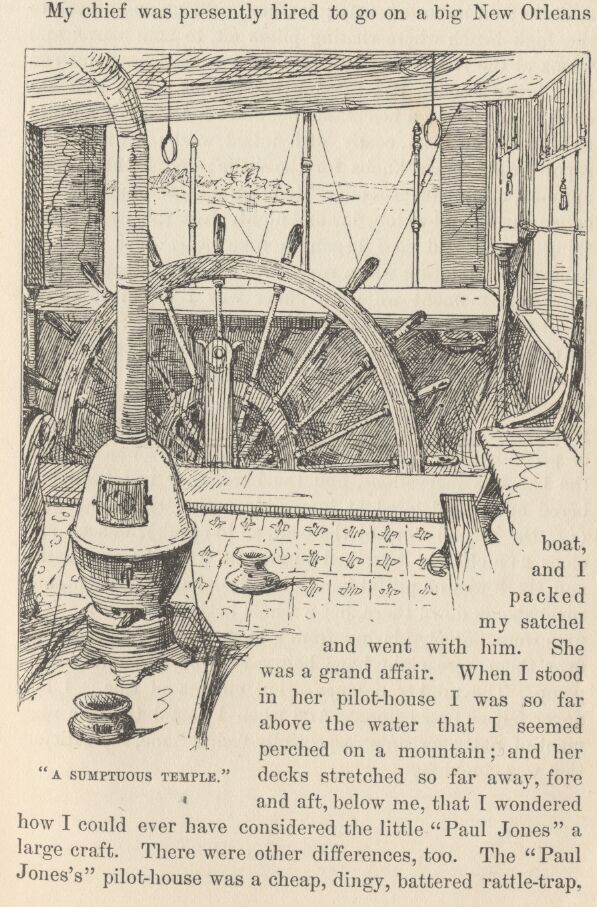
My chief was presently hired to go on a big New Orleans boat, and I packed my satchel and went with him. She was a grand affair. When I stood in her pilot-house I was so far above the water that I seemed perched on a mountain; and her decks stretched so far away, fore and aft, below me, that I wondered how I could ever have considered the little 'Paul Jones' a large craft. There were other differences, too. The 'Paul Jones's' pilot-house was a cheap, dingy, battered rattle-trap, cramped for room: but here was a sumptuous glass temple; room enough to have a dance in; showy red and gold window-curtains; an imposing sofa; leather cushions and a back to the high bench where visiting pilots sit, to spin yarns and 'look at the river;' bright, fanciful 'cuspadores' instead of a broad wooden box filled with sawdust; nice new oil-cloth on the floor; a hospitable big stove for winter; a wheel as high as my head, costly with inlaid work; a wire tiller-rope; bright brass knobs for the bells; and a tidy, white-aproned, black 'texas-tender,' to bring up tarts and ices and coffee during mid-watch, day and night. Now this was 'something like,' and so I began to take heart once more to believe that piloting was a romantic sort of occupation after all. The moment we were under way I began to prowl about the great steamer and fill myself with joy. She was as clean and as dainty as a drawing-room; when I looked down her long, gilded saloon, it was like gazing through a splendid tunnel; she had an oil-picture, by some gifted sign-painter, on every stateroom door; she glittered with no end of prism-fringed chandeliers; the clerk's office was elegant, the bar was marvelous, and the bar-keeper had been barbered and upholstered at incredible cost. The boiler deck (i.e. the second story of the boat, so to speak) was as spacious as a church, it seemed to me; so with the forecastle; and there was no pitiful handful of deckhands, firemen, and roustabouts down there, but a whole battalion of men. The fires were fiercely glaring from a long row of furnaces, and over them were eight huge boilers! This was unutterable pomp. The mighty engines—but enough of this. I had never felt so fine before. And when I found that the regiment of natty servants respectfully 'sir'd' me, my satisfaction was complete.
My boss was soon hired to work on a big New Orleans boat, and I packed my satchel and went with him. She was a magnificent boat. Standing in her pilot-house, I was so high above the water that I felt perched on a mountain. Her decks stretched so far below me, from bow to stern, that I wondered how I had ever considered the little 'Paul Jones' a large boat. There were other differences, too. The 'Paul Jones's' pilot-house was a cheap, dingy, battered, cramped rattletrap. But here was a lavish glass temple, with enough room for a dance. It had showy red and gold window curtains and an impressive sofa. The high bench where visiting pilots sat to tell stories and 'look at the river' had leather cushions and a backrest. There were bright, fancy 'cuspadores' instead of a wide wooden box filled with sawdust. The floor had nice new oilcloth, and a big, welcoming stove stood ready for winter. The wheel was as tall as I was and decorated with expensive inlaid work. There was a wire tiller-rope, bright brass knobs for the bells, and a tidy black 'texas-tender' in a white apron. He brought up tarts, ices, and coffee during the middle watch, day and night. Now this was 'something like,' and I began to believe again that piloting was a romantic occupation after all. The moment we got under way, I began exploring the great steamer, filling myself with joy. She was as clean and neat as a drawing-room. Looking down her long, gilded saloon was like looking through a splendid tunnel. Every stateroom door had an oil painting by some gifted sign painter. The boat glittered with countless chandeliers hung with prisms. The clerk's office was elegant, the bar was marvelous, and the bar-keeper had been barbered and upholstered at incredible cost. The boiler deck, the boat's second story, so to speak, seemed as spacious as a church. So did the forecastle. There was no pitiful handful of deckhands, firemen, and roustabouts down there, but a whole battalion of men. Fires glared fiercely from a long row of furnaces, and above them were eight huge boilers! This was splendor beyond words. The mighty engines, but enough of this. I had never felt so fine before. And when I found that the regiment of smartly dressed servants respectfully called me 'sir,' my satisfaction was complete.