Chapter 59
Legends and Scenery
WE added several passengers to our list, at La Crosse; among others an old gentleman who had come to this north-western region with the early settlers, and was familiar with every part of it. Pardonably proud of it, too. He said—
We took on several passengers at La Crosse. One was an old man who had come to this northwestern region with the early settlers. He knew every part of the region. He was proud of it, too, and understandably so. He said:
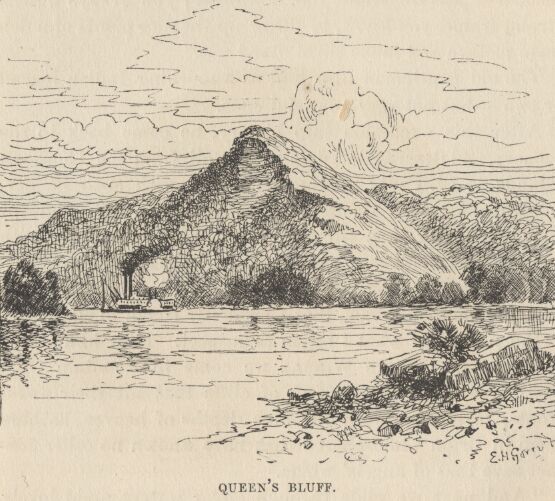
'You'll find scenery between here and St. Paul that can give the Hudson points. You'll have the Queen's Bluff—seven hundred feet high, and just as imposing a spectacle as you can find anywheres; and Trempeleau Island, which isn't like any other island in America, I believe, for it is a gigantic mountain, with precipitous sides, and is full of Indian traditions, and used to be full of rattlesnakes; if you catch the sun just right there, you will have a picture that will stay with you. And above Winona you'll have lovely prairies; and then come the Thousand Islands, too beautiful for anything; green? why you never saw foliage so green, nor packed so thick; it's like a thousand plush cushions afloat on a looking-glass—when the water 's still; and then the monstrous bluffs on both sides of the river—ragged, rugged, dark-complected—just the frame that's wanted; you always want a strong frame, you know, to throw up the nice points of a delicate picture and make them stand out.'
'You'll find scenery between here and St. Paul that can rival the Hudson. You'll see Queen's Bluff, seven hundred feet high and as impressive a sight as you can find anywhere. Then there's Trempeleau Island, which I believe is unlike any other island in America. It's a gigantic mountain with steep sides. It's full of Native American traditions, and it used to be full of rattlesnakes. If you catch the sun just right there, you'll have a picture that will stay with you. Above Winona, you'll see lovely prairies. Then come the Thousand Islands, too beautiful for words. Green? Why, you've never seen foliage so green or so thickly packed. When the water is still, the islands look like a thousand plush cushions floating on a mirror. And the huge bluffs on both sides of the river are ragged, rugged, and dark. They're just the frame the picture needs. You always want a strong frame, you know, to bring out the fine points of a delicate picture.'
The old gentleman also told us a touching Indian legend or two—but not very powerful ones.
The old man also told us a touching Native American legend or two, but they were not very powerful.
After this excursion into history, he came back to the scenery, and described it, detail by detail, from the Thousand Islands to St. Paul; naming its names with such facility, tripping along his theme with such nimble and confident ease, slamming in a three-ton word, here and there, with such a complacent air of 't isn't-anything,-I-can-do-it-any-time-I-want-to, and letting off fine surprises of lurid eloquence at such judicious intervals, that I presently began to suspect—
After this trip into history, he returned to the scenery. He described it detail by detail, from the Thousand Islands to St. Paul. He named each place so effortlessly and moved through his subject with such nimble confidence. Here and there, he tossed in a three-ton word, looking as if to say, “It’s nothing. I can do it anytime I want.” At just the right intervals, he also let loose fine surprises of flamboyant eloquence. Before long, I began to suspect...
But no matter what I began to suspect. Hear him—
But never mind what I began to suspect. Listen to him:
'Ten miles above Winona we come to Fountain City, nestling sweetly at the feet of cliffs that lift their awful fronts, Jovelike, toward the blue depths of heaven, bathing them in virgin atmospheres that have known no other contact save that of angels' wings.
'Ten miles upstream from Winona, we come to Fountain City, nestled sweetly at the foot of towering cliffs. Like Jove, the cliffs lift their awe-inspiring faces toward the blue depths of heaven. Their faces are bathed in untouched air that has known no contact except the wings of angels.
'And next we glide through silver waters, amid lovely and stupendous aspects of nature that attune our hearts to adoring admiration, about twelve miles, and strike Mount Vernon, six hundred feet high, with romantic ruins of a once first-class hotel perched far among the cloud shadows that mottle its dizzy heights—sole remnant of once-flourishing Mount Vernon, town of early days, now desolate and utterly deserted.
'Next, we glide for about twelve miles through silver waters, surrounded by beautiful, majestic scenery that fills our hearts with worshipful admiration. Then we reach Mount Vernon, which rises six hundred feet high. The romantic ruins of a once first-class hotel perch high on its dizzying slopes, mottled by cloud shadows. They are all that remain of the once-flourishing town of Mount Vernon, founded in the early days and now desolate and completely deserted.
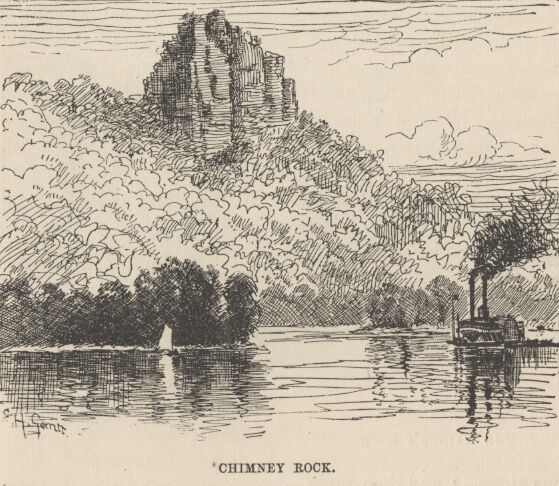
'And so we move on. Past Chimney Rock we fly—noble shaft of six hundred feet; then just before landing at Minnieska our attention is attracted by a most striking promontory rising over five hundred feet—the ideal mountain pyramid. Its conic shape—thickly-wooded surface girding its sides, and its apex like that of a cone, cause the spectator to wonder at nature's workings. From its dizzy heights superb views of the forests, streams, bluffs, hills and dales below and beyond for miles are brought within its focus. What grander river scenery can be conceived, as we gaze upon this enchanting landscape, from the uppermost point of these bluffs upon the valleys below? The primeval wildness and awful loneliness of these sublime creations of nature and nature's God, excite feelings of unbounded admiration, and the recollection of which can never be effaced from the memory, as we view them in any direction.
'And so we move on. We fly past Chimney Rock, a magnificent pillar six hundred feet high. Just before landing at Minnieska, we notice a striking promontory rising over five hundred feet. It is the ideal mountain pyramid. Its cone shape, densely wooded sides, and pointed summit make the viewer marvel at nature's work. From its dizzying heights, superb views stretch for miles across forests, streams, bluffs, hills, and valleys. As we gaze down on this enchanting landscape from the tops of these bluffs, what grander river scenery can we imagine? In every direction, the ancient wildness and awe-inspiring loneliness of these sublime creations of nature and nature's God fill us with boundless admiration. Their memory can never be erased.
'Next we have the Lion's Head and the Lioness's Head, carved by nature's hand, to adorn and dominate the beauteous stream; and then anon the river widens, and a most charming and magnificent view of the valley before us suddenly bursts upon our vision; rugged hills, clad with verdant forests from summit to base, level prairie lands, holding in their lap the beautiful Wabasha, City of the Healing Waters, puissant foe of Bright's disease, and that grandest conception of nature's works, incomparable Lake Pepin—these constitute a picture whereon the tourist's eye may gaze uncounted hours, with rapture unappeased and unappeasable.
'Next we come to the Lion's Head and the Lioness's Head, carved by nature to adorn and overlook the beautiful river. Soon the river widens, and a charming and magnificent view of the valley suddenly opens before us. Rugged hills are covered with green forests from top to bottom. Level prairies cradle beautiful Wabasha, City of the Healing Waters, a powerful foe of Bright's disease. And there is incomparable Lake Pepin, the grandest of nature's creations. Together, they make a picture a tourist may gaze upon for countless hours, with delight that never fades and can never be satisfied.
'And so we glide along; in due time encountering those majestic domes, the mighty Sugar Loaf, and the sublime Maiden's Rock—which latter, romantic superstition has invested with a voice; and oft-times as the birch canoe glides near, at twilight, the dusky paddler fancies he hears the soft sweet music of the long-departed Winona, darling of Indian song and story.
'And so we glide along, eventually coming upon those majestic domes, the mighty Sugar Loaf and the sublime Maiden's Rock. Romantic superstition has given Maiden's Rock a voice. Often, as a birch canoe glides near at twilight, its dark-skinned paddler imagines hearing soft, sweet music. It is the music of the long-dead Winona, the darling of Indian songs and stories.
'Then Frontenac looms upon our vision, delightful resort of jaded summer tourists; then progressive Red Wing; and Diamond Bluff, impressive and preponderous in its lone sublimity; then Prescott and the St. Croix; and anon we see bursting upon us the domes and steeples of St. Paul, giant young chief of the North, marching with seven-league stride in the van of progress, banner-bearer of the highest and newest civilization, carving his beneficent way with the tomahawk of commercial enterprise, sounding the warwhoop of Christian culture, tearing off the reeking scalp of sloth and superstition to plant there the steam-plow and the school-house—ever in his front stretch arid lawlessness, ignorance, crime, despair; ever in his wake bloom the jail, the gallows, and the pulpit; and ever—'
'Then Frontenac comes into view, a delightful resort for weary summer tourists. Next comes progressive Red Wing, followed by Diamond Bluff, massive and impressive in its solitary grandeur. Then come Prescott and the St. Croix. Soon the domes and steeples of St. Paul burst into view. St. Paul is the giant young chief of the North, marching at the head of progress with seven-league strides. He carries the banner of the highest and newest civilization. He cuts his benevolent path with the tomahawk of commercial enterprise and sounds the war cry of Christian culture. He tears off the bloody scalp of laziness and superstition, planting the steam plow and the schoolhouse in its place. Ahead of him always stretch barren lawlessness, ignorance, crime, and despair. Behind him always bloom the jail, the gallows, and the pulpit. And always...'
'Have you ever traveled with a panorama?'
'Have you ever traveled with a panorama?'
'I have formerly served in that capacity.'
'I have done that job before.'
My suspicion was confirmed.
My suspicion was confirmed.
'Do you still travel with it?'
'Do you still travel with it?'
'No, she is laid up till the fall season opens. I am helping now to work up the materials for a Tourist's Guide which the St. Louis and St. Paul Packet Company are going to issue this summer for the benefit of travelers who go by that line.'
'No, she is out of service until the fall season begins. I am now helping prepare materials for a Tourist's Guide. The St. Louis and St. Paul Packet Company plans to publish it this summer for travelers who use that line.'
'When you were talking of Maiden's Rock, you spoke of the long-departed Winona, darling of Indian song and story. Is she the maiden of the rock?—and are the two connected by legend?'
'When you were talking about Maiden's Rock, you mentioned Winona, who died long ago and is beloved in Native American songs and stories. Is she the maiden of the rock? Are Winona and Maiden's Rock connected by a legend?'
'Yes, and a very tragic and painful one. Perhaps the most celebrated, as well as the most pathetic, of all the legends of the Mississippi.'
'Yes, and a very tragic and painful one. Perhaps it is the most famous and the saddest of all the Mississippi legends.'
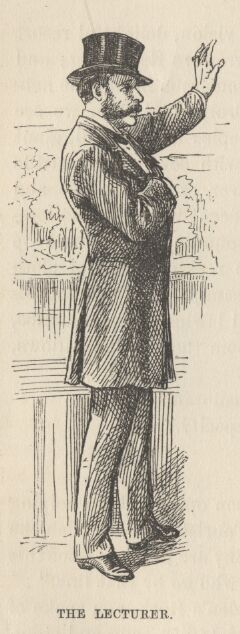
We asked him to tell it. He dropped out of his conversational vein and back into his lecture-gait without an effort, and rolled on as follows—
We asked him to tell it. He effortlessly switched from conversation back into lecture mode and rolled on as follows:
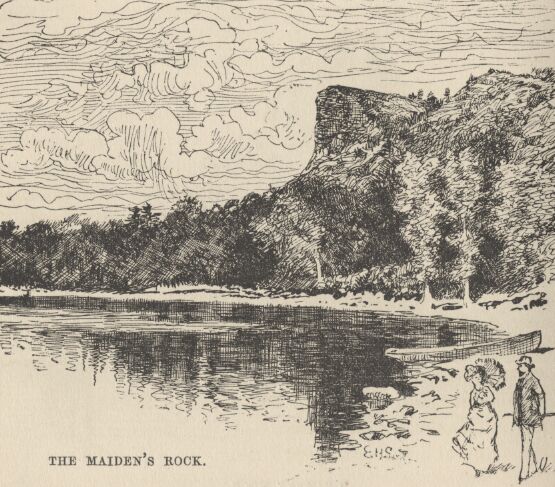
'A little distance above Lake City is a famous point known as Maiden's Rock, which is not only a picturesque spot, but is full of romantic interest from the event which gave it its name, Not many years ago this locality was a favorite resort for the Sioux Indians on account of the fine fishing and hunting to be had there, and large numbers of them were always to be found in this locality. Among the families which used to resort here, was one belonging to the tribe of Wabasha. We-no-na (first-born) was the name of a maiden who had plighted her troth to a lover belonging to the same band. But her stern parents had promised her hand to another, a famous warrior, and insisted on her wedding him. The day was fixed by her parents, to her great grief. She appeared to accede to the proposal and accompany them to the rock, for the purpose of gathering flowers for the feast. On reaching the rock, We-no-na ran to its summit and standing on its edge upbraided her parents who were below, for their cruelty, and then singing a death-dirge, threw herself from the precipice and dashed them in pieces on the rock below.'
'A short distance above Lake City is a famous point called Maiden's Rock. It is a picturesque spot, made even more romantic by the event that gave it its name. Not many years ago, the Sioux Indians favored the area for its fine fishing and hunting. Large numbers of them could always be found there. One of the families that came there belonged to the tribe of Wabasha. A maiden named We-no-na (first-born) had pledged to marry a lover from the same band. But her stern parents had promised her hand to another man, a famous warrior, and insisted that she marry him. They set the wedding day, much to her grief. She seemed to agree and went with them to the rock to gather flowers for the feast. When they reached the rock, We-no-na ran to the top. Standing at its edge, she scolded her parents below for their cruelty. Then, singing a death song, she threw herself from the cliff and dashed them to pieces on the rock below.'
'Dashed who in pieces—her parents?'
'Who was smashed to pieces? Her parents?'
'Yes.'
'Yes.'
'Well, it certainly was a tragic business, as you say. And moreover, there is a startling kind of dramatic surprise about it which I was not looking for. It is a distinct improvement upon the threadbare form of Indian legend. There are fifty Lover's Leaps along the Mississippi from whose summit disappointed Indian girls have jumped, but this is the only jump in the lot hat turned out in the right and satisfactory way. What became of Winona?'
'Well, it certainly was a tragic affair, as you say. And it has a startling dramatic twist that I didn't expect. It is a clear improvement on the worn-out form of Indian legend. There are fifty Lover's Leaps along the Mississippi where disappointed Indian girls have jumped from the top. But this is the only jump of the lot that turned out the right and satisfying way. What happened to Winona?'
'She was a good deal jarred up and jolted: but she got herself together and disappeared before the coroner reached the fatal spot; and 'tis said she sought and married her true love, and wandered with him to some distant clime, where she lived happy ever after, her gentle spirit mellowed and chastened by the romantic incident which had so early deprived her of the sweet guidance of a mother's love and a father's protecting arm, and thrown her, all unfriended, upon the cold charity of a censorious world.'
'She was badly shaken and jolted, but she pulled herself together. She disappeared before the coroner reached the fatal spot. It is said that she found and married her true love, and they wandered off to some distant land. There she lived happily ever after. The romantic incident softened and humbled her gentle spirit. It had deprived her early in life of the sweet guidance of a mother's love and a father's protection. It had also left her friendless, at the mercy of a cold and judgmental world.'
I was glad to hear the lecturer's description of the scenery, for it assisted my appreciation of what I saw of it, and enabled me to imagine such of it as we lost by the intrusion of night.
I was glad to hear the lecturer describe the scenery. His description helped me appreciate what I saw and imagine what we missed when night fell.
As the lecturer remarked, this whole region is blanketed with Indian tales and traditions. But I reminded him that people usually merely mention this fact—doing it in a way to make a body's mouth water—and judiciously stopped there. Why? Because the impression left, was that these tales were full of incident and imagination—a pleasant impression which would be promptly dissipated if the tales were told. I showed him a lot of this sort of literature which I had been collecting, and he confessed that it was poor stuff, exceedingly sorry rubbish; and I ventured to add that the legends which he had himself told us were of this character, with the single exception of the admirable story of Winona. He granted these facts, but said that if I would hunt up Mr. Schoolcraft's book, published near fifty years ago, and now doubtless out of print, I would find some Indian inventions in it that were very far from being barren of incident and imagination; that the tales in Hiawatha were of this sort, and they came from Schoolcraft's book; and that there were others in the same book which Mr. Longfellow could have turned into verse with good effect. For instance, there was the legend of 'The Undying Head.' He could not tell it, for many of the details had grown dim in his memory; but he would recommend me to find it and enlarge my respect for the Indian imagination. He said that this tale, and most of the others in the book, were current among the Indians along this part of the Mississippi when he first came here; and that the contributors to Schoolcraft's book had got them directly from Indian lips, and had written them down with strict exactness, and without embellishments of their own.
As the lecturer said, this whole region is covered with Indian tales and traditions. But I reminded him that people usually just mention this fact, making your mouth water, and wisely stop there. Why? Because they leave the pleasant impression that these tales are full of action and imagination. That impression would quickly disappear if they actually told the tales. I showed him a collection of such literature I had gathered. He admitted that it was poor stuff, extremely sorry rubbish. I ventured to add that the legends he had told us were just as bad, except for the admirable story of Winona. He agreed, but said I should look up Mr. Schoolcraft's book. It had been published nearly fifty years earlier and was doubtless out of print. If I found it, he said, I would discover some Indian stories far from lacking in action and imagination. The tales in Hiawatha were of this kind, and they came from Schoolcraft's book. He said the book contained other tales that Mr. Longfellow could have turned into verse to good effect. One example was the legend of 'The Undying Head.' He could not tell it because many details had faded from his memory. But he recommended that I find it and increase my respect for the Indian imagination. He said that this tale and most of the others in the book were current among the Indians along this part of the Mississippi when he first came here. The contributors to Schoolcraft's book had heard them directly from Indians. They had written them down with strict accuracy, without adding any embellishments of their own.
I have found the book. The lecturer was right. There are several legends in it which confirm what he said. I will offer two of them—'The Undying Head,' and 'Peboan and Seegwun, an Allegory of the Seasons.' The latter is used in Hiawatha; but it is worth reading in the original form, if only that one may see how effective a genuine poem can be without the helps and graces of poetic measure and rhythm—
I have found the book. The lecturer was right. Several legends in the book confirm what he said. I will share two of them: 'The Undying Head,' and 'Peboan and Seegwun, an Allegory of the Seasons.' The second legend is used in Hiawatha. But it is worth reading in its original form. Even if only to see how effective a genuine poem can be without the help and grace of poetic meter and rhythm.
PEBOAN AND SEEGWUN.
PEBOAN AND SEEGWUN.
An old man was sitting alone in his lodge, by the side of a frozen stream. It was the close of winter, and his fire was almost out, He appeared very old and very desolate. His locks were white with age, and he trembled in every joint. Day after day passed in solitude, and he heard nothing but the sound of the tempest, sweeping before it the new-fallen snow.
An old man sat alone in his lodge beside a frozen stream. Winter was nearly over, and his fire was almost out. He looked very old and lonely. His hair was white with age, and every joint trembled. Day after day, he was alone. He heard nothing but the storm sweeping the freshly fallen snow before it.
One day, as his fire was just dying, a handsome young man approached and entered his dwelling. His cheeks were red with the blood of youth, his eyes sparkled with animation, and a smile played upon his lips. He walked with a light and quick step. His forehead was bound with a wreath of sweet grass, in place of a warrior's frontlet, and he carried a bunch of flowers in his hand.
One day, just as his fire was dying out, a handsome young man approached and entered his home. His cheeks were red with youth, his eyes sparkled with energy, and a smile played on his lips. He walked with quick, light steps. A wreath of sweet grass circled his forehead instead of a warrior's headband, and he carried a bunch of flowers.
'Ah, my son,' said the old man, 'I am happy to see you. Come in. Come and tell me of your adventures, and what strange lands you have been to see. Let us pass the night together. I will tell you of my prowess and exploits, and what I can perform. You shall do the same, and we will amuse ourselves.'
'Ah, my son,' said the old man, 'I am happy to see you. Come in. Tell me about your adventures and the strange lands you have visited. Let us spend the night together. I will tell you about my strength, my exploits, and what I can do. You can do the same, and we will enjoy ourselves.'
He then drew from his sack a curiously wrought antique pipe, and having filled it with tobacco, rendered mild by a mixture of certain leaves, handed it to his guest. When this ceremony was concluded they began to speak.
He then took an intricately crafted antique pipe from his sack. He filled it with tobacco, made mild by a mixture of certain leaves, and handed it to his guest. When the ceremony was over, they began to speak.
'I blow my breath,' said the old man, 'and the stream stands still. The water becomes stiff and hard as clear stone.'
'I breathe out,' said the old man, 'and the stream stops flowing. The water becomes stiff and hard as clear stone.'
'I breathe,' said the young man, 'and flowers spring up over the plain.'
'I breathe,' said the young man, 'and flowers spring up across the plain.'
'I shake my locks,' retorted the old man, 'and snow covers the land. The leaves fall from the trees at my command, and my breath blows them away. The birds get up from the water, and fly to a distant land. The animals hide themselves from my breath, and the very ground becomes as hard as flint.'
'I shake my hair,' the old man replied, 'and snow covers the land. At my command, leaves fall from the trees, and my breath blows them away. The birds rise from the water and fly to a distant land. Animals hide from my breath, and even the ground becomes as hard as flint.'
'I shake my ringlets,' rejoined the young man, 'and warm showers of soft rain fall upon the earth. The plants lift up their heads out of the earth, like the eyes of children glistening with delight. My voice recalls the birds. The warmth of my breath unlocks the streams. Music fills the groves wherever I walk, and all nature rejoices.'
'I shake my curls,' the young man replied, 'and warm showers of soft rain fall on the earth. Plants lift their heads from the earth, like children's eyes shining with delight. My voice calls the birds back. My warm breath frees the streams. Wherever I walk, music fills the woods, and all nature rejoices.'
At length the sun began to rise. A gentle warmth came over the place. The tongue of the old man became silent. The robin and bluebird began to sing on the top of the lodge. The stream began to murmur by the door, and the fragrance of growing herbs and flowers came softly on the vernal breeze.
At last, the sun began to rise. A gentle warmth spread over the place. The old man fell silent. The robin and bluebird began to sing on top of the lodge. The stream began to murmur by the door. The scent of growing herbs and flowers drifted in on the gentle spring breeze.
Daylight fully revealed to the young man the character of his entertainer. When he looked upon him, he had the icy visage of Peboan.{footnote [Winter.]} Streams began to flow from his eyes. As the sun increased, he grew less and less in stature, and anon had melted completely away. Nothing remained on the place of his lodge-fire but the miskodeed,{footnote [The trailing arbutus.]} a small white flower, with a pink border, which is one of the earliest species of northern plants.
In the full daylight, the young man could see what his host really was. When he looked at him, he saw the icy face of Peboan.{footnote [Winter.]} Streams began to flow from Peboan’s eyes. As the sun grew stronger, he grew smaller and smaller, until he melted away completely. All that remained where his lodge fire had been was the miskodeed,{footnote [The trailing arbutus.]} a small white flower with a pink border. It is one of the earliest northern plants to appear.
'The Undying Head' is a rather long tale, but it makes up in weird conceits, fairy-tale prodigies, variety of incident, and energy of movement, for what it lacks in brevity.{footnote [See appendix D.]}
'The Undying Head' is a rather long tale. But it makes up for its length with strange ideas, fairy-tale wonders, varied events, and lively action.{footnote [See appendix D.]}