Chapter 60
Thoughts and Conclusions
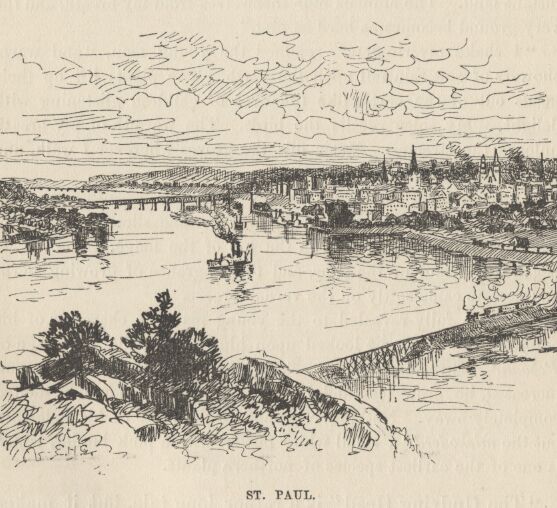
WE reached St. Paul, at the head of navigation of the Mississippi, and there our voyage of two thousand miles from New Orleans ended. It is about a ten-day trip by steamer. It can probably be done quicker by rail. I judge so because I know that one may go by rail from St. Louis to Hannibal—a distance of at least a hundred and twenty miles—in seven hours. This is better than walking; unless one is in a hurry.
We reached St. Paul, the farthest point on the Mississippi that boats can navigate. There our 2,000-mile voyage from New Orleans ended. The trip takes about ten days by steamboat. You can probably do it faster by train. I think so because I know you can travel by train from St. Louis to Hannibal in seven hours. That is a distance of at least 120 miles. Taking the train is better than walking, unless you are in a hurry.
The season being far advanced when we were in New Orleans, the roses and magnolia blossoms were falling; but here in St. Paul it was the snow, In New Orleans we had caught an occasional withering breath from over a crater, apparently; here in St. Paul we caught a frequent benumbing one from over a glacier, apparently.
The season was well along when we were in New Orleans, and the roses and magnolia blossoms were falling. But here in St. Paul, snow was falling. In New Orleans, we occasionally felt a scorching breeze, apparently from over a crater. Here in St. Paul, we often felt a numbing breeze, apparently from over a glacier.
But I wander from my theme. St. Paul is a wonderful town. It is put together in solid blocks of honest brick and stone, and has the air of intending to stay. Its post-office was established thirty-six years ago; and by and by, when the postmaster received a letter, he carried it to Washington, horseback, to inquire what was to be done with it. Such is the legend. Two frame houses were built that year, and several persons were added to the population. A recent number of the leading St. Paul paper, the 'Pioneer Press,' gives some statistics which furnish a vivid contrast to that old state of things, to wit: Population, autumn of the present year (1882), 71,000; number of letters handled, first half of the year, 1,209,387; number of houses built during three-quarters of the year, 989; their cost, $3,186,000. The increase of letters over the corresponding six months of last year was fifty per cent. Last year the new buildings added to the city cost above $4,500,000. St. Paul's strength lies in her commerce—I mean his commerce. He is a manufacturing city, of course—all the cities of that region are—but he is peculiarly strong in the matter of commerce. Last year his jobbing trade amounted to upwards of $52,000,000.
But I’m getting away from my subject. St. Paul is a wonderful town. It is built in solid blocks of honest brick and stone, and looks as if it intends to stay. Its post office was established thirty-six years ago. Eventually, the postmaster received a letter. He carried it on horseback to Washington to ask what he should do with it. So the legend goes. Two wooden houses were built that year, and several people were added to the population. A recent issue of St. Paul’s leading newspaper, the 'Pioneer Press,' gives statistics that sharply contrast with those early days. In the fall of this year, 1882, the population was 71,000. The post office handled 1,209,387 letters in the first half of the year. During the first three quarters of the year, 989 houses were built, at a cost of $3,186,000. The number of letters increased by fifty percent over the same six months last year. Last year, new buildings added to the city cost more than $4,500,000. St. Paul’s strength lies in her commerce. I mean his commerce. He is a manufacturing city, of course. All the cities in that region are. But he is especially strong in commerce. Last year, his wholesale trade amounted to more than $52,000,000.
He has a custom-house, and is building a costly capitol to replace the one recently burned—for he is the capital of the State. He has churches without end; and not the cheap poor kind, but the kind that the rich Protestant puts up, the kind that the poor Irish 'hired-girl' delights to erect. What a passion for building majestic churches the Irish hired-girl has. It is a fine thing for our architecture but too often we enjoy her stately fanes without giving her a grateful thought. In fact, instead of reflecting that 'every brick and every stone in this beautiful edifice represents an ache or a pain, and a handful of sweat, and hours of heavy fatigue, contributed by the back and forehead and bones of poverty,' it is our habit to forget these things entirely, and merely glorify the mighty temple itself, without vouchsafing one praiseful thought to its humble builder, whose rich heart and withered purse it symbolizes.
He has a custom house and is building an expensive capitol to replace the one that recently burned. For he is the state capital. He has churches without end, and not the cheap, poor kind. They are the kind that rich Protestants build, the kind that poor Irish 'hired-girls' love to build. What a passion the Irish hired-girl has for building majestic churches. It is good for our architecture, but too often we enjoy her stately churches without giving her a grateful thought. In fact, we forget entirely that 'every brick and every stone in this beautiful building represents an ache or a pain, a handful of sweat, and hours of hard work, contributed by the back, forehead, and bones of poverty.' Instead, we simply glorify the mighty church itself, without giving a single thought of praise to its humble builder. The church is a symbol of her generous heart and her depleted purse.
This is a land of libraries and schools. St. Paul has three public libraries, and they contain, in the aggregate, some forty thousand books. He has one hundred and sixteen school-houses, and pays out more than seventy thousand dollars a year in teachers' salaries.
This is a land of libraries and schools. St. Paul has three public libraries with about forty thousand books in total. The city has one hundred and sixteen school buildings and pays teachers more than seventy thousand dollars a year.
There is an unusually fine railway station; so large is it, in fact, that it seemed somewhat overdone, in the matter of size, at first; but at the end of a few months it was perceived that the mistake was distinctly the other way. The error is to be corrected.
There is an unusually fine railway station. At first, it seemed a little too large. But after a few months, it became clear that the mistake was the opposite. The error will be corrected.
The town stands on high ground; it is about seven hundred feet above the sea level. It is so high that a wide view of river and lowland is offered from its streets.
The town stands on high ground, about seven hundred feet above sea level. From its streets, you can see a wide stretch of river and lowland below.
It is a very wonderful town indeed, and is not finished yet. All the streets are obstructed with building material, and this is being compacted into houses as fast as possible, to make room for more—for other people are anxious to build, as soon as they can get the use of the streets to pile up their bricks and stuff in.
It is a truly wonderful town, and it is not finished yet. All the streets are blocked with building materials. The materials are being turned into houses as fast as possible to make room for more. Other people are eager to build as soon as they can use the streets to pile up their bricks and stuff.
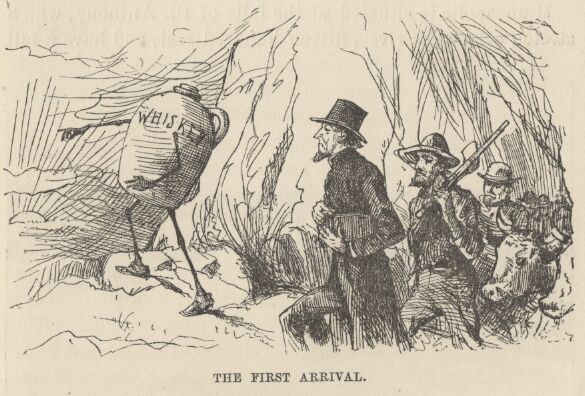
How solemn and beautiful is the thought, that the earliest pioneer of civilization, the van-leader of civilization, is never the steamboat, never the railroad, never the newspaper, never the Sabbath-school, never the missionary—but always whiskey! Such is the case. Look history over; you will see. The missionary comes after the whiskey—I mean he arrives after the whiskey has arrived; next comes the poor immigrant, with ax and hoe and rifle; next, the trader; next, the miscellaneous rush; next, the gambler, the desperado, the highwayman, and all their kindred in sin of both sexes; and next, the smart chap who has bought up an old grant that covers all the land; this brings the lawyer tribe; the vigilance committee brings the undertaker. All these interests bring the newspaper; the newspaper starts up politics and a railroad; all hands turn to and build a church and a jail—and behold, civilization is established for ever in the land. But whiskey, you see, was the van-leader in this beneficent work. It always is. It was like a foreigner—and excusable in a foreigner—to be ignorant of this great truth, and wander off into astronomy to borrow a symbol. But if he had been conversant with the facts, he would have said—
How solemn and beautiful is the thought that civilization’s first pioneer, its leader, is always whiskey! Never the steamboat, the railroad, the newspaper, the Sunday school, or the missionary. That is how it happens. Look through history and you will see. The missionary comes after the whiskey. I mean he arrives after the whiskey has arrived. Next comes the poor immigrant, with ax, hoe, and rifle. Then comes the trader, followed by the rush of all sorts of people. Next come the gambler, the desperado, the highwayman, and all their fellow sinners of both sexes. Then comes the clever fellow who has bought an old land grant covering all the land. He brings the tribe of lawyers. The vigilance committee brings the undertaker. All these interests bring the newspaper. The newspaper starts up politics and a railroad. Everyone pitches in and builds a church and a jail. And behold, civilization is established in the land forever. But whiskey, you see, led the way in this wonderful work. It always does. It was just like a foreigner to be ignorant of this great truth. And a foreigner could be excused for wandering off into astronomy to borrow a symbol. But if he had known the facts, he would have said:
Westward the Jug of Empire takes its way.
The Jug of Empire makes its way west.
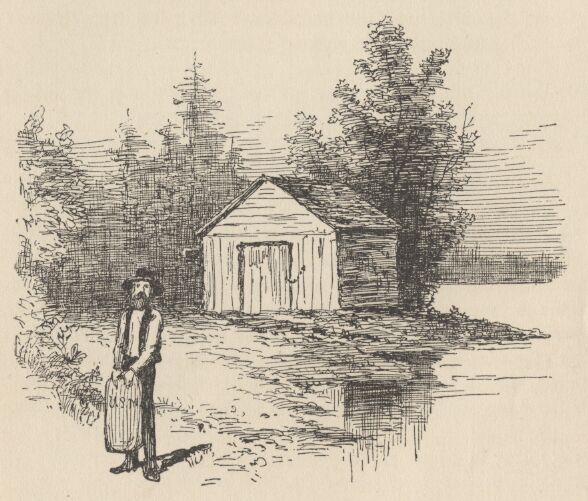
This great van-leader arrived upon the ground which St. Paul now occupies, in June 1837. Yes, at that date, Pierre Parrant, a Canadian, built the first cabin, uncorked his jug, and began to sell whiskey to the Indians. The result is before us.
This great pioneer arrived at the site of what is now St. Paul in June 1837. Yes, that was when Pierre Parrant, a Canadian, built the first cabin, uncorked his jug, and began selling whiskey to the Indians. The result is before us.
All that I have said of the newness, briskness, swift progress, wealth, intelligence, fine and substantial architecture, and general slash and go, and energy of St. Paul, will apply to his near neighbor, Minneapolis—with the addition that the latter is the bigger of the two cities.
Everything I have said about St. Paul also applies to its close neighbor, Minneapolis. Both cities are new, lively, wealthy, intelligent, and full of energy. Both are progressing rapidly and have fine, solid buildings and a vigorous, bustling spirit. Minneapolis, though, is the larger of the two.
These extraordinary towns were ten miles apart, a few months ago, but were growing so fast that they may possibly be joined now, and getting along under a single mayor. At any rate, within five years from now there will be at least such a substantial ligament of buildings stretching between them and uniting them that a stranger will not be able to tell where the one Siamese twin leaves off and the other begins. Combined, they will then number a population of two hundred and fifty thousand, if they continue to grow as they are now growing. Thus, this center of population at the head of Mississippi navigation, will then begin a rivalry as to numbers, with that center of population at the foot of it—New Orleans.
A few months ago, these extraordinary towns were ten miles apart. But they were growing so fast that they may have joined by now and may be getting along under one mayor. In any case, within five years, a solid link of buildings will stretch between them. A stranger will not be able to tell where one Siamese twin ends and the other begins. If they keep growing at their current rate, the towns will then have a combined population of 250,000. This population center at the head of Mississippi navigation will then begin to rival the population center at the foot, New Orleans.
Minneapolis is situated at the falls of St. Anthony, which stretch across the river, fifteen hundred feet, and have a fall of eighty-two feet—a waterpower which, by art, has been made of inestimable value, business-wise, though somewhat to the damage of the Falls as a spectacle, or as a background against which to get your photograph taken.
Minneapolis is located at the falls of St. Anthony. The falls stretch 1,500 feet across the river and drop 82 feet. Engineering has made their waterpower invaluable for business, though somewhat at the expense of the falls as a spectacle. They have also suffered as a backdrop for photographs.
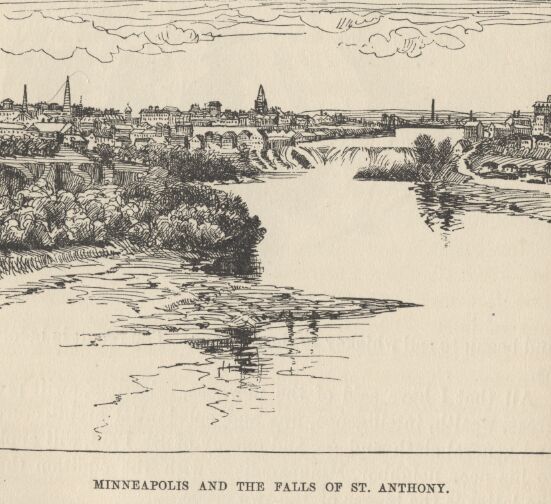
Thirty flouring-mills turn out two million barrels of the very choicest of flour every year; twenty sawmills produce two hundred million feet of lumber annually; then there are woolen mills, cotton mills, paper and oil mills; and sash, nail, furniture, barrel, and other factories, without number, so to speak. The great flouring-mills here and at St. Paul use the 'new process' and mash the wheat by rolling, instead of grinding it.
Thirty flour mills produce two million barrels of the finest flour every year. Twenty sawmills produce two hundred million feet of lumber annually. There are also woolen, cotton, paper, and oil mills. There are sash, nail, furniture, barrel, and other factories, almost too many to count. The great flour mills here and in St. Paul use the 'new process'. They crush the wheat by rolling it instead of grinding it.
Sixteen railroads meet in Minneapolis, and sixty-five passenger trains arrive and depart daily. In this place, as in St. Paul, journalism thrives. Here there are three great dailies, ten weeklies, and three monthlies.
Sixteen railroads meet in Minneapolis, and sixty-five passenger trains arrive and depart each day. Journalism thrives in Minneapolis, just as it does in St. Paul. Minneapolis has three major daily newspapers, ten weekly papers, and three monthly publications.
There is a university, with four hundred students—and, better still, its good efforts are not confined to enlightening the one sex. There are sixteen public schools, with buildings which cost $500,000; there are six thousand pupils and one hundred and twenty-eight teachers. There are also seventy churches existing, and a lot more projected. The banks aggregate a capital of $3,000,000, and the wholesale jobbing trade of the town amounts to $50,000,000 a year.
There is a university with four hundred students. Better still, it educates both men and women. There are sixteen public schools, with buildings that cost $500,000. They have six thousand pupils and one hundred and twenty-eight teachers. There are also seventy churches, and many more are planned. The banks have a combined capital of $3,000,000. The town’s wholesale trade amounts to $50,000,000 a year.
Near St. Paul and Minneapolis are several points of interest—Fort Snelling, a fortress occupying a river-bluff a hundred feet high; the falls of Minnehaha, White-bear Lake, and so forth. The beautiful falls of Minnehaha are sufficiently celebrated—they do not need a lift from me, in that direction. The White-bear Lake is less known. It is a lovely sheet of water, and is being utilized as a summer resort by the wealth and fashion of the State. It has its club-house, and its hotel, with the modern improvements and conveniences; its fine summer residences; and plenty of fishing, hunting, and pleasant drives. There are a dozen minor summer resorts around about St. Paul and Minneapolis, but the White-bear Lake is the resort. Connected with White-bear Lake is a most idiotic Indian legend. I would resist the temptation to print it here, if I could, but the task is beyond my strength. The guide-book names the preserver of the legend, and compliments his 'facile pen.' Without further comment or delay then, let us turn the said facile pen loose upon the reader—
Near St. Paul and Minneapolis are several points of interest: Fort Snelling, a fortress on a river bluff a hundred feet high, Minnehaha Falls, White-bear Lake, and so on. The beautiful Minnehaha Falls are famous enough. They don't need any help from me in that regard. White-bear Lake is less well known. It's a lovely lake, and the state's wealthy and fashionable people use it as a summer resort. It has a clubhouse and a hotel with modern improvements and conveniences. It also has fine summer homes and plenty of fishing, hunting, and pleasant drives. There are a dozen smaller summer resorts around St. Paul and Minneapolis, but White-bear Lake is the resort. White-bear Lake has a most idiotic Indian legend associated with it. I would resist the temptation to print the legend here if I could, but the task is beyond my strength. The guidebook names the person who preserved the legend and praises his 'facile pen.' So, without further comment or delay, let's turn that facile pen loose on the reader:
A LEGEND OF WHITE-BEAR LAKE.
A LEGEND OF WHITE-BEAR LAKE.
Every spring, for perhaps a century, or as long as there has been a nation of red men, an island in the middle of White-bear Lake has been visited by a band of Indians for the purpose of making maple sugar.
Every spring, perhaps for a century, or for as long as there has been a Native American nation, a group of Native Americans has visited an island in the middle of White-bear Lake to make maple sugar.
Tradition says that many springs ago, while upon this island, a young warrior loved and wooed the daughter of his chief, and it is said, also, the maiden loved the warrior. He had again and again been refused her hand by her parents, the old chief alleging that he was no brave, and his old consort called him a woman!
Tradition says that many years ago, a young warrior on this island loved and courted his chief’s daughter. It is also said that she loved him. Her parents had refused his requests to marry her again and again. The old chief claimed the warrior was not brave, and his wife called him a woman!
The sun had again set upon the 'sugar-bush,' and the bright moon rose high in the bright blue heavens, when the young warrior took down his flute and went out alone, once more to sing the story of his love, the mild breeze gently moved the two gay feathers in his head-dress, and as he mounted on the trunk of a leaning tree, the damp snow fell from his feet heavily. As he raised his flute to his lips, his blanket slipped from his well-formed shoulders, and lay partly on the snow beneath. He began his weird, wild love-song, but soon felt that he was cold, and as he reached back for his blanket, some unseen hand laid it gently on his shoulders; it was the hand of his love, his guardian angel. She took her place beside him, and for the present they were happy; for the Indian has a heart to love, and in this pride he is as noble as in his own freedom, which makes him the child of the forest. As the legend runs, a large white-bear, thinking, perhaps, that polar snows and dismal winter weather extended everywhere, took up his journey southward. He at length approached the northern shore of the lake which now bears his name, walked down the bank and made his way noiselessly through the deep heavy snow toward the island. It was the same spring ensuing that the lovers met. They had left their first retreat, and were now seated among the branches of a large elm which hung far over the lake. (The same tree is still standing, and excites universal curiosity and interest.) For fear of being detected, they talked almost in a whisper, and now, that they might get back to camp in good time and thereby avoid suspicion, they were just rising to return, when the maiden uttered a shriek which was heard at the camp, and bounding toward the young brave, she caught his blanket, but missed the direction of her foot and fell, bearing the blanket with her into the great arms of the ferocious monster. Instantly every man, woman, and child of the band were upon the bank, but all unarmed. Cries and wailings went up from every mouth. What was to be done'? In the meantime this white and savage beast held the breathless maiden in his huge grasp, and fondled with his precious prey as if he were used to scenes like this. One deafening yell from the lover warrior is heard above the cries of hundreds of his tribe, and dashing away to his wigwam he grasps his faithful knife, returns almost at a single bound to the scene of fear and fright, rushes out along the leaning tree to the spot where his treasure fell, and springing with the fury of a mad panther, pounced upon his prey. The animal turned, and with one stroke of his huge paw brought the lovers heart to heart, but the next moment the warrior, with one plunge of the blade of his knife, opened the crimson sluices of death, and the dying bear relaxed his hold.
The sun had again set on the 'sugar-bush,' and the bright moon rose high in the clear blue sky. The young warrior took down his flute and went out alone, once more to sing of his love. A gentle breeze stirred the two colorful feathers in his headdress. As he climbed onto the trunk of a leaning tree, damp snow fell heavily from his feet. He raised his flute to his lips, and his blanket slipped from his well-formed shoulders, falling partly onto the snow. He began his strange, wild love song, but soon felt cold. As he reached back for his blanket, an unseen hand gently laid it over his shoulders. It was the hand of his love, his guardian angel. She sat beside him, and for the moment they were happy. For the Indian has a heart that can love. In the pride of love he is as noble as in his freedom, which makes him a child of the forest. According to the legend, a large white bear set out on a journey south. Perhaps he thought that polar snows and gloomy winter weather reached everywhere. At last he came to the northern shore of the lake that now bears his name. He walked down the bank and made his way silently through the deep, heavy snow toward the island. The lovers met that following spring. They had left their first hiding place and were now sitting among the branches of a large elm. The tree hung far over the lake. (The same tree is still standing and arouses everyone's curiosity and interest.) They spoke almost in whispers for fear of being discovered. They were just getting up to return to camp in good time and avoid suspicion when the maiden shrieked. Her cry was heard at the camp. She sprang toward the young warrior and grabbed his blanket, but she lost her footing. She fell, taking the blanket with her, into the great arms of the ferocious beast. At once, every man, woman, and child in the band rushed to the bank, but all were unarmed. Everyone cried out and wailed. What could they do? Meanwhile, the savage white beast held the breathless maiden in his huge grasp. He fondled his precious prey as if he were used to scenes like this. One deafening yell from the warrior rose above the cries of hundreds of his tribe. He dashed to his wigwam, seized his trusty knife, and returned almost in a single leap to the terrifying scene. He ran along the leaning tree to the spot where his treasure had fallen. Then, springing with the fury of a mad panther, he pounced on the bear. The animal turned and, with one stroke of his huge paw, brought the lovers heart to heart. But the next moment, the warrior plunged his knife into the bear, opening the crimson floodgates of death. The dying bear loosened his grip.
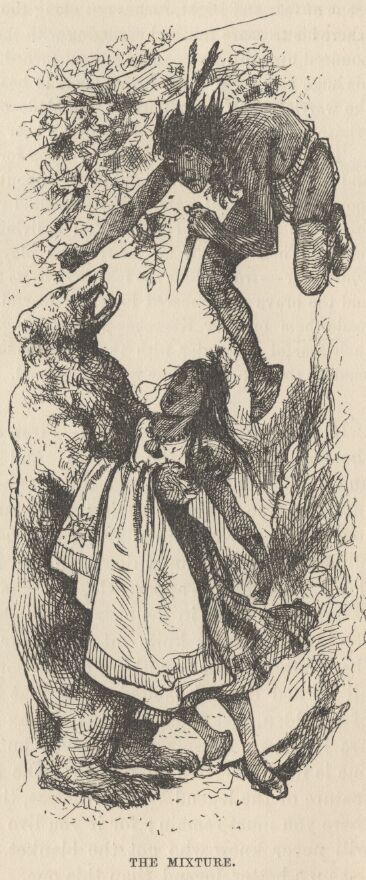
That night there was no more sleep for the band or the lovers, and as the young and the old danced about the carcass of the dead monster, the gallant warrior was presented with another plume, and ere another moon had set he had a living treasure added to his heart. Their children for many years played upon the skin of the white-bear—from which the lake derives its name—and the maiden and the brave remembered long the fearful scene and rescue that made them one, for Kis-se-me-pa and Ka-go-ka could never forget their fearful encounter with the huge monster that came so near sending them to the happy hunting-ground.
That night, neither the band nor the lovers slept again. Young and old danced around the dead monster's carcass, and the brave warrior was given another plume. Before another moon had set, a living treasure had been added to his heart. For many years, their children played on the skin of the white bear, for which the lake is named. The maiden and the warrior long remembered the terrifying scene and the rescue that brought them together. Kis-se-me-pa and Ka-go-ka could never forget their terrifying encounter with the huge monster that almost sent them to the happy hunting-ground.
It is a perplexing business. First, she fell down out of the tree—she and the blanket; and the bear caught her and fondled her—her and the blanket; then she fell up into the tree again—leaving the blanket; meantime the lover goes war-whooping home and comes back 'heeled,' climbs the tree, jumps down on the bear, the girl jumps down after him—apparently, for she was up the tree—resumes her place in the bear's arms along with the blanket, the lover rams his knife into the bear, and saves—whom, the blanket? No—nothing of the sort. You get yourself all worked up and excited about that blanket, and then all of a sudden, just when a happy climax seems imminent you are let down flat—nothing saved but the girl. Whereas, one is not interested in the girl; she is not the prominent feature of the legend. Nevertheless, there you are left, and there you must remain; for if you live a thousand years you will never know who got the blanket. A dead man could get up a better legend than this one. I don't mean a fresh dead man either; I mean a man that's been dead weeks and weeks.
It’s a puzzling story. First, she fell out of the tree, blanket and all. The bear caught her and cuddled her and the blanket. Then she fell back up into the tree, leaving the blanket behind. Meanwhile, her lover went home with a war whoop and came back armed. He climbed the tree and jumped down onto the bear. The girl apparently jumped down after him, since she had been up the tree. She took her place again in the bear’s arms, along with the blanket. The lover stabbed the bear and saved whom? The blanket? No, nothing of the sort. You get all worked up and excited about that blanket. Then, just when a happy ending seems close, you’re let down flat. Nothing is saved but the girl. Yet you aren’t interested in the girl. She isn’t the main feature of the legend. Still, that’s where the story leaves you, and there you must stay. Even if you live a thousand years, you’ll never know who got the blanket. A dead man could make up a better legend than this one. I don’t mean a freshly dead man, either. I mean a man who’s been dead for weeks and weeks.
We struck the home-trail now, and in a few hours were in that astonishing Chicago—a city where they are always rubbing the lamp, and fetching up the genii, and contriving and achieving new impossibilities. It is hopeless for the occasional visitor to try to keep up with Chicago—she outgrows his prophecies faster than he can make them. She is always a novelty; for she is never the Chicago you saw when you passed through the last time. The Pennsylvania road rushed us to New York without missing schedule time ten minutes anywhere on the route; and there ended one of the most enjoyable five-thousand-mile journeys I have ever had the good fortune to make.
We headed home, and within a few hours we were in that astonishing city, Chicago. People there are always rubbing the lamp, summoning genies, and dreaming up and achieving new impossibilities. An occasional visitor has no hope of keeping up with Chicago. The city outgrows his predictions faster than he can make them. Chicago is always new. It is never the same city you saw when you last passed through. The Pennsylvania Railroad rushed us to New York without falling ten minutes behind schedule anywhere along the route. There ended one of the most enjoyable five-thousand-mile journeys I have ever been lucky enough to make.