Chapter 58
On the Upper River
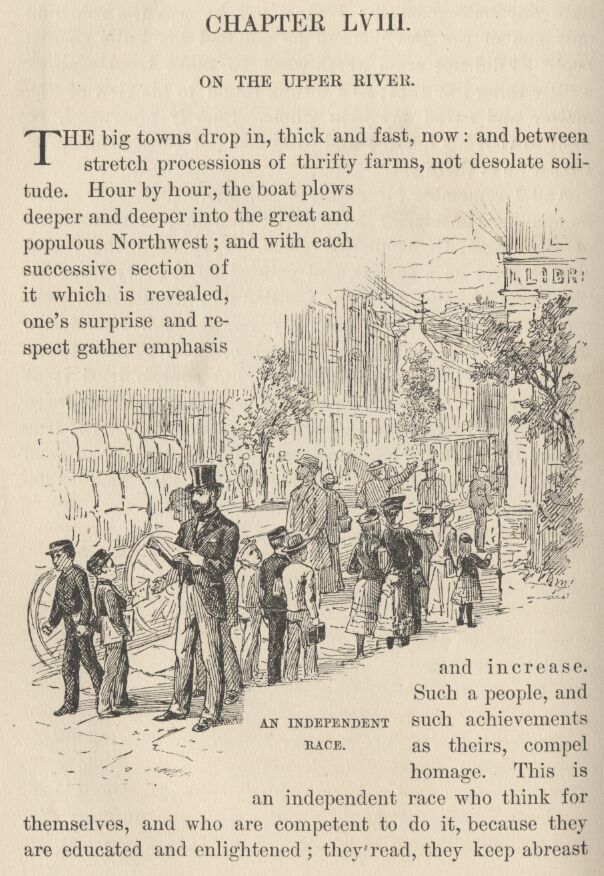
THE big towns drop in, thick and fast, now: and between stretch processions of thrifty farms, not desolate solitude. Hour by hour, the boat plows deeper and deeper into the great and populous North-west; and with each successive section of it which is revealed, one's surprise and respect gather emphasis and increase. Such a people, and such achievements as theirs, compel homage. This is an independent race who think for themselves, and who are competent to do it, because they are educated and enlightened; they read, they keep abreast of the best and newest thought, they fortify every weak place in their land with a school, a college, a library, and a newspaper; and they live under law. Solicitude for the future of a race like this is not in order.
Big towns now appear one after another, with prosperous farms between them instead of empty wilderness. Hour by hour, the boat travels deeper into the vast, populous Northwest. Each new part of the region increases one's surprise and respect. Such a people and their achievements command admiration. They are an independent people who think for themselves. They can do so because they are educated and enlightened. They read and keep up with the best and newest ideas. Wherever their land is weak, they strengthen it with a school, a college, a library, and a newspaper. And they live under law. There is no need to worry about the future of a people like this.
This region is new; so new that it may be said to be still in its babyhood. By what it has accomplished while still teething, one may forecast what marvels it will do in the strength of its maturity. It is so new that the foreign tourist has not heard of it yet; and has not visited it. For sixty years, the foreign tourist has steamed up and down the river between St. Louis and New Orleans, and then gone home and written his book, believing he had seen all of the river that was worth seeing or that had anything to see. In not six of all these books is there mention of these Upper River towns—for the reason that the five or six tourists who penetrated this region did it before these towns were projected. The latest tourist of them all (1878) made the same old regulation trip—he had not heard that there was anything north of St. Louis.
This region is new, so new that you might say it is still a baby. From what it has accomplished while still teething, you may predict the marvels it will achieve when it grows up. The region is so new that foreign tourists have not yet heard of it or visited it. For sixty years, foreign tourists have traveled by steamboat between St. Louis and New Orleans. Then they have gone home and written their books. They believed they had seen all of the river that was worth seeing or had anything to see. Fewer than six of these books mention the Upper River towns. That is because the five or six tourists who reached this region came before the towns were even planned. The most recent tourist of them all, in 1878, made the same old standard trip. He had not heard that there was anything north of St. Louis.
Yet there was. There was this amazing region, bristling with great towns, projected day before yesterday, so to speak, and built next morning. A score of them number from fifteen hundred to five thousand people. Then we have Muscatine, ten thousand; Winona, ten thousand; Moline, ten thousand; Rock Island, twelve thousand; La Crosse, twelve thousand; Burlington, twenty-five thousand; Dubuque, twenty-five thousand; Davenport, thirty thousand; St. Paul, fifty-eight thousand, Minneapolis, sixty thousand and upward.
Yet there was. There was this amazing region, filled with great towns that seemed to have been planned just the day before yesterday and built the next morning. About twenty of them have populations of 1,500 to 5,000. Then there is Muscatine, with 10,000 people, Winona, with 10,000, and Moline, with 10,000. Rock Island has 12,000, La Crosse has 12,000, Burlington has 25,000, and Dubuque has 25,000. Davenport has 30,000, St. Paul has 58,000, and Minneapolis has 60,000 or more.
The foreign tourist has never heard of these; there is no note of them in his books. They have sprung up in the night, while he slept. So new is this region, that I, who am comparatively young, am yet older than it is. When I was born, St. Paul had a population of three persons, Minneapolis had just a third as many. The then population of Minneapolis died two years ago; and when he died he had seen himself undergo an increase, in forty years, of fifty-nine thousand nine hundred and ninety-nine persons. He had a frog's fertility.
The foreign tourist has never heard of these places. His books say nothing about them. They sprang up overnight while he slept. This region is so new that even I, though relatively young, am older than it is. When I was born, St. Paul had three residents. Minneapolis had only one. That one resident of Minneapolis died two years ago. By then, he had seen himself increase by 59,999 people in forty years. He had a frog’s fertility.
I must explain that the figures set down above, as the population of St. Paul and Minneapolis, are several months old. These towns are far larger now. In fact, I have just seen a newspaper estimate which gives the former seventy-one thousand, and the latter seventy-eight thousand. This book will not reach the public for six or seven months yet; none of the figures will be worth much then.
I should explain that the population figures given above for St. Paul and Minneapolis are several months old. These towns are much larger now. In fact, I just saw a newspaper estimate that puts St. Paul's population at 71,000 and Minneapolis's at 78,000. This book will not reach the public for another six or seven months. By then, none of the figures will be worth much.
We had a glimpse of Davenport, which is another beautiful city, crowning a hill—a phrase which applies to all these towns; for they are all comely, all well built, clean, orderly, pleasant to the eye, and cheering to the spirit; and they are all situated upon hills. Therefore we will give that phrase a rest. The Indians have a tradition that Marquette and Joliet camped where Davenport now stands, in 1673. The next white man who camped there, did it about a hundred and seventy years later—in 1834. Davenport has gathered its thirty thousand people within the past thirty years. She sends more children to her schools now, than her whole population numbered twenty-three years ago. She has the usual Upper River quota of factories, newspapers, and institutions of learning; she has telephones, local telegraphs, an electric alarm, and an admirable paid fire department, consisting of six hook and ladder companies, four steam fire engines, and thirty churches. Davenport is the official residence of two bishops—Episcopal and Catholic.
We caught a glimpse of Davenport, another beautiful city on a hill. That phrase applies to all these towns. They are all attractive, well built, clean, orderly, pleasant to the eye, and cheering to the spirit. They are all on hills, too. So we will give that phrase a rest. The Indians have a tradition that Marquette and Joliet camped where Davenport now stands in 1673. The next white man to camp there did so about a hundred and seventy years later, in 1834. Davenport has gathered its thirty thousand people in the past thirty years. It now sends more children to school than its entire population numbered twenty-three years ago. It has the usual Upper River share of factories, newspapers, and schools. It has telephones, local telegraphs, an electric alarm, and an admirable paid fire department. The department consists of six hook and ladder companies, four steam fire engines, and thirty churches. Davenport is the official residence of two bishops, one Episcopal and one Catholic.
Opposite Davenport is the flourishing town of Rock Island, which lies at the foot of the Upper Rapids. A great railroad bridge connects the two towns—one of the thirteen which fret the Mississippi and the pilots, between St. Louis and St. Paul.
Across from Davenport is the thriving town of Rock Island, at the foot of the Upper Rapids. A large railroad bridge connects the two towns. It is one of thirteen bridges between St. Louis and St. Paul that trouble the Mississippi and its pilots.
The charming island of Rock Island, three miles long and half a mile wide, belongs to the United States, and the Government has turned it into a wonderful park, enhancing its natural attractions by art, and threading its fine forests with many miles of drives. Near the center of the island one catches glimpses, through the trees, of ten vast stone four-story buildings, each of which covers an acre of ground. These are the Government workshops; for the Rock Island establishment is a national armory and arsenal.
The charming island of Rock Island is three miles long and half a mile wide. It belongs to the United States, and the government has turned it into a wonderful park. The government has added to the island’s natural beauty and laid out many miles of roads through its fine forests. Near the center of the island, you can glimpse ten enormous four-story stone buildings through the trees. Each building covers an acre of ground. These are government workshops, because the Rock Island establishment is a national armory and arsenal.
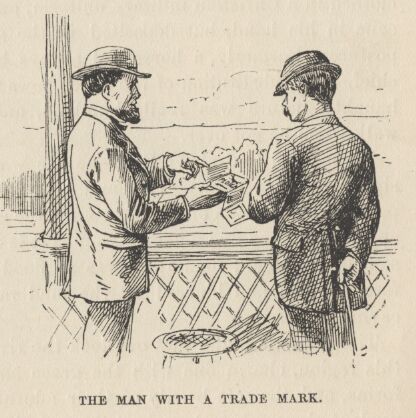
We move up the river—always through enchanting scenery, there being no other kind on the Upper Mississippi—and pass Moline, a center of vast manufacturing industries; and Clinton and Lyons, great lumber centers; and presently reach Dubuque, which is situated in a rich mineral region. The lead mines are very productive, and of wide extent. Dubuque has a great number of manufacturing establishments; among them a plow factory which has for customers all Christendom in general. At least so I was told by an agent of the concern who was on the boat. He said—
We travel up the river through enchanting scenery. There is no other kind on the Upper Mississippi. We pass Moline, a center of vast manufacturing industries, and Clinton and Lyons, major lumber centers. Before long, we reach Dubuque, which lies in a rich mineral region. Its lead mines are extensive and very productive. Dubuque has many factories, including a plow factory that sells to all of Christendom. At least, that is what an agent for the company told me on the boat. He said:
'You show me any country under the sun where they really know how to plow, and if I don't show you our mark on the plow they use, I'll eat that plow; and I won't ask for any Woostershyre sauce to flavor it up with, either.'
'Show me any country in the world where they really know how to plow. If I can't show you our mark on the plow they use, I'll eat that plow. And I won't even ask for any Worcestershire sauce to flavor it.'
All this part of the river is rich in Indian history and traditions. Black Hawk's was once a puissant name hereabouts; as was Keokuk's, further down. A few miles below Dubuque is the Tete de Mort—Death's-head rock, or bluff—to the top of which the French drove a band of Indians, in early times, and cooped them up there, with death for a certainty, and only the manner of it matter of choice—to starve, or jump off and kill themselves. Black Hawk adopted the ways of the white people, toward the end of his life; and when he died he was buried, near Des Moines, in Christian fashion, modified by Indian custom; that is to say, clothed in a Christian military uniform, and with a Christian cane in his hand, but deposited in the grave in a sitting posture. Formerly, a horse had always been buried with a chief. The substitution of the cane shows that Black Hawk's haughty nature was really humbled, and he expected to walk when he got over.
All this part of the river is rich in Native American history and traditions. Black Hawk's name was once powerful here, as Keokuk's was farther downriver. A few miles below Dubuque is the Tete de Mort, or Death's-head rock, a bluff. In early times, the French drove a band of Native Americans to the top and trapped them there. Death was certain, and they could only choose how to die: starve, or jump off and kill themselves. Toward the end of his life, Black Hawk adopted the ways of white people. When he died, he was buried near Des Moines in Christian fashion, modified by Native American custom. He wore a Christian military uniform and held a Christian cane, but he was buried sitting up. In earlier times, a horse had always been buried with a chief. The cane in place of a horse shows that Black Hawk's proud nature was truly humbled. He expected to walk when he got to the other side.
We noticed that above Dubuque the water of the Mississippi was olive-green—rich and beautiful and semi-transparent, with the sun on it. Of course the water was nowhere as clear or of as fine a complexion as it is in some other seasons of the year; for now it was at flood stage, and therefore dimmed and blurred by the mud manufactured from caving banks.
We noticed that above Dubuque, the Mississippi’s water was olive-green. In the sunlight, it looked rich, beautiful, and partly transparent. Of course, the water was nowhere near as clear or beautifully colored as it is at some other times of year. The river was at flood stage, so mud from collapsing banks had made the water cloudy.
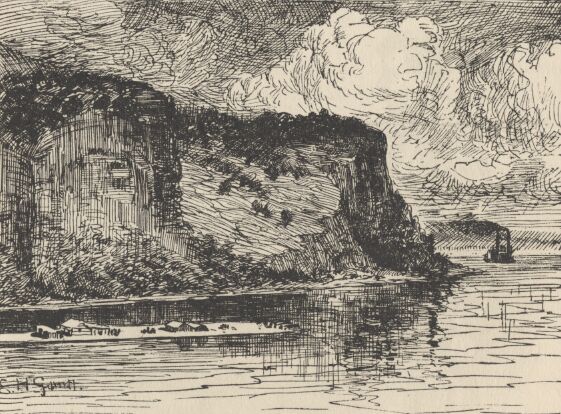
The majestic bluffs that overlook the river, along through this region, charm one with the grace and variety of their forms, and the soft beauty of their adornment. The steep verdant slope, whose base is at the water's edge is topped by a lofty rampart of broken, turreted rocks, which are exquisitely rich and mellow in color—mainly dark browns and dull greens, but splashed with other tints. And then you have the shining river, winding here and there and yonder, its sweep interrupted at intervals by clusters of wooded islands threaded by silver channels; and you have glimpses of distant villages, asleep upon capes; and of stealthy rafts slipping along in the shade of the forest walls; and of white steamers vanishing around remote points. And it is all as tranquil and reposeful as dreamland, and has nothing this-worldly about it—nothing to hang a fret or a worry upon.
The majestic bluffs overlooking the river in this region charm visitors with their graceful, varied shapes and soft beauty. A steep green slope rises from the water’s edge. At the top stands a towering wall of jagged rocks shaped like turrets. Their colors are beautifully rich and mellow, mostly dark brown and muted green, with splashes of other colors. Then there is the shining river, winding this way and that. Clusters of wooded islands break up its course, with silver channels running between them. You catch glimpses of distant villages asleep on headlands. Rafts slip quietly along in the shade of forest walls, while white steamers disappear around distant points. It is all as peaceful and restful as a dream. Nothing about it feels like this world. There is nothing to attach a worry or concern to.
Until the unholy train comes tearing along—which it presently does, ripping the sacred solitude to rags and tatters with its devil's warwhoop and the roar and thunder of its rushing wheels—and straightway you are back in this world, and with one of its frets ready to hand for your entertainment: for you remember that this is the very road whose stock always goes down after you buy it, and always goes up again as soon as you sell it. It makes me shudder to this day, to remember that I once came near not getting rid of my stock at all. It must be an awful thing to have a railroad left on your hands.
Until the unholy train comes tearing along, as it soon does. Its devilish war cry and the roar and thunder of its rushing wheels rip the sacred solitude to rags and tatters. Suddenly, you are back in this world, with one of its annoyances ready to entertain you. You remember that this railroad’s stock always goes down after you buy it. And it always goes up again as soon as you sell it. To this day, I shudder to remember that I once almost failed to get rid of my stock at all. It must be an awful thing to be stuck with a railroad.
The locomotive is in sight from the deck of the steamboat almost the whole way from St. Louis to St. Paul—eight hundred miles. These railroads have made havoc with the steamboat commerce. The clerk of our boat was a steamboat clerk before these roads were built. In that day the influx of population was so great, and the freight business so heavy, that the boats were not able to keep up with the demands made upon their carrying capacity; consequently the captains were very independent and airy—pretty 'biggity,' as Uncle Remus would say. The clerk nut-shelled the contrast between the former time and the present, thus—
From the steamboat’s deck, you can see a locomotive almost all the way from St. Louis to St. Paul, a distance of eight hundred miles. These railroads have devastated steamboat commerce. Our boat’s clerk was a steamboat clerk before the railroads were built. Back then, so many people were arriving and so much freight needed shipping that the boats could not carry it all. As a result, captains were very independent and swaggering, pretty 'biggity,' as Uncle Remus would say. The clerk summed up the difference between then and now like this:
'Boat used to land—captain on hurricane roof—mighty stiff and straight—iron ramrod for a spine—kid gloves, plug tile, hair parted behind—man on shore takes off hat and says—
'The boat would land. The captain stood on the hurricane roof, stiff and straight, as if he had an iron rod for a spine. He wore kid gloves and a top hat, and his hair was parted at the back. A man on shore took off his hat and said:
'“Got twenty-eight tons of wheat, cap'n—be great favor if you can take them.”
'“I've got twenty-eight tons of wheat, captain. It would be a great favor if you could take it.”
'Captain says—
'The captain says...
'“'ll take two of them”—and don't even condescend to look at him.
'“I'll take two of them” and don't even bother to look at him.
'But nowadays the captain takes off his old slouch, and smiles all the way around to the back of his ears, and gets off a bow which he hasn't got any ramrod to interfere with, and says—
'But nowadays the captain takes off his old slouch hat and grins from ear to ear. He bows, with no ramrod in his back to get in the way, and says:
'“Glad to see you, Smith, glad to see you—you're looking well—haven't seen you looking so well for years—what you got for us?”
'“Glad to see you, Smith, glad to see you. You're looking well. I haven't seen you looking so well for years. What have you got for us?”
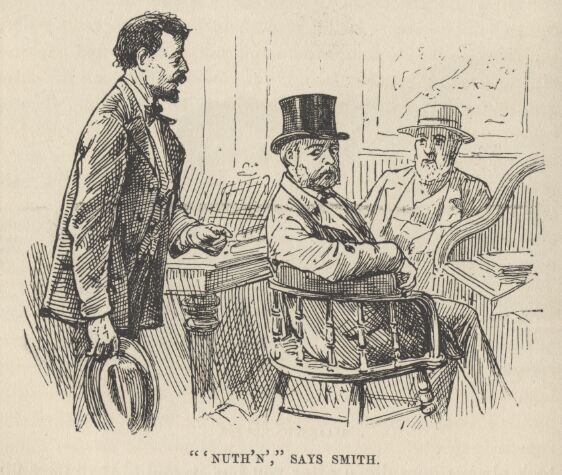
'“Nuth'n”, says Smith; and keeps his hat on, and just turns his back and goes to talking with somebody else.
'“Nothing,” says Smith. He keeps his hat on, turns his back, and starts talking to someone else.
'Oh, yes, eight years ago, the captain was on top; but it's Smith's turn now. Eight years ago a boat used to go up the river with every stateroom full, and people piled five and six deep on the cabin floor; and a solid deck-load of immigrants and harvesters down below, into the bargain. To get a first-class stateroom, you'd got to prove sixteen quarterings of nobility and four hundred years of descent, or be personally acquainted with the nigger that blacked the captain's boots. But it's all changed now; plenty staterooms above, no harvesters below—there's a patent self-binder now, and they don't have harvesters any more; they've gone where the woodbine twineth—and they didn't go by steamboat, either; went by the train.'
'Oh, yes, eight years ago, the captain was on top. But it's Smith's turn now. Eight years ago, boats went upriver with every stateroom full. People were piled five or six deep on the cabin floor. On top of that, the deck below was packed with immigrants and harvesters. To get a first-class stateroom, you had to prove you had sixteen noble ancestors and four hundred years of noble descent. Or you had to know the Black man who polished the captain's boots personally. But it's all changed now. There are plenty of staterooms above and no harvesters below. There's a patented self-binder now, so they don't have harvesters anymore. The harvesters have gone where the woodbine grows. And they didn't go by steamboat, either. They went by train.'
Up in this region we met massed acres of lumber rafts coming down—but not floating leisurely along, in the old-fashioned way, manned with joyous and reckless crews of fiddling, song-singing, whiskey-drinking, breakdown-dancing rapscallions; no, the whole thing was shoved swiftly along by a powerful stern-wheeler, modern fashion, and the small crews were quiet, orderly men, of a sedate business aspect, with not a suggestion of romance about them anywhere.
Farther up the river, we met acres upon acres of lumber rafts coming downstream. But they were not floating leisurely along in the old-fashioned way. Back then, their crews were joyful, reckless scoundrels who fiddled, sang, drank whiskey, and danced breakdowns. No, now a powerful stern-wheel steamboat pushed the whole mass swiftly along, in modern fashion. The small crews were quiet, orderly men with a serious, businesslike air. There was not a hint of romance about them.
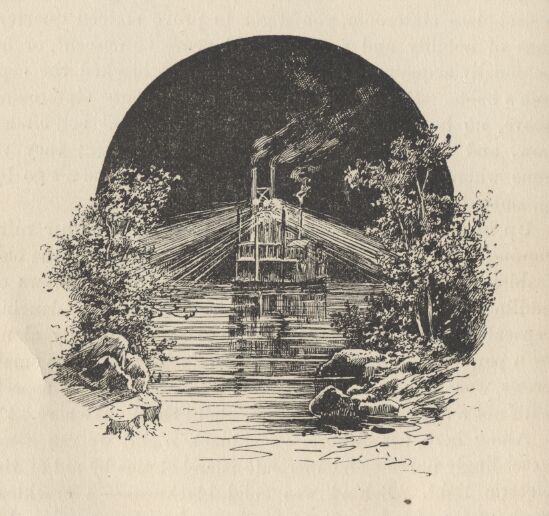
Along here, somewhere, on a black night, we ran some exceedingly narrow and intricate island-chutes by aid of the electric light. Behind was solid blackness—a crackless bank of it; ahead, a narrow elbow of water, curving between dense walls of foliage that almost touched our bows on both sides; and here every individual leaf, and every individual ripple stood out in its natural color, and flooded with a glare as of noonday intensified. The effect was strange, and fine, and very striking.
Somewhere along here, on a pitch-black night, we navigated some extremely narrow, winding channels between islands using electric light. Behind us was solid blackness, a wall without a crack. Ahead, a narrow bend of water curved between dense walls of foliage. The foliage almost touched our bow on both sides. Here, every leaf and every ripple stood out in its natural color, flooded with a glare brighter than midday sunlight. The effect was strange, beautiful, and striking.
We passed Prairie du Chien, another of Father Marquette's camping-places; and after some hours of progress through varied and beautiful scenery, reached La Crosse. Here is a town of twelve or thirteen thousand population, with electric lighted streets, and with blocks of buildings which are stately enough, and also architecturally fine enough, to command respect in any city. It is a choice town, and we made satisfactory use of the hour allowed us, in roaming it over, though the weather was rainier than necessary.
We passed Prairie du Chien, another of Father Marquette’s campsites. After several hours of traveling through varied and beautiful scenery, we reached La Crosse. The town has twelve or thirteen thousand people and electrically lit streets. Its blocks of buildings are grand and architecturally fine enough to command respect in any city. It is a delightful town, and we made good use of the hour we had to wander around it, though the weather was rainier than necessary.