Chapter 56
A Legal Question
THE slaughter-house is gone from the mouth of Bear Creek and so is the small jail (or 'calaboose') which once stood in its neighborhood. A citizen asked, 'Do you remember when Jimmy Finn, the town drunkard, was burned to death in the calaboose?'
The slaughterhouse is gone from the mouth of Bear Creek. So is the small jail (or 'calaboose') that once stood nearby. A local asked, 'Do you remember when Jimmy Finn, the town drunk, burned to death in the calaboose?'
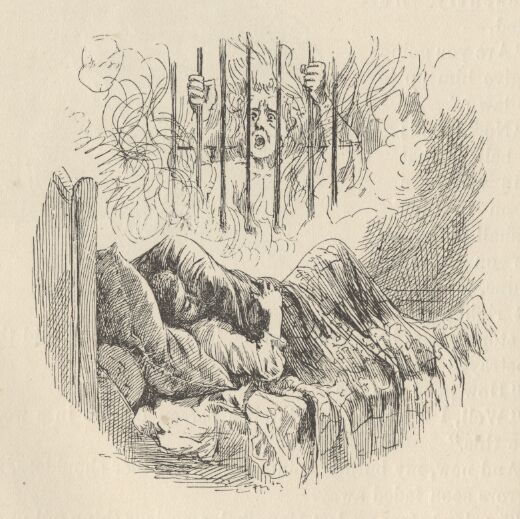
Observe, now, how history becomes defiled, through lapse of time and the help of the bad memories of men. Jimmy Finn was not burned in the calaboose, but died a natural death in a tan vat, of a combination of delirium tremens and spontaneous combustion. When I say natural death, I mean it was a natural death for Jimmy Finn to die. The calaboose victim was not a citizen; he was a poor stranger, a harmless whiskey-sodden tramp. I know more about his case than anybody else; I knew too much of it, in that bygone day, to relish speaking of it. That tramp was wandering about the streets one chilly evening, with a pipe in his mouth, and begging for a match; he got neither matches nor courtesy; on the contrary, a troop of bad little boys followed him around and amused themselves with nagging and annoying him. I assisted; but at last, some appeal which the wayfarer made for forbearance, accompanying it with a pathetic reference to his forlorn and friendless condition, touched such sense of shame and remnant of right feeling as were left in me, and I went away and got him some matches, and then hied me home and to bed, heavily weighted as to conscience, and unbuoyant in spirit. An hour or two afterward, the man was arrested and locked up in the calaboose by the marshal—large name for a constable, but that was his title. At two in the morning, the church bells rang for fire, and everybody turned out, of course—I with the rest. The tramp had used his matches disastrously: he had set his straw bed on fire, and the oaken sheathing of the room had caught. When I reached the ground, two hundred men, women, and children stood massed together, transfixed with horror, and staring at the grated windows of the jail. Behind the iron bars, and tugging frantically at them, and screaming for help, stood the tramp; he seemed like a black object set against a sun, so white and intense was the light at his back. That marshal could not be found, and he had the only key. A battering-ram was quickly improvised, and the thunder of its blows upon the door had so encouraging a sound that the spectators broke into wild cheering, and believed the merciful battle won. But it was not so. The timbers were too strong; they did not yield. It was said that the man's death-grip still held fast to the bars after he was dead; and that in this position the fires wrapped him about and consumed him. As to this, I do not know. What was seen after I recognized the face that was pleading through the bars was seen by others, not by me.
See how history becomes corrupted over time, with help from people’s bad memories. Jimmy Finn was not burned in the calaboose, or jail. He died a natural death in a tanning vat, from a combination of delirium tremens and spontaneous combustion. By a natural death, I mean it was natural for Jimmy Finn to die that way. The victim in the calaboose was not a citizen. He was a poor stranger, a harmless tramp soaked in whiskey. I know more about his case than anyone else. In those days, I knew too much about it to enjoy speaking of it. One chilly evening, the tramp wandered the streets with a pipe in his mouth, begging for a match. He got neither matches nor courtesy. Instead, a gang of bad little boys followed him, amusing themselves by pestering and bothering him. I joined in. But at last, the traveler begged us to leave him alone. His sad words about being alone and friendless touched what little shame and sense of right I had left. So I went and got him some matches. Then I hurried home to bed, my conscience heavy and my spirits low. An hour or two later, the marshal arrested the man and locked him in the calaboose. Marshal was a grand name for a constable, but it was his title. At two in the morning, the church bells rang to signal a fire. Of course, everyone turned out, and I went with them. The tramp had used his matches with disastrous results. He had set his straw bed on fire, and the oak lining of the room had caught fire too. When I arrived, two hundred men, women, and children stood crowded together, frozen with horror. They were staring at the barred windows of the jail. Behind the bars stood the tramp, pulling at them desperately and screaming for help. He looked like a black figure against a sun, so white and intense was the light behind him. The marshal could not be found, and he had the only key. Someone quickly made a battering ram. The sound of its blows against the door was so encouraging that the crowd broke into wild cheers. They believed the battle to save him was won. But it was not. The timbers were too strong. They did not give way. People said the man’s death grip still held the bars after he died. They said the flames surrounded and consumed him in that position. I do not know whether that is true. After I recognized the face pleading behind the bars, others saw what happened, but I did not.
I saw that face, so situated, every night for a long time afterward; and I believed myself as guilty of the man's death as if I had given him the matches purposely that he might burn himself up with them. I had not a doubt that I should be hanged if my connection with this tragedy were found out. The happenings and the impressions of that time are burnt into my memory, and the study of them entertains me as much now as they themselves distressed me then. If anybody spoke of that grisly matter, I was all ears in a moment, and alert to hear what might be said, for I was always dreading and expecting to find out that I was suspected; and so fine and so delicate was the perception of my guilty conscience, that it often detected suspicion in the most purposeless remarks, and in looks, gestures, glances of the eye which had no significance, but which sent me shivering away in a panic of fright, just the same. And how sick it made me when somebody dropped, howsoever carelessly and barren of intent, the remark that 'murder will out!' For a boy of ten years, I was carrying a pretty weighty cargo.
For a long time afterward, I saw that face as it had been, every night. I felt as guilty of the man's death as if I had given him the matches to burn himself up. I had no doubt that I would be hanged if anyone discovered my connection to the tragedy. The events and impressions of that time are burned into my memory. Thinking about them entertains me as much now as they distressed me then. If anyone spoke of that grisly matter, I listened at once, alert to anything they might say. I was always afraid and expected to discover that I was suspected. My guilty conscience was so sensitive that it often detected suspicion in the most meaningless remarks. It also detected suspicion in looks, gestures, and glances that meant nothing. Even so, they sent me away shivering in a panic. And how sick I felt when someone casually said, with no intention behind it, that 'murder will out!' For a ten-year-old boy, I was carrying a pretty heavy cargo.
All this time I was blessedly forgetting one thing—the fact that I was an inveterate talker in my sleep. But one night I awoke and found my bed-mate—my younger brother—sitting up in bed and contemplating me by the light of the moon. I said—
All this time, I was blissfully forgetting one thing. I was a chronic sleep talker. But one night I woke up and found my younger brother, who shared my bed, sitting up and watching me in the moonlight. I said:
'What is the matter?'
'What's the matter?'
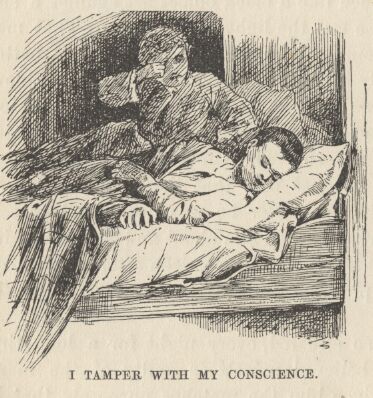
'You talk so much I can't sleep.'
'You talk so much I can't sleep.'
I came to a sitting posture in an instant, with my kidneys in my throat and my hair on end.
I sat up in an instant, with my kidneys in my throat and my hair standing on end.
'What did I say. Quick—out with it—what did I say?'
'What did I say? Quick, tell me, what did I say?'
'Nothing much.'
'Nothing much.'
'It's a lie—you know everything.'
'It's a lie. You know everything.'
'Everything about what?'
'Everything about what?'
'You know well enough. About that.'
'You know perfectly well. About that.'
'About what?—I don't know what you are talking about. I think you are sick or crazy or something. But anyway, you're awake, and I'll get to sleep while I've got a chance.'
'About what? I don't know what you're talking about. I think you're sick or crazy or something. But anyway, you're awake, and I'll get some sleep while I have the chance.'
He fell asleep and I lay there in a cold sweat, turning this new terror over in the whirling chaos which did duty as my mind. The burden of my thought was, How much did I divulge? How much does he know?—what a distress is this uncertainty! But by and by I evolved an idea—I would wake my brother and probe him with a supposititious case. I shook him up, and said—
He fell asleep, and I lay there in a cold sweat, turning this new terror over in the swirling chaos that passed for my mind. My thoughts kept circling around the same questions: How much had I revealed? How much did he know? The uncertainty was agonizing! But after a while, I had an idea. I would wake my brother and question him with a made-up scenario. I shook him awake and said:
'Suppose a man should come to you drunk—'
'Suppose a drunk man came to you.'
'This is foolish—I never get drunk.'
'This is silly. I never get drunk.'
'I don't mean you, idiot—I mean the man. Suppose a man should come to you drunk, and borrow a knife, or a tomahawk, or a pistol, and you forgot to tell him it was loaded, and—'
'I don't mean you, idiot. I mean the man. Suppose a man came to you drunk and borrowed a knife, a tomahawk, or a pistol. And suppose you forgot to tell him it was loaded, and...'
'How could you load a tomahawk?'
'How could you load a tomahawk?'
'I don't mean the tomahawk, and I didn't say the tomahawk; I said the pistol. Now don't you keep breaking in that way, because this is serious. There's been a man killed.'
'I don't mean the tomahawk, and I didn't say the tomahawk. I said the pistol. Now stop interrupting like that, because this is serious. A man has been killed.'
'What! in this town?'
'What! In this town?'
'Yes, in this town.'
'Yes, in this town.'
'Well, go on—I won't say a single word.'
'Well, go on. I won't say a single word.'
'Well, then, suppose you forgot to tell him to be careful with it, because it was loaded, and he went off and shot himself with that pistol—fooling with it, you know, and probably doing it by accident, being drunk. Well, would it be murder?'
'Well, then, suppose you forgot to warn him that the pistol was loaded. And suppose he went off and shot himself with it while fooling around, probably by accident because he was drunk. Well, would that be murder?'
'No—suicide.'
'No, suicide.'
'No, no. I don't mean his act, I mean yours: would you be a murderer for letting him have that pistol?'
'No, no. I don't mean what he did. I mean what you did: would letting him have that pistol make you a murderer?'
After deep thought came this answer—
After deep thought, the answer came:
'Well, I should think I was guilty of something—maybe murder—yes, probably murder, but I don't quite know.'
'Well, I guess I was guilty of something. Maybe murder. Yes, probably murder, but I don't really know.'
This made me very uncomfortable. However, it was not a decisive verdict. I should have to set out the real case—there seemed to be no other way. But I would do it cautiously, and keep a watch out for suspicious effects. I said—
This made me very uncomfortable. Still, the verdict was not final. I would have to explain the real situation. There seemed to be no other way. But I would do it carefully and watch for suspicious reactions. I said:
'I was supposing a case, but I am coming to the real one now. Do you know how the man came to be burned up in the calaboose?'
'I was imagining a case, but now I'm coming to the real one. Do you know how the man came to be burned up in the jail?'
'No.'
'No.'
'Haven't you the least idea?'
'Don't you have any idea at all?'
'Not the least.'
'Not at all.'
'Wish you may die in your tracks if you have?'
'Do you wish you might drop dead on the spot if you have?'
'Yes, wish I may die in my tracks.'
'Yes, I swear I could drop dead right here if I'm lying.'
'Well, the way of it was this. The man wanted some matches to light his pipe. A boy got him some. The man set fire to the calaboose with those very matches, and burnt himself up.'
'Well, this is how it happened. The man wanted some matches to light his pipe. A boy got him some. The man used those same matches to set fire to the jail and burned himself to death.'
'Is that so?'
'Is that so?'
'Yes, it is. Now, is that boy a murderer, do you think?'
'Yes, it is. Now, do you think that boy is a murderer?'
'Let me see. The man was drunk?'
'Let me see. The man was drunk?'
'Yes, he was drunk.'
'Yes, he was drunk.'
'Very drunk?'
'Very drunk?'
'Yes.'
'Yes.'
'And the boy knew it?'
'And the boy knew it?'
'Yes, he knew it.'
'Yes, he knew it.'
There was a long pause. Then came this heavy verdict—
There was a long pause. Then came this grave verdict:
'If the man was drunk, and the boy knew it, the boy murdered that man. This is certain.'
'If the man was drunk, and the boy knew it, then the boy murdered him. That is certain.'
Faint, sickening sensations crept along all the fibers of my body, and I seemed to know how a person feels who hears his death sentence pronounced from the bench. I waited to hear what my brother would say next. I believed I knew what it would be, and I was right. He said—
A faint, sickening feeling crept through every part of my body. I felt as though I knew what it was like to hear a judge pronounce a death sentence. I waited to hear what my brother would say next. I thought I knew what he would say, and I was right. He said:
'I know the boy.'
'I know the boy.'
I had nothing to say; so I said nothing. I simply shuddered. Then he added—
I had nothing to say, so I said nothing. I just shuddered. Then he added:
'Yes, before you got half through telling about the thing, I knew perfectly well who the boy was; it was Ben Coontz!'
'Yes, before you were halfway through telling me about it, I knew exactly who the boy was. It was Ben Coontz!'
I came out of my collapse as one who rises from the dead. I said, with admiration—
I recovered from my collapse like someone rising from the dead. I said with admiration:
'Why, how in the world did you ever guess it?'
'Wow, how in the world did you guess it?'
'You told it in your sleep.'
'You told it in your sleep.'
I said to myself, 'How splendid that is! This is a habit which must be cultivated.'
I said to myself, 'How wonderful! This is a habit I must develop.'
My brother rattled innocently on—
My brother kept chatting innocently.
'When you were talking in your sleep, you kept mumbling something about “matches,” which I couldn't make anything out of; but just now, when you began to tell me about the man and the calaboose and the matches, I remembered that in your sleep you mentioned Ben Coontz two or three times; so I put this and that together, you see, and right away I knew it was Ben that burnt that man up.'
‘When you were talking in your sleep, you kept mumbling something about “matches.” I couldn't make sense of it. But just now, when you started telling me about the man, the jail, and the matches, I remembered something. You mentioned Ben Coontz two or three times in your sleep. So I put it all together, you see, and knew right away that Ben had burned that man up.’
I praised his sagacity effusively. Presently he asked—
I praised his good judgment enthusiastically. Soon he asked:
'Are you going to give him up to the law?'
'Are you going to turn him over to the police?'
'No,' I said; 'I believe that this will be a lesson to him. I shall keep an eye on him, of course, for that is but right; but if he stops where he is and reforms, it shall never be said that I betrayed him.'
'No,' I said. 'I believe this will teach him a lesson. Of course, I'll keep an eye on him, because that's the right thing to do. But if he stays where he is and reforms, I'll never betray him.'
'How good you are!'
'You are so good!'
'Well, I try to be. It is all a person can do in a world like this.'
'Well, I try to be. That is all a person can do in a world like this.'
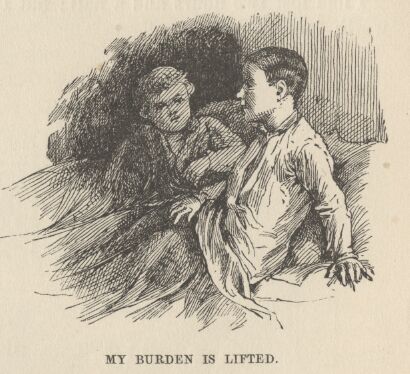
And now, my burden being shifted to other shoulders, my terrors soon faded away.
Now that someone else had taken on my burden, my fears soon faded away.
The day before we left Hannibal, a curious thing fell under my notice—the surprising spread which longitudinal time undergoes there. I learned it from one of the most unostentatious of men—the colored coachman of a friend of mine, who lives three miles from town. He was to call for me at the Park Hotel at 7.30 P.M., and drive me out. But he missed it considerably—did not arrive till ten. He excused himself by saying—
The day before we left Hannibal, I noticed something curious. Time seemed to stretch out surprisingly there. I learned this from a very modest man, the Black coachman of a friend who lived three miles from town. The coachman was supposed to pick me up at the Park Hotel at 7:30 p.m. and drive me out. But he was considerably late. He did not arrive until ten. He excused himself by saying:
'De time is mos' an hour en a half slower in de country en what it is in de town; you'll be in plenty time, boss. Sometimes we shoves out early for church, Sunday, en fetches up dah right plum in de middle er de sermon. Diffunce in de time. A body can't make no calculations 'bout it.'
'Time is almost an hour and a half slower in the country than in town. You'll have plenty of time, boss. Sometimes we set out early for church on Sunday and arrive right in the middle of the sermon. It's the difference in time. You just can't calculate it.'
I had lost two hours and a half; but I had learned a fact worth four.
I had lost two and a half hours, but I had learned a fact worth four hours.