Chapter 55
A Vendetta and Other Things
DURING my three days' stay in the town, I woke up every morning with the impression that I was a boy—for in my dreams the faces were all young again, and looked as they had looked in the old times—but I went to bed a hundred years old, every night—for meantime I had been seeing those faces as they are now.
During my three days in town, I woke up every morning feeling like a boy. In my dreams, all the faces were young again, just as they had been in the old days. But every night I went to bed a hundred years old, because during the day I had seen those faces as they are now.
Of course I suffered some surprises, along at first, before I had become adjusted to the changed state of things. I met young ladies who did not seem to have changed at all; but they turned out to be the daughters of the young ladies I had in mind—sometimes their grand-daughters. When you are told that a stranger of fifty is a grandmother, there is nothing surprising about it; but if, on the contrary, she is a person whom you knew as a little girl, it seems impossible. You say to yourself, 'How can a little girl be a grandmother.' It takes some little time to accept and realize the fact that while you have been growing old, your friends have not been standing still, in that matter.
Of course, I had some surprises at first, before I had adjusted to how things had changed. I met young women who did not seem to have changed at all. But they turned out to be the daughters, and sometimes the granddaughters, of the young women I remembered. When you are told that a stranger of fifty is a grandmother, there is nothing surprising about it. But if she is someone you knew as a little girl, it seems impossible. You say to yourself, 'How can a little girl be a grandmother?' It takes a little time to accept and realize that your friends have been growing old along with you.
I noticed that the greatest changes observable were with the women, not the men. I saw men whom thirty years had changed but slightly; but their wives had grown old. These were good women; it is very wearing to be good.
I noticed that the women had changed much more than the men. I saw men who had changed very little in thirty years. But their wives had grown old. These were good women. Being good is very tiring.
There was a saddler whom I wished to see; but he was gone. Dead, these many years, they said. Once or twice a day, the saddler used to go tearing down the street, putting on his coat as he went; and then everybody knew a steamboat was coming. Everybody knew, also, that John Stavely was not expecting anybody by the boat—or any freight, either; and Stavely must have known that everybody knew this, still it made no difference to him; he liked to seem to himself to be expecting a hundred thousand tons of saddles by this boat, and so he went on all his life, enjoying being faithfully on hand to receive and receipt for those saddles, in case by any miracle they should come. A malicious Quincy paper used always to refer to this town, in derision as 'Stavely's Landing.' Stavely was one of my earliest admirations; I envied him his rush of imaginary business, and the display he was able to make of it, before strangers, as he went flying down the street struggling with his fluttering coat.
There was a saddler I wanted to see, but he was gone. They said he had been dead for many years. Once or twice a day, the saddler used to race down the street, putting on his coat as he went. Then everyone knew a steamboat was coming. Everyone also knew that John Stavely was not expecting anyone on the boat, or any freight either. Stavely must have known that everyone knew, but it made no difference to him. He liked to imagine he was expecting a hundred thousand tons of saddles on the boat. So all his life he enjoyed being faithfully on hand to receive and sign for those saddles, if by some miracle they should arrive. A spiteful Quincy newspaper always mocked the town by calling it 'Stavely's Landing.' Stavely was one of the first people I admired. I envied him his rush of imaginary business and the show he could make of it before strangers. He would go flying down the street, struggling to put on his fluttering coat.
But there was a carpenter who was my chiefest hero. He was a mighty liar, but I did not know that; I believed everything he said. He was a romantic, sentimental, melodramatic fraud, and his bearing impressed me with awe. I vividly remember the first time he took me into his confidence. He was planing a board, and every now and then he would pause and heave a deep sigh; and occasionally mutter broken sentences— confused and not intelligible—but out of their midst an ejaculation sometimes escaped which made me shiver and did me good: one was, 'O God, it is his blood!' I sat on the tool-chest and humbly and shudderingly admired him; for I judged he was full of crime. At last he said in a low voice—
But there was a carpenter who was my greatest hero. He was a tremendous liar, but I didn't know that. I believed everything he said. He was a romantic, sentimental, melodramatic fraud, and his manner filled me with awe. I vividly remember the first time he took me into his confidence. He was planing a board, and every now and then he paused and let out a deep sigh. Occasionally he muttered broken sentences that were confused and impossible to understand. But sometimes an exclamation escaped from among them that made me shiver and gave me pleasure. One was, 'O God, it is his blood!' I sat on the tool chest and admired him humbly, shivering as I did. I thought he was full of crime. At last he said in a low voice:
'My little friend, can you keep a secret?'
'My little friend, can you keep a secret?'
I eagerly said I could.
I eagerly said I could.
'A dark and dreadful one?'
'A dark and terrible one?'
I satisfied him on that point.
I convinced him on that point.
'Then I will tell you some passages in my history; for oh, I must relieve my burdened soul, or I shall die!'
'Then I will tell you some parts of my story, because, oh, I must unburden my soul, or I will die!'
He cautioned me once more to be 'as silent as the grave;' then he told me he was a 'red-handed murderer.' He put down his plane, held his hands out before him, contemplated them sadly, and said—
He warned me once more to be 'as silent as the grave.' Then he told me he was a 'red-handed murderer.' He put down his plane, held his hands out in front of him, looked at them sadly, and said:
'Look—with these hands I have taken the lives of thirty human beings!'
'Look, I have killed thirty people with these hands!'
The effect which this had upon me was an inspiration to him, and he turned himself loose upon his subject with interest and energy. He left generalizing, and went into details,—began with his first murder; described it, told what measures he had taken to avert suspicion; then passed to his second homicide, his third, his fourth, and so on. He had always done his murders with a bowie-knife, and he made all my hairs rise by suddenly snatching it out and showing it to me.
The effect on me encouraged him, and he launched into his subject with interest and energy. He stopped speaking in general terms and went into detail. He began with his first murder, describing it and explaining what he had done to avoid suspicion. Then he moved on to his second killing, his third, his fourth, and so on. He had always used a bowie knife for his murders. He made all my hair stand on end by suddenly pulling it out and showing it to me.
At the end of this first seance I went home with six of his fearful secrets among my freightage, and found them a great help to my dreams, which had been sluggish for a while back. I sought him again and again, on my Saturday holidays; in fact I spent the summer with him—all of it which was valuable to me. His fascinations never diminished, for he threw something fresh and stirring, in the way of horror, into each successive murder. He always gave names, dates, places—everything. This by and by enabled me to note two things: that he had killed his victims in every quarter of the globe, and that these victims were always named Lynch. The destruction of the Lynches went serenely on, Saturday after Saturday, until the original thirty had multiplied to sixty—and more to be heard from yet; then my curiosity got the better of my timidity, and I asked how it happened that these justly punished persons all bore the same name.
At the end of our first session, I went home carrying six of his terrifying secrets. They gave my dreams a much-needed boost, since my dreams had been sluggish for a while. I visited him again and again on my Saturday holidays. In fact, I spent the summer with him, all the part of it that mattered to me. He never became less fascinating, because he added some fresh, thrilling horror to each new murder. He always gave names, dates, places, everything. Before long, these details allowed me to notice two things: he had killed his victims in every part of the world, and they were always named Lynch. The slaughter of the Lynches went calmly on, Saturday after Saturday. The original thirty had grown to sixty, and there were more yet to come. Then my curiosity overcame my shyness, and I asked why all these justly punished people had the same name.
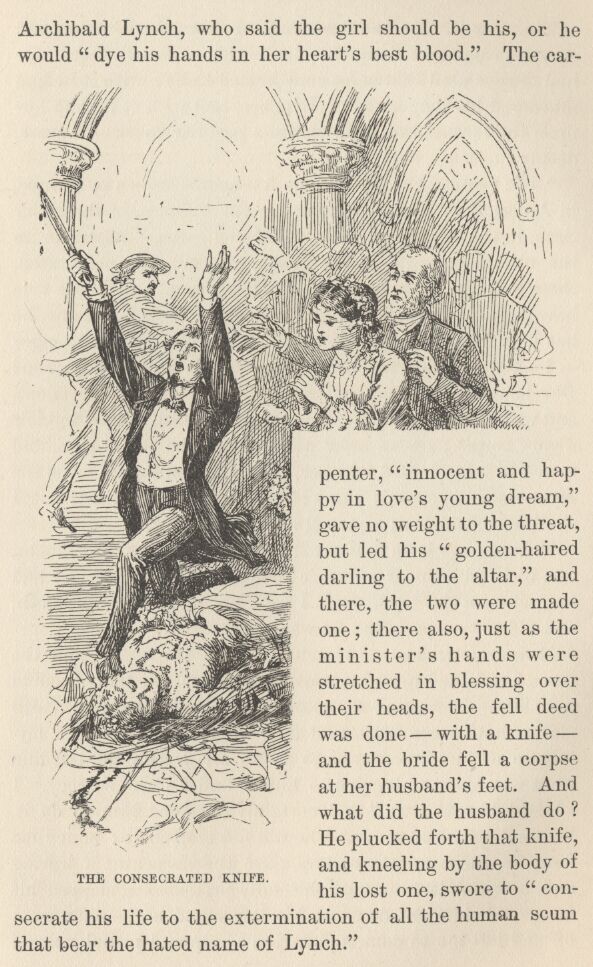
My hero said he had never divulged that dark secret to any living being; but felt that he could trust me, and therefore he would lay bare before me the story of his sad and blighted life. He had loved one 'too fair for earth,' and she had reciprocated 'with all the sweet affection of her pure and noble nature.' But he had a rival, a 'base hireling' named Archibald Lynch, who said the girl should be his, or he would 'dye his hands in her heart's best blood.' The carpenter, 'innocent and happy in love's young dream,' gave no weight to the threat, but led his 'golden-haired darling to the altar,' and there, the two were made one; there also, just as the minister's hands were stretched in blessing over their heads, the fell deed was done—with a knife—and the bride fell a corpse at her husband's feet. And what did the husband do? He plucked forth that knife, and kneeling by the body of his lost one, swore to 'consecrate his life to the extermination of all the human scum that bear the hated name of Lynch.'
My hero said he had never revealed that dark secret to anyone alive. But he felt he could trust me, so he would tell me the story of his sad and ruined life. He had loved a woman “too beautiful for this world,” and she had returned his love “with all the sweet affection of her pure and noble nature.” But he had a rival, a “lowly hired man” named Archibald Lynch. Lynch said the girl would be his, or he would “stain his hands with the blood from her heart.” The carpenter, “innocent and happy in love’s young dream,” paid no attention to the threat. He led his “golden-haired darling to the altar,” and there the two became one. Just as the minister stretched out his hands to bless them, the terrible deed was done with a knife. The bride fell dead at her husband’s feet. And what did the husband do? He pulled out the knife and knelt beside his lost love’s body. There he swore to “devote his life to wiping out all the human scum who bear the hated name of Lynch.”
That was it. He had been hunting down the Lynches and slaughtering them, from that day to this—twenty years. He had always used that same consecrated knife; with it he had murdered his long array of Lynches, and with it he had left upon the forehead of each victim a peculiar mark—a cross, deeply incised. Said he—
That was it. He had been hunting down and slaughtering the Lynches ever since that day, twenty years ago. He had always used the same consecrated knife to murder the long line of Lynches. With it, he had left a distinctive mark on each victim’s forehead, a deeply carved cross. He said:
'The cross of the Mysterious Avenger is known in Europe, in America, in China, in Siam, in the Tropics, in the Polar Seas, in the deserts of Asia, in all the earth. Wherever in the uttermost parts of the globe, a Lynch has penetrated, there has the Mysterious Cross been seen, and those who have seen it have shuddered and said, “It is his mark, he has been here.” You have heard of the Mysterious Avenger—look upon him, for before you stands no less a person! But beware—breathe not a word to any soul. Be silent, and wait. Some morning this town will flock aghast to view a gory corpse; on its brow will be seen the awful sign, and men will tremble and whisper, “He has been here—it is the Mysterious Avenger's mark!” You will come here, but I shall have vanished; you will see me no more.'
'The cross of the Mysterious Avenger is known in Europe, America, China, Siam, the Tropics, the Polar Seas, the deserts of Asia, and all the earth. Wherever a Lynch has traveled, even to the farthest parts of the globe, the Mysterious Cross has been seen. Those who have seen it have shuddered and said, “It is his mark, he has been here.” You have heard of the Mysterious Avenger. Look at him, for he stands before you now! But beware. Do not breathe a word to anyone. Be silent, and wait. Some morning this town will gather in horror to see a bloody corpse. On its forehead will be the awful sign, and men will tremble and whisper, “He has been here, it is the Mysterious Avenger's mark!” You will come here, but I will have vanished. You will see me no more.'
This ass had been reading the 'Jibbenainosay,' no doubt, and had had his poor romantic head turned by it; but as I had not yet seen the book then, I took his inventions for truth, and did not suspect that he was a plagiarist.
This fool had no doubt been reading 'Jibbenainosay,' and the book had turned his poor romantic head. But I hadn't read the book yet, so I believed his made-up stories and didn't suspect he was a plagiarist.
However, we had a Lynch living in the town; and the more I reflected upon his impending doom, the more I could not sleep. It seemed my plain duty to save him, and a still plainer and more important duty to get some sleep for myself, so at last I ventured to go to Mr. Lynch and tell him what was about to happen to him—under strict secrecy. I advised him to 'fly,' and certainly expected him to do it. But he laughed at me; and he did not stop there; he led me down to the carpenter's shop, gave the carpenter a jeering and scornful lecture upon his silly pretensions, slapped his face, made him get down on his knees and beg—then went off and left me to contemplate the cheap and pitiful ruin of what, in my eyes, had so lately been a majestic and incomparable hero.
However, a man named Lynch lived in our town, and the more I thought about his coming doom, the less I could sleep. Saving him seemed clearly my duty. But getting some sleep myself seemed an even clearer and more important duty. So at last I dared to go to Mr. Lynch and tell him what was about to happen to him. I told him in strict secrecy. I advised him to 'flee,' and I certainly expected him to do it. But he laughed at me, and he did not stop there. He took me down to the carpenter's shop and mocked the carpenter for his silly claims. He slapped his face and made him get down on his knees and beg. Then Mr. Lynch went off, leaving me to contemplate the cheap and pitiful ruin of a man. So recently, in my eyes, the carpenter had been a majestic hero beyond compare.
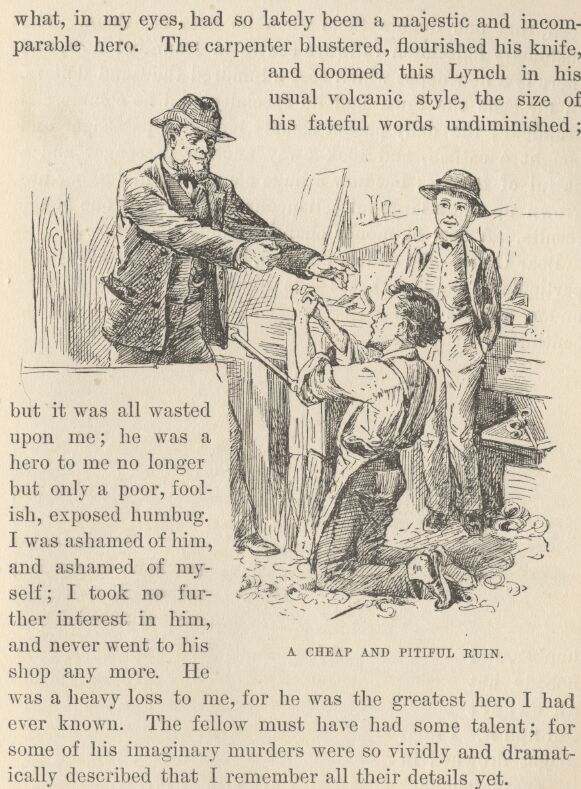
The carpenter blustered, flourished his knife, and doomed this Lynch in his usual volcanic style, the size of his fateful words undiminished; but it was all wasted upon me; he was a hero to me no longer, but only a poor, foolish, exposed humbug. I was ashamed of him, and ashamed of myself; I took no further interest in him, and never went to his shop any more. He was a heavy loss to me, for he was the greatest hero I had ever known. The fellow must have had some talent; for some of his imaginary murders were so vividly and dramatically described that I remember all their details yet.
The carpenter blustered, waved his knife, and threatened to kill Lynch in his usual explosive style. His deadly words were as grand as ever, but they had no effect on me. He was no longer a hero to me, just a poor, foolish fraud who had been found out. I was ashamed of him and ashamed of myself. I lost interest in him and never went to his shop again. Losing him was a heavy blow, because he was the greatest hero I had ever known. The fellow must have had some talent. He described some of his imaginary murders so vividly and dramatically that I still remember all the details.
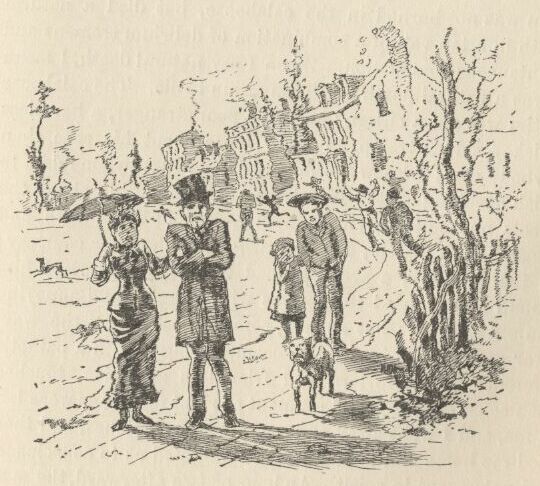
The people of Hannibal are not more changed than is the town. It is no longer a village; it is a city, with a mayor, and a council, and water-works, and probably a debt. It has fifteen thousand people, is a thriving and energetic place, and is paved like the rest of the west and south—where a well-paved street and a good sidewalk are things so seldom seen, that one doubts them when he does see them. The customary half-dozen railways center in Hannibal now, and there is a new depot which cost a hundred thousand dollars. In my time the town had no specialty, and no commercial grandeur; the daily packet usually landed a passenger and bought a catfish, and took away another passenger and a hatful of freight; but now a huge commerce in lumber has grown up and a large miscellaneous commerce is one of the results. A deal of money changes hands there now.
The people of Hannibal have changed no more than the town itself. Hannibal is no longer a village. It is a city, with a mayor, a council, waterworks, and probably a debt. It has fifteen thousand people and is a thriving, energetic place. Its streets are paved like those in the rest of the West and South. In those places, a well-paved street and a good sidewalk are so rare that you doubt them when you see them. The usual half dozen railways now meet in Hannibal, and a new depot cost a hundred thousand dollars. In my time, the town had no specialty and no great commerce. The daily packet boat usually dropped off a passenger, bought a catfish, and took away another passenger and a hatful of freight. But now a huge lumber trade has grown up, and a large trade in other goods has followed. A lot of money changes hands there now.
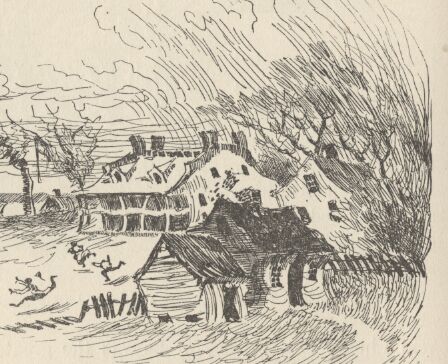
Bear Creek—so called, perhaps, because it was always so particularly bare of bears—is hidden out of sight now, under islands and continents of piled lumber, and nobody but an expert can find it. I used to get drowned in it every summer regularly, and be drained out, and inflated and set going again by some chance enemy; but not enough of it is unoccupied now to drown a person in. It was a famous breeder of chills and fever in its day. I remember one summer when everybody in town had this disease at once. Many chimneys were shaken down, and all the houses were so racked that the town had to be rebuilt. The chasm or gorge between Lover's Leap and the hill west of it is supposed by scientists to have been caused by glacial action. This is a mistake.
Bear Creek was perhaps named for having so few bears. It is now hidden under islands and continents of piled lumber. Only an expert can find it. I used to drown in Bear Creek every summer, without fail. Then some chance enemy would drain me out, inflate me, and get me going again. But not enough of the creek is unoccupied now for anyone to drown in it. In its day, the creek was famous for breeding chills and fever. I remember one summer when everyone in town had the disease at once. Many chimneys were shaken down, and all the houses were so damaged that the town had to be rebuilt. Scientists believe the chasm between Lover's Leap and the hill west of it was caused by glaciers. This is a mistake.
There is an interesting cave a mile or two below Hannibal, among the bluffs. I would have liked to revisit it, but had not time. In my time the person who then owned it turned it into a mausoleum for his daughter, aged fourteen. The body of this poor child was put into a copper cylinder filled with alcohol, and this was suspended in one of the dismal avenues of the cave. The top of the cylinder was removable; and it was said to be a common thing for the baser order of tourists to drag the dead face into view and examine it and comment upon it.
There is an interesting cave among the bluffs a mile or two below Hannibal. I would have liked to visit it again, but I did not have time. In my day, the cave’s owner turned it into a tomb for his fourteen-year-old daughter. The poor child’s body was placed in a copper cylinder filled with alcohol. The cylinder was suspended in one of the cave’s gloomy passages. Its top could be removed. It was said that the more vulgar tourists often pulled the dead girl’s face into view, examined it, and commented on it.