Chapter 54
Past and Present
Being left to myself, up there, I went on picking out old houses in the distant town, and calling back their former inmates out of the moldy past. Among them I presently recognized the house of the father of Lem Hackett (fictitious name). It carried me back more than a generation in a moment, and landed me in the midst of a time when the happenings of life were not the natural and logical results of great general laws, but of special orders, and were freighted with very precise and distinct purposes—partly punitive in intent, partly admonitory; and usually local in application.
Left alone up there, I kept picking out old houses in the distant town. I recalled the people who had once lived in them, bringing them back from the musty past. Soon I recognized the house of Lem Hackett's father (a fictitious name). In an instant, the house took me back more than a generation. I found myself in a time when life's events were not seen as the natural, logical results of broad laws. Instead, they were seen as the result of special orders, each with a precise and distinct purpose. These purposes were partly to punish and partly to warn, and they usually applied locally.
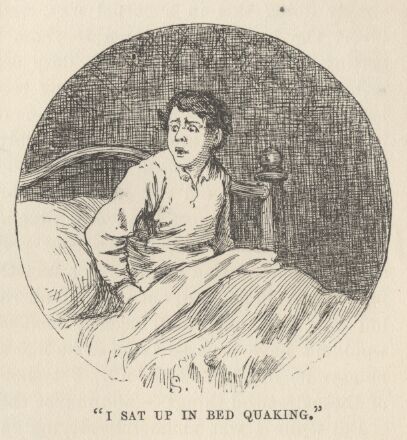
When I was a small boy, Lem Hackett was drowned—on a Sunday. He fell out of an empty flat-boat, where he was playing. Being loaded with sin, he went to the bottom like an anvil. He was the only boy in the village who slept that night. We others all lay awake, repenting. We had not needed the information, delivered from the pulpit that evening, that Lem's was a case of special judgment—we knew that, already. There was a ferocious thunder-storm, that night, and it raged continuously until near dawn. The winds blew, the windows rattled, the rain swept along the roof in pelting sheets, and at the briefest of intervals the inky blackness of the night vanished, the houses over the way glared out white and blinding for a quivering instant, then the solid darkness shut down again and a splitting peal of thunder followed, which seemed to rend everything in the neighborhood to shreds and splinters. I sat up in bed quaking and shuddering, waiting for the destruction of the world, and expecting it. To me there was nothing strange or incongruous in heaven's making such an uproar about Lem Hackett. Apparently it was the right and proper thing to do. Not a doubt entered my mind that all the angels were grouped together, discussing this boy's case and observing the awful bombardment of our beggarly little village with satisfaction and approval. There was one thing which disturbed me in the most serious way; that was the thought that this centering of the celestial interest on our village could not fail to attract the attention of the observers to people among us who might otherwise have escaped notice for years. I felt that I was not only one of those people, but the very one most likely to be discovered. That discovery could have but one result: I should be in the fire with Lem before the chill of the river had been fairly warmed out of him. I knew that this would be only just and fair. I was increasing the chances against myself all the time, by feeling a secret bitterness against Lem for having attracted this fatal attention to me, but I could not help it—this sinful thought persisted in infesting my breast in spite of me. Every time the lightning glared I caught my breath, and judged I was gone. In my terror and misery, I meanly began to suggest other boys, and mention acts of theirs which were wickeder than mine, and peculiarly needed punishment—and I tried to pretend to myself that I was simply doing this in a casual way, and without intent to divert the heavenly attention to them for the purpose of getting rid of it myself. With deep sagacity I put these mentions into the form of sorrowing recollections and left-handed sham-supplications that the sins of those boys might be allowed to pass unnoticed—'Possibly they may repent.' 'It is true that Jim Smith broke a window and lied about it—but maybe he did not mean any harm. And although Tom Holmes says more bad words than any other boy in the village, he probably intends to repent—though he has never said he would. And whilst it is a fact that John Jones did fish a little on Sunday, once, he didn't really catch anything but only just one small useless mud-cat; and maybe that wouldn't have been so awful if he had thrown it back—as he says he did, but he didn't. Pity but they would repent of these dreadful things—and maybe they will yet.'
When I was a small boy, Lem Hackett drowned on a Sunday. He fell out of an empty flatboat where he was playing. Loaded down with sin, he sank like an anvil. He was the only boy in the village who slept that night. The rest of us lay awake, repenting. That evening, the preacher told us Lem’s death was a special judgment. We did not need to be told. We already knew. A ferocious thunderstorm raged that night without stopping until nearly dawn. The wind blew, the windows rattled, and rain swept across the roof in pounding sheets. Every few moments, the inky blackness vanished. The houses across the way glared white and blinding for a flickering instant. Then solid darkness closed in again. A splitting peal of thunder followed, seeming to tear everything nearby into shreds and splinters. I sat up in bed, shaking and shuddering, waiting for the world to end and expecting it to happen. I saw nothing strange or out of place in heaven making such an uproar over Lem Hackett. Apparently, it was the right and proper thing to do. I had no doubt that all the angels were gathered together, discussing Lem’s case. They were watching the terrible bombardment of our poor little village with satisfaction and approval. One thought troubled me deeply. Now that heaven’s attention was fixed on our village, the angels were bound to notice other people among us. Otherwise, those people might have escaped notice for years. I felt that I was one of them, and the one most likely to be found out. That discovery could have only one result. I would be in the fire with Lem before he had even warmed up from the chill of the river. I knew that would be only right and fair. I kept making my chances worse by secretly resenting Lem for drawing this fatal attention to me. But I could not help it. This sinful thought kept invading my mind despite my efforts. Every time the lightning flashed, I caught my breath and thought I was done for. In my terror and misery, I began, like a coward, to bring up other boys. I mentioned things they had done that were more wicked than anything I had done and especially deserved punishment. I tried to pretend I was only mentioning these things casually. I pretended I had no intention of turning heaven’s attention to the other boys to get it off myself. Very cleverly, I put my mentions in the form of sad recollections and sly, fake prayers. I prayed that the other boys’ sins might go unnoticed. ‘Possibly they may repent.’ ‘It is true that Jim Smith broke a window and lied about it, but maybe he did not mean any harm. And although Tom Holmes says more bad words than any other boy in the village, he probably intends to repent. He has never said he would, though. And it is a fact that John Jones did fish a little on Sunday, once. But he did not really catch anything except one small, useless mud-cat. And maybe that would not have been so awful if he had thrown it back. He says he did, but he did not. It is a pity they do not repent of these dreadful things, and maybe they still will.’
But while I was shamefully trying to draw attention to these poor chaps—who were doubtless directing the celestial attention to me at the same moment, though I never once suspected that—I had heedlessly left my candle burning. It was not a time to neglect even trifling precautions. There was no occasion to add anything to the facilities for attracting notice to me—so I put the light out.
But while I was shamefully trying to draw attention to those poor fellows, I had carelessly left my candle burning. No doubt they were drawing heaven’s attention to me at the same moment, though I never suspected it. This was no time to neglect even the smallest precautions. There was no need to make it any easier to attract attention to me, so I put out the light.
It was a long night to me, and perhaps the most distressful one I ever spent. I endured agonies of remorse for sins which I knew I had committed, and for others which I was not certain about, yet was sure that they had been set down against me in a book by an angel who was wiser than I and did not trust such important matters to memory. It struck me, by and by, that I had been making a most foolish and calamitous mistake, in one respect: doubtless I had not only made my own destruction sure by directing attention to those other boys, but had already accomplished theirs!—Doubtless the lightning had stretched them all dead in their beds by this time! The anguish and the fright which this thought gave me made my previous sufferings seem trifling by comparison.
It was a long night for me, and perhaps the most distressing one I ever spent. I suffered agonies of remorse for sins I knew I had committed. I also suffered for others I was unsure about. Yet I was sure an angel had written them down against me in a book. The angel was wiser than I was and did not trust such important matters to memory. After a while, I realized I had made a terribly foolish and disastrous mistake in one respect. By drawing attention to those other boys, I had surely not only sealed my own destruction but brought about theirs! Surely lightning had struck them all dead in their beds by now! The anguish and fear this thought caused made my earlier suffering seem trivial by comparison.
Things had become truly serious. I resolved to turn over a new leaf instantly; I also resolved to connect myself with the church the next day, if I survived to see its sun appear. I resolved to cease from sin in all its forms, and to lead a high and blameless life for ever after. I would be punctual at church and Sunday-school; visit the sick; carry baskets of victuals to the poor (simply to fulfil the regulation conditions, although I knew we had none among us so poor but they would smash the basket over my head for my pains); I would instruct other boys in right ways, and take the resulting trouncings meekly; I would subsist entirely on tracts; I would invade the rum shop and warn the drunkard— and finally, if I escaped the fate of those who early become too good to live, I would go for a missionary.
Things had become truly serious. I decided to change my ways immediately. I also decided to join the church the next day, if I lived to see the sun rise. I decided to stop sinning in every way and lead a noble, blameless life forever after. I would be on time for church and Sunday school. I would visit the sick and carry baskets of food to the poor. I would carry the baskets just to meet the usual requirements. I knew no one among us was so poor that they wouldn't smash the basket over my head for my trouble. I would teach other boys to do right and meekly accept the beatings that followed. I would live entirely on religious pamphlets. I would march into the saloon and warn the drunkard. Finally, if I escaped the fate of those who become too good to live at an early age, I would become a missionary.
The storm subsided toward daybreak, and I dozed gradually to sleep with a sense of obligation to Lem Hackett for going to eternal suffering in that abrupt way, and thus preventing a far more dreadful disaster—my own loss.
The storm died down toward daybreak, and I gradually drifted off to sleep. I felt indebted to Lem Hackett for going to eternal suffering so abruptly. By doing so, he had prevented a far more dreadful disaster: my own loss.
But when I rose refreshed, by and by, and found that those other boys were still alive, I had a dim sense that perhaps the whole thing was a false alarm; that the entire turmoil had been on Lem's account and nobody's else. The world looked so bright and safe that there did not seem to be any real occasion to turn over a new leaf. I was a little subdued, during that day, and perhaps the next; after that, my purpose of reforming slowly dropped out of my mind, and I had a peaceful, comfortable time again, until the next storm.
But when I got up later, feeling refreshed, I found that the other boys were still alive. I had a vague feeling that perhaps the whole thing had been a false alarm, and that all the turmoil had been on Lem's account and no one else's. The world looked so bright and safe that there didn't seem to be any real reason to change my ways. I was a little subdued that day, and perhaps the next. After that, my resolve to reform slowly faded from my mind, and I had a peaceful, comfortable time again until the next storm.
That storm came about three weeks later; and it was the most unaccountable one, to me, that I had ever experienced; for on the afternoon of that day, 'Dutchy' was drowned. Dutchy belonged to our Sunday-school. He was a German lad who did not know enough to come in out of the rain; but he was exasperatingly good, and had a prodigious memory. One Sunday he made himself the envy of all the youth and the talk of all the admiring village, by reciting three thousand verses of Scripture without missing a word; then he went off the very next day and got drowned.
That storm came about three weeks later. To me, it was the most baffling storm I had ever experienced, because 'Dutchy' drowned that afternoon. Dutchy belonged to our Sunday school. He was a German boy who did not know enough to come in out of the rain. But he was annoyingly good and had an extraordinary memory. One Sunday, he recited three thousand verses of Scripture without missing a word. He became the envy of all the young people and the talk of the whole admiring village. Then, the very next day, he went off and drowned.
Circumstances gave to his death a peculiar impressiveness. We were all bathing in a muddy creek which had a deep hole in it, and in this hole the coopers had sunk a pile of green hickory hoop poles to soak, some twelve feet under water. We were diving and 'seeing who could stay under longest.' We managed to remain down by holding on to the hoop poles. Dutchy made such a poor success of it that he was hailed with laughter and derision every time his head appeared above water. At last he seemed hurt with the taunts, and begged us to stand still on the bank and be fair with him and give him an honest count—'be friendly and kind just this once, and not miscount for the sake of having the fun of laughing at him.' Treacherous winks were exchanged, and all said 'All right, Dutchy—go ahead, we'll play fair.'
The circumstances made his death especially striking. We were all bathing in a muddy creek with a deep hole. The coopers had sunk a pile of green hickory hoop poles there to soak, about twelve feet underwater. We were diving and 'seeing who could stay under longest.' We stayed down by holding on to the hoop poles. Dutchy did so poorly that everyone laughed and jeered whenever his head came above water. At last he seemed hurt by the taunts. He begged us to stand still on the bank, be fair, and give him an honest count. He asked us to 'be friendly and kind just this once, and not count wrong just to have the fun of laughing at him.' We exchanged sneaky winks, and everyone said, 'All right, Dutchy, go ahead, we'll play fair.'
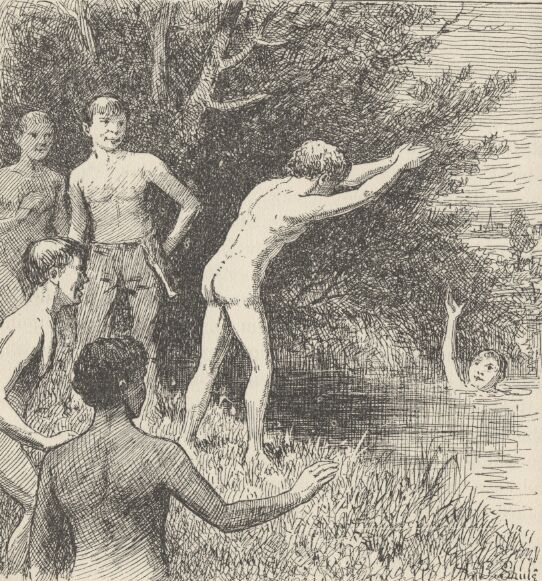
Dutchy plunged in, but the boys, instead of beginning to count, followed the lead of one of their number and scampered to a range of blackberry bushes close by and hid behind it. They imagined Dutchy's humiliation, when he should rise after a superhuman effort and find the place silent and vacant, nobody there to applaud. They were 'so full of laugh' with the idea, that they were continually exploding into muffled cackles. Time swept on, and presently one who was peeping through the briers, said, with surprise—
Dutchy plunged in, but the boys did not start counting. Instead, they followed one of the boys to a row of blackberry bushes nearby and hid behind them. They imagined how humiliated Dutchy would be when he surfaced after a superhuman effort. The place would be silent and empty, with nobody there to applaud him. They were 'so full of laughter' at the thought that they kept bursting into muffled cackles. Time passed, and soon one boy who was peeking through the bushes said in surprise:
'Why, he hasn't come up, yet!'
'Why, he hasn't come up yet!'
The laughing stopped.
The laughing stopped.
'Boys, it 's a splendid dive,' said one.
'Boys, it's a great dive,' said one.
'Never mind that,' said another, 'the joke on him is all the better for it.'
'Never mind that,' said another, 'it makes the joke on him even better.'
There was a remark or two more, and then a pause. Talking ceased, and all began to peer through the vines. Before long, the boys' faces began to look uneasy, then anxious, then terrified. Still there was no movement of the placid water. Hearts began to beat fast, and faces to turn pale. We all glided out, silently, and stood on the bank, our horrified eyes wandering back and forth from each other's countenances to the water.
A few more remarks followed, and then a pause. Everyone stopped talking and began peering through the vines. Before long, the boys' faces began to look uneasy, then anxious, then terrified. Still, the calm water did not move. Hearts began to beat faster, and faces turned pale. We all slipped out silently and stood on the bank. Our horrified eyes wandered back and forth between each other's faces and the water.
'Somebody must go down and see!'
'Someone has to go down and see!'
Yes, that was plain; but nobody wanted that grisly task.
Yes, that was clear, but nobody wanted that gruesome task.
'Draw straws!'
'Draw straws!'
So we did—with hands which shook so, that we hardly knew what we were about. The lot fell to me, and I went down. The water was so muddy I could not see anything, but I felt around among the hoop poles, and presently grasped a limp wrist which gave me no response—and if it had I should not have known it, I let it go with such a frightened suddenness.
So we did, but our hands shook so badly that we hardly knew what we were doing. The lot fell to me, and I went down. The water was so muddy I could not see anything. But I felt around among the hoop poles and soon grabbed a limp wrist. It gave no response. Even if it had, I would not have known it. I let go so suddenly, I was so frightened.
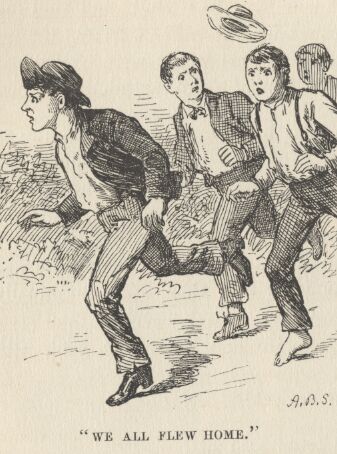
The boy had been caught among the hoop poles and entangled there, helplessly. I fled to the surface and told the awful news. Some of us knew that if the boy were dragged out at once he might possibly be resuscitated, but we never thought of that. We did not think of anything; we did not know what to do, so we did nothing—except that the smaller lads cried, piteously, and we all struggled frantically into our clothes, putting on anybody's that came handy, and getting them wrong-side-out and upside-down, as a rule. Then we scurried away and gave the alarm, but none of us went back to see the end of the tragedy. We had a more important thing to attend to: we all flew home, and lost not a moment in getting ready to lead a better life.
The boy had become tangled among the hoop poles and was trapped there, helpless. I rushed to the surface and told them the terrible news. Some of us knew that if the boy were pulled out immediately, he might possibly be revived. But we never thought of that. We did not think of anything. We did not know what to do, so we did nothing. The younger boys cried pitifully, and we all struggled frantically into our clothes. We put on whatever clothes came to hand, usually inside out or upside down. Then we hurried away and raised the alarm. But none of us went back to see how the tragedy ended. We had something more important to do. We all raced home and lost no time getting ready to lead a better life.
The night presently closed down. Then came on that tremendous and utterly unaccountable storm. I was perfectly dazed; I could not understand it. It seemed to me that there must be some mistake. The elements were turned loose, and they rattled and banged and blazed away in the most blind and frantic manner. All heart and hope went out of me, and the dismal thought kept floating through my brain, 'If a boy who knows three thousand verses by heart is not satisfactory, what chance is there for anybody else?'
Night soon fell. Then came that tremendous and utterly inexplicable storm. I was completely dazed. I could not understand the storm. It seemed to me that there must be some mistake. The elements were let loose, rattling, banging, and blazing away in the most blind and frantic way. All my courage and hope vanished, and a dismal thought kept floating through my mind: 'If a boy who knows three thousand verses by heart is not good enough, what chance does anyone else have?'
Of course I never questioned for a moment that the storm was on Dutchy's account, or that he or any other inconsequential animal was worthy of such a majestic demonstration from on high; the lesson of it was the only thing that troubled me; for it convinced me that if Dutchy, with all his perfections, was not a delight, it would be vain for me to turn over a new leaf, for I must infallibly fall hopelessly short of that boy, no matter how hard I might try. Nevertheless I did turn it over—a highly educated fear compelled me to do that—but succeeding days of cheerfulness and sunshine came bothering around, and within a month I had so drifted backward that again I was as lost and comfortable as ever.
Of course, I never doubted for a moment that the storm was on Dutchy’s account. Nor did I doubt that he or any other insignificant creature deserved such a majestic display from above. The lesson was the only thing that troubled me. It convinced me that if Dutchy, with all his perfections, was not a delight, it was pointless for me to turn over a new leaf. No matter how hard I tried, I would surely fall hopelessly short of that boy. Nevertheless, I did turn over a new leaf. A thoroughly educated fear forced me to do it. But then cheerful, sunny days came bothering around, and within a month I had drifted back. Once again, I was as lost and comfortable as ever.
Breakfast time approached while I mused these musings and called these ancient happenings back to mind; so I got me back into the present and went down the hill.
Breakfast time approached as I reflected and recalled those long-ago events. So I returned to the present and went down the hill.
On my way through town to the hotel, I saw the house which was my home when I was a boy. At present rates, the people who now occupy it are of no more value than I am; but in my time they would have been worth not less than five hundred dollars apiece. They are colored folk.
On my way through town to the hotel, I saw the house where I lived as a boy. At today’s prices, the people who live there now are worth no more than I am. But in my day, they would have been worth at least five hundred dollars each. They are Black people.
After breakfast, I went out alone again, intending to hunt up some of the Sunday-schools and see how this generation of pupils might compare with their progenitors who had sat with me in those places and had probably taken me as a model—though I do not remember as to that now. By the public square there had been in my day a shabby little brick church called the 'Old Ship of Zion,' which I had attended as a Sunday-school scholar; and I found the locality easily enough, but not the old church; it was gone, and a trig and rather hilarious new edifice was in its place. The pupils were better dressed and better looking than were those of my time; consequently they did not resemble their ancestors; and consequently there was nothing familiar to me in their faces. Still, I contemplated them with a deep interest and a yearning wistfulness, and if I had been a girl I would have cried; for they were the offspring, and represented, and occupied the places, of boys and girls some of whom I had loved to love, and some of whom I had loved to hate, but all of whom were dear to me for the one reason or the other, so many years gone by—and, Lord, where be they now!
After breakfast, I went out alone again. I wanted to visit some Sunday schools and see how the pupils compared with their parents. Their parents had attended Sunday school with me and had probably taken me as a model. Though I don't remember whether they did now. In my day, a shabby little brick church stood by the public square. It was called the 'Old Ship of Zion,' and I had attended Sunday school there. I found the spot easily enough, but the old church was gone. A neat, rather cheerful new building stood in its place. The pupils were better dressed and better looking than the pupils in my day. As a result, they didn't resemble their parents, and there was nothing familiar to me in their faces. Still, I looked at them with deep interest and longing. If I had been a girl, I would have cried. They were the children of those boys and girls from so many years ago. They represented them and occupied their places. Some I had loved to love, and some I had loved to hate. But all were dear to me for one reason or the other. And Lord, where are they now!
I was mightily stirred, and would have been grateful to be allowed to remain unmolested and look my fill; but a bald-summited superintendent who had been a tow-headed Sunday-school mate of mine on that spot in the early ages, recognized me, and I talked a flutter of wild nonsense to those children to hide the thoughts which were in me, and which could not have been spoken without a betrayal of feeling that would have been recognized as out of character with me.
I was deeply moved and would have been grateful to be left alone to look as long as I wanted. But a bald-headed superintendent recognized me. Long ago, he had been a blond Sunday school classmate of mine in that very spot. So I chattered wildly to the children to hide my thoughts. I could not have spoken those thoughts without showing feelings that would have seemed out of character for me.
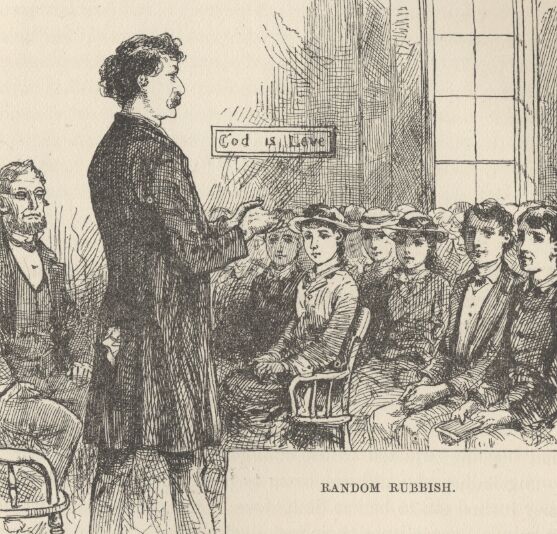
Making speeches without preparation is no gift of mine; and I was resolved to shirk any new opportunity, but in the next and larger Sunday-school I found myself in the rear of the assemblage; so I was very willing to go on the platform a moment for the sake of getting a good look at the scholars. On the spur of the moment I could not recall any of the old idiotic talks which visitors used to insult me with when I was a pupil there; and I was sorry for this, since it would have given me time and excuse to dawdle there and take a long and satisfying look at what I feel at liberty to say was an array of fresh young comeliness not matchable in another Sunday-school of the same size. As I talked merely to get a chance to inspect; and as I strung out the random rubbish solely to prolong the inspection, I judged it but decent to confess these low motives, and I did so.
Speaking without preparation is no gift of mine, and I had resolved to avoid any new opportunity. But at the next Sunday school, which was larger, I found myself at the back of the crowd. So I was quite willing to go onto the platform for a moment to get a good look at the pupils. On the spur of the moment, I could not remember any of the idiotic old talks visitors used to insult me with when I was a pupil there. I was sorry about that. Such a talk would have given me time and an excuse to linger and take a long, satisfying look. I feel free to say that no other Sunday school of the same size could match that array of fresh young beauty. I spoke only to get a chance to look at the pupils. And I dragged out my random nonsense solely to prolong that look. So I thought it only decent to confess these low motives, and I did.
If the Model Boy was in either of these Sunday-schools, I did not see him. The Model Boy of my time—we never had but the one—was perfect: perfect in manners, perfect in dress, perfect in conduct, perfect in filial piety, perfect in exterior godliness; but at bottom he was a prig; and as for the contents of his skull, they could have changed place with the contents of a pie and nobody would have been the worse off for it but the pie. This fellow's reproachlessness was a standing reproach to every lad in the village. He was the admiration of all the mothers, and the detestation of all their sons. I was told what became of him, but as it was a disappointment to me, I will not enter into details. He succeeded in life.
If the Model Boy was in either of these Sunday schools, I did not see him. We had only one Model Boy in my time. He was perfect in manners, dress, conduct, devotion to his parents, and outward religious behavior. But underneath it all, he was a prig. His brains could have been swapped with the contents of a pie, and only the pie would have suffered. This fellow’s flawless behavior was a constant rebuke to every boy in the village. All the mothers admired him, and all their sons hated him. I was told what became of him, but the news disappointed me, so I will not go into details. He succeeded in life.