Chapter 53
My Childhood Home
WE took passage in one of the fast boats of the St. Louis and St. Paul Packet Company, and started up the river.
We boarded one of the fast boats of the St. Louis and St. Paul Packet Company and headed upriver.
When I, as a boy, first saw the mouth of the Missouri River, it was twenty-two or twenty-three miles above St. Louis, according to the estimate of pilots; the wear and tear of the banks have moved it down eight miles since then; and the pilots say that within five years the river will cut through and move the mouth down five miles more, which will bring it within ten miles of St. Louis.
When I first saw the mouth of the Missouri River as a boy, pilots estimated it was twenty-two or twenty-three miles above St. Louis. Since then, erosion of the banks has moved the mouth eight miles downstream. The pilots say that within five years, the river will cut through and move the mouth another five miles downstream. That will bring the mouth within ten miles of St. Louis.
About nightfall we passed the large and flourishing town of Alton, Illinois; and before daylight next morning the town of Louisiana, Missouri, a sleepy village in my day, but a brisk railway center now; however, all the towns out there are railway centers now. I could not clearly recognize the place. This seemed odd to me, for when I retired from the rebel army in '61 I retired upon Louisiana in good order; at least in good enough order for a person who had not yet learned how to retreat according to the rules of war, and had to trust to native genius. It seemed to me that for a first attempt at a retreat it was not badly done. I had done no advancing in all that campaign that was at all equal to it.
Around nightfall we passed the large, thriving town of Alton, Illinois. Before daylight the next morning, we passed Louisiana, Missouri. In my day it was a sleepy village, but now it is a busy railway center. Then again, all the towns out there are railway centers now. I could not clearly recognize Louisiana. That seemed odd to me, because when I left the rebel army in 1861, I retreated to Louisiana in good order. At least, it was good enough for someone who had not yet learned to retreat according to the rules of war. I had to rely on natural genius. For a first attempt at a retreat, I thought I had done fairly well. Nothing I had done while advancing during that whole campaign was nearly as good.
There was a railway bridge across the river here well sprinkled with glowing lights, and a very beautiful sight it was.
A railway bridge crossed the river here, dotted with glowing lights. It was a very beautiful sight.
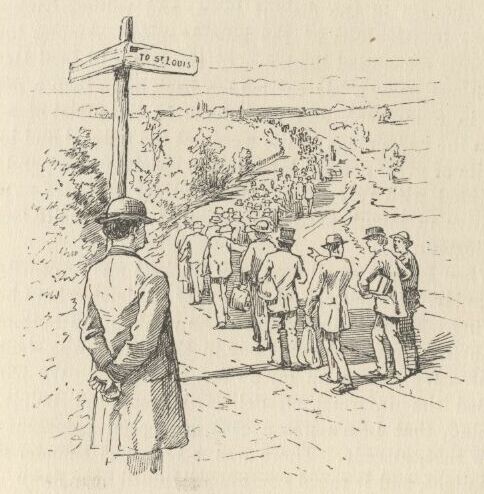
At seven in the morning we reached Hannibal, Missouri, where my boyhood was spent. I had had a glimpse of it fifteen years ago, and another glimpse six years earlier, but both were so brief that they hardly counted. The only notion of the town that remained in my mind was the memory of it as I had known it when I first quitted it twenty-nine years ago. That picture of it was still as clear and vivid to me as a photograph. I stepped ashore with the feeling of one who returns out of a dead-and-gone generation. I had a sort of realizing sense of what the Bastille prisoners must have felt when they used to come out and look upon Paris after years of captivity, and note how curiously the familiar and the strange were mixed together before them. I saw the new houses— saw them plainly enough—but they did not affect the older picture in my mind, for through their solid bricks and mortar I saw the vanished houses, which had formerly stood there, with perfect distinctness.
At seven in the morning, we reached Hannibal, Missouri, where I had spent my boyhood. I had caught a glimpse of the town fifteen years ago, and another six years before that. But both visits were so brief that they hardly counted. The only image of the town left in my mind was how I had known it when I first left, twenty-nine years ago. That picture was still as clear and vivid as a photograph. I stepped ashore feeling like someone returning from a generation long dead and gone. I had a sense of what the Bastille prisoners must have felt when they came out after years of captivity. They would look at Paris and see how strangely the familiar and the unfamiliar were mixed together. I saw the new houses plainly enough, but they did not change the older picture in my mind. Through their solid bricks and mortar, I could see the vanished houses that had once stood there, perfectly clearly.
It was Sunday morning, and everybody was abed yet. So I passed through the vacant streets, still seeing the town as it was, and not as it is, and recognizing and metaphorically shaking hands with a hundred familiar objects which no longer exist; and finally climbed Holiday's Hill to get a comprehensive view. The whole town lay spread out below me then, and I could mark and fix every locality, every detail. Naturally, I was a good deal moved. I said, 'Many of the people I once knew in this tranquil refuge of my childhood are now in heaven; some, I trust, are in the other place.' The things about me and before me made me feel like a boy again—convinced me that I was a boy again, and that I had simply been dreaming an unusually long dream; but my reflections spoiled all that; for they forced me to say, 'I see fifty old houses down yonder, into each of which I could enter and find either a man or a woman who was a baby or unborn when I noticed those houses last, or a grandmother who was a plump young bride at that time.'
It was Sunday morning, and everyone was still in bed. So I walked through the empty streets, still seeing the town as it had been, not as it was now. I recognized a hundred familiar things that no longer existed and imagined shaking hands with them. Finally, I climbed Holiday's Hill for a view of the whole town. It lay spread out below me, and I could identify and fix in my mind every place and every detail. Naturally, I was deeply moved. I said, 'Many of the people I once knew in this peaceful refuge of my childhood are now in heaven. Some, I trust, are in the other place.' Everything around me and before me made me feel like a boy again. It convinced me that I was a boy again and had merely been having an unusually long dream. But my thoughts spoiled all that. They forced me to say, 'I see fifty old houses down there. I could enter any one of them and find either a man or woman who was a baby or not yet born when I last saw those houses, or a grandmother who was a plump young bride then.'
From this vantage ground the extensive view up and down the river, and wide over the wooded expanses of Illinois, is very beautiful—one of the most beautiful on the Mississippi, I think; which is a hazardous remark to make, for the eight hundred miles of river between St. Louis and St. Paul afford an unbroken succession of lovely pictures. It may be that my affection for the one in question biases my judgment in its favor; I cannot say as to that. No matter, it was satisfyingly beautiful to me, and it had this advantage over all the other friends whom I was about to greet again: it had suffered no change; it was as young and fresh and comely and gracious as ever it had been; whereas, the faces of the others would be old, and scarred with the campaigns of life, and marked with their griefs and defeats, and would give me no upliftings of spirit.
From this vantage point, the broad view up and down the river and across the wooded expanses of Illinois is beautiful. I think it is one of the most beautiful views on the Mississippi. That is a risky thing to say, because the eight hundred miles of river between St. Louis and St. Paul offer an unbroken succession of lovely scenes. My affection for this particular view may make me judge it too favorably. I cannot say. In any case, it was beautiful enough to satisfy me, and it had one advantage over all the other friends I was about to greet again. The view had not changed. It was as young, fresh, lovely, and graceful as ever. The faces of my other friends, however, would be old, scarred by life's struggles, and marked by grief and defeat. They would not lift my spirits.
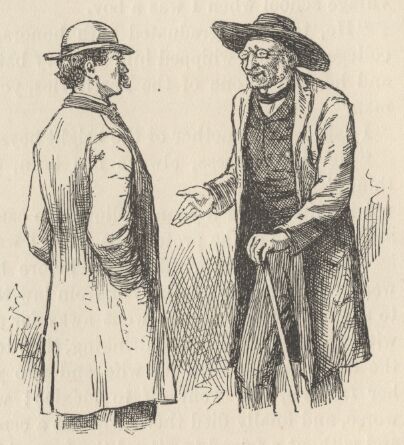
An old gentleman, out on an early morning walk, came along, and we discussed the weather, and then drifted into other matters. I could not remember his face. He said he had been living here twenty-eight years. So he had come after my time, and I had never seen him before. I asked him various questions; first about a mate of mine in Sunday school—what became of him?
An old man came along on an early morning walk. We talked about the weather, then drifted into other subjects. I didn’t recognize his face. He said he had lived here for twenty-eight years. So he had come after my time, and I had never seen him before. I asked him several questions. First, I asked what had become of a friend of mine from Sunday school.
'He graduated with honor in an Eastern college, wandered off into the world somewhere, succeeded at nothing, passed out of knowledge and memory years ago, and is supposed to have gone to the dogs.'
'He graduated with honors from a college in the East. He wandered off somewhere, failed at everything, and was forgotten years ago. People assume his life fell apart.'
'He was bright, and promised well when he was a boy.'
'He was bright and showed promise as a boy.'
'Yes, but the thing that happened is what became of it all.'
'Yes, but what happened is how it all turned out.'
I asked after another lad, altogether the brightest in our village school when I was a boy.
I asked about another boy, who had been by far the brightest in our village school when I was young.
'He, too, was graduated with honors, from an Eastern college; but life whipped him in every battle, straight along, and he died in one of the Territories, years ago, a defeated man.'
'He, too, graduated with honors from an Eastern college. But life defeated him in every battle, and years ago he died a defeated man in one of the Territories.'
I asked after another of the bright boys.
I asked about another of the bright boys.
'He is a success, always has been, always will be, I think.'
'He is successful, always has been, and always will be, I think.'
I inquired after a young fellow who came to the town to study for one of the professions when I was a boy.
I asked about a young man who had come to town to study for a profession when I was a boy.
'He went at something else before he got through—went from medicine to law, or from law to medicine—then to some other new thing; went away for a year, came back with a young wife; fell to drinking, then to gambling behind the door; finally took his wife and two young children to her father's, and went off to Mexico; went from bad to worse, and finally died there, without a cent to buy a shroud, and without a friend to attend the funeral.'
'Before finishing, he switched to something else. He went from medicine to law, or from law to medicine, then tried something new. He went away for a year and came back with a young wife. He began drinking, then gambling in secret. Finally, he took his wife and two young children to her father's house and went off to Mexico. Things went from bad to worse, and he finally died there. He did not have a cent to buy a burial shroud or a friend to attend his funeral.'
'Pity, for he was the best-natured, and most cheery and hopeful young fellow that ever was.'
'It's a pity, because he was the kindest, most cheerful and hopeful young man who ever lived.'
I named another boy.
I named another boy.
'Oh, he is all right. Lives here yet; has a wife and children, and is prospering.'
'Oh, he's doing fine. He still lives here, has a wife and children, and is doing well.'
Same verdict concerning other boys.
The same verdict applied to the other boys.
I named three school-girls.
I named three schoolgirls.
'The first two live here, are married and have children; the other is long ago dead—never married.'
'The first two live here, are married, and have children. The other died long ago and never married.'
I named, with emotion, one of my early sweethearts.
I named one of my early sweethearts, feeling emotional.
'She is all right. Been married three times; buried two husbands, divorced from the third, and I hear she is getting ready to marry an old fellow out in Colorado somewhere. She's got children scattered around here and there, most everywheres.'
'She is all right. She has been married three times. She buried two husbands and divorced the third. I hear she is getting ready to marry an old fellow somewhere in Colorado. She has children scattered here and there, just about everywhere.'
The answer to several other inquiries was brief and simple—
The answer to several other questions was brief and simple:
'Killed in the war.'
'Killed in the war.'
I named another boy.
I named another boy.
'Well, now, his case is curious! There wasn't a human being in this town but knew that that boy was a perfect chucklehead; perfect dummy; just a stupid ass, as you may say. Everybody knew it, and everybody said it. Well, if that very boy isn't the first lawyer in the State of Missouri to-day, I'm a Democrat!'
'Well, now, his case is curious! Everyone in this town knew that boy was a complete fool. A complete dummy. Just a stupid ass, you might say. Everyone knew it, and everyone said it. Well, if that very boy isn't the top lawyer in the State of Missouri today, I'm a Democrat!'
'Is that so?'
'Is that so?'
'It's actually so. I'm telling you the truth.'
'It's really true. I'm telling you the truth.'
'How do you account for it?'
'How do you explain it?'
'Account for it? There ain't any accounting for it, except that if you send a damned fool to St. Louis, and you don't tell them he's a damned fool they'll never find it out. There's one thing sure—if I had a damned fool I should know what to do with him: ship him to St. Louis— it's the noblest market in the world for that kind of property. Well, when you come to look at it all around, and chew at it and think it over, don't it just bang anything you ever heard of?'
'Explain it? There’s no explaining it, except this: if you send a damned fool to St. Louis and don’t tell them he’s a damned fool, they’ll never figure it out. One thing’s for sure. If I had a damned fool, I’d know what to do with him: ship him to St. Louis. It’s the best market in the world for that kind of property. Well, when you look at it from every angle, chew on it, and think it over, doesn’t it beat anything you’ve ever heard of?'
'Well, yes, it does seem to. But don't you think maybe it was the Hannibal people who were mistaken about the boy, and not the St. Louis people.'
'Well, yes, it does seem to. But don't you think maybe the Hannibal people were mistaken about the boy, not the St. Louis people?'
'Oh, nonsense! The people here have known him from the very cradle— they knew him a hundred times better than the St. Louis idiots could have known him. No, if you have got any damned fools that you want to realize on, take my advice—send them to St. Louis.'
'Oh, nonsense! The people here have known him since he was a baby. They knew him a hundred times better than the St. Louis idiots could have known him. No, if you have any damned fools you want to profit from, take my advice. Send them to St. Louis.'
I mentioned a great number of people whom I had formerly known. Some were dead, some were gone away, some had prospered, some had come to naught; but as regarded a dozen or so of the lot, the answer was comforting:
I mentioned many people I had known before. Some had died, some had moved away, some had prospered, and some had come to nothing. But for about a dozen of them, the answer was comforting:
'Prosperous—live here yet—town littered with their children.'
'Prosperous, still live here. The town is littered with their children.'
I asked about Miss ——.
I asked about Miss [name withheld].
Died in the insane asylum three or four years ago—never was out of it from the time she went in; and was always suffering, too; never got a shred of her mind back.'
She died in the psychiatric hospital three or four years ago. She never left after she was admitted. She suffered the whole time, too. She never regained any of her mind.'
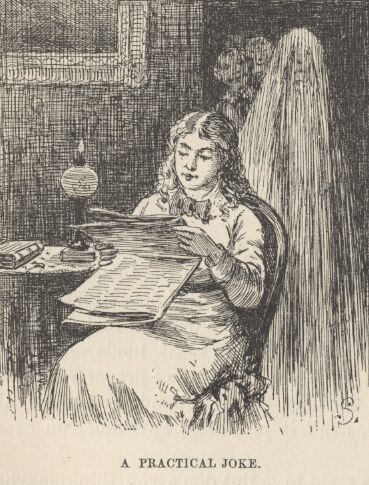
If he spoke the truth, here was a heavy tragedy, indeed. Thirty-six years in a madhouse, that some young fools might have some fun! I was a small boy, at the time; and I saw those giddy young ladies come tiptoeing into the room where Miss —— sat reading at midnight by a lamp. The girl at the head of the file wore a shroud and a doughface, she crept behind the victim, touched her on the shoulder, and she looked up and screamed, and then fell into convulsions. She did not recover from the fright, but went mad. In these days it seems incredible that people believed in ghosts so short a time ago. But they did.
If he was telling the truth, this was a terrible tragedy indeed. Thirty-six years in a madhouse, so that some young fools could have some fun! I was a small boy at the time. I saw those carefree young women tiptoe into the room where Miss _____ sat reading by lamplight at midnight. The girl leading the line wore a shroud and a dough mask. She crept behind Miss _____ and touched her on the shoulder. Miss _____ looked up and screamed, then fell into convulsions. She never recovered from the fright, but went mad. Today, it seems unbelievable that people believed in ghosts such a short time ago. But they did.
After asking after such other folk as I could call to mind, I finally inquired about myself:
After asking about everyone else I could remember, I finally asked about myself:
'Oh, he succeeded well enough—another case of damned fool. If they'd sent him to St. Louis, he'd have succeeded sooner.'
'Oh, he succeeded well enough. Another damned fool. If they'd sent him to St. Louis, he'd have succeeded sooner.'
It was with much satisfaction that I recognized the wisdom of having told this candid gentleman, in the beginning, that my name was Smith.
I was very pleased to realize how wise I had been to tell this frank gentleman at the beginning that my name was Smith.