Chapter 46
Magic and Magicians
THE largest annual event in New Orleans is a something which we arrived too late to sample—the Mardi-Gras festivities. I saw the procession of the Mystic Crew of Comus there, twenty-four years ago—with knights and nobles and so on, clothed in silken and golden Paris-made gorgeousnesses, planned and bought for that single night's use; and in their train all manner of giants, dwarfs, monstrosities, and other diverting grotesquerie—a startling and wonderful sort of show, as it filed solemnly and silently down the street in the light of its smoking and flickering torches; but it is said that in these latter days the spectacle is mightily augmented, as to cost, splendor, and variety. There is a chief personage—'Rex;' and if I remember rightly, neither this king nor any of his great following of subordinates is known to any outsider. All these people are gentlemen of position and consequence; and it is a proud thing to belong to the organization; so the mystery in which they hide their personality is merely for romance's sake, and not on account of the police.
The biggest annual event in New Orleans is something we arrived too late to experience: the Mardi-Gras festivities. I saw the procession of the Mystic Crew of Comus there twenty-four years ago. Knights, nobles, and others wore magnificent silk and gold costumes made in Paris, designed and bought for that one night. Following them came all kinds of giants, dwarfs, monsters, and other amusing grotesques. The procession was a startling and wonderful sight as it moved solemnly and silently down the street. Smoking torches flickered along its path. But people say the spectacle has grown much grander in recent years, in cost, splendor, and variety. There is a chief figure called 'Rex.' If I remember rightly, no outsider knows who this king or any of his many followers are. All these men are gentlemen of standing and importance, and belonging to the organization is a source of pride. So they hide their identities only for the sake of romance, not because of the police.
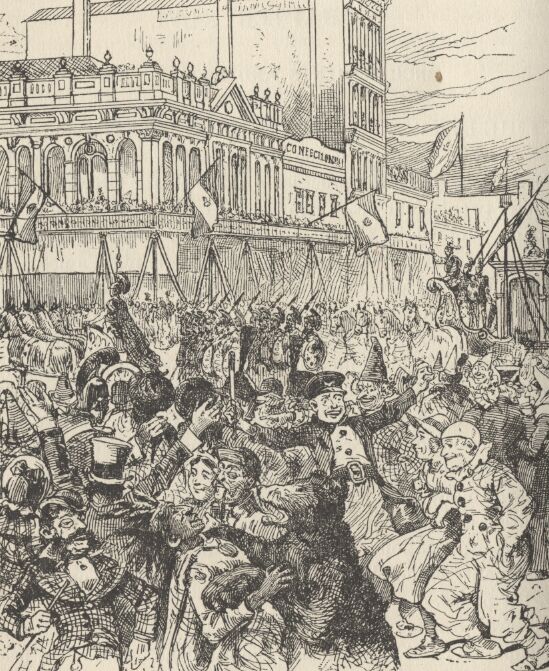
Mardi-Gras is of course a relic of the French and Spanish occupation; but I judge that the religious feature has been pretty well knocked out of it now. Sir Walter has got the advantage of the gentlemen of the cowl and rosary, and he will stay. His medieval business, supplemented by the monsters and the oddities, and the pleasant creatures from fairy-land, is finer to look at than the poor fantastic inventions and performances of the reveling rabble of the priest's day, and serves quite as well, perhaps, to emphasize the day and admonish men that the grace-line between the worldly season and the holy one is reached.
Mardi-Gras is, of course, a relic of the French and Spanish occupation. But I think its religious side has pretty much been knocked out of it now. Sir Walter has got the better of the gentlemen of the cowl and rosary, and he is here to stay. His medieval pageantry, with its monsters, oddities, and pleasant creatures from fairyland, is finer to look at. It is finer than the poor, fanciful inventions and performances of the reveling rabble in the priest's day. And perhaps it serves just as well to mark the day and remind people that the boundary between the worldly season and the holy one has been reached.
This Mardi-Gras pageant was the exclusive possession of New Orleans until recently. But now it has spread to Memphis and St. Louis and Baltimore. It has probably reached its limit. It is a thing which could hardly exist in the practical North; would certainly last but a very brief time; as brief a time as it would last in London. For the soul of it is the romantic, not the funny and the grotesque. Take away the romantic mysteries, the kings and knights and big-sounding titles, and Mardi-Gras would die, down there in the South. The very feature that keeps it alive in the South—girly-girly romance—would kill it in the North or in London. Puck and Punch, and the press universal, would fall upon it and make merciless fun of it, and its first exhibition would be also its last.
Until recently, this Mardi-Gras pageant belonged exclusively to New Orleans. But now it has spread to Memphis, St. Louis, and Baltimore. It has probably spread as far as it will go. The pageant could hardly exist in the practical North. It would certainly last only a very short time there, just as it would in London. For its soul is romance, not humor or the grotesque. Take away the romantic mysteries, the kings and knights, and the grand-sounding titles, and Mardi-Gras would die in the South. The very thing that keeps it alive there, girly-girly romance, would kill it in the North or in London. Puck and Punch, along with the entire press, would attack it and make merciless fun of it. Its first show would also be its last.
Against the crimes of the French Revolution and of Bonaparte may be set two compensating benefactions: the Revolution broke the chains of the ancien regime and of the Church, and made of a nation of abject slaves a nation of freemen; and Bonaparte instituted the setting of merit above birth, and also so completely stripped the divinity from royalty, that whereas crowned heads in Europe were gods before, they are only men, since, and can never be gods again, but only figureheads, and answerable for their acts like common clay. Such benefactions as these compensate the temporary harm which Bonaparte and the Revolution did, and leave the world in debt to them for these great and permanent services to liberty, humanity, and progress.
The crimes of the French Revolution and of Bonaparte may be weighed against two benefits. The Revolution broke the chains of the ancien regime and of the Church. It turned a nation of helpless slaves into a nation of free people. Bonaparte established merit above birth. He also so completely stripped royalty of its divine status that Europe's crowned heads, once gods, have since been only human. They can never be gods again, but only figureheads, accountable for their actions like ordinary people. These benefits make up for the temporary harm done by Bonaparte and the Revolution. They leave the world in debt to them for their great and lasting services to liberty, humanity, and progress.
Then comes Sir Walter Scott with his enchantments, and by his single might checks this wave of progress, and even turns it back; sets the world in love with dreams and phantoms; with decayed and swinish forms of religion; with decayed and degraded systems of government; with the sillinesses and emptinesses, sham grandeurs, sham gauds, and sham chivalries of a brainless and worthless long-vanished society. He did measureless harm; more real and lasting harm, perhaps, than any other individual that ever wrote. Most of the world has now outlived good part of these harms, though by no means all of them; but in our South they flourish pretty forcefully still. Not so forcefully as half a generation ago, perhaps, but still forcefully. There, the genuine and wholesome civilization of the nineteenth century is curiously confused and commingled with the Walter Scott Middle-Age sham civilization; and so you have practical, common-sense, progressive ideas, and progressive works; mixed up with the duel, the inflated speech, and the jejune romanticism of an absurd past that is dead, and out of charity ought to be buried. But for the Sir Walter disease, the character of the Southerner—or Southron, according to Sir Walter's starchier way of phrasing it—would be wholly modern, in place of modern and medieval mixed, and the South would be fully a generation further advanced than it is. It was Sir Walter that made every gentleman in the South a Major or a Colonel, or a General or a Judge, before the war; and it was he, also, that made these gentlemen value these bogus decorations. For it was he that created rank and caste down there, and also reverence for rank and caste, and pride and pleasure in them. Enough is laid on slavery, without fathering upon it these creations and contributions of Sir Walter.
Then Sir Walter Scott comes along with his enchantments. By his power alone, he stops this wave of progress and even turns it backward. He makes the world fall in love with dreams and ghosts, with decayed and piggish forms of religion, and with decayed and degraded systems of government. He makes the world love the foolishness and emptiness, the false grandeur, the fake finery, and the fake chivalry of a brainless, worthless society that vanished long ago. He did immeasurable harm, perhaps more real and lasting harm than any other person who ever wrote. Most of the world has now outgrown much of this harm, though by no means all of it. But in our South, these harmful influences still flourish quite strongly. Perhaps not as strongly as they did half a generation ago, but still strongly. There, the genuine and healthy civilization of the nineteenth century is strangely mixed with Walter Scott’s fake medieval civilization. So you have practical, sensible, progressive ideas and progressive works. But they are mixed with dueling, pompous speech, and the childish romanticism of an absurd past. That past is dead, and out of kindness it ought to be buried. Without the Sir Walter disease, the Southerner’s character would be entirely modern instead of a mixture of modern and medieval. Sir Walter, in his more pompous way, would call the Southerner a Southron. And the South would be a full generation further advanced than it is. Before the war, Sir Walter made every gentleman in the South a Major, a Colonel, a General, or a Judge. He also made these gentlemen value these fake honors. For he created rank and caste down there, along with respect, pride, and pleasure in rank and caste. Slavery gets blamed for enough already, without also blaming it for these creations and contributions of Sir Walter.
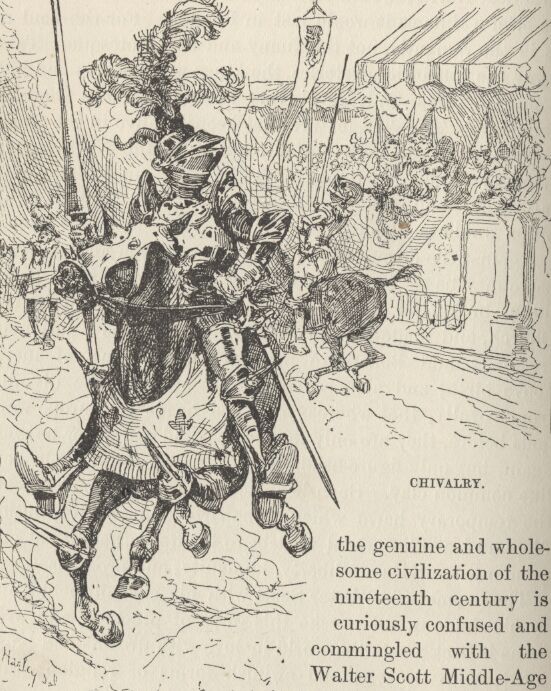
Sir Walter had so large a hand in making Southern character, as it existed before the war, that he is in great measure responsible for the war. It seems a little harsh toward a dead man to say that we never should have had any war but for Sir Walter; and yet something of a plausible argument might, perhaps, be made in support of that wild proposition. The Southerner of the American Revolution owned slaves; so did the Southerner of the Civil War: but the former resembles the latter as an Englishman resembles a Frenchman. The change of character can be traced rather more easily to Sir Walter's influence than to that of any other thing or person.
Sir Walter had such a large part in shaping Southern character before the war that he is largely responsible for the war. It seems a little harsh to say of a dead man that we never would have had a war without him. Yet perhaps a somewhat plausible argument could be made for that wild claim. The Southerner of the American Revolution owned slaves, as did the Southerner of the Civil War. But the two resembled each other as much as an Englishman resembles a Frenchman. The change in character can be traced to Sir Walter's influence more easily than to any other thing or person.
One may observe, by one or two signs, how deeply that influence penetrated, and how strongly it holds. If one take up a Northern or Southern literary periodical of forty or fifty years ago, he will find it filled with wordy, windy, flowery 'eloquence,' romanticism, sentimentality—all imitated from Sir Walter, and sufficiently badly done, too—innocent travesties of his style and methods, in fact. This sort of literature being the fashion in both sections of the country, there was opportunity for the fairest competition; and as a consequence, the South was able to show as many well-known literary names, proportioned to population, as the North could.
One or two signs show how deeply that influence took hold and how strongly it persists. Pick up a Northern or Southern literary magazine from forty or fifty years ago. You will find it full of wordy, windy, flowery 'eloquence,' romanticism, and sentimentality. All of it was imitated from Sir Walter, and badly done, too. In fact, these were innocent parodies of his style and methods. This kind of literature was fashionable in both parts of the country, so there was a fair chance to compete. As a result, the South could boast as many well-known literary names as the North, relative to its population.
But a change has come, and there is no opportunity now for a fair competition between North and South. For the North has thrown out that old inflated style, whereas the Southern writer still clings to it—clings to it and has a restricted market for his wares, as a consequence. There is as much literary talent in the South, now, as ever there was, of course; but its work can gain but slight currency under present conditions; the authors write for the past, not the present; they use obsolete forms, and a dead language. But when a Southerner of genius writes modern English, his book goes upon crutches no longer, but upon wings; and they carry it swiftly all about America and England, and through the great English reprint publishing houses of Germany—as witness the experience of Mr. Cable and Uncle Remus, two of the very few Southern authors who do not write in the Southern style. Instead of three or four widely-known literary names, the South ought to have a dozen or two—and will have them when Sir Walter's time is out.
But things have changed, and there is no longer a chance for fair competition between North and South. The North has abandoned that old inflated style, while Southern writers still cling to it. As a result, they have a limited market for their work. Of course, there is as much literary talent in the South now as there ever was. But under present conditions, that talent’s work can gain little circulation. Southern authors write for the past, not the present. They use outdated forms and a dead language. But when a Southerner of genius writes modern English, his book no longer travels on crutches. It takes wing. Those wings carry it swiftly throughout America and England, and through the great English reprint publishing houses of Germany. Consider the experience of Mr. Cable and Uncle Remus. They are two of the very few Southern authors who do not write in the Southern style. The South ought to have a dozen or two widely known literary names, instead of three or four. And it will, when Sir Walter’s time is over.
A curious exemplification of the power of a single book for good or harm is shown in the effects wrought by 'Don Quixote' and those wrought by 'Ivanhoe.' The first swept the world's admiration for the medieval chivalry-silliness out of existence; and the other restored it. As far as our South is concerned, the good work done by Cervantes is pretty nearly a dead letter, so effectually has Scott's pernicious work undermined it.
The effects of 'Don Quixote' and 'Ivanhoe' offer a curious example of a single book’s power for good or harm. The first wiped out the world’s admiration for the silliness of medieval chivalry, and the second restored it. In our South, Cervantes’s good work has been almost completely undone. Scott’s harmful work has undermined it that effectively.