Chapter 45
Southern Sports
IN the North one hears the war mentioned, in social conversation, once a month; sometimes as often as once a week; but as a distinct subject for talk, it has long ago been relieved of duty. There are sufficient reasons for this. Given a dinner company of six gentlemen to-day, it can easily happen that four of them—and possibly five—were not in the field at all. So the chances are four to two, or five to one, that the war will at no time during the evening become the topic of conversation; and the chances are still greater that if it become the topic it will remain so but a little while. If you add six ladies to the company, you have added six people who saw so little of the dread realities of the war that they ran out of talk concerning them years ago, and now would soon weary of the war topic if you brought it up.
In the North, you hear the war mentioned in social conversation once a month, sometimes as often as once a week. But it stopped being a topic of conversation in its own right long ago. There are good reasons for this. At a dinner party of six gentlemen today, four of them, and possibly five, may never have fought in the war. So the odds are four to two, or five to one, that the war will never come up that evening. The odds are even greater that, if it does come up, the conversation will soon move on. If you add six ladies to the party, you have added six people who saw little of the war’s dreadful realities. They ran out of things to say about those realities years ago. Now, if you brought up the war, they would soon tire of the subject.
The case is very different in the South. There, every man you meet was in the war; and every lady you meet saw the war. The war is the great chief topic of conversation. The interest in it is vivid and constant; the interest in other topics is fleeting. Mention of the war will wake up a dull company and set their tongues going, when nearly any other topic would fail. In the South, the war is what A.D. is elsewhere: they date from it. All day long you hear things 'placed' as having happened since the waw; or du'in' the waw; or befo' the waw; or right aftah the waw; or 'bout two yeahs or five yeahs or ten yeahs befo' the waw or aftah the waw. It shows how intimately every individual was visited, in his own person, by that tremendous episode. It gives the inexperienced stranger a better idea of what a vast and comprehensive calamity invasion is than he can ever get by reading books at the fireside.
Things are very different in the South. There, every man you meet fought in the war, and every woman you meet saw it. The war is the main topic of conversation. Interest in it is intense and constant. Interest in other topics quickly fades. Mention the war, and a dull group will come to life and start talking. Almost any other topic would fail. In the South, the war serves as A.D. does elsewhere: people date events from it. All day long, you hear events 'placed' as happening since the war, during the war, before the war, or right after the war. Or they happened about two, five, or ten years before or after the war. This shows how personally that tremendous event touched every individual. It gives an inexperienced stranger a clearer idea of how vast and all encompassing the disaster of invasion is. No amount of reading books by the fire can do the same.
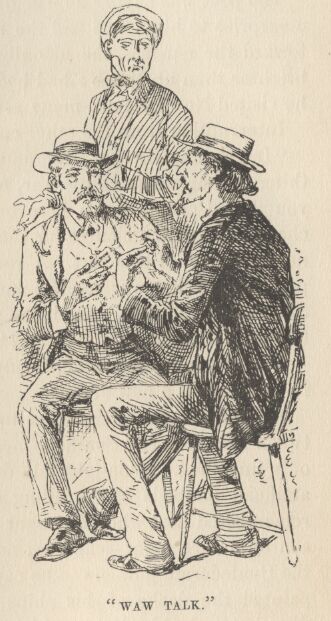
At a club one evening, a gentleman turned to me and said, in an aside—
One evening at a club, a man turned to me and said quietly:
'You notice, of course, that we are nearly always talking about the war. It isn't because we haven't anything else to talk about, but because nothing else has so strong an interest for us. And there is another reason: In the war, each of us, in his own person, seems to have sampled all the different varieties of human experience; as a consequence, you can't mention an outside matter of any sort but it will certainly remind some listener of something that happened during the war—and out he comes with it. Of course that brings the talk back to the war. You may try all you want to, to keep other subjects before the house, and we may all join in and help, but there can be but one result: the most random topic would load every man up with war reminiscences, and shut him up, too; and talk would be likely to stop presently, because you can't talk pale inconsequentialities when you've got a crimson fact or fancy in your head that you are burning to fetch out.'
'You notice, of course, that we are nearly always talking about the war. It isn't because we have nothing else to talk about. It's because nothing else interests us so strongly. There's another reason, too: during the war, each of us seems to have experienced every kind of human experience firsthand. As a result, you can't mention any outside subject without reminding someone of something that happened during the war. And out comes the story. Of course, that brings the conversation back to the war. You can try all you want to keep other subjects in the conversation, and we may all join in and help. But there can be only one result: even the most random subject would fill every man's head with war memories and leave him silent. Soon the conversation would probably stop, because you can't talk about pale, trivial things when you have a vivid fact or idea burning in your head, waiting to come out.'
The poet was sitting some little distance away; and presently he began to speak—about the moon.
The poet was sitting a little distance away. Soon he began to speak about the moon.
The gentleman who had been talking to me remarked in an 'aside:' 'There, the moon is far enough from the seat of war, but you will see that it will suggest something to somebody about the war; in ten minutes from now the moon, as a topic, will be shelved.'
The man who had been talking to me said in an aside: 'There, the moon is far enough from the fighting. But you will see that it will remind someone of the war. In ten minutes, no one will be talking about the moon anymore.'
The poet was saying he had noticed something which was a surprise to him; had had the impression that down here, toward the equator, the moonlight was much stronger and brighter than up North; had had the impression that when he visited New Orleans, many years ago, the moon—
The poet said he had noticed something that surprised him. He had thought that moonlight was much stronger and brighter down here, toward the equator, than up North. He had thought that when he visited New Orleans many years ago, the moon...
Interruption from the other end of the room—
An interruption from the other end of the room:
'Let me explain that. Reminds me of an anecdote. Everything is changed since the war, for better or for worse; but you'll find people down here born grumblers, who see no change except the change for the worse. There was an old negro woman of this sort. A young New-Yorker said in her presence, “What a wonderful moon you have down here!” She sighed and said, “Ah, bless yo' heart, honey, you ought to seen dat moon befo' de waw!”'
'Let me explain that. It reminds me of a story. Everything has changed since the war, for better or worse. But you'll find people down here who are born complainers. They see only changes for the worse. There was an old Black woman like that. A young New-Yorker said in her presence, “What a wonderful moon you have down here!” She sighed and said, “Ah, bless your heart, honey, you should have seen that moon before the war!”'
The new topic was dead already. But the poet resurrected it, and gave it a new start.
The new topic had already died out. But the poet brought it back to life and gave it a fresh start.
A brief dispute followed, as to whether the difference between Northern and Southern moonlight really existed or was only imagined. Moonlight talk drifted easily into talk about artificial methods of dispelling darkness. Then somebody remembered that when Farragut advanced upon Port Hudson on a dark night—and did not wish to assist the aim of the Confederate gunners—he carried no battle-lanterns, but painted the decks of his ships white, and thus created a dim but valuable light, which enabled his own men to grope their way around with considerable facility. At this point the war got the floor again—the ten minutes not quite up yet.
A brief argument followed over whether Northern and Southern moonlight really differed or whether people only imagined the difference. The talk about moonlight easily turned to artificial ways of lighting the dark. Then someone recalled how Farragut had advanced on Port Hudson on a dark night. He had not wanted to help the Confederate gunners aim, so he carried no battle-lanterns. Instead, he painted his ships’ decks white. This created a dim but useful light that let his men find their way around fairly easily. At that point, the war took over the conversation again. The ten minutes were not quite up yet.
I was not sorry, for war talk by men who have been in a war is always interesting; whereas moon talk by a poet who has not been in the moon is likely to be dull.
I was glad. Talk about war by men who have been in one is always interesting. But talk about the moon by a poet who has never been there is likely to be dull.
We went to a cockpit in New Orleans on a Saturday afternoon. I had never seen a cock-fight before. There were men and boys there of all ages and all colors, and of many languages and nationalities. But I noticed one quite conspicuous and surprising absence: the traditional brutal faces. There were no brutal faces. With no cock-fighting going on, you could have played the gathering on a stranger for a prayer-meeting; and after it began, for a revival—provided you blindfolded your stranger—for the shouting was something prodigious.
We went to a cockfighting arena in New Orleans on a Saturday afternoon. I had never seen a cockfight before. Men and boys of all ages and colors were there, speaking many languages and representing many nationalities. But I noticed one striking and surprising absence: the brutal faces you would expect. There were no brutal faces. Before the cockfighting began, you could have passed the gathering off to a stranger as a prayer meeting. After it began, you could have passed it off as a revival, as long as you blindfolded the stranger. The shouting was tremendous.
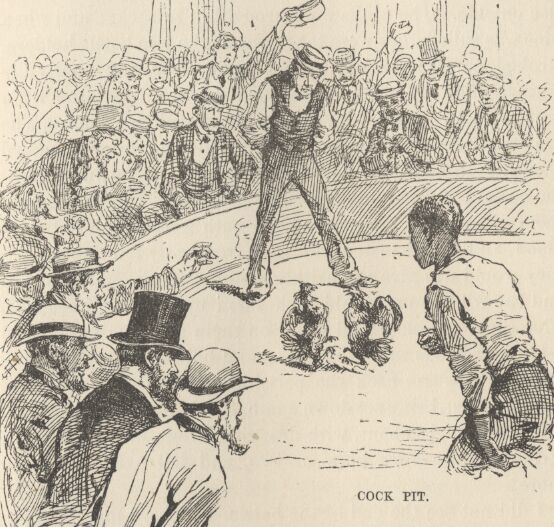
A negro and a white man were in the ring; everybody else outside. The cocks were brought in in sacks; and when time was called, they were taken out by the two bottle-holders, stroked, caressed, poked toward each other, and finally liberated. The big black cock plunged instantly at the little gray one and struck him on the head with his spur. The gray responded with spirit. Then the Babel of many-tongued shoutings broke out, and ceased not thenceforth. When the cocks had been fighting some little time, I was expecting them momently to drop dead, for both were blind, red with blood, and so exhausted that they frequently fell down. Yet they would not give up, neither would they die. The negro and the white man would pick them up every few seconds, wipe them off, blow cold water on them in a fine spray, and take their heads in their mouths and hold them there a moment—to warm back the perishing life perhaps; I do not know. Then, being set down again, the dying creatures would totter gropingly about, with dragging wings, find each other, strike a guesswork blow or two, and fall exhausted once more.
A Black man and a white man were in the ring. Everyone else was outside. The roosters were brought in inside sacks. When the fight was called, the two handlers took them out, stroked and caressed them, pushed them toward each other, and finally let them go. The big black rooster immediately lunged at the little gray one and struck him on the head with his spur. The gray rooster fought back fiercely. Then a babel of shouting in many languages broke out and never stopped. After the roosters had fought for a while, I expected them to drop dead at any moment. Both were blind, covered in blood, and so exhausted that they often fell down. Yet they would not give up, and neither would they die. Every few seconds, the Black man and the white man would pick them up, wipe them off, and blow a fine spray of cold water over them. The men would also take the roosters’ heads into their mouths and hold them there for a moment. Perhaps they were trying to warm the life back into the dying birds. I do not know. Then the men would set them down again. The dying creatures would stagger blindly about with their wings dragging, find each other, strike a blow or two by guesswork, and fall exhausted once more.
I did not see the end of the battle. I forced myself to endure it as long as I could, but it was too pitiful a sight; so I made frank confession to that effect, and we retired. We heard afterward that the black cock died in the ring, and fighting to the last.
I did not see the end of the fight. I forced myself to watch as long as I could, but the sight was too pitiful. I said so openly, and we left. We heard later that the black cock died in the ring, fighting to the end.
Evidently there is abundant fascination about this 'sport' for such as have had a degree of familiarity with it. I never saw people enjoy anything more than this gathering enjoyed this fight. The case was the same with old gray-heads and with boys of ten. They lost themselves in frenzies of delight. The 'cocking-main' is an inhuman sort of entertainment, there is no question about that; still, it seems a much more respectable and far less cruel sport than fox-hunting—for the cocks like it; they experience, as well as confer enjoyment; which is not the fox's case.
Clearly, this 'sport' has plenty of appeal for people who know something about it. I never saw people enjoy anything more than this crowd enjoyed the fight. Old gray-haired men and ten-year-old boys alike lost themselves in frenzies of delight. The 'cocking-main' is an inhumane form of entertainment, without question. Still, it seems much more respectable and far less cruel than fox-hunting. The roosters like it. They enjoy it as well as give others enjoyment, which is not the case for the fox.
We assisted—in the French sense—at a mule race, one day. I believe I enjoyed this contest more than any other mule there. I enjoyed it more than I remember having enjoyed any other animal race I ever saw. The grand-stand was well filled with the beauty and the chivalry of New Orleans. That phrase is not original with me. It is the Southern reporter's. He has used it for two generations. He uses it twenty times a day, or twenty thousand times a day; or a million times a day—according to the exigencies. He is obliged to use it a million times a day, if he have occasion to speak of respectable men and women that often; for he has no other phrase for such service except that single one. He never tires of it; it always has a fine sound to him. There is a kind of swell medieval bulliness and tinsel about it that pleases his gaudy barbaric soul. If he had been in Palestine in the early times, we should have had no references to 'much people' out of him. No, he would have said 'the beauty and the chivalry of Galilee' assembled to hear the Sermon on the Mount. It is likely that the men and women of the South are sick enough of that phrase by this time, and would like a change, but there is no immediate prospect of their getting it.
One day, we attended a mule race. I believe I enjoyed the contest more than any other mule there. I enjoyed it more than any other animal race I remember seeing. The grandstand was well filled with the beauty and the chivalry of New Orleans. That phrase is not mine. It belongs to the Southern reporter. He has used it for two generations. He uses it twenty times a day, or twenty thousand times a day, or a million times a day, depending on the need. If he has occasion to mention respectable men and women a million times a day, he must use the phrase that often. He has no other phrase for the job. He never gets tired of it. It always sounds fine to him. It has a kind of grand medieval swagger and glitter that pleases his showy, barbaric soul. If he had been in Palestine in those early times, he would never have mentioned 'much people'. No, he would have said 'the beauty and the chivalry of Galilee' assembled to hear the Sermon on the Mount. By now, the men and women of the South are probably sick of that phrase and would like a change. But there is no immediate chance of their getting one.
The New Orleans editor has a strong, compact, direct, unflowery style; wastes no words, and does not gush. Not so with his average correspondent. In the Appendix I have quoted a good letter, penned by a trained hand; but the average correspondent hurls a style which differs from that. For instance—
The New Orleans editor has a strong, concise, direct style, with no fancy language. He wastes no words and does not gush. The average correspondent is another matter. In the Appendix, I have quoted a good letter written by a skilled writer. But the average correspondent unleashes a very different style. For example:
The 'Times-Democrat' sent a relief-steamer up one of the bayous, last April. This steamer landed at a village, up there somewhere, and the Captain invited some of the ladies of the village to make a short trip with him. They accepted and came aboard, and the steamboat shoved out up the creek. That was all there was 'to it.' And that is all that the editor of the 'Times-Democrat' would have got out of it. There was nothing in the thing but statistics, and he would have got nothing else out of it. He would probably have even tabulated them, partly to secure perfect clearness of statement, and partly to save space. But his special correspondent knows other methods of handling statistics. He just throws off all restraint and wallows in them—
Last April, the 'Times-Democrat' sent a relief steamer up one of the bayous. The steamer stopped at a village somewhere up there. The captain invited some of the village ladies to take a short trip with him. They accepted and came aboard, and the steamboat headed farther up the creek. That was all there was 'to it.' And that is all the editor of the 'Times-Democrat' would have gotten out of it. There was nothing in the story but statistics, and he would have found nothing else in it. He probably would even have put the statistics in a table, partly for clarity and partly to save space. But his special correspondent has other ways of handling statistics. He just throws off all restraint and wallows in them:
'On Saturday, early in the morning, the beauty of the place graced our cabin, and proud of her fair freight the gallant little boat glided up the bayou.'
'Early Saturday morning, the local beauty joined us in the cabin. Proud of its lovely passenger, the gallant little boat glided up the bayou.'
Twenty-two words to say the ladies came aboard and the boat shoved out up the creek, is a clean waste of ten good words, and is also destructive of compactness of statement.
Using twenty-two words to say the ladies came aboard and the boat headed up the creek wastes ten good words. It also makes the statement less concise.
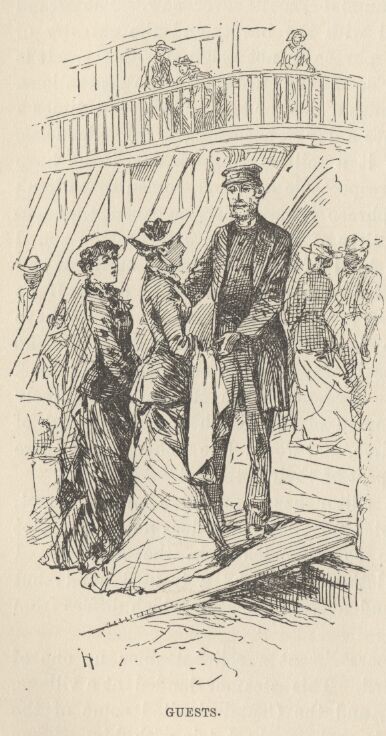
The trouble with the Southern reporter is—Women. They unsettle him; they throw him off his balance. He is plain, and sensible, and satisfactory, until a woman heaves in sight. Then he goes all to pieces; his mind totters, he becomes flowery and idiotic. From reading the above extract, you would imagine that this student of Sir Walter Scott is an apprentice, and knows next to nothing about handling a pen. On the contrary, he furnishes plenty of proofs, in his long letter, that he knows well enough how to handle it when the women are not around to give him the artificial-flower complaint. For instance—
The trouble with the Southern reporter is women. They unsettle him and throw him off balance. He is plain, sensible, and satisfactory until a woman comes into view. Then he falls apart. His mind falters, and he becomes flowery and idiotic. From the extract above, you would think this student of Sir Walter Scott was a beginner who hardly knew how to write. On the contrary, his long letter offers plenty of proof that he knows how to write. He does well enough when women are not around to give him a case of artificial flowers. For instance:
'At 4 o'clock ominous clouds began to gather in the south-east, and presently from the Gulf there came a blow which increased in severity every moment. It was not safe to leave the landing then, and there was a delay. The oaks shook off long tresses of their mossy beards to the tugging of the wind, and the bayou in its ambition put on miniature waves in mocking of much larger bodies of water. A lull permitted a start, and homewards we steamed, an inky sky overhead and a heavy wind blowing. As darkness crept on, there were few on board who did not wish themselves nearer home.'
'At 4 o'clock, ominous clouds began to gather in the southeast. Soon a wind came up from the Gulf, growing stronger every moment. It was no longer safe to leave the landing, so we waited. The wind tugged long strands of moss from the oaks, like hair from their beards. The bayou grew ambitious, raising miniature waves in mockery of much larger bodies of water. When the wind eased, we were able to set off. We steamed toward home beneath an inky sky, with a strong wind blowing. As darkness fell, nearly everyone on board wished they were closer to home.'
There is nothing the matter with that. It is good description, compactly put. Yet there was great temptation, there, to drop into lurid writing.
There is nothing wrong with that. It is a good, concise description. Yet there was a strong temptation to make the writing sensational.
But let us return to the mule. Since I left him, I have rummaged around and found a full report of the race. In it I find confirmation of the theory which I broached just now—namely, that the trouble with the Southern reporter is Women: Women, supplemented by Walter Scott and his knights and beauty and chivalry, and so on. This is an excellent report, as long as the women stay out of it. But when they intrude, we have this frantic result—
But let us return to the mule. Since I left him, I have searched around and found a full report of the race. The report confirms the theory I just put forward: the trouble with the Southern reporter is Women. Women, along with Walter Scott and his knights, beauty, chivalry, and so on. This is an excellent report as long as the women stay out of it. But when they intrude, the frantic result is this:
'It will be probably a long time before the ladies' stand presents such a sea of foam-like loveliness as it did yesterday. The New Orleans women are always charming, but never so much so as at this time of the year, when in their dainty spring costumes they bring with them a breath of balmy freshness and an odor of sanctity unspeakable. The stand was so crowded with them that, walking at their feet and seeing no possibility of approach, many a man appreciated as he never did before the Peri's feeling at the Gates of Paradise, and wondered what was the priceless boon that would admit him to their sacred presence. Sparkling on their white-robed breasts or shoulders were the colors of their favorite knights, and were it not for the fact that the doughty heroes appeared on unromantic mules, it would have been easy to imagine one of King Arthur's gala-days.'
'It will probably be a long time before the ladies' stand again looks like the sea of foam-like beauty it was yesterday. New Orleans women are always charming, but never more so than at this time of year. In their delicate spring outfits, they bring a breath of mild freshness and an indescribable air of holiness. The stand was so crowded with them that many a man walking below could see no way to approach. He understood as never before how the Peri felt at the Gates of Paradise. He wondered what priceless gift would admit him to their sacred presence. The colors of their favorite knights sparkled on the breasts or shoulders of their white dresses. If the brave heroes had not appeared on unromantic mules, it would have been easy to imagine a grand celebration in King Arthur's day.'
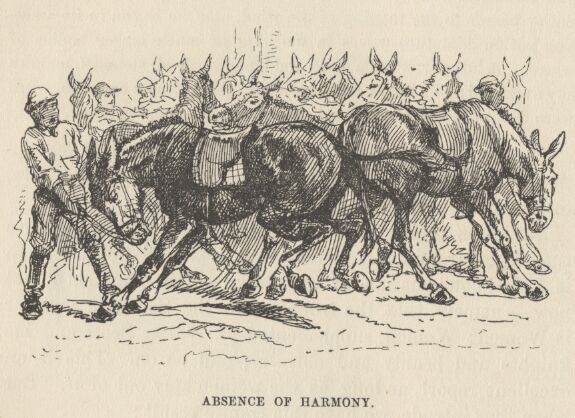
There were thirteen mules in the first heat; all sorts of mules, they were; all sorts of complexions, gaits, dispositions, aspects. Some were handsome creatures, some were not; some were sleek, some hadn't had their fur brushed lately; some were innocently gay and frisky; some were full of malice and all unrighteousness; guessing from looks, some of them thought the matter on hand was war, some thought it was a lark, the rest took it for a religious occasion. And each mule acted according to his convictions. The result was an absence of harmony well compensated by a conspicuous presence of variety—variety of a picturesque and entertaining sort.
There were thirteen mules in the first heat, and they were all sorts of mules. They differed in color, gait, temperament, and appearance. Some were handsome creatures, and some were not. Some were sleek, and some hadn't had their coats brushed lately. Some were innocently cheerful and frisky. Some were full of malice and every kind of wickedness. Judging by their looks, some thought the event was a war, while some thought it was a lark. The rest took it for a religious occasion. And each mule acted according to his beliefs. The result was a lack of harmony, well made up for by an obvious abundance of variety. It was a picturesque and entertaining kind of variety.
All the riders were young gentlemen in fashionable society. If the reader has been wondering why it is that the ladies of New Orleans attend so humble an orgy as a mule-race, the thing is explained now. It is a fashion-freak; all connected with it are people of fashion.
All the riders were young gentlemen from fashionable society. If you have wondered why the ladies of New Orleans attend such a humble spectacle as a mule race, now you know. It is a passing fashion. Everyone involved is fashionable.
It is great fun, and cordially liked. The mule-race is one of the marked occasions of the year. It has brought some pretty fast mules to the front. One of these had to be ruled out, because he was so fast that he turned the thing into a one-mule contest, and robbed it of one of its best features—variety. But every now and then somebody disguises him with a new name and a new complexion, and rings him in again.
It is great fun, and everyone enjoys it. The mule race is one of the year's big events. It has brought some pretty fast mules to the front. One mule had to be disqualified because he was so fast. He turned the race into a one-mule contest and robbed it of one of its best features: variety. But every now and then, somebody gives him a new name and a new color and sneaks him into the race again.
The riders dress in full jockey costumes of bright-colored silks, satins, and velvets.
The riders wear full jockey outfits made of brightly colored silk, satin, and velvet.
The thirteen mules got away in a body, after a couple of false starts, and scampered off with prodigious spirit. As each mule and each rider had a distinct opinion of his own as to how the race ought to be run, and which side of the track was best in certain circumstances, and how often the track ought to be crossed, and when a collision ought to be accomplished, and when it ought to be avoided, these twenty-six conflicting opinions created a most fantastic and picturesque confusion, and the resulting spectacle was killingly comical.
After a couple of false starts, all thirteen mules got away together and scampered off with tremendous energy. Each mule and rider had a different opinion about how the race should be run. Each had ideas about which side of the track was best at certain times, and how often to cross it. Each also had ideas about when to collide and when to avoid a collision. These twenty-six conflicting opinions created a wonderfully wild and colorful confusion. The resulting spectacle was hilariously funny.
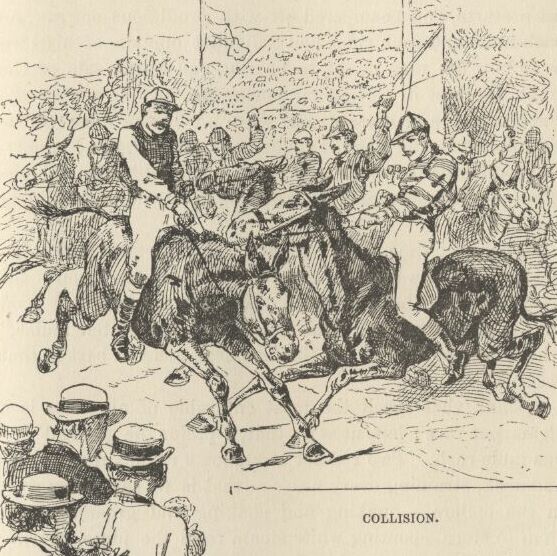
Mile heat; time 2:22. Eight of the thirteen mules distanced. I had a bet on a mule which would have won if the procession had been reversed. The second heat was good fun; and so was the 'consolation race for beaten mules,' which followed later; but the first heat was the best in that respect.
One-mile heat. Time: 2:22. Eight of the thirteen mules fell so far behind that they were eliminated. I bet on a mule that would have won if the order had been reversed. The second heat was good fun. So was the 'consolation race for beaten mules' that followed later. But the first heat was the most fun.
I think that much the most enjoyable of all races is a steamboat race; but, next to that, I prefer the gay and joyous mule-rush. Two red-hot steamboats raging along, neck-and-neck, straining every nerve—that is to say, every rivet in the boilers—quaking and shaking and groaning from stem to stern, spouting white steam from the pipes, pouring black smoke from the chimneys, raining down sparks, parting the river into long breaks of hissing foam—this is sport that makes a body's very liver curl with enjoyment. A horse-race is pretty tame and colorless in comparison. Still, a horse-race might be well enough, in its way, perhaps, if it were not for the tiresome false starts. But then, nobody is ever killed. At least, nobody was ever killed when I was at a horse-race. They have been crippled, it is true; but this is little to the purpose.
I think a steamboat race is by far the most enjoyable race of all. Next to that, I prefer a lively, joyous mule-rush. Two red-hot steamboats race along neck and neck, straining every nerve, or rather, every rivet in their boilers. They quake, shake, and groan from stem to stern. White steam shoots from their pipes, black smoke pours from their chimneys, and sparks rain down. They split the river into long stretches of hissing foam. This is sport that makes a person's very liver curl with enjoyment. A horse race is pretty tame and dull by comparison. Still, a horse race might be enjoyable enough in its own way, perhaps, if not for the tiresome false starts. But then, nobody is ever killed. At least, nobody was ever killed when I was at a horse race. People have been crippled, it's true, but that's hardly the point.