Chapter 43
The Art of Burial
ABOUT the same time, I encountered a man in the street, whom I had not seen for six or seven years; and something like this talk followed. I said—
Around the same time, I met a man on the street whom I hadn't seen for six or seven years. Our conversation went something like this. I said:
'But you used to look sad and oldish; you don't now. Where did you get all this youth and bubbling cheerfulness? Give me the address.'
'But you used to look sad and a little old. You don't anymore. Where did you get all this youth and bubbly cheerfulness? Give me the address.'
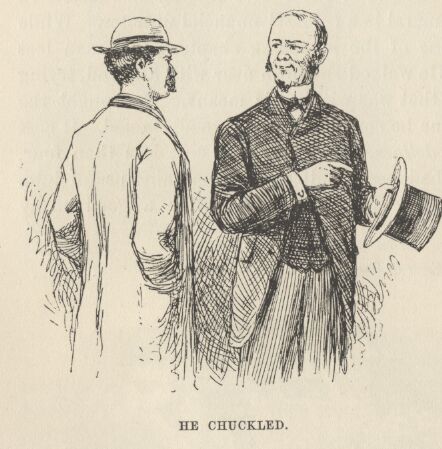
He chuckled blithely, took off his shining tile, pointed to a notched pink circlet of paper pasted into its crown, with something lettered on it, and went on chuckling while I read, 'J. B——, Undertaker.' Then he clapped his hat on, gave it an irreverent tilt to leeward, and cried out—
He chuckled cheerfully and took off his shiny hat. He pointed to a notched pink circle of paper pasted inside the crown, with something printed on it. He kept chuckling while I read, 'J. B--, Undertaker.' Then he put his hat back on, tilted it disrespectfully away from the wind, and cried out:
'That's what's the matter! It used to be rough times with me when you knew me—insurance-agency business, you know; mighty irregular. Big fire, all right—brisk trade for ten days while people scared; after that, dull policy-business till next fire. Town like this don't have fires often enough—a fellow strikes so many dull weeks in a row that he gets discouraged. But you bet you, this is the business! People don't wait for examples to die. No, sir, they drop off right along—there ain't any dull spots in the undertaker line. I just started in with two or three little old coffins and a hired hearse, and now look at the thing! I've worked up a business here that would satisfy any man, don't care who he is. Five years ago, lodged in an attic; live in a swell house now, with a mansard roof, and all the modern inconveniences.'
'That's right! Times were tough for me when you knew me. I was in the insurance business, you know, and business was mighty irregular. A big fire was good for business. Trade was brisk for ten days while people were scared. After that, policy sales were slow until the next fire. A town like this doesn't have fires often enough. A fellow gets so many slow weeks in a row that he gets discouraged. But you bet, undertaking is the business to be in! People don't wait for someone to die as an example. No, sir, they keep dropping off. There aren't any slow spots in the undertaking business. I started out with two or three little old coffins and a hired hearse. Now look at it! I've built up a business here that would satisfy any man, no matter who he is. Five years ago, I lived in an attic. Now I live in a fancy house with a mansard roof and all the modern inconveniences.'
'Does a coffin pay so well. Is there much profit on a coffin?'
'Does a coffin bring in that much money? Is there much profit in a coffin?'
'Go-way! How you talk!' Then, with a confidential wink, a dropping of the voice, and an impressive laying of his hand on my arm; 'Look here; there's one thing in this world which isn't ever cheap. That's a coffin. There's one thing in this world which a person don't ever try to jew you down on. That's a coffin. There's one thing in this world which a person don't say—“I'll look around a little, and if I find I can't do better I'll come back and take it.” That's a coffin. There's one thing in this world which a person won't take in pine if he can go walnut; and won't take in walnut if he can go mahogany; and won't take in mahogany if he can go an iron casket with silver door-plate and bronze handles. That's a coffin. And there's one thing in this world which you don't have to worry around after a person to get him to pay for. And that's a coffin. Undertaking?—why it's the dead-surest business in Christendom, and the nobbiest.
'Oh, go on! Listen to you!' Then he winked, lowered his voice, and placed his hand on my arm for emphasis. 'Look here. There's one thing in this world that's never cheap. That's a coffin. There's one thing in this world people never try to bargain you down on. That's a coffin. There's one thing in this world people don't say this about: “I'll look around a little, and if I can't find a better deal, I'll come back and take it.” That's a coffin. There's one thing in this world people won't buy in pine if they can afford walnut. They won't buy it in walnut if they can afford mahogany. And they won't buy it in mahogany if they can afford an iron casket with a silver nameplate and bronze handles. That's a coffin. And there's one thing in this world you don't have to chase people down to get them to pay for. That's a coffin. Undertaking? Why, it's the surest business in Christendom, and the classiest.'
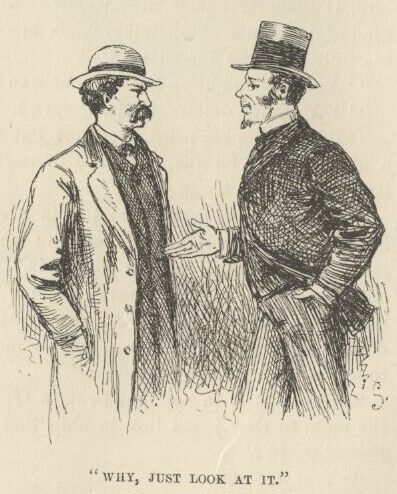
'Why, just look at it. A rich man won't have anything but your very best; and you can just pile it on, too—pile it on and sock it to him—he won't ever holler. And you take in a poor man, and if you work him right he'll bust himself on a single lay-out. Or especially a woman. F'r instance: Mrs. O'Flaherty comes in—widow—wiping her eyes and kind of moaning. Unhandkerchiefs one eye, bats it around tearfully over the stock; says—
'Why, just look at it. A rich man wants only your very best. And you can pile it on and charge him plenty. He'll never complain. And if you bring in a poor man and work him right, he'll spend every last penny on a single purchase. Or especially a woman. For instance, Mrs. O'Flaherty comes in. She's a widow, wiping her eyes and sort of moaning. She takes the handkerchief away from one eye and looks tearfully around at the goods. Then she says:
'“And fhat might ye ask for that wan?”
'“And what might you ask for that one?”
'“Thirty-nine dollars, madam,” says I.
'“Thirty-nine dollars, madam,” I said.
'“It 's a foine big price, sure, but Pat shall be buried like a gintleman, as he was, if I have to work me fingers off for it. I'll have that wan, sor.”
'“It's a very high price, certainly, but Pat will be buried like a gentleman, as he was, even if I have to work my fingers off to pay for it. I'll take that one, sir.”
'“Yes, madam,” says I, “and it is a very good one, too; not costly, to be sure, but in this life we must cut our garment to our clothes, as the saying is.” And as she starts out, I heave in, kind of casually, “This one with the white satin lining is a beauty, but I am afraid—well, sixty-five dollars is a rather—rather—but no matter, I felt obliged to say to Mrs. O'Shaughnessy—”
'“Yes, madam,” I say, “and it is a very good one, too. It is not expensive, of course, but in this life we must cut our garment to our clothes, as the saying goes.” As she starts to leave, I casually add, “This one with the white satin lining is a beauty, but I am afraid... Well, sixty-five dollars is rather... rather... but never mind. I felt obliged to say to Mrs. O'Shaughnessy...”
'“D'ye mane to soy that Bridget O'Shaughnessy bought the mate to that joo-ul box to ship that dhrunken divil to Purgatory in?”
“Do you mean Bridget O'Shaughnessy bought the matching jewel box to ship that drunken devil to Purgatory in?”
'“Yes, madam.”
'“Yes, ma'am.”
'“Then Pat shall go to heaven in the twin to it, if it takes the last rap the O'Flaherties can raise; and moind you, stick on some extras, too, and I'll give ye another dollar.”
'“Then Pat will go to heaven in a matching one, even if it takes the O'Flaherties' last penny. And mind you, add some extras, too, and I'll give you another dollar.”
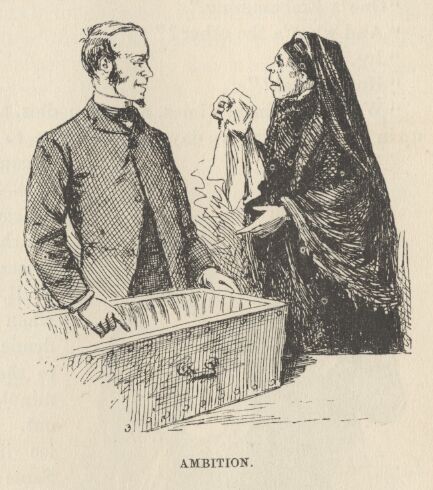
'And as I lay-in with the livery stables, of course I don't forget to mention that Mrs. O'Shaughnessy hired fifty-four dollars' worth of hacks and flung as much style into Dennis's funeral as if he had been a duke or an assassin. And of course she sails in and goes the O'Shaughnessy about four hacks and an omnibus better. That used to be, but that's all played now; that is, in this particular town. The Irish got to piling up hacks so, on their funerals, that a funeral left them ragged and hungry for two years afterward; so the priest pitched in and broke it all up. He don't allow them to have but two hacks now, and sometimes only one.'
'And since I have an arrangement with the carriage stables, of course I make sure to mention Mrs. O'Shaughnessy. She hired fifty-four dollars' worth of carriages and gave Dennis a funeral as grand as a duke's or an assassin's. And of course she comes in and outdoes Mrs. O'Shaughnessy by about four carriages and an omnibus. That used to happen, but it has all stopped now, at least in this particular town. The Irish began hiring so many carriages for their funerals that a funeral left them ragged and hungry for two years afterward. So the priest stepped in and put a stop to it all. He only allows them two carriages now, and sometimes just one.'
'Well,' said I, 'if you are so light-hearted and jolly in ordinary times, what must you be in an epidemic?'
‘Well,’ I said, ‘if you’re so cheerful and jolly in ordinary times, what must you be like during an epidemic?’
He shook his head.
He shook his head.
'No, you're off, there. We don't like to see an epidemic. An epidemic don't pay. Well, of course I don't mean that, exactly; but it don't pay in proportion to the regular thing. Don't it occur to you, why?'
'No, you're wrong about that. We don't like to see an epidemic. An epidemic doesn't pay. Well, of course, I don't mean that exactly. But an epidemic doesn't pay as well as the usual business. Can you think why?'
No.
No.
'Think.'
'Think.'
'I can't imagine. What is it?'
'I can't imagine. What is it?'
'It's just two things.'
'It's just two things.'
'Well, what are they?'
'Well, what are they?'
'One's Embamming.'
'One's Embamming.'
'And what's the other?'
'And what's the other?'
'Ice.'
'Ice.'
'How is that?'
'How is that?'
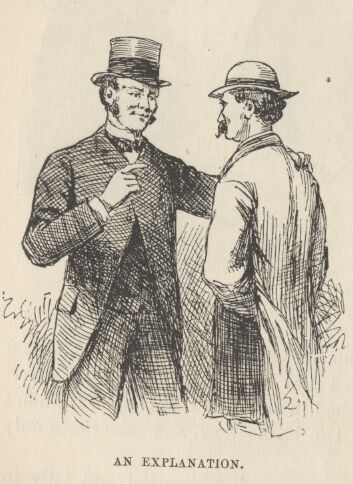
'Well, in ordinary times, a person dies, and we lay him up in ice; one day two days, maybe three, to wait for friends to come. Takes a lot of it—melts fast. We charge jewelry rates for that ice, and war-prices for attendance. Well, don't you know, when there's an epidemic, they rush 'em to the cemetery the minute the breath's out. No market for ice in an epidemic. Same with Embamming. You take a family that's able to embam, and you've got a soft thing. You can mention sixteen different ways to do it—though there ain't only one or two ways, when you come down to the bottom facts of it—and they'll take the highest-priced way, every time. It's human nature—human nature in grief. It don't reason, you see. Time being, it don't care a dam. All it wants is physical immortality for deceased, and they're willing to pay for it. All you've got to do is to just be ca'm and stack it up—they'll stand the racket. Why, man, you can take a defunct that you couldn't give away; and get your embamming traps around you and go to work; and in a couple of hours he is worth a cool six hundred—that's what he's worth. There ain't anything equal to it but trading rats for di'monds in time of famine. Well, don't you see, when there's an epidemic, people don't wait to embam. No, indeed they don't; and it hurts the business like hell-th, as we say—hurts it like hell-th, health, see?—Our little joke in the trade. Well, I must be going. Give me a call whenever you need any—I mean, when you're going by, sometime.'
'Well, in ordinary times, someone dies, and we lay him on ice. We keep him there one, two, maybe three days, waiting for friends to arrive. That takes a lot of ice. It melts fast. We charge jewelry prices for the ice and wartime prices for attendance. But don't you see, during an epidemic, they rush people to the cemetery as soon as they stop breathing. There's no market for ice during an epidemic. Same with embalming. When a family can afford embalming, you've got an easy deal. You can mention sixteen different ways to do it, though there aren't more than one or two when you get down to the facts. They'll choose the most expensive way every time. It's human nature, human nature in grief. It doesn't reason, you see. For the time being, it doesn't care a damn. All the family wants is physical immortality for the deceased, and they're willing to pay for it. All you have to do is stay calm and pile on the charges. They'll pay the bill. Why, man, you can take a dead person you couldn't give away. Get your embalming tools around you and go to work. In a couple of hours, he's worth a cool six hundred. That's what he's worth. The only thing that comes close is trading rats for diamonds during a famine. But don't you see, during an epidemic, people don't wait for embalming. No, they certainly don't. And it hurts the business like hell-th, as we say. Hurts it like hell-th, health, see? Our little joke in the trade. Well, I must be going. Give me a call whenever you need any. I mean, when you're passing by sometime.'
In his joyful high spirits, he did the exaggerating himself, if any has been done. I have not enlarged on him.
In his joyful excitement, he did the exaggerating himself, if there was any. I have not exaggerated his account.
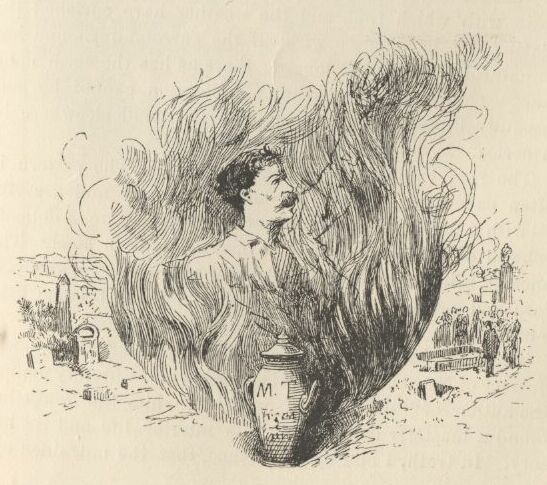
With the above brief references to inhumation, let us leave the subject. As for me, I hope to be cremated. I made that remark to my pastor once, who said, with what he seemed to think was an impressive manner—
With those brief remarks about burial, let us leave the subject. As for me, I hope to be cremated. I once said so to my pastor. He replied in what he seemed to think was an impressive manner:
'I wouldn't worry about that, if I had your chances.' Much he knew about it—the family all so opposed to it.
'I wouldn't worry about that if I had your chances.' What did he know about it? The whole family was so opposed to it.