Chapter 42
Hygiene and Sentiment
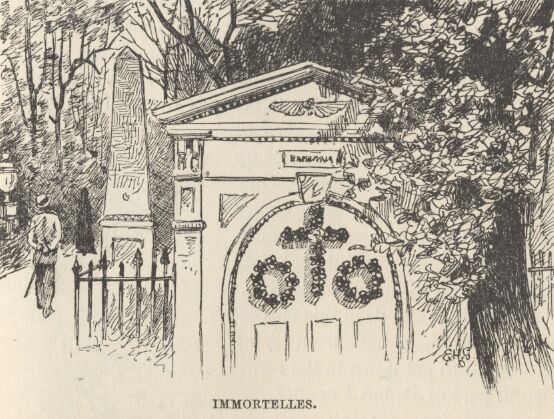
THEY bury their dead in vaults, above the ground. These vaults have a resemblance to houses—sometimes to temples; are built of marble, generally; are architecturally graceful and shapely; they face the walks and driveways of the cemetery; and when one moves through the midst of a thousand or so of them and sees their white roofs and gables stretching into the distance on every hand, the phrase 'city of the dead' has all at once a meaning to him. Many of the cemeteries are beautiful, and are kept in perfect order. When one goes from the levee or the business streets near it, to a cemetery, he observes to himself that if those people down there would live as neatly while they are alive as they do after they are dead, they would find many advantages in it; and besides, their quarter would be the wonder and admiration of the business world. Fresh flowers, in vases of water, are to be seen at the portals of many of the vaults: placed there by the pious hands of bereaved parents and children, husbands and wives, and renewed daily. A milder form of sorrow finds its inexpensive and lasting remembrancer in the coarse and ugly but indestructible 'immortelle'—which is a wreath or cross or some such emblem, made of rosettes of black linen, with sometimes a yellow rosette at the conjunction of the cross's bars—kind of sorrowful breast-pin, so to say. The immortelle requires no attention: you just hang it up, and there you are; just leave it alone, it will take care of your grief for you, and keep it in mind better than you can; stands weather first-rate, and lasts like boiler-iron.
They bury their dead in vaults above ground. These vaults look like houses, or sometimes temples. They are generally built of marble and are graceful and well shaped. They face the cemetery's walks and driveways. When you move among a thousand or so vaults, you see their white roofs and gables stretching into the distance in every direction. Suddenly, the phrase 'city of the dead' has meaning. Many of the cemeteries are beautiful and kept in perfect order. Coming to a cemetery from the levee or the nearby business streets, you cannot help thinking about the people down there. If they lived as neatly while alive as they do after death, they would find many advantages in it. Besides, their district would be the wonder and admiration of the business world. At the entrances to many vaults, you can see fresh flowers in vases of water. Grieving parents and children, husbands and wives, place them there with loving care and replace them daily. A milder form of sorrow finds an inexpensive and lasting reminder in the coarse, ugly, but indestructible 'immortelle'. This is a wreath, cross, or similar emblem made of black linen rosettes. Sometimes there is a yellow rosette where the bars of the cross meet. It is a kind of mournful brooch, so to speak. The immortelle needs no attention. You just hang it up, and there you are. Leave it alone, and it will take care of your grief for you and remember it better than you can. It stands up to the weather wonderfully and lasts like boiler iron.
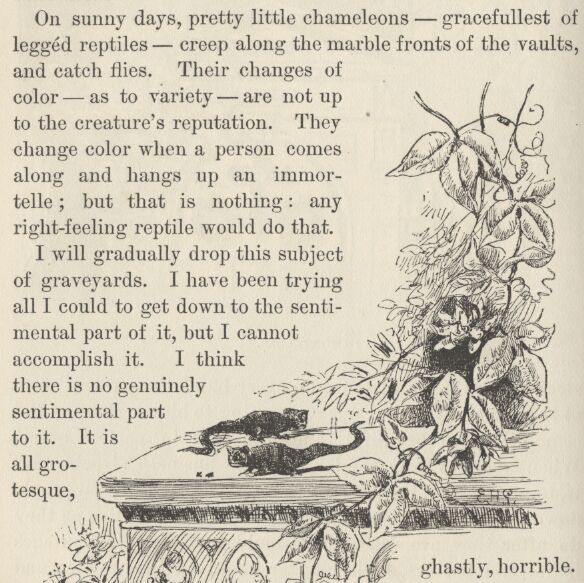
On sunny days, pretty little chameleons—gracefullest of legged reptiles—creep along the marble fronts of the vaults, and catch flies. Their changes of color—as to variety—are not up to the creature's reputation. They change color when a person comes along and hangs up an immortelle; but that is nothing: any right-feeling reptile would do that.
On sunny days, pretty little chameleons creep along the marble fronts of the vaults and catch flies. They are the most graceful of all reptiles with legs. The variety of their color changes does not live up to their reputation. They change color when someone comes along and hangs up an immortelle, a memorial wreath. But that is nothing. Any reptile with proper feelings would do the same.
I will gradually drop this subject of graveyards. I have been trying all I could to get down to the sentimental part of it, but I cannot accomplish it. I think there is no genuinely sentimental part to it. It is all grotesque, ghastly, horrible. Graveyards may have been justifiable in the bygone ages, when nobody knew that for every dead body put into the ground, to glut the earth and the plant-roots, and the air with disease-germs, five or fifty, or maybe a hundred persons must die before their proper time; but they are hardly justifiable now, when even the children know that a dead saint enters upon a century-long career of assassination the moment the earth closes over his corpse. It is a grim sort of a thought. The relics of St. Anne, up in Canada, have now, after nineteen hundred years, gone to curing the sick by the dozen. But it is merest matter-of-course that these same relics, within a generation after St. Anne's death and burial, made several thousand people sick. Therefore these miracle-performances are simply compensation, nothing more. St. Anne is somewhat slow pay, for a Saint, it is true; but better a debt paid after nineteen hundred years, and outlawed by the statute of limitations, than not paid at all; and most of the knights of the halo do not pay at all. Where you find one that pays—like St. Anne—you find a hundred and fifty that take the benefit of the statute. And none of them pay any more than the principal of what they owe—they pay none of the interest either simple or compound. A Saint can never quite return the principal, however; for his dead body kills people, whereas his relics heal only—they never restore the dead to life. That part of the account is always left unsettled.
I will gradually leave the subject of graveyards behind. I have tried my best to get to the sentimental side of it, but I cannot. I do not think there is any genuinely sentimental side. It is all grotesque, ghastly, horrible. Graveyards may have been justifiable in the old days, when nobody knew what a buried body did. It fills the earth, plant roots, and air with disease germs. And for every body buried, five or fifty, or perhaps a hundred people must die before their time. But graveyards are hardly justifiable now. Even children know that a dead saint begins a century-long career of assassination the moment the earth closes over his corpse. It is a grim thought. The relics of St. Anne, up in Canada, have now, after nineteen hundred years, begun curing sick people by the dozen. But of course those same relics made several thousand people sick within a generation of St. Anne’s death and burial. So these miracles are simply compensation, nothing more. St. Anne is somewhat slow to pay, for a Saint, it is true. But a debt paid after nineteen hundred years is better than one never paid, even if the statute of limitations has expired. Most of the knights of the halo do not pay at all. For every one that pays, like St. Anne, you find a hundred and fifty that take advantage of the statute. And none of them pay more than the principal they owe. They pay no interest, either simple or compound. A Saint can never quite repay the principal, though. His dead body kills people, while his relics only heal them. They never bring the dead back to life. That part of the account is always left unsettled.
'Dr. F. Julius Le Moyne, after fifty years of medical practice, wrote: “The inhumation of human bodies, dead from infectious diseases, results in constantly loading the atmosphere, and polluting the waters, with not only the germs that rise from simply putrefaction, but also with the specific germs of the diseases from which death resulted.”
Dr. F. Julius Le Moyne wrote after fifty years of medical practice: “Burying people who died from infectious diseases constantly fills the air and pollutes the water with germs. These include not only germs from ordinary decay, but also the specific germs of the diseases that caused their deaths.”
'The gases (from buried corpses) will rise to the surface through eight or ten feet of gravel, just as coal-gas will do, and there is practically no limit to their power of escape.
'Gases (from buried corpses) can rise to the surface through eight or ten feet of gravel, just as coal gas can. There is practically no limit to their ability to escape.
'During the epidemic in New Orleans in 1853, Dr. E. H. Barton reported that in the Fourth District the mortality was four hundred and fifty-two per thousand—more than double that of any other. In this district were three large cemeteries, in which during the previous year more than three thousand bodies had been buried. In other districts the proximity of cemeteries seemed to aggravate the disease.
'During the 1853 epidemic in New Orleans, Dr. E. H. Barton reported that the death rate in the Fourth District was 452 per 1,000. That was more than twice the rate in any other district. The Fourth District had three large cemeteries. More than 3,000 bodies had been buried in them the previous year. In other districts, being close to cemeteries seemed to make the disease worse.
'In 1828 Professor Bianchi demonstrated how the fearful reappearance of the plague at Modena was caused by excavations in ground where, three hundred years previously, the victims of the pestilence had been buried. Mr. Cooper, in explaining the causes of some epidemics, remarks that the opening of the plague burial-grounds at Eyam resulted in an immediate outbreak of disease.'—North American Review, No. 3, Vol. 135.
'In 1828 Professor Bianchi showed how digging in the ground caused the frightening return of the plague in Modena. Victims of the plague had been buried there three hundred years earlier. Mr. Cooper, explaining the causes of some epidemics, notes that opening the plague burial grounds at Eyam caused an immediate outbreak of disease.' North American Review, No. 3, Vol. 135.
In an address before the Chicago Medical Society, in advocacy of cremation, Dr. Charles W. Purdy made some striking comparisons to show what a burden is laid upon society by the burial of the dead:—
In a speech to the Chicago Medical Society, Dr. Charles W. Purdy argued in favor of cremation. He made some striking comparisons to show what a burden burying the dead places on society:
'One and one-fourth times more money is expended annually in funerals in the United States than the Government expends for public-school purposes. Funerals cost this country in 1880 enough money to pay the liabilities of all the commercial failures in the United States during the same year, and give each bankrupt a capital of $8,630 with which to resume business. Funerals cost annually more money than the value of the combined gold and silver yield of the United States in the year 1880! These figures do not include the sums invested in burial-grounds and expended in tombs and monuments, nor the loss from depreciation of property in the vicinity of cemeteries.'
'Each year, the United States spends one and a quarter times more on funerals than the government spends on public schools. In 1880, funerals cost enough to pay the debts of all commercial failures in the United States. The money would also have given each bankrupt business owner $8,630 to start again. Each year, funerals cost more than the combined value of all the gold and silver produced in the United States in 1880! These figures do not include money spent on burial grounds, tombs, and monuments. They also exclude losses from declining property values near cemeteries.'
For the rich, cremation would answer as well as burial; for the ceremonies connected with it could be made as costly and ostentatious as a Hindu suttee; while for the poor, cremation would be better than burial, because so cheap {footnote [Four or five dollars is the minimum cost.]}—so cheap until the poor got to imitating the rich, which they would do by-and-bye. The adoption of cremation would relieve us of a muck of threadbare burial-witticisms; but, on the other hand, it would resurrect a lot of mildewed old cremation-jokes that have had a rest for two thousand years.
For the rich, cremation would work as well as burial. Its ceremonies could be made as costly and showy as a Hindu suttee. For the poor, cremation would be better than burial because it is so cheap {footnote [The minimum cost is four or five dollars.]}. It would stay cheap until the poor began imitating the rich, as they would eventually do. Adopting cremation would rid us of a heap of worn-out burial jokes. But it would also bring back a lot of moldy old cremation jokes that have been resting for two thousand years.
I have a colored acquaintance who earns his living by odd jobs and heavy manual labor. He never earns above four hundred dollars in a year, and as he has a wife and several young children, the closest scrimping is necessary to get him through to the end of the twelve months debtless. To such a man a funeral is a colossal financial disaster. While I was writing one of the preceding chapters, this man lost a little child. He walked the town over with a friend, trying to find a coffin that was within his means. He bought the very cheapest one he could find, plain wood, stained. It cost him twenty-six dollars. It would have cost less than four, probably, if it had been built to put something useful into. He and his family will feel that outlay a good many months.
I have a Black acquaintance who makes a living doing odd jobs and heavy manual labor. He never earns more than four hundred dollars a year. Because he has a wife and several young children, he must scrimp to make it through the year without debt. For a man like him, a funeral is a huge financial disaster. While I was writing one of the earlier chapters, he lost a young child. He and a friend walked all over town, looking for a coffin he could afford. He bought the cheapest one he could find, made of plain, stained wood. It cost him twenty-six dollars. The coffin would probably have cost less than four if it had been built to hold something useful. He and his family will feel the cost for many months.