Chapter 41
The South's Great City
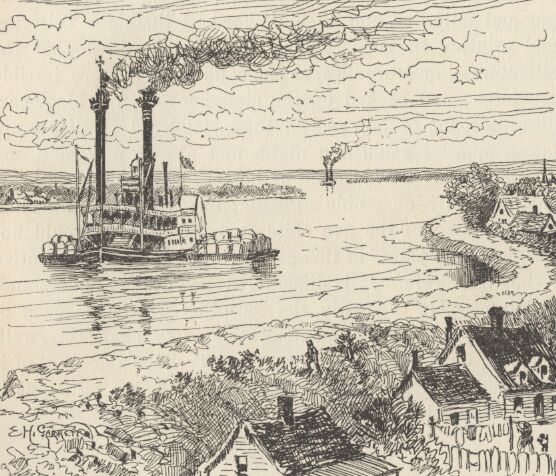
THE approaches to New Orleans were familiar; general aspects were unchanged. When one goes flying through London along a railway propped in the air on tall arches, he may inspect miles of upper bedrooms through the open windows, but the lower half of the houses is under his level and out of sight. Similarly, in high-river stage, in the New Orleans region, the water is up to the top of the enclosing levee-rim, the flat country behind it lies low—representing the bottom of a dish—and as the boat swims along, high on the flood, one looks down upon the houses and into the upper windows. There is nothing but that frail breastwork of earth between the people and destruction.
The approaches to New Orleans were familiar, and their general appearance was unchanged. In London, a train may carry you swiftly along a railway raised on tall arches. From there, you can look through open windows into miles of upstairs bedrooms. But the lower halves of the houses are below you and out of sight. Similarly, when the river is high around New Orleans, the water reaches the top of the surrounding levee. The flat land behind the levee lies low, like the bottom of a dish. As the boat moves along, high on the flood, you look down on the houses and into their upper windows. Nothing but that frail wall of earth stands between the people and destruction.
The old brick salt-warehouses clustered at the upper end of the city looked as they had always looked; warehouses which had had a kind of Aladdin's lamp experience, however, since I had seen them; for when the war broke out the proprietor went to bed one night leaving them packed with thousands of sacks of vulgar salt, worth a couple of dollars a sack, and got up in the morning and found his mountain of salt turned into a mountain of gold, so to speak, so suddenly and to so dizzy a height had the war news sent up the price of the article.
The old brick salt warehouses clustered at the upper end of the city looked just as they always had. But since I had last seen them, they had experienced something like the magic of Aladdin's lamp. When the war broke out, the owner went to bed one night with the warehouses packed with thousands of sacks of ordinary salt. Each sack was worth a couple of dollars. By morning, he found his mountain of salt had turned into a mountain of gold, so to speak. The news of the war had sent the price of salt soaring so suddenly and so high.
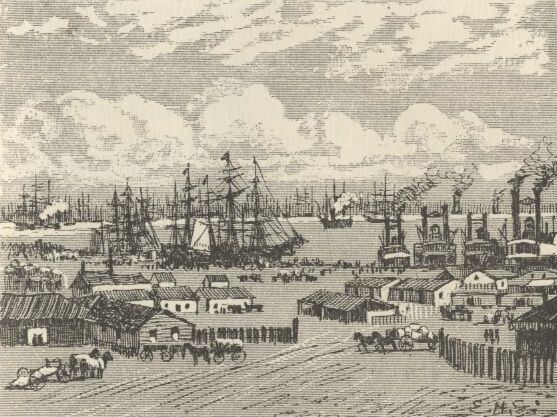
The vast reach of plank wharves remained unchanged, and there were as many ships as ever: but the long array of steamboats had vanished; not altogether, of course, but not much of it was left.
The vast stretch of wooden wharves was unchanged, and there were as many ships as ever. But the long row of steamboats was gone. Not entirely, of course, but very few steamboats were left.
The city itself had not changed—to the eye. It had greatly increased in spread and population, but the look of the town was not altered. The dust, waste-paper-littered, was still deep in the streets; the deep, trough-like gutters alongside the curbstones were still half full of reposeful water with a dusty surface; the sidewalks were still—in the sugar and bacon region—encumbered by casks and barrels and hogsheads; the great blocks of austerely plain commercial houses were as dusty-looking as ever.
The city itself had not changed in appearance. It had grown much larger in area and population, but it looked the same. Dust still lay deep in the streets, littered with scraps of paper. The deep, trough-like gutters beside the curbs were still half full of still water, covered with dust. In the sugar and bacon district, casks, barrels, and hogsheads still crowded the sidewalks. The great blocks of starkly plain commercial buildings looked as dusty as ever.
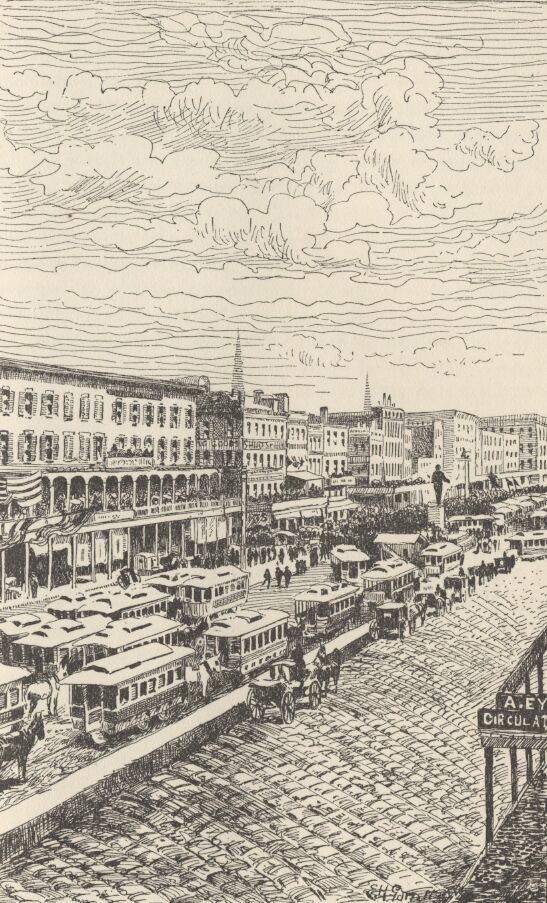
Canal Street was finer, and more attractive and stirring than formerly, with its drifting crowds of people, its several processions of hurrying street-cars, and—toward evening—its broad second-story verandas crowded with gentlemen and ladies clothed according to the latest mode.
Canal Street was finer, more attractive, and livelier than before. Crowds drifted along, and streetcars hurried past in several lines. Toward evening, the broad second-story verandas were crowded with men and women dressed in the latest fashion.
Not that there is any 'architecture' in Canal Street: to speak in broad, general terms, there is no architecture in New Orleans, except in the cemeteries. It seems a strange thing to say of a wealthy, far-seeing, and energetic city of a quarter of a million inhabitants, but it is true. There is a huge granite U.S. Custom-house—costly enough, genuine enough, but as a decoration it is inferior to a gasometer. It looks like a state prison. But it was built before the war. Architecture in America may be said to have been born since the war. New Orleans, I believe, has had the good luck—and in a sense the bad luck—to have had no great fire in late years. It must be so. If the opposite had been the case, I think one would be able to tell the 'burnt district' by the radical improvement in its architecture over the old forms. One can do this in Boston and Chicago. The 'burnt district' of Boston was commonplace before the fire; but now there is no commercial district in any city in the world that can surpass it—or perhaps even rival it—in beauty, elegance, and tastefulness.
Not that there is any 'architecture' on Canal Street. Generally speaking, there is no architecture in New Orleans, except in the cemeteries. That sounds strange for a wealthy, forward-looking, energetic city of a quarter of a million people, but it is true. There is a huge granite U.S. Custom-house. It is costly enough and genuine enough, but as a decoration it is inferior to a gasometer. It looks like a state prison. But it was built before the war. You could say that architecture in America was born after the war. New Orleans, I believe, has had the good luck, and in a sense the bad luck, to avoid a great fire in recent years. That must be so. If there had been a great fire, I think you could identify the 'burnt district' by its radically improved architecture. You can do this in Boston and Chicago. Boston's 'burnt district' was ordinary before the fire. But now no commercial district in any city in the world can surpass it in beauty, elegance, and taste. Perhaps none can even rival it.
However, New Orleans has begun—just this moment, as one may say. When completed, the new Cotton Exchange will be a stately and beautiful building; massive, substantial, full of architectural graces; no shams or false pretenses or uglinesses about it anywhere. To the city, it will be worth many times its cost, for it will breed its species. What has been lacking hitherto, was a model to build toward; something to educate eye and taste; a suggester, so to speak.
However, New Orleans has only just begun, you might say. When completed, the new Cotton Exchange will be a stately and beautiful building. It will be massive and solid, with graceful architectural details. There will be nothing fake, pretentious, or ugly about it anywhere. The building will be worth many times its cost to the city, because it will inspire others like it. Until now, the city has lacked a model to build toward, something to educate the eye and refine taste. It has lacked a suggester, so to speak.
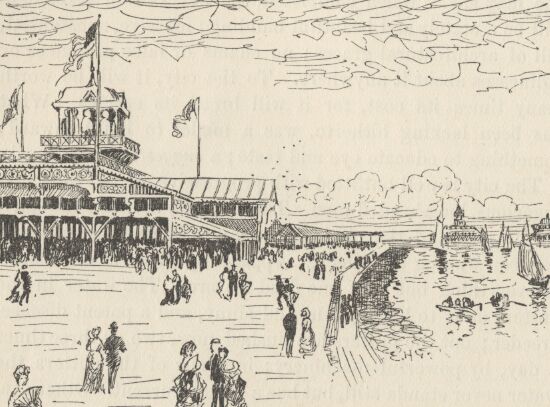
The city is well outfitted with progressive men—thinking, sagacious, long-headed men. The contrast between the spirit of the city and the city's architecture is like the contrast between waking and sleep. Apparently there is a 'boom' in everything but that one dead feature. The water in the gutters used to be stagnant and slimy, and a potent disease-breeder; but the gutters are flushed now, two or three times a day, by powerful machinery; in many of the gutters the water never stands still, but has a steady current. Other sanitary improvements have been made; and with such effect that New Orleans claims to be (during the long intervals between the occasional yellow-fever assaults) one of the healthiest cities in the Union. There's plenty of ice now for everybody, manufactured in the town. It is a driving place commercially, and has a great river, ocean, and railway business. At the date of our visit, it was the best lighted city in the Union, electrically speaking. The New Orleans electric lights were more numerous than those of New York, and very much better. One had this modified noonday not only in Canal and some neighboring chief streets, but all along a stretch of five miles of river frontage. There are good clubs in the city now—several of them but recently organized—and inviting modern-style pleasure resorts at West End and Spanish Fort. The telephone is everywhere. One of the most notable advances is in journalism. The newspapers, as I remember them, were not a striking feature. Now they are. Money is spent upon them with a free hand. They get the news, let it cost what it may. The editorial work is not hack-grinding, but literature. As an example of New Orleans journalistic achievement, it may be mentioned that the 'Times-Democrat' of August 26, 1882, contained a report of the year's business of the towns of the Mississippi Valley, from New Orleans all the way to St. Paul—two thousand miles. That issue of the paper consisted of forty pages; seven columns to the page; two hundred and eighty columns in all; fifteen hundred words to the column; an aggregate of four hundred and twenty thousand words. That is to say, not much short of three times as many words as there are in this book. One may with sorrow contrast this with the architecture of New Orleans.
The city has plenty of progressive men, thoughtful, shrewd, and farsighted. The contrast between the city's spirit and its architecture is like the contrast between waking and sleep. Apparently, everything is enjoying a 'boom' except that one lifeless feature. The water in the gutters used to be stagnant and slimy, and a powerful breeder of disease. But powerful machines now flush the gutters two or three times a day. In many gutters, the water never stands still, but flows steadily. Other sanitary improvements have also been made. As a result, New Orleans claims to be one of the healthiest cities in the Union during the long intervals between occasional yellow-fever outbreaks. There is now plenty of ice for everyone, manufactured in the city. New Orleans is a bustling commercial city, with a great deal of river, ocean, and railway trade. At the time of our visit, it was the best-lit city in the Union, at least as far as electric lighting was concerned. New Orleans had more electric lights than New York, and much better ones. This softened daylight lit not only Canal Street and some neighboring main streets, but also five miles of riverfront. The city now has several good clubs, some of them only recently founded. West End and Spanish Fort also have inviting, modern places for recreation. The telephone is everywhere. One of the most notable advances is in journalism. As I remember them, the newspapers were once nothing special. Now they are. Money is spent freely on them. They get the news, whatever the cost. The editorial work is not hackwork, but literature. The 'Times-Democrat' of August 26, 1882, offers an example of New Orleans journalism. It reported on the year's business in the towns of the Mississippi Valley, from New Orleans all the way to St. Paul, a distance of two thousand miles. That issue had forty pages, with seven columns per page, making two hundred and eighty columns in all. At fifteen hundred words per column, the total came to four hundred and twenty thousand words. That is not much less than three times the number of words in this book. One can only compare this achievement with the architecture of New Orleans with sorrow.
I have been speaking of public architecture only. The domestic article in New Orleans is reproachless, notwithstanding it remains as it always was. All the dwellings are of wood—in the American part of the town, I mean—and all have a comfortable look. Those in the wealthy quarter are spacious; painted snow-white usually, and generally have wide verandas, or double-verandas, supported by ornamental columns. These mansions stand in the center of large grounds, and rise, garlanded with roses, out of the midst of swelling masses of shining green foliage and many-colored blossoms. No houses could well be in better harmony with their surroundings, or more pleasing to the eye, or more home-like and comfortable-looking.
I have been speaking only of public architecture. The houses in New Orleans are beyond criticism, though they remain as they always were. In the American part of town, I mean, all the houses are made of wood, and all look comfortable. Those in the wealthy quarter are spacious and usually painted snow-white. They generally have wide verandas, or double verandas, supported by decorative columns. These mansions stand in the middle of large grounds. Draped in roses, they rise from lush masses of glossy green foliage and flowers of many colors. No houses could be better suited to their surroundings, more pleasing to the eye, or more homey and comfortable-looking.
One even becomes reconciled to the cistern presently; this is a mighty cask, painted green, and sometimes a couple of stories high, which is propped against the house-corner on stilts. There is a mansion-and-brewery suggestion about the combination which seems very incongruous at first. But the people cannot have wells, and so they take rain-water. Neither can they conveniently have cellars, or graves,{footnote [The Israelites are buried in graves—by permission, I take it, not requirement; but none else, except the destitute, who are buried at public expense. The graves are but three or four feet deep.]} the town being built upon 'made' ground; so they do without both, and few of the living complain, and none of the others.
You even get used to the cistern after a while. It is a huge green tank, sometimes two stories high, raised on stilts against a corner of the house. At first, the combination looks oddly like a mansion attached to a brewery. But people cannot have wells, so they collect rainwater. They cannot conveniently have cellars or graves either,{footnote [The Israelites are buried in graves, by permission, I suppose, not because they are required to be. No one else is buried in a grave except the destitute, who are buried at public expense. The graves are only three or four feet deep.]} because the town is built on 'made' ground. So they do without both. Few of the living complain, and none of the others do.