Chapter 40
Castles and Culture
BATON ROUGE was clothed in flowers, like a bride—no, much more so; like a greenhouse. For we were in the absolute South now—no modifications, no compromises, no half-way measures. The magnolia-trees in the Capitol grounds were lovely and fragrant, with their dense rich foliage and huge snow-ball blossoms. The scent of the flower is very sweet, but you want distance on it, because it is so powerful. They are not good bedroom blossoms—they might suffocate one in his sleep. We were certainly in the South at last; for here the sugar region begins, and the plantations—vast green levels, with sugar-mill and negro quarters clustered together in the middle distance—were in view. And there was a tropical sun overhead and a tropical swelter in the air.
Baton Rouge was covered in flowers, like a bride. No, much more than that, like a greenhouse. For we were in the true South now. There were no adjustments, no compromises, no halfway measures. The magnolia trees on the Capitol grounds were lovely and fragrant, with dense, rich leaves and huge, snowball-like blossoms. The flowers smell very sweet, but you need some distance from them because their scent is so powerful. They are not good bedroom flowers. They might suffocate a person in their sleep. We were certainly in the South at last, for the sugar region begins here. The plantations were in view, vast green stretches with sugar mills and quarters for Black workers clustered in the middle distance. A tropical sun was overhead, and the air was tropically sweltering.
And at this point, also, begins the pilot's paradise: a wide river hence to New Orleans, abundance of water from shore to shore, and no bars, snags, sawyers, or wrecks in his road.
Here, too, the pilot’s paradise begins. The river is wide from here to New Orleans, with plenty of water from shore to shore. There are no sandbars, snags, sawyers, or wrecks in his path.
Sir Walter Scott is probably responsible for the Capitol building; for it is not conceivable that this little sham castle would ever have been built if he had not run the people mad, a couple of generations ago, with his medieval romances. The South has not yet recovered from the debilitating influence of his books. Admiration of his fantastic heroes and their grotesque 'chivalry' doings and romantic juvenilities still survives here, in an atmosphere in which is already perceptible the wholesome and practical nineteenth-century smell of cotton-factories and locomotives; and traces of its inflated language and other windy humbuggeries survive along with it. It is pathetic enough, that a whitewashed castle, with turrets and things—materials all ungenuine within and without, pretending to be what they are not—should ever have been built in this otherwise honorable place; but it is much more pathetic to see this architectural falsehood undergoing restoration and perpetuation in our day, when it would have been so easy to let dynamite finish what a charitable fire began, and then devote this restoration-money to the building of something genuine.
Sir Walter Scott is probably responsible for the Capitol building. This little fake castle would surely never have been built if his medieval romances had not driven people mad a couple of generations ago. The South has still not recovered from the weakening influence of his books. People here still admire his fantastic heroes, their grotesque acts of 'chivalry', and their childish romantic antics. Yet the healthy, practical nineteenth-century smell of cotton factories and locomotives is already in the air. Traces of the inflated language and other empty nonsense of Scott's romances survive here too. It is pathetic enough that a whitewashed castle, complete with turrets and the like, was ever built in this otherwise honorable place. Its materials are fake inside and out, pretending to be what they are not. But it is much more pathetic to see this architectural lie being restored and preserved in our own day. It would have been so easy to let dynamite finish what a merciful fire began, then spend the restoration money on something genuine.
Baton Rouge has no patent on imitation castles, however, and no monopoly of them. Here is a picture from the advertisement of the 'Female Institute' of Columbia; Tennessee. The following remark is from the same advertisement—
Baton Rouge, however, has no patent on imitation castles and no monopoly on them. Here is a picture from an advertisement for the 'Female Institute' of Columbia, Tennessee. The following remark comes from the same advertisement:
'The Institute building has long been famed as a model of striking and beautiful architecture. Visitors are charmed with its resemblance to the old castles of song and story, with its towers, turreted walls, and ivy-mantled porches.'
'The Institute building has long been famous for its striking and beautiful architecture. Visitors are charmed by its resemblance to the old castles of songs and stories, with towers, turreted walls, and ivy-covered porches.'
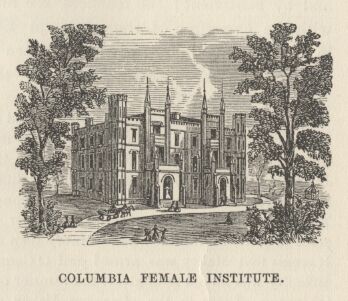
Keeping school in a castle is a romantic thing; as romantic as keeping hotel in a castle.
Running a school in a castle is romantic, just as romantic as running a hotel in a castle.
By itself the imitation castle is doubtless harmless, and well enough; but as a symbol and breeder and sustainer of maudlin Middle-Age romanticism here in the midst of the plainest and sturdiest and infinitely greatest and worthiest of all the centuries the world has seen, it is necessarily a hurtful thing and a mistake.
By itself, the imitation castle is doubtless harmless and good enough. But it symbolizes, fosters, and sustains a sentimental romantic view of the Middle Ages. It does so in the midst of the plainest and sturdiest century the world has ever seen. This century is also infinitely the greatest and worthiest of them all. So the imitation castle is necessarily harmful and a mistake.
Here is an extract from the prospectus of a Kentucky 'Female College.' Female college sounds well enough; but since the phrasing it in that unjustifiable way was done purely in the interest of brevity, it seems to me that she-college would have been still better—because shorter, and means the same thing: that is, if either phrase means anything at all—
Here is an extract from the prospectus of a Kentucky 'Female College.' Female college sounds well enough. But that unjustifiable wording was used purely to save words. So it seems to me that she-college would have been even better. It is shorter and means the same thing, if either phrase means anything at all.
'The president is southern by birth, by rearing, by education, and by sentiment; the teachers are all southern in sentiment, and with the exception of those born in Europe were born and raised in the south. Believing the southern to be the highest type of civilization this continent has seen, the young ladies are trained according to the southern ideas of delicacy, refinement, womanhood, religion, and propriety; hence we offer a first-class female college for the south and solicit southern patronage.'
'The president was born, raised, and educated in the South and shares Southern values. All the teachers share Southern values, and all except those born in Europe were born and raised in the South. We believe Southern civilization is the highest form of civilization this continent has seen. So the young women are taught Southern ideas of delicacy, refinement, womanhood, religion, and proper conduct. We therefore offer a first-class college for women in the South and invite Southerners to support it.'
{footnote [Illustrations of it thoughtlessly omitted by the advertiser:
{footnote [The advertiser thoughtlessly left out illustrations of it:
KNOXVILLE, Tenn., October 19.—This morning a few minutes after ten o'clock, General Joseph A. Mabry, Thomas O'Connor, and Joseph A. Mabry, Jr., were killed in a shooting affray. The difficulty began yesterday afternoon by General Mabry attacking Major O'Connor and threatening to kill him. This was at the fair grounds, and O'Connor told Mabry that it was not the place to settle their difficulties. Mabry then told O'Connor he should not live. It seems that Mabry was armed and O'Connor was not. The cause of the difficulty was an old feud about the transfer of some property from Mabry to O'Connor. Later in the afternoon Mabry sent word to O'Connor that he would kill him on sight. This morning Major O'Connor was standing in the door of the Mechanics' National Bank, of which he was president. General Mabry and another gentleman walked down Gay Street on the opposite side from the bank. O'Connor stepped into the bank, got a shot gun, took deliberate aim at General Mabry and fired. Mabry fell dead, being shot in the left side. As he fell O'Connor fired again, the shot taking effect in Mabry's thigh. O'Connor then reached into the bank and got another shot gun. About this time Joseph A. Mabry, Jr., son of General Mabry, came rushing down the street, unseen by O'Connor until within forty feet, when the young man fired a pistol, the shot taking effect in O'Connor's right breast, passing through the body near the heart. The instant Mabry shot, O'Connor turned and fired, the load taking effect in young Mabry's right breast and side. Mabry fell pierced with twenty buckshot, and almost instantly O'Connor fell dead without a struggle. Mabry tried to rise, but fell back dead. The whole tragedy occurred within two minutes, and neither of the three spoke after he was shot. General Mabry had about thirty buckshot in his body. A bystander was painfully wounded in the thigh with a buckshot, and another was wounded in the arm. Four other men had their clothing pierced by buckshot. The affair caused great excitement, and Gay Street was thronged with thousands of people. General Mabry and his son Joe were acquitted only a few days ago of the murder of Moses Lusby and Don Lusby, father and son, whom they killed a few weeks ago. Will Mabry was killed by Don Lusby last Christmas. Major Thomas O'Connor was President of the Mechanics' National Bank here, and was the wealthiest man in the State.—Associated Press Telegram.
KNOXVILLE, Tenn., October 19. A few minutes after ten this morning, General Joseph A. Mabry, Thomas O'Connor, and Joseph A. Mabry, Jr., were killed in a shootout. The trouble began yesterday afternoon when General Mabry attacked Major O'Connor and threatened to kill him. They were at the fairgrounds, and O'Connor told Mabry it was not the place to settle their dispute. Mabry then told O'Connor he would not live. It seems Mabry was armed and O'Connor was not. The dispute arose from an old feud over the transfer of some property from Mabry to O'Connor. Later that afternoon, Mabry sent word to O'Connor that he would kill him on sight. This morning Major O'Connor was standing in the doorway of the Mechanics' National Bank, where he was president. General Mabry and another gentleman walked down Gay Street on the opposite side from the bank. O'Connor stepped into the bank, got a shotgun, took careful aim at General Mabry, and fired. Mabry was shot in the left side and fell dead. As he fell, O'Connor fired again, hitting Mabry in the thigh. O'Connor then reached into the bank and got another shotgun. About this time, General Mabry's son, Joseph A. Mabry, Jr., came rushing down the street. O'Connor did not see him until he was within forty feet. Then the young man fired a pistol, hitting O'Connor in the right breast. The bullet passed through his body near his heart. The instant Mabry fired, O'Connor turned and fired, hitting young Mabry in the right breast and side. Mabry fell, pierced by twenty buckshot. Almost instantly, O'Connor fell dead without a struggle. Mabry tried to rise, but fell back dead. The whole tragedy took place within two minutes, and none of the three spoke after being shot. General Mabry had about thirty buckshot in his body. A bystander was painfully wounded in the thigh by a buckshot pellet, and another was wounded in the arm. Four other men had their clothing pierced by buckshot. The affair caused great excitement, and thousands of people crowded Gay Street. Only a few days ago, General Mabry and his son Joe were acquitted of murdering Moses Lusby and Don Lusby. They had killed the father and son a few weeks earlier. Will Mabry was killed by Don Lusby last Christmas. Major Thomas O'Connor was president of the Mechanics' National Bank here and was the wealthiest man in the State. Associated Press Telegram.
One day last month, Professor Sharpe, of the Somerville, Tenn., Female College, 'a quiet and gentlemanly man,' was told that his brother-in-law, a Captain Burton, had threatened to kill him. Burton, it seems, had already killed one man and driven his knife into another. The Professor armed himself with a double-barreled shot gun, started out in search of his brother-in-law, found him playing billiards in a saloon, and blew his brains out. The 'Memphis Avalanche' reports that the Professor's course met with pretty general approval in the community; knowing that the law was powerless, in the actual condition of public sentiment, to protect him, he protected himself.
One day last month, Professor Sharpe learned that his brother-in-law, Captain Burton, had threatened to kill him. Sharpe taught at Somerville Female College in Somerville, Tenn., and was described as 'a quiet and gentlemanly man.' Burton, it seems, had already killed one man and stabbed another. The Professor armed himself with a double-barreled shotgun and went looking for his brother-in-law. He found Burton playing billiards in a saloon and blew his brains out. The 'Memphis Avalanche' reports that the community generally approved of what the Professor did. He knew that, given public opinion, the law was powerless to protect him, so he protected himself.
About the same time, two young men in North Carolina quarreled about a girl, and 'hostile messages' were exchanged. Friends tried to reconcile them, but had their labor for their pains. On the 24th the young men met in the public highway. One of them had a heavy club in his hand, the other an ax. The man with the club fought desperately for his life, but it was a hopeless fight from the first. A well-directed blow sent his club whirling out of his grasp, and the next moment he was a dead man.
Around the same time, two young men in North Carolina quarreled over a girl and exchanged 'hostile messages'. Friends tried to reconcile them, but their efforts were wasted. On the 24th, the young men met on a public road. One carried a heavy club, and the other had an ax. The man with the club fought desperately for his life, but the fight was hopeless from the start. A well-aimed blow knocked the club from his hand. A moment later, he was dead.
About the same time, two 'highly connected' young Virginians, clerks in a hardware store at Charlottesville, while 'skylarking,' came to blows. Peter Dick threw pepper in Charles Roads's eyes; Roads demanded an apology; Dick refused to give it, and it was agreed that a duel was inevitable, but a difficulty arose; the parties had no pistols, and it was too late at night to procure them. One of them suggested that butcher-knives would answer the purpose, and the other accepted the suggestion; the result was that Roads fell to the floor with a gash in his abdomen that may or may not prove fatal. If Dick has been arrested, the news has not reached us. He 'expressed deep regret,' and we are told by a Staunton correspondent of the Philadelphia Press that 'every effort has been made to hush the matter up.'—Extracts From The Public Journals.]}
About the same time, two 'well-connected' young Virginians came to blows while 'playing around.' They were clerks in a hardware store in Charlottesville. Peter Dick threw pepper in Charles Roads's eyes. Roads demanded an apology, but Dick refused. They agreed that a duel was unavoidable, but there was a problem. Neither man had a pistol, and it was too late at night to get one. One suggested that butcher knives would do, and the other agreed. As a result, Roads fell to the floor with a gash in his abdomen that may or may not prove fatal. If Dick has been arrested, the news has not reached us. He 'expressed deep regret,' and a Staunton correspondent for the Philadelphia Press tells us that 'every effort has been made to hush the matter up.' Extracts From The Public Journals.]}
What, warder, ho! the man that can blow so complacent a blast as that, probably blows it from a castle.
Hey, guard! A man who blows a horn so smugly probably does it from a castle.
From Baton Rouge to New Orleans, the great sugar plantations border both sides of the river all the way, and stretch their league-wide levels back to the dim forest-walls of bearded cypress in the rear. Shores lonely no longer. Plenty of dwellings all the way, on both banks—standing so close together, for long distances, that the broad river lying between the two rows, becomes a sort of spacious street. A most home-like and happy-looking region. And now and then you see a pillared and porticoed great manor-house, embowered in trees. Here is testimony of one or two of the procession of foreign tourists that filed along here half a century ago. Mrs. Trollope says—
From Baton Rouge to New Orleans, great sugar plantations line both sides of the river all the way. Their flat fields stretch back for miles to the distant walls of bearded cypress forest. The shores are no longer lonely. Houses line both banks all the way. For long stretches, they stand so close together that the broad river between the two rows becomes a kind of spacious street. The whole region looks welcoming and happy. Now and then, you see a great manor house with columns and a portico, nestled among trees. Here are accounts from one or two of the many foreign tourists who traveled this way half a century ago. Mrs. Trollope says:
'The unbroken flatness of the banks of the Mississippi continued unvaried for many miles above New Orleans; but the graceful and luxuriant palmetto, the dark and noble ilex, and the bright orange, were everywhere to be seen, and it was many days before we were weary of looking at them.'
'The banks of the Mississippi remained completely flat for many miles above New Orleans. But graceful, lush palmettos, dark, stately ilex trees, and bright orange trees were everywhere. It took many days for us to tire of looking at them.'
Captain Basil Hall—
Captain Basil Hall:
'The district of country which lies adjacent to the Mississippi, in the lower parts of Louisiana, is everywhere thickly peopled by sugar planters, whose showy houses, gay piazzas, trig gardens, and numerous slave-villages, all clean and neat, gave an exceedingly thriving air to the river scenery.
'The land along the Mississippi in lower Louisiana was everywhere densely populated by sugar planters. Their showy houses, colorful porches, tidy gardens, and numerous slave villages were all clean and neat. Together, they gave the river scenery a very prosperous look.
All the procession paint the attractive picture in the same way. The descriptions of fifty years ago do not need to have a word changed in order to exactly describe the same region as it appears to-day—except as to the 'trigness' of the houses. The whitewash is gone from the negro cabins now; and many, possibly most, of the big mansions, once so shining white, have worn out their paint and have a decayed, neglected look. It is the blight of the war. Twenty-one years ago everything was trim and trig and bright along the 'coast,' just as it had been in 1827, as described by those tourists.
All the travelers in the procession paint the same attractive picture. The descriptions from fifty years ago still describe the region exactly as it looks today. The only exception is the 'neatness' of the houses. The whitewash is gone from the cabins of Black people. Many, possibly most, of the grand mansions have lost their once gleaming white paint. They look worn and neglected. This is the damage left by the war. Twenty-one years ago, everything along the 'coast' was neat, tidy, and bright. It was just as those tourists had described it in 1827.
Unfortunate tourists! People humbugged them with stupid and silly lies, and then laughed at them for believing and printing the same. They told Mrs. Trollope that the alligators—or crocodiles, as she calls them—were terrible creatures; and backed up the statement with a blood-curdling account of how one of these slandered reptiles crept into a squatter cabin one night, and ate up a woman and five children. The woman, by herself, would have satisfied any ordinarily-impossible alligator; but no, these liars must make him gorge the five children besides. One would not imagine that jokers of this robust breed would be sensitive—but they were. It is difficult, at this day, to understand, and impossible to justify, the reception which the book of the grave, honest, intelligent, gentle, manly, charitable, well-meaning Capt. Basil Hall got.
Poor tourists! People fooled them with stupid, silly lies. Then they laughed at the tourists for believing and printing those lies. They told Mrs. Trollope that alligators were terrible creatures. She called them crocodiles. To back up the claim, they told a bloodcurdling story about one of these slandered reptiles. It supposedly crept into a squatter's cabin one night and ate a woman and five children. The woman alone would have satisfied any ordinarily impossible alligator. But no, these liars had to make it gobble up the five children too. You might not expect such robust jokers to be sensitive, but they were. Today, it is hard to understand how Capt. Basil Hall's book was received, and impossible to justify that reception. He was serious, honest, intelligent, gentle, manly, charitable, and well-meaning.