Chapter 38
The Beautiful House
WE took passage in a Cincinnati boat for New Orleans; or on a Cincinnati boat—either is correct; the former is the eastern form of putting it, the latter the western.
We booked passage in a Cincinnati boat for New Orleans. Or on a Cincinnati boat. Either is correct. People in the East say “in,” while people in the West say “on.”
Mr. Dickens declined to agree that the Mississippi steamboats were 'magnificent,' or that they were 'floating palaces,'—terms which had always been applied to them; terms which did not over-express the admiration with which the people viewed them.
Mr. Dickens refused to agree that the Mississippi steamboats were 'magnificent' or that they were 'floating palaces.' People had always used those terms for the steamboats. The terms did not overstate how much people admired them.
Mr. Dickens's position was unassailable, possibly; the people's position was certainly unassailable. If Mr. Dickens was comparing these boats with the crown jewels; or with the Taj, or with the Matterhorn; or with some other priceless or wonderful thing which he had seen, they were not magnificent—he was right. The people compared them with what they had seen; and, thus measured, thus judged, the boats were magnificent—the term was the correct one, it was not at all too strong. The people were as right as was Mr. Dickens. The steamboats were finer than anything on shore. Compared with superior dwelling-houses and first-class hotels in the Valley, they were indubitably magnificent, they were 'palaces.' To a few people living in New Orleans and St. Louis, they were not magnificent, perhaps; not palaces; but to the great majority of those populations, and to the entire populations spread over both banks between Baton Rouge and St. Louis, they were palaces; they tallied with the citizen's dream of what magnificence was, and satisfied it.
Mr. Dickens's position was perhaps impossible to dispute. The people's position certainly was. If Mr. Dickens was comparing these boats with the crown jewels, the Taj, the Matterhorn, or some other priceless or wonderful thing he had seen, he was right. By that measure, the boats were not magnificent. The people compared the boats with what they had seen. By that measure, the boats were magnificent. The word was right, and not at all too strong. The people were just as right as Mr. Dickens. The steamboats were finer than anything on shore. Compared with the best houses and first-class hotels in the Valley, the boats were undoubtedly magnificent. They were 'palaces.' To a few people living in New Orleans and St. Louis, perhaps the boats were not magnificent or palaces. But they were palaces to the great majority of people in those cities. They were also palaces to everyone living along both banks between Baton Rouge and St. Louis. The boats matched and fulfilled the citizen's dream of magnificence.
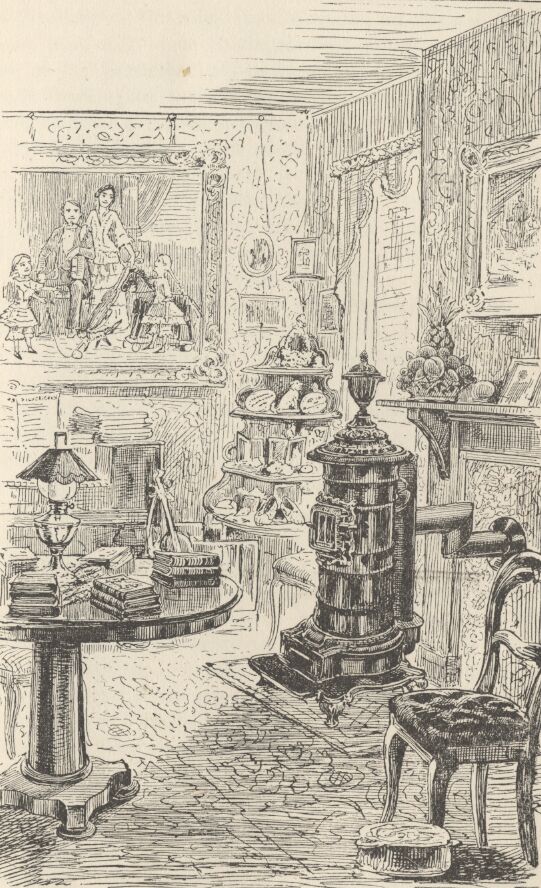
Every town and village along that vast stretch of double river-frontage had a best dwelling, finest dwelling, mansion,—the home of its wealthiest and most conspicuous citizen. It is easy to describe it: large grassy yard, with paling fence painted white—in fair repair; brick walk from gate to door; big, square, two-story 'frame' house, painted white and porticoed like a Grecian temple—with this difference, that the imposing fluted columns and Corinthian capitals were a pathetic sham, being made of white pine, and painted; iron knocker; brass door knob—discolored, for lack of polishing. Within, an uncarpeted hall, of planed boards; opening out of it, a parlor, fifteen feet by fifteen—in some instances five or ten feet larger; ingrain carpet; mahogany center-table; lamp on it, with green-paper shade—standing on a gridiron, so to speak, made of high-colored yarns, by the young ladies of the house, and called a lamp-mat; several books, piled and disposed, with cast-iron exactness, according to an inherited and unchangeable plan; among them, Tupper, much penciled; also, 'Friendship's Offering,' and 'Affection's Wreath,' with their sappy inanities illustrated in die-away mezzotints; also, Ossian; 'Alonzo and Melissa:' maybe 'Ivanhoe:' also 'Album,' full of original 'poetry' of the Thou-hast-wounded-the-spirit-that-loved-thee breed; two or three goody-goody works—'Shepherd of Salisbury Plain,' etc.; current number of the chaste and innocuous Godey's 'Lady's Book,' with painted fashion-plate of wax-figure women with mouths all alike—lips and eyelids the same size—each five-foot woman with a two-inch wedge sticking from under her dress and letting-on to be half of her foot. Polished air-tight stove (new and deadly invention), with pipe passing through a board which closes up the discarded good old fireplace. On each end of the wooden mantel, over the fireplace, a large basket of peaches and other fruits, natural size, all done in plaster, rudely, or in wax, and painted to resemble the originals—which they don't. Over middle of mantel, engraving—Washington Crossing the Delaware; on the wall by the door, copy of it done in thunder-and-lightning crewels by one of the young ladies—work of art which would have made Washington hesitate about crossing, if he could have foreseen what advantage was going to be taken of it. Piano—kettle in disguise—with music, bound and unbound, piled on it, and on a stand near by: Battle of Prague; Bird Waltz; Arkansas Traveler; Rosin the Bow; Marseilles Hymn; On a Lone Barren Isle (St. Helena); The Last Link is Broken; She wore a Wreath of Roses the Night when last we met; Go, forget me, Why should Sorrow o'er that Brow a Shadow fling; Hours there were to Memory Dearer; Long, Long Ago; Days of Absence; A Life on the Ocean Wave, a Home on the Rolling Deep; Bird at Sea; and spread open on the rack, where the plaintive singer has left it, ro-holl on, silver moo-hoon, guide the trav-el-lerr his way, etc. Tilted pensively against the piano, a guitar—guitar capable of playing the Spanish Fandango by itself, if you give it a start. Frantic work of art on the wall—pious motto, done on the premises, sometimes in colored yarns, sometimes in faded grasses: progenitor of the 'God Bless Our Home' of modern commerce. Framed in black moldings on the wall, other works of arts, conceived and committed on the premises, by the young ladies; being grim black-and-white crayons; landscapes, mostly: lake, solitary sail-boat, petrified clouds, pre-geological trees on shore, anthracite precipice; name of criminal conspicuous in the corner. Lithograph, Napoleon Crossing the Alps. Lithograph, The Grave at St. Helena. Steel-plates, Trumbull's Battle of Bunker Hill, and the Sally from Gibraltar. Copper-plates, Moses Smiting the Rock, and Return of the Prodigal Son. In big gilt frame, slander of the family in oil: papa holding a book ('Constitution of the United States'); guitar leaning against mamma, blue ribbons fluttering from its neck; the young ladies, as children, in slippers and scalloped pantelettes, one embracing toy horse, the other beguiling kitten with ball of yarn, and both simpering up at mamma, who simpers back. These persons all fresh, raw, and red—apparently skinned. Opposite, in gilt frame, grandpa and grandma, at thirty and twenty-two, stiff, old-fashioned, high-collared, puff-sleeved, glaring pallidly out from a background of solid Egyptian night. Under a glass French clock dome, large bouquet of stiff flowers done in corpsy-white wax. Pyramidal what-not in the corner, the shelves occupied chiefly with bric-a-brac of the period, disposed with an eye to best effect: shell, with the Lord's Prayer carved on it; another shell—of the long-oval sort, narrow, straight orifice, three inches long, running from end to end—portrait of Washington carved on it; not well done; the shell had Washington's mouth, originally—artist should have built to that. These two are memorials of the long-ago bridal trip to New Orleans and the French Market. Other bric-a-brac: Californian 'specimens'—quartz, with gold wart adhering; old Guinea-gold locket, with circlet of ancestral hair in it; Indian arrow-heads, of flint; pair of bead moccasins, from uncle who crossed the Plains; three 'alum' baskets of various colors—being skeleton-frame of wire, clothed-on with cubes of crystallized alum in the rock-candy style—works of art which were achieved by the young ladies; their doubles and duplicates to be found upon all what-nots in the land; convention of desiccated bugs and butterflies pinned to a card; painted toy-dog, seated upon bellows-attachment—drops its under jaw and squeaks when pressed upon; sugar-candy rabbit—limbs and features merged together, not strongly defined; pewter presidential-campaign medal; miniature card-board wood-sawyer, to be attached to the stove-pipe and operated by the heat; small Napoleon, done in wax; spread-open daguerreotypes of dim children, parents, cousins, aunts, and friends, in all attitudes but customary ones; no templed portico at back, and manufactured landscape stretching away in the distance—that came in later, with the photograph; all these vague figures lavishly chained and ringed—metal indicated and secured from doubt by stripes and splashes of vivid gold bronze; all of them too much combed, too much fixed up; and all of them uncomfortable in inflexible Sunday-clothes of a pattern which the spectator cannot realize could ever have been in fashion; husband and wife generally grouped together—husband sitting, wife standing, with hand on his shoulder—and both preserving, all these fading years, some traceable effect of the daguerreotypist's brisk 'Now smile, if you please!' Bracketed over what-not—place of special sacredness—an outrage in water-color, done by the young niece that came on a visit long ago, and died. Pity, too; for she might have repented of this in time. Horse-hair chairs, horse-hair sofa which keeps sliding from under you. Window shades, of oil stuff, with milk-maids and ruined castles stenciled on them in fierce colors. Lambrequins dependent from gaudy boxings of beaten tin, gilded. Bedrooms with rag carpets; bedsteads of the 'corded' sort, with a sag in the middle, the cords needing tightening; snuffy feather-bed—not aired often enough; cane-seat chairs, splint-bottomed rocker; looking-glass on wall, school-slate size, veneered frame; inherited bureau; wash-bowl and pitcher, possibly—but not certainly; brass candlestick, tallow candle, snuffers. Nothing else in the room. Not a bathroom in the house; and no visitor likely to come along who has ever seen one.
Every town and village along that vast stretch of riverbank, on both sides, had its best house, its finest house, its mansion. It belonged to the richest and most prominent citizen. It is easy to describe: a large grassy yard, with a white picket fence in fairly good repair. A brick path leads from the gate to the door. The big, square, two-story frame house is painted white and has a portico like a Greek temple. There is one difference. The impressive fluted columns and Corinthian capitals are a pathetic fake, made of painted white pine. There is an iron knocker and a brass doorknob, discolored from lack of polishing. Inside is an uncarpeted hallway with planed floorboards. A parlor opens off it, measuring fifteen feet by fifteen, or sometimes five or ten feet larger. It has an ingrain carpet and a mahogany center table. On the table is a lamp with a green paper shade. It stands on what might be called a gridiron of brightly colored yarn, made by the young ladies of the house and called a lamp mat. Several books are piled and arranged with rigid precision, according to an inherited and unchangeable plan. Among them is Tupper, heavily marked in pencil. There are also 'Friendship's Offering' and 'Affection's Wreath,' with their sentimental nonsense illustrated in faint, dreamy mezzotints. There is Ossian, 'Alonzo and Melissa,' perhaps 'Ivanhoe,' and an 'Album' full of original 'poetry' of the Thou-hast-wounded-the-spirit-that-loved-thee kind. There are two or three overly moral works, such as 'Shepherd of Salisbury Plain.' There is also the current issue of the proper and harmless Godey's 'Lady's Book.' Its colored fashion plate shows wax-figure women whose mouths are all alike. Their lips and eyelids are the same size. Each five-foot woman has a two-inch wedge sticking out from under her dress, pretending to be half her foot. A polished airtight stove stands nearby, a new and deadly invention. Its pipe passes through a board that closes up the discarded good old fireplace. At each end of the wooden mantel is a large basket of life-size peaches and other fruit. They are crudely made of plaster or wax and painted to resemble the originals, which they don't. Above the middle of the mantel hangs an engraving, Washington Crossing the Delaware. On the wall by the door is a copy stitched in thunder-and-lightning colored yarns by one of the young ladies. If Washington could have foreseen how his crossing would be exploited, this work of art would have made him hesitate. There is a piano, a kettle in disguise. Bound and loose sheet music is piled on it and on a nearby stand: Battle of Prague; Bird Waltz; Arkansas Traveler; Rosin the Bow; Marseilles Hymn; On a Lone Barren Isle (St. Helena); The Last Link is Broken; She wore a Wreath of Roses the Night when last we met; Go, forget me, Why should Sorrow o'er that Brow a Shadow fling; Hours there were to Memory Dearer; Long, Long Ago; Days of Absence; A Life on the Ocean Wave, a Home on the Rolling Deep; Bird at Sea. On the music rack, left open by the mournful singer, is ro-holl on, silver moo-hoon, guide the trav-el-lerr his way, etc. A guitar leans thoughtfully against the piano. Give that guitar a start and it could play the Spanish Fandango by itself. On the wall is a frantic work of art, a religious motto made in the house. Sometimes it is done in colored yarn, sometimes in faded grasses. It is the ancestor of the 'God Bless Our Home' sold today. Other works of art hang on the wall in black frames, imagined and executed in the house by the young ladies. They are grim black-and-white crayon drawings, mostly landscapes. There is a lake, a solitary sailboat, petrified clouds, prehistoric trees on the shore, and a coal-black cliff. The criminal's name stands out in the corner. There is a lithograph of Napoleon Crossing the Alps and another of The Grave at St. Helena. There are steel engravings of Trumbull's Battle of Bunker Hill and the Sally from Gibraltar. There are copper engravings of Moses Smiting the Rock and Return of the Prodigal Son. In a large gilt frame hangs an oil painting that slanders the family. Papa holds a book, the 'Constitution of the United States.' A guitar leans against mamma, with blue ribbons fluttering from its neck. The young ladies appear as children, wearing slippers and scalloped pantelettes. One hugs a toy horse, the other entertains a kitten with a ball of yarn. Both smile coyly up at mamma, who smiles coyly back. They are all fresh, raw, and red, apparently skinned. Opposite them, in a gilt frame, are grandpa and grandma at thirty and twenty-two. Stiff and old-fashioned, with high collars and puffed sleeves, they glare pale-faced from a background of solid Egyptian night. Under a French clock's glass dome is a large bouquet of stiff flowers made of corpse-white wax. In the corner stands a pyramid-shaped what-not, its shelves mostly filled with period knickknacks arranged for the best effect. There is a shell with the Lord's Prayer carved on it. Another shell is long and oval, with a narrow, straight opening three inches long, running from end to end. Washington's portrait is carved on it, but not well. The shell originally had Washington's mouth, and the artist should have built on that. These two shells are souvenirs of the long-ago bridal trip to New Orleans and the French Market. Other knickknacks include Californian 'specimens' of quartz, with a wart of gold stuck to each. There is an old Guinea-gold locket containing a ring of an ancestor's hair, and Indian arrowheads made of flint. There is a pair of beaded moccasins from the uncle who crossed the Plains. There are three 'alum' baskets of various colors. Each is a wire framework covered in cubes of crystallized alum, like rock candy. These works of art were made by the young ladies. Their exact copies can be found on every what-not in the land. There is a gathering of dried bugs and butterflies pinned to a card. A painted toy dog sits on a set of bellows. Press it and its lower jaw drops and it squeaks. There is a sugar-candy rabbit, its limbs and features blended together and not clearly defined. There is a pewter presidential campaign medal, and a miniature cardboard woodcutter meant to be attached to the stovepipe and powered by the heat. There is a small Napoleon made of wax. There are open daguerreotypes of dim children, parents, cousins, aunts, and friends, posed in every position except a natural one. There is no temple-like portico behind them, and no artificial landscape stretching into the distance. Those came later, with the photograph. All these vague figures are lavishly adorned with chains and rings. Bright gold-bronze stripes and splashes make the metal unmistakable. Every figure is too carefully combed and dressed up. All look uncomfortable in stiff Sunday clothes, in styles the viewer cannot believe were ever fashionable. Husband and wife are generally posed together, the husband sitting and the wife standing with a hand on his shoulder. Through all these fading years, both retain some trace of the daguerreotypist's brisk "Now smile, if you please!" On a bracket above the what-not, in a place of special reverence, is an outrage in watercolor. It was made by the young niece who visited long ago and died. A pity, too, for she might have repented of it in time. There are horsehair chairs and a horsehair sofa that keeps sliding out from under you. Oilcloth window shades have milkmaids and ruined castles stenciled on them in fierce colors. Lambrequins hang from gaudy boxes of gilded beaten tin. The bedrooms have rag carpets and corded bedsteads that sag in the middle because the cords need tightening. There is a musty feather bed that is not aired often enough. There are cane-seat chairs and a splint-bottomed rocking chair. A mirror the size of a school slate hangs on the wall in a veneered frame. There is an inherited bureau, and possibly, though not certainly, a washbowl and pitcher. There is a brass candlestick, a tallow candle, and snuffers. Nothing else is in the room. There is not a bathroom in the house, and no visitor is likely to come along who has ever seen one.
That was the residence of the principal citizen, all the way from the suburbs of New Orleans to the edge of St. Louis. When he stepped aboard a big fine steamboat, he entered a new and marvelous world: chimney-tops cut to counterfeit a spraying crown of plumes—and maybe painted red; pilot-house, hurricane deck, boiler-deck guards, all garnished with white wooden filigree work of fanciful patterns; gilt acorns topping the derricks; gilt deer-horns over the big bell; gaudy symbolical picture on the paddle-box, possibly; big roomy boiler-deck, painted blue, and furnished with Windsor armchairs; inside, a far-receding snow-white 'cabin;' porcelain knob and oil-picture on every stateroom door; curving patterns of filigree-work touched up with gilding, stretching overhead all down the converging vista; big chandeliers every little way, each an April shower of glittering glass-drops; lovely rainbow-light falling everywhere from the colored glazing of the skylights; the whole a long-drawn, resplendent tunnel, a bewildering and soul-satisfying spectacle! In the ladies' cabin a pink and white Wilton carpet, as soft as mush, and glorified with a ravishing pattern of gigantic flowers. Then the Bridal Chamber—the animal that invented that idea was still alive and unhanged, at that day—Bridal Chamber whose pretentious flummery was necessarily overawing to the now tottering intellect of that hosannahing citizen. Every state-room had its couple of cozy clean bunks, and perhaps a looking-glass and a snug closet; and sometimes there was even a washbowl and pitcher, and part of a towel which could be told from mosquito netting by an expert—though generally these things were absent, and the shirt-sleeved passengers cleansed themselves at a long row of stationary bowls in the barber shop, where were also public towels, public combs, and public soap.
That was where the leading citizen lived, all the way from the suburbs of New Orleans to the edge of St. Louis. When he stepped aboard a big, fine steamboat, he entered a new and marvelous world. The tops of the smokestacks were shaped like sprays of feathers, and perhaps painted red. The pilot-house, hurricane deck, and boiler-deck guards were all decorated with fanciful patterns of white wooden filigree. Gilded acorns topped the derricks, and gilded deer antlers hung over the big bell. There might be a gaudy symbolic picture on the paddle-box. The big, roomy boiler deck was painted blue and furnished with Windsor armchairs. Inside, a snow-white "cabin" stretched far into the distance. Each stateroom door had a porcelain knob and an oil painting. Curving filigree patterns touched with gold stretched overhead, all the way down the narrowing passage. Large chandeliers hung at short intervals, each an April shower of glittering glass drops. Lovely rainbow light fell everywhere through the colored glass of the skylights. The whole cabin was a long, brilliant tunnel, a bewildering and soul-satisfying sight! In the ladies' cabin was a pink and white Wilton carpet, as soft as mush. Its gorgeous pattern featured enormous flowers. Then there was the Bridal Chamber. The creature who invented that idea was still alive and unhanged in those days. The Bridal Chamber's pretentious frills were bound to overwhelm the already reeling mind of the citizen singing its praises. Every stateroom had two cozy, clean bunks, and perhaps a mirror and a snug closet. Sometimes there was even a washbowl and pitcher, and part of a towel. An expert could tell the towel from mosquito netting. But generally these things were absent. Instead, passengers in their shirtsleeves washed at a long row of fixed basins in the barber shop. There they also found public towels, public combs, and public soap.
Take the steamboat which I have just described, and you have her in her highest and finest, and most pleasing, and comfortable, and satisfactory estate. Now cake her over with a layer of ancient and obdurate dirt, and you have the Cincinnati steamer awhile ago referred to. Not all over—only inside; for she was ably officered in all departments except the steward's.
The steamboat I have just described was at its best, most pleasing, comfortable, and satisfactory. Now coat it with a layer of old, stubborn dirt, and you have the Cincinnati steamer I mentioned earlier. Not all over, just inside. Every department except the steward’s was capably managed.
But wash that boat and repaint her, and she would be about the counterpart of the most complimented boat of the old flush times: for the steamboat architecture of the West has undergone no change; neither has steamboat furniture and ornamentation undergone any.
But if you washed and repainted that boat, it would look much like the most admired boat of the old boom times. For Western steamboat design has not changed, and neither have the furnishings or decorations.