Chapter 30
Sketches Along the Way
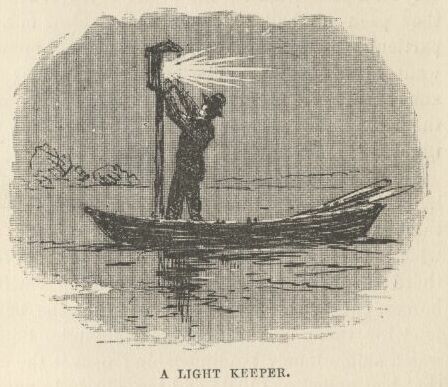
IT was a big river, below Memphis; banks brimming full, everywhere, and very frequently more than full, the waters pouring out over the land, flooding the woods and fields for miles into the interior; and in places, to a depth of fifteen feet; signs, all about, of men's hard work gone to ruin, and all to be done over again, with straitened means and a weakened courage. A melancholy picture, and a continuous one;—hundreds of miles of it. Sometimes the beacon lights stood in water three feet deep, in the edge of dense forests which extended for miles without farm, wood-yard, clearing, or break of any kind; which meant that the keeper of the light must come in a skiff a great distance to discharge his trust,—and often in desperate weather. Yet I was told that the work is faithfully performed, in all weathers; and not always by men, sometimes by women, if the man is sick or absent. The Government furnishes oil, and pays ten or fifteen dollars a month for the lighting and tending. A Government boat distributes oil and pays wages once a month.
Below Memphis, the river was huge. Everywhere, the water filled the banks, and very often it overflowed them. It poured over the land, flooding woods and fields for miles inland, in places to a depth of fifteen feet. All around were signs of people’s hard work ruined. All of it would have to be done again, with less money and less courage. It was a melancholy sight, and it went on for hundreds of miles. Sometimes the beacon lights stood in three feet of water at the edge of dense forests. The forests stretched for miles without a farm, wood-yard, clearing, or break of any kind. This meant the lightkeeper had to travel a long distance by skiff to do the job, often in terrible weather. Yet I was told the work was done faithfully in all weather. Men did not always do it. Sometimes women did it if the man was sick or away. The Government provided the oil and paid ten or fifteen dollars a month to light and tend the beacons. A Government boat delivered oil and paid wages once a month.
The Ship Island region was as woodsy and tenantless as ever. The island has ceased to be an island; has joined itself compactly to the main shore, and wagons travel, now, where the steamboats used to navigate. No signs left of the wreck of the 'Pennsylvania.' Some farmer will turn up her bones with his plow one day, no doubt, and be surprised.
The Ship Island region was as wooded and uninhabited as ever. The island was no longer an island. It had joined the mainland, and wagons now traveled where steamboats once sailed. No signs of the wreck of the 'Pennsylvania' remained. No doubt some farmer will one day turn up her bones with his plow and be surprised.
We were getting down now into the migrating negro region. These poor people could never travel when they were slaves; so they make up for the privation now. They stay on a plantation till the desire to travel seizes them; then they pack up, hail a steamboat, and clear out. Not for any particular place; no, nearly any place will answer; they only want to be moving. The amount of money on hand will answer the rest of the conundrum for them. If it will take them fifty miles, very well; let it be fifty. If not, a shorter flight will do.
We were now heading into a region where Black people were on the move. These poor people could never travel when they were enslaved, so they make up for it now. They stay on a plantation until they feel the urge to travel. Then they pack up, hail a steamboat, and leave. They are not headed anywhere in particular. No, almost any place will do. They just want to be moving. The money they have on hand settles the rest of the puzzle. If it will take them fifty miles, very well, let it be fifty. If not, a shorter trip will do.
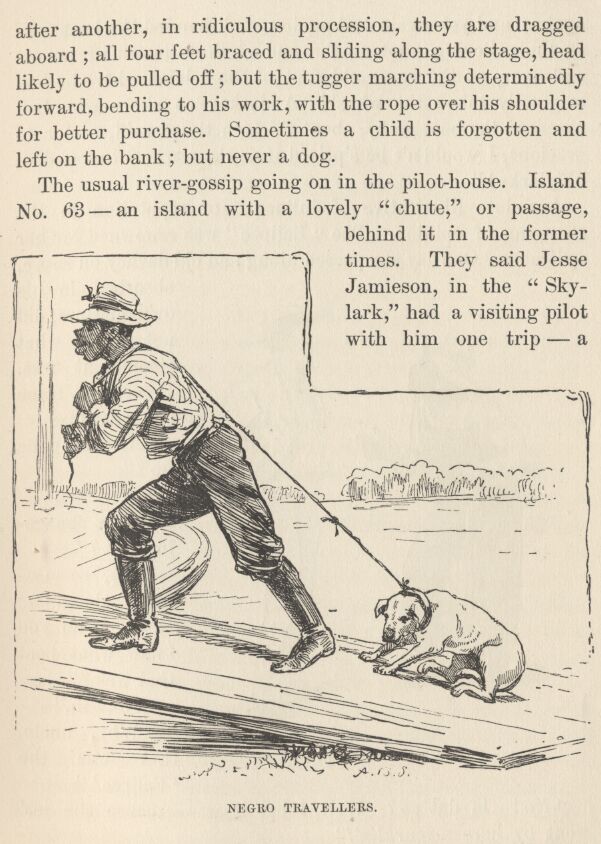
During a couple of days, we frequently answered these hails. Sometimes there was a group of high-water-stained, tumble-down cabins, populous with colored folk, and no whites visible; with grassless patches of dry ground here and there; a few felled trees, with skeleton cattle, mules, and horses, eating the leaves and gnawing the bark—no other food for them in the flood-wasted land. Sometimes there was a single lonely landing-cabin; near it the colored family that had hailed us; little and big, old and young, roosting on the scant pile of household goods; these consisting of a rusty gun, some bed-ticks, chests, tinware, stools, a crippled looking-glass, a venerable arm-chair, and six or eight base-born and spiritless yellow curs, attached to the family by strings. They must have their dogs; can't go without their dogs. Yet the dogs are never willing; they always object; so, one after another, in ridiculous procession, they are dragged aboard; all four feet braced and sliding along the stage, head likely to be pulled off; but the tugger marching determinedly forward, bending to his work, with the rope over his shoulder for better purchase. Sometimes a child is forgotten and left on the bank; but never a dog.
Over a couple of days, we often answered these calls. Sometimes we came upon a group of rundown cabins, stained by high water. They were crowded with Black people, with no white people in sight. Here and there were patches of dry ground without grass. A few trees had been cut down, and skeletal cattle, mules, and horses ate the leaves and gnawed the bark. There was no other food for them in the flood-ravaged land. Sometimes there was a single, lonely cabin at a landing. Nearby was the Black family that had called to us. Big and little, old and young, they perched on their small pile of household goods. These included a rusty gun, some mattress sacks, chests, tinware, stools, a damaged mirror, and an old armchair. Six or eight lowborn, dispirited yellow mutts were tied to the family with strings. They had to have their dogs. They couldn't go without their dogs. Yet the dogs were never willing. They always objected. So, one after another, they were dragged aboard in a ridiculous procession. Each dog braced all four feet and slid along the gangplank, its head almost pulled off. But the person pulling marched determinedly forward, leaning into the work, with the rope over one shoulder for better leverage. Sometimes a child was forgotten and left on the bank, but never a dog.
The usual river-gossip going on in the pilot-house. Island No. 63—an island with a lovely 'chute,' or passage, behind it in the former times. They said Jesse Jamieson, in the 'Skylark,' had a visiting pilot with him one trip—a poor old broken-down, superannuated fellow—left him at the wheel, at the foot of 63, to run off the watch. The ancient mariner went up through the chute, and down the river outside; and up the chute and down the river again; and yet again and again; and handed the boat over to the relieving pilot, at the end of three hours of honest endeavor, at the same old foot of the island where he had originally taken the wheel! A darkey on shore who had observed the boat go by, about thirteen times, said, 'clar to gracious, I wouldn't be s'prised if dey's a whole line o' dem Sk'ylarks!'
The usual river gossip was going around in the pilot-house. Island No. 63 used to have a lovely 'chute,' or passage, behind it. They said Jesse Jamieson once had a visiting pilot aboard the 'Skylark.' The visitor was a poor old fellow, worn out and past his working days. At the foot of Island No. 63, Jamieson left him at the wheel to finish the watch. The old mariner went up through the chute and down the river on the outside. Then he went up the chute and down the river again. He did it again and again. After three hours of honest effort, he handed the boat over to the relieving pilot. The boat was at the same old foot of the island where he had taken the wheel! A Black man on shore had seen the boat go by about thirteen times. He said, 'Good gracious, I wouldn't be surprised if there's a whole line of those 'Skylarks'!'
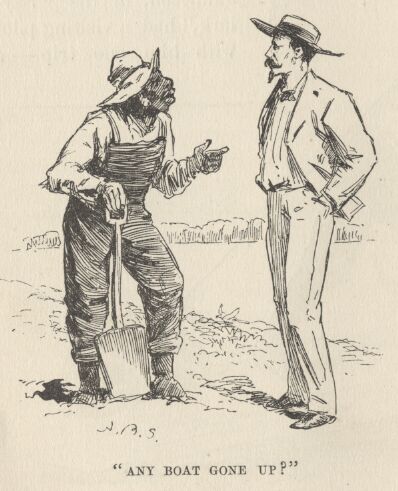
Anecdote illustrative of influence of reputation in the changing of opinion. The 'Eclipse' was renowned for her swiftness. One day she passed along; an old darkey on shore, absorbed in his own matters, did not notice what steamer it was. Presently someone asked—
An anecdote shows how reputation can change an opinion. The 'Eclipse' was famous for her speed. One day she passed by an old Black man on shore. He was absorbed in his own affairs and did not notice which steamer it was. Soon someone asked:
'Any boat gone up?'
'Has any boat gone up?'
'Yes, sah.'
'Yes, sir.'
'Was she going fast?'
'Was she going fast?'
'Oh, so-so—loafin' along.'
'Oh, so-so, just loafing along.'
'Now, do you know what boat that was?'
'Now, do you know what boat that was?'
'No, sah.'
'No, sir.'
'Why, uncle, that was the “Eclipse.”'
'Why, Uncle, that was the “Eclipse.”'
'No! Is dat so? Well, I bet it was—cause she jes' went by here a-sparklin'!'
'No! Is that so? Well, I bet it was, because she just went by here sparkling!'
Piece of history illustrative of the violent style of some of the people down along here, During the early weeks of high water, A's fence rails washed down on B's ground, and B's rails washed up in the eddy and landed on A's ground. A said, 'Let the thing remain so; I will use your rails, and you use mine.' But B objected—wouldn't have it so. One day, A came down on B's ground to get his rails. B said, 'I'll kill you!' and proceeded for him with his revolver. A said, 'I'm not armed.' So B, who wished to do only what was right, threw down his revolver; then pulled a knife, and cut A's throat all around, but gave his principal attention to the front, and so failed to sever the jugular. Struggling around, A managed to get his hands on the discarded revolver, and shot B dead with it—and recovered from his own injuries.
Here is a story that shows how violent some people down here can be. During the first weeks of high water, A's fence rails washed onto B's land. B's rails washed into the eddy and landed on A's land. A said, 'Let's leave things as they are. I'll use your rails, and you use mine.' But B objected. He wouldn't agree to it. One day, A went onto B's land to get his rails. B said, 'I'll kill you!' and went after him with a revolver. A said, 'I'm not armed.' So B, who wanted to do only what was right, threw down his revolver. Then he pulled a knife and cut all around A's throat. But he paid most of his attention to the front, so he failed to sever the jugular vein. As they struggled, A managed to get hold of the discarded revolver and shot B dead with it. A recovered from his own injuries.
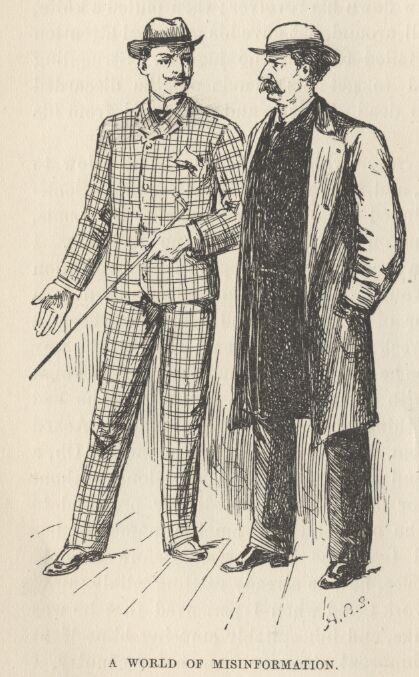
Further gossip;—after which, everybody went below to get afternoon coffee, and left me at the wheel, alone, Something presently reminded me of our last hour in St. Louis, part of which I spent on this boat's hurricane deck, aft. I was joined there by a stranger, who dropped into conversation with me—a brisk young fellow, who said he was born in a town in the interior of Wisconsin, and had never seen a steamboat until a week before. Also said that on the way down from La Crosse he had inspected and examined his boat so diligently and with such passionate interest that he had mastered the whole thing from stem to rudder-blade. Asked me where I was from. I answered, New England. 'Oh, a Yank!' said he; and went chatting straight along, without waiting for assent or denial. He immediately proposed to take me all over the boat and tell me the names of her different parts, and teach me their uses. Before I could enter protest or excuse, he was already rattling glibly away at his benevolent work; and when I perceived that he was misnaming the things, and inhospitably amusing himself at the expense of an innocent stranger from a far country, I held my peace, and let him have his way. He gave me a world of misinformation; and the further he went, the wider his imagination expanded, and the more he enjoyed his cruel work of deceit. Sometimes, after palming off a particularly fantastic and outrageous lie upon me, he was so 'full of laugh' that he had to step aside for a minute, upon one pretext or another, to keep me from suspecting. I staid faithfully by him until his comedy was finished. Then he remarked that he had undertaken to 'learn' me all about a steamboat, and had done it; but that if he had overlooked anything, just ask him and he would supply the lack. 'Anything about this boat that you don't know the name of or the purpose of, you come to me and I'll tell you.' I said I would, and took my departure; disappeared, and approached him from another quarter, whence he could not see me. There he sat, all alone, doubling himself up and writhing this way and that, in the throes of unappeasable laughter. He must have made himself sick; for he was not publicly visible afterward for several days. Meantime, the episode dropped out of my mind.
After more gossip, everyone went below for afternoon coffee, leaving me alone at the wheel. Soon, something reminded me of our last hour in St. Louis. I had spent part of it on the rear of this boat's hurricane deck. A stranger joined me there and struck up a conversation. He was a lively young fellow from a town in the interior of Wisconsin. He said he had never seen a steamboat until a week earlier. He also said he had inspected his boat diligently and with passionate interest on the way down from La Crosse. He had mastered the whole thing, he claimed, from the bow to the rudder blade. He asked where I was from. I said New England. 'Oh, a Yank!' he said, and kept chatting without waiting for me to agree or disagree. He immediately offered to show me all over the boat, name its different parts, and teach me their uses. Before I could protest or make an excuse, he was already rattling away at his kind work. I saw that he was giving things the wrong names. He was amusing himself at the expense of an innocent stranger from a distant place, which was hardly hospitable. So I kept quiet and let him have his way. He gave me a great deal of misinformation. The further he went, the more his imagination grew and the more he enjoyed his cruel deception. Sometimes, after passing off a particularly wild and outrageous lie, he was so 'full of laugh' that he had to step aside. He would make some excuse and stay away for a minute, so I would not suspect him. I stayed faithfully by him until his comedy was finished. Then he said he had undertaken to 'teach' me all about a steamboat, and had done it. But if he had overlooked anything, I had only to ask and he would fill the gap. 'Anything about this boat that you don't know the name of or the purpose of, you come to me and I'll tell you.' I said I would and left. Then I disappeared and approached him from another direction, where he could not see me. There he sat, all alone, doubled over and twisting this way and that, helpless with unstoppable laughter. He must have made himself sick, because he was not seen in public for several days afterward. Meanwhile, I forgot all about the episode.
The thing that reminded me of it now, when I was alone at the wheel, was the spectacle of this young fellow standing in the pilot-house door, with the knob in his hand, silently and severely inspecting me. I don't know when I have seen anybody look so injured as he did. He did not say anything—simply stood there and looked; reproachfully looked and pondered. Finally he shut the door, and started away; halted on the texas a minute; came slowly back and stood in the door again, with that grieved look in his face; gazed upon me awhile in meek rebuke, then said—
What reminded me of it now, alone at the wheel, was the sight of this young fellow. He stood in the pilot-house doorway, holding the doorknob and silently inspecting me with a stern look. I don't know when I've seen anyone look so hurt. He said nothing. He just stood there, looking at me reproachfully and thinking. Finally, he closed the door and started away. He stopped on the texas for a minute, then slowly came back and stood in the doorway again. He still had that hurt look on his face. He gazed at me for a while with a meek look of reproach, then said:
'You let me learn you all about a steamboat, didn't you?'
'You let me teach you all about a steamboat, didn't you?'
'Yes,' I confessed.
'Yes,' I confessed.
'Yes, you did—didn't you?'
'Yes, you did, didn't you?'
'Yes.'
'Yes.'
'You are the feller that—that—'
'You are the fellow who, who...'
Language failed. Pause—impotent struggle for further words—then he gave it up, choked out a deep, strong oath, and departed for good. Afterward I saw him several times below during the trip; but he was cold—would not look at me. Idiot, if he had not been in such a sweat to play his witless practical joke upon me, in the beginning, I would have persuaded his thoughts into some other direction, and saved him from committing that wanton and silly impoliteness.
He ran out of words. He paused and struggled in vain to say more. Then he gave up, choked out a deep, forceful curse, and left for good. I saw him several times below deck later in the trip, but he was cold and would not look at me. Idiot! If he had not been so eager to play his witless practical joke on me at the start, I would have steered his thoughts elsewhere. I would have saved him from that deliberately rude and silly act.
I had myself called with the four o'clock watch, mornings, for one cannot see too many summer sunrises on the Mississippi. They are enchanting. First, there is the eloquence of silence; for a deep hush broods everywhere. Next, there is the haunting sense of loneliness, isolation, remoteness from the worry and bustle of the world. The dawn creeps in stealthily; the solid walls of black forest soften to gray, and vast stretches of the river open up and reveal themselves; the water is glass-smooth, gives off spectral little wreaths of white mist, there is not the faintest breath of wind, nor stir of leaf; the tranquillity is profound and infinitely satisfying. Then a bird pipes up, another follows, and soon the pipings develop into a jubilant riot of music. You see none of the birds; you simply move through an atmosphere of song which seems to sing itself. When the light has become a little stronger, you have one of the fairest and softest pictures imaginable. You have the intense green of the massed and crowded foliage near by; you see it paling shade by shade in front of you; upon the next projecting cape, a mile off or more, the tint has lightened to the tender young green of spring; the cape beyond that one has almost lost color, and the furthest one, miles away under the horizon, sleeps upon the water a mere dim vapor, and hardly separable from the sky above it and about it. And all this stretch of river is a mirror, and you have the shadowy reflections of the leafage and the curving shores and the receding capes pictured in it. Well, that is all beautiful; soft and rich and beautiful; and when the sun gets well up, and distributes a pink flush here and a powder of gold yonder and a purple haze where it will yield the best effect, you grant that you have seen something that is worth remembering.
I had myself awakened for the four o'clock watch each morning, because you cannot see too many summer sunrises on the Mississippi. They are enchanting. First comes the eloquence of silence, as a deep hush settles over everything. Next comes the haunting sense of loneliness and isolation, of being far from the worries and bustle of the world. Dawn creeps in quietly. The solid walls of black forest soften to gray, and vast stretches of the river come into view. The water is smooth as glass and gives off ghostly little wreaths of white mist. There is not the faintest breath of wind or movement of a leaf. The peace is profound and endlessly satisfying. Then one bird begins to sing, followed by another. Soon their calls grow into a joyful riot of music. You see none of the birds. You simply move through an atmosphere of song that seems to sing itself. When the light grows a little stronger, you see one of the loveliest, softest pictures imaginable. Nearby, the thick, crowded leaves are a deep green. Ahead, the green grows paler shade by shade. On the next point of land, a mile away or more, the color has softened to the tender young green of spring. The point beyond that has almost lost its color. The farthest point, miles away below the horizon, rests on the water like a faint mist. You can hardly separate it from the sky above and around it. The whole stretch of river is a mirror. In it, you see the shadowy reflections of the leaves, the curving shores, and the points of land stretching into the distance. Well, the whole scene is beautiful, soft and rich and beautiful. Then the sun rises high enough to spread a pink glow here, a dusting of gold there, and a purple haze wherever it will look best. You have to admit that you have seen something worth remembering.
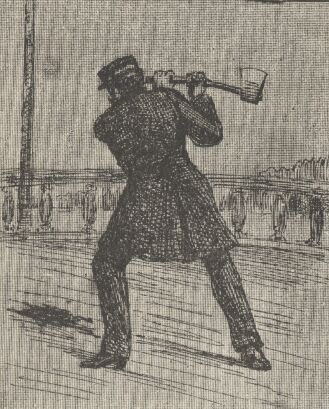
We had the Kentucky Bend country in the early morning—scene of a strange and tragic accident in the old times, Captain Poe had a small stern-wheel boat, for years the home of himself and his wife. One night the boat struck a snag in the head of Kentucky Bend, and sank with astonishing suddenness; water already well above the cabin floor when the captain got aft. So he cut into his wife's state-room from above with an ax; she was asleep in the upper berth, the roof a flimsier one than was supposed; the first blow crashed down through the rotten boards and clove her skull.
We reached the Kentucky Bend country early in the morning. It was the scene of a strange and tragic accident long ago. Captain Poe had a small stern-wheel boat that had been home to him and his wife for years. One night, the boat struck a snag at the head of Kentucky Bend and sank with astonishing speed. By the time the captain reached the back of the boat, water was already well above the cabin floor. So he used an ax to cut into his wife's stateroom from above. She was asleep in the upper bunk. The roof was weaker than anyone had supposed. The first blow crashed through the rotten boards and split her skull.
This bend is all filled up now—result of a cut-off; and the same agent has taken the great and once much-frequented Walnut Bend, and set it away back in a solitude far from the accustomed track of passing steamers.
This bend is now completely filled in because of a cutoff. The same process has left the great Walnut Bend, once much traveled, isolated far from the usual route of passing steamboats.
Helena we visited, and also a town I had not heard of before, it being of recent birth—Arkansas City. It was born of a railway; the Little Rock, Mississippi River and Texas Railroad touches the river there. We asked a passenger who belonged there what sort of a place it was. 'Well,' said he, after considering, and with the air of one who wishes to take time and be accurate, 'It's a hell of a place.' A description which was photographic for exactness. There were several rows and clusters of shabby frame-houses, and a supply of mud sufficient to insure the town against a famine in that article for a hundred years; for the overflow had but lately subsided. There were stagnant ponds in the streets, here and there, and a dozen rude scows were scattered about, lying aground wherever they happened to have been when the waters drained off and people could do their visiting and shopping on foot once more. Still, it is a thriving place, with a rich country behind it, an elevator in front of it, and also a fine big mill for the manufacture of cotton-seed oil. I had never seen this kind of a mill before.
We visited Helena and also Arkansas City, a new town I had never heard of before. The town owed its birth to a railway. The Little Rock, Mississippi River and Texas Railroad reaches the river there. We asked a passenger from Arkansas City what kind of place it was. He thought for a moment, as if he wanted to take his time and be accurate. 'Well,' he said, 'It's a hell of a place.' The description was as exact as a photograph. There were several rows and clusters of shabby wooden houses. There was enough mud to keep the town supplied for a hundred years, since the flood had only recently gone down. Stagnant ponds stood here and there in the streets. A dozen crude flatboats lay scattered about, stranded wherever the water had left them. People could once again walk to visit their neighbors and do their shopping. Still, Arkansas City is thriving, with rich country behind it and a grain elevator in front. It also has a fine, large mill that makes cottonseed oil. I had never seen that kind of mill before.
Cotton-seed was comparatively valueless in my time; but it is worth $12 or $13 a ton now, and none of it is thrown away. The oil made from it is colorless, tasteless, and almost if not entirely odorless. It is claimed that it can, by proper manipulation, be made to resemble and perform the office of any and all oils, and be produced at a cheaper rate than the cheapest of the originals. Sagacious people shipped it to Italy, doctored it, labeled it, and brought it back as olive oil. This trade grew to be so formidable that Italy was obliged to put a prohibitory impost upon it to keep it from working serious injury to her oil industry.
In my time, cottonseed was worth very little. But now it is worth $12 or $13 a ton, and none of it is thrown away. Cottonseed oil is colorless, tasteless, and almost odorless, if not entirely so. Some claim that, with the right treatment, it can be made to look and work like any oil. They also claim it can be produced more cheaply than even the cheapest of those oils. Clever people shipped cottonseed oil to Italy, altered it, labeled it, and brought it back as olive oil. This trade grew so large that Italy had to impose a prohibitive tax on cottonseed oil. The tax kept the trade from seriously harming Italy’s olive oil industry.
Helena occupies one of the prettiest situations on the Mississippi. Her perch is the last, the southernmost group of hills which one sees on that side of the river. In its normal condition it is a pretty town; but the flood (or possibly the seepage) had lately been ravaging it; whole streets of houses had been invaded by the muddy water, and the outsides of the buildings were still belted with a broad stain extending upwards from the foundations. Stranded and discarded scows lay all about; plank sidewalks on stilts four feet high were still standing; the board sidewalks on the ground level were loose and ruinous,—a couple of men trotting along them could make a blind man think a cavalry charge was coming; everywhere the mud was black and deep, and in many places malarious pools of stagnant water were standing. A Mississippi inundation is the next most wasting and desolating infliction to a fire.
Helena sits in one of the prettiest spots on the Mississippi. It rests on the last and southernmost group of hills visible on that side of the river. Normally, Helena is a pretty town. But flooding, or possibly seepage, had recently ravaged it. Muddy water had invaded whole streets of houses. The buildings still had broad stains running up from their foundations. Stranded and abandoned scows lay everywhere. Plank sidewalks on four-foot-high stilts were still standing. The board sidewalks at ground level were loose and falling apart. A couple of men trotting along them could make a blind man think a cavalry charge was coming. Everywhere, the mud was black and deep. In many places, stagnant pools of water carried the risk of malaria. A Mississippi flood is second only to a fire in the destruction and desolation it causes.
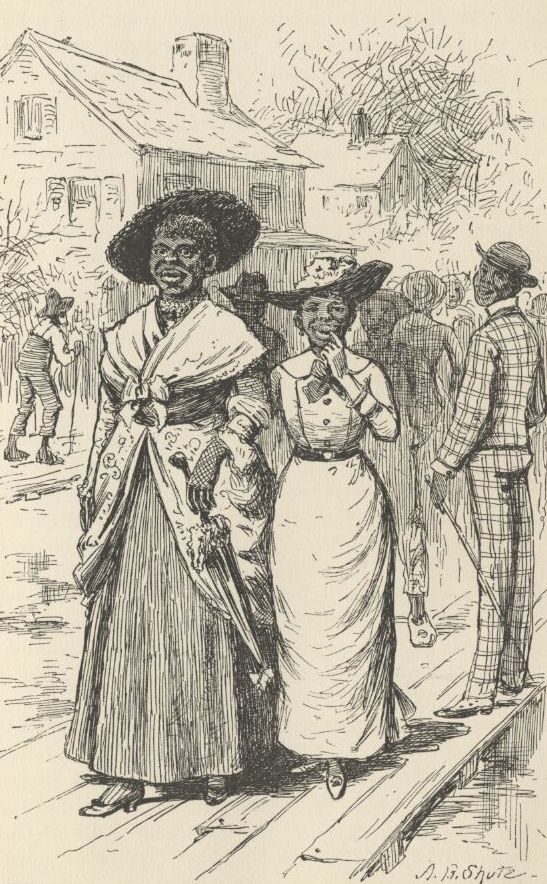
We had an enjoyable time here, on this sunny Sunday: two full hours' liberty ashore while the boat discharged freight. In the back streets but few white people were visible, but there were plenty of colored folk—mainly women and girls; and almost without exception upholstered in bright new clothes of swell and elaborate style and cut—a glaring and hilarious contrast to the mournful mud and the pensive puddles.
We had an enjoyable time here on this sunny Sunday. We had two full hours ashore while the boat unloaded freight. Few white people were visible in the back streets, but there were plenty of Black people, mostly women and girls. Almost all of them were dressed in bright new clothes with fancy, elaborate designs and cuts. Their clothes made a glaring, hilarious contrast to the mournful mud and pensive puddles.
Helena is the second town in Arkansas, in point of population—which is placed at five thousand. The country about it is exceptionally productive. Helena has a good cotton trade; handles from forty to sixty thousand bales annually; she has a large lumber and grain commerce; has a foundry, oil mills, machine shops and wagon factories—in brief has $1,000,000 invested in manufacturing industries. She has two railways, and is the commercial center of a broad and prosperous region. Her gross receipts of money, annually, from all sources, are placed by the New Orleans 'Times-Democrat' at $4,000,000.
Helena is the second largest town in Arkansas by population, with an estimated 5,000 people. The land around Helena is exceptionally productive. Helena has a thriving cotton trade, handling between 40,000 and 60,000 bales a year. It also has a large trade in lumber and grain, along with a foundry, oil mills, machine shops, and wagon factories. In all, Helena has $1,000,000 invested in manufacturing. It has two railways and is the commercial center of a broad, prosperous region. The New Orleans 'Times-Democrat' estimates Helena's total annual receipts from all sources at $4,000,000.